

Archives of Epidemiology & Public Health Research(AEPHR)
ISSN: 2833-4353 | DOI: 10.33140/AEPHR

Impact Factor: 1.98


Review Article - (2022) Volume 1, Issue 1
Special Recommendation Footwear for Older Peoples at Risk of Falling Injuries
Received Date: Jun 07, 2022 / Accepted Date: Jun 15, 2022 / Published Date: Jun 29, 2022
Copyright: ©Copyright: ©2022 Durairaj Dhanapal, et al. This is an open-access article distributed under the terms of the Creative Commons Attribution License, which permits unrestricted use, distribution, and reproduction in any medium, provided the original author and source are credited.
Citation: Durairaj Dhanapal and Sitwala Mundia (2022). A Review
Abstract
Footwear influences balance and the subsequent risk of slips, trips, and falls by altering somatosensory feedback to the foot and ankle and modifying frictional conditions at the shoe and floor interface area. Walking indoors barefoot or in socks and walking indoors or outdoors in high-heel shoes have been shown to increase the risk of falls in older people. Other footwear characteristics such as heel collar height, sole hardness, and tread and heel geometry also influence measures of balance and gait. Because many older people wear sub-optimal shoes, maximizing safe shoe use may offer an effective fall prevention strategy. Based on findings of a systematic literature review, older people should wear shoes with low heels and firm slip-resistant soles both inside and outside the home Future research should investigate the potential benefits of tread sole shoes for preventing slips and whether shoes with high collars or flared soles can enhance balance when challenging tasks are undertaken.
Keywords
Accidental Falls, Aged People, Heel Height, Balance, Biomechanics, Rehabilitation,
Introduction
Many falls experienced by older people result from age-related de-terioration of the balance and neuro muscular systems, most falls occur during motor tasks, and footwear has been identified as an environmental risk factor for both indoor and outdoor falls by al¬tering somatosensory feedback the foot and ankle and modifying frictional conditions at the shoe-sole or floor interface, footwear influences postural stability and the subsequent risk of slips, trips, and falls [1]. While the primary role of a shoe is to protect the foot and facilitate propulsion, fashion has strongly influenced the design of footwear throughout the ages, compromising the natural functioning of the foot. Footwear is one of the clothing accessories and as such today it is an indispensable part of the human outfit. Shoe functions and forms follow and complement the features of the wearing apparel [2]. The value of a pair of shoes depends not only on its functionality (purpose, comfort, aesthetics, material composition, durability, etc.) but it is relative to time, social status, and economic conditions an individual taste. Shoes are designed to protect the feet during their primary functions of mobility and support. Over the past century, fashion has frequently interfered with the original purposes of protection from injury and exposure. Footwear is sometimes the cause of, and frequently a contributor to, musculoskeletal disorders (Charrete, 2002) The Chiropractic. The footwear must also provide support to allow the foot to func¬tion adequately in both dynamic and static conditions. But from the aesthetical point of view; the form of shoes expresses different meanings from antiquity to now. This review analyzed all older people’s footwear’s necessary parameters and their application to prevent the risk of falling activities.
Literature Review
An average day of walking brings a force equal to several hundred tons on them. Since a person takes approximately 5,000-10,000 steps each day, mostly on hard surfaces, their entire musculoskel¬etal systems are being punished if their shoes do not fit correctly. (Information from the American Podiatric Medical Association) These men, people are subject to more injury than any other part of the body, underscoring the need to protect them with proper footwear [3]. Despite the presence of pain, people are reluctant to change their footwear styles. The main function of modern foot¬wear is to provide feet with protection from hard and rough sur¬faces, as well as climate and environmental exposure. This caus¬es foot injuries. “For example, according to research almost all (95 percent or more) of these physically deprived feet of adults Americans and Europeans begin in childhood with the wearing of faulty designed and constructed footwear, Finding the best walking shoes for seniors can be a huge challenge. As people age, they lose fat protection on the bottoms of their feet. Their heel will begin to press more firmly against the floor and it can become irritated and sore or worse, you can get a heel spur which can be- come very painful. A podiatrist can diagnose this issue and make appropriate recommendations. As people age, they are more prone to diseases such as diabetes and higher blood pressure. Many se-niors can reduce their risk of some health issues and diseases by simply maintaining weight and staying active. Regular walking is an ideal activity to help maintain weight and remain active. Anoth-er reason for seniors to stay active is to help reduce the effects of arthritis which seems to plague many seniors. An added bonus to walking is that it’s an excellent way to enjoy some fresh air and to enjoy some time with friends. Remaining social is so very import¬ant for seniors. The importance of good shoes for seniors should not be underestimated. As people age, the chances of them being injured in a fall will increase substantially. It is not uncommon for elderly people to fall and sustain bruises, lacerations, broken bones, and severe head injuries as a result. The good news is that the senior’s right shoes can lower the risks of falling and being injured [4]. Older adults are much more likely to fall because of a variety of reasons. Experts believe that as people age there are natural changes that occur in the feet that can cause people to fall over more easily. Another reason is that older people tend to lose some of the feelings in their feet which can cause a person to feel as though they are off-balance. The shape of your feet can change significantly as you age. Your feet can flatten, arches drop, and toes can curl and form “claw toes” due to the imbalance of mus¬cle. These changes, together with other physical changes can force a person to walk differently and to lose their balance which can cause them to fall.
Necessary Parameters for Older Peoples’s footwear Selection of Material
Older peoples of selection footwear and their construction material characteristic is very important for better fit to comport and biome¬chanical properties. Major issues such as structural fatigue, slipper bumps, hammer toes, bunions, blisters, abrasions, ingrown nails, calluses, fungus, hallux valgus, achilles tendon inflammation, back problems, body column chance, knee discomforts, sprains and lig¬ament injuries, heel spur etc., are all side-effects of footwear on the market designed for the fashion concepts disregarding the human footwear interface and interaction [5]. We can purchase these in various widths, so whether they have narrow or wide feet, they could find a pair of shoes that suits perfectly. Moreover, when they have a high arch and high instep, these shoes are also ideal for their daily needs. The outsole is also excellent when they walk in rain and tile because of the good traction. However, they may slip on snow or ice because there is not enough traction for these elements. Mainly older people’s footwear construction material low heat density and light weight material is better for footwear construction. Heavy coated fabric and heavy leather is not conve¬nient for footwear construction. So, Selection material and their physical and thermal characteristics is very important.
Cushion Ability
Another viable choice for seniors who want shoes that are com-fortable, Outsole and midsole sock cushionable is very important for older people’s foot plantar pressure distribution. There is a 1.25-inch heel that should give you a slight boost in height, and the collar is padded at the same time for additional comfort. Now¬adays contoured footbed molds are used for Diabetic and orthope¬dic footwears EVA in socks, PU viscoelastic memory foam insole is recently developed by CLRI India, and lightweight PU insole is easily reduced the foot pressure and prevents the heel pain and ankle pain [6]. Closed-cell synthetic rubber foam in the midsole that’s lighter and softer than the other major midsole fabric, poly¬urethane. Compression molding distributes the EVA foam within the midsole to areas that need the most cushioning.
Breathability
Shoes are responsible for injury prevention foot health and max¬imizing performance. People often underestimate the importance of wearing shoes that are in good condition and that also suit their own needs. Each component of a shoe, like each part of the hu¬man foot, has to work to fulfill its role in helping older people [7]. Several people who have tried this product were delighted about the fact that this comes with stress. When it comes to comfortable shoes that are fashionable at the same time, Heel conduct and sock that is more breathable is very important for older people’s foot¬wear construction.
Light Weight Outsoles
Some footwear can increase the risk of slips, trips, and falls by making people more prone to poor balance and bad gait, or by making it difficult to judge surface friction and distance from the floor. Examples of unsuitable footwear for the elderly included. Loose, worn or backless slippers. These are one of the most com¬mon causes of older people falling Slip-on shoes, such as sling backs or flip flops which can slip and trip you up Shoes with slip¬pery or worn soles, can cause you to slip, especially in wet weather Shoes with a heel higher than one inch, or with a narrow heel, as these can make your foot unstable and can cause. Nowadays all footwear industries use Rubber soles, TBR, TPU, and PU, but especially in older people’s footwear outsoles, PU is better than other outsoles because this outsole has more fashion ability than other out soling materials [8].
Comport Fit Parameters
Older people should be advised about the importance of wearing well-fitting shoes and about the characteristics of particular shoes which can aid in improved walking and gait. These include a high back or collar to support the ankle support, A hard, slip-resistant sole heel height lower than one inch it is also recommended that older people wear well-fitted, slip-resistant slippers or house shoes indoors rather than walking barefoot or in socks or tights. When we buy indoor shoes, we consider lightweight and better slip resis¬tance outsole footwear is best for preventing slippage [9]. Shock absorption and ground force reaction, force attenuation, and ergo¬nomic fitting are very necessary for old age people’s footwear. In case there is no improper foot pressure point is more and it will be leading to heel pain and foot injuries.
Slip Resistance Co-factor
However, there is no standardization of “slip-resistant” designa-tions in the currently marketed shoe in the world. In shoe stud¬ies, slip risk is quantified using the coefficient of friction (COF) at the shoe-floor interface. COF is calculated as the ratio of shear forces (parallel to the surface) to normal forces (perpendicular to the surface). High COF values equate to lower slip risk moments. Some CLRI research has also been done to determine the role of flooring conditions such as the type of tile and the presence of fluid contaminants. Although previous shoe-floor literature is plentiful, there is a lack of whole shoe mechanical slip testing across poten-tially slippery conditions for products that are currently available to consumers. Older people’s shoes having more sip resistance is a must for preventing up normal silage during walking, this review considers all current older people falling risk and up to normal stability of footwear and refer to the correct way of techniques to avoid such types of issues.
Force Attenuation and Shock Absorption
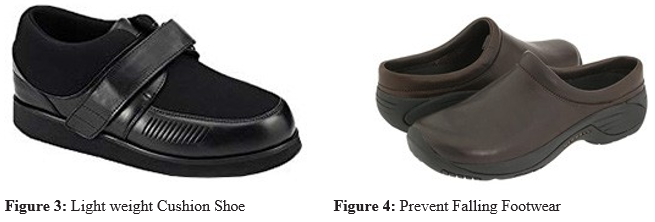
Extra-depth shoes without seams and a soft upper are vitally im¬portant for a person with loss of feeling and deformity. Unfortu¬nately, the shoe industry does not seem to have standards regard¬ing depth, and what one manufacturer regards as extra depth may not be extra depth to another. Older people’s shoes have muscle activation moment and better ground force reaction, and its planet hunter pressure distribution [10]. Older people should be advised to check their feet pressure by scan test methods. Now days lot of styles of older-age lightweight shoe available in the market but some non-branded footwears are not technically constructed to reduce force reaction, in case we buy these types of shoes defi¬nitely, we meet lot foot pain and over sock absorption [11]. Better sock absorption footwear, insock, cushion foot bed is a must for preventing up normal foot stability and heel pains. This Ethiopian Eitex leather department review recommends light weight PU out¬sole and PU visco elastic insock is better for other TBR. Rubber outsole foot wears.
Biomechanical for Comfort
Foot exercises are another excellent way to prevent accidental falls. Exercises for your ankles and your feet can help you to re-duce the stiffness that comes with age-related muscle loss. So, footwear biomechanical characteristic is very important parame-ters for older footwears. It is important for seniors to avoid wear-ing just stockings or socks, high heels, walking barefoot or wear-ing any kind of footwear that has a slick outsole. Many people tend to think that slippers are the best thing for seniors to wear around their home indoors, but they can be uncomfortable and danger¬ous. Our body 60 total weight activated in heel conduct area and 40 weights is activated in human foot bore part. So selected foot¬wear is not proper biomechanical comfort, thus the peoples meet lot heel pains and leg pain [12]. In each and every step our body weight is evenly distributed by shoe, it is better ergonomic condi¬tioned construction otherwise we are not easily solved their foot pains and over heel pains. This review tips are more use for older peoples footwears purchase and easily they will avoid footwear up normal planter pressure and weight bearing issues
Result and Discussion
Always select shoes that have a thick sole and give good arch support. If the footprint is flat, the arches are flat. Select shoes with plenty of cushioning. Biomechanical outsoles are ideal for those who suffer from limited joint mobility. They offer plenty of support for joints that are stiff or difficult to maneuver . older shoes will selected very carefully. It is important to wear shoes all the time, even at home. Wearing shoes inside of your home instead of wearing socks, slippers or having bare feet can help to prevent you from sustaining a serious injury that can occur from you hav¬ing a fall. Never wear a shoe that is too loose or is untied. These specially crafted inserts are molded it prevent falls by redistribut¬ing the pressure in the shoe, and stabilizing the feet [13]. Seniors or those who know seniors who are prone to falls may wish to speak to a health professional that specializes in feet to receive the right treatment. It is important for seniors to avoid wearing just stockings or socks, high heels, walking barefoot or wearing any kind of footwear that has a slick outsole. Cushioning technology is quite varied with manufacturers marketing air soles, pads, pods, gel or fluid soles, and so on. Even though midsole cushioning is supposed to attenuate or dampen the forces on the body, the actual force acting on the body remains relatively unchanged with foot-wear (Mc Poil, 2000). Thus, most problems arise when awearer of a shoe perceives a relatively false sense of security when a foot bed and foot covering the present.
Many people tend to think that slippers are the best thing for se¬niors to wear around their home indoors, but they can be uncom¬fortable and dangerous [14]. Never wear shoes that are worn out or footwear that is overly flexible. Shoes should have midsoles that are sturdy without being too flexible and will ensure greater sta¬bility. Size is very important always wear shoes that fit properly. If shoes are too large they can become problematic for walking in. If they are too small they can cause a variety of foot problems includ¬ing corns, calluses, and bunions. This can all lead to increased leg pain when the senior is walking and they also have an increased risk of falling. Footwear that is open in the back is a terrible choice because shoes that do not have a closed heel can cause dangerous instability because the fit is highly insecure. Shoes that are too high can cause a senior to lose their balance, so it is important to remember that shoes that are small or bigger should be avoided. Also, shoes that have over padded insoles should be prevented. Shoes that are heavy and have thick soles can present a problem for seniors because they do not provide enough stability to the wearer. Shoes that are lighter in weight are generally more highly recommended because they are much easier to walk in. Although you are looking for light weight shoes, make certain that they are not too light or that they do not have too much flexibility near the midsole [15]. High-quality slip-resistant shoes look and feel like other shoes, but they’re built to increase traction through special sole materials and tread design. The tread design of the sole can also be a contributor to falls. If the sole is too smooth, it can cause the wearer to slip but if it has too much grip it may contribute to tripping. If older adults are too high from the ground, they have an increased risk of a fall, so it is important to choose a shoe with a lower profile. Those shoes should have a low and wide heel that has more contact with the ground [16]. Shoes that feature hook and loop closures because they are much easier for seniors to adjust. These closures should not be left unattached because it could cause an improper fit which could lead to a serious fall. Laces are a prop¬er closure as long as there are tied securely.
Some footwear can increase the risk of slips, trips and falls by making people more prone to poor balance and bad gait, or by making it difficult to judge surface friction and distance from the floor. Examples of unsuitable footwear for the elderly include: Older people should be advised about the importance of wearing well-fitting shoes and about the characteristics of particular shoes which can aid improved walking and gait [17]. These include a high back or collar to support the ankle hard, slip-resistant sole heel height lower than one inchIt is also recommended that older people wear well-fitted, slip-resistant slippers or house shoes in¬doors rather than walking barefoot or in socks or tights


Figure 1:(Falling injuries) Figure 2 : older Shoe Construction view
Conclusion
Walking indoors barefoot or in socks and walking indoors or out-doors in high heel shoes have been shown to increase the risk of falls in older people. As designs become more detailed, the interac-tion between the humanengineering and other disciplines becomes more advantageous [18]. The implementation ofthe requirements needs to be verified, and additional design decisions need to be madeas the design progresses. The specific human engineering re¬quirements, such as design requirements and human performance requirements, must be used to evaluate the designs. Especially some products like footwear directly interact with the human body. In this concept, the evaluation of footwear design could be possible by using the human engineering-based knowledge. Since a person takes approximately 5,000-10,000 steps each day, mostly on hard surfaces, their entire musculoskeletal systems are being punished if their shoes do not fit correctly [19]. Evaluating the shoe design solutions and fit using a human engineering process will frequent¬ly provide comfort for the consumer and prevent being the source of their aching back, sore knees, and body fatigue. Because many older people wear sub-optimal shoes, maximizing safe shoe use may offer an effective fall prevention strategy. Based on findings of a systematic literature review, older people should wear shoes with low heels and firm slip-resistant soles both inside and outside the home. Senior researcher Marian T. Hanna, D.Sc. M.P.H., co-di-rector of the Musculoskeletal Research Center at the Institute for Aging Research notes that “Our findings show that older people going barefoot, wearing only socks, or wearing slippers may be at considerably increased risk of falls in their homes. Therefore, older people should wear shoes at home whenever possible to min¬imize their risk of falling [20]. Around the home, people may not wish to wear shoes all day, though shoes can be generally more supportive. Unfortunately, they often prefer the convenience and comfort of slippers, which can have little or no support. Most falls occurred in peoples’ homes (48%), where slippers are the most commonly worn footwear. So this review article referrer that light weight and cushion ability, ergonomic construction footwear is the best option to prevent the risk of falling injuries to older people.
References
- Harden, R. N., Oaklander, A. L., Burton, A. W., Perez, R. S., Richardson, K., Swan, M., ... & Bruehl, S. (2013). Complex regional pain syndrome: practical diagnostic and treatment guidelines. Pain medicine, 14(2), 180-229.
- Hyatt, K. A. (2010). Overview of complex regional pain syndrome and recent management using spinal cord stimulation. AANA journal, 78(3).
- Singh, G., Willen, S. N., Boswell, M. V., Janata, J. W., & Che-limsky, T. C. (2004). The value of interdisciplinary pain management in complex regional pain syndrome type I: a prospective outcome study. Pain physician, 7(2), 203-210.
- Clarke, T. E., Frederick, E. C., & Hamill, C. L. (1983). The effects of shoe design parameters on rearfoot control in running. Medicine and science in sports and exercise, 15(5), 376-381.
- Goonetilleke, R. S. (2003). Designing footwear: back to basics in an effort to design for people. Proceedings of SEAMEC, 2003, 25-31.
- Kaelin, X., Segesser, B., & Wasser, T. (2011). Unstable shoes and rehabilitation. Footwear Science, 3(sup1), S85-S86.
- Branthwaite, H., Chockalingam, N., Grogan, S., & Jones, M. (2013). Footwear choices made by young women and their potential impact on foot health. Journal of health psychology, 18(11), 1422-1431.
- Brodie, B. S. (2001). Health determinants and podiatry. The journal of the Royal Society for the Promotion of Health, 121(3), 174-176.
- Dawson, J., Thorogood, M., Marks, S. A., Juszczak, E., Dodd, C., Lavis, G., & Fitzpatrick, R. (2002). The prevalence of foot problems in older women: a cause for concern. Journal of Public Health, 24(2), 77-84.
- Gillath, O., Bahns, A. J., Ge, F., & Crandall, C. S. (2012). Shoes as a source of first impressions. Journal of Research in Personality, 46(4), 423-430.
- Frey, C., Thompson, F., Smith, J., Sanders, M., & Horstman,H. (1993). American Orthopaedic Foot and Ankle Society women’s shoe survey. Foot & ankle, 14(2), 78-81.
- Freychat, P., & Bouche, N. (1999, August). Dynamic Arch Deformation and its Consequence on Shoe Design. In Footwear Symposium. Canmore, Canada (p. 560).
- 14.Advanced Research Department, Decathlon Production, France, Vol. 25, p.650
- Forner, A. García, A.C. Alcántara, E. Ramiro, J. Hoyos, J.V.Vera, P. 1995, “Foot Ankle Int.”, Vol.16, No:12, pp:778-786
- Luximon, A., Goonetilleke, R., & Tsui, K. (2003). Foot land-marking for footwear customization. Ergonomics, 46(4), 364-383.
- Goonetilleke, R. S. (1998). Designing to miminize discomfort. Ergonomics in Design, 6(3), 12-19.
- Goonetilleke, R. S., & Luximon, A. (1999). Foot flare and foot axis. Human factors, 41(4), 596-607.
- Goonetilleke, R. S., & Eng, T. J. (1994, October). Contact area effects on discomfort. In Proceedings of the Human Factors and Ergonomics Society Annual Meeting (Vol. 38, No. 10, pp. 688-690). Sage CA: Los Angeles, CA: SAGE Publications.
- Goonetilleke, R. S. (1999). Footwear cushioning: relating objective and subjective measurements. Human factors, 41(2), 241-256.
- Dufour, A. B., Broe, K. E., Nguyen, U. S. D., Gagnon, D. R.,Hillstrom, H. J., Walker, A. H., ... & Hannan, M. T. (2009). Foot pain: is current or past shoewear a factor?. Arthritis care & research, 61(10), 1352-1358.