



Research Article - (2026) Volume 11, Issue 1
Social Robot Research: A Narrative Review
Received Date: Jan 01, 2026 / Accepted Date: Jan 27, 2026 / Published Date: Feb 02, 2026
Copyright: ©2026 Tiffany Field. This is an open-access article distributed under the terms of the Creative Commons Attribution License, which permits unrestricted use, distribution, and reproduction in any medium, provided the original author and source are credited.
Citation: Field, T. (2026). Social Robot Research: A Narrative Review. Int J Psychiatry, 11(1), 01-05.
Abstract
This narrative review includes summaries of recently published studies on features/qualities of social robots, as well as positive and negative effects of social robots on humans. The most effective features of the social robots include their human-like faces and voices. Other qualities that have been attributed to social robots include their intelligence and responsivity. Positive effects have been reported for children and adolescents being physically and verbally interactive with social robots and their stress and anxiety decreasing following interactions with the robots. In older adults, decreased loneliness, depression and agitation have been self-reported as well as increased physical activity. Increased oxytocin and decreased cortisol have also been noted following exposure to social robots, likely related to increased physical activity and decreased depression. In at least one study, socialization with humans was not decreased in older adults who were interacting with social robots. The negative effects of exposure to social robots include concerns about their cost and availability, fear of losing autonomy and stigma associated with owning a social robot. Methodological limitations of this current literature include the almost exclusive sampling of young children, adolescents and older adults as well as the variability of the robots used in the studies and the infrequent observational research on interactions between humans and social robots.
Keywords
Social Robots, Anthropomorphic Traits, Decreased LonelinessIntroduction
Social robots have been defined as robots that resemble the human body. They have been designed for functional purposes such as interacting with humans and working alongside them. Typically, social robots have a torso, a head, two arms and two legs, although some may only replicate part of the human body. Sophia was the first robot to be granted citizenship (in Saudi Arabia in 2017). While she was so human-like that she was granted a passport and was given legal personhood, it’s unclear what specific rights she has. Nonetheless, she has become widely known through television and conferences.
Because social robots have been known to be responsive to humans during social interactions, research has focused on their human qualities as well as their positive and negative effects. In this review, recent studies on social robots are summarized. This research was found on PubMed and PsycINFO by entering the term social robots. Exclusion criteria were pilot research, case studies and non-English papers. Twenty papers are reviewed here that could be categorized as qualities of social robots (6 papers), as well as positive effects (9 papers) and negative effects (5 papers) on the humans who interact with them. These sections are followed by a discussion of methodological limitations of this literature.
Qualities and Functions of Social Robots
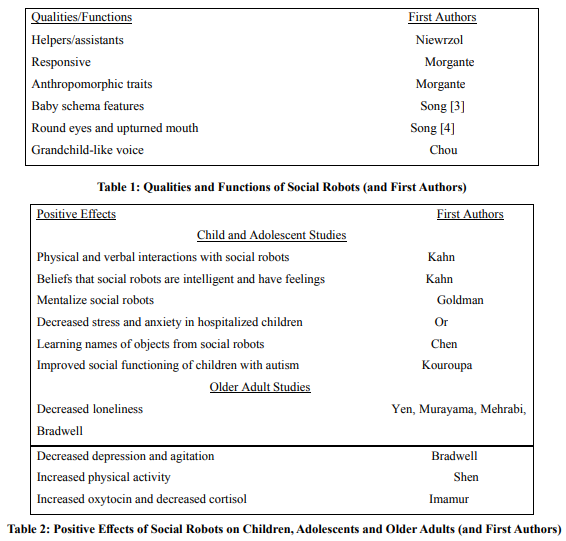
In a study entitled “Development and validation of the Attitudes Towards Social Robots Scale” (N=214, mean age= 31), two main components were noted for the scale [1]. The components included robots as helpers and assistants which explained 53% of the variance and robots as equal partners that accounted for 18% of the variance. The components of this scale do not seem to reflect the recent literature which has focused primarily on social and emotional effects of social robots rather than their provision of physical assistance.
The current literature includes the anthropomorphic traits and the responsivity of social robots. For example, in a systematic review entitled “Is it possible for people to develop a sense of empathy toward positive robots?”, 11 papers were reviewed [2]. The authors of the review concluded that robots that were responsive evoked empathy, especially if they exhibited anthropomorphic traits.
Anthropomorphic traits have included a human-like face and voice. In a study called “The effect of facial features on facial anthropomorphic trustworthiness in social robots”, robots with “baby schema features” were the most effective [3]. These included large eyes with vertical and horizontal positions of the eyes and mouth. These data were not surprising given that neoteny (the retention of juvenile features in adults) has also been linked to attractive human adults.
In a study by the same research group, different robots were presented (N=211) [4]. The robots had two different eye shapes and 3 different mouth shapes. Round versus narrow eyes were most preferred. And an upturned versus a downturned mouth was preferred. This combination of round eyes and upturned mouth led to greater trustworthiness and positive attitudes regarding the robot.
In similar research but on voices of robots, older adults were presented with different voices (Chou et al, 2025). The older adults were more willing to accept social robots with grandchildren –like voices. These results are clearly related to the participants’ positive experiences with their grandchildren.
Positive Effects of Social Robots
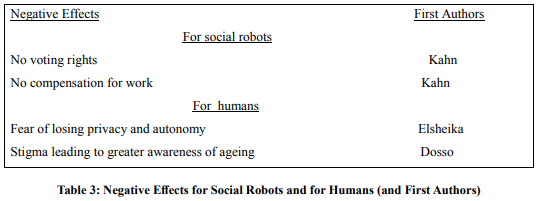
Several positive effects of exposure to social robots include children being physically and verbally interactive with them, a reduction in stress and anxiety in hospitalized children and increased social behavior in young children with autism. In older adults, a reduction in depression, loneliness, and agitation and an increase in physical activity have been reported. Also, an increase in oxytocin (the â??loveâ? hormone) and a decrease in cortisol (stress hormone) have also occurred after exposure to social robots.Child and Adolescent Studies
In one of the few experimental studies in this literature, children and adolescents were observed interacting for 15-minute periods with a social robot (N=90 who were 9, 12 and 15-years-old) [5]. After the interactions, the children were interviewed for 50 minutes. The children physically and verbally interacted with the robot called “Robovie”. They reported that they believed that Robovie was intelligent and had feelings and could be a friend. But they also thought that Robovie had no voting rights and could not be compensated for work.
In a study entitled “Children’s attribution of mental states to humans and social robots assessed with the theory of mind scale”, children were noted to mentalize social robots (understand behaviors stemming from underlying states like thoughts and feelings) [6]. These results were surprising because the social robots were 6-inch figurines which didn’t seem very human-like and the children were only 4 and 5-years-old.
In a meta-analysis on studies on the use of social robots with hospitalized children (N=313 studies on children ranging in age from one to 12-years-old), the well-being of the children was improved [7]. This was concluded from decreased scores on stress and anxiety measures. The children were exposed to a social robot in a group setting, suggesting a potential contagion effect of the children collectively enjoying the social robot.
Social robots have also been effectively used with children and young people on the autism spectrum (ASD). In one study on a comparison between children with ASD (N=29) and typically developing children (N=38), the children were assessed on learning the names of objects from social robots or humans (children ranging in age from 4-to-7-years-old) [8]. The children with autism showed less trust of the social robot. This result was not surprising given that children with autism often appear to be distrusting.
However, in a meta-analysis on 40 studies (17 randomized controlled studies), the use of social robots with children and young people on the autism spectrum was effective [9]. Social robots were based in clinics (67%), at home (37%) and in schools (17%). Generally, increased social functioning was reported, but, surprisingly, emotional and motor functioning did not change. Greater effects were noted for younger children, likely because younger children in general are more responsive to social robots.
Older Adult Studies
Positive effects have been reported for social robots in reducing loneliness among community- dwelling older adults (N= 68, mean age = 82) [10]. The randomly assigned older adults in this study (94% women) experienced less loneliness and greater well-being after spending four weeks with a robot. A content analysis of these data revealed that well-being was comprised of emotional support and psychological connection, lifestyle assistance, enriched social interaction, cognitive and mental stimulation. Unfortunately, the relative contributions of these components of well-being were not determined.
Loneliness also decreased in a meta-analysis of 19 studies (N=1083) [11]. The decrease in loneliness especially occurred in institutional settings. Adults in institutional and group settings have generally been more affected by social robots which again could be a contagion effect. The positive effects of social robots were greater in Japan and Turkey versus the U.S. This may be because those countries are more communal than individualistic societies like the U.S. As already noted, the positive effects of social robots are more frequently felt in larger group settings versus individual settings.
At least two other studies addressed loneliness in older people. In one study, younger adults (N= 67) were asked about their perceptions of the use of companion robots with older people [12]. The younger adults suggested that social robots could decrease loneliness, depression and agitation in older adults. They also expressed concerns about the cost and the availability of social robots for those who could not afford them. Although the cost and availability concerns are realistic, they are typically not experienced in institutional settings where social robots are more commonly present. It was also not clear why younger adults were being asked about their perceptions about the use of social robots instead of older adults who were experiencing companion robots.
In a meta-analysis entitled “The effect of social robots on depression and loneliness for older adults”, eight studies with large effect sizes were included [13]. These effects were again more frequently reported for group-based living situations versus living alone. Not surprisingly, the longer the duration of the exposure to the social robots, the greater the effects.
Some of these positive effects may be explained by an increase in physical activity as physical activity has been noted to decrease loneliness and depression, and physical activity has increased following exposure to social robots. For example, in a systematic review of 19 studies, artificial intelligence – powered social robots promoted physical activity in older adults [14].
The positive effects could also be explained by higher levels of oxytocin concentrations in adults who owned social robots because high levels of oxytocin have been associated with high activity levels and low levels of depression. In a group comparison between social robot owners versus non—owners, the robot owners had higher oxytocin levels than the non-owners [15]. As few as 15- minutes of interaction with a robot led to higher oxytocin levels and lower cortisol levels in both the owners and the non-owners of social robots [15]. These data are not surprising given that oxytocin also increases following brief interactions with humans and several of the studies on social robots highlight their human qualities.
Negative Effects of Social Robots
Several negative effects have been cited for social robots. They include the suggestion that social robots don’t have voting rights and don’t receive compensation for work. Others have expressed concern about the cost and availability of social robots. Still others have reported the fear of losing autonomy and the stigma of having a social robot.
In a study already summarized, the children believed that “Robovie” the social robot was intelligent, but they also suggested that a social robot had no voting rights and could not be compensated for work [5]. In another study also already reviewed, young adults expressed concern regarding the cost and lack of availability of social robots for those who could not afford them [12].
Fear is still another negative effect. In a review of 49 studies (N= 6670 adults), seven fear categories were noted [16]. The categories included the fear of losing privacy and autonomy, losing trust and reliability, having emotional and ethical discomfort, having usability challenges as well as the fear of becoming dependent and being unfamiliar with technology. The authors concluded that social robots needed to be co-designed with humans, and that humans needed to be gradually exposed to social robots. The latter is likely true, although the co-design is seemingly happening with artificial intelligence (AI) which may not be desirable as AI, like social robots, has had limited emotionality.
In a study entitled “Older adult perspectives on emotion and stigma in social robots”, 90-minute online workshops were given (N= 2 adults with dementia and 20 without dementia in their 50s to 80s) [17]. The participants suggested that robots were desirable for improving relationships between caregivers and their patients, but they expressed concern about the stigma of having a robot. The stigma, they suggested, could lead to a greater awareness of ageing and dementia. They also expressed the desire for social robots to have the same level of emotion as humans. The concern about dementia-related stigma was surprising given that only 2 adults had dementia. The desire for emotionality in social robots was not surprising even in this very small sample given that that desire has been expressed in virtually every study in this literature.
Methodological Limitations of this Literature
Several methodological limitations can be noted for this current literature on human-social robot interactions. The limitations include sampling problems, variability of the social robots and variability on the amount of exposure to the robots.
The sampling of the studies has been almost exclusively limited to children, adolescents and older adults. That is likely related to the almost exclusive use of robots by children and older adults, but that exclusivity limits the generalizability of the data. Further, research on attitudes and perspectives on social robots has been conducted with young adults rather than with the older adults who have actually been using social robots. The views of young and older adults are also likely to differ. For example, young adults have viewed social robots as helpers and assistants (Niewodol et al, 2024). But older adults have expressed the view that social robots are potentially stigmatic, reminding them of their ageing and wanting social robots to have the same level of emotions that humans have [17].
Only a few live interaction observation studies have been conducted to explore the reliability of the self-report data that suggests that interactions with social robots reduce their depression. An observable reduction in depression could be more reliable than a self-reported reduction in depression.
Variability of social robots across studies has also been a methodological limitation. The social robots have varied on their size and their anthropomorphic features as well as their spontaneous responsivity. Some are as small as 6-inch figurines and others are life-size like Sophia. Social robots are still lacking emotionality, which differentially affects individuals depending on the level of emotionality they prefer. Emotionality of the social robots will likely be enhanced by progress in artificial intelligence technology. At least two studies have reported that facial and vocal features that are similar to humans have enhanced the humans’ responses to the social robots.
In those live/ in person studies, there is likely variability in the findings, depending on whether the exposure to the social robot was a brief 15-minute period in the lab versus an ownership exposure of four-weeks. It has been reported that effects on loneliness and depression are enhanced by longer-term exposure to social robots. Variability has also been reported across countries with the use of social robots being greater, for example, in Turkey and Japan than it is in the U.S.
Most of the studies were focused on positive effects of social robots on both children and older adults. Exceptions were the studies reporting stigma and fear of negative effects of being with social robots (Elsheikh et al, 2025). The study of fear highlighted as many as seven fear categories, including the fear of losing privacy and autonomy, the fear of not trusting and not finding the social robot reliable, the emotional and ethical discomfort related to being with the robot, the usability challenges, the fear of becoming dependent and the unfamiliar technology. These fears derived from as many as 49 studies assessing 6670 participants, but they were only addressed in that review paper.
Despite these methodological limitations, the studies, reviews and meta-analyses in this recent literature have highlighted the value of social robots for humans. Future research on live interaction observations would help inform the development of more emotional social robots [18].
References
- Niewrzol, D. B., & Ostermann, T. (2024, January). Development and Validation of the Attitudes towards Social Robots Scale. In Healthcare (Vol. 12, No. 3, p. 286). MDPI.
- Morgante, E., Susinna, C., Culicetto, L., Quartarone, A., & Lo Buono, V. (2024). Is it possible for people to develop a sense of empathy toward humanoid robots and establish meaningful relationships with them?. Frontiers in Psychology, 15, 1391832.
- Song, Y., Luximon, A., & Luximon, Y. (2021). The effect of facial features on facial anthropomorphic trustworthiness in social robots. Applied Ergonomics, 94, 103420.
- Song, Y., & Luximon, Y. (2024). When trustworthiness meets face: Facial design for social robots. Sensors, 24(13), 4215.
- Kahn Jr, P. H., Kanda, T., Ishiguro, H., Freier, N. G.,Severson, R. L., Gill, B. T., ... & Shen, S. (2012). “Robovie, you’ll have to go into the closet now”: Children’s social and moral relationships with a humanoid robot. Developmental psychology, 48(2), 303.
- Goldman, E. J., Baumann, A. E., Pare, L., Beaudoin, J., & Poulin-Dubois, D. (2025). Children’s attribution of mental states to humans and social robots assessed with the Theory of Mind Scale. Scientific Reports, 15(1), 16357.
- Or, X. Y., Ng, Y. X., & Goh, Y. S. (2025). Effectiveness of social robots in improving psychological well-being of hospitalised children: A systematic review and meta-analysis. Journal of Pediatric Nursing, 82, 11-20.
- Chen, Z., Zheng, J., Gao, Y., Fang, J., Wang, Y., Chen, H., & Wang, T. (2024). Do children with autism spectrum disorders show selective trust in social robots?. Journal of Autism and Developmental Disorders, 1-8.
- Kouroupa, A., Laws, K. R., Irvine, K., Mengoni, S. E., Baird, A., & Sharma, S. (2022). The use of social robots with children and young people on the autism spectrum: A systematic review and meta-analysis. Plos one, 17(6), e0269800.
- Murayama, H., & Takase, M. (2025). Evaluating the Effectiveness of Digital Social Robots in Reducing Loneliness Among Community-Dwelling Older Adults in Japan: Randomized Controlled Trial and Qualitative Analysis. JMIR aging, 8(1), e74422.
- Mehrabi, F., & Ghezelbash, A. (2025). Wired for companionship: a meta-analysis on social robots filling the void of loneliness in later life. The Gerontologist, 65(12), gnaf219.
- Bradwell, H. L., Winnington, R., Thill, S., & Jones, R.B. (2020). Ethical perceptions towards real-world use of companion robots with older people and people with dementia: survey opinions among younger adults. BMC geriatrics, 20(1), 244.
- Yen, H. Y., Huang, C. W., Chiu, H. L., & Jin, G. (2024).The effect of social robots on depression and loneliness for older residents in long-term care facilities: a meta-analysis of randomized controlled trials. Journal of the American Medical Directors Association, 25(6).
- Shen, J., Yu, J., Zhang, H., Lindsey, M. A., & An, R. (2025). Artificial intelligence-powered social robots for promoting physical activity in older adults: A systematic review. Journal of Sport and Health Science, 101045.
- Imamura, S., Gozu, Y., Tsutsumi, M., Hayashi, K., Mori, C., Ishikawa, M., ... & Kajiya, K. (2023). Higher oxytocin concentrations occur in subjects who build affiliative relationships with companion robots. Iscience, 26(12).
- Elsheikh, A., Al-Thani, D., & Othman, A. (2025). Exploring fear in human-robot interaction: a scoping review of older adults’ experiences with social robots. Frontiers in Robotics and AI, 12, 1626471.
- Dosso, J. A., Kailley, J. N., Guerra, G. K., & Robillard, J. M. (2023). Older adult perspectives on emotion and stigma in social robots. Frontiers in Psychiatry, 13, 1051750.
- Zhou, C., & Dong, W. (2025). How do older adults react to social robots’ offspring-like voices. Social Science & Medicine, 364, 117545.