

Journal of Quantum Science & Emerging Technologies(JQSET)


Review Article - (2026) Volume 1, Issue 1
Six-Dimensional Relativity (Modifications to Relativity and Expansion of Dimensions)

Received Date: May 04, 2026 / Accepted Date: Jun 18, 2026 / Published Date: Jun 23, 2026
Copyright: ©2026 Chang-Ming Tsai. This is an open-access article distributed under the terms of the Creative Commons Attribution License, which permits unrestricted use, distribution, and reproduction in any medium, provided the original author and source are credited.
Citation: Tsai, C. M. (2026). Six-Dimensional Relativity (Modifications to Relativity and Expansion of Dimensions). J of Quantum Science & Emerging Techno, 1(1), 01-02.
Abstract
To address the issue of mass increasing to infinity as the velocity approaches the speed of light c in relativity, in this study, we propose a hypothesis for integrating the mass, charge, and space–time structure of relativity into a sixdimensional physical system, referred to as six-dimensional relativity. When the velocity reaches the speed of light c, all measurement values in a moving frame become zero, including the mass, which is not considered infinite as previously believed in physics, but zero. Further findings and applications are discussed in this study. This theory is in its preliminary stages. Further research will require the collective efforts of the scientific community.
Keywords
Six-Dimensional Relativity, Six-Dimensional Minkowski, Transformation Matrix, Sixth-Order Curvature Tensor PACS :03.30.+p
Brief Common Physical Descriptions Are As Follows:
• The mass increases with velocity. When the velocity approaches the speed of light c, the mass tends toward infinity.
• The length and time vary in the opposite manner to those of the mass as the velocity changes.
• Due to the photoelectric effect, the mass of a photon is assumed to be zero.
• The de Broglie’s wave–particle duality formula is applied.
• The formula for mass–energy equivalence and conservation of energy is applied.
• Based on the above descriptions, a contradiction is observed between Description 1 and the other four descriptions, which cannot be explained reasonably.
• It is important to determine whether there is any method to eliminate this contradiction.
In this study, we used a self-developed sixth-order curvature tensor to evaluate the feasibility of constructing a six-dimensional physical system.
Introduction
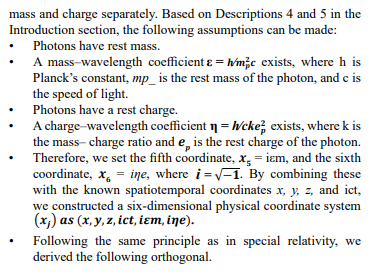
Based on the concept that the coefficient between time and wavelength along the time axis of the coordinate system in relativity is c, the following assumptions are proposed to coordinate the
Minkowski Matrix
Discussion & Conclusion
Based on the assumption that a particle (mass or charge) can attain the speed of light, we applied fundamental concepts of quantum mechanics, such as the photoelectric effect and de Broglie’s wave–particle duality, along with the well-known mass– energy equivalence formula and an undiscovered charge– energy equivalence formula, to derive the wavelength coefficients and the corresponding coordinate axes.
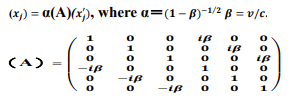
These are then combined with the space–time of relativity to derive a sixdimensional physical system with a geometric space comprising three real axes and three imaginary axes.
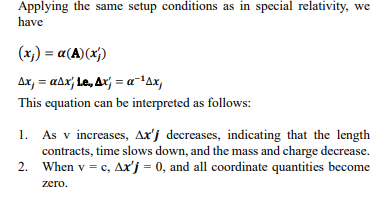
The results derived from the six-order Minkowski transformation matrix are briefly described as follows:
• The space contracts in all three dimensions as the velocity increases.
• When the velocity reaches the speed of light c, the space decreases to zero.
• The time decreases as the velocity increases.
• When the velocity reaches the speed of light c, the time stops (what does this mean?).
• The mass decreases as the velocity increases.
• When the velocity reaches the speed of light c, the mass becomes zero. This validates the mass–energy equivalence formula, that is, the total rest mass is converted into energy.
• This also partially explains why a photon under the photoelectric effect can generate energy. In accordance with the current assumption that photons have zero rest mass, where does their energy originate from?
The charge decreases as the velocity increases.
When the velocity reaches the speed of light c, the charge becomes zero. According to the law of charge conservation, the charge must be converted into some form of energy, which is tentatively referred to as charge energy in this study
This aspect requires Further Investigation.
The properties of the charge (electrical and magnetic) are yet to be determined.
Some extended applications of this theory are briefly proposed as follows:
• The matrix of the six-dimensional Maxwell electromagnetic field includes two additional fields. One of them is the gravitational/antigravitational field produced by the mass, whereas the other is an undefined field produced by the charge (perhaps a unified field?).
The six-dimensional d’Alembertian particle-wave equation encompasses the Klein–Gordon equation and the Schrodinger equation.
Afterword
• This theory is still in its preliminary stages and requires further verification and research.
• The concepts and inferences presented in this study are based on the most fundamental physics principles in textbooks on special relativity. Therefore, the derivation methods of the equations presented in the Introduction section are not further elaborated in this study.
Additionally, because no journals were referred for this study and only textbooks were consulted, references are not included (however, a bibliography can be provided).
The mathematical tools required for further research on this theory include the following:
• Three-rank near-complex structure
• Three-rank spinors
• Relevant de Sitter group
• Is this theory the foundation of the Unification Field, Quark, and other theories?
• What do the positive and negative values on the mass and charge coordinates represent?
• Can the propulsion system of unidentified flying objects be explained based on the energy and force generated between the positive and negative mass and charge using this theory?
Is there a light quantum particle, j, that travels faster than the speed of light (c), with its own constant speed (cj)? Do different universes have different values of cj? This theory and its mathematical derivations were developed during my third year (1965) at the National Taipei Institute of Technology (the predecessor of the National Taipei University of Technology). The theory was revised on October 31, 2014.