

Current Trends in Mass Communication(CTMC)
ISSN: 2993-8678 | DOI: 10.33140/CTMC



Research Article - (2025) Volume 4, Issue 1
Significance of Soft Skills Towards Engineering Graduates for Career Enhancement
Received Date: Feb 19, 2025 / Accepted Date: Mar 18, 2025 / Published Date: Mar 25, 2025
Copyright: ©Â©2025 B. Madhura. This is an open-access article distributed under the terms of the Creative Commons Attribution License, which permits unrestricted use, distribution, and reproduction in any medium, provided the original author and source are credited.
Citation: Madhura, B. (2025). Significance of Soft Skills Towards Engineering Graduates for Career Enhancement. Curr Trends Mass Comm, 4(1), 01-10.
Abstract
Background: Present research work intent to explore the significance of soft skills in academics besides employability among the engineering graduates. While soft skills show a key impact cutting-edge on personality of an individual gaining a good grade and prosper in job beside business.
Objective: The behavioural traits have major effect on the overall performance of the individuals, the skills that enhances one’s ability to think, solve problem, take effective decision making, time management, teamwork allows to reach the goals ahead. Methods: The simple random sample method has been implemented for the current study; sample study includes the graduates studying engineering. The questionnaire consists of six variables of soft skills, Team work, Work ethics, time management, problem solving, creativity and leadership. The hypotheses testing has been done using descriptive statistics, correlation, multiple linear regression and factor analysis.
Results: leadership, time management and work ethics are highly essential for all the graduates with irrespective of age levels. Creativity skills, Problem solving skills and leaderships skills scored high variance.
Conclusion: Among other things, it was suggested that in order to guarantee students' success in their chosen occupations and to improve their academic achievement, governments, school administrators, and all other stakeholders should make sure that the development of soft skills as a significant part of the school as well as college and University curriculum.
Keywords
Soft Skills, Graduates, Age, Gender, Work Ethics, Problem Solving
Introduction
“What is chiefly needed is skill rather than machinery” [1] .Soft skills help in building personality as well as professional development, as such all individuals may not possess all the skills by birth, yet the mastering of the skills depends upon the learning ability of the individual, the ability to do task reflects the hard-core skills, although a hard degree quite essential to get a job, perhaps the soft skills enable the employers to hire the employees. Today there is lot of diversity in the workforce, organizations focus the most important skills worthy for the young employees are adapt to the changing environment, time management skills, flexible, focus on collaborative works with cross cultural teams, effective communication, capacity to think creatively, innovative skills as such industry specific skills to meet the specified. Soft skills remain vitally necessary to achieve success in any line of work, be it the manufacturing or IT sectors, family businesses, or multinational companies [2].
According to Udemy, the most practising soft skills among the workforce are a) creativity, b) innovation, c) communication skills, d) decision making, e) willingness to learn f) adaptability to change g) leadership, h) emotional intelligence and i) critical thinking. Experiential learning, in which students actively participate in real-world situations requiring the application of particular talents, is one useful strategy to enhance soft skills. Delicate abilities are connected with human emotions, and perceptions quite difficult to measure and assess, beside hard skills are learned and gained by training [3]. Individuals can gradually increase their competence and confidence in using soft skill development in a variety of circumstances by incorporating it into daily routines and activities. In today's workforce, soft skills are among the most sought-after competencies. As data reveals that knowledge, or soft skills, are a significant predictor of future performance, employers and educational academics have recently focused more emphasis on the value of knowledge as conferred [4].
The research study conducted by (Vyas, 2018) [5]. clearly shows that hiring companies perceive soft skills as essential qualifications. Through the use of organized behavioural event interviews and in-depth examinations of candidates' actions, behaviours, and results, recruiters can evaluate their methods of communication and flexibility in remote work settings and capacity for work efficiently within teams. According to hiring for skills outlook 2024, unpacking the soft skills landscape report – top challenges while hiring for soft skills in 2024. Seventy percent - assessing cultural fit, sixty-one percent identifying soft skills during interview, fifty-nine percent evolving skill demands, fifty-four percent lack of robust assessment tools, thirty-three percent adapting to remote hiring challenges, thirty-three percent navigating diversity and inclusion considerations, five percent others. Forty-nine percent skill recruiters to focus more on soft skills. The economy of today demands talents that are getting more and more sophisticated. In order to deliver timely solutions, formal education systems are having difficulty. Particularly when it comes to soft skills—which are typically excluded from formal education curricula—there is a significant disconnect between the demands of business and formal education. The study's aims are: Research the components of soft skills as assessed and perceived by the graduates, examine at the soft skills that graduates are highly in demand for.
Problem Statement
Students with graduate degrees are competing fiercely for jobs and finding it challenging to obtain employment due to the global labour market's competitiveness. In order to designate successful then influential within the workplace, beginners should acquire an array of soft skills for improving ability to find employment [6]. Graduates who want to position for them self as competent individuals seeking jobs in the desired workplace must comprehend the demanding difficulties that recruiters face [7]. assert that while technical skills are important, soft skills are more important for today's and tomorrow's engineers.
In order to comprehend soft skill needs and find the best candidate, interviewers collaborate closely with our recruiters and business partners. American firms frequently have a strong demand for specific skills. Soft skills comprise, the capacity for problem-solving, make decisions, exercise critical thinking, communicate effectively, then take social and personal responsibility, among other things. Academics tend to focus more on hard skills than on helping students develop their soft skills to a sufficient degree. Universities are now required by accreditation authorities to rectify this lack of quality.
Literature Review
Soft skills refer to transfer of authority, networking, time management, capacity building for teams and knowledge of the individual [8]. soft skills place a high place on demand list, secondly general skills, thirdly job tasks skills and lastly the organizational skills among the human interaction skills, The soft skills that employers value the most are teamwork, problem solving, critical thinking and communication skills [ 9,10].
Higher educational institutions and corporate companies need to focus in improving and increasing the awareness about significance of soft skills among the students for being able to ready for employability and meet the changing demands of the work environment [11]. Students need to be trained in order to be productive team members, as stated It is a common observation made by employers that excellent teamwork and leadership qualities are lacking in business graduates."
According to Pritchard (2013), 75% of companies are seeking personnel with soft skills. [12-15] Succeeding in acquiring soft skills influences an individual's behaviour in social and workplace environments. Apart from the technical and hard skills for employment, additionally, morality, amiability, leadership, and teamwork are qualities that businesses value in their employee [16]. Identifying right skilfulness helps in building professional career, as on today the workforce in organizations has been affected by several factors via skill shortage, remote work, changes in skills in demand, gig economy, changes in job economy [17].
The most crucial skills for the induction process and for gaining entry-level employment are decision-making and communication, Intrapersonal communications abilities, interactions with others, teamwork, problem-solving, situational adaptation, creativity, and leadership follow later [18]. A specific set of job-related competencies, such as the ability to solve problems, have a strong work ethic, and make decisions are preferred by employers while taking candidates’ job interview Consider the importance of certain these soft skills include work ethics, teamwork, a cheerful outlook, and efficient communication[19, 20].
Social competency and career advancement depend on soft skills. Individual who possesses they can succeed more because they have stronger interpersonal skills for networking and connection. [21]. Soft skill abilities give a person a competitive edge at the career level because, when combined with technical skills, they make a person more marketable in the highly competitive labour market. When employing new staff, managers usually look for a select few soft skills, such as creativity, integrity, leadership, critical thinking, strong work ethics, positive attitude, communication, time management, teamwork, problem solving, self-confidence, etc [22,23].
Working on the significance of communication and its impact on teacher-student interaction and classroom management discovered that having effective communication skills aids students in succeeding academically. Being unable to connect with others may impede advancement in career. There is a lot of data to support the idea that people who battle to progress in their careers lack a variety of effective communication abilities [24, 25]. Together with fostering collaboration and open communication, teamwork also fosters a culture of shared accountability and mutual support, where people value and appreciate one another's efforts. One of the key components of soft skills is teamwork. Multiple studies have demonstrated how well collaboration can enhance job performance. To fit into the organizational culture, graduates need to empower their skills in learning, engaging in innovation build a good skill set and mind setm [26-28]. Talking about teamwork personnel who can more easily accomplish organizational goals [21]. When individuals collaborate in a team, work ethics and morale are raised. For strategic business success, teamwork is also essential. Higher productivity and more positive work motivation are produced by teams [29]. The usefulness of university programs in educating students about future career and teamwork skills was noted [30]. Professional skills enable to increased productivity in the organizations, therefore the workforce needs to build communication skills, confidence levels, work ethics, improve in human capabilities to collaborate and operate in teams [17]. It was determined by the students that the five most important soft skills are decision-making, problem-solving, critical thinking, and teamwork and collaboration [22]. Soft skills are crucial for finding an ideal job and for future professional development. respondents deemed communication skills to be the most crucial, with teamwork coming in second and time management. Generating fresh approaches to thinking and doing, creativity promotes development and beneficial transformation. Both cognitive and soft skill components are present in creativity. This skill, also known as "Divergent Thinking," entails creating information that is not just bold, helpful, and task-specific, but also inventive, original, and unexpected [31]. Continuous learning by the graduates enhances creativity and foster innovation ability in solving the complex organizational and societal problems.
A proactive and adaptable mind set is fostered by problem-solving abilities. Strong problem-solving skills enable scholars to effectively deal with these difficulties and find workable solutions, the capacity to generate and implement fresh concepts in problem solving is known as creativity [32]. Those who possess good time management abilities can set priorities, distribute resources wisely, and fulfil deadlines on time. A student who manages his time well will be more focused, organized, have more time for his social life, and have a better reputation, states [33]. Acquiring soft skills training is now necessary to improve productivity, maximize job performance, and progress in one's career [20]. Personal responsibility, a strong work ethic, optimistic attitudes, self-drive, the level of teamwork, personal skills, dispute resolve, negotiating ability, and Individuals' flexibility are examples of soft skills. The capacity for innovative thought, effective communication, coaching and mentoring etc [34, 35]. Challenging and encouraging individuals or groups to accomplish shared goals is a more important aspect of leadership than simply issuing instructions. The study acts as a bridge between students' leadership abilities and their self-assurance in the workforce [36].
Methods
The primary data has been collected through filled in questionnaires from the graduates, the questionnaire consists of six variables of soft skills, leadership, creativity, problem-solving, work ethics, and time management. Each variable contains four questions, two positive and two negatives’ items respectively. Every negative item in the questionnaire has a reverse rating, ranging from strongly disagree to strongly agree on a five-point Likert scale. Table 1defines explicitly the descriptive statistics of demographic variables of participants of the study.
|
|
Age |
Gender |
Team |
Creativity |
Problem-Solving |
Time Management |
Work Ethics |
Leadership |
|
Mean |
1.5677 |
1.5355 |
13.4516 |
13.6323 |
13.0323 |
13.2645 |
15.3290 |
12.8387 |
|
Std. Deviation |
0.58036 |
0.49955 |
1.65736 |
1.74423 |
2.13590 |
2.28709 |
2.43255 |
2.07461 |
|
Source: SPSS –Primary data output |
||||||||
Table 1: Descriptive Statistics
In the tests of normality table, the significant values of Kolmogorov-Smirnov statics for both variables Cronbach’s alpha (α) value for overall scale is 0.564 besides Cronbach ‘s alpha (α) based on standardized items is 0.604 for the scale has twenty-four items. The mean values of variable work ethics (x–= 15.3290), creativity (x– = 13.6323), team (x– = 13.4516), time management (x– = 13.2645), problem solving (x– = 13.0323) and leadership (x– = 12.8387), age (x–= 1.5677), gender (x–?= 1.5.355).
Table 2 signifies correlation analysis of study variables. The correlation coefficient r = .275 for creativity and team, r = .288 for problem solving and creativity, r = .423 for work ethics and problem solving, while r = .136 for leadership and time management. All the variables of the study under soft skills in the present research are positively related to each other, beside the variables work ethics and problem solving is highly strongly correlated, this implies work ethics and problem solving are quite essential skills to be acquired by the graduates and more expected by the employers in the organization.
|
|
Team |
Creativity |
Problem solving |
Time management |
Work Ethics |
Leadership |
|
Team |
1 |
.275** |
.168** |
0.095 |
.194** |
.113* |
|
Creativity |
|
1 |
.288** |
0.070 |
.373** |
0.062 |
|
Problem solving |
|
|
1 |
0.080 |
.423** |
0.109 |
|
Time Management |
1 |
.175** |
.136* |
|||
|
Work Ethics |
|
1 |
0.032 |
|||
|
Leadership |
|
|
1 |
Table 2: Correlation Analysis
**. Correlation is significant at the 0.01 level (2-tailed).
*. Correlation is significant at the 0.05 level (2-tailed).
Hypotheses Testing
H10: Across all age groups of the graduates, there is no discernible variation in the mean values of the following variables: creativity, leadership, problem solving, work ethics, and time management.Table 3 illustrates the model summary of Hierarchical regression analysis output.
|
Model |
R |
R Square |
Adjusted R Square |
Std. Error of the Estimate |
Change Statistics |
F Change |
df1 |
df2 |
Sig. F Change |
Durbin- Watson |
|
1 |
.300a |
0.090 |
0.072 |
0.55913 |
0.090 |
4.986 |
6 |
303 |
0.000 |
|
|
2 |
.300b |
0.090 |
0.075 |
0.55825 |
0.000 |
0.052 |
1 |
303 |
0.821 |
|
|
3 |
.295c |
0.087 |
0.075 |
0.55808 |
-0.002 |
0.814 |
1 |
304 |
0.368 |
|
|
4 |
.282d |
0.079 |
0.070 |
0.55956 |
-0.008 |
2.621 |
1 |
305 |
0.106 |
0.878 |
|
Source: SPSS –Primary data output |
||||||||||
Table 3: Hypotheses 1Model Summary
Hierarchical regression analysis was conducted to observe the difference of mean scores of time management, work ethics, problem solving, leadership, teamwork and creativity across the age levels of the graduates. The study employed a four step hierarchical approach, Backward stepwise regression method introducing predictors in the following order, teamwork, creativity, problem solving, time management, work ethics and leadership.
The first model (leadership, work ethics, time management, team, creativity, problem-solving) shows that all six predictors contributed to only 9% of variability across age of the graduate’s  F (6,303) = 4.98, P 0.000 < 0.000, R2 = 0.09 Adjusted R2 = 0.007, With five (leadership, work ethics, time management, team, problem-solving) predicted variables accounted for R2 of 0.090, and Adjusted R2 = 0.09, F (1,303) = 0.052, p 0.821 > 0.000.
With four (leadership, work ethics, time management, problem-solving) predicted variables accounted for R2 of 0.087, and Adjusted R2 = 0.075, F (1,304) = 0.814, p 0.814 > 0.000.
With three (leadership, work ethics, time management) predicted variables accounted for R2 of 0.079, and Adjusted R2 = 0.070, F (1,305) = 2.621, p 0.106 > 0.000.
The ANOVA results as shown in Table 4 gave us the significance of each of the four models, perhaps it could be observed all the models are significant model 1 (p <0.05) with F (6, 303) = 4.986, model 2 (p <0.05) with F (5, 304) = 5.992, model 3 (p <0.05) with F (4, 305) = 7.290 and model 4 (p <0.05) with F (3, 306) = 8.800 respectively. The F value is largest for the model 4 it indicates the predicator variables leadership, time management and work ethics are highly essential for all the individuals with irrespective of age of the individuals.
|
Sum of Squares Regression Residual |
Degrees of Freedom |
Mean Square Regression Residual |
F |
Sig. |
||
|
9.353 |
94.725 |
6, 303 |
1.559 |
0.313 |
4.986 |
.000b |
|
9.336 |
94.741 |
5, 304 |
1.867 |
0.312 |
5.992 |
.000c |
|
9.083 |
94.995 |
4, 305 |
2.271 |
0.311 |
7.290 |
.000d |
|
8.266 |
95.811 |
3, 306 |
2.755 |
0.313 |
8.800 |
.000e |
|
Source: SPSS –Primary data output |
||||||
Table 4: ANOVA
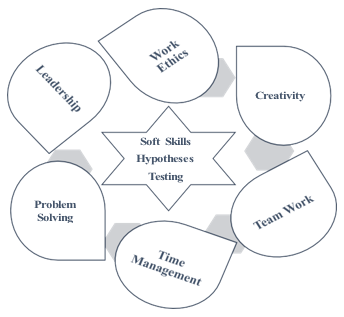
Figure I: Soft Skills Hypotheses Testing Across Age and Gender
Source: Author Self-Compilation
H20: Between-gender differences in the graduates' mean scores for time management, work ethics, problem solving, leadership, teamwork, and creativity are not statistically significant.
Figure I displays the variables of soft skills for hypotheses testing. The first model (leadership, work ethics, time management, team, creativity, problem-solving) shows that all six predictors contributed to only 0.053 percent of variability across male and female graduate’s F (6,303) = 2.804, p 0.011 > 0.000, R2 = 0.053 Adjusted R2 =- 0.034. With five (work ethics, time management, team, creativity, problem-solving) predicted variables second model accounted for R2 of 0.052, and Adjusted R2 = 0.037, F (1,303) = 0.112, p 0.738 > 0.000.
With four (time management, team, creativity, problem-solving) predicted variables third model accounted for R2 of 0.052, and Adjusted R2 = 0.052, F (1,304) = 0.194, p 0.660 > 0.000. Model 4 With three (time management, team, problem-solving) predicted variables accounted for R2 of 0.047, and Adjusted R2 = 0.037, F (1,305) = 1.627, p 0.203 > 0.000. model 5 with two (time management, problem-solving) predicted variables accounted for R^2 of 0.042, and Adjusted R2 = 0.036, F (1,306) = 1.306, p 0.254 > 0.000 and last model 6 time management predicted variables accounted for R2 of 0.035, and Adjusted R2 = 0.032, F (1,307) = 2.381, p 0.124 > 0.000 as displayed in Table 5
|
Model |
R |
R Square |
Adjusted R Square |
Std. Error of the Estimate |
Change Statistics |
F Change |
df1 |
df2 |
Sig. F Change |
Durbin-Watson |
|
1 |
.229a |
0.053 |
0.034 |
0.49103 |
0.053 |
2.801 |
6 |
303 |
0.011 |
|
|
2 |
.228b |
0.052 |
0.037 |
0.49031 |
0.000 |
0.112 |
1 |
303 |
0.738 |
|
|
3 |
.227c |
0.052 |
0.039 |
0.48967 |
-0.001 |
0.194 |
1 |
304 |
0.660 |
|
|
4 |
.216d |
0.047 |
0.037 |
0.49017 |
-0.005 |
1.627 |
1 |
305 |
0.203 |
|
|
5 |
.206e |
0.042 |
0.036 |
0.49041 |
-0.004 |
1.306 |
1 |
306 |
0.254 |
|
|
6 |
.187f |
0.035 |
0.032 |
0.49151 |
-0.007 |
2.381 |
1 |
307 |
0.124 |
1.877 |
|
Source: SPSS –Primary data output |
||||||||||
Table 5: Hypotheses 2 Model Summary
The ANOVA Table 6 result presented the significance of each of the six models, feasibly it could be observed all the models are significant except model 1 (p >0.05) with F (6, 303) = 2.801, and model 2 (p >0.05) with F (5, 304) = 3.349, model 3 (p <0.05) with F (4, 305) = 4.149 model 4 (p <0.05) with F (3, 306) = 4.979, model 5 (p >0.05) with F (2, 307) = 6.808 model 6 (p >0.05) with F (1, 306) = 11.186 respectively. The F value is largest for the model 6 it indicates the predicator variables time management is highly essential and significant between male and female individuals.
|
Model |
Sum of Squares Regression Residual |
Degrees of Freedom |
Mean Square Regression Residual |
F |
Sig. |
||
|
1. |
4.053 |
73.057 |
6, 303 |
0.675 |
0.241 |
2.801 |
.011b |
|
2. |
4.026 |
73.084 |
5, 304 |
0.805 |
0.240 |
3.349 |
.006c |
|
3. |
3.979 |
73.131 |
4, 305 |
0.995 |
0.240 |
4.149 |
.003d |
|
4. |
3.589 |
73.521 |
3, 306 |
1.196 |
0.240 |
4.979 |
.002e |
|
5. |
3.275 |
73.835 |
2, 307 |
1.637 |
0.241 |
6.808 |
.001f |
|
6. |
2.702 |
74.407 |
1, 308 |
2.702 |
0.242 |
11.186 |
.001g |
|
Source: SPSS –Primary data output |
|||||||
Table 6: ANOVA Hypotheses 2
Factor Analysis
The correlation coefficient and significant values of the variables are displayed in the correlation matrix table. Determinant value is 0.010 > 0.00001, it means variables are sufficiently correlated to each other to run exploratory factor analysis for the research study. Equation 1 illustrates the KMO test that has been conducted with the help of the formula.
Equation 1 KMO Test Formula
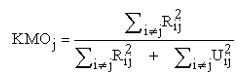
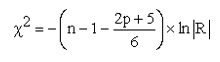
The sample size is sufficient for the exploratory factor analysis, as indicated by the KMO value of 0.639 >0.5 and the significance value of 0.000 < 0.05 for the Bartlett's test of sphericity. Bartlett’s test of sphericity has been calculated with the help of the formula as presented in Equation 2 where in ‘p’ refers to the number of values, ‘R’ correlation matrix and ‘n’ = total sample size. Equation 2 Bartlett's test of sphericity
The communalities values of all variables are greater than 0.5 except variable 15 and 19 fall below 0.5. Hence the variables 15 and 19 may not correlate with any other variable. The total variance explained table provides the cumulative percentage explained by the factors whose Eigen values is greater than 1. Table 7 indicates there are nine factors whose Eigen values are greater than 1 and all other factors cumulatively explains 62.422%. after the Varimax rotation, the sum of squared loadings for the first, second, third, fourth, fifth, sixth, seventh, eighth, and ninth factors, the total Eigen value is: 8.795, 16.872, 24.325, 31.554, 38.630, 45.533, 51.485, 57.042, and 62. 422.
|
6 |
1.242 |
5.177 |
48.610 |
1.242 |
5.177 |
48.610 |
1.657 |
6.903 |
45.533 |
|
7 |
1.203 |
5.015 |
53.625 |
1.203 |
5.015 |
53.625 |
1.429 |
5.953 |
51.485 |
|
8 |
1.097 |
4.571 |
58.195 |
1.097 |
4.571 |
58.195 |
1.334 |
5.556 |
57.042 |
|
9 |
1.014 |
4.227 |
62.422 |
1.014 |
4.227 |
62.422 |
1.291 |
5.380 |
62.422 |
|
10 |
0.971 |
4.044 |
66.466 |
|
|
|
|
|
|
|
11 |
0.931 |
3.878 |
70.344 |
|
|
|
|
|
|
|
12 |
0.788 |
3.284 |
73.629 |
|
|
|
|
|
|
|
13 |
0.745 |
3.104 |
76.733 |
|
|
|
|
|
|
|
14 |
0.728 |
3.032 |
79.764 |
|
|
|
|
|
|
|
15 |
0.696 |
2.899 |
82.663 |
|
|
|
|
|
|
|
16 |
0.613 |
2.556 |
85.220 |
|
|
|
|
|
|
|
17 |
0.594 |
2.473 |
87.693 |
|
|
|
|
|
|
|
18 |
0.568 |
2.366 |
90.059 |
|
|
|
|
|
|
|
19 |
0.495 |
2.063 |
92.122 |
|
|
|
|
|
|
|
20 |
0.441 |
1.836 |
93.958 |
|
|
|
|
|
|
|
21 |
0.412 |
1.715 |
95.673 |
|
|
|
|
|
|
|
22 |
0.385 |
1.605 |
97.278 |
|
|
|
|
|
|
|
23 |
0.341 |
1.419 |
98.697 |
|
|
|
|
|
|
|
24 |
0.313 |
1.303 |
100.000 |
|
|
|
|
|
|
|
Source: SPSS –Primary data output |
|||||||||
Table 7: Factors Extracted -Factor analysis

correlation coefficient between the variable and  the factor and error = 1- λ2, the value of
  is taken form the rotated matrix of the EFA analysis. The composite reliability and average variance explained values of all the three factors are greater than 0.7 and 0.5 respectively. It means the instrument is valid to measure the said construct. The calculated composite value (0.95) of factor -1 creativity skills is CR>AV greater than average variance (0.84).
Results
Soft talents are those that enable people to lead, empathize, solve issues, communicate, and think creatively [37].
Table 8 indicates Factor -1 labelled as Creativity skills, the item no 10 “I try my best to find root cause of the problem ranked first with highest factor load .752, beside item no 6 “I make an effort to take on new challenges” factor load .586, while on other hand item 18 “I believe that job well done is a reward in itself” and item no 17 “I work the same way whether the boss is there or not” factor load .534 and .477 respectively. The sum total of factor loadings of factor 1 is around 2.349 [38]. They are the capacity to develop concepts and construct strategies and techniques which lead to positive results in the workplace.
|
Item |
Name of the Item |
Anti –Image Matrices |
Correlation Matrix |
Mean |
Std.Dev |
Factor Loading |
|
|
10 |
I try my best to find root cause of the problem. |
.681a |
0.228 |
3.3742 |
.59282 |
.752 |
|
|
6 |
I make an effort to take on new challenges |
.785a |
0.145 |
3.3935 |
.62832 |
.586 |
|
|
18 |
I believe that job well done is a reward in itself. |
.722a |
0.261 |
4.2774 |
.76776 |
.534 |
|
|
17 |
I work the same way whether the boss is there or not. |
.664a |
0.135 |
4.0968 |
96391 |
.477 |
|
|
Eigen Value: 8.795 |
AV = 0.84 |
CR = 0.95 |
|
|
2.349 |
||
Table 8: Factor 1 Creativity Skills
Table 9 specifies Factor - 2 categorized as Problem solving skills, all the items loadings accounted for a sum of 2.362, item no 20 “I believe one should not work unless there is some emergency” has highest factor loading .734, item no 12 “I hope problems will sort themselves” next highest with factor load .661, yet on other side, item no 7 “I prefer not to talk over problems with other people” and item no 19 “I would still prefer to work even if I don’t earn for living” with factor loading .523 and .444 respectively. Discovering something that is not known is the first step in solving an issue [39]. The calculated composite value (0.68) of factor -2 problem solving skills is CR>AV greater than average variance (0.35).
|
Item |
Name of the Item |
Anti – Image Matrices |
Correlation Matrix |
Mean |
Std.Dev |
Factor Loading |
|
20 |
I believe one should not work |
.572a |
0.207 |
3.8774 |
1.23768 |
.734 |
|
|
unless there is some |
|
|
|
|
|
|
|
emergency. |
|
|
|
|
|
|
12 |
I hope problems will sort themselves. |
.640a |
0.224 |
3.2903 |
1.36041 |
.661 |
|
7 |
I prefer not to talk over problems with other people |
.666a |
0.009 |
3.3806 |
.89059 |
.523 |
|
19 |
I would still prefer to work even if I don t earn for living. |
.609a |
-0.066 |
3.0774 |
1.32458 |
.444 |
|
Eigen Value: 16.872 AV = 0.35 CR =0.68 2.362 |
||||||
Table 9: Factor 2 Problem Solving Skills
Table 10 explains Factor - 3 characterized as leadership skills the sum score of factor loadings are 1.847, item no 23 “Allocating tasks is a challenging aspect of my job” ranked highest factor load .736, item no 4 teamwork is overrated in terms of the actual results produced ranked second highest factor load with .691, finally item no 16 “I am unable to meet deadlines” factor load with .420. These abilities are required in order to engage in teamwork, negotiate with people, serve clients, customers, and peers, and settle disputes. This is significant because it will facilitate the achievement of objectives by both individuals and organizations [40]. The calculated composite value (0.65) of factor -3 leadership skills is CR>AV greater than average variance (0.40).
|
Item |
Name of the Item |
Anti – Image Matrices |
Correlation Matrix |
Mean |
Std.Dev |
Factor Loading |
|
23 |
Allocating tasks is a challenging aspect of my job. |
.658a |
0.004 |
2.1613 |
1.06418 |
.736 |
|
4 |
Teamwork is overrated in |
.693a |
0.193 |
3.3355 |
.76558 |
.691 |
|
terms of the actual results |
|
|
|
|
||
|
produced. |
|
|
|
|
||
|
16 |
I am unable to meet deadlines. |
.569a |
0.172 |
3.0968 |
1.31594 |
.420 |
|
Eigen Value: 24.325 |
AV= 0.40 |
|
CR -= 0.65 |
1.847 |
||
Table 10: Factor 3 Leadership Skills
Factor - 4 named as Managerial skills, as shown in Table 11 item no 22 “I enjoy responding the peoples requests and concerns” factor loading is .783, on other aside item no 21 and 9 “Managing people and resources is one of my strengths”, and “I have an OK approach, depends how big the problem is” has factor loadings .692 and .474 respectively. Overall the factor - 4 scored 1.95 sum of all factor loadings. You may show employers that you respect your work and that you know it's important to give it your all by exhibiting your work ethic. The calculated composite value (0.68) of factor -4 managerial skills is CR>AV greater than average variance (0.43).
|
Item Name of the Item Anti – Image Matrices |
Correlation Mean Matrix |
Std.Dev |
Factor Loading |
|
|
22 I enjoy responding the .589a |
0.392 |
4.0968 |
.92973 |
.783 |
|
peoples requests and |
|
|
|
|
|
concerns. |
|
|
|
|
|
21 Managing people and .695a |
-0.053 |
4.0710 |
.85226 |
.692 |
|
resources is one of my strengths. |
||||
|
9 I have an OK approach, .680a |
0.106 |
3.8968 |
.78969 |
.475 |
|
depends how big the problem |
|
|
|
|
|
is. |
|
|
|
|
|
Eigen Value: 31.554 AV = 0.43 |
|
CR = 0.68 |
|
1.95 |
Table 11: Factor 4 Managerial Skills
Factor - 5 titled as time management skill, the total score of factor loading accounted is 1.657, here by item 13 “I accomplish what needs to be done during the day” placed highest .730 factor load, item 9 “I have an OK approach, depends how big the problem is rated .548 and item 14 “I prioritize my list in order of importance not urgency” has factor load .379. The calculated composite value (0.57) of factor -5 Time management skills is CR>AV greater than average variance (0.32) as depicted in Table 12
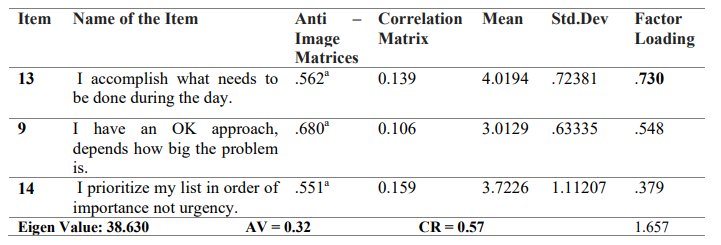
Table 12: Factor 5 Time Management Skills
Factor - 6 titled as collaborative skills, only one item is loaded in the factor with factor load .821, and Eigen value score value is around 45.533. The calculated composite value (0.68) of factor -6 Collaborative skills is CR>AV greater than average variance (0.68). Collaboration skills are regarded as critical competencies that are necessary to function well in both academic and professional settings. On the one hand, they have a very favourable impact on students' learning and personal development.
Similarly, Factor - 7 titled as goal setting, only one item is loaded in the factor with factor load .821, and Eigen value score value is around 45.533. The calculated composite value (0.56) of factor -7 goal setting is CR=AV equal to average variance (0.56). Students who create their own goals are more driven to achieve them and are more likely to put in more effort to achieve them than those that are imposed from others.
Perhaps Factor – 8 is named as team work skills, the total factor score accounted for 1.2, Item 3 “I do my best work alone rather than in a team” topped with high factor load .823, sequentially item 2 “working in a team gets me to think more creatively” has .377 factor load. The calculated composite value (0.69) of factor – 8 Teamwork is CR>AV greater than average variance (0.40). At last factor – 9 Motivation skills scored total factor load .821, wherein item 24 “I use my emotions to motivate others scored. 821 factor load, item 15 “I force myself to make time for planning has .369 factor load. The calculated composite value (0.54) of factor - 9 Motivation skills is CR>AV greater than average variance (0.40).
Discussion
The ability to combine creative Employers most commonly cite soft skills as one of their top requirements, as described [41]. and mastery of soft skills is increasingly fetching a crucial component of business recruitment procedures [42]. As creativity is a crucial component of selection procedures, it must to be taught to students alongside the other cross-disciplinary abilities [43]. highlighting the importance of problem-solving abilities by showing how they can improve creativity, enjoyment, interest, and learning. These abilities include the capacity to identify an issue, assess various alternatives, and develop viable options for solving the particular problem [44]. Because instructors are motivated to increase students' achievement, problem solving is essential to education, claim‘s [45].
Time management is a crucial ability that every college student should possess since it is essential to achieving exceptional academic success [46]. A student who manages his time well will be more focused, organized, take enough time for his social life., and have a better reputation, claims [33]. Research on the relationship between motivation, time management, organization in online study programs and student academic accomplishment was conducted [47].
More significant than academic knowledge is the ability to innovate—the capacity to solve issues creatively or create new possibilities—as well as abilities like critical thinking, communication, and teamwork [48]. Stated in [49]. When working with different departments and teams, a person's talents frequently become even more important [50].
Goal-setting can also result in a high level of goal commitment, [51]. Implementing these steps can help you realize your goals: 1) determine your personal and professional goals, 2) define your goals for your personal life, 3) adopt action to reach the objective, 4) Establish a plan; 5) Determine the goal's time frame; and 6) Avoid distractions [52].
Students who possess high levels of self-efficacy and self-motivation are able to take on more difficult assignments, have better time management skills, are more resilient when faced with setbacks, and show less anxiety when adjusting to new learning environments [53]. as a result, they succeed greatly [54]. Assert that both personal and professional life depend on motivation. Without motivation, one cannot accomplish the desired outcome.
Conclusion
Among other things, it was suggested that in order to guarantee students' success in their chosen occupations and to improve their academic achievement, governments, school administrators, and all other stakeholders should make sure that the development of soft skills is a significant part of the school curriculum [55]. Encourage students to use the earlier suggested methods to enhance their soft skills, such as reading specific books, attending classes, and joining clubs or associations to widen their world of possibilities. Including courses on soft skills in a program's curriculum would be a formal solution to the challenge.
Acknowledgments
I thank Sreenidhi Institute of Science and Technology Management for undertaking this project and allowing me to collect the responses from the engineering students to study the importance of soft skills. I thank all engineering students for contributing valid time in giving suggestions and improvements in bringing out the valid outcomes of the research study for career enhancement
Author contributions
CONCEPTION: Dr.B.Madhura
METHODOLOGY: Dr.B.Madhura
DATA COLLECTION: Engineering graduates.
INTERPRETATION OR ANALYSIS OF DATA: Dr.B.Madhura
PREPARATION OF THE MANUSCRIPT: Dr.B.Madhura
REVISION FOR IMPORTANT INTELLECTUAL CONTENT: Dr. Dr.B.Madhura
SUPERVISION: Dr.B.Madhura
References
- Wilbur, L. E. (1962). AN ANALYSIS OF SELECTED AREAS OF BRITISH FURTHER EDUCATION, 1926-1938.University of Southern California.
- Ramesh, G. (2010). The ace of soft skills: attitude, communication and etiquette for success. Pearson Education India.
- Wesley, S. C., Jackson, V. P., & Lee, M. (2017). The perceived importance of core soft skills between retailing and tourism management students, faculty and businesses. Employee Relations, 39(1), 79-99.
- Nazron, M. A., Lim, B., & Nga, J. L. (2017). Soft skills attributes and graduate employability: A case in Universiti Malaysia Sabah. Malaysian Journal of Business and Economics (MJBE).
- Vyas, M. A. (2018). A study of soft skills to be instilled within management students. International Journal of Research and Analytical Reviess, 6(1), 1088-1092.
- Azmi, I. A. G., Ahmad, Z. A., & Zainuddin, Y. (2009). The Effects of Competency Based Career Development and Performance Management Practices on Service Quality: Some Evidence From Malaysian Public Organizations. International review of business research papers, 5(1), 97-112.
- ten Caten, C. S., Silva, D. S., Aguiar, R. B., Silva Filho, L. C. P., & Huerta, J. M. P. (2019). Reshaping engineering learning to promote innovative entrepreneurial behavior. Brazilian Journal of Operations & Production Management, 16(1), 141-148.
- Yeardley, T. (2017). Training of new managers: why are we kidding ourselves?. Industrial and Commercial Training, 49(5), 245-255.
- Lavy, I., & Yadin, A. (2013). Soft skills-An important key for employability in the" shift to a service driven economy" era. International Journal of e-Education, e-Business, e-Management and e-Learning, 3(5), 416.
- Zainal Shah, N., Ab Aziz, N. S., & Balraj, B. M. (2022). Soft skills for employability from lecturers’ perspectives.
- Succi, C., & Canovi, M. (2020). Soft skills to enhance graduate employability: comparing students and employers’ perceptions. Studies in higher education, 45(9), 1834-1847.
- Thacker, R. A., & Yost, C. A. (2002). Training students to become effective workplace team leaders. Team Performance Management: An International Journal, 8(3/4), 89-94.
- Pritchard, J. (2013). The importance of soft skills in entry-level employment and postsecondary success.
- Gibb, S. (2014). Soft skills assessment: Theory development and the research agenda. International journal of lifelong education, 33(4), 455-471.
- Zaman, L., Sarker, A. R., & Akhter, N. (2018). Study on Practice of Soft Skills among the Workforce: A Case from Ready Made Garment (RMG) Industry of Bangladesh. International Journal of Asian Social Science, 8(10), 808-8018.
- Johnson, K. M. (2015). Non-technical skills for IT professionals in the landscape of social media. American Journal of Business and Management, 4(3), 102-122.
- Majid, S., Liming, Z., Tong, S., & Raihana, S. (2012). Importance of soft skills for education and career success. International journal for cross-disciplinary subjects in education, 2(2), 1037-1042.
- Rodriguez Martinez, A., Sánchez, V. S., Falcon Linares, C., & Latorre Cosculluela, C. (2021). Key soft skills in the orientation process and level of employability. Sustainability, 13(6), 3554.
- Kechagias, K. (2011). Teaching and assessing soft skills.
- Tripathy, M. (2020). Significance of soft skills in career development. Career Development and Job Satisfaction, 15.
- Rao, M. S. (2018). Soft skills: toward a sanctimonious discipline. On the Horizon, 26(3), 215-224.
- Sharma, M. (2009). How Important Are Soft Skills from the Recruiter's Perspective. ICFAI Journal of Soft Skills, 3(2).
- Patacsil, F. F., & Tablatin, C. L. S. (2017). Exploring the importance of soft and hard skills as perceived by IT internship students and industry: A gap analysis. Journal of Technology and Science education, 7(3), 347-368.
- Bee, S. B. (2012). The impact of teachers’ communication skills on teaching: Reflections of pre-service teachers on their communication strengths and weaknesses. Humanising language teaching, 14(1), 14-23.
- Ellis, R. (2002). Communication skills: Stepladders to success for the professional.
- Kalleberg, A. L., Nesheim, T., & Olsen, K. M. (2009). Is participation good or bad for workers? Effects of autonomy, consultation and teamwork on stress among workers in Norway. Acta sociologica, 52(2), 99-116.
- Criss, E. (2010). Teamwork in the music room. Music Educators Journal, 97(1), 30-36.
- Weinstein, J., Morton, L., Taras, H., & Reznik, V. (2013). Teaching teamwork to law students. J. Legal Educ., 63, 36.
- Tang, K. N. (2020). The importance of soft skills acquisition by teachers in higher education institutions. Kasetsart Journal of Social Sciences, 41(1), 22-27.
- Riebe, L., Roepen, D., Santarelli, B., & Marchioro, G. (2010). Teamwork: effectively teaching an employability skill. Education+ Training, 52(6/7), 528-539.
- Casner-Lotto, J., & Barrington, L. (2006). Are they really ready to work? Employers' perspectives on the basic knowledge and applied skills of new entrants to the 21st century US workforce. Partnership for 21st Century Skills. 1 Massachusetts Avenue NW Suite 700, Washington, DC 20001.
- Hasanah, M. A., & Surya, E. (2017). Differences in the abilities of creative thinking and problem solving of students in mathematics by using cooperative learning and learning of problem solving. International Journal of Sciences: Basic and Applied Research (IJSBAR), 34(01), 286-299.
- Nyatyowa, L. (2017). Here is how good time management will make you a better student. Lagos: Oxbridge Academy.
- Zaman, U., Zahid, H., Aktan, M., Raza, S., & Sidiki, S.N. (2021). Predictors of self-employment behavior among business graduates. Cogent Business & Management, 8(1), 1947760.
- Taylor, E., 2016. Investigating the perception of stakeholders on soft skills development of students: Evidence from South Africa. Interdisciplinary journal of e-skills and lifelong learning, 12(1), pp.1-18.
- Gerhardt, T. (2019). An analysis of the impact of a leadership intervention on an undergraduate work-based learning project for human resource management students. Journal of Work-Applied Management, 11(1), 53-62.
- Wentz, F. H. (2012). Soft skills training: A workbook to develop skills for employment. (No Title).
- Asefer, A., & Abidin, Z. (2021). Soft skills and graduates’ employability in the 21st century from employers’ perspectives: A review of literature. International Journal of Infrastructure Research and Management, 9(2), 44-59.
- Jonassen, D. H. (2000). Toward a design theory of problem solving. Educational technology research and development, 48(4), 63-85.
- Kantrowitz, T. M. (2005). Development and construct validation of a measure of soft skills performance. Georgia Institute of Technology.
- Knell, E., Lindsay, N., & Rae, J. (2007). Creative graduates: Employability and the creative economy. London: Creative Graduates Creative Futures.
- Brunet, L. A. (2017). Forging Europe: Industrial Organisation in France, 1940–1952. Springer.\
- Yu, W. F., She, H. C., & Lee, Y. M. (2010). The effects of Webâ?ÂÂbased/nonâ?ÂÂWebâ?ÂÂbased problemâ?ÂÂsolving instruction and high/ low achievement on students’ problemâ?ÂÂsolving ability and biology achievement. Innovations in Education and Teaching International, 47(2), 187-199.
- MM (2019). 21st Century Skill “Problem Solving”: Defining the Concept. Asian Journal of Interdisciplinary Research, 2(1), pp.64-74.
- Mayer, R. E. (2010). Merlin C. Wittrock's enduring contributions to the science of learning. Educational Psychologist, 45(1), 46-50.
- Aeon, B., & Aguinis, H. (2017). It’s about time: New perspectives and insights on time management. Academy of management perspectives, 31(4), 309-330.
- Basila, C. (2014). Good time management and motivation level predict student academic success in college on-line courses. International Journal of Cyber Behavior, Psychology and Learning (IJCBPL), 4(3), 45-52.
- Wagner, T. (2010). The global achievement gap: Why even our best schools don't teach the new survival skills our children need-and what we can do about it. ReadHowYouWant. com.
- Friedman, T. L. (2005). The world is flat: A brief history of the twenty-first century. Macmillan.
- Chalupa, S., & Chadt, K. (2021). The perception of soft skills and their training at hotel front–Office in Connection to CoVid-19 pandemics. TEM journal, 10(2), 517.
- Schunk, D. H. (1991). Goal setting and self-evaluation: A social cognitive perspective on self-regulation. Advances in motivation and achievement, 7, 85-113.
- Davidova, J., & Kokina, I. (2020, June). Students’ Opinion on the Quality Assurance of a Study Process: Case Study at Daugavpils University, Latvia. In The Proceedings of the International Scientific Conference Rural Environment. Education. Personality (REEP) (Vol. 13, pp. 48-54).
- Abd-Elmotaleb, M., & Saha, S. K. (2013). The Role of Academic Self-Efficacy as a Mediator Variable between Perceived Academic Climate and A
- Hitka, M., Vetráková, M., Balázová, Z., & Danihelová,Z. (2015). Corporate culture as a tool for competitiveness improvement. Procedia Economics and Finance, 34, 27-34.
- Obilor, E. I. (2019). Soft skills and students’ academic achievement. The International Journal of Community and Social Development, 7(2), 27-37.