


Review Article - (2026) Volume 11, Issue 1
Sibling Relationships Research: A Narrative Review
Received Date: Feb 02, 2026 / Accepted Date: Feb 23, 2026 / Published Date: Mar 06, 2026
Copyright: ©2026 Tiffany Field. This is an open-access article distributed under the terms of the Creative Commons Attribution License, which permits unrestricted use, distribution, and reproduction in any medium, provided the original author and source are credited.
Citation: Field, T. (2026). Sibling Relationships Research: A Narrative Review. Int J Psychiatry, 11(1), 01-05.
Abstract
This narrative review includes brief summaries of papers on sibling relationships that were published in 2024 and 2025 and can be categorized as positive and negative effects as well as risk factors/predictor variables. In this current literature, positive effects of sibling relationships include siblings serving as role models and caregivers, fostering competence, lower cortisol levels, sibling relatedness happening again in later romantic relationships, and sibling relatedness contributing to later cognitive performance. Negative effects include bullying, sexual abuse and early puberty. Risk factors/predictor variables include hyperactivity, sibling disability, low intimacy, victimization, and parental differential treatment of the siblings. Methodological limitations of this current literature include the samples being limited to children/adolescents, the sampling of dyads that include one with a disability or a mental disorder as opposed to a healthy sibling, the lack of comparisons between siblings and only children, the selection of variables that is frequently limited to those in archival databases and the results of the data analyses on sibling conflict being confounded by parental conflict.
Introduction
Sibling relationships are unique and often the longest-term relationships in one’s life. They can be both supportive and conflictual, but they are considered training for other relationships on, for example, the development of conversation skills, negotiation and empathy. They differ as a function of birth order, age, and gender, although these variables were not the focus of studies in the current literature.
A significant literature on sibling relationships has preceded this review. Because that literature has already been reviewed, this narrative review is focused on the current literature published in the years 2024 and 2025. Finding the current literature on sibling relationships research involved entering the search terms sibling relationships and 2024-2026 into PubMed and PsycINFO. Exclusion criteria included protocols, case studies and non-English language papers. This review of the current literature on sibling relationships is comprised of 16 papers that are divided into sections that are labeled positive effects, negative effects, and risk factors/predictor variables. Only 5 papers were found on positive effects, 4 papers on negative effects and 7 papers on risk factors/ predictor variables.
Positive Effects
Several positive effects have been noted for sibling relationships (see table 1). They include siblings serving as role models and caregivers, fostering competence, lower cortisol levels, relatedness to siblings happening again in later romantic relationships, and sibling relatedness contributing to later cognitive performance.
In a paper entitled “Sibling influence on eating behavior in early childhood: siblings as role models and caregivers”, the results are given in the title [1]. In this sample (N=30), the eating behavior of young children was positively affected by their older siblings providing role models and assisting with the feeding of their younger siblings. The effects of being a model for behavior and assisting with the behavior are confounded and their relative contributions to the effects likely cannot be determined even statistically.
Younger siblings have also gauged their competence in sports as being greater when they have made sibling–based (upward) comparisons with their older siblings and have greater relationship warmth with their older siblings [2]. In this sample of sports-involved sibling dyads (N= 47), the first-born children averaged 11 years old, and the younger siblings averaged 9 years old. Again, the relative contributions of the two independent variables, upward comparisons and relationship warmth, to the siblings’ perception of competence were not determined.
In a paper entitled “Social buffering by siblings in childhood and adolescence”, the children (N=72 children 9 to 11 years old) and adolescents (N=66 adolescents 15 to 17 years old) completed a social stress test online with same age or older siblings versus a stranger [3]. Adolescents with depressive symptoms who worked on the social stress test with a sibling versus a stranger had lower cortisol reactivity. Greater alienation between siblings led to impaired cortisol recovery. Although biochemical data like cortisol reactivity has often been considered less subjective, it was surprising that self-report data were not collected or not reported by these researchers.
Positive behaviors between siblings during adolescence have been similarly positive during romantic partnerships in adulthood decades later [4]. The positive behaviors included warmth, support, and positive communication. Sibling relationships during adolescence have frequently been considered training grounds for later romantic relationships. However, the positive relationships between adolescent siblings often continue into adulthood which may be even more predictive because they are contemporaneous variables.
Sibling relationships have also positively affected cognitive functioning in late adulthood [5]. Based on the Wisconsin Longitudinal Study, positive childhood sibling interactions (for example, hugging and helping) were associated with sibling closeness and contact in the participants’ mid 50s through early 70s, which, in turn, were associated with cognitive scores in their early 80s. These data were not surprising as the positive sibling interactions would likely facilitate their later interactions and social interactions, in turn, could provide cognitive stimulation that would contribute to cognitive development.
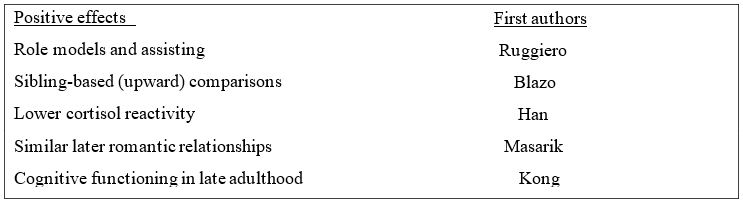
Table 1: Positive Effects of Siblings’ Relationships (and First Authors)
Negative Effects
A few negative effects have been reported for having siblings (see table 2). These include bullying, sexual abuse and early puberty.
In a paper entitled “Genetic influences of sibling bullying and mental difficulties”, the Avon Longitudinal Study (N= 3959 adolescents 11 to 13-years-old) provided the sample [6]. Sibling bullying, victimization plus polygenic scores predicted mental health difficulties. The contribution of polygenic scores (indices of genetic risk for major depression disorder and ADHD) suggested that genetic risk could lead to mental health difficulties, which, in turn, could make individuals more susceptible to sibling bullying. Although three variables predicted mental health difficulties in this sample, the relative contribution of these variables to mental health difficulties was not determined. Intervention efforts would likely target the bullying and victimization.
Sexual abuse has been the focus of at least two papers in this current literature. In a large sample study (N= 1863), as many as 13% had sexual contact with a sibling starting at age 10 [7]. The risk factors were sexual abuse by parents, having a step sibling and a positive attitude towards nudity. Unfortunately, children don’t typically report this problem and sexually abusing parents are also not likely to seek treatment for their sexually abused children.
In a systematic review, the most common intra-familial – child abuse was sibling sexual abuse [8]. This was more common in males with histories of abuse, learning disabilities and exposure to family conflict, violence, and disadvantage. The victims are most commonly females who did not disclose their sexual abuse until adulthood. These results are not surprising except that sibling sexual abuse was more common than parental abuse in these studies. Parental abuse may have been underreported as parents are typically the recruited participants in studies involving child abuse.
In the Puberty Cohort of Denmark (N= 10,657) girls and boys from age 11 who had full siblings versus full plus half or no siblings experienced earlier puberty [9]. It is not clear that earlier puberty is necessarily a negative effect, although any form of precocious development has been considered disadvantageous for being “out of step” with one’s same-age peers.

Table 2: Negative Effects of Siblings’ Relationships (and First Authors)
Risk Factors/Predictor Variables
At least five risk factors /predictor variables have been the focus of current research on siblings (see table 3). They include hyperactivity, sibling disability, low intimacy, victimization, and differential treatment by parents.
In a study entitled “Child hyperactivity, mother – child negativity, and sibling dyads’ negativity”, the results are given in the title [10]. In this sample from the Avon Longitudinal Study (N=4429 children who were 4, 7 and 8 years old), all three of these problems contributed to mental health problems. The child’s hyperactivity likely contributed to differential treatment by parents which would be expected to exacerbate the hyperactivity problem for the sibling. Those who have siblings with mental disorders are said to have low quality relationships [11]. Females and young siblings are the most distressed. Females and young siblings likely resent not only less attention from their parents in this situation but also being expected to assist in the caregiving of the mentally disturbed sibling. When there was less parentification of the sibling, there was a greater quality relationship between the siblings. Females versus males are more often assigned caregiver roles and younger versus older siblings may feel less competent for caregiving.
In a systematic review of the empirical literature (N= 60 studies and N=10,146 participants), the sibling of a person with a disability was said to have the primary role of the caregiver [12]. That reality may relate to the increasing prevalence of dual career families and parents not being present during work hours. Most of the siblings who played the caregiver role, not surprisingly, experienced anxiety, depression, and aggression.
Less intimacy between siblings has also led to greater conflict [13]. In this sample of first born- second born pairs three years apart (N= 196 adolescents 14-17- years-old), father– adolescent conflict, not surprisingly, led to sibling relationship aggression. This decreased from early to late adolescence likely because the adolescents became less involved with family relationships and more involved with their classmates.
In a longitudinal UK birth cohort called the Millennium Cohort Study (N=12,000), sibling victimization at 11 and 14 years led to mental health problems at 17 years [14]. Victimization plus the absence of close friends led to worse outcomes. As might be expected, school engagement was a buffer for these problems. Classmates and teachers are frequently buffers for adolescents’ problems.
Parental differential treatment of siblings has been the focus of at least two meta- analyses in this current literature on siblings. Parental differential hostility led to more externalizing behavior in a meta-analysis of 13 studies [15]. Parental differential treatment of siblings was associated with psychopathology in another metanalysis [16]. In this meta-analysis of 26 studies, the disfavored child had greater anxiety, depression, internalizing behavior, and aggression. The sibling relationship mediated the association between parental differential treatment and psychopathology. Although the direction of effects is not always indicated in mediation analyses, it would seem that a positive sibling relationship would reduce the effects of parental differential treatment on the disfavored child’s problems.
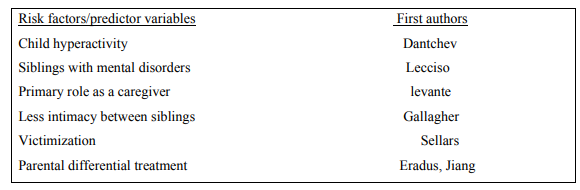
Table 3: Risk Factors/Predictor Variables of Siblings’ Relationships (and First Authors)
Methodological Limitations of this Literature
Several methodological limitations can be noted for this literature on sibling relationships. They include the sampling being limited to children/adolescents, the almost exclusive sampling of dyads that include one with a disability or a mental disorder, the selection of variables that is limited to those in an archival database and the results of the data analyses on sibling conflict being confounded by parental conflict.
In several of the studies, one sibling had a disability or a mental disorder. This resulted in the unaffected sibling often assuming a role model or a caregiving role. The caregiving role was sometimes viewed as a positive effect and sometimes as a negative effect. Typically, effects were measured on the younger sibling, the disadvantaged or the disfavored sibling. Surprisingly, only one study included a comparison group of “only child” participants. Understanding sibling effects would seem to require comparisons between children with siblings and only child children.
Several results interpreted as sibling conflict were confounded by parent – child conflict that was also experienced by the siblings. Sibling conflict effects were also often confounded by the siblings having no close friends.
Several samples were taken from longitudinal studies, for example, the Avon Longitudinal Study, the Wisconsin Longitudinal Study, the Millennium Cohort and the Puberty Cohort. This limited the selection of variables to those in the data sets like bullying and sexual abuse. Variables that would be considered relevant for sibling relationships like the positive variables of playing together, affection, support, and confiding, and negative variables like sibling rivalry and fighting were missing from this literature.
Despite these methodological limitations, this literature is informative. The limitations are suggestive of future research directions. They suggest sampling healthy dyads not only during childhood and adolescence but also throughout adulthood, as most siblings are still relating to each other during adulthood. Comparing children who have siblings with those who do not would also be informative. As already mentioned, studies including the more common positive as well as negative effects experienced by siblings would inform this literature. The current literature is limited but highly suggestive of future research on sibling relationships.
References
- Ruggiero, C. F., Moore, A. M., & Savage, J. S. (2024). Direct sibling influence on eating behavior in early childhood: Siblings as role models and caregivers. Academic pediatrics, 24(1), 119-123.
- Blazo, J. A., Smith, A. L., Whiteman, S. D., & Kashy, D. A. (2024). Sibling comparisons, sibling relationship quality, and perceived sport competence in young athletes. Psychology of Sport and Exercise, 72, 102613.
- Han, D., Thwaites, N. A., Olson, J., Rivera, K. M., Dmitrieva, J., & Doom, J. R. (2025). Social buffering by siblings in childhood and adolescence. Psychoneuroendocrinology, 107580.
- Masarik, A. S., & Rogers, C. R. (2024). Behavioral pathways from sibling relationships in adolescence to romantic partnerships in adulthood. Journal of Research on Adolescence, 34(4), 1276-1286.
- Kong, J., Moorman, S. M., Lee, G., & Engelman, M. (2025). Life course associations of sibling relationships and cognitive functioning in late adulthood. The Journals of Gerontology, Series B: Psychological Sciences and Social Sciences, 80(1), gbae191.
- Toseeb, U., Vincent, J., & Asbury, K. (2024). Genetic influences on sibling bullying and mental health difficulties. Journal of child psychology and psychiatry, 65(9), 1165-1174.
- Babchishin, K. M., Holmes, E. J., Banse, R., Huppertz, L., & Seto, M. C. (2024). Characteristics and risk factors for sibling incest. Plos one, 19(12), e0314550.
- Russell, D. H., Trew, S., Dickson, J., Hunt, G. R., & Higgins,D. J. (2025). The risk and protective factors, response to disclosure, and interventions for sibling sexual abuse: A systematic review. Child Abuse & Neglect, 162, 107136.
- Andersen, K., Rothausen, K. W., Håberg, S. E., Myrskylä, M., Ramlau-Hansen, C. H., & Gaml-Sørensen, A. (2024). Sibling relatedness and pubertal development in girls and boys: A population-based cohort study. Annals of Epidemiology, 98, 51-58.
- Dantchev, S., Wolke, D., & Zemp, M. (2024). Child hyperactivity, mother–child negativity, and sibling dyad negativity: A transactional family systems approach. Journal of Family Psychology, 38(1), 82.
- Lecciso, F., Martis, C., Del Prete, C. M., Martino, P., Primiceri, P., & Levante, A. (2025). Determinants of sibling relationships in the context of mental disorders. Plos one, 20(4), e0322359.
- Levante, A., Martis, C., Del Prete, C. M., Martino, P., Primiceri, P., & Lecciso, F. (2025). Siblings of persons with disabilities: A systematic integrative review of the empirical literature. Clinical child and family psychology review, 28(1), 209-253.
- Gallagher, A., Updegraff, K. A., Padilla, J., & McHale, S. M. (2024). Sibling relational aggression: Developmental change and associations with family relationships across adolescence. Journal of Family Psychology.
- Sellars, E., Oliver, B. R., & Bowes, L. (2024). Children’s resilience to sibling victimization: The role of family, peer, school, and neighborhood factors. Development and psychopathology, 36(4), 1973-1987.
- Eradus, M., Leijten, P., Melendez-Torres, G. J., Foo, X. Q., & Oliver, B. R. (2024). Parental differential warmth, hostility, and sibling differences in internalizing and externalizing behavior problems: A meta-analysis. Journal of Family Psychology, 38(3), 387.
- Jiang, Z., Yang, Y., & Chen, B. B. (2025). Parental Differential Treatment of Siblings and Child Psychopathology: A Network Meta-analysis. Clinical Child and Family Psychology Review, 1-18.