

Earth & Environmental Science Research & Reviews(EESRR)
ISSN: 2639-7455 | DOI: 10.33140/EESRR
Impact Factor: 1.6

Review Article - (2026) Volume 9, Issue 1
Role of Physicochemical and Spectroscopic Methods to Characterize the insitu Chemical Speciation of the Inorganic Contaminants for Remediation of Water Pollution, and Global Warming Through the Catalytic Oxidants and ‘Predictive Model of Chemical Reaction Kinetics (PM-CRK)’
Received Date: Mar 12, 2026 / Accepted Date: Apr 06, 2026 / Published Date: Apr 14, 2026
Copyright: ©2026 Virendra Goswami. This is an open-access article distributed under the terms of the Creative Commons Attribution License, which permits unrestricted use, distribution, and reproduction in any medium, provided the original author and source are credited.
Citation: Goswami, V. (2026). Role of Physicochemical and Spectroscopic Methods to Characterize the in-situ Chemical Speciation of the Inorganic Contaminants for Remediation of Water Pollution, and Global Warming Through the Catalytic Oxidants and
Abstract
In the present investigations the efforts are focused to develop physicochemical and spectroscopic methods to characterize the in-situ chemical speciation of the inorganic contaminants and develop Predictive Model of Chemical Reaction Kinetics (PM-CRK) for remediation of water pollution by catalytic oxidants. The Oxidation process would be employed to treat Groundwater contaminants by making use of the chemical oxidant s viz. hydrogen peroxide, persulfate, permanganate & ozone. These oxidants have been able to cause the rapid and complete chemical destruction of many toxic organic chemicals; other organics are amenable to partial degradation as an aid to subsequent bioremediation.
Water gets polluted due to toxins & toxic gases. There are generally four types of toxic entities: chemical, biological, physical and radiation. Chemical toxicants include inorganic substances such as, lead, mercury, hydrofluoric acid, and chlorine gas, and organic compounds such as methyl alcohol. Hence, the focus is to develop innovative methods to entrap toxins, by developing High Affinity Toxin Receptors (HART), converting GHG (Methane) to ethanol by catalytic processes and develop hybrid fuels like bioethanol and biodiesel and go for electricity from biomass. It’s presumed that catalytic oxides of first row transition metal oxides e.g. Cobalt oxide should optimize the process of subsurface remediation and above-ground water treatment systems depending on a variety of site-specific conditions e.g. reaction rate kinetics. Chemical oxidation be applied in subsurface systems and in above ground water treatment systems involving chemical oxidation regeneration of granular activated carbon (GAC). Also, to correlate Physicochemical properties of these catalytic oxides of first row transition metal oxides, to discuss strategies to control Global Warming and remediation of Water pollution resulting due to toxin, toxic gases, GHG (Green House Gases), in order to save marine life (under water). Next, to evaluate correlation of chemical oxidants with chemical species associated with soil, aquifer materials, and contaminants during water treatment processes in order to develop Correlational ‘Predictive Model of Chemical Reaction Kinetics (PM-CRK)’to investigate process fundamentals and assess contaminant transformation.
Keywords
High Affinity Toxin Receptors (HART), Granular Activated Carbon (GAC), Reaction Rate Kinetics, Catalytic Oxides, Global Warming, Water & Environmental Pollution, ‘Predictive Model of Chemical Reaction Kinetics (PMCRK)’
Description of Project
Introduction
When solutes are introduced into groundwater systems or into surface waters, complex physicochemical reactions occur between the dissolved solutes and native solid materials. Knowledge of these complex interfacial reactions is required to assess the impact of such inputs on water quality in aquatic and terrestrial ecosystems. Assessments of water quality and efforts to restore contaminated waters depend strongly on a fundamental understanding of geochemical processes involving reactions with mineral surfaces and substrates. Such processes include weathering reactions that contribute dissolved chemicals, sorption that removes aqueous species, and electron transfer mechanisms that establish redox conditions. Knowledge of the geochemical behaviour and cycling of major elements, trace elements, and nutrients in terrestrial ecosystems is necessary for understanding and predicting the consequences of deliberate or accidental anthropogenic additions of these substances to the environment.
Water gets polluted due to toxins & toxic gases. There are generally four types of toxic entities: chemical, biological, physical and radiation. To control marine-environment pollution, subsurface systems and in above ground water treatment systems.
Hence, efforts are to be focused to develop innovative methods to entrap toxins, Chemical toxicants include inorganic substances such as, lead, mercury, hydrofluoric acid, and chlorine gas, and organic compounds such as methyl alcohol, by developing High Affinity Toxin Receptors (HART) & convert GHG (Methane, CO2, ) to ethanol by catalytic processes and develop hybrid fuels like bio¬ethanol and bio-diesel and go for electricity from biomass.
Next, strategies be developed to control Water pollution resulting due to toxin, toxic gases, GHG (Green House Gases), by making use of Catalytic oxides & to control Global Warming and save marine life (Under Water) by inhibiting marine pollution though remediation of Water treatment process by making use of catalytic oxidants.
The oxidation process would be employed to treat Groundwater contaminants by making use of the chemical oxidant s viz. hydrogen peroxide, persulfate, permanganate & ozone. These oxidants have been able to cause the rapid and complete chemical destruction of many toxic organic chemicals; other organics are amenable to partial degradation as an aid to subsequent bioremediation.
In my view, the catalytic oxides of first row transition metal oxides e.g. Cobalt oxide should optimize the process of subsurface remediation and above-ground water treatment systems depending on a variety of site-specific conditions e.g. reaction rate kinetics. Also, to correlate Physicochemical properties of these catalytic oxidants involving chemical oxidation be applied in subsurface systems and in above ground water treatment systems involving chemical oxidation regeneration of granular activated carbon (GAC).
The new water filtration systems may help in remediation of Water & Environmental Pollution as well as scarce access to potable water in remote rural areas.
Past Research
Goswami VK et.al. found that Cobaltous Oxide is a good catalyst for oxidation reactions. The existence of two forms of cobaltous oxide possessing different physico-chemical properties have been reported. The form I, CoO(I) (prepared by heating cobalt metal in carbon dioxide at 1000deg.C) has a NaCl structure. The form II, CoO (II) (prepared by decomposing cobalt carbonate at 300deg.C in vacuum) has a NaCl structure with half of its (+)ve ion sites and half of its (-)ve ion sites vacant. The density measurements have shown that CoO (I) has a density of 6.4 gms / cm3 whereas, CoO (II) has a density of 4.8 ± 0.5 gms per cm3.
The same authors have also found that CoO (II) transforms noticeably to CoO (I) at about 300deg.C, giving CoO (I,II) – a mixture of form I and II. It remains to be investigated which of the two forms of cobaltous oxide is mainly responsible for the catalytic activity, through a study of the physical properties of the two forms and their catalytic activities.
HT; 29Apr’17 reported that the particles in the polluted air can travel from lungs into our blood stream resulting the increase of risk of heart attack or strokes since Nanoparticles in air pollution have been associated with cardiovascular disease leading to premature death. As per the State of Global Air 2017 Report, released in Boston on 14 Feb’17, as many as 2.54 lakhs death occurred in 2015 on account of exposure to ozone and its impact on chronic lung disease.
(Ref: Hindustan Times,14 Feb’17), Researchers in University of Washington ,USA & University of Edinburgh found that the pools underneath the glacier, Thwaites, which is on the edge of West Antarctica, Amundsen Sea are draining out at an unprecedented rate and emptying themselves resulting of global sea level rise as well as have an impact on local water supplies & give rise to Water Pollution as per my presumptions.
On 02 May 17(TOI), at British Columbia university Canada, Prof. Pierre Berube has developed a low maintenance water filtration system using the technology which combines microbes and gravity using ultra-filtration membranes, which is very fine screen that removes not just particulate matter but, also large molecules, e .g. disinfectants or herbicides, pesticides and contaminants from water e.g. microbial pathogens, viruses and bacteria
Research Methodology
To evaluate correlation of chemical oxidants with chemical species associatedwithsoil,aquifermaterials,andcontaminantsduringwater treatment processes in order to develop Correlational ‘Predictive Model of Chemical Reaction Kinetics (PM-CRK)’.
The aim of the research is to examine some of the solid-state work pertinent to catalysis on oxide and explore further the relationship between them. The emphasis in the introduction will therefore be laid on developments in our knowledge of the structure and properties of the solid state and on the background to the fields of chemisorption and catalysis.
The present investigations on the Study of the relationship between the physicochemical characterization and catalytic activity of catalysts having the same electronic configuration, such as CoO(I), CoO(II) and CoO(I,II);have been undertaken to find out which of the two structures 3d6 or 3d7 of the oxides is the more active configuration for catalytic reactions involving hydrogen and /or hydrocarbons. The oxide, prepared either by decomposing nitrates /oxalates or by heating the lower oxides in oxygen, were characterized by (I) X-ray diffraction pattern (II) differential thermal analysis (III) magnetic susceptibility measurements (IV) surface area determination and (V) chemical analysis.
The catalytic activity of the oxides, cobaltous oxides, i.e. CoO(I) and CoO(II) and the mixed form, CoO(I,II) were investigated through a study of the dehydrogenation of cyclohexane at initial cyclohexane pressure of 100 psi in the temperature range 120deg.C to 250deg.C. The experiments were carried out under static condition in a pressure vessel specially designed for the purpose. Hydrogenation of ethylene over CoO(I), CoO(II) and CoO (I,II) at selected temperature only has also been studied. The catalytic behaviors of the two forms of Cobaltous oxides have been examined in the light of their physical characteristics (as observed by differential thermal analysis and magnetic susceptibility measurements) and it has been suggested that factor other than 3d configuration need be considered in such correlative studies.
Method of Characterisation of the Catalysts
The oxides, prepared either by decomposing nitrates/oxalates or by heating the lower oxides in oxygen, using the apparatus designed by Dr. Virendra Goswami, at IIT Kharagpur and the individual oxides) were characterized by (i) X-ray diffraction analysis (ii) differential thermal analysis (iii) magnetic susceptibility measurement (iv) surface area determination; and (v) chemical analysis.
i. X-ray Diffraction: The X-ray diffraction pattern has been used to identify the crystalline nature and structure of the oxides by calculating the lattice parameter in some cases. Differential Thermal Analysis (DTA) Differential thermal analysis was carried out with the help of a manual unit.
ii. Differential Thermal Analysis (DTA): By using DTA, Goswami VK et.al found that CoO (II) transforms noticeably to CoO (I) at about 300deg.C, giving CoO (I,II) – a mixture of form I and II. Also, it was investigated which of the two forms of cobaltous oxide is mainly responsible for the catalytic activity, through a study of the physical properties of the two forms and their catalytic activities.
Experimental
CoO (II), CoO (I), CoO (I,II) have been prepared following the methods described by Ok and Mullen.(1) .In addition to this, CoO(I) and CoO(I,II) have also been prepared by a second method. The DTA measurements on CoO (II) in the temperature region 300deg – 850degK in vacuum and Ar. Atmosphere were done in sealed Pyrex glass ampule by using the conventional DTA apparatus.
Differential Thermal Analysis (DTA)
Prior to the measurement, CoO (II) was prepared was placed in one of the ampoules of the specially designed Sample -Holder and in the adjacent ampoule, the thermally inert reference substance (calcined -alumina) was placed. The ampoules were sealed in vacuum and mounted on the porcelain support. (Figure.1). In the case of other Cobalt Oxides, the samples were packed in one of the two holes of the nickel specimen holder, the other being filled with the reference substance. The system was calibrated with known substances. The sample-holder was positioned in the furnace and the rate of the heating was maintained constant at 10 + 1deg.C /min. The required atmosphere air/nitrogen/hydrogen) was maintained and the galvanometer reading noted down. The ‘thermogram’ has been plotted in the form of continuous curves correlating galvanometer deflection, which is a function of differential temperature of the furnace (T), represented as the abscissa, such that the exothermal peaks upwards with respect to the base line  T = 0.

Figure 1: DTA-Apparatus
Magnetic Susceptibility
Magnetic Susceptibility: was studied by the specially designed and fabricated Magnetic Balance at IIT Kharagpur. The specimen to be studied was tightly packed in a small round Pyrex glass ampoule, seated under vacuum and was suspended from one end of the balance beam by means of a tungsten fiber. The beam of the balance was then made horizontal by placing suitable counterpoising weight on the beam. The position of the phototubes were adjusted, so that the spot of light reflected from the mirror say M, illuminated the cathodes equally. Then the balance assembly wasenclosed in a brass case provided with a glass window and the entire system was evacuated to avoid convection disturbances.When the vacuum was of the order of 10-5 mm of mercury, initial deflection in the output galvanometer was noted, and on switching the magneticfield, the galvanometer spot was observed to move away. The current in the compensating coil was switched on and it was adjusted by using various controls until the galvanometer spot comes back to the original position. The potential drop across a standard 10 Ohm resistance was measured by means of micro potentiometer. The temperature was measured by.copper-constantan thermocouple kept very close to the sample.
Magnetic Susceptibility
The following expression was used for the calculation of mass susceptibility.


Figure 2: Specially Designed and Fabricated Magnetic Balance at IIT Kharagpur
Surface Area Measurement
Since heterogeneous catalysis is a surface phenomenon, the determination of catalystsurfacearea is necessary in thereproducible preparation and the systematic composition of Physicochemical properties and catalytic activity of catalysts. A high surface area is an important characteristic of all good catalysts. Brun Auer, Emmett and Teller (B.E.T.) method was used for the determination of surface area of oxide catalysts.
The Dehydrogenation of Cyclohexane
The experiments were done in a batch (static) system and the procedure as detailed blow as follow. The experiment set up along with High Pressure Reactors was designed and fabricated at IIT Kharagpur by the author (Shown Below in Figure.3).
i. Setting the Apparatus: At first all the high-pressure valves, reactor and pre- heater were thoroughly cleaned with water, followed by solvent oil and finally dried to remove the last traces of cleansing liquids.
ii. Charging of Reactor and Preheater: The powered catalyst was taken, weighed accurately and smeared on the perforated ring (catalyst-seat). A layer of fine glass wool was then placed over the catalyst seat in such a way as to cover the space between the catalyst and the orifice in the top nut of the reactor, when the bottom stud is fixed in its position. The reactor was next connected in turn to the precision gauge, pre-heater, vacuum line and product release assembly through the high pressure Amico four-way connector. The outlet of the reactor was closed.
iii. The Entry of Inert Gas: when necessary was regulated by spindle Valve. A known amount of purified cyclohexane was taken into the preheater by opening the stud of the reactant inlet at the top nut and finally tightening it well with an adjustable spanner. The amount of cyclohexane fed into the reactor could be known either from the amount of cyclohexane left over in the preheater or from the observed pressure, temperature and known volume (available space) of the reactor.
iv. Reaction Study: The whole unit was finally connected with a high vacuum system through spindle of the valve, keeping the other parts isolated by the spindle of valve and spindle of valve. The simultaneous evacuation and degassing of the catalyst were done at a temperature. higher than the maximum reaction temperature depending upon the nature of the catalyst. This operation was carried out for four-six hours, which was found sufficient for obtaining reproducible results.

Figure 3: Flow Diagram for Dehydrogenation of Cyclohexane, IIT Kharagpur C.f (Ph. D Thesis Submitted by Dr. Virendra Kumar Goswami (Author)
After evaluation, the high-pressure unit was disconnected from the vacuum unit by closing the spindle of valve. The reactor temperature was then brought down and maintained at the reaction temperature by regulating the voltage. The preheater was then heated so that cyclohexane (in vapor form) may be taken into the rector at reaction temperature. When the requisite pressure of cyclohexane (about 300 psi) developed in the pre-heater & was opened and cyclohexane vapours were let into the reactor.
The pressure of the cyclohexane was adjusted by the spindle of valve. The connecting tubes were heated electrically by using a heating tube in order to avoid any condensation cyclohexane vapor. After attainment of the desired initial pressure (100 psi) in the rector system, the spindle of valve was closed to disconnect the pre-heater. At this stage, all the high-pressure valves closed, and the reactor system was an isolated system. The course of the reaction was followed by noting the change in pressure (P) at regular interval of time and analysing the product in vapor phase chromatograph (VPC). The pressure change (P) was noted by means of precision pressure gauge. It was confirmed experimentally during blank runs that the reaction and the properties of the catalyst used were unaffected by glass wool.
v. Collection of the Product: The product was released at desired intervals (residence period) through the outlet and collected in the spiral condensers immersed in ice-bath. The gaseous product incondensable in the ice-bath (viz. hydrogen gas), was collected in the gas pipette. Finally, the spindle valve was opened very slowly, and pure argon gas was passed into the system to transfer the remaining product from the reactor system to the spiral condensers. This flushing of the unit was carried out for five to ten minutes. The gas pipette was disconnected during the flushing operation.
vi. Analysis of the Product
• Gas Analysis: Gaseous products whenever collected were analysed by modified Fisher gas analysis apparatus fitted with both slow and high combustion units. Only hydrogen could be detected.
• Analysis of the Condensate: The condensed products in the spiral condenser were analysed by vapor phase chromatograph (Perkin Elmer Model 154) by using the requisite columns. No product other than benzene and unreacted cyclohexane could be detected. Generally, the amount of benzene was found to be approximately one third of the gaseous product.
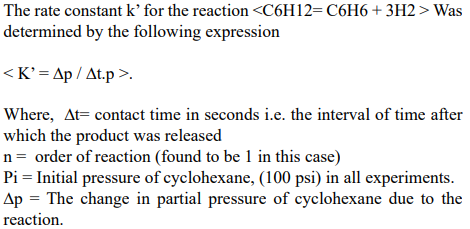
vii. Calculation of the Rate Constant
Results & Discussion
The results of magnetic susceptibility measurement and DTA are shown in figure 1 & 4 respectively.
The magnetic susceptibility data of the two forms of CoO and the mixture show that CoO(II) has got the highest magnetic susceptibility value at room temperature (5231 x 106 gms/mole), in comparison to the room temperature susceptibility values of CoO(I) (4684 x 106 gms per mole) and CoO(I,II) (4762 x 106 gms/mole). This arises from the low density of CoO(II) compared to CoO(I) and CoO(I,II). Along with the temperature dependence of magnetic susceptibility of CoO(I,II), CoO(I) and CoO(II), the magnetic susceptibility data of La Blanche Tais has also been shown in figure 1. The sample-to-sample variation in the region 300deg – 600deg K indicates that the magnetic susceptibility depends profoundly on the sample preparation. The plot of Xm-1 vs T in CoO(I,II) follows a linear relationship whereas CoO(I) shows a slight curvature; increasing in the case of CoO(II). Further, in CoO(II) the susceptibility shows an anomalous behavior in the temperature region 550deg – 600degK ;indicating that in this temperature range CoO(II) slowly passes into CoO(I). Beyond the transition region all the samples show a similar behavior. This result is in conformity with the Mossbauer data. The transition observed in CoO(II) is not of magnetic origin since the sample is paramagnetic both below and above the transition temperature. But the large density difference between the two forms suggests that the transition is probably of first order. The evaluation of exchange parameter appears difficult due to the magnetic anomaly in the region 300deg – 800 deg.K. The DTA measurements on CoO(II) show that the endothermic pattern of thermograph changes at about 550 ± 50 deg K ;indicating a change in the form of CoO. Such a change might be due to contraction of the lattice. On the basis of the observed differences in the physical properties of the two specimens of CoO, the catalytic activity has been investigated by Goswami VK et.al. Furthermore, D.T.A and temperature dependence of magnetic susceptibility of CoO(II) arises from a first order phase transition. The magnetic data of CoO(I) and CoO(II) have been correlated with a two sublattice model and exchange parameters evaluated.

Figure 4: Differential Thermal Analysis (DTA) Results
Scope
The study of global warming control may accelerate the progress in global environmental research with the development of new technology to control the air pollution as well as to check of sea level rise due to global warming providing the pollution free atmosphere, countering climate and its impacts in India, as well as on the earth with healthy living for human beings [1-14].
References
- Goswami, VK: Role of Physicochemical and spectroscopic methods to characterize the in-situ chemical speciation of the inorganic contaminants for Remediation of Water Pollution, and Global Warming through the Catalytic Oxidants and ‘Predictive Model of Chemical Reaction Kinetics (PM-CRK)’
- <01Mar’24 Accepted for Fireside Chat speaker in the 70th EPOC Anniversary at Timberline Lodge in Mt. Hood, Oregon, September 11-14, 2024.>
- <03Jan’24 Submitted for Academia Engineering (ISSN: 2994-7065) Special Issue on the topic "Chemical Processes and Breakthroughs in Advanced Oxidation Techniques for Water and Wastewater Treatment".>
- Goswami. (2018). Pathways to Control Health Diseases through Remediation of Environmental Pollution. J Adv Res Med Sci Tech, 5(3&4), 1-5.
- Goswami. VK: ‘Development of Computational Correlation Predicting (CCPM)for detoxification of GHS through physicochemical properties of solid catalysts.
- [Proc. of Int. Natl. Workshop on CDPW, Toulouse, 18th-21st October 2016]
- Goswami V.K: The physicochemical characteristics of the chemical substances to Control the GW by the development of physicochemical process by selective catalyst-beds’. [Presented at ESF-FMSH Entre-Sciences Conf. in partnership with UPCAM; Global Change Research II: Environmental Crisis, Energy Issues and Global Regulation Policies: 11-16 Jun’10 IGESA, Fran ce.]
- Goswami V. K: Control of global warming by detoxification of chemical substances and Green House Gases by catalytic process. [ ESF Conf; Innsbruck) Austria; June.
- Goswami, V. K. (2007). ‘Magnetic and Thermodynamic properties of Co0(I), Co0(II), CoO (I,II)’, J. of Hydrogen Materials Sc. & Chem. of Carbon Nanomaterials, ICHM-2005, Crimea, Ukraine 563-564.
- Goswami VK: Correlation of physical characteristics and catalytic activity of solid catalysts: XX International Symposium on Macrocyclic Chemistry, Jerusalem, 1999.
- Goswami VK: (Ph. D Thesis Submitted by Dr. Virendra Kumar Goswami (Author), IIT Kharagpur.
- Okand, M. (1968). The Phy.Rev.,168(2), 550-552.
- Subrahmanyam. (1966). Indian J. of Phys., XL, 9, 527.
- La Blanchetais, CH (1951). Contribution to the study of antiferromagnetism. Thermomagnetic study of cobalt and nickel protoxides. Journal de Physique et de la Radium , 12 (8),765-771.