

Archives of Case Reports: Open Access(ACROA)
ISSN: 3065-7598 | DOI: 10.33140/ACROA


Review Article - (2024) Volume 1, Issue 1
Revisioning the Soul of Medical Practice
Received Date: Jun 10, 2024 / Accepted Date: Jul 23, 2024 / Published Date: Jul 30, 2024
Copyright: ©Â©2024 Julian Ungar-Sargon. This is an open-access article distributed under the terms of the Creative Commons Attribution License, which permits unrestricted use, distribution, and reproduction in any medium, provided the original author and source are credited.
Citation: Ungar-Sargon, J. (2024). Revisioning the Soul of Medical Practice. Arch of case Rep: Open, 1(1), 01-07.
Abstract
One of medicine’s great traditions is humanistic care of those who are suffering [1-6]. Deep-seated personal commitment to incorporate human values like caring, compassion, and respect into every health care relationship defines medical humanism and is imbedded within the fabric of medical professionalism [7-12].
The Problem of Depersonalization the Centrality of Molecular Biology, and the Practice of Mechanistic Medicine
One of medicine’s great traditions is humanistic care of those who are suffering [1-6]. Deep-seated personal commitment to incorporate human values like caring, compassion, and respect into every health care relationship defines medical humanism and is imbedded within the fabric of medical professionalism [7-12].
Yet, while remarkable technological advances have influenced what we can do to patients, much of what patients want and expect from their doctors remains within the humanistic realm of being with patients when they are suffering. This includes listening, helping with difficult decisions, and navigating their illness trajectories [13].
Healthcare has evolved rapidly, resulting in significant changes in organizational and practice environments. Economic forces and commercial interests now drive the healthcare industry to focus on clinical productivity, efficiency, performance metrics and regulations, pushing physicians to see higher volumes of patients with less time for each [14,15]. Time spent in meaningful interactions with patients has diminished, compromising the traditional patient–doctor relationship. Over half of US physicians now experience professional burnout.
Healthcare professionals’ stress and burnout inhibit forming therapeutic relationships and detract from the patient experience and quality of care.20 Incongruence between personal and health system values and work overload contribute significantly to physician burnout, whereas value congruence significantly predicts professional efficacy in addition to well-being of physicians. Medical educators’ efforts to counter the decline in humanistic care have largely focused on cultivating humanistic attributes in individual physicians [16,17].
Such efforts have included curricular and programmatic interventions, such as courses teaching ethics and professionalism, mindfulness, and wellbeing and group support. At the same time, it is clear that organizational factors play a central role in physician stress and the development of burnout. Organizational factors influence how individuals act, their responses to new situations, what they pay attention to, and significantly impact patient safety and quality of care.
The lifeless soulless practice of medicine in its corporate iteration has damaged the doctor-patient relationship beyond repair. What is needed is a new vision for healthcare that starts and ends with the focal point where the healthcare practitioner meets the patient. It is in this sacred space that the work of healing must tale place. All other considerations, though they may be in the best interests of the patient, all other factors such as cost benefit analyses, insurance constraints, governmental guidelines, need for machines to test this or that organ, are secondary to the primary interface.
In this space there needs to be a sense of mutual human contact, one that nourishes the soul and provides care and compassion. The caregiver needs to open himself or herself to becoming vulnerable while listening to the suffering and anguish of the patient.
This requires spiritual retooling so that the caregiver learns to process and manage the weight of such emotional baggage. The patient will only open up the deeper aspects of their pain and anguish, the deeper wounds if there is a sacred and safe space where to be, and this place is the very soul of the practitioner. This sacred bond develops over time and with the right conditions, until now considered intangible and not measurable in the current systems of managing time and billable entities. The entire team supporting the practitioner must also be sensitive and buy in to this new vision. This includes the front desk clerk to the EEG or MRI technician.
The Physical Plant of The Practice: A Humane Scenario
Waiting & Greeting Area
Upon arrival at the center one is struck by nature, plant life, an aquarium, indoor rubber plants, flowers, and a sense of peace. There is a brook or waterfall greeting you as you sit down in the waiting area. There is no desk separating the intake secretary, rather small pods where the patient meets the intake secretary. The secretary is dressed in a way that does not intimidate the patient but imparts a sense of security as she or he knows the fear that accompanies patients prior to seeing the doctor.
Quiet music is playing that encourages introspection and a sense of harmony with the plant life around. Patients converse with each other openly without any sense of intimidation, and refreshments are served as they prepare themselves to meet staff.
Initial Intake Area
In this space the triage aspects of care occur. The patient is put at ease by the non-intrusive discussion with the caregiver easing them into disclosing their main concerns. The focus is non-confrontational and soothing all the while attempting to parse out the issue and focus of the visit.
Now the first interface with machines (vital signs, BP, oxygen meters, etc etc, takes place. How we manage this interface with machines is a critical divergence from current interactions.
The machine/technician/patient interface needs to be suffused with the same dynamic of inner compassion and kindness throughout the procedure.
Doctor Interaction
Here is the critical interface between two human souls, willing to share their mutual vulnerability in an atmosphere os compassion and kindness. The inner work takes place simultaneously as the outer diagnostic and therapeutic network, so that embedded in a matrix of soul care the outer technical aspects of medications, testing, interventions can seamlessly flow.

Background Theory Adapted from Other Disciplines
In order to access a new vision, we had to go beyond the medical humanities to visionaries in other fields and borrow ideas and adapt them to this new approach. Erich Fromm represents one such voice. A critic of modernity yet fully embracing the humanistic perspective, he saw the dehumanizing force of capitalist enterprise on social institutions.
Eric Fromm
• Erich Fromm (1900-1980) was a German-American psychoanalyst associated with the Frankfurt School, who emphasized culture’s role in developing personality. He advocated psychoanalysis as a tool for curing cultural problems and thus reducing mental illness.
• Fromm believed that character in humans evolved as a way for people to meet their needs. Unlike Freud, he did not believe that character was fixed.
• Fromm outlined five essential human needs: relatedness, rootedness, transcendence, sense of identity, and frame of orientation. The absence of these, according to Fromm, would cause mental and social problems such as alienation.
• Fromm envisioned ideal versions of society and religion that emphasized freedom and meeting human needs. In doing so, he became one of the founders of humanistic socialism.
The Sane Society was intended to be a continuation of his first work, Escape from Freedom, published 15 years earlier (Tillich, 1955), expanding between his prior psycho and socio-analysis to develop an image of a future society where the health of the whole supports the health of every individual.
In the Sane Society, Fromm describes the “alienation” of man in mid-twentieth century Democracy (Fromm, 1955). Fromm considered this alienation a necessity of human development and, thus, something which can be overcome in the course of human development. Fromm’s sane society conquers alienation (Tillich, 1955).
Ultimately, Fromm branded Western capitalism and Soviet communism as dehumanizing and causal in creating alienation. Ultimately, The Sane Society established Fromm as a founder of socialist humanism (Fromm, 2017).
Fromm’s Five Human Needs
Fromm postulated that there are five fundamental human needs: relatedness, rootedness, transcendence, sense of identity, and frame of orientation (Das, 1993).
Relatedness
Fromm discussed the problem of alienation in contemporary society heavily. He believed that alienation was the problem that resulted when people’s need for relatedness was not met. This need was so important to form that he considered alienation to be the “central problem of mental health.” (Fromm, 2017). Fromm expanded on Marx’s idea that alienation was undesirable for people to talk about. He believed that alienation led to boredom, which Fromm regarded as an enormous psychological, and thus social, problem.
To Fromm, relatedness was the source of psychological energy, joy, well-being, and identity, and its loss dissipated this energy away. To Fromm, it’s a lack of active relatedness to the world and our own feelings that result from social circumstances that prevent people from developing genuine, loving, productive relationships.
Rootedness and Unity
Fromm considered the need for rootedness and unity to be variations on the need for relatedness. He believed that people seek unity because of an existential split between the human and nonhuman world.
Fromm believed that this condition would be unbearable” if humans would not establish a sense of unity within themselves and with the natural and human world outside. As with relatedness, Fromm believed that people could develop relatedness through developing ties with others. This helps people to overcome their separateness from others in their society and feel less alone.
Excitement and Stimulation
Fromm argued that people have an inherent need for excitement and stimulation and display a tendency to seek pleasure and be actively interested in people, things, and ideas (Fromm, 2017). Citing Karl Bühler, Fromm believed that people find inherent pleasure in being functional (Funktionslust) and doing activities.
Effectiveness
This activity, however, does not alone satisfy human needs, in Fromm’s view. Instead, Fromm believed that people need to do creative work that meaningfully affects the world. He believed that people have a need to affect something because this effect asserts that someone is not impotent but alive and functioning human (Fromm, 2000).
To illustrate the need for effectiveness, Fromm borrowed Marx’s example of the medieval artisan. The artisan., Fromm believed, was a productive and original individual who enjoyed the process of work (Fromm, 2017). The physical result of artisanship responded to the deep need not just for stimulation or activity itself but for effectiveness.
Sense of Identity
Fromm’s sense of identity is also derivative of and dependent upon the core needs for relatedness and effectance. Fromm believed that being in a strange and overwhelming world, people can feel incompetent. To compensate for the real possibility of feeling passive — and losing one’s sense of will — people must acquire a sense of being able to do something. This ability to be effective forms someone’s identity (Fromm, 2000).
Frame of Orientation
Another need related to a sense of identity was for a frame of orientation. This frame of orientation takes the form, according to Fromm, of both a frame of reference and an object of devotion around which someone can organize and direct their actions. This frame of reference can provide a coherent map of the world, providing people with an understanding of the world and their place in it (Fromm, 2017).
Transcendence
Finally, Fromm emphasized the need for transcendence. This need for transcendence, traditionally used in theology, describes people’s tendency to transcend their self-centered and isolated position in the world to one of “being related to others, of openness to the world, escaping the hell of self-centeredness and hence self-imprisonment” (Fromm, 2000). Fromm believed that religion could serve this need.
Analysis of Religion and its Relation to Human Development
Fromm believed that life was a struggle between three fundamental dichotomies: freedom and determinism, separateness and unity, and knowledge and ignorance. Fromm was notable for his neo-Freudian critique of religion. He believed that religion is an escape from responsibility - and that reason is always better than religion.
While priests and psychoanalysts both deal with the soul, Fromm asserted, only the psychoanalyst makes the individual the responsible authority (Tillich, 1955). Yet, Fromm also believed that everyone has a religious need. People, according to Fromm, need meaning in life and a deeper way of orienting to the world than reason alone can provide. Unlike Freud, Fromm believed that religion was inevitable.
As a result, Fromm sought to distinguish between good and bad religion. He considered bad, or “authoritarian religion,” to be that where people are made inappropriately subservient to a higher power and are therefore forced to sacrifice their integrity (Tillich, 1955). Meanwhile, what Fromm calls “humanistic religion” centers on the strength of human beings over their powerlessness and assumes that what fulfills individuals is good. The goal of humanistic religion, according to Fromm, was self-realization, not obedience to authority.
Christopher Alexander
Christopher Alexander has applied his inner vision of spirituality to architecture. In an essay written for the Templeton Prize he outlines the following 7 items he felt needed to applied to the conventional design of buildings.
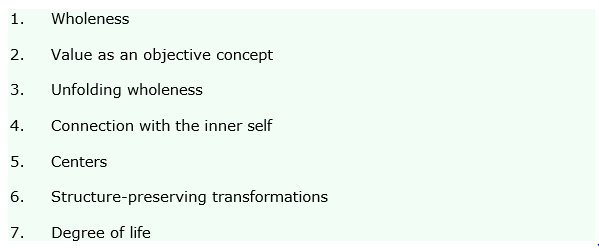
These concepts, and a few others, were introduced, by me, because I found them to be essential to the task of thinking clearly about the life of buildings. Yet they were almost not definable within the terms of reference of then-contemporary scientific thinking. This was true to such a degree, that even raising these topics as matters for discussion and clear thinking in professional architectural circles, caused raised eyebrows, obstructive discussion, and certainly little sincere effort to get to the bottom of the issues needing discussion [18].
All this, the experiments, the vision, and the consequential impact on planning and architecture, seem to have a unique ability to point to the reality of God. In theory, other disciplines like ethics, might seem to have more claim to lead to a knowledge of God. But the tangible substance of architecture, and the fact that in a successful architecture every tiny piece is (by definition) suffused with God, either more or less: this gives the concept of God a meaning, essentially translated from the beauty of what may be seen in such a place, which shows us God made manifest in a way that has rarely before been claimed, or seen, or attempted.
Even more so does this apply to the caring profession where beauty compassion and kindness and God like qualities are absent. Due to the same curse of modernity where mind and soul are divorced from body and machine, the exacerbation of individual alienation is actually exacerbated when entering systems like hospitals and clinics.
Nikos A. Salingaros, an early collaborator with Alexander described the alienation as follows [19].
“It occurred at the beginning of the 20th Century, in a deliberate break with the past, breaking away from our own nature.
Mechanization following violent social revolution required that we disown our biological nature, so the buildings of the future were meant for machines, not humans. Once the Second World War ended, the industries producing glass, steel, and cars threw their enormous weight behind this new vision of the world. Our society inherited and continues to abide by that worldview.” We in medicine need a new language of healing that respects the body and soul and integrates the two without delegitimizing the therapies, drugs and machines (medical devices and computers) that have assisted and advanced medical cures for the body.
The challenge is to mediate and integrate these two systems or “actor networks” under a new matrix that respects both the inner workings of the soul as well as the objective evidentiary aspects of clinic science.
Doug Lea applied these principles to software engineering and programs [20].
“Even though exemplified with architectural artifacts, Alexander’s concerns and methods apply equally well to software systems, subsystems, objects, etc. While there are many obvious differences between houses and software, most are matters of degree at this level of discussion. Consider, for example:
• Software entities engage in greater dynamic interaction (e.g., send messages to each other).
• Sometimes, describing software is the same as constructing it (as in programming).
• More of a software design is hidden from its users.
• Software generally has many fewer physical constraints.
• Some software requirements are allegedly more explicit and precise than ``build a house here’’.

The recipe for developing patterns resist formulas and the classic blueprint drawings divorced from construction itself.
The resulting developing patterns from an organic based model include:
Collective Development
Development is a social process. Participation from all levels (users, policy-makers, etc.) is required for decisions affecting multiple parts or users, as well as those concerning future growth and evolution. Rather than a plan, a group adopts a (stateful) process that balances collective and individual needs and preserves the rationale for particular decisions.
Participatory Design
Users can help design things that they really need and want, that are better adapted to their surroundings, and that are more aesthetically pleasing. Even if the design participants are not the permanent, ultimate users, participation by someone impacted by the artifact is better than the alternative. Architects may reject user requests only when their knowledge of local constraints is demonstrably greater.
Responsibility
Architects hold financial and legal charge for the consequences of their activities, and control corresponding cash flow. This provides both authority and responsibility for adaptation across development.
Decentralization
Larger efforts can be subdivided into expanding centers or domains, that increasingly influence one another in the course of growth. Localized experimentation, discovery, and change are intrinsic to such adaptation. This includes situations in which conditions change and designs evolve. The diagnosis and local repair of problems with existing parts are part of any design effort.
Integration of Roles
Designers operate at several levels. Primary roles should be assigned with respect to problem task or domain, not phase or level. Architects must sometimes be builders, and vice versa. They cannot otherwise get things right. Intimacy with all aspects of an effort allows the builder-architect to firsthand discover constraints, needs and desires.
Integration of Activities
Design is interwoven with synthesis in a mainly bottom-up fashion. Construction proceeds in an order governed by pattern interdependencies, the continuous analysis and repair of failures, and commitment to detail, variety, experimentation, and wholeness. Concurrent development of mostly-independent parts allows construction to branch out from multiple centers, ultimately ``stiffening'' into final form.
Stepwise Construction
Artifacts are constructed one pattern at a time, each of which results in a complete, recognizable form adapted to other already-constructed artifacts and partially committed plans. Efforts are focused upon operations, not components. Each operation is complete in itself. Creativity and accomplishment are maintained at all levels of this process.

Eishin Highschool Campus, Japan
Nikolaus H. Philipsen writes [21].
Alexander was postulating that for hundreds of years (maybe since Newton) humans had their cosmology wrong by seeing the cosmos as a machine and the human outside as an observer. Today's physicists would agree. Century old assumptions of physics, biology and about fundamental patterns have been proven wrong and as too mechanistic. Views back into the depth of the universe revealing its early beginnings or by peering into microscopes showing the inside of a cell and the entire world of quantum space have upended the cosmology of order with much uncertainty.
Architecture and construction seemed unaffected except by the upheaval except for a chaos of styles, somewhere between Palladio Mies van der Rohe and Peter Eisenmann, Bulding production remains strangely archaic. The climate challenge highlights the urgent need for change in the way how buildings are conceived, designed, built and operated. No longer can it be first about "looks", the "built environment" simply must perform better, become more affordable and much less impactful on the environment. Alexander stands firmly on all sides of these issues, insisting on an order that may not exist, at the same time referring to the complexities that Newtonian cosmology missed.
Alexander assumes that some geometrical necessity for structural coherence is built into the DNA of human nature and is complemented by an aesthetic arising from what is biologically “useful.” He spent decades discovering what those rules could be and then derived a set of 15 properties that all structures that we perceive to have “life” possess.
Levels of scale
• Strong centers
• Thick boundaries
• Alternating repetition
• Positive space
• Good shape
• Local symmetries
• Deep interlock and ambiguity
• Contrast
• Gradients
• Roughness
• Echoes
• The void
• Simplicity and inner calm
• Not-separateness
Alexander assumes that humans are genetically coded to perceive this coherence subconsciously and that they are deeply affected by it, whether they know it or not. Conversely, humans also notice incoherence, i.e. when one or several of the fifteen properties are absent. That would disturb, alarm, and excite humans, which he assumed to be unhealthy in the long term. Alexander really became a cultural pessimist, decrying aggression, depression and ugliness everywhere, convinced that architects too are at fault, because of their wish to draw attention to their designs instead of making people feel good.
Connecting the Self to the Physical World [22].
Creating living architecture-in the sense of directly experienced visceral beauty and emotional nourishment—is a process of connecting with our inner self. In biology, connectedness is an imperative for life; here, we seek to link ourselves to a piece of the physical world. Alexander uses philosophical and poetic language to explain this process of discovering the designer’s “self” in whatever they are trying to make. He refers to establishing as deep and intuitive a connection to the emergent design and its physical context as possible. Before any design can be conceived as visual form, or even in order to consider its practical implications, Alexander looks for a vague but strongly-perceived emotional quality that will connect his own self with whatever he’s making.
He delays making procedural decisions until he has established some deeply felt connection with the amorphous virtual object. He then uses this felt sense of connection to guide the creative process. This very personal emotional link is essential because it helps designers discern among the overwhelming range of possibilities present at each step of the development cycle. Lacking such a visceral connection leads the design process astray, however. When designers have no aid to guide them in taking sequential design decisions, they default to a facile, one-step standard—copy from a pre-existing vocabulary of forms.
Those ready-made solutions can range from barely adequate to totally inappropriate; they can never truly adapt to the specific requirements of the current problem. But that’s what has been happening for the past century! A generic design process has no step-wise selection, thus automatically ruling out any adaptation. It does not bring users any closer to connecting emotionally to the finished result. This revolution in design is based on a deep sense of spirituality.
In the Nature of Order, Alexander advances the thesis that the geometry of the environment influences our life either negatively or positively. Whenever spaces and surfaces possess the correct affordances, then we perform all of life’s activities fluently without noticing the environment at all. Nevertheless, those actions are enabled because—and only when—we connect to surrounding details and dimensions, which boost our physiology and thought. This process is unconscious. If, by contrast, we find ourselves in a psychologically hostile environment, that impacts our actions and we have to force ourselves to accomplish even the most basic everyday functions under stressful conditions.
Environments in which we feel anxiety or insecurity due to their geometry will prevent psychological coexistence. Those places limit our life by hindering our freedom to live to our fullest extent. Factors that prevent interaction define anti-affordances—both physiological and psychological—perceived unconsciously.
1. Beauty as a Shared Experience: Alexander teaches us how to search for beauty, identify it, create it, and savor it. He believes that beauty is not idiosyncratic but something we all share within ourselves. It intimately connects us to the beauty of our world and the universe.
2. The Sacredness of the Physical World: Alexander’s work suggests that there is a necessary connection between God and architecture.
By paying attention to the Earth, its land, rocks, trees, buildings, and all living creatures, we can recognize the sacredness of the physical world. This recognition becomes a path toward understanding the existence of God as an essential part of the universe’s reality.
3. Building Beauty Program: Alexander’s legacy extends to the Building Beauty Program in Sorrento, Italy. This program aims to connect students to universal truths of creation, emphasizing humanity in design. It offers an academic crystallization of Alexander’s theory and practice, focusing on making beauty a central aesthetic measure and method [01-06].
In summary, Christopher Alexander’s philosophy invites us to explore beauty, connect with our inner selves, and recognize the sacredness of the physical world through architecture and design.
Applying These Principles to Revisioning Healthcare
In a STUDY OF NURSING PERSONNEL and ALIENATION FROM WORK LEONARD I. PEARLIN found that Alienation, defined as subjectively experienced powerlessness to control one's own work activities intensified where authority relations are such as to limit the reciprocal influence of subordinates [23].
This is reflected in situations where there is great positional disparity between superordinates and their subjects, where authority is exercised in a peremptory fashion and where authority figures are physically inaccessible. Career experiences within the hospital opportunity structure are also related to alienation; limited achievement and dissatisfaction with extrinsic work rewards are alienating conditions. Finally, personnel working in isolation and without outside social ties to fellow workers are more subject to intense alienation.
Both Christopher and Fromm forms the theoretical basis for a newer vision of society where beauty compassion kindness are the bedrock for relationships and where people are not commodities but work together in a spiritual venture to help other people. The challenge becomes how to integrate this at all levels of an organizational structure, such as a clinic for instance, from the moment a patient enters through to the billing and collections.
References
- Peabody, F. W. (1927). The care of the patient. Journal of the American Medical Association, 88(12), 877-882.
- Arnold, P. (2024). Gold Foundation.
- Weissmann, P. F., Branch, W. T., Gracey, C. F., Haidet, P., & Frankel, R. M. (2006). Role modeling humanistic behavior: learning bedside manner from the experts. Academic Medicine, 81(7), 661-667.
- Chou, C. M., Kellom, K., & Shea, J. A. (2014). Attitudes and habits of highly humanistic physicians. Academic medicine, 89(9), 1252-1258.
- Wright, S. M., & Carrese, J. A. (2001). Which values do attending physicians try to pass on to house officers?. Medical Education, 35(10), 941-945.
- Puchalski, C. M., Blatt, B., Kogan, M., & Butler, A. (2014). Spirituality and health: the development of a field. Academic medicine, 89(1), 10-16.
- Miller, S. Z., & Schmidt, H. J. (1999). The habit of humanism: a framework for making humanistic care a reflexive clinical skill. Academic Medicine, 74(7), 800-3.
- Pelligrino, E. (1979). Humanism and the Physician. Knoxville: University of Tennessee Press.
- Little, J. M. (2002). Humanistic medicine or values-based medicine… what’s in a name?. Medical journal of Australia, 177(6), 319-321.
- Cohen, J. J. (2007). Linking professionalism to humanism: What it means, why it matters. Academic Medicine, 82(11), 1029-1032.
- Gracey, C. F., Haidet, P., Branch, W. T., Weissmann, P., & Kern,D. E., et al. (2005). Precepting humanism: strategies for fostering the human dimensions of care in ambulatory settings. Academic Medicine, 80(1), 21-28.
- Rider, E. A., Kurtz, S., Slade, D., Longmaid III, H. E., & Ho, M. J., et al. (2014). The International Charter for Human Values in Healthcare: an interprofessional global collaboration to enhance values and communication in healthcare. Patient education and counseling, 96(3), 273-280.
- Rider, E. A., Gilligan, M. C., Osterberg, L. G., Litzelman, D. K., & Plews-Ogan, M., et al. (2018). Healthcare at the crossroads: the need to shape an organizational culture of humanistic teaching and practice. Journal of general internal medicine, 33, 1092-1099.
- Dugdale, D. C., Epstein, R., & Pantilat, S. Z. (1999). Time and the patient–physician relationship. Journal of general internal medicine, 14(Suppl 1), S34.
- Sinsky, C., Colligan, L., Li, L., Prgomet, M., & Reynolds, S., et al. (2016). Allocation of physician time in ambulatory practice: a time and motion study in 4 specialties. Annals of internal medicine, 165(11), 753-760.
- Leiter, M. P., Frank, E., & Matheson, T. J. (2009). Demands, values, and burnout: relevance for physicians. Canadian Family Physician, 55(12), 1224-1225.
- Branch Jr, W. T., Kern, D., Haidet, P., Weissmann, P., & Gracey,C. F., et al. (2001). Teaching the human dimensions of care in clinical settings. Jama, 286(9), 1067-1074.
- Christopher, A. (2019). The Long Path that Leads from the Making of Our World to God.
- Salingaros, N. A. (2017). Calling for an Architecture That Connects Us to Our Bodies.
- Christopher, A. (1997). An Introduction for Object-Oriented Designers.
- Christopher, A. (1961). Christopher Alexander’s Quest for Eternal Truth and Beauty in Architecture: A Fools Errand?.
- Friedman, K., Lou, Y., & Ma, J. (2015). Shè Jì: The Journal of Design, Economics, and Innovation. She Ji: The Journal of Design, Economics, and Innovation, 1(1), 1-4.
- Pearlin, L. I. (1962). Alienation from work: A study of nursing personnel. American Sociological Review, 314-326.