

Current Trends in Mass Communication(CTMC)
ISSN: 2993-8678 | DOI: 10.33140/CTMC



Review Article - (2025) Volume 4, Issue 1
Research on the Possibility of Using Blockchain Technology for Number Portability Databases
Received Date: Aug 22, 2024 / Accepted Date: Sep 27, 2024 / Published Date: Feb 12, 2025
Copyright: ©©2025 Oleg Khovayko. This is an open-access article distributed under the terms of the Creative Commons Attribution License, which permits unrestricted use, distribution, and reproduction in any medium, provided the original author and source are credited.
Citation: Khovayko, O. (2025). Research on the Possibility of Using Blockchain Technology for Number Portability Databases. Curr Trends Mass Comm, 4(1), 01-05.
Abstract
Number Portability Databases (NPDB) play a pivotal role in modern telecommunications by facilitating the seamless transfer of phone numbers between service providers. However, traditional NPDB systems face significant challenges, including centralization, high costs, and security vulnerabilities. This paper proposes a novel approach leveraging blockchain technology through the ENUMER system. ENUMER, designed initially to enhance ENUM operations, demonstrates a unique suitability for NPDB tasks due to its decentralized architecture, enhanced security, and cost efficiency. Our study involved testing ENUMER on standard hardware to ensure results stem from architectural advantages rather than high-performance equipment. The findings reveal sub-millisecond retrieval times and rapid record updates, showcasing ENUMER’s potential to outperform traditional NPDB systems. Although direct comparison data from existing NPDBs is scarce, our results suggest that ENUMER can serve as both an immediate solution and a foundation for future NPDB developments. For example, integrating public key infrastructure for caller ID verification could further enhance its functionality. This research highlights ENUMER’s capability to address current NPDB limitations and offers a promising direction for future improvements in telecom infrastructure.
Keywords
Blockchain, Decentralized, ENUM, LNP, NPDB
Introduction
Local Number Portability (LNP) is a critical component of modern telecommunications systems, ensuring that subscribers can retain their numbers when changing operators. This process is managed through number portability databases (NPDB), which are currently centralized systems. These systems face a number of challenges, including high operational costs, vulnerability to cyberattacks, and a single point of failure. This paper explores the possibility of using blockchain technology to build a decentralized NPDB using the ENUMER system as a model solution.
Current State of NPDB
Number Portability Databases (NPDB) are essential components of the modern telecommunications landscape, enabling the seamless transfer of phone numbers between different service providers. This capability is vital for fostering competition among providers and offering consumers the flexibility to retain their numbers despite switching services. The traditional architecture of NPDB systems is predominantly centralized, providing a direct and manageable approach to handling number portability. However, this centralization introduces several significant challenges and limitations.
Single Point of Failure
The centralized nature of NPDB systems makes them critically vulnerable to attacks or system failures. Any disruption in the NPDB service can lead to massive outages, affecting telecommunications across entire regions.
High Costs
Maintaining NPDB infrastructure incurs substantial costs, including connection fees, monthly service charges, and fees per query. These costs are often indirectly passed on to consumers, resulting in higher service charges and potentially creating barriers to entry for smaller providers.
Dedicated Secure Infrastructure
NPDB systems require special servers and networks to ensure security and reliability. This includes maintaining Public Key Infrastructure (PKI) and other security subsystems, which adds to the complexity and cost of the system.
Record Updates
Updating records in the NPDB is a complex and slow process, often taking several days to ensure the integrity and accuracy of the data. This delay can impact the timeliness of number portability services.
Network-centric Architecture
The reliance on external network services and connections means that the telecom infrastructure's functionality is heavily dependent on the availability and performance of these networks.
Latency and Performance
The centralized nature of NPDB systems can lead to delays in data access, particularly during peak loads, affecting call routing efficiency and overall system performance.
Security and Trust
Centralized systems are at risk of service outages due to unauthorized access, data breaches, or even human errors in system administration. Ensuring trust and security in such a system is an ongoing challenge.
In light of these limitations, the telecommunications industry is actively seeking alternative architectures that can address these challenges more effectively. Decentralized systems, which distribute data and processing tasks across multiple nodes, offer a promising solution. By reducing reliance on a single point of failure, decentralized approaches can enhance system reliability, improve processing efficiency, and lower operational costs. These limitations underscore the necessity of exploring alternative architectures for NPDB systems. The inherent drawbacks of centralized systems, including high costs, processing delays, security vulnerabilities, and lack of flexibility, highlight the pressing need for innovation in this critical area of telecommunications infrastructure. The search for more robust, efficient, and secure solutions is driving the industry towards exploring decentralized approaches, such as blockchain technology, which promises to address many of these issues while providing additional benefits in terms of transparency and resilience.
Blockhain as a Solution
Recent advancements in blockchain technology have spurred interest in its potential application for NPDB management. Blockchain's decentralized and secure nature makes it a compelling candidate for rethinking NPDB architecture. By leveraging blockchain, it is possible to create a system that distributes data and processing tasks across a network of nodes, enhancing resilience and reducing the risks associated with centralization. Blockchain-based architecture promises to deliver the following benefits:
Decentralization
Eliminates a single point of failure by distributing data and tasks across multiple nodes.
Security
Uses cryptographic methods to protect data from unauthorized access and tampering.
Transparency and Immutability
Ensures records in the blockchain cannot be altered or deleted, increasing trust and accountability.
Cost Reduction
Reduces the need for expensive centralized infrastructure, as data can be accessed and verified directly from the blockchain.
Simplicity of Record Updates
Allows the current operator to change or transfer records by broadcasting a transaction to the blockchain, significantly streamlining the update process.
High Scalability and Retrieval Speed
Record searches are always performed on a local copy of the blockchain, eliminating external services and network connections, thus avoiding bottlenecks.
In the following sections, we will provide a detailed justification for the choice of blockchain technology and present a test model for the NPDB. We will conduct a series of tests on this model to evaluate its performance and reliability. Based on the results obtained, we will draw conclusions regarding the applicability and effectiveness of blockchain technology for NPDB systems. This comprehensive analysis aims to offer valuable insights into whether blockchain can effectively address the limitations of current NPDB architectures.
Enumer as a Model System
ENUMER (ENUM on Emercoin blockchain) is a blockchain-based model that serves as an innovative approach to number portability databases (NPDB) [1-3]. While originally developed to enhance the ENUM system by decentralizing its architecture, ENUMER's internal logic closely aligns with the principles of NPDB. ENUMER is designed to manage individual numbers and facilitate their transfer between operators, distinguishing it from traditional ENUM systems that delegate segments of number space among segment controllers. Similarity inner archiyecture to NPDB making it an ideal model for NPDB testing. This alignment in internal logic, combined with ENUMER’s compatibility with VOIP standards such as RFC6116, positions it as a robust test model [4]. Testing with ENUMER provides valuable insights into the potential performance and reliability of blockchain-based NPDB systems.
Test Environment
A standard personal computer from a decade ago was deliberately chosen for testing. This approach ensured that the test environment would not produce impressive results due to high-performance hardware. We believe that since we are evaluating an architectural solution, the results should be achieved through the architectural advantages of the new technology, rather than relying on high-performance hardware. Naturally, on more powerful hardware, the results would be even better than those demonstrated here.
Server
Server: Personal computer with Intel Core i5-2400 CPU @ 3.10GHz, 12GB RAM.
OS: Linux 5.12.19-1-MANJARO.
Emer Node (ENUMER Server): 0.8.4 Release version [5].
Test programs
dnsperf: For performance testing.
dig: For debugging and individual latency testing.
FreeSWITCH: Integral test with practical use of NPDB for real test calls.
Testing
Prior to testing, the Emercoin node emercoin-qt was launched to synchronize the blockchain. After synchronization, the following lines were added to the configuration file of the Emercoin node located at $HOME/.emercoin/emercoin.conf, enabling the emerDNS and ENUMER subsystems:
emcdns=1 # Activate DNS
emcdnsallowed=33$enum # Allowed TLDs
enumtrust=ver:enum # Standard verifyer
enumtollfree=@enum:tollfree # Common TF-list
The Emercoin node was then restarted to apply these configuration changes. After the restart, the tests were conducted.
An example of two consecutive queries using the dig command for the same number demonstrates the performance difference. The first query took 3 ms, while the second query was resolved in less than 1 ms due to the record being cached in the system:
$ dig NAPTR 2.0.1.0.0.0.9.8.7.6.5.enum @::1 -p 5335 | grep time
;; Query time: 3 msec
$ dig NAPTR 2.0.1.0.0.0.9.8.7.6.5.enum @::1 -p 5335 | grep time
;; Query time: 0 msec
$
The example of performance testing using dnsperf with 5000 queries is shown below:
$ wc -l dnsperf-enum.txt
5000 dnsperf-enum.txt
$ dnsperf -s ::1 -p 5335 -d dnsperf-enum.txt -q 1
DNS Performance Testing Tool
Version 2.11.2
[Status] Command line: dnsperf -s ::1 -p 5335 -d dnsperf-enum. txt -q 1
[Status] Sending queries (to [::1]:5335)
[Status] Started at: Wed Jul 10 22:05:35 2024
[Status] Stopping after 1 run through file
[Status] Testing complete (end of file)
Statistics
Queries sent: 5000
Queries completed: 5000 (100.00%)
Queries lost: 0 (0.00%)
Response codes: NOERROR 5000 (100.00%)
Average packet size: request 44, response 120
Run time (s): 1.844709
Queries per second: 2710.454603
Average Latency (s): 0.000343 (min 0.000286, max 0.000774)
Latency StdDev (s): 0.000042
$
The creation and updating of ENUM records in the blockchain were performed in advance, and the records were accepted in the next block, indicating an update speed of approximately 10 minutes.
To conduct the test call, we integrated the ENUMER subsystem into the DNS server following the emerDNS integration guide [6]. Subsequently, FreeSWITCH executed the number resolution query using the standard dialplan commands as outlined below:
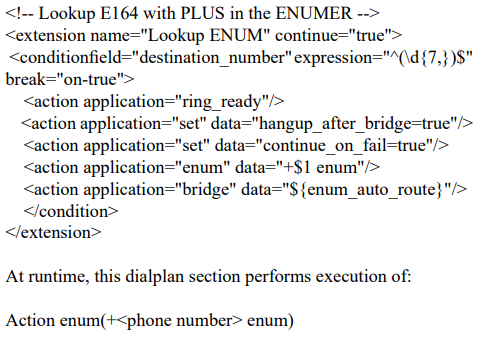
This integration facilitated the seamless resolution of phone numbers through the ENUMER system, demonstrating its practical application and potential for efficient interoperability within existing telecommunication infrastructures.
Test Results
The following section presents the results of our performance tests conducted on the ENUMER system. We evaluated the system's response times and overall efficiency under various conditions. The tests were designed to assess the capability of the blockchain-based architecture in handling NPDB functionalities, such as query response times and update latencies. The data gathered from these tests provides valuable insights into the system's performance and highlights its potential advantages over traditional NPDB solutions.
|
Test |
Result |
|
Integral test with FreeSWITCH ENUM interface test call |
Test call successful, conversation occurred. Test passed. |
|
Search time for a single previously unrequested record |
~3ms |
|
Search time for a single previously requested record |
~560µs |
|
Search time during continuous stress test of 5000 requests |
347µs (stdev 49µs) |
|
Performance during continuous stress test of 5000 requests |
~2600 requests per second |
|
Failure probability |
Less than 0.0001%. No failures detected in a million requests. |
|
Record update time in NPDB |
~10 minutes (equal to the block closure time of the Emercoin platform) |
|
Creation of a fake record with an invalid signature |
Record ignored by the search mechanism |
|
Search performance with all network connections disabled |
Resolving works, not interrupted |
Interpretation of Results
Testing demonstrated that the model NPDB system based on a blockchain has all the necessary properties for industrial operation:
Integration
Allows integration into telecom systems using either the standard ENUM protocol or a custom protocol tailored to the needs of telecom systems.
Throughput
The system’s throughput and query processing time are an order of magnitude higher than existing classical solutions (hundreds of microseconds versus tens of milliseconds).
Record Update Time
The time to update an LNP record in NPDB is also significantly lower than that of classical systems (tens of minutes versus days).
Protection from Malicious Actors
The system can reject invalid records introduced by malicious actors. Digital signature verification using elliptic curve secp256k1 is employed [7].
Independence from Network Connections
The resolving system continues to function even with a complete loss of all network connections.
We were unable to locate publicly available data for direct comparison with the performance metrics of existing NPDB systems. This lack of transparency in the industry underscores the challenge in benchmarking. However, we encourage operators and administrators of current NPDB infrastructures to compare the results presented in this study with their internal metrics. The sub-millisecond retrieval times achieved by ENUMER inspire justified optimism regarding its efficiency. Furthermore, the ten-minute record transfer time in ENUMER is significantly faster than the multi-day process typically observed in number portability between operators. Such a comparative analysis will enable a more informed evaluation of the potential benefits and efficiencies offered by the proposed ENUMER architecture, facilitating an evidence-based assessment of its applicability within your operational context.
Conclusion
In this study, we have explored the potential application of blockchain technology, specifically through the implementation of ENUMER, as an alternative architecture for NPDB systems. Our test results demonstrate that ENUMER not only meets but exceeds the performance expectations traditionally associated with NPDBs. The sub-millisecond retrieval times and the rapid ten-minute record transfer highlight ENUMER's operational efficiency, suggesting a viable path forward for modernizing NPDB infrastructures.
It is important to note that this research focused on evaluating a model system. While ENUMER in its current form shows promise, it also serves as a foundational prototype for further development. One potential enhancement involves integrating public key infrastructure (PKI) within the NPDB framework. By storing the public keys of operators for each phone number and utilizing these keys to sign challenges during calls, a more robust Caller ID (CLID) verification system can be established. This method could potentially offer a superior alternative to existing solutions like STIR/SHAKEN, improving the overall security and trustworthiness of telecommunications [8]. The insights gained from this study provide a compelling case for the broader adoption and adaptation of blockchain technology in NPDB systems. Future research and development can build upon the ENUMER framework, addressing specific operational requirements and enhancing its functionality to fully realize the benefits of decentralized and secure number portability solutions. We encourage further exploration and innovation in this domain, leveraging the architectural advantages demonstrated by ENUMER to meet the evolving needs of the telecommunications industry.
Author Information
Oleg Khovayko, CTO of Emercoin project, and coordinator of Emercoin team.
URLs: LinkedIn: https://www.linkedin.com/in/oleg-khovayko-78a2165/
StackOverflow: https://stackoverflow.com/users/339937/olegarch
Acknowledgments
I extend my gratitude to OpenAI's language model, ChatGPT, for providing invaluable assistance in refining and enhancing the scientific quality of this paper.
References
- ENUMER: http://enumer.org/
- ENUM: https://en.wikipedia.org/wiki/Telephone_number_mapping
- Emercoin: https://emercoin.com
- RFC 6116: https://datatracker.ietf.org/doc/html/rfc6116
- Emercoin Releases: https://github.com/emercoin/emercoin/ releases
- emerDNS: https://emercoin.com/en/documentation/blockchain-services/emerdns/emerdns-introduction/
- Bitcoin Digital Signature: https://en.bitcoin.it/wiki/Elliptic_ curve_digital_signature_algorithm
- STIR/SHAKEN: https://www.fcc.gov/call-authentication