

Journal of Electrical Electronics Engineering(JEEE)
ISSN: 2834-4928 | DOI: 10.33140/JEEE
Impact Factor: 1.2


Research Article - (2026) Volume 5, Issue 4
Relativity and Absoluteness Inherent in the Law of the Constancy of the Speed of Light

Received Date: Jun 03, 2026 / Accepted Date: Jul 23, 2026 / Published Date: Jul 30, 2026
Copyright: ©2026 Hyoungseok Koh. This is an open-access article distributed under the terms of the Creative Commons Attribution License, which permits unrestricted use, distribution, and reproduction in any medium, provided the original author and source are credited.
Citation: Koh, H. (2026). Relativity and Absoluteness Inherent in the Law of the Constancy of the Speed of Light. J Electrical Electron Eng, 5(4), 01-13.
Abstract
This paper re-evaluates the foundations of special relativity from the perspective of measurement mechanics, demonstrating that while the law of the constancy of the speed of light universally holds, the operational methods for measuring light speed fundamentally differ between the stationary frame and constant velocity frames. In the absolute stationary frame, light speed is measured directly via physical round-trips. Conversely, in a moving frame, its invariance is operationally constructed through "coordinate borrowing" and phase synchronization, rather than direct mechanical measurement. By deriving the full Lorentz transformation solely from light-speed constancy and spacetime linearity, we prove that the principle of relativity is a subordinate proposition rather than an independent postulate. Crucially, assuming an absolute stationary frame, we re-interpret the null result of the Michelson-Morley experiment through phase synchronization mechanics, emphasizing an instrumental asymmetry between the invariant rigid ruler and the adjusted light ruler. This framework successfully bridges relativistic paradigms with quantum mechanics.
Keywords
Absolute Stationary Frame, Measurement Mechanics, Coordinate Borrowing, Lorentz Transformation, Instrumental Asymmetry, Michelson-Morley Experiment
Introduction
Although physics employs mathematics as its language, its essence lies in the precise measurement of natural entities. Richard Feynman famously insisted that “physics is not mathematics” and must ultimately be verified by experiment and measurement, emphasizing that statements which cannot be confirmed by measurement fall outside the scope of science [1]. This position implies that the long-standing debate over the absolute versus the relational character of spacetime must be accompanied not merely by mathematical consistency but also by clear operational definitions and measurability. In support of this view, S. Hossenfelder has recently argued that modern physics tends to prioritize mathematical aesthetics—such as naturalness and symmetry—over empirical evidence, and emphasized that physical theories must be re-evaluated upon a concrete foundation of measurement mechanics [2]. This combined critical perspective provides a legitimate basis for the present study’s attempt to restore the physical reality of an 'absolute stationary frame' hidden behind mathematical symmetry.
Actually, this necessity is most clearly evidenced by the fundamental tension between the two pillars of modern physics. While Einstein’s special relativity established the relativity of spacetime by postulating the physical equivalence of all inertial frames, quantum mechanics—especially in its treatment of non-local interactions and discrete state transitions—often implicitly requires a preferred temporal axis or a background spacetime [2]. By re-examining the 'measurement mechanics' of light speed, this paper aims to bridge this conceptual gap and demonstrate that an absolute frame is not a regression to classical ether, but a physical requirement for a consistent description of both relativistic and quantum phenomena.
Historically, the measurement of the speed of light has been pursued through a rigorous sequence of optical experiments. In 1676, Rømer provided an astronomical demonstration of the finite speed of light, and in the nineteenth century, Fizeau and Foucault determined precise terrestrial values [3,4]. Maxwell subsequently unified these findings by expressing the vacuum speed c in terms of fundamental electromagnetic constants [5]. Crucially, these foundational specifications effectively treated the Earth as a stationary frame, focusing on the empirical value itself rather than the operational symmetry between frames.
In 1887, the Michelson-Morley experiment challenged this view by yielding a null result [6]. In response, Lorentz introduced dynamical corrections like “length contraction,” while Einstein elevated the “constancy of the speed of light” to a postulate, transforming the paradigm of spacetime [7]. However, as Hossenfelder recently noted, the modern preoccupation with such mathematical symmetries often obscures the underlying physical reality. Both Lorentz and Einstein’s approaches yield the Lorentz transformation, yet they tend to treat light-speed invariance as a formal starting point rather than an outcome of specific measurement dynamics. They fail to address the operational asymmetry between a frame that measures light directly and a moving frame that must "borrow" coordinates.
To overcome these conceptual limitations and restore the "measurement mechanics" advocated by Feynman [1], this study advances a new logical structure:
First, it analyzes the operational divergence in how light speed is defined. We demonstrate that while the stationary frame conducts a direct round-trip measurement, the invariance observed in the moving frame is a secondary product of “coordinate borrowing” from the absolute background.
Second, this study proves that the linearity of spacetime and the 'relativity between observers' are not independent assumptions but are logically derived from the constancy of light speed. This allows for a more rigorous derivation of the Lorentz transformation and its inverse without redundant postulates.
Third, it re-examines major historical experiments to show how the absolute background of space and the null result of the Michelson–Morley experiment can coexist consistently through instrumental correction.
In conclusion, this study argues that the constancy of the speed of light is not merely a hypothetical postulate. Rather, it is the inevitable consequence of the measurement dynamics between an absolute stationary frame as a physical reality and the observers moving relative to it—making relativity not just a principle, but a physical necessity.
Theorey
The special principle of relativity presents the speed of light c in an inertial frame in the form of three postulates [7]. First, any light ray moves at a constant velocity c in a “stationary” coordinate system; accordingly, Einstein measures the speed of light c in an arbitrary stationary frame by means of a round-trip light experiment. Second, the speed of light is c regardless of whether the light ray is emitted from a stationary body or from a moving body. Third, the operational definition speed =((path of light))⁄((time interval)) applies to every inertial frame. Here, “time interval” refers to the condition in which time tA at point A and time tB at point B satisfy the following equation: let a ray of light depart from A at time, arrive at B at timetB, be reflected there, and return to A at time tA' . The two clocks are said to be synchronized when [8].

This condition is assumed to be applicable between arbitrary pairs of points.
The present study employs a thought experiment to demonstrate that, while the law of the constancy of the speed of light holds, the method by which that speed is measured differs between the stationary frame and the moving frame.
In order to measure the one-way speed of light, speed = (path of light)/ (time interval), in an inertial frame, a rigid ruler for measuring distance and an atomic clock for measuring time are indispensable. However, before the one-way speed of light is known, it is impossible to install mutually synchronized clocks at the departure and arrival points. This means that the one-way speed of light cannot be measured; only the round-trip speed is accessible. Einstein’s synchronization condition (1) corresponds to ε = ½ in Hans Reichenbach’s general synchronization formula.

Accordingly, for Einstein’s synchronization condition to hold, two requirements must be met: first, a rigid rod (or rigid ruler) and an atomic clock must be available for performing the round-trip light experiment; and second, the vacuum must satisfy homogeneity, isotropy, and instantaneous reflection of light.
In the present work, an inertial frame in which the round-trip travel times of light in vacuum are constant is defined as the stationary frame. When the rigid ruler measures the distance between two points O and P in the stationary frame as r, and the round-trip travel time of light is t, the speed of light c is given by

Once the speed of light has been determined in the stationary frame, a rigid ruler, atomic clocks, and light are used first to measure the coordinates of stationary points. Because Einstein was convinced that no distinction could be drawn between the stationary and the moving frame, he chose an arbitrary stationary frame; he measured spatial coordinates by means of a rigid ruler following the methods of Euclidean geometry, and measured time with a clock, expressing the coordinates of a stationary point P in Cartesian form P(x,y,z,t) [10]. stationary point P in the stationary frame is defined as a stationary-frame observer P(x,y,z,t), and separated stationary-frame observers P(x,y,z,t)are synchronized using light in a manner distinct from Einstein’s synchronization scheme. Denoting the time at the origin O of the stationary frame as to, the stationary-frame atomic clock P(x,y,z,t) at rigid-ruler distance r from O is synchronized by light as follows [11].

When the atomic clocks thus synchronized by the rigid ruler and by light are established, the stationary-frame observers share a common time. With atomic clocks synchronized by light available, a “light ruler” can be constructed—defined as the product of the speed of light c and the travel time of light. When the stationary frame is synchronized, equation (4) can be rewritten to give

This expresses the coincidence between the length r measured by the rigid ruler and the length c(tP − to) measured by the light ruler. This coincidence in the stationary frame between the rigid ruler and the light ruler holds because the origin at which the rigid ruler is placed coincides with the hypothetical origin from which the light ruler infers distances [12]. The alignment of the rigid ruler and the light ruler in the stationary system is due to the coincidence of the origin where the rigid ruler is placed and the virtual origin estimated by the light ruler.
Unlike a stationary point, a moving point cannot have its coordinates measured directly by a synchronized rigid ruler and an atomic clock in its own frame. Instead, the stationary-frame observer P(x,y,z,t) must assign its own coordinates to the passing moving point P', such thatP^' is effectively mapped as P' (ξ,η,ζ,τ). As P' progresses and encounters a subsequent stationary observer P0(x0, y0, z0, t0), its coordinates are updated to P'(x0, y0, z0, t0) [12]. In this study, this operational process—where a moving point adopts the coordinates of the stationary points it passes—is defined as “coordinate borrowing.”
In defining motion within the stationary frame, the dynamical properties of massive bodies (m ≠ 0) and light (m = 0) must be rigorously distinguished [13]. A massive body M′ moves through points coordinated by a rigid ruler at a constant velocity v. Conversely, a photon L emitted in the stationary frame is a discontinuously moving entity that departs from the stationary source O and reaches observer P at speed c. From a quantum mechanical perspective, this propagation consists of repeated microscopic steps within near-field zones. Light passes through a sequence of hypothetical observation points (P1, P2, …, Pn) spaced at wavelength intervals λ. This discontinuous rectilinear propagation, while appearing as a continuous macroscopic average speed of c, is in reality the cumulative result of successive microscopic transitions.
When an observer P' is fixed within a frame moving at velocity v, the point becomes relatively stationary, allowing its coordinates to be measured by the ruler and clock of that moving frame. Consequently, the moving point P' possesses a dual coordinate identity: the borrowed coordinates from the stationary frame and the measured coordinates intrinsic to the moving frame. The physical transformation between the stationary observer P and the moving observer P' is thus defined as the functional relationship relating these borrowed values to the measured ones.
While Einstein introduced the concept of “vicinity,” asserting that a stationary clock must be located in the immediate proximity of a point his framework focused on the mathematical expression of coordinates as a function of time [8]. Crucially, he did not provide a physical operational definition or a specific measurement-mechanical protocol for how these coordinates are actually obtained for a moving body. This study addresses this gap by establishing that the transformation is not a mere mathematical convention, but a direct consequence of the mechanical interaction between these two distinct coordinate systems.
In order for the moving frame observe P' (ξ,η,ζ,τ) to construct the moving frame using light and atomic clocks, the speed of light must first be determined. However, the moving system does not measure the speed of light independently but determines it through ‘coordinate borrowing.’ As described earlier, the stationary frame observer P(x,y,z,t), by means of coordinate borrowing, regards the stationary light source O and the moving light source O0' as identical sources, and thus asserts that the speed of all emitted light is c. Furthermore, since lights emitted from the stationary-frame origin O(0,0,0,0) reaches both the stationary observer P(x,y,z,t) and the moving observer P' (ξ,η,ζ,τ) , the stationary observer concludes that the speed of light is ccc in all cases. At this point, the stationary observer P P'assigns the value c to the speed of light, and the moving observer P^' cannot assign a different value c′. This is because, according to the law of reflection, lights emitted from the stationary origin O, reflected at mirrors located at both P and P' , and returning to O, must have the same speed c in all cases. Finally, the moving observer P' (ξ,η,ζ,τ), again by coordinate borrowing, considers the moving light source O0' and the stationary light source O to be identical, and thus concludes that the speed of all light is c. That is, since the light beams emitted from both the stationary source O and the moving source O0' reach the stationary observer P and the moving observer P' simultaneously, both observers at this stage share the conclusion that the speed of light is always c, independent of the motion of the source, and the following relation holds [14].

Thus, the law of the constancy of the speed of light holds in every inertial frame, but the method by which the speed of light is measured is asymmetric between the stationary frame and the moving frame. Einstein postulated the constancy of the speed of light in the inertial frame; however, since the speed of light measured by round-trip experiment in the stationary frame is extended to the moving frame through “coordinate assignment and coordinate borrowing,” it cannot be a genuine postulate [7].
Applications
Both Lorentz and Einstein presupposed the constancy of the speed of light and derived the Lorentz transformation by different paths: Lorentz focused on the form-invariance (covariance) of electromagnetic laws, while Einstein took the special relativity principle as the theoretical foundation. However, neither examined with sufficient rigor whether the electromagnetic laws or the relativity principle constitute propositions independent of the constancy of the speed of light. The present section argues that both the electromagnetic laws and the relativity principle are propositions derived from the constancy of the speed of light, and therefore cannot be independent postulates.
In a previous study, “The Third Lorentz Transformation as a Reformulation of Special Relativity,” the Lorentz transformation and its inverse were derived solely from the postulate of the invariance of the speed of light together with the assumption of linearity [15]. Moreover, even the invariance of the speed of light—originally introduced by Einstein as a fundamental postulate—can be replaced by a stepwise operational definition. Furthermore, even the law of the constancy of the speed of light—which Einstein set as a postulate—can be replaced by a stepwise operational definition. The present section describes, step by step, the process of measuring the speed of light in the stationary frame and in the moving frame, and demonstrates the derivation of the Lorentz transformation and its inverse using the constancy of the speed of light as the sole premise.
The transformation of the moving-frame observer P' (ξ,η,ζ,τ) with respect to the stationary-frame observer P(x,y,z,t) is divided into two groups: one group comprises the coordinate ξ and the time τ parallel to the direction of motion, and the other comprises the coordinates η and ζ perpendicular to the direction of motion.
First Group: Coordinates Parallel to the Direction of Motion
The ξ and τ coordinates of the moving-frame observer P′ are linear in the x and t
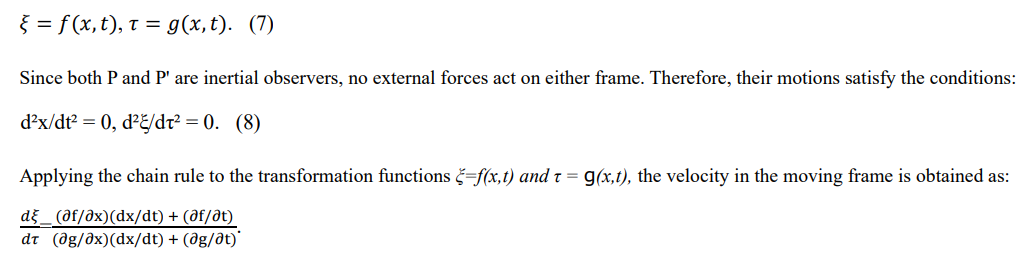
Under the condition of uniform motion in the rest frame (dx/dt = v, with constant v), the requirement that the acceleration d²ξ/dτ² = 0 holds for arbitrary values of v implies that all second-order partial derivatives must vanish:
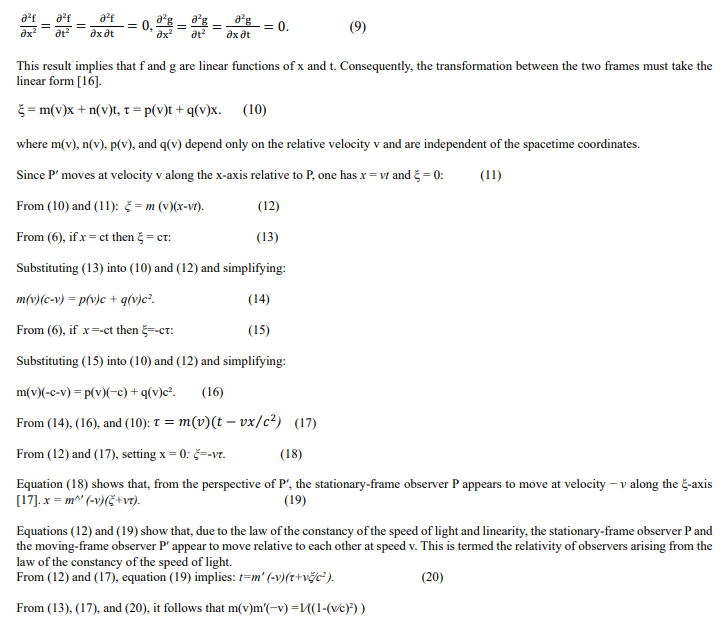
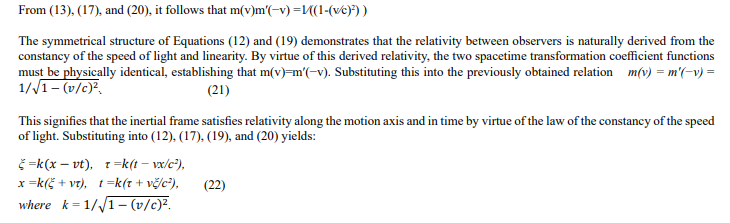
Second Group :coordinates of the stationary-frame observer P and are affected by the relative velocity v. Accordingly, they are defined as general functions of x and t:
Second Group: Coordinates Perpendicular to The Direction of Motion
Since P′ moves only in the x-direction at velocity v, the perpendicular coordinates satisfy η = h(v)y and ζ = h(v)z, with h(0)=1 :. (23) From the perspective of P′, P moves at velocity −v, so:
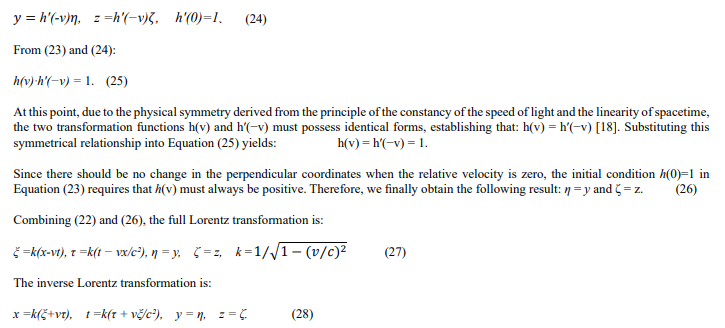
This derivation process clearly elucidates the physical foundations upon which the Lorentz transformation is established. The methodology of this study is distinguished from existing historical approaches in two primary aspects.
First, unlike Lorentz, who derived the transformation equations to preserve the form invariance of electromagnetic laws, this paper does not rely on laws specific to the field of electromagnetism. By deriving the Lorentz transformation solely from the minimal geometric postulates of the constancy of the speed of light and the linearity of spacetime, this study demonstrates that the transformation is not a byproduct of a specific mechanical framework but a universal property of spacetime arising from the dynamics of light measurement. Furthermore, the uniqueness of this approach is prominent when compared with Einstein’s method. Einstein adopted the 'principle of relativity'—which presupposes the physical equivalence of all inertial frames—as an independent postulate, citing examples such as the Maxwell-Hertz equations, electromagnetic force, optical energy formulas, the Doppler effect, and stellar aberration [19]. In contrast, this study confirms that the relativity between observers is naturally derived from the constancy of the speed of light itself, without the need for such external hypotheses. This implies that relativity between inertial frames does not stem from the physical equivalence of observers but is rather a result of measurement mechanics within the process of defining coordinates mediated by light.
Ultimately, the derivation presented in this section eliminates the redundancy of hypotheses found in conventional models and re-establishes the Lorentz transformation upon the singular foundation of the constancy of the speed of light. Such logical consistency compels a direct confrontation with the operational asymmetry between the stationary and moving frames—an aspect often obscured by mathematical symmetry—and serves as the fundamental basis for explaining how relative spacetime is constructed upon the physical reality of an absolute stationary frame.
Interpretation
In the preceding section, the Lorentz transformation and its inverse between the stationary-frame observer and the moving-frame observer were derived from the principle of the constancy of the speed of light. It is important to note, however, that while the stationary frame measures the speed of light through a round-trip experiment, the moving frame employs the stationary frame’s speed of light via coordinate borrowing. This difference in the method of measuring the speed of light reflects the operational asymmetry between the stationary frame—which uses a rigid ruler, light, and atomic clocks—and the moving frame—which uses only light and atomic clocks. In other words, although the mathematical structure of the Lorentz transformation may appear to represent an observer relativity, it is merely an apparent symmetry confined to the motion axis and the time coordinate. The present section reveals the physical asymmetry between inertial frames that is concealed beneath the mathematical formalism of the Lorentz transformation and its inverse [20].
Spatial asymmetry
Comparing the spatial coordinates of the two observers in equations (27) and (28), the x, y, z, t coordinates of the stationary-frame observer P(x,y,z,t)are measured by the rigid ruler, light, and atomic clocks, whereas the ξ, η, ζ, τ coordinates of the moving-frame observer P' (ξ,η,ζ,τ) are computed by applying the law of the constancy of the speed of light to the coordinates of the stationary-frame observer P. In terms of measurement mechanics, a clock in the moving frame is synchronized with a clock in the stationary frame by utilizing light from both the stationary and moving systems. This is referred to as a light clock in the moving system. Furthermore, the process by which the moving frame observer P' calculates the distance and direction from a virtual light source—using synchronized atomic clocks and incoming light—is defined as a light ruler. To distinguish the two, the x, y, z, t coordinates of P are termed “Mechanical real coordinates” and the ξ, η, ζ, τ coordinates of P′ are termed “electromagnetic observational coordinates.” Meanwhile, the axes perpendicular to the direction of motion (η, ζ) coincide with the stationary-frame axes (y, z), so the physical validity of the rigid ruler is preserved. However, for the ξ-axis parallel to the direction of motion, an independent coordinate measurement via the rigid ruler is impossible, meaning that we can only construct the coordinate system by means of the light, which yields:

The moving-frame observer P'employs a rigid ruler to measure coordinates from the actual source; in practice, however, the distance is calculated by borrowing the coordinates of both the actual source O0'and the moving observerP^' as measured by a rigid ruler in the stationary frame. The following presents a schematic representation of the sources as measured by P′ using the light ruler and the rigid ruler. Light emitted simultaneously from the stationary-frame source O and from the actual source O0' travels in a straight line and arrives simultaneously at the stationary-frame observer P(x,y,z,t) and at the moving-frame observer P' (ξ,η,ζ,τ). The direction cosines of the two rays L and L′ as measured by P and P′ are cos α, cos β, cos γ and cos α′, cos β′, cos γ′ respectively.
Applying the Lorentz transformation (27), the direction cosines of rays L′ and L are related as follows [21].
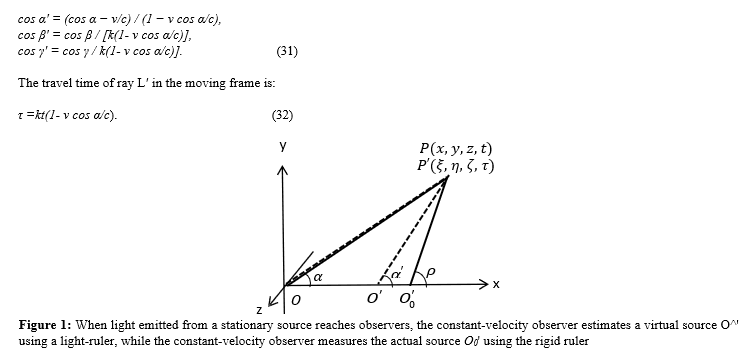
As shown in Figure. 1, while light departing from the stationary source O travels a distance ct in a straight line to reach the stationary-frame observer P, the actual source—which departed from O —has moved a distance vt and is now at the position of the actual source O0'. However, P′ observes light arriving with direction cosines cos α′, cos β′, cos γ′ from the virtual source O', whereas, when using the rigid ruler, it confirms that the actual source is located at O0' . If ρ denotes the angle between the ξ-axis and the line connecting O0'to P′, then:
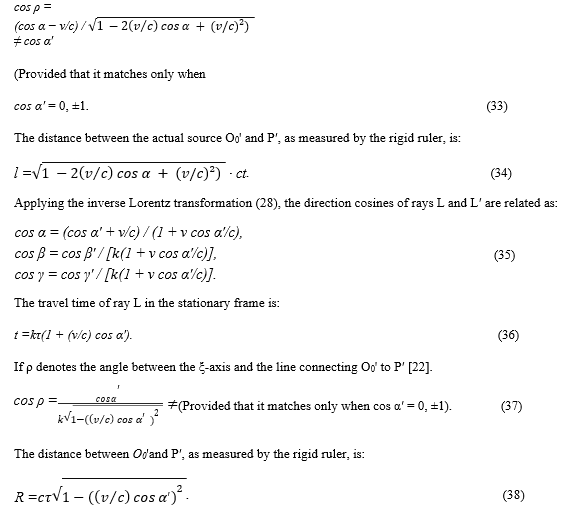
From equations (31) and (35), and (32) and (36), relativity is apparent in the transformation and inverse transformation of the direction cosines of light. However, in describing light propagation, the dynamical asymmetry between the stationary frame and the moving frame arising from the physical state of the source must be rigorously distinguished. For the stationary-frame observer P, the rigid ruler and the light ruler coincide, so only a single source O exists, and the spatial isotropy and homogeneity are maintained, making it possible to measure the speed of light through a round-trip experiment. For the moving-frame observer P′, by contrast, the rigid ruler and the light ruler do not coincide, giving rise to a separation between the virtual source O' and the actual source O0'. This is because, while light from the stationary source travels a distance ct to reach the observer, the actual source has departed from its original position, having moved a distance vt to the position of O0'. This result suggests that, despite the electromagnetic relativity, the two frames are not mutually relative from the standpoint of measurement dynamics. In other words, the moving frame lacks the spatial isotropy and homogeneity required to determine the speed of light through its own round-trip experiment; it can only be described by borrowing the coordinates of the stationary frame.
The following explains why the round-trip times of light in the moving frame differ by direction, making it impossible to determine the speed of light by a round-trip experiment [23]. When light traverses a rigid rod of length L in the moving frame, the stationary frame and the moving frame each measure the round-trip time with their respective clocks. Viewed from the stationary frame, the round-trip time of light traveling perpendicular to the direction of motion from the virtual source O' is, from equation (34), a total of 2kL/c. (39)
The round-trip time of light traveling parallel to the direction of motion is, from equations (34) and (32), a total of 2k²L/c. (40)
Viewed from the moving frame, the round-trip distance of light is calculated from the virtual source O'[23].
The round-trip time of light moving perpendicular is, from (34) and (32), a total of 2L/c. (41)
The round-trip time of light moving horizontally is, from (34) and (32), 2kL/c. (42)
When a round-trip light experiment is performed, equations (39) and (40), and (41) and (42) show that in both the stationary and the moving frame, the perpendicular light returns first and the horizontal light returns later. Furthermore, it is confirmed that the round-trip time as observed in the moving frame is reduced by a factor of 1/k compared with the stationary frame [19]. This is related to the time dilation in which the atomic clock of the actual source O0' runs 1/k times more slowly than the atomic clock of the source O. Since the round-trip times of light in the moving frame differ by direction, the speed of light cannot be determined by a round-trip experiment in the moving frame. The assumption, based on the relativity principle, that the round-trip travel time of light in an inertial frame is the same in all directions is at variance with physical fact.
The Michelson–Morley interference experiment is known as an experiment supporting the relativity of inertial frames. This view is an interpretation that does not take into account the fact that round-trip travel times of light differ in the round-trip light experiment. If the light path in the interference experiment is calculated from the actual source O0', the wave emitted in the horizontal direction travels a round-trip distance of 2kL according to equation (42), and the wave emitted in the vertical direction travels a round-trip distance of 2L according to equation (41), both arriving at O0'simultaneously. Despite this path difference, no significant interference fringes appear in the simultaneously arriving waves. To explain this phenomenon, FitzGerald and Lorentz proposed the theory that bodies contract in the direction of motion [6]. However, if a body contracts in the direction of motion, its constituent atoms would become oblate spheroids and stable atomic configurations could not exist. Einstein argued that, because the speed of light is invariant regardless of the motion of the observer, no interference fringes are produced [24]. However, as shown by the round-trip light experiment, a time difference between the two paths does exist, so Einstein’s claim that there is no path difference due to the relativity of inertial frames lacks sufficient persuasive force.
The reason no interference fringes appear in the Michelson–Morley experiment is that the round-trip distance of the wave is measured by the “rigid ruler” from the actual source O0' [25]. When a wave emitted vertically from O0' (0,0,0,0) completes a round-trip of 2L/c according to equation (41) and arrives, the phase of the wave is τ1 = 2L/c − 2L/c = 0. When a wave emitted horizontally from O0' (0,0,0,0)completes a round-trip of 2kL/c according to equation (42) and arrives, its phase is τ2 = 2kL/c − 2L/c. When the two waves arrive simultaneously at O0' within the moving frame, their phases both become τ3 = τ − 2L/c, which are identical. Hence no interference fringes appear.
Synchronization Asymmetry
While the virtual source and the actual source coincide in the stationary frame, their non-coincidence in the moving frame gives rise to a synchronization asymmetry. The fact that the method of measuring the speed of light differs between the stationary frame and the moving frame implies a corresponding difference in the method of synchronization. The stationary-frame observer P synchronizes with other stationary-frame observers, while the moving-frame observer P′ synchronizes with the stationary-frame observer P. Specifically, P(x,y,z,t) synchronizes the stationary-frame atomic clocks with each other using the rigid ruler and light:

The stationary frame performs a “coordinate synchronization” in which all atomic clocks are consistently synchronized via light over the geometrical distances fixed by the rigid ruler.
By contrast, the moving-frame observer
P' (ξ,η,ζ,τ) aligns their own clocks with those of the stationary frame by utilizing light signals from both the stationary and moving systems. Consequently, the time coordinates of P' are determined by the spatial and temporal coordinates (x, t) of the stationary-frame observer P(x,y,z,t). We define planes that pass through the moving-frame observer P^' and the stationary-frame observer P, respectively, oriented perpendicular to the axes of motion ξ and x. These planes are designated as the Moving Perpendicular Plane V' and the Stationary Perpendicular Plane V. The points where these planes intersect the axes of motion ξ and x are defined as the Moving Synchronizer R' (ξ,O,O,τ)and the Stationary Synchronizer R(x,0,0,t), respectively. Under this construction, all points within the moving-frame perpendicular plane V' are simultaneous. This principle is defined as Perpendicular Plane Synchronization. The fact that the entire coordinate system is simultaneous in the stationary frame, whereas only the simultaneous plane V′ is simultaneous in the moving frame, is a consequence of the non-coincidence in the moving frame of the virtual source and the actual source.
Since the time of the actual source O0' (ξ = 0) is denoted by τ0 = t/k, the distance from the actual source to the moving synchronizer is x', and the distance from the virtual source to the moving-frame synchronizer is ξ, the following temporal relationship is established from equations (28) and (29) [26].
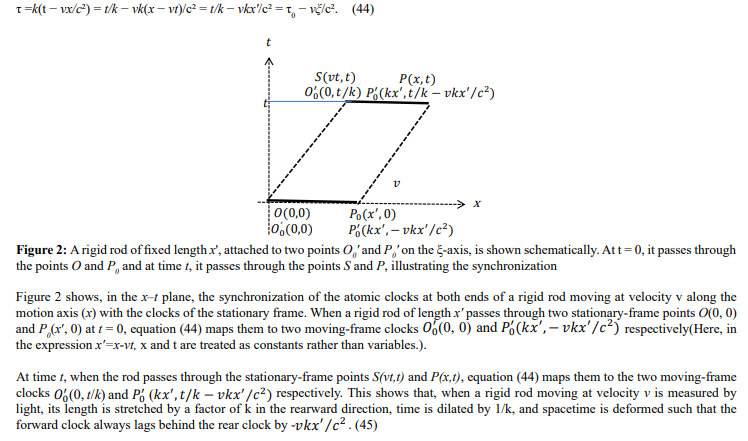
The fact that coordinate synchronization is performed in the stationary frame while plane synchronization is applied in the moving frame means that the temporal relativity appearing in the Lorentz transformation and its inverse represents a relativity between points, not a relativity between inertial frames.
Asymmetry in an Identical Round-Trip Experiment
First, an experiment is performed in which light from the stationary source O and from the actual moving-frame source O0' is each reflected at a mirror M and M′, respectively, placed at a distance L along the η-axis, and then returns to O0' and to the stationary-frame observer R respectively.
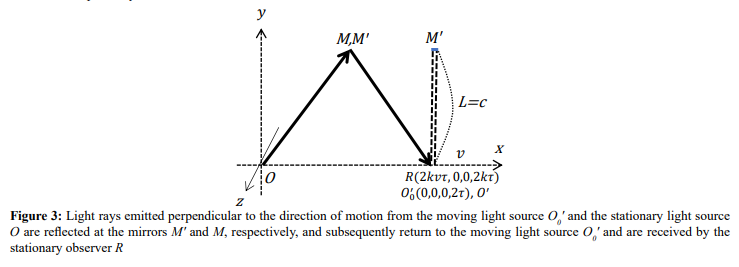
Figure 3 schematizes the round-trip of light from O0' and O perpendicular to the direction of motion. From equation (35), the direction cosines of light from the two sources are (0, 1, 0) and (v/c, 1/k, 0); and those of the light reflected at mirrors M'and M are (0, −1, 0) and (v/c, −1/k, 0) respectively. Accordingly, O0'(0, 0, 0, 2τ) states that the round-trip of light took τ1 = 2τ, and the stationary-frame observer R(2kvτ, 0, 0, 2kτ) states that it took t1 = 2kτ. The round-trip distance of light in the moving frame is 1/k times shorter than that in the stationary frame, and the time is also delayed by a factor of 1/k. (46)
Since the virtual source O' and the actual source O0' lie on the same simultaneous plane, the distance between the stationary source O and O0' is 2kvτ. (47)
Next, an experiment is performed in which light from O and from O0' is each reflected at a mirror M and M′, respectively, placed at a distance L along the y-axis, and then returns to O and to the moving-frame observer R′ respectively.
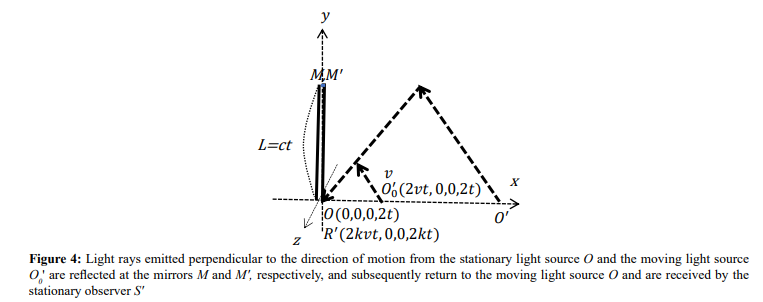
Figure 4 schematizes this configuration. From equation (31), the direction cosines of light from the two sources are (0, 1, 0) and (−v/c, 1/k, 0); and those of the light reflected at mirrors M and M′ are (0, −1, 0) and (−v/c, −1/k, 0) respectively. Accordingly, O(0, 0, 0, 2t) states that the round-trip took t2 = 2t, and R' (2kvt, 0, 0, 2kt) states that it took τ2 = 2kt. The round-trip distance of light in the stationary frame appears to be 1/k times shorter than that in the moving frame, and the time appears to be delayed by a factor of 1/k as well. (48)
However, the actual source O0' and the virtual source O' do not coincide. The distance from O to O0' is 2vt, while the distance from O to O'is 2kvt. Therefore, it is not the case that light in the moving frame has traveled a distance of 2kct or that a time of 2kt has elapsed. This is merely an inference based on the direction cosines of light incident on mirror M'and moving - frame observer R'. (49)
Figures 3 and 4 appear to show the two round-trip experiments as mutually relative, because the coordinates of P(x,y,z,t) and P' (ξ,η,ζ,τ) are measured with reference to the stationary source O and the virtual source O'. The two experiments show that O is at rest while O0' moves at velocity v along the motion axis. When O and O' are taken as the reference, relativity appears between P and P′; when O and O0' are taken as the reference, the asymmetry between the stationary frame and the moving frame is confirmed. In short, comparing only equations (46) and (48) from the electromagnetic perspective, the two experiments show that P and P′ are mutually relative. However, comparing equations (47) and (49) from the measurement-dynamical perspective, the stationary frame and the moving frame are not symmetric.
Despite the mathematical symmetry of the Lorentz transformation, it has been confirmed that, from the perspective of actual measurement dynamics, an essential physical asymmetry exists between the stationary frame and the moving frame. The stationary frame possesses an autonomous metrological structure in which the rigid ruler and the light ruler coincide, whereas in the moving frame the divergence of the rigid ruler and the light ruler gives rise to the phenomenon in which the virtual source and the actual source are separated. This divergence means that the moving frame lacks spatial isotropy and homogeneity, and is structurally incapable of determining the speed of light through its own round-trip experiment alone. Ultimately, the invariance of the speed of light observed in the moving frame is not an autonomous physical reality but merely an electromagnetically effective phenomenon arising from borrowing the coordinates of the stationary frame. Therefore, the relativity principle—which holds that all inertial frames are physically equivalent—is merely a derivative consequence of the constancy of the speed of light, and cannot conceal the asymmetry of the measurement dynamics grounded in the absolute stationary frame.
Conclusion
This study has reexamined the law of the constancy of the speed of light—the central postulate of special relativity—and argued that it does not imply the physical equivalence of inertial frames but rather constitutes evidence for the reality of an “absolute stationary frame.”
First, it has been established that the constancy of the speed of light within an inertial frame is not a consequence of all inertial frames being physically identical, but is rather a phenomenon arising from the process of “coordinate borrowing” in which the moving frame borrows the measured quantity c from the stationary frame. While the stationary frame directly measures the speed of light through a round-trip experiment, the moving frame defines the speed c through coordinate borrowing with the stationary frame; accordingly, the methods by which the two frames measure the speed of light are operationally asymmetric.
Second, it has been proved that by deriving the Lorentz transformation using only the constancy of the speed of light and the linearity of spacetime—without setting the relativity principle as an independent postulate— “observer relativity” can still be obtained. This implies that the relativity of physical laws is a result subordinate to the law of the constancy of the speed of light.
Third, asymmetries in measurement instruments underlying the mathematical formalism of the Lorentz transformation have been identified. In the moving frame, the rigid ruler and the light ruler do not coincide; unlike the stationary frame, which performs “coordinate synchronization,” the moving frame depends on “plane synchronization,” giving rise to physical asymmetries. In particular, the “positional asymmetry of the source” that occurs in the moving frame causes a discrepancy between the virtual source and the actual source, and serves as the core mechanism that provides a physically consistent explanation for the null result of the Michelson–Morley experiment and the time dilation of moving-frame atomic clocks.
In conclusion, the universal observation of the speed of light as c in all inertial frames is not a subjective stipulation of observers, but an objective outcome produced by measurement dynamics against the backdrop of an absolute stationary frame as a physical reality. By restoring the physical reality of the absolute stationary frame that modern physics has overlooked, this study is expected to contribute to the proposal of a new paradigm for the interpretation of spacetime.
Acknowledgement
The author formulated the conceptual system work, conducted the theoretical analysis, and synthesized relevant literature.
Data Availability
All data generated or analyzed during this study are included in this published article.
Author Contributions
The author formulated the conceptual framework, conducted the theoretical analysis, and synthesized the relevant literature. AI assistance was limited to ensuring linguistic precision, standardizing terminology, and verifying the logical coherence of the proposed ideas.
Financial Declarations
The author did not receive financial support from any organization for the submitted work.
Conflict of interest
The author declares no conflict of interest. All findings and interpretations presented in this work were derived independently, without any external influence that could bias the conclusions.
References
- Feynman R. (1965). The Character of Physical Law. MIT Press, Cambridge, MA, 50–55.
- Hossenfelder S. (2018). Lost in Math: How Beauty Leads Physics Astray. Basic Books, New York.
- Rømer O. (1677). A demonstration concerning the option of light. Philosophical Transactions of the Royal Society of London, v.12, 893.
- Fizeau H. L. (1849). On an experiment relative to the velocity of the propagation of light. London, Edinburgh and Dublin Philosophical Magazine and Journal of Science, v. 35, 443.
- Maxwell J. C. (1865). A dynamical theory of the electromagnetic field. Philosophical Transactions of the Royal Society of London,v. 155, 459.
- Michelson A. A., Morley E. W. (1887). On the relative motion of the Earth and the luminiferous ether. American Journal of Science,v. 34 (203), 333–345.
- Miller A. I. (1981). Albert Einstein’s Special Theory of Relativity. Addison-Wesley, Reading, MA, 395.
- Miller A. I. (1984). Albert Einstein’s Special Theory of Relativity. Addison-Wesley, Reading, MA, 394.
- Reichenbach, H. (1958). The Philosophy of Space and Time. Translated by M. Reichenbach and J. Freund, Dover Publications, New York, p. 120–130.
- Miller A. I. (1981). Albert Einstein’s Special Theory of Relativity. Addison-Wesley, Reading, MA, 393.
- Taylor, E. F., Wheeler, J. A. (1992). Spacetime Physics. W. H. Freeman, New York, 37.
- Koh, H. (2025). The condition for the invariance of the speed of light in special and general relativity. Journal of Electrical and Electronic Engineering, v. 4 (6), 3.
- Koh, H. (2023). Coexistence of Relativity between Observers and the Absoluteness of Inertial Systems. Journal of Electrical and Electronic Engineering, 2023, v. 2 (1), 34.
- French, A. P. (1968). Special Relativity. W. W. Norton, New York, 77.
- Koh, H. (2025). The third Lorentz transformation as a reformulation of special relativity. Journal of Electrical and Electronic Engineering. v. 5 (1), 3.
- Pauli, W. (1958). Theory of Relativity. Pergamon Press, London. 11-15.
- Møller, C. (1952). The Theory of Relativity. Oxford University Press, London, 33–38.
- Resnick, R. (1968). Introduction to Special Relativity. Wiley, New York, 63.
- Miller, A. I. (1981). Albert Einstein’s Special Theory of Relativity. Addison-Wesley, Reading, MA, 404-410.
- Bell J. S. (1987). Speakable and Unspeakable in Quantum Mechanics. Cambridge University Press, Cambridge, 77.
- Møller, C. (1952). The Theory of Relativity. Oxford University Press, London, 33.
- Koh, H. (2023). Special relativity and absoluteness. Journal of Electrical and Electronic Engineering, v. 2 (1), 460–461.
- Koh H. (2025). Special relativity with modified relativity of physical laws. Journal of Electrical and Electronic Engineering, v. 4 (6), 5.
- Einstein, A. (1982). How I created the theory of relativity. Translated by Y. A. Ono. Physics Today, v. 35 (8), 45.
- Koh, H. (2025). Special relativity with modified relativity of physical laws. Journal of Electrical and Electronic Engineering, v. 4 (6), 6.
- Koh, H. (2026). The third Lorentz transformation as a reformulation of special relativity. Journal of Electrical and Electronic Engineering, v. 5 (1), 4.