

International Journal of Media and Networks(IJMN)
ISSN: 2995-3286 | DOI: 10.33140/IJMN
Impact Factor: 1.02



Review Article - (2025) Volume 3, Issue 3
Relativistic Mass According to ‘MATTER (Re-examined)’
Received Date: Apr 01, 2025 / Accepted Date: Apr 30, 2025 / Published Date: May 08, 2025
Copyright: ©©2025 Nainan K. Varghese. This is an open-access article distributed under the terms of the Creative Commons Attribution License, which permits unrestricted use, distribution, and reproduction in any medium, provided the original author and source are credited.
Citation: Varghese, N. K. (2025). Relativistic Mass According to
Abstract
Although the mass of an object is defined to represent the equivalent of 3D matter it contains, it is often considered as the quantity of 3D matter contained in the object. Mass is the mathematical relation between an external linear effort on an object and the rate of the rate of its displacement in the direction of the external effort. This relationship is often ignored, and the value of mass is regarded in almost all academic fields as the quantity of 3D matter present in the object. The dependency of the mass of an object on its linear speed introduces changes in the value of its mass depending on the initial speed of the object considered.
Keywords
Matter, Mass, Effort, Force, Energy, Relativistic Mass and Universal Medium
Introduction
This article explores an unconventional viewpoint on the fundamental nature of matter. It argues that mass is only a mathematical relation assumed to represent the equivalent of the quantity of 3D matter in a body.
The substance of an entity provides its objective reality and positive existence in space. In our material world, the existence of matter is closest to absolute truth. Therefore, all real entities have matter as their substance. Any entity not formed by matter is not real, and it is a functional entity. Functional entities are imaginary and fulfil only those functions assigned to them by their proposers. They exist only in mathematical analyses and in the minds of physicists.
Matter is also defined as the ‘material substance that constitutes the observable universe and, together with energy, forms the basis of all objective phenomena’ (Wikipedia). Here, the matter is a real entity and the energy is a functional entity. A common definition of matter is "anything that has mass and occupies volume."
Opinions expressed in this article are taken from an alternative concept presented in the book ‘MATTER (Re-examined)’. For details, kindly refer to the same.
3D Matter
The existence of a real entity needs space. The space is an imaginary container envisaged by rational beings whenever they think of a real entity. Usually, the space is described by three spatial dimensions. Hence, the volume of space occupied by matter (a real entity) is defined by its spatial dimensions. As we are 3D beings, all of our senses and instruments are devised to sense and measure 3D material objects in volumetric space. Only those material objects that are tangible by the scales used in the 3D spatial system are considered real entities. Despite its existence in a volumetric space, a material object that is apparent only in 1D or 2D spatial systems is not considered real by us. If the measurement of a material object in any spatial dimension is less than that which can be measured by the scale used by us, it is currently considered non-existent. However, its existence in volumetric space is true, and it is our inability to measure them that makes them non- existent in our view. Thus, we have 2D material objects that exist in two-dimensional space and 1D material objects that exist in one-dimensional space.
All 3D material objects share certain fundamental properties, as understood from nature. Every 3D physical entity is assumed to have properties of mass, gravity, inertia, etc. All primary properties of 3D material bodies are amenable to mathematical description. Nevertheless, their secondary properties (or qualities) are not considered mathematically. Although the mass of an object is the measure of its inertia, it is commonly taken as the equivalent measure of the amount of 3D material contained in it. 3D matter in bulk may have several states of existence in nature.
As no reference is available to form a measuring scale for the quantity of 3D matter in an object, we use one of the attributes of 3D matter—the mass—to represent its equivalent. Hence, a mathematical relation between an external effort (force) on a 3D material object and the acceleration of its linear displacement in the direction of the external effort (the mass) is used to represent the equivalent of the quantity of 3D matter contained in a real object. However, the importance given to the mass as a substitute for the quantity of 3D matter contained in an object caused the 3D matter to be regarded as an unnecessary factor even for the existence of material bodies. Modern physics defines mass in terms of inertia and energy at the expense of matter. Currently,all scientific enquiries are based on mass rather than the quantity of 3D material in a real body. Even if mass is a mathematical abstraction, it remains useful in describing observable phenomena.
Conceptualising a logical system to quantify the 3D matter in an object can help restore matter's lost glory as the only substance that can provide objective reality and positive existence to real entities.
An Alternative Concept
The concept, proposed in the book ‘MATTER (Re-examined)’, suggests logical mechanisms for the development of an all- encompassing universal medium by quanta of matter in lower spatial existence and its actions. This concept is based on only one assumption, namely the existence of matter. It presents an alternative framework for understanding matter, gravitation, and fundamental particles through the existence of an all-encompassing universal medium.
The universal medium is inherently under compression. Compressive pressure exerted by the universal medium is the gravitation. Gravitational pressure is enormously strong and manifests in the form of different natural and other efforts (causes of forces). All actions (including the creation, sustenance, and destruction of 3D material entities) and apparent interactions by and between 3D material objects are initiated, sustained, and terminated by the universal medium. The universal medium compresses free quanta of matter in (accidental) gaps formed in its structure into a 3D matter core of segmented spherical (disc) shape and moves it at the highest possible (hence, constant) linear speed (restricted by the ability of the universal medium to preserve its structure) and spins it at a spin speed proportional to the quantity of 3D matter in the 3D matter core. Movements of the 3D matter core are attained by the transfer of structural distortions in the surrounding universal medium. When the 3D matter core and the accompanying structural distortions in the surrounding universal medium attain stability, both of them, together, form a photon—a corpuscle of radiation.
Photons are the most basic 3D matter particles. Two complimentary photons, in binary fashion, form a primary 3D matter particle—a biton. Constituent photons of a biton move at the speed of light in a circular path about a common centre. A biton (the primary 3D matter particle) is the most stable 3D matter particle, and in free space it has 3D matter content of constant value. All superior 3D matter particles and macro-objects are formed by the bitons in various combinations.
Mass
Scientists and philosophers searched for a long time to define the nature of matter. Other than observing certain qualities of matter, they were unsuccessful in their attempt to know the true nature of matter. Frustrated, more influential among them sought an easy way out of this predicament. Instead of considering matter itself as the fundamental substance or stuff in real entities, a quality of 3D matter was enthroned in its place as a real entity. Thus, the mass, a measure of the inertia of a 3D object, came to be regarded as a real entity that represents the equivalent of its 3D matter content.
All further developments in physics were based on this illogical assumption. Mass is treated as an indirect measure of 3D matter content, yet it is not the same as 3D matter itself.
The inability to directly measure 3D matter has led to the adoption of mass as a proxy. The mass of an object is distinct from the quantity of its 3D matter. Since we have no measuring scales for the 3D matter contained in an object directly, we depend on indirect representative measurements. One of the measuring systems used in physics to represent the quantity of 3D matter in an object is its mass. Because 3D matter is a poorly defined concept and different definitions of 3D matter agree on its attribute of mass, mass is used to represent the equivalent of 3D matter, often in physics. Hence, we say that all real entities (made of 3D matter) have the attribute of mass. All 3D material objects have the property of mass, but not all mass is associated with identifiable 3D matter. Mass is defined as the cause of the inertial property (resistance to changes of state when acted on by an external effort) of an object. Since functional entities contain no matter, they do not have the attribute of mass. They can provide only intentional objects. An intentional object is part of a state of mind, whereas a material object always has an independent (and objective) existence. However, the reverse is not always held. For there are real objects, which are assumed to have no mass.
‘Mass’ commonly refers to any of the three properties of 3D matter: inertial mass, active gravitational mass, and passive gravitational mass, which have been shown experimentally to be equivalent. Mass is also considered to have many attributes in various theories; it measures the 3D matter contained in an object (material mass). It measures an object's resistance to change in its state of motion when an external effort is applied (inertial mass). It produces a gravitational field in space, surrounding the object (active gravitational mass). It causes an object's interaction with an external gravitational field (passive gravitational mass), etc.
In certain theories, mass is assumed to curve the imaginary space- time or as a difference between an object’s quantum frequency and its wave number (quantum mass). Differences between inertial mass, gravitational mass, and various other mass-related phenomena are distinct and can suit only the concept that is using a particular attribute. No practical experiments so far have shown any non-proportional difference in the values of mass. Therefore, mass is generally accepted as an abstract concept and a proportionality constant that links force and acceleration.
In physics, ‘mass’ is also defined as the ‘quantitative measure of inertia,’ a fundamental property presently attributed to 3D material objects. It is the resistance offered by a 3D material body to change in its state of motion upon the application of an external effort. The mass of a 3D body is the mathematical relation between external effort (force) on it and the rate of change of its state of motion—its acceleration. Mathematically, this relation is expressed as: where, ‘M’ is the magnitude of mass, ‘F’ is the magnitude of external effort in terms of ‘force,’ and ‘a’ is the magnitude of acceleration in the direction of force. Since ‘F’ and ‘a’ can have only positive values, the mass of a 3D body can only be a positive number, larger than zero. However, depending on the relative magnitudes of the external effort and the acceleration produced by the action of the effort, the mass of a 3D body can vary from a very small value to infinity. Hence, no real body (constituted by 3D matter) can be massless.
The quantity of 3D matter in a body, measured by determining its mass, can have a reasonable relation to the quantity of 3D matter in it only if the body is at rest with respect to an absolutely steady reference. If for any reason the external effort by its action on the 3D material body cannot change its state of motion, by the above-given relation, the mass of the 3D body will reach infinite proportion, even under the steady magnitude of its 3D matter content. This is a fallacy created by the equation rather than by an increase in the quantity of 3D matter in the body.
However, modern physics considers mass not an attribute of 3D matter but a result of interactions at the quantum level. It further assumes that particles acquire mass through their interaction with certain imaginary fields. That is, mass itself has no direct relation to an object's 3D matter content. The 3D matter content of a real object is projected as a manifestation of imaginary field interactions. These ideas reject outright the existence of matter in our material universe.
Energy
Energy is the most important concept in contemporary physics—a fundamental quantity that governs all physical processes. It is currently defined as the ability or capacity to do work. Ability is an adjective. Like any other adjective, it is a quality and a functional entity. It has neither real objectivity nor a positive existence in space. It is a mathematical abstraction that quantifies the changes in field interactions. Although energy has no physical existence, it is considered the basis of all physical phenomena in nature. Energy is a convenient functional entity that can be used as the cause of any action where a logical cause is not obvious.
In the alternative concept, proposed in the book ‘MATTER (Re-examined)’, the energy is shown as a shadow of work. This concept fundamentally redefines energy as an abstract functional entity rather than a physically real entity. Strain in the universal medium is structural distortions in it. The structural distortions in the universal medium, being physical displacements of quanta of matter, are real and are called the work. Stress in the universal medium, in association with the work, is the energy. It is an intangible byproduct of structural distortions in the universal medium and a physically non-existent entity. However, in contemporary physics, energy is used as a real entity on which the structure of the entire universe and all actions in our natural world depend.
Mass and energy are functional entities, convenient for mathematical representations. Too many physical theories are based on these fictional assumptions. I think it is time to revise our conception of physical reality and consider matter the sole real substance.
Relativistic Mass
All actions are recognized by motion or changes in the state of motion of 3D objects. If there is no change in the state of motion, it is understood that the external effort is unable to act on the object. The action of an effort always presupposes the ability of the ‘force- applying mechanism’ to move faster than the ‘force-receiving body.’. For an action by external effort, the ‘force-applying mechanism’ has to move towards the ‘force-receiving body’ at greater speed. Although the ‘force-applying mechanism,’ when in contact with the ‘force-receiving body,’ does not apparently move faster, there has to be a minute difference in their speeds. It is this speed difference that enables the ‘force-applying mechanism’ to press onto the ‘force-receiving body.’. By interacting, the ‘force- applying mechanism’ compels the ‘force-receiving body’ to change its state of motion. This is possible only as long as the linear speed of the ‘force-receiving body’ is less than the linear speed of the ‘force-applying mechanism.’.
As the difference in their speeds reduces, the quantum of action by the ‘force-applying mechanism’ on the ‘force-receiving body’ diminishes. As and when their speeds become equal, the ‘force- applying mechanism’ will no longer be able to act on the ‘force- receiving body.’. The acceleration component of the equation will be zero. This is a simple logical reasoning. If the mass of the ‘force- receiving body’ were now determined by relation to the equation,
<img src="https://www.opastpublishers.com/scholarly-images/9107-6994007b7536a-relativistic-mass-according-to-matter-reexamined.png" width="300" height="60">
Its mass would have reached infinity in magnitude. Taking this as the quantity of 3D matter it contains is absurd. The direction of motions being the same, a slow-moving macro body cannot act on a faster-moving macro body. Similarly, however large the magnitude of (mathematical) ‘force’ may be, if the linear speed of the ‘force-receiving body’ is restricted by a limit, its mass may appear to approach infinite proportions. Both of these situations indicate the inability of an external effort to produce desired results rather than a change in the constitution of the ‘force-receiving body.’.
Currently, the relation between the linear speed of the ‘force- receiving body’ and the inability of the ‘force-applying mechanism’ is not acknowledged. However, an increase in the mass of an object as its linear speed increases is noticed. This illogical situation, the mass of an object approaching infinite proportions in calculations as its linear speed approaches the highest possible linear speed, is rescued by an equally illogical suggestion that energy (an undefined entity in physics) supplied by the ‘force-applying mechanism’ is being converted into mass in the ‘force-receiving body’ and thus increasing the magnitude of its mass to infinity. The increase in mass with velocity is a misinterpretation of the inability of an external force to act on a high-speed 3D object, rather than an actual increase in its physical substance.
Unfortunately, no one has ever devised a logical mechanism for this conversion of a functional entity (energy—a quality) to a real entity (physical 3D material). The fact that the quantity of 3D matter contained in the object has not varied at all during the variation in its linear speed is left to the reader’s imagination. Changes to the quantity of 3D matter in the ‘force-receiving body’ or the inability of the ‘force-applying mechanism’ to act on the ‘force-receiving body’ are not considered. This mysterious ‘energy to mass’ conversion is the phenomenon of ‘relativistic mass.’. The unchanged part of the mass of the ‘force-receiving body,’ as may be determined, when its (absolute) linear speed is zero, is its ‘rest mass.’. Rest mass is assumed to represent the equivalent of the quantity of 3D matter contained in the object.
Some modern scientific theories relate increase in the mass of a body with its velocity with respect to the observer to an assumed mass-energy conversion, which is further arbitrarily related to the linear speed of light for no particular reason.
Another phenomenon related to the speed of light for no particular reason is called the ‘mass defect’. Mass defect is the difference between the total mass of the individual nucleons (protons and neutrons) in an atomic nucleus and the actual measured mass of the nucleus. It is believed as the result of conversion of mass into binding energy that holds components of nucleus together. Higher the number of components in an entity, greater will be mass defect of the combined entity.
Only real physical objects exist, and abstract quantities like energy, relativistic mass, and mass defect are convenient mathematical tools.
Efficiency of an Effort
While considering the magnitude of external effort, the linear speed or the ability of the ‘force-applying mechanism’ to act on the ‘force-receiving body’ also needs to be considered. While forming the above-given equation of motion, no thought was spared about the ability of the ‘force-applying mechanism’ to move faster than the ‘force-receiving body.’. It was simply considered that any ‘force-applying mechanism’ could move with infinite linear speed if required. This thoughtlessness led to ignoring the efficiency of the external effort’s action. The efficiency of an external effort’s action on an object is determined by the relation between the magnitudes of the highest possible linear speed of the ‘force- applying mechanism’ (Vmax) and the current linear speed of the ‘force-receiving body’ (V).
The efficiency of effort, η, depends on the highest possible linear speed, Vmax, of 3D material bodies and the present speed, V, of the ‘force-applying mechanism.’.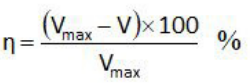
Efficiency of external effort, Efficiency of external effort is the highest (100%), when (absolute) linear speed of the ‘force-receiving body’ is zero. Efficiency of external effort is zero or it is unable to act on the ‘force-receiving body’, when its (absolute) speed becomes equal to the highest possible linear speed (in the direction of motion) of the ‘force- applying mechanism’.
Since mass is only a functional entity, it can neither act or be acted upon. External effort on an object acts on its 3D matter content. Magnitude of action depends on magnitude of 3D matter content and the efficiency of external effort. Quantity of 3D matter in an object does not vary due to the action of an effort. Nevertheless, depending on the (absolute) linear speed of an object, its mass varies. This is the result of variations in efficiency of external effort to act on an object.
This phenomenon limits linear speed of (photons) corpuscles light to its highest possible linear speed in space. Hence, speed of light is a critical constant. Incidentally, attempt to increase linear speed of photon tends to increase its 3D matter content rather than its linear speed. Similarly, attempt to reduce photon’s linear speed tends to reduce its 3D matter content rather than reduce its linear speed. This mechanism keeps the linear speed of a photon constant, with respect to an absolute reference.
Fallacies
The linear speed of a photon (a corpuscle of light) is the highest limit at which any 3D matter particle can move. At this linear speed, all superior 3D matter particles break down into their constituent photons. At this linear speed, the efficiency of an external effort trying to act on a photon, in the direction of its motion, is zero. That is, no external effort can act on a photon in its direction of linear motion. Thus, by the above definition of mass, the magnitude of the mass of a photon is infinity. The absurdity of this result is removed by declaring the photons as massless entities. This assumption further contends that the massless photons contain no 3D matter. Without 3D matter, they are not real objects. Hence, although they can be perceived by our sensory organs, they are treated as functional entities. This is one of many examples, developed as a result of assuming the mass to represent the equivalent of 3D matter content. Nevertheless, the ability of a photon, a massless entity, to have momentum is maintained for the sake of some other theories. This is contrary to the definition of momentum (another attribute of matter), which is given by the result of mass times its linear velocity.
It is a fact of observation that the light (photons) moves. In the current state of physics, light has no logical mechanism of motion; neither the cause nor the mechanism of motion is understood. Hence, it is simply assumed that light (photon) moves at its observed speed without external influence or an accelerating stage. This is against basic physical laws. Because of this ignorance, it is simply assumed that a corpuscle of light achieved its steady linear speed without the action of an external effort on it. Considering action in this way, by the above equation, the mass of a corpuscle of light becomes zero. Thus, a photon appears as a massless 3D matter particle and the light without 3D matter content but with momentum. Without 3D material content, light becomes pure wave motion transmitted through empty space, where nothing is present to wave. The reason for this confusion is our unawareness of the structure of photons and the mechanism of their motion.
It is due to the critical linear speed of light that no external effort, in the direction of its motion, can act on it. If the direction of external effort is different from the direction of its linear motion, external effort is found to act on light (photon) and cause its displacement in the direction of external effort. Light is noticed to bend its path while passing near very large macrobodies. Being shy to accept the fact of the 3D matter content of a photon, this phenomenon is illogically attributed to an assumed physical curvature of space (an entity, without physical structure) due to a gravitational field instead of apparent gravitational attraction between the photons and the large macro body.
By definition, a real entity causes sensory perception. Matter is the only real entity. Sight is a sensory perception. Irrespective of the fact that light is instrumental to the sense of sight, it is considered a functional (massless) entity. Light is considered as mere wave motions of certain energy particles (defined only in mathematical equations) through empty space. This is not right. Since the photons cause sensory perceptions, they are made of 3D matter that has a positive existence in space. Their high speed of motion should not deprive them of their true nature. Corpuscles of light have 3D matter cores with definite structure and shape. Nature provides a simple and logical mechanism for their creation, motion, and other actions. Photons (corpuscles of light) are basic 3D matter particles, and in different combinations, they form all other superior 3D material bodies.
Conclusion
The method of estimating 3D matter content in terms of mass and undue importance given to the mass has caused many misinterpretations and given rise to illogical theories. Mass is one of the attributes of a material body. It is a mathematical relation between the magnitude of external effort acting on a material body and the body’s linear acceleration. By accepting universal medium as an absolute reference and determining the mass of a static electron (three bitons – three pairs of photons) in free space, it may be possible to devise a measuring scale to directly quantify the 3D matter content of a real object [1].