

Archivos de Ciencia e Investigación(ADCI)
ISSN: 3068-014X | DOI: 10.33140/ADCI


Review Article - (2026) Volume 2, Issue 1
Recognition and Verification of Photoelectric Effect Mechanism
Received Date: Jan 04, 2026 / Accepted Date: Mar 12, 2026 / Published Date: Mar 16, 2026
Copyright: ©2026 Xiaotao Peng. This is an open-access article distributed under the terms of the Creative Commons Attribution License, which permits unrestricted use, distribution, and reproduction in any medium, provided the original author and source are credited.
Citation: Peng, X. (2026). Recognition and Verification of Photoelectric Effect Mechanism. Arch Cienc Investig, 2(1), 01-04.
Abstract
Photoelectric effect has been recognized as the direct evidence of light quantum and has been accepted and recognized by mainstream scholars. However, after careful study, I found that there are three insurmountable obstacles to explain the photoelectric effect by light quantum: the red limit is only related to the material properties and has nothing to do with the intensity of illumination, the angle between the direction of photoelectron movement and the direction of light illumination can be greater than 90 degrees, and the number of photoelectrons does not increase but decreases with the increase of the frequency of illumination when the frequency of illumination is high to a certain extent. Only when the photoelectric effect is explained in terms of the synchrotron effect can these three obstacles be avoided and all the problems related to the photoelectric effect be satisfactorily explained. At the same time, the experimental scheme of verifying the photoelectric effect as the synchronous acceleration of electromagnetic field is put forward.
First, the difficulties encountered in explaining the photoelectric effect by photons
The Red Limit is Only Related to the Properties of the Material and has Nothing to do with the Intensity of The Light. It is Difficult to Break the Law of Particle Interaction
When the frequency of the light irradiated on the metal surface is higher than red limit of the irradiated metal material (only light above a certain frequency can produce the photoelectric effect, which is called the red limit), the photoelectric effect will occur regardless of the intensity of the irradiated light. However, if the photoelectric effect is that the kinetic energy/momentum carried by the photon increases the kinetic energy/momentum of the electron in the metal and reaches the speed of escaping from the metal to become a photoelectron, then we cannot exclude that two or more photons slightly below the red limit act on the same electron at the same time or successively to increase its kinetic energy and momentum to become a photoelectron! Because, according to the interaction between particles, when the density of particles (the intensity of light) increases to a certain extent, the chance of the same electron being acted on by two or more electrons at the same time or successively will increase. Therefore, as the intensity of the illuminating light increases, the red limit should gradually decrease.
The angle between the direction of photoelectron motion and the direction of light irradiation can be greater than 90 degrees, which is difficult to break the law of conservation of energy and momentum
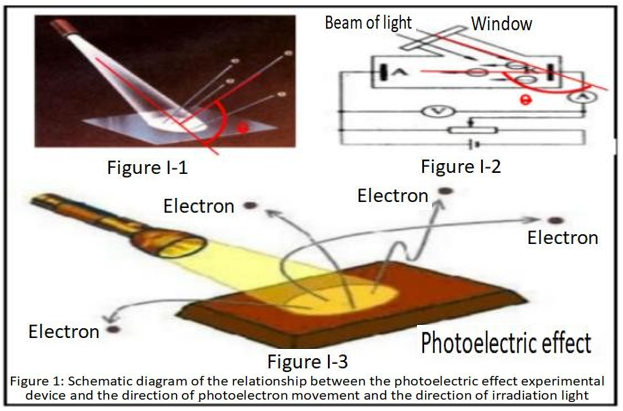
As shown in Figure 1 above, a large number of experiments have proved that in the photoelectric effect, the angle between the movement direction of photoelectrons and the irradiation direction of light can be greater than 90 degrees. According to the law of interaction between particles, the law of conservation of momentum and kinetic energy must be followed. However, it can be seen from Figure 1 that when the angle between the motion direction of the photoelectron and the irradiation direction of the light is greater than 90 degrees, if the photoelectric effect is caused by the transfer of the photon momentum and kinetic energy to the electron to increase the kinetic energy and momentum of the electron to become the photoelectron, the law of conservation of kinetic energy/momentum will be violated!
When the irradiation frequency is high to a certain extent, the number of photoelectrons does not increase but decreases with the increase of the irradiation frequency, which violates the difficulty of the law of interaction between particles
Figure 2 below shows the spectral characteristics of a photocell, that is, the relationship between the frequency of the photoelectron effect in a semiconductor and the number of photoelectrons in it. Although it is not the external photoelectric effect in the usual sense, its principle and internal factors should be the same. The frequency characteristic of a general photoelectric effect tube is also basically similar to the quasi-normal distribution curve with low ends and high middle as shown in Figure 2 below.
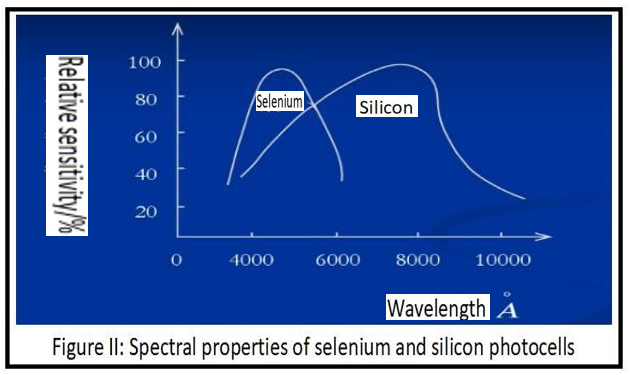
According to the law of interaction between particles, if the kinetic energy and momentum of photons increase with the increase of frequency, then in the case of the same number or density of photons, the higher the frequency of photons should be able to produce more photoelectrons rather than opposite. That is to say, the fact that the number of photoelectrons does not increase with the increase of the frequency of the irradiated light is an insurmountable obstacle to the explanation of the photoelectric effect by photons, and is also an important evidence to deny the theory of photons. To sum up, it is not feasible to explain the photoelectric effect with photons carrying momentum/kinetic energy proportional to their frequency!
Second, the essential factors of photoelectric effect are discussed
Electrons in atoms are synchrotronically accelerated by an electromagnetic field, which is responsible for the photoelectric effect
Light is a changing electromagnetic field. When light is irradiated on the metal surface, a changing electromagnetic field with the same frequency as the light will be formed on the metal surface. Therefore, when the phase of the electrons outside the atom in the metal and the frequency of the motion around the nucleus are equal or close to the frequency of the changing electromagnetic field generated by light, the electrons will be synchronously accelerated. When the electron is accelerated to a speed at which the electron can escape from the binding of the atomic nucleus, the electron will fly away from the atomic nucleus and toward the outside of the metal surface, and then it will break away from the binding of the metal surface and become a free electron, that is, a photoelectron. This creates the photoelectric effect.
The velocity distribution of molecular thermal motion is one of the main factors that determine the frequency response range of photoelectric effect
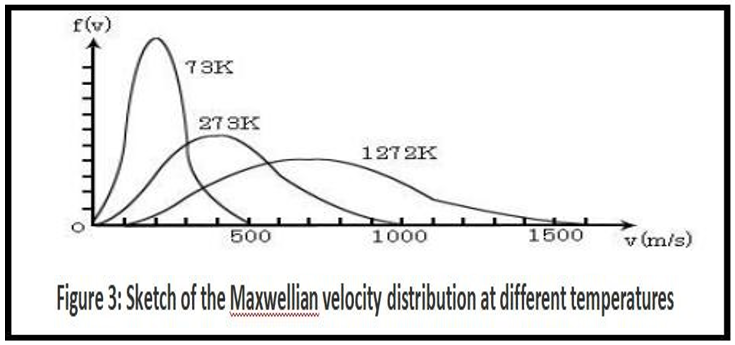
Although Maxwell's velocity distribution law is summarized from the study of molecular thermal motion of gaseous substances, the velocity distribution law of molecular thermal motion of liquid and solid substances should be similar. As shown in Figure 3 below, when the temperature of the metal plate is constant, there is a relationship similar to normal distribution between the thermal motion speed of molecules/atoms inside the metal and the number of molecules/atoms. Thus, the overall velocity of the external electrons of an atom in a metal (relative to the changing electromagnetic field produced by the illuminating light) is a superposition of the thermal velocity of the molecule/atom and the velocity of the electrons around the nucleus. When a certain frequency of light irradiates the metal surface, the number of electrons in accordance with the synchronous acceleration will also show a distribution law similar to the velocity distribution law of molecular/atomic thermal motion. That is to say, when the temperature of the metal plate is constant, there is a relationship similar to normal distribution between the number of electrons that can be synchronously accelerated to escape the metal and the frequency of the irradiation light. Although the velocity of electrons around the atomic nucleus is generally discrete and discontinuous, the overall velocity distribution of electrons relative to the changing electromagnetic field generated by light irradiation is continuous because of the continuous distribution of molecular thermal velocity. This is the reason why the photoelectric effect can be produced by illuminating light above a certain frequency.
Using Electromagnetic Field Synchrotron to Explain The Photoelectric Effect Can Easily Solve The Three Major Obstacles Encountered In The Quantum Interpretation Of Light
The Red Limit Is Only Related to Material Properties and has Nothing to do with light intensity
At a certain temperature, the velocity distribution is only related to the type of atoms in the material due to the superposition of the velocity of electrons outside the atoms of different materials and the thermal velocity of molecules. Therefore, the frequency of motion around the nucleus and the escape velocity are only related to the type of atoms in the material. This determines that the red limit is only related to the material properties, and has little to do with the light intensity.
The included angle between the photoelectron motion direction and the light irradiation direction can be greater than 90 degrees
Because of the change of electromagnetic field on the metal surface caused by the irradiation light, it is perpendicular to the direction of light irradiation. Therefore, the direction in which the electrons are accelerated is also perpendicular to the light irradiation direction. At the same time, due to the superposition of the thermal velocity of the molecule, the position at which the electron is accelerated to the escape velocity can be arbitrary. As a result, the angle between the direction of movement of the photoelectrons and the direction of illumination of the light can be any value, so that the presence of an angle greater than 90 degrees is perfectly normal.
The number of photoelectrons does not increase with the increase of the frequency of the irradiated light
Because the velocity of electrons in the atoms in the metal plate and the frequency of movement around the nucleus show a similar normal distribution with the number of atoms. Therefore, it is more and more difficult for electrons to form synchronous acceleration by irradiating light above a certain frequency, and the number of photoelectrons produced naturally will be reduced. Only illumination light with a frequency close to the frequency of electron motion around the nucleus can produce the largest number of photoelectrons. This well explains why the number of photoelectrons does not increase with the increase of the frequency of the irradiated light.
Third, the experimental scheme to verify that the photoelectric effect is synchronously accelerated by the electromagnetic field
a. The same set of photoelectric effect experimental device is used to count the number of photoelectrons produced by incident light with different frequencies. Key points: the illuminated area and position, duration, illumination intensity of the metal surface of the photoelectric tube and the temperature of the metal plate surface are basically the same (only the frequency is allowed to change, and other parameters remain unchanged) ï¼?
b. The frequency of the illuminating light should be as single as possible.
c. The frequency band of the irradiation light used in the experiment is from the radio band to the X-ray band or the higher r-ray band, but the frequency interval should be as equal as possible and should not be too large (preferably less than 1/3 of the shortest period of the electron movement around the nucleus (the highest frequency)).
d. The angle between the illuminating light and the metal surface shall preferably be not less than three cases: less than 45 Ë?, equal to 45 Ë? and more than 45 Ë?, preferably 15 Ë?, 45 Ë?, 75 Ë?, etc.
e. In the vicinity of the critical frequency (red limit), the intensity, duration and metal surface temperature of not less than five kinds of illumination light are systematically and densely measured, and the variation range of illumination intensity and duration is as large as possible.
f. The experimental data were normalized and plotted as a graph of the number of photoelectrons with parameters such as light intensity, duration, and metal surface temperature, as a function of light frequency.
Fourth, prediction of experimental results
a. When the plot of the number of electrons versus frequency shows a multi-peak phenomenon (there are different energy States for electrons moving around the nucleus in a metal). Therefore, there are different synchrotron frequencies), it can be proved that the photoelectric effect is determined by the synchronous acceleration of the electromagnetic field.
b. When electrons can still be excited when the illumination angle is greater than 45 Ë?, it can be proved that the photoelectric effect is not caused by particle collision.
c. When the illumination angle is greater than 45 Ë?, there are no excited electrons, and the higher the frequency of illumination, the more the number of electrons overflow, it can be proved that the photoelectric effect is caused by the collision of photons.
d. When the critical frequency (red limit) does not change with the intensity and duration of illumination, it indicates that the photoelectric effect is caused by the synchronous acceleration of the electromagnetic field; otherwise, it may be caused by the action of photons.
e. When the critical frequency (red limit) increases with the increase of the metal surface temperature, it indicates that the photoelectric effect is caused by the synchronous acceleration of the electromagnetic field; otherwise, it may be caused by the action of photons.
References
- Herrick, C. S. (2018). Classic field theory. World Book Publishing Company.
- Landau, L. D., & Lifshitz, E. M. (2021). The classical theory of fields. World Book Publishing Co., Ltd. (Beijing Branch).
- Chen, B. (2014). Electromagnetics. Peking University Press.
- Guo, Y. (2017). Optics (3rd ed.). Higher Education Press.
- Hu, Z., & Sun, Y. (2019). Astronomy tutorial. ShanghaiJiaotong University Press.
- Hao, J. (n.d.). A new study on the phenomena of diffraction and interference.
- Yang, F. (n.d.). New discovery in optical experiment.
- Zou, W. (2011). Analysis on the formula of blackbody radiation energy density and Wien's displacement law. Neijiang Science and Technology, 32(11), 20–55.
- Huang, Z. (2013). Eight problems affecting the development of physics. Frontier Science, 7(3), 59–85.