

Advances in Bioengineering and Biomedical Science Research(ABBSR)
ISSN: 2640-4133 | DOI: 10.33140/ABBSR
Impact Factor: 1.7

Research Article - (2023) Volume 6, Issue 2
Radium-223 Dichloride Related Toxicity in Post-Chemotherapy Castrate Resistant Prostate Cancer Patients Treated for Bone Metastases
Received Date: Feb 17, 2023 / Accepted Date: Feb 25, 2023 / Published Date: Feb 27, 2023
Copyright: ©Â©2023 Ofodire Emeka1. This is an open-access article distributed under the terms of the Creative Commons Attribution License, which permits unrestricted use, distribution, and reproduction in any medium, provided the original author and source are credited.
Citation: Ofodire, E. (2023). Radium- 223 Dichloride Related Toxicity in Post - Chemotherapy Castrate Resistant Prostate Cancer Patients Treated for Bone Metastases. Adv Bioeng Biomed Sci Res 6(2), 23-29.
Abstract
Background: Radiation pharmacokinetics and pharmacodynamics of Radium point to bone as its site of primary uptake and action. It is therefore very important to investigate the hematological and other toxicity of the radiopharmaceutical Radium -223 dichloride in the wake of its introduction for treatment of bone metastases.
Methods: Five Patients with post-chemotherapy castrate resistant prostate cancer with bone metastases received 50kBq/ kg body weight of Radium-223 Dichloride injection every 4 weeks for 5 cycles. 1. Screening 2. Treatment (including an End of Treatment Visit) 3. Follow-up
Results: The ranges of measured parameters for 4 patients at the end of 5th cycle (20th week) were within normal limits: Hb : Wk 20 = 110 -126g/l, pre-treatment = 110-136g/l (normal range 120-170) Wbc: Wk 20 = 3.3-6.2x10⁹/l, Pre-treatment=3.5-8.9x10⁹/l (normal range 4.5-10) Platelets: Wk 20 = 156-241x109/l, pre-treatment = 206-302x109/l (normal range 150-400). Alkaline Phosphatase: Wk 20 = 43-128IU/l, Pre-treatment = 57-253IU/l (normal Range 40-120). The 5th Patient developed bone marrow failure in the 12th week, with concurrent flaring of his alkaline phosphatase value.
Conclusion: The results of this study suggest that Radium-223 dichloride at dose of 50kbq/kg is safe for palliative treatment of bone pains in metastatic bone diseases. The 5th patient’s bone marrow failure cause may be attributed to several factors such as 1. Direct effect of the drug on bone tissues 2. Drug induced allergic response 3. myelosuppression worsened by concomitant radiotherapy.
Keywords
Radium – 223 Dichloride, Treatment – Related Toxicity, Bone Marrow Failure.
Introduction
The indications for targeted radionuclide therapy include exten¬sive skeletal metastases seen on nuclear medicine bone scan, when there is intolerance to prescribed analgesics or when pain is not well managed by analgesics, hormone-resistant cases [1, 2].
Radium-223, was recently introduced for the palliative treat-ment of bone pains in skeletal metastases, due to reasons which include among others: its natural bone-seeking behaviour; avail¬able means of production; short-ranged highly-energetic linear radiations which are site specific making it excellent for micro metastases; its radioimmunotherapy potentials; Gamma-rays as part of its decay which allows post-administration imaging to study its biodistribution, dosimetry and activity calibration; itsrequirements of little radiation protection issues and its potential of causing less bone marrow toxicity than beta-emitters, owing to its bone marrow-sparing as part of its therapeutic effects [3-10].
Radium was discovered by Marie Curie and Pierre Curie in 1898. The four commonly known Radium radioisotopes are-223Ra,224Ra,226Ra and228Ra. Radium recycling biokinetics models showed its re-circulation between bone surfaces and blood, and final integration into bone [11]. Biodistribution stud¬ies following Radium-223 administration showed that it was rap¬idly eliminated from blood and taken up in bone (60% at 4 hour), only about 2-3% clears through the kidneys, less than 1% clears through the liver (11) [12]. In tissue dosimetry study, absorbed doses were calculated for 25 tissues after six intravenous injec¬tions with 0.005MBq/kg of Ra-223 Chloride each equivalent to 21MBq for a 70kg patient. Bone endosteum and red blood mar-row with absorbed alpha doses of 16Gy and 1.5Gy respectively, showed the highest dose co-efficient (4) [13]. Pre-clinical stud¬ies of Radium-223 in rats showed that at high doses > 185kBq/ kg, death occur due to haemorrhage, while clinical studies in humans showed that doses less than 200kBq/kg were well toler¬ated (11) [14]. All these studies showed bone to be the primary site of uptake and action of Radium -223. It will be worthwhile to find out the treatment related toxicity of this drug, in the wake of its introduction for targeted radionuclide therapy.
This research gives a summary of the clinical findings of 5 pa-tients with metastatic castrate resistant prostate cancer who were treated with Radium -223 dichloride radionuclide therapy for bone metastases and it include their investigations and response to the therapy.
Methods And Materials
Study Design
The study was designed to assess the Radium-223 related tox-icity in Symptomatic Castrate-Resistant (Hormone Refractory) Prostate Cancer Patients with progressive bone diseases after docetaxel chemotherapy but with no significant visceral metastases.
The Patients received 50kBq/kg body weight of Radium-223 Di-chloride (Alpharadin) injection at intervals of every 4 weeks for up to 5 cycles.
The research was divided into three different periods:
1. Screening
2. Treatment (including an End of Treatment Visit)
3. Follow-up The study was sponsored by Bayer Healthcare AG (D-51368 Leverkusen, Germany from November 2012 to August 2014 and was carried out at the London Clinic in line with the World Medical Association Declaration of Helsinki (1964) and Good Clinical Practice Principles [15]. The research protocol was re-viewed and given approval by the National Research Ethics Ser-vice (NRES) Committee.
The purpose, design, potential risks and benefits of the research, were fully explained to the patients [16]. Each of the patients was issued with the Participant Information Sheet which has the research design protocol that was adhered to throughout the re¬search period, and they all signed the informed consent forms (15).
Patients
Five (5) male patients with ages between 67 and 73 years were involved in the study. All of the patients had castrate resistant prostate cancer with bone metastases and they have all received prior chemotherapy treatments.
They weighed between 77 to 104 kg and were referred from the Urology Oncology MDT.
Screening
After signing of the consent form, patients went through series of investigations to ensure they were eligible to participate in the research.
About 15ml of each patient's venous blood were obtained to investigate their pre - radionuclide therapy blood counts (Hb, Wbc, Platelets), blood chemistry alkaline phosphatase (ALP), serum testosterone and prostate specific antigen (PSA).
Pre- Treatment Scintigraphy
The pre-treatment whole body scans were carried out with 99mTc MDP whole body scintigraphy using the dual head Gam-ma camera with LEHR Collimator and +/- 20% energy window centred at about 140keV photo peaks.
Treatment
50kBq/kg body weight of Radium-223 Dichloride (Alpharadin) sterile injections were given intravenously to each patient during each visit cycle. Drug is safe to administer with little radiation protection measures.
Post-Treatment Follow-Up
The essence of the follow-up was to study 1) patients’ response to study drug 2) long term effects of the study drug 3) disease progression and 4) survival status. The follow-up visits include the
1. end of treatment visit
2. active follow-up phase
3. long-term follow-up periods (15).
Results and Analysis
Results Documentation and Statistical Analysis
The results of the study were analysed using simple tables, charts and graphs. Analysis of the data was carried out with SPSS sta-tistical software.
TABLE 1. Hemoglobin (Hb), White Blood Cells (wbc), Platelets and Alkaline Phosphatase (ALP) Profiles of Patients in Pre – Treatment, Week 4, Week 8, Week 12, Week 16 and Week 20 of Radium -223 Dichloride Treatment.
Radium - 223 Dichloride (Alpharadin) in Castration - Resistant(Hormone-Refract) Prostate Cancer Patients With Bone Metastases. Sponsor's Protocol Code Number: BAY88-8223/16216. Link: https://www.clinicaltrialsregister.eu/ctr-search/trial/2012-000075-16/ GB [17].
|
patient No |
Age |
Weight (Kg) |
Post Chem |
Skel Met |
Pre Hb |
Wbc |
Platelet |
ALP |
PSA |
|
1 |
67 |
101 |
Y |
2 |
110 |
6.5 |
258 |
253 |
158 |
|
2 |
67 |
98 |
Y |
3 |
135 |
3.5 |
206 |
123 |
932 |
|
3 |
73 |
89 |
Y |
2 |
122 |
4.8 |
235 |
57 |
13.6 |
|
4 |
71 |
77 |
Y |
3 |
136 |
8.9 |
302 |
126 |
83.9 |
|
5 |
67 |
104 |
Y |
4 |
112 |
6.7 |
175 |
303 |
571.5 |
|
WK 4 |
Hb |
Wbc |
Platelet |
ALP |
PSA |
WK8 |
Hb |
Wbc |
Platelet |
ALP |
PSA |
|
|
105 |
3.3 |
177 |
105 |
|
|
105 |
4 |
208 |
76 |
264.6 |
|
|
115 |
6.2 |
230 |
77 |
|
|
118 |
6.2 |
215 |
62 |
|
|
|
117 |
3.7 |
265 |
53 |
|
|
118 |
4.4 |
200 |
46 |
11 |
|
|
130 |
9.7 |
258 |
115 |
|
|
129 |
10.5 |
264 |
139 |
316.6 |
|
|
117 |
3.4 |
171 |
193 |
498.3 |
|
116 |
6 |
145 |
143 |
492 |
|
WK12 |
Hb |
Wbc |
Platelet |
ALP |
PSA |
WK16 |
Hb |
Wbc |
Platelet |
ALP |
PSA |
|
|
103 |
3.5 |
188 |
|
|
|
88 |
3.8 |
169 |
56 |
|
|
|
120 |
4.1 |
230 |
52 |
|
|
121 |
4.1 |
249 |
61 |
786.79 |
|
|
115 |
3.8 |
231 |
58 |
|
|
118 |
3.6 |
213 |
38 |
|
|
|
124 |
8.9 |
244 |
137 |
|
|
122 |
6.9 |
222 |
135 |
|
|
|
9.2 |
5.5 |
142 |
290 |
|
|
8.9 |
4.2 |
139 |
168 |
345.7 |
|
WK20 |
Hb |
Wbc |
Platelet |
ALP |
PSA |
|
|
110 |
4 |
156 |
55 |
209 |
|
|
119 |
5.1 |
223 |
53 |
767.8 |
|
|
114 |
3.3 |
194 |
43 |
|
|
|
126 |
6.2 |
241 |
128 |
|
|
|
8.3 |
3.9 |
128 |
141 |
|
Only the results of 5 cycles (4 weekly courses for 20 weeks) of Radium -223 treatment were available for each patient at the time of submission of this research report, and these were com-puted for analysis.
The PSA results of the patients in the treatment cycles were not imputed in the analysis as PSA tests were not routinely carried out for the patients during the radium treatment and available results were very irregular (17).
TABLE 2. Skeletal Metastases Scores and Pain Responses of Patients during the Radium – 223 Dichloride Treatment.
Radium - 223 Dichloride (Alpharadin) in Castration - Resistant(Hormone-Refract) Prostate Cancer Patients With Bone Metastases. Sponsor's Protocol Code Number: BAY88-8223/16216. Link: https://www.clinicaltrialsregister.eu/ctr-search/trial/2012-000075-16/ GB (17).
|
Patient number |
Age |
Weight (kg) |
Post Chemo |
Skeletal Met Score |
Pain Response |
|
1 |
67 |
101 |
Yes |
2 |
Complete |
|
2 |
67 |
98 |
Yes |
3 |
+ ve up to wk 20 |
|
3 |
73 |
89 |
Yes |
2 |
No bone pain |
|
4 |
71 |
77 |
Yes |
3 |
Partial |
|
5 |
67 |
104 |
Yes |
4 |
Minor improve |
SKELETAL METASTASES SCORES
1 = < 6
2 = 6 to 20
3 = > 20
4 = Superscan
Patient 1 Profile:
Patient Characteristics:
Patient 1 is a 67-year-old post-chemo-therapy male who weighed 101kg with pre-treatment skeletal metastases score of 2.
Study Compliance and Survival:Patient was compliant with the study as at time of result analysis.
Safety: the safety profile of the study drug was satisfactory as patient recorded no serious adverse effects at the injected dose.
Efficacy: Patient recorded complete pain response
Skeletal – Related Events: Not noted
Other Important Events: Patient received 2 units of blood in the 16th week after an operation to replace bilateral ureteric stent and maintained his Hb afterward and remained well.
Haematological Profile:
Hb analysis summary: Patient had the highest Hb decrease of 22g/l or 20% from its pre-treatment value in the 16th week after an operation to replace ureteric stents.
Wbc analysis summary: Patient had the highest decrease which was very sudden (approximately 50%) in wbc after the first treatment from 6.5 x 10⁹ /l to 3.2 x10⁹/l in 4th week.
Platelet analysis summary: Patient had the highest overall and inter-cycle platelet decrease of 81 or 28.9% of pre-treatment in the 1st cycle of treatment from 258 to 177x109/l.
Alkaline phosphatase analysis summary: ALP achieved its highest overall and inter-cycle decrease in the 4th week. This proportional decrease is equally the highest of all the measured parameters. ALP achieved sustained decrease throughout the cy¬cle unlike the other parameters. Alkaline phosphatase has the highest variance as well as standard deviation of all the mea¬sured parameters.
Patient 1: Summary
The Wbc, platelets and alkaline phosphatase showed greatest re-sponse to the first course of radium treatment by been reduced to approximately half of their pre-treatment values, with alkaline phosphatase showing the greatest response of all, been reduced to more than half of its pre-treatment value. These results were correlated by the patient’s absolute and complete pain resolution with the treatment at the particular dose of 50kb/kg. This showed the instantaneous effects of the radium treatment on tumor cells with lesser effects on bone marrow cells.
The least effects were noticed on the red blood cells, either be-cause radium has no serious effects on the bone marrow cells or, it could be presumed that the effects were buffered by the circu¬lating red blood cells which have a life span of between 90 to 120 days (12-16 weeks) because the most marked effects (sud¬den decrease) became noticeable during 12 – 16 weeks period unlike what was obtained with the other indices whose greatest responses were in the first treatment cycle. Though it has been noted that patient had operation within same period a more like¬ly explanation for the sudden decrease.
But despite this sudden change, the effects (decrease) on red blood cells (15g/l or 14.6%) were of lesser significance com-pared to that seen in the ALP which showed >50% decrease in the first course of treatment confirming that the greatest effects of radium treatment were outside the bone marrow.
The effects on the marrow cells can be offset by tissue mediated responses and blood transfusion unlike the alkaline phosphatase whose decrease was unmitigated throughout the cycle.
The continuous decrease in platelets even after transfusion is a pointer to marrow suppression. The short life span of circulating platelets of about 9 days and even shorter life span of transfused platelets of about 3 days necessitate platelets re-transfusion ev¬ery 2 to 3 days.
The anti-tumor and bone pain palliation effect of radium 223 was very much depicted in the change in alkaline phosphatase enzyme from its pre-treatment very high level of 253IU/l to within normal level 105IU/L (normal range 40IU -120IU) in the 4th week first treatment cycle correlating with observed com¬plete symptomatic response in patient.
Patient 2 Profile:
Patient characteristics: Patient 2 is a 67-year-old post-chemo-therapy male who weighed 98kg with pre-treatment skeletal me-tastases score of 3.
Study Compliance and Survival: Patient was compliant with the study as at time of result analysis.
Safety: the safety profile of the study drug was satisfactory as patient recorded no serious adverse effects at the injected dose.
Efficacy: Patient recorded positive pain response up to the 20th week.
Skeletal – Related Events: there was increased local pain at right hip at 20th week requiring external beam radiotherapy.
Haematological Profile:
Patient 3 Profile:
Patient characteristics: Patient 3 is a 73-year-old post-chemo-therapy male who weighed 89kg with pre-treatment skeletal me-tastases score of 2.
Study Compliance and Survival: Patient was compliant with the study as at time of result analysis.
Safety: the safety profile of the study drug was satisfactory as patient recorded no serious adverse effects at the injected dose.
Efficacy: Patient 3 had no bone pain before, during or after treat¬ment.
Skeletal – Related Events: Not noted
Haematological Profile:
Patient 4 Profile:
Patient characteristics: Patient 4 is a 71-year-old post-chemo-therapy male who weighed 77kg with pre-treatment skeletal me-tastases score of 3.
Study Compliance and Survival: Patient was compliant with the study as at time of result analysis.
Safety: the safety profile of the study drug was satisfactory as patient recorded no serious adverse effects at the injected dose
Efficacy: Patient had partial pain response.
Skeletal – Related Events: patient had severe unremitting lum-bosacral pain and had external beam radiotherapy to the lumbar spine between week 8 to 12. No pain elsewhere.
Haematological Profile:
Patient 5 Profile:
Patient characteristics: Patient 5 is a 67-year-old post-chemo-therapy male who weighed 104kg with pre-treatment skeletal metastases score of 4 (Superscan).
Study Compliance and Survival: Patient was compliant with the study as at time of result analysis.
Safety: the safety profile of the study drug was satisfactory as patient recorded no serious adverse effects at the injected dose.
Efficacy: Patient recorded minor pain improvement during the course of treatment.
Skeletal – Related Events: Patient developed spinal cord com-pression and needed external beam radiotherapy.
Other Important Events: He had bone marrow failure and be-came transfusion dependent. Also, there was a two months gap between cycle 3 and 4 as patient developed spinal cord compres-sion and needed external beam radiotherapy.
Patient 5 Haematological Profile:
Hb analysis: Patient’s Hb suddenly decreased by 106.8g/l (92% of 8th week, 95.4% of pre-treatment, 172.5% of mean) to 9.2g/l (14.86% of mean, 8.2% of pre-treatment) in the 12th week (3rd cycle), from the 8th week value of 116g/l (187% of mean value 61.9g/l, 103.6% of pre-treatment).
The Hb decrease continued by 0.3g/l from 9.2g/l in the 12th week to 8.9g/l in the 16th week (4th cycle). Patient was trans-fused 2 units of blood in the 16th week, but the Hb continued on the decrease by 0.6g/l to 8.3g/l in the 20th week. Patient was transfused another 2 units of blood in the 20th week and was transfusion dependent at time of write-up.
Wbc analysis: Patient Wbc decreased from the pre-treatment value of 6.7(1.75 or 35.4% >mean value 4.95 x 10⁹/l) to 3.4(1.55 or 31.3%
Platelet analysis: Patient pre-treatment platelet level of 175 (16.7%>mean) decreased by 4 to 171 in the 4th week, this value decreased further by 26 (15.2% of 4th week value, 14.9% of pre-treatment, 17.3% of mean) to 145 in the 8thweek, then 142 in the 12th week, 139 in the 16th week and finally 128 in the 20th week.
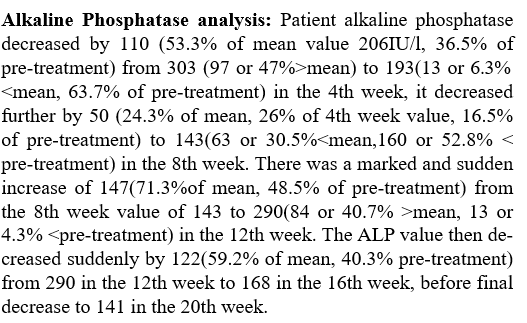
Alkaline Phosphatase Analysis Summary: there was a sudden reduction in alkaline phosphatase level in the 4th week from 303IU/l to 193IU/l compatible with radium 223 treatment re-sponse. There was a sudden rise in the alkaline phosphatase lev¬el (ALP flare) from 143 to 290 in the 12th week of treatment suggestive of extensive bone tissues response to treatment or decompensation.
Patient 5: Summary Patient 5 has the most advanced form of the metastatic bone disease among the 5 patients studied (Superscan). The patient showed minimal symptomatic response to the radium treatment. The efficacy of the radium treatment is not in doubt as shown by the decrease in level of the tumor marker indices in the 4th week (1st cycle).
Patient Hb increased from its pre-treatment value of 112g/l to its 4th week value of 117g/l while the Wbc and ALP decreased by about 50% of its pre-treatment in the 4th week showing once again that the radium treatment has lesser effects on the red blood marrow.
The Hb suddenly decreased from 116g/l in the 8th week to 9.2g/l in the 12th week with a corresponding sudden increase in alka-line phosphatase from 143IU/l to 290IU/l at the same interval, points to the fact that extensive reaction to treatment in metastat¬ic bone disease may cause marrow suppression.
The capacity of radium-223 itself to directly cause bone mar-row failure is not in doubt as suggested by its radiation physics, chemistry, biology and epidemiology [18] [19] [20] [21] [22]. But its capacity to cause such sudden marrow failure at the ther¬apeutic dose of 50kbq/kg casts serious doubt.
This is because of the established time- and dose- dependent relationship between Radium and its effects, which are cumula¬tive, and threshold dependent respectively, as well as its targeted biologic activity.
Discussion
Results findings and analysis summary showed that while somepatients responded positively to the treatment others showed partial or minimal symptomatic response.
The safety profile and therapeutic efficacy of the study drug in regard to the measured parameters at the administered dose were satisfactory because apart from patient 5 who developed bone marrow failure at the 12th week from cause not directly related to the toxic effects of the study drug, all the measured parameters of the remaining four patients were within normal limits at the end of the fifth cycle of treatment.
The ranges of the measured parameters for the four patients at the 20th week were:
Hb : Wk 20 = 110 -126g/l, pre-treatment = 110-136g/l (normal range 120-170)
Wbc: Wk 20= 3.3-6.2x10⁹/l, Pre-treatment=3.5-8.9x10⁹/l (nor¬\mal range 4.5-10)
Platelets: Wk 20 = 156-241x109/l, pre-treatment = 206-302x109/l (normal range 150-400).
Alkaline Phosphatase: Wk 20 = 43-128IU/l, Pre-treatment = 57-253IU/l (normal Range 40-120).
These ranges of the haematological parameters in general at the 20th week of treatment do not reflect significant deviation from the pre-treatment and normal values. Measured alkaline phos¬phatase values at 20th week showed the greatest variance and for the four patients were within normal limits. There was a <5% re¬duction in the Hb of all the patients in the 1st cycle of treatment and <10% difference between the pre-treatment Hb and the end of 5th cycle Hb levels for the 1st four patients.
The role of elevated ALP as a marker of disease extent and sever¬ity was shown by the 3rd patient who had the least severe form of the disease with the lowest score of 2. The 3rd Patient had the lowest pre-treatment ALP level of 57IU/l which decreased to a 20th week value of 43IU/l. He was the oldest of all the treated patients (73 years), had no bone pain before, during and after treatment and had the most stable of all the measured parameters of Hb, Wbc, Platelets and ALP of all the five treated patients.
The results of the study bear correlation to those obtained in oth¬er studies like the phase II study of radium-223 chloride for pal¬liation of painful bone metastases [23] [24] [25], which showed that reduction in platelet, white blood cell and neutrophil counts tend to occur in the first two weeks following radium treatment and later returned to baseline levels. A randomised, Double-blind, Dose – Finding, Multicenter, Phase 2 study of Radium 223 Chloride in patients with Bone metastases and castration-resistant prostate cancer showed a > 50% decrease in baseline bone ALP in 67% of patients who re¬ceived 3 injections of 50kBq/kg dose of Radium 223 at 6 weekly intervals as against 16% in those who received 25kBq/l and 66% in those that received 80kBq/kg within the same interval [26]. Hence confirming the efficacy of the administered injection of 50kBq/kg Radium 223 in the research study. Also of comparable dimensions are the results of the phase III clinical trial of radium 223 chloride [27].
Patient 5 had the most advanced form of the disease of all the treated cases and apparently least response of all. He had meta¬static spinal cord compression after the 3rd cycle and required radiotherapy. The sudden flare of the Wbc from its 4th week val¬ue of 3.4 x 10⁹/l to 6.0 x 10⁹/l in the 8thweek (approximately twice its 4th week value) just before the sudden reduction in Hb value with corresponding flare in ALP value suggest reactionary features or myelotoxicity.
This research has some limitations which include small sample size, absence of controls, non-randomization, non-input of PSA values in the analysis, restriction of detailed analysis to patient 1 and 5, interruptions in some patients’ treatment due to oth¬er events and interventions, absence of post-treatment scans to correlate findings, restriction of study to 5 cycle values rather than the conventional 6 cycles, variations in patient’s ages and weights etc.
However, the findings of this research may be useful in predict¬ing patients with metastatic bone diseases treatment response to Radium-223 dichloride targeted radionuclide therapy. Thereby equipping managing physicians with some knowledge on what to expect during the course of this therapy.
Conclusion
This study findings showed the results and responses of 5 cas-trate resistant prostate cancer patients managed for bone me-tastases with the novel radiopharmaceutical Radium – 223 di-chloride (Alpharadin), with the study patients showing various degrees of response.
The measured parameters of 4 patients were within normal lim¬its at the end of the 5th cycle of treatment. The 5th Patient de¬veloped bone marrow failure in the 12th week, with concurrent flaring of his alkaline phosphatase value, the cause may be attributed to several factors.
Oncology physicians will be equipped with information on what to expect in the course of management of advanced cancer pa¬tients with metastatic bone diseases with Radium -223 dichlo¬ride therapy, through this study.
Acknowledgement
I wish to thank the staff of the department of Nuclear Medicine King’s College London, for their support and assistant through¬out the research period.
References
- Tomblyn, M. (2012). The role of bone-seeking radionuclides in the palliative treatment of patients with painful osteoblastic skeletal metastases. Cancer Control, 19(2), 137-144.
- Cook J R C, Maisey M N, Britton K E et al. (2006). Clinical Nuclear Medicine 4th Edition, 766-769.
- Cheetham, P. J., & Petrylak, D. P. (2012). Alpha particles as radiopharmaceuticals in the treatment of bone metastases: mechanism of action of radium-223 chloride (Alpharadin) and radiation protection. Oncology, 26(4), 3303
- Bruland, O. S., Jonasdottir, T. J., Fisher, D. R., & Larsen, R.H. (2008). Radium-223: From radiochemical development to clinical applications in targeted cancer therapy. Current Radiopharmaceuticals, 1(3), 203-208.
- Seidl, C. (2014). Radioimmunotherapy with α-parti-cle-emitting radionuclides. Immunotherapy, 6(4), 431-458.
- Michael R M, George S, Ronald D F, et al. (1998). Radioimmunotherapy with alpha-emitting nuclides. European journ of nucl med, 25(9), 1341-1351.
- Report on licensing for Radium-223 Dichloride. Nuclear regulatory commission (NRC), Advisory committee on the medical uses of isotopes (ACMUI) November 20,2012.
- Lewington, V., Lamey, R., Staudacher, K., & Vogelzang, N. (2012). Radium-223 chloride: Radiation safety, tolerability, and survival gain in patients with castration-resistant prostate cancer (CRPC) and bone metastases.
- Nilsson, S., Parker, C., Biggin, C., & Bruland, O. (2010). Clinical experience and radiation safety of the first-in-class alpha-pharmaceutical, alpharadin (radium-223) in patients with castration-resistant prostate cancer (CRPC) and bone metastases. International Journal of Radiation Oncology, Biology, Physics, 78(3), S375-S376.
- Harrison, M. R., Wong, T. Z., Armstrong, A. J., & George,D. J. (2013). Radium-223 chloride: a potential new treatment for castration-resistant prostate cancer patients with metastatic bone disease. Cancer management and research, 1-14.
- Sgouros, G., Roeske, J. C., McDevitt, M. R., Palm, S., Al-len, B. J., Fisher, D. R., ... & Akabani, G. (2010). MIRD pamphlet no. 22 (abridged): radiobiology and dosimetry of α-particle emitters for targeted radionuclide therapy. Journal of nuclear medicine, 51(2), 311-328.
- Lewington, V., Parker, C., Hindorf, C., Flux, G., Chittenden, S., Sgouros, G., ... & Aksnes, A. (2010). Radium-223 chloride, a first-in-class alpha-pharmaceutical for patients with castration-resistant prostate cancer (CRPC) and bone metastases: Biodistribution/dosimetry compared to overall safety profile. Journal of Clinical Oncology, 28(15_suppl), e15009-e15009.
- Lassmann, M., & Nosske, D. (2013). Dosimetry of 223 Ra-chloride: dose to normal organs and tissues. European Journal of Nuclear Medicine and Molecular Imaging, 40, 207-212.
- Bruland, Ø. S., Nilsson, S., Fisher, D. R., & Larsen, R. H. (2006). High-linear energy transfer irradiation targeted to skeletal metastases by the α-emitter 223Ra: adjuvant or alternative to conventional modalities?. Clinical cancer research, 12(20), 6250s-6257s.
- Guy's and St Thomas' Oncology and Haematological Clinical Trials Participant Information Sheet - Study 16216. Protocol: BAY 88-8223/16216.
- Therapeutic use of XofigoR Procedure Checklist. Bayer HealthCare Pharmaceutical Inc. Reference ID: 3308326.
- Radium - 223 Dichloride (Alpharadin) in Castration - Resis-tant(Hormone-Refract) Prostate Cancer Patients With Bone Metastases. Sponsor's Protocol Code Number: BAY88-8223/16216.
- Harrison, J. D., & Muirhead, C. R. (2003). Quantitative comparisons of cancer induction in humans by internally deposited radionuclides and external radiation. International journal of radiation biology, 79(1), 1-13.
- Internalized alpha-particle emitting radionuclides. International agency for research on cancer 2001.
- Rowland, R. E. (1994). Radium in humans: a review of US studies. Argonne, IL: Argonne National Laboratory. Environmental Research Division..
- Larsen, R. H., Saxtorph, H., Skydsgaard, M., Borrebaek, J., Jonasdottir, T. J., Bruland, Ø. S., ... & Ramdahl, T. (2006). Radiotoxicity of the alpha-emitting bone-seeker 223Ra injected intravenously into mice: histology, clinical chemistry and hematology. In vivo, 20(3), 325-331.
- Hobbs, R. F., Song, H., Watchman, C. J., Bolch, W. E., Ak-snes, A. K., Ramdahl, T., ... & Sgouros, G. (2012). A bone marrow toxicity model for 223Ra alpha-emitter radiopharmaceutical therapy. Physics in Medicine & Biology, 57(10), 3207.
- Nilsson, S., Strang, P., Aksnes, A. K., Franzèn, L., Olivier, P., Pecking, A., ... & Bruland, Ø. S. (2012). A randomized, dose–response, multicenter phase II study of radium-223 chloride for the palliation of painful bone metastases in patients with castration-resistant prostate cancer. European journal of cancer, 48(5), 678-686.
- Algeta’s phase II clinical study data for AlpharadinTM in prostate cancer published in lancet oncology. Press release, life sciences news and events.
- Nilsson, S., Franzén, L., Parker, C., Tyrrell, C., Blom, R., Tennvall, J., ... & Bruland, Ø. S. (2007). Bone-targeted radi-um-223 in symptomatic, hormone-refractory prostate cancer: a randomised, multicentre, placebo-controlled phase II study. The lancet oncology, 8(7), 587-594.
- Parker, C. C., Pascoe, S., Chodacki, A., O'Sullivan, J. M.,Germá, J. R., O’Bryan-Tear, C. G., ... & Hoskin, P. (2013). A randomized, double-blind, dose-finding, multicenter, phase 2 study of radium chloride (Ra 223) in patients with bone metastases and castration-resistant prostate cancer. European urology, 63(2), 189-197.
- Parker, C. A., Nilsson, S., Heinrich, D., Helle, S. I., O'sulli-van, J. M., Fosså, S. D., ... & Sartor, O. (2013). Alpha emitter radium-223 and survival in metastatic prostate cancer. New England Journal of Medicine, 369(3), 213-223.