



Review Article - (2026) Volume 3, Issue 1
Quantitative Simulations on Temperature-Dependent Lattice Thermal Capacity of Linear, Branched and Cyclic Polymers

Received Date: Jul 21, 2026 / Accepted Date: Aug 24, 2026 / Published Date: Sep 02, 2026
Copyright: ©2026 Valeri Ligatchev. This is an open-access article distributed under the terms of the Creative Commons Attribution License, which permits unrestricted use, distribution, and reproduction in any medium, provided the original author and source are credited.
Citation: Ligatchev, V. (2026). Quantitative Simulations on Temperature-Dependent Lattice Thermal Capacity of Linear, Branched and Cyclic Polymers. Ther Res: Open Access, 3(1), 01-40.
Abstract
Effects of spatial confinement, and interactions among neighboring molecular fragments, as well as amendments in topological characteristics are taken into account explicitly at semi-empirical quantitative evaluations on temperature-dependent isochoric lattice thermal capacity of several one-dimensional (linear), branched and ‘cyclic’ polymeric macromolecules, in order to replicate compellingly their experimentally obtained temperature-dependent isobaric counterparts. Those experimental dependencies might exhibit ‘sublinear’, nearly-linear, and ‘super-linear’ enlargement(s) with the temperature within ‘moderate’ temperature ranges alongside with so-called ‘low-temperature anomalies’, which are persistently manifested in profound decline(s) in the lattice thermal capacities with the temperature diminishment below the ‘moderate’ ranges. The obtained lengths of the spatial confinement of acoustic phonons located within the liner and branched polymers are compared with the Kuhn and persistent lengths of the linear, branched and cyclic polymers, while other simulation results are discussed in comparison with predictions of the ‘fractal theory’ of heat capacity of polymers, Tarasov’s equations, as well as with those of the ‘free energy of confinement’ approximation.
Keywords
Harmonic, Anharmonic, Thermal, Capacity, Low-Dimensional, Polymers
Introduction
Physical properties of polymeric solids comprised of linear (1D), branched, two-dimensional, 2D, and 3D macromolecules are of key importance for many of their essential application areas: materials engineering and science, medical and biomedical usages, chemistry, etc. Those polymeric solids are customarily comprised of adjoined repetitive (monomeric) molecular units, aggregated into macromolecules, though – in general – their atomic structure(s) might appear either in crystalline and/or amorphous (glassy) modifications, or even as a combination of those [1-3]. Structural and topological characteristics of individual macromolecules (chains) are of primarily importance for the linear ‘molecular wires’ (MWs), quasi-crystals comprised of (interacting) 1D MWs, and even for branched polymers, whereas for the 2D and 3D polymeric solids, planar and spatial interconnections among their macro-molecules as well as morphological characteristics of entire solids (e.g., their shape, sizes, crystalline orientation – if any) might be of crucial significance as well. Therefore, structural, topological and statistical characterization of linear, branches and globular macro-molecules (MWs) became attractive scientific topic in the second half of the twenty’s century.
In particular, both before beginning and especially soon after ending of the World War II, intensive experimental and theoretical investigations on the structural, mechanical, energetic, thermal, and others fundamental characteristics of polymers yielded in several celebrated theoretical concepts: freely joint and freely-rotating ideal chain ones, hindered rotation model, rotational isomeric state model, warm-like (Kratky-Porod) chain model, Flory’s characteristic ratio(s) (FCRs) and length, Kuhn length (KL), which is representing ‘statistical segment’ in a polymer chain (MW), and ‘…characterizing crossover to the large-scale random-walk behavior…’, persistence length (PL), which is the ‘…distance over which orientations of the bonds persists…’, radius of gyration (RG), excluded volume and self-avoiding walk, Stockmayer-Hecht model (and its Genensky-Newel extension) for vibrational spectrum of 1D crystals with realistic phonon dispersion, and ‘embedded’ interactions among neighboring MWs, as well as Tarasov’s equations for thermal capacity of layered and chain polymeric structures, alongside with others fundamental models closely related to them [4-10]. Extended discussion(s) on archetypal features of some of the aforementioned approximations are provided in the second section. Though those approximations rather represent idealized structural, topological, and spectral characteristics of low-dimensional polymeric materials, they became tremendously beneficial for deep understanding and appropriate interpretations of many key physical concepts and properties of both real and idealized chain and branched polymers with essentially different spatial extents (lengths) and topology (connectivity) among their monomers and macromolecules.
Though aforementioned spatial characteristics of idealized solid and liquids polymers comprise ‘…wide range…’ of their physically meaningful specific lengths, those characteristics customarily do not include explicitly length (spatial extent) of the confinement of thermal acoustic and optical vibrations (phonons), in spite of its very obvious significance for various thermal characteristics of polymeric materials. For instance, key features of thermal transport in high-quality bulk crystalline semiconductors and insulators are defined evidently by the phonon-phonon interactions, while phonon scattering on point and linear defects might affect considerably parameters of thermal transport in real semiconductors and insulators as well [7,11,12]. In other words, phonon(s) Mean-Free-Path (MFP) – or their ‘coherence length’ – became among the key characteristic lengths of those bulk material, while so-called ‘Casimir length’ (CL)– which apparently simply coincides with the (appropriate) spatial extent of nano-crystals, nano-flakes, nano-ribbons, nano-wires, ‘quantum dots’, etc. – came to be of key importance for thermal transport of aforementioned nano-scaled materials [13-15].
Nonetheless, it is not very clear even up to now, which of the mentioned above (and discussed briefly, for instance, elsewhere in ref. [7] .) well-established structural (topological, morphological) characteristic lengths of idealized and real linear polymers as well as those of branched ones actually defines their MFP and/or confinement length of their acoustic and optic phonons? Furthermore, those confinement lengths (spatial extents) – alongside with other purely ‘geometrical’ characteristics of inter-chain interactions in 1D polymeric quasi-crystals – affect very straightforwardly particularities of other crucial (for thermal transport and heat capacity) features of those polymers: their Vibrational Density-Of-States (VDOS) functions, phonon dispersion relation(s), etc. This misapprehension impedes considerably appropriate understanding of some intriguing features of experimentally evaluated dependencies on isobaric thermal capacities of real linear and branched polymers: tenacious appearance of so-called ‘low-temperature’ anomalies [16] (see also references therein), as well as those of ‘sub-linear’ and ‘super-linear’ enlargement with the temperature within moderate temperature ranges, etc. [7-9,16,17]. Those common features might be manifested as well in similar dependencies of the real linear and branched polymers composed of essentially different structural ‘blocks’: e.g., ‘aromatic’ and (for instance) ‘5-member’ and/or ‘7-member’ rings, different types of the ‘backbone’ chains, ‘terminal groups’, with and without incorporated oxygen and nitrogen atoms, etc.: see some discussion on this issue with particular examples of those polymers in the second section.
This article is predominantly devoted to semi-empirical simulations and, detailed discussion(s) on effect(s) of alteration(s)s in key structural, topological and morphological features of linear and branched polymers as well as of changes in their other key physical characteristics on the modelled temperature-dependent heat capacity and comparison of those simulated dependencies with their experimental counterparts reported for several different types (linear, branched, cyclic) of real polymeric materials. Details of implemented simulation approach are described at the beginning of the third section of the article.
Obtained simulation results (also presented and discussed in the third and fourth sections of this article), intend to clarify some outstanding issues on the actual physical significance of the mentioned above in this section renowned theoretical approximations and their connection(s) to the structural, topological, morphological, and spectral features on the thermal characteristics of real linear and branched polymers [1-10]. In particular, intimate interrelation among amendments in length of spatial confinement of quantized vibrations (phonons) in those real linear, branched and cyclic polymers, and, especially, particularities of their simulated and experimental temperature-dependent thermal capacity, will be discussed (to some extent) in connections with the well-documented changes in the mentioned above renowned structural and statistical characteristics of those low-dimensional polymers. Thus, combination of aforementioned well-established theoretical approximations, with more realistic (and yet innovative) simulation techniques is generally expected not only allow one to replicate convincingly representative features of the experimental temperature dependencies of their lattice heat capacities in wide temperature ranges, but also articulate crucial physical parameters and key spatial extents of those well-known structural models in order to clarify further their fundamental essences in a wider physical context, protracted well beyond their original (i.e., predominantly classical, ‘geometrical’ and/or statistical) meanings [7,16].
Some Archetypal Structural and Morphological Models of Low-Dimensional Polymers
Mentioned in the previous section ‘standard’ structural model(s) of linear polymer(s) might be (formally) separated into two groups: those linked (in one or another ways) to real ‘discrete’ atomic and/or molecular structures of their monomers (molecular units), and essentially idealized continuous models [1-3]. Aforementioned differences are crucial for ‘flexibility mechanisms’ and/or those of conformation of linear and branched polymeric chains (MWs) with dominant rotations of ‘discrete’ inter-atomic bonds around elongated spatial direction(s) of linear chains (i.e., variation in torsion angles) for the first group, or bending of entire continuous chain on (for instance) a 2D plane. It is noteworthy, that both aforementioned models are ‘composed’ rather based on the idealized continuous representation(s) of the ‘backbone’ and ‘branch’ chains, than on their more realistic ‘discrete’ (atomistic) representation(s) [1].
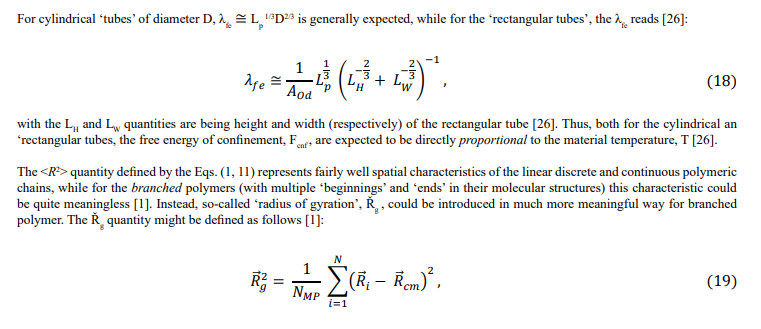
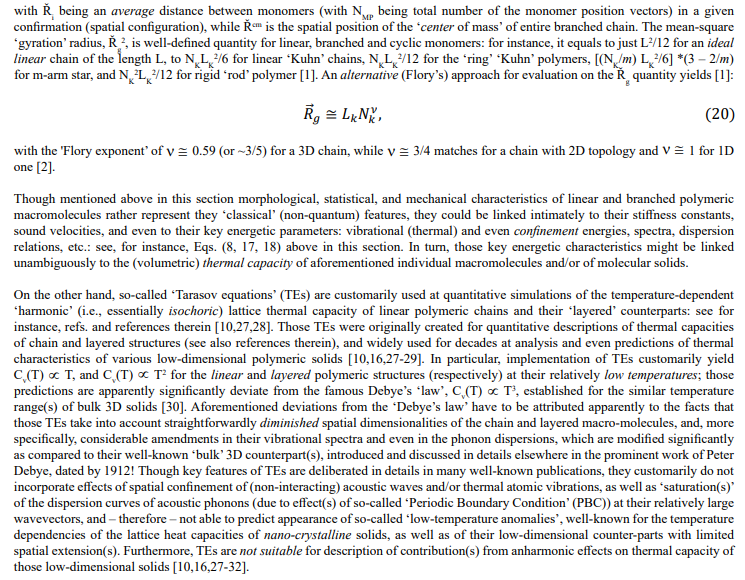
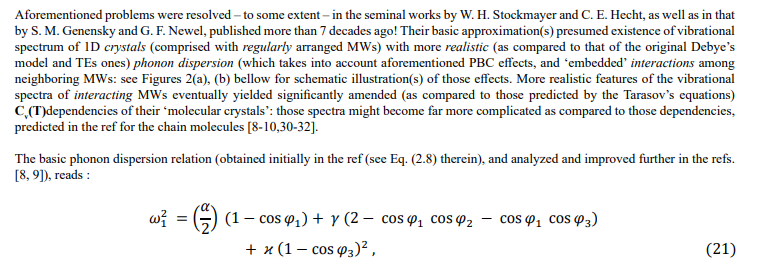
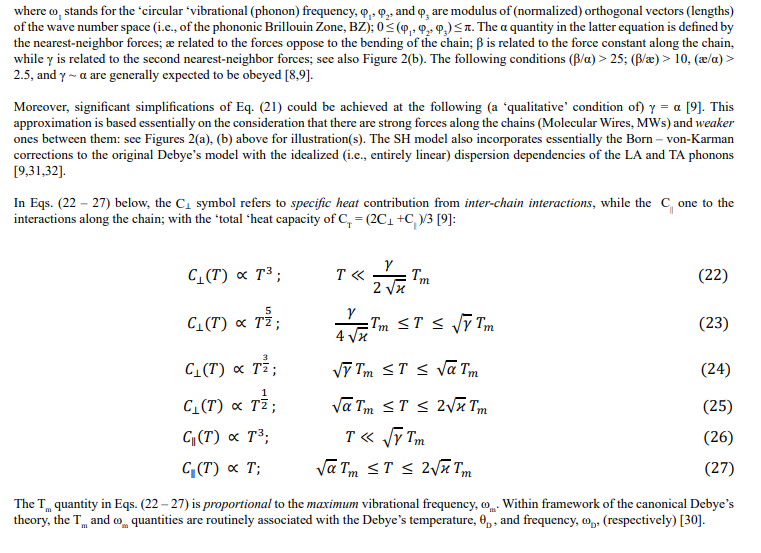
‘Standard’ Structural and Topological Models of Linear and Branched Polymers
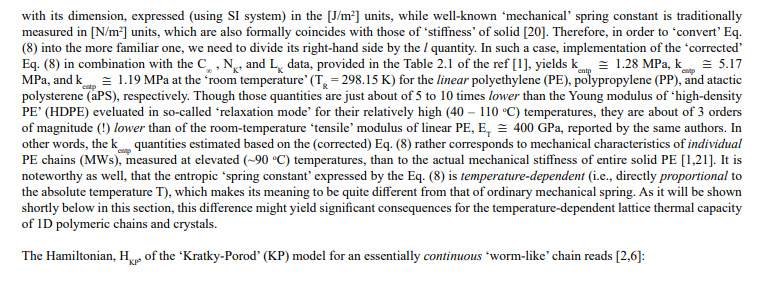
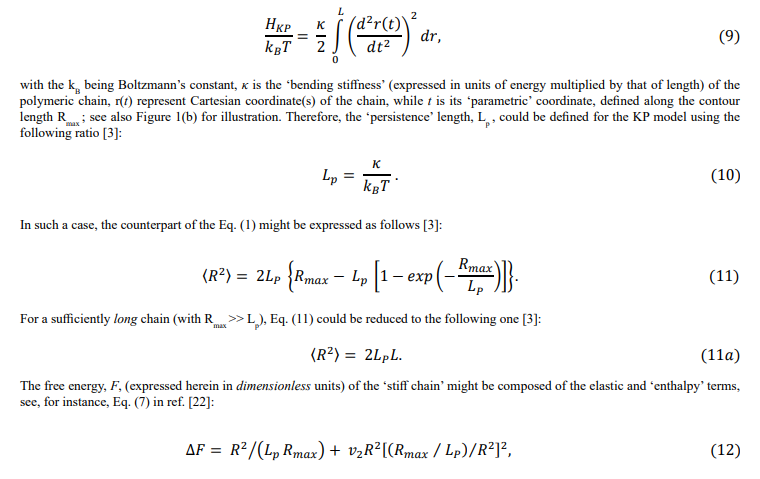
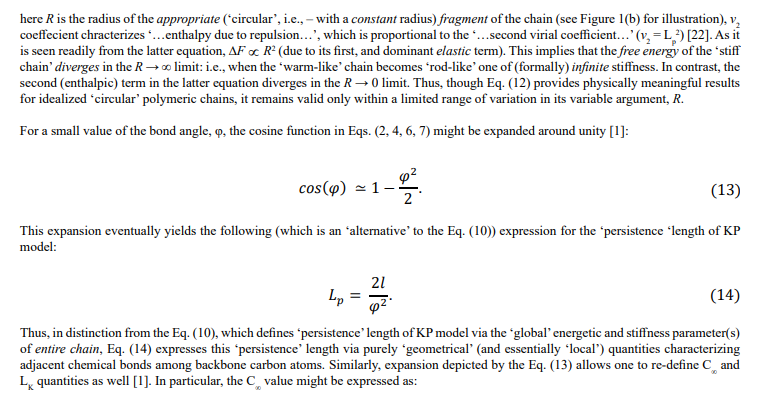
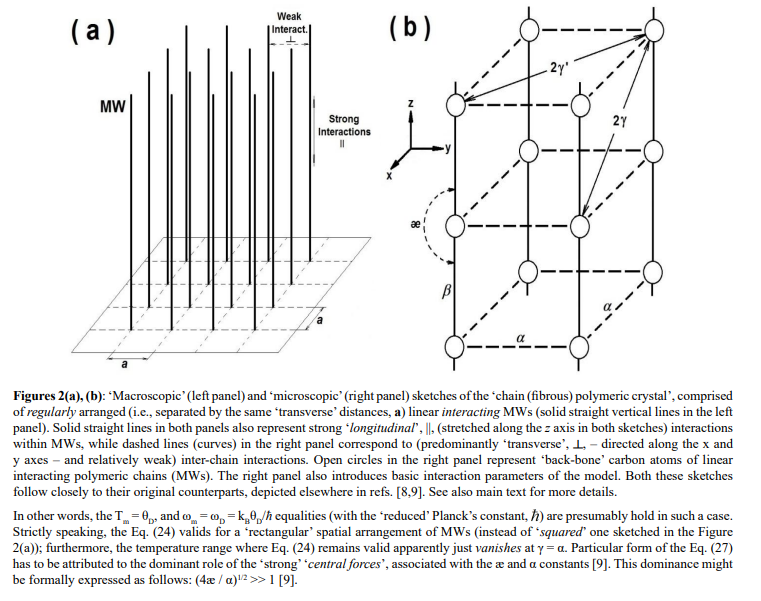
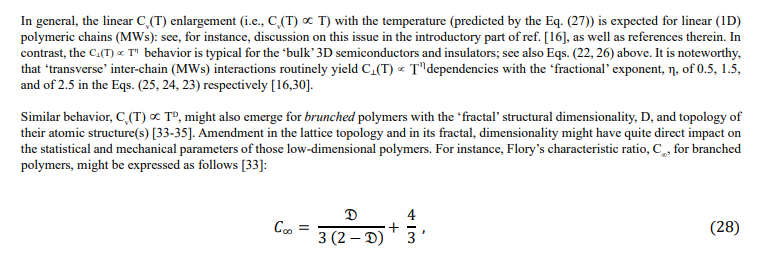
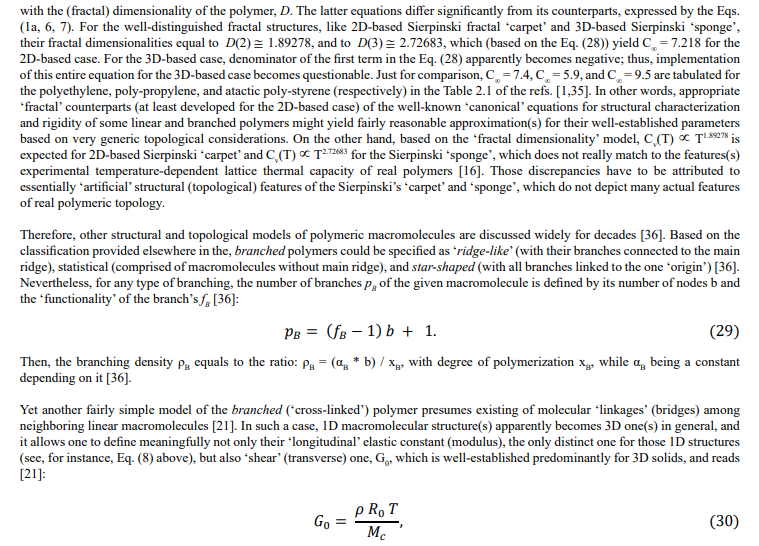
The Figures 1(a), and 1(b) illustrate key features of two well-known ‘representatives’ from the first and second aforementioned groups. The Figures 1(c) and 1(d) also illustrate key features of the ‘comb’ and ‘bottle-brash’ models of the branched polymers [1-3]. One of the most important spatial extents of the ‘freely joint’ model (with no interactions among joint linear fragments and no correlation among directions of chemical bonds between such joined fragments) is so-called ‘Kuhn length’, LK, (see also Figure 1(a) for illustration), corresponding to the length of a rigid ‘statistical segment’ in a freely joint polymer chain (or molecular wire, MW), with its rigidity defined by the FCR [1-5]. In contrast, the Kratky-Porod (KP) model is rather characterized by the ‘persistence’ length, Lp, and the curvature radius, R (see Figure. 1(b)), which – in a general case – may vary at every point of a continuous chain. Both Lp and R quantities are characterizing stiffness of the quasi-continuous polymeric chain (MW), while the dimensionless Flory characteristic ratio(s), Cn, alongside with the Flory length, LF, rather characterize stiffness of particular linear segments within framework of the freely ‘jointed’ chain model [1-3]. Well-known structural (topological) models of the branched polymers, the ‘comb’ and ‘bottle-brash’ ones are sketched in the Figures 1(c), (d) [1-3].
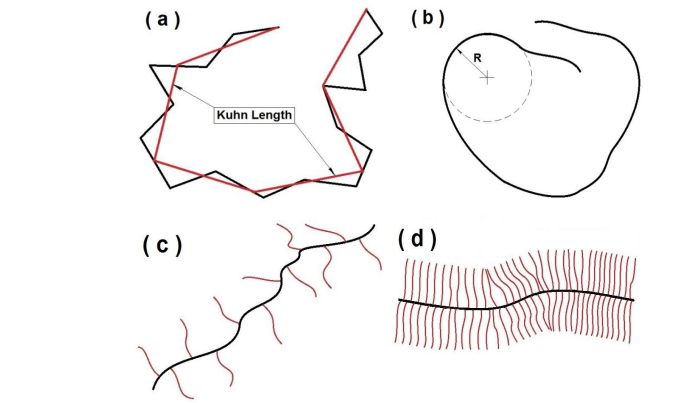
Figures 1(a), 1(b), 1(c), 1(d): (color online). Two-dimensional sketches of some well-known models of the linear and branched polymers:(a) ‘freely joint’ chain model with the delineated Kuhn length (represented in this figure with the red straight lines); (b) of the ‘warm-like’ (Kratky-Porod, KP) model with the exemplified ‘curvature’ radius, R, fitted to a particular (circular) segment of the chain; panels (c) and(d) illustrate key features of the ‘comb’ (c), and ‘bottle-brash’ (d) models of branched polymers [1-4,6]. Black straight linear fragments in the figure (a) represent individual chemical bonds (presumably of the (same) bond length, l) among neighboring carbon atoms within the ‘backbone’ chain, and with total number of n of such bonds in this particular chain. In the figures (c) and (d) black curves represent ‘backbone’ chains, while red ones represent ‘side’ chains (branches).
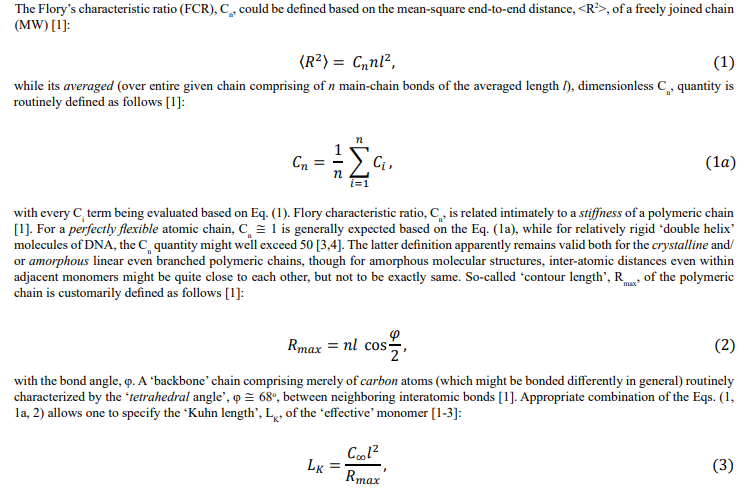
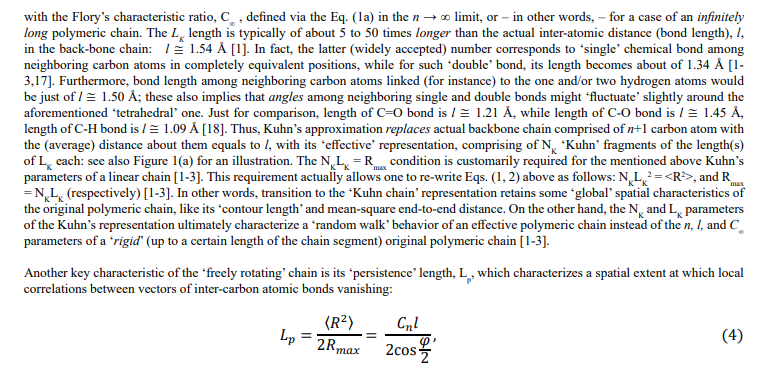
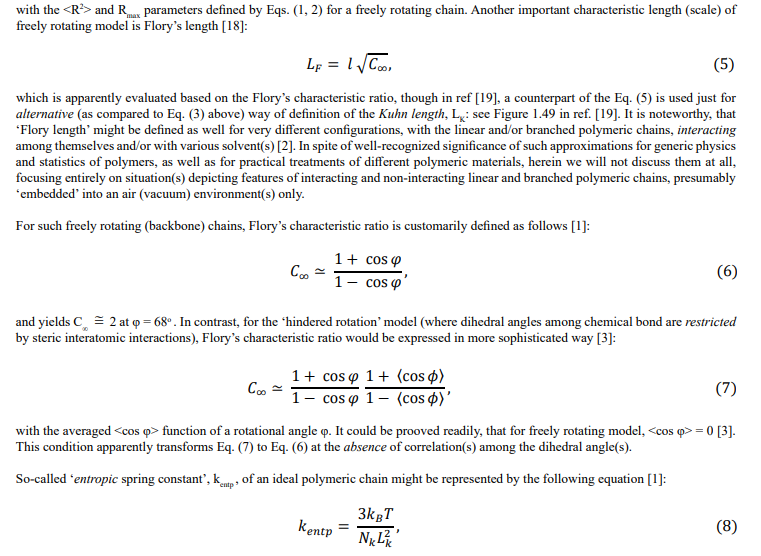
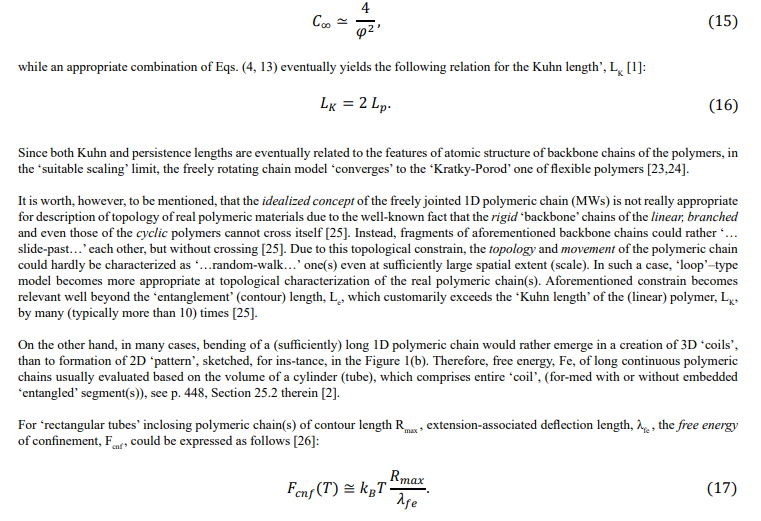
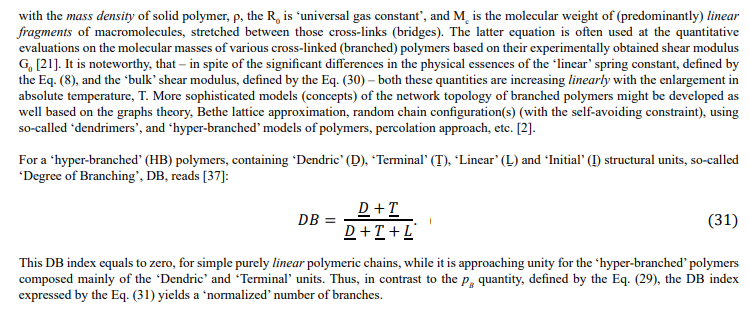
One of the mostly reconnoitered modifications of the HB polymers is so-called ‘bottle-brush’ macromolecules; see also references therein and Figure 1(d) above for an illustration [38]. This particular modification of HB polymers might form ‘…stiff, cylindrical, and shape-persistent structures…’ [38]. Furthermore, ‘High branching densities can lead to strong stiffening of the backbone due to steric overcrowding of the side chains in the densely packed brush’. As a result, the Kuhn length, LK, of such bottle-brush structure(s), evaluated experimentally via dynamic- and static-light scattering techniques, might be as high as 70 ± 4 nm, which exceeds by many (~46) times its counterpart evaluated for the ‘...bare backbone…’ of the poly (alkyl methacrylate), PAM [38]. Fractal dimensionality of the ‘brush’ is estimated to be of D = 1.64 ± 0.08, which is quite close to that ‘…expected for a three-dimensional (?) self-avoiding random walk…’ [38].
Amendments in the molecular structures and topology of many well-known polymeric solids might also affect considerably their vibrational and thermal characteristics, though experimental temperature dependencies of their lattice thermal capacities often exhibit ‘tenacious’ common features, which emerge importunately regardless to the chemical, structural and topological features of those macromolecules, see sub-section 2.2 below for details. In order to discuss persuasively contributions of various chemical, structural and topological factors to the particularities of the temperature-dependent lattice thermal capacities of different types of solid polymers comprised of (predominantly) linear and branched macromolecules, we have to comprehend briefly their chemical composition(s) and structural features. Those features are illustrated and discussed briefly in the next sub-section.
Molecular Features of Some Low-Dimensional Solid Polymers
Molecular structures of some well-known ‘industrial’ linear and branched polymers usually comprised of ‘back-bone’ chain(s) of interlinked carbon atoms, ‘complemented’ with isolated ‘peripheral’ hydrogen atoms, and/or ‘terminal’ structural groups, composed of the carbon and hydrogen atoms only [1-3]. More sophisticated polymeric structures might comprise of ‘cyclic’ components, like ‘aromatic rings’, (e.g., benzene, pyridine, pyridinium, cyclopentadienyl, and cyclo-heptatrienyl ones), as well as biphenyl, naphthalene, pyrol, pyrrole, thiophene, and indene molecular rings, alongside with the (isolated) nitrogen, oxygen, sulfur (etc.) atoms, which might be incorporated both into ‘backbone’ polymeric chains, and/or into different types of ‘terminal’ groups and cyclic structures as well [1-3].
Chemical (atomic) composition(s) of molecular units (monomers) and sketched structures of macro-molecules of some well-known linear solid polymers are specified in the Table 1. Those linear polymeric chains are comprised of (predominantly) carbon backbone atoms only alongside with the ‘isolated’ hydrogen, fluorine, and chlorine ‘terminal’ atoms. However, repetitive alteration of the single and double chemical bonds among neighboring carbon atoms might occur for backbones of linear MWs based on relatively long monomers, like poly-butadiene (PBDN). On the other hand, the ‘backbone’ chains of the MWs of polyglycine (PGCN) and polyurethane (PU) incorporates oxygen and nitrogen atoms as well, see two bottom rows of the Table 1. The oxygen and nitrogen atoms might also be attached as the ‘terminal’ ones to the backbones PGCN and PU macromolecules.
In the Table 1, the MolView (version 2.4) software is used at creation of graphical representations of the structural units of all linear monomers, while ChemSketch (freeware), version 2.4 (2023), is used for creating of sketches of atomic arrangements within all those linear polymeric structural units. The grey, green, light green, blue and red balls represents carbon, chlorine, fluorine, nitrogen, and oxygen atoms (respectively), while white ones represent hydrogen atoms in the graphical illustrations of monomers.
The Table 2 reveals molecular structures of some well-known ‘branched’ polymers and their monomers, with the ‘separated’ CH3 (methyl), CO (carbonyl), NH2 (amino), and CN (cyano) terminal groups, and/or combination(s) of those terminal groups. Again, the MolView (version 2.4) software is used at creation of graphical representations of the structural units of all linear monomers, while ChemSketch (freeware), version 2.4 (2023), is used for creating of sketches of atomic arrangements within all those linear polymeric structural units. The grey, green, light green, blue and red balls represents carbon, chlorine, fluorine, nitrogen, and oxygen atoms (respectively), while white ones represent hydrogen atoms in the graphical illustrations of monomers.
It is noteworthy, that the Vmnm abbreviation in the head of the 4th column of this table (as well as in the other tables shown below in this sub-section) represents so-called ‘monomer volume’ (tabulated, for instance, for some polymers in the Table 19.2 of the ref. [2], while NATmnm in the head of the fifth column stands for the total number of atoms of the given monomer. For polymers not reflected in that Table 19.2, the Vmnm quantity is evaluated based on the following (generic) relation: Vmnm = 1.66 x 10⁻³ * MM / ρM, with the MM being molar mass of the monomer expressed in the (g/mol) units, while ρM stands for its mass density (g/cm3); see also comments to the Table 19.2 of the ref. [2]. Those evaluated Vmnm quantities tabulated in the fourth column of the Tables 1-4 are marked oud with the ‘star’ symbol.
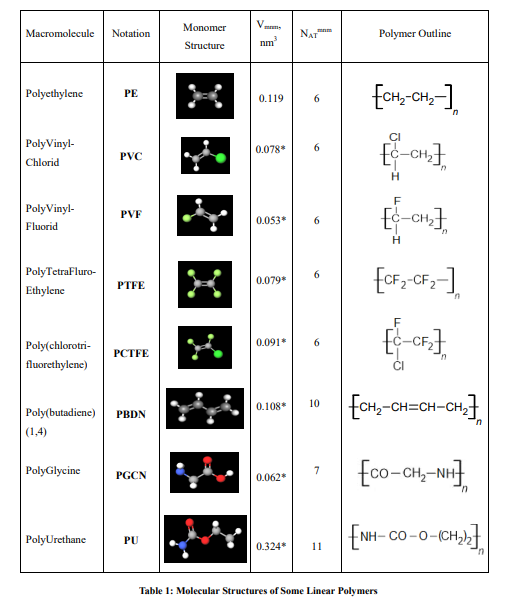
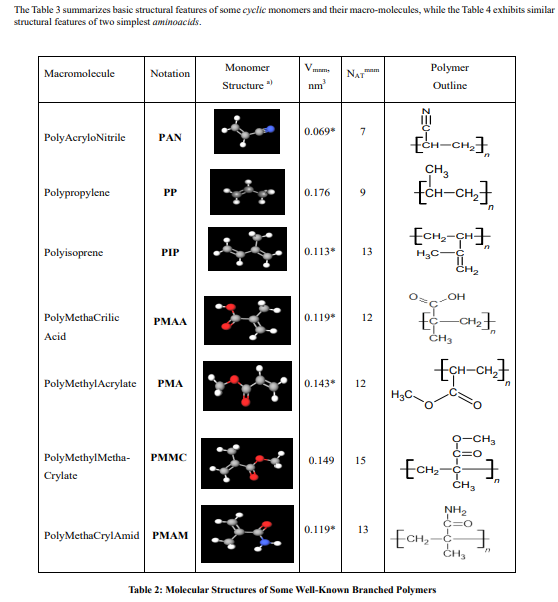
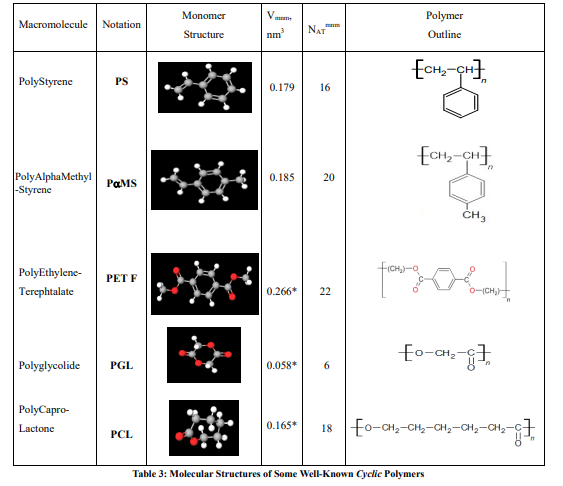
The MolView (version 2.4) software is used at creation of graphical representations of the structural units of all linear monomers, while ChemSketch (freeware), version 2.4 (2023), is used for creating of sketches of atomic arrangements within all those linear polymeric structural units. The grey, green, light green, blue and red balls represents carbon, chlorine, fluorine, nitrogen, and oxygen atoms (respectively), while white ones represent hydrogen atoms in the graphical illustrations of monomers.
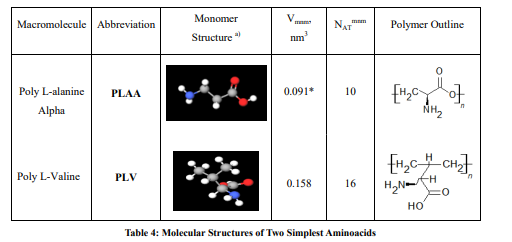
In general, the ‘electronegativity’ of aforementioned oxygen and nitrogen atoms deviate significantly from those of carbon and hydrogen atoms, and such differences eventually yield additional dynamic Coulomb (i.e., predominantly dipole-dipole – due to iconicity of the C-H, C-O and/or C-N, N-H chemical bonds) interactions among different fragments of the same polymeric chains, as well as among neighboring such chains; see alsoFigures 2(a) and 2(b) above for an illustration. As it will be discussed briefly in the next sub-section, those additional (Coulombian in their nature) dynamic interactions might contribute significantly to the vibrational and energetic characteristics of such macromolecules and eventually affect significantly features of the temperature dependencies of lattice heat capacity of those particular macromolecules, especially for those mentioned in the Table 4 above [39]. It is noteworthy, that cyclic (ring) topology of the PGL and PCL emerges only for their mono-molecular (monomeric) structures, while their macromolecules rather exhibit relatively simple linear atomic arrangements with alternating hydrogen and oxygen terminal atoms of the essentially 1D backbone chain(s) with both carbon and oxygen atoms embedded into their atomic structures, in an apparent similarities with the backbones of the liner PGCN and PU, shown in the Table 1: see two last rows in the Table 3 for illustration(s). On the other hand, structures of macromolecules of the PLAA and PLV rather correspond to those of branched polymers, with both carbon and oxygen atoms incorporated into their backbone(s) as well, and relatively complex (especially in the case of PLV) atomic structures of their branches: see Table 4. Nevertheless, – in general – essentially different chemical (atomic) composition(s) of monomers and topologies of macromolecules of the well-known linear (listed in the Table 1), branches (Table 2), and cyclic (Table 3) polymers, as well as those of simplest aminoacids (Table 4), might eventually yield unique features in their temperature dependencies of isobaric lattice thermal capacities, Cp(T). The next sub-section is devoted to description of those experimentally evaluated Cp(T) dependencies and very brief discussion on the relation-ships among their features and structural particularities of aforementioned macromolecules.
Temperature-Dependent Lattice Thermal Capacity
Intensive experimental and theoretical investigations on the characteristics of thermal capacity of polymers emerged as an important branch of material science and engineering soon after the end of the World War II (see also references therein). Later, those studies were also ‘expanded’ to the medical and biological sciences [10,16,40-44]. Below in this sub-section, typical temperature dependencies of the lattice thermal capacities of some typical linear, brunched, and cyclic polymers, as well as those of simplest aminoacids are plotted based on the data, tabulated elsewhere in refs. [45-48]. In particular, Figures 3(a), (b), reveal the Cp(T) dependencies, plotted based on the data, tabulated else-where in the refs. for the linear amorphous poly-Ethylene, polyTetra-FluroEthylene, crystalline polyChloroTri-FluorEthylene, polyVinylChloride, polyVinylFluorid, poly(butadiene) (1,4), polyGlycine, and ‘glassy’ polyUrethane. As it is seen from the Figures 3(a), (b), all plotted experimental Cp(T) dependencies exhibit close to linear (i.e., with the log-log slopes ranging from ~0.7 to ~1.0) enlargement with the tem-perature at elevated temperatures (typically exceeding 50 – 100 K), alongside with relatively sharp Cp(T) decline with the temperature diminishment at relatively low temperatures [45-48]. Those distinct declines in Cp(T) dependencies are customarily denoted as ‘low-temperature anomalies’: see, for instance, and references therein. Nonetheless, every plotted Cp(T) curve could be approximated reasonably well (though within limited temperature ranges) with cubical polynomials, represented, for illustration purpose(es) with the dashed curves in Figures 3(a), (b) [16,17].
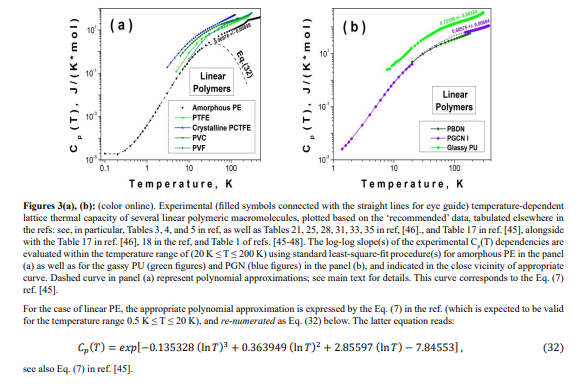
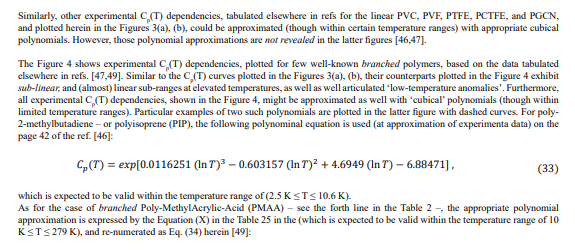
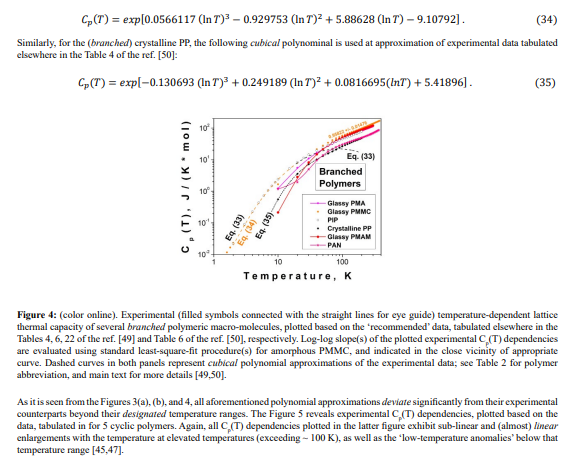
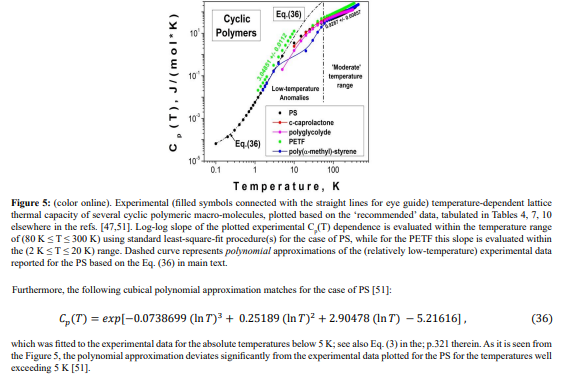
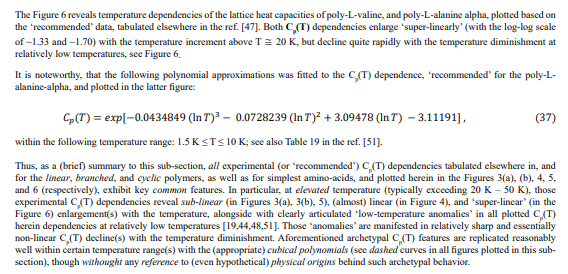
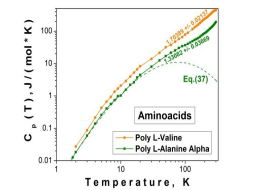
Figure 6: (color online). Experimental (filled symbols connected with the straight lines just for eye guide) temperature-dependent lattice thermal capacity of poly-L-valine, and poly-L-alanine alpha, plotted based on the ‘recommended’ data, tabulated elsewhere in the Tables 21 and 24 of the ref. [47]. Log-log slope(s) of the plotted experimental Cp(T) dependencies are evaluated within the temperature range of (20 K ≤ T ≤ 200 K) using standard least-square-fit procedure(s), and indicated in the close vicinity of appropriate curve. Dashed curve represents polynomial approximations of plotted the experimental Cp(T) data for poly-L-alanine-alpha, expressed by the Eq. (37); see main text for more details.
The next section of this article is devoted to the discussion on thinkable physical reasons causing the depicted above Cp(T) behavior for linear, branched and cyclic polymers, as well as resounding approximation(s) on the aforementioned Cp(T) dependencies based on (primarily one-dimensional) ‘spatial confinement’ and molecular rotation(s) phenomena, as well as to the appropriate discussion of all obtained simulation results in comparison with prediction(s) of well-known structural and topological models of low-dimensional polymeric materials, discussed in the sub-section 2.1 above, and results of independent experimental evaluations.
Simulation and Approach Results
Simulation Formalism
As it will be shown shortly below in this section, the Cp(T) dependencies plotted in the sub-section 2.3 might be replicated and interpreted reasonably well based on the (appropriately re-normalized) one-dimensional (1D) basic equation of so-called ‘Generalized Skettrup Model’ (GSM), with its original form provider elsewhere in the, see also references therein [16]:

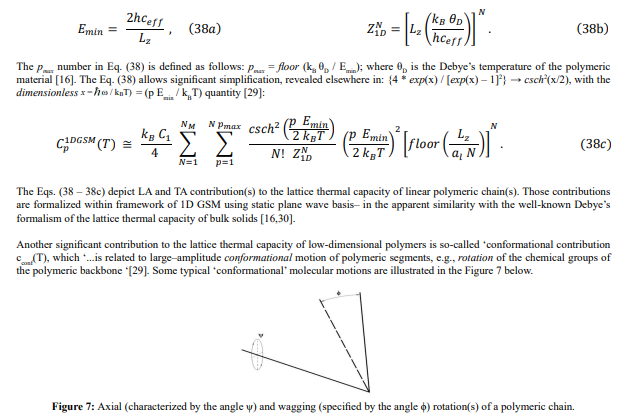
here C1 is the dimensional ‘normalizing coefficient‘, the function floor(x) returns an integer part of its rational argument, al is an (average) interatomic distance (‘lattice constant’) of the MW material, kB is the Boltzmann constant, Emin is the ‘minimal’ energy of the phonons, confined within 1D polymeric MW, Z1D N is the N-particle ‘statistical sum’ (N-phonon partition function), while ceff is an effective sound velocity, routinely defined as follows: 3/ceff = (1/cl + 1/ct1 + 1/ct2), where cl stands for the longitudinal sound velocity, while ct1 and ct2 denote two (different in general) transverse sound velocities of the MW material [16].
In general, the specific (algebraic) expression and the dimension (physical units) of the ref. [2]. C1 coefficient might be defined in several different ways. Probably the most physically meaningful and straightforward way entails the C1 definition as the (volumetric) atomic density, ρAT , of the 1D chain: C1 = ρAT = NAT / V0 , with the NAT being the number of atoms in its repetitive molecular fragment, and V0 is the volume of such fragment. This C1 definition brings in naturally the energy-independent (as generally expected) 1D DensityOfatomic-States (DOS), into the right-hand side of the latter equation. Actually, the DOS terms are quite common for many equations created for simulations on the temperature-dependent thermal capacity of a solid; see also references therein, and – in our particular case– makes the dimension of the entire Cp 1DGSM(T) term defined by the Eq. (38) to be equal to the [J / (K * cm3 )], i.e., it eventually simply turns to be the volumetric thermal capacity of the 1D semiconductors and insulators [16,30]. This definition is apparently suitable not only for the linear and branched polymeric chains, but actually for any 1D chain predominantly linked via the covalent and/or ionic interatomic bonds, either with a strictly (crystalline) atomic arrangement(s), or even for those chains with the spatially disordered (amorphous) atomic arrangements. At the same time, such definition of the C1 coefficient is directly applicable to the low-dimensional polymeric materials, mentioned – for instance – in the sub-section 2.2 of this article. Indeed, in the latter cases, the ρAT and C1 quantities of the given polymeric material could be subtracted directly from the fourth and fifth columns of the Tables 1 – 4, as the appropriate ratio(s) of the NAT mnm / Vmnm parameters, listed in those columns of the aforementioned tables. More generic way of definition of the ρAT quantity might be based on the following algebraic expression: ρAT = ρM NA NAT / Wmol , with the mass density of the polymeric material, ρM , and the Avogadro’s number, NA , while the Wmol stands for the molecular weight of the 1D material (polymeric chain). In such a case, the physical meaning of the C1 quantity still could be identified with the DOS one [52].
Alternatively, the C1 coefficint might be defined as follows: C1 = NAT mnm Wmol / (ρM Vmnm), here NAT mnm is the (total) number of atoms in the given monomer, and Vmnm is the monomer volume (tabulated for some well-known polymers elsewhere in the Table 19.2 of the ref. [2].see also beginning of the sub-section 2.2, and Tables 1-4 therein) [2]. This ‘alternative’ definition of the C1 coefficient is linked more straightforwardly to the specific polymeric parameters, listed – in particular – in the aforementioned tables, and eventually makes dimension of the ‘outcome’ of the Eq. (38) to be of [J / (K * mol)], which allows one to compare them directly to the experimental Cp (T) quantities (dependencies), tabulated and plotted for a dominant majority of polymeric materials: see, for instances refs, and also Figure. 3(a) – 6 above. However, in such a case, the C1 meaning could not be identified with the DOS one any more. The latter definition of the C1 coefficient with the omitted Wmol term allows one to express the Cp (T) quantities in the [J / (K * g)] units [44-51].
The Emin and Z1D N quantities incorporated into the Eq. (38) are customarily defined as follows, see also references therein [16]:
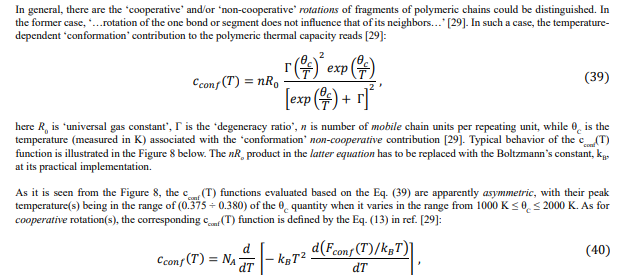
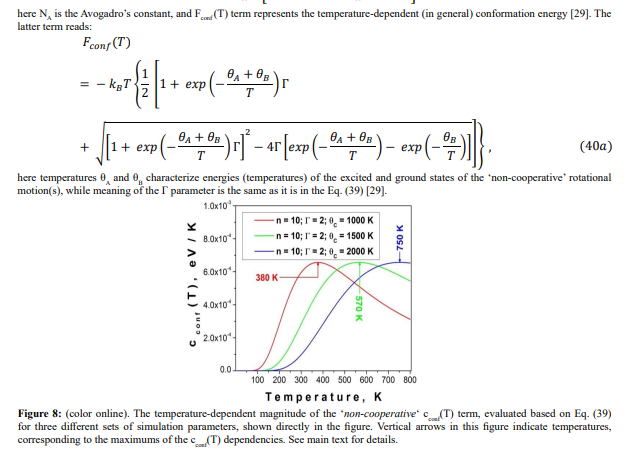
It is noteworthy, that all Eqs. (39 – 40a) are obtained using static rotational basis. However, the Eqs. (40, 40a) are apparently much more complicated than the Eq. (39): the latter equations require consecutive (analytical or numerical) evaluations of two derivatives of the temperature-dependent algebraic function(s) with respect to the absolute temperature; therefore, the latter equations will not be used at Cp (T) simulations herein.
Simulation Results
The Figures 9(a)-9(h) reveal simulation results (represented with curves) obtained based on the first term of the Eq.(38c) for harmonic contributions to the experimental Cp (T) dependencies, tabulated for linear polymers elsewhere in refs. [45-48]. Therefore, our simulated Cv (T) curves rather represent temperature-dependent isochoric lattice thermal capacities, than the Cp (T) ones, since the anharmonic effects (corresponding to higher outer summations terms with N = 2, 3… in the Eqs. (38 – 38c)) are simply omitted at all these simulations. Our simulated Cv (T) curves are also plotted against their appropriate experimental Cp (T) dependencies; see also Figures 3(a), (b) in the sub-section 2.3.
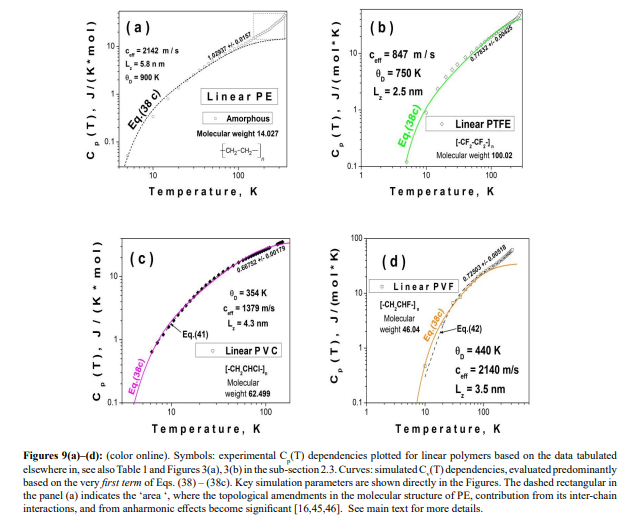
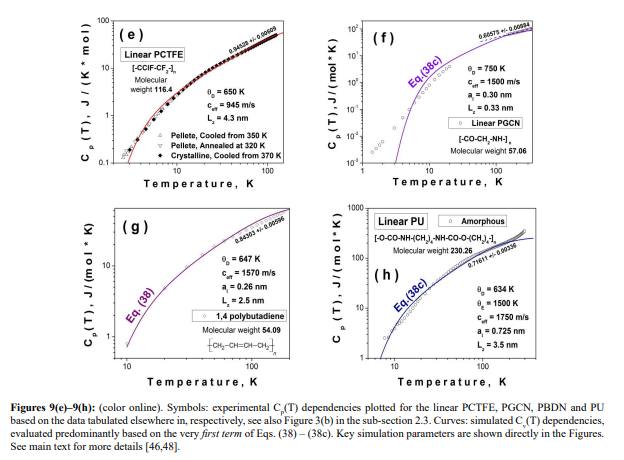
As it is seen readily in the Figure 9(a)-9(d), 9(e)-9(h) reasonably well approximation of the experimental Cp (T) dependencies obtained for the linear polymers with the simulated Cv (T) curves (including sub-ranges corresponding to the ‘low-temperature anomalies’, and those with the (almost) linear Cp (T) and/or Cv (T) enlargement(s)), is achieved (without any further adjustment for the cases with the dominant contributions from the acoustic phonons!) based on dominant contributions from the ‘acoustic’ terms, expressed by the Eqs. (38 – 38c).
At the same time, significant contribution(s) the Cv (T) dependencies from so-called ‘optical’ terms at elevated temperatures (exceeding 250 K) have to be taken account for the data plotted in the Figure 9(h). The latter contribution has been evaluated based on the very first term of the Eq. (38c) at N = 1 and ET = hωopt (here hωopt stand for the energies of the optical phonon(s), and – in general – incorporation of the contribution(s) from the optical phonons require some additional adjustment for such terms Cv (T) on the vertical scale, in order to match the appropriate experimental Cp (T) dependence [16].
In addition, in the Figures 9(c) and 9(d) both experimental Cp (T) and simulated Cv (T) dependencies are compared as well with their following polynomial approximation(s) [46]:

these equations correspond to the Equations (b in the Table 29, and 12) (respectively) in the, and represented with the dashed curve in the Figures 9(c) and 9(d) [46].
Moreover, as it is seen from the Figures 9(a)–9(h), within sub-range(s) corresponding to elevated temperatures, significant discrepancies among the experimental Cp(T) curves and simulated Cv(T) ones occurs, and might to be attributed predominantly to significant contributions from the anharmonic effects [16,17]. Though those anharmonic effects within the linear MWs might be – at least in principle – simulated based on the higher (the second, third, fourth, etc.) algebraic terms in the Eqs. (38 – 38c) (see also their counterparts in the refs and Figures 9(a) – 10(b) in the illustrations), all those terms are generally expected to yield linear in the absolute temperature Cah(T) dependencies for the 1D MWs at their elevated temperatures (see, for instance, Figure(s) 2 in the refs. [19,52-54]).
However, the experimental Cp(T) quantities apparently enlarge with this (elevated) temperatures ‘superlinearly’: see, in particular, insets to Figures 9(a) and 10(a) as well as the Figures 9(b) and 10(b) in the ref (see also references therein), where the log-log slop of the appropriate expe-rimental Cp(T) dependence approaching ~1.44 for the linear PE, and ~1.32 for the branched PP. In fact, aforementioned discrepancies among predictions of the Eqs. (38 – 38c) and actual behavior of the Cp(T) curves at elevated temperatures could be – in principle – caused by several different reasons [16]. First of all, significant alterations in intensity of interactions among different fragments of the atomic as well as in the molecular structures of PE and PP caused by the temperature enlargement, and even significant amendments in the structural an topological characte-ristics of those macromolecules, especially in vicinity of the temperature(s) of their phase transi-tions (like glass transition temperature, Tg, of PP indicated in the Figures 9(a), (b) of the ref. [16]) could be generally expected at elevated temperatures It is noteworthy, that aforementioned amendments in the topological features of the molecular networks and intensity of inter-action(s) among neighboring fragments of the polymeric chains are expected to affect not only anharmonic contributions to the thermal capacity of polymers, but also dominant harmonic ones.
In particular, essential features of the Cp(T) and Cv(T) dependencies could be altered due to:
a. Enhanced dynamic interactions among linear fragments of those macromolecules at elevated temperatures, which were explained and parameterized elsewhere in refs. [8,9]; see also Eqs. (21 – 28) in the sub-section 2.1, and Figures 2(a), (b);
b. Additional structural entanglement among neighboring polymeric chains of the linear and branched polymers at their elevated temperatures, with subsequent significant amendments in the topological (‘fractal’) characteristic of their molecular network(s);
c. Formation of relatively small fraction(s) of crystalline, amorphous, and even liquid nano-clusters (nuclei of the new phases) of essentially different spatial dimensionalities (e.g., 2D, 3D), embedded in the predominantly linear topological network(s) of those polymers in vicinity of temperatures of their phase transitions.

of the harmonic fraction of the experimental Cp(T) dependencies, obtained for the PE and PP at their elevated temperatures.
Effect of the temperature-induced entanglement(s) among the neighboring chain of the fractal and linear polymers, and caused by its amendments in the fractal dimensionality of their molecular networks could be depicted quantitatively based on the following equation for the (harmonic) Cv(T) dependence is expected for the solid polymer(s) [48]:

where D is the ‘fractal ‘dimension of the polymeric structure, NM is number of the ‘particles ‘in its ‘molecule’, Γ(D + 1) is the Euler’s Gamma-function, and ξ(D + 1) is the Rieman’s ξ-function, while θmax stands for a ‘characteristic temperature; see also references therein; the θmax ≈ θD equality could be assumed for many practical cases. Based on the latter equation, the log-log slope of the harmonic fraction, Cv(T) at elevated temperatures simply equals to the fractional dimensionality, D , of the polymeric network: i.e., of D ≈ 1.44 for the case of PE, and of D ≈ 1.32 for the case of PP. Thus, the temperature-induced additional entanglement among the neighboring linear fragments of polymeric macromolecules is generally expected to increase eventually the log-log slope(s) of both Cp(T) and Cv(T) dependencies, reported for the linear PE and branched PP; see also references therein [16,48].
Appearance of a significant concentrations of the nano-scaled 2D and 3D clusters (nuclei of those new phases) in the temperature ranges close to the temperature of appropriate phase transition within predominantly linear structural network(s) of the 1D and branched polymers might also contribute to the amendment in the Cp(T) and Cv(T) dependencies see, for instance, Eqs. (11, 12) elsewhere in the ref, as well as comments to them, and references therein. Moreover – in a substantial distinction from the two aforementioned approximations – in such a case – contributions to both purely harmonic and anharmonic fractions of the lattice thermal capacity of the amended polymeric framework(s) might be evaluated independently [16]. However, quantitative simulation(s) of the log-log slope(s) of those Cv(T) and/or Cp(T) dependencies would require fairly accurate estimation(s) on the actual features of morphology of aforementioned 2D and 3D nano-clusters (nuclei), their temperature-dependent (in general) shapes, concentrations, etc. This information is simply not available for the linear and branched polymers, with their experimental Cp(T) and Cv(T) dependencies, reported elsewhere for the in the refs. [45-49]. Therefore, this approach to interpretation on the ‘superliner’ behavior of the experimental Cp(T) dependencies will not be discussed any further herein.
Nevertheless, implementation of appropriate combination(s) of the described above simulation approaches, predominantly based on quantized and essentially 1D Eqs. (38 – 38c) with explicitly incorporated the dominant confinement length, yield fairly good (in general) approximation for the experimental Cp(T) dependencies reported for linear polymers within almost entire temperature range, available for the experimental studies. This indicates overall correctness of the implemented simulation approach, as well as importance of the quantum confinement phenomenon for appropriate understanding of the experimental results, reported for many linear (chain) polymers.
However, actual situation could be more complicated for branched and cyclic polymers, where topology of the molecular structure(s) apparently differs from the linear one(s). The Figures 10(a)-(f) compare experimental Cp(T) dependencies reported for some well-known branched polymers with their simulated counterparts, obtained predominantly based on the Eq. (38c). It is noteworthy, that for the cases of PMA and PMMC, additional ‘optical’ and ‘rotational’ terms have to be incorporated as well in order to approximate the experimental Cp(T) curve reasonable well: see Figures 10(d), and 10(f). The latter term is evaluated based on the Eq. (39) with the ‘fitted’ θE and θc quantities, indicated directly within the figure. The dashed curve in the Figure 10(c) corresponds to the polynomial approximation, specifies by the Eq. (33): see also comments to the Figure 3(b) above.
As it is seen from the Figures 10(a)-(f), our 1D quantized equation yields, again, fairly reasonable overall approximation for the experimental Cp(T) dependencies, reported for branched polymers, except the temperature ranges approaches phase transition areas, where anharmonic effect(s) [16], as well as – briefly discussed above in this section – topological and structural re-arrangements of molecular network might play significant role(s).
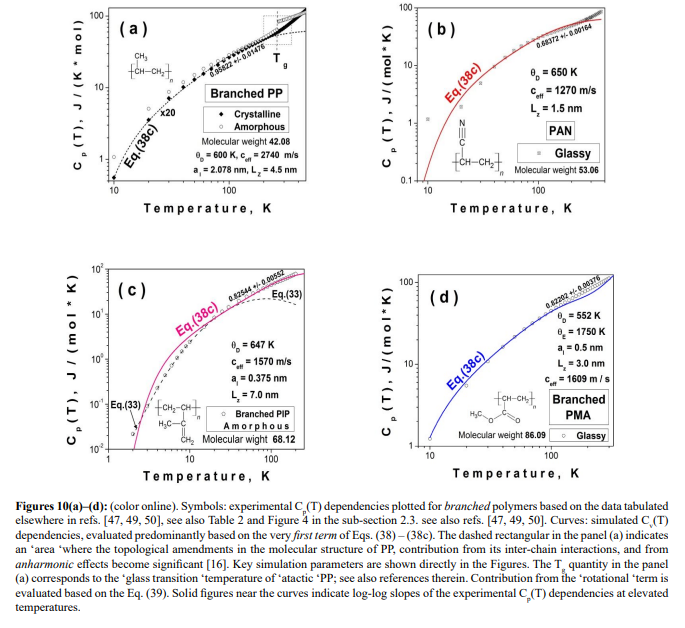
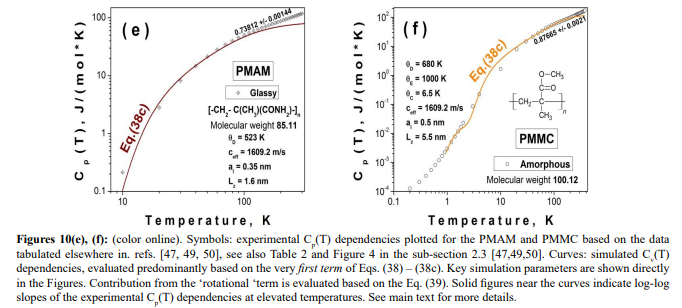
This indicated that contribution(s) from the ‘backbone’ acoustic, optical, and even rotational vibrations clearly dominate Cp(T) behavior even for branched polymers, in spite of generally expected significant contribution from the molecular branches of (predominantly) linear ‘individual’ topology. Such domination could be explained readily, if – assuming relatively short length of (presumably) linear branches and an absence of phonon-phonon interactions (correlations) among the ‘backbone’ and linear branches (as well as among even neighboring branches themselves) – we compare contribution(s) to the Cv(T) function(s) from the ‘backbone’ chain(s) and those branches.
Indeed, as it is shown elsewhere in the Figure 7(b) of the ref. [16], contribution from the relatively short linear branches would be significant only at elevated temperatures, where the ‘independent’ (within a zero-order approximation) Cv(T) curves originated from the individual ‘backbone’ chains and those originated from these branches would be ‘averaged’ linearly in accordance to their relative fractions (molecular weights) in the total weight of the macromolecule of the given branched polymer (with the anticipated Cv(T) behavior close to the linear one at the elevated temperatures) [16]. In such a case, the experimental Cp(T) behavior within the temperature range, corresponding to the ‘low-temperature anomalies’, would be clearly defined by the longest linear molecular chain, which is apparently expected to be the ‘backbone’ chain for majority of branched polymers: see, for instance, Figure 7(b) of the ref. [16]. However, for so-called ‘hyper-branched’ (HB) polymers, the ‘aggregate’ fraction of all (though relatively short) branches in the molecular weight of their macromolecule(s) might exceed well similar fraction of the ‘backbone’ chain(s) [37].
In such a case, two (or even more) ‘low-temperature anomalies might emerge in the temperature dependencies of the heat capacity of the HB polymers, as it was sketched elsewhere in the Figure 7(b) of the ref. [16]. Only in such a case, particular shape of the Cp(T) might indicate presence of the dominant fraction of the branched polymers in the studied polymeric material. When, however, lengths of the ‘backbone chain’ and branches of the given polymer are well comparable, we would hardly be able to distinguish contributions to the Cp(T) dependence from the ‘backbone’ and from chain: see the Figure 7(a) in the ref. [16].
As it will be shown shortly below, similar explanation might be relevant even for the case of cyclic polymers, where topology of the ‘core’ (‘backbone’) and branched molecular structures is generally expected to be essentially different.
Indeed, as it is seen from the very first row of the Table 3, molecular structure of monomer of the polystyrene (PS) comprises of ‘linear’ CH–CH2 ‘backbone’ chain (which is quite similar to its counterparts in the polymeric structures of PE and PP, revealed in the Tables 1 and 2), though instead of the ‘terminal’ hydrogen atom in the PE and the ’terminal’ methyl group of the PP, molecular structure of PS monomer (repeat unit) comprises of terminal ‘aromatic’ (benzene) ring. Similar topology of the polymeric chain also emerges for the case of Poly-Alpha-Methyl-Styrene (PαMS), though instead of the benzene ring itself of the PS, molecular structure of the PαMS comprises of such ring with attached ‘additional’ methyl group: see Table 3 for details and illustration(s). It is noteworthy, that the vibrational wavenumber of the ‘terminal’ hydrogen atom (or C-H bond) is about of 2850–2960 cm-1 (or vibrational energy of 245.59 – 255.07 meV) in alkanes and of 3020–3100 cm-1 (260.0 – 267.14 meV) in alkenes, which corresponds to the ‘optical’ phonon (group) vibration energy range. Consequently, in general, confinement length(s) of the LA and TA phonons might be significantly different for those phonons associated with the thermal vibrations of aromatic (and/or diester) rings, and for phonons involvement into atomic and molecular vibrations of linear ‘backbone’ chains of PS and PαMS. Situation could be even more complicated for the case of PETF, where the ‘aromatic’ rings are incorporated into the ‘backbone’ chain of the macromolecules [2].
As a result, more than one ‘low-temperature’ anomalies could be distinguished in the experimental Cp(T) dependencies, reported for the PαMS elsewhere in the ref, and replicated in the Figure 5 herein. The first one emerges when the temperature of those polymers drops below ~60 K. This seemingly corresponds to the relatively small phonon confinement size, which could be associated readily with the ‘diameter’ of the ‘benzene’ ring; it (roughly) equals to double lengths of the C-C bond, i.e., just of ~0.3 nm. However, the second ‘anomaly’ (with the ‘onset’ temperature ranging from 2 to 4 K) apparently originates from the larger spatial extent of the ‘linear’ back bone chain of the PαMS, see Figure 5 above [50]. It is noteworthy as well, that the Cp(T) dependence below the aforementioned ‘onset’ temperature in this figure reveals the log-log slop approaching 3, which corresponds to the well-known ‘Debye’s law, with C (T) µT3 [30]. This also implies indirectly that behaviour of the low-temperature Cp(T) branch originates predominantly from contribution from 3D molecular network(s) of the PαMS and PETF. Though the Cp(T) dependence, plotted in the Figure 5 for the PETF exhibits certain similarity with the behaviour of its counterpart plotted in the same figure for the PαMS (especially at temperatures below 10 K), the ‘second anomaly’ is not articulated so clearly as it done for the case of the PαMS. The experimental Cp(T) dependencies with two low-temperature ‘anomalies’, reported for the case(s) of PαMS and PETF, are not fitted herein with the relevant Cv(T) curves because of relative complexity of their macromolecules, and necessity to approximate aptly spatial, vibrational and rotational characteristics of relatively complicated structural units of those macromolecules.
Typical experimental Cp(T) and simulated Cv(T) dependencies, obtained for three other cyclic polymers are compared in the Figures 11(a)- (c). As it is seen from the Figures 11(a)-(c), our simulated Cv(T) curves, obtained based on the Eqs. (38c) replicate reasonably well the experimental Cp(T) dependencies for the poly-glycolide (PGL, see Fig. 11(b)) and poly-c-caprolactone (PCL, see Figure 11(c)).
However, more sophisticated experimental Cp(T) dependencies reported for the polystyrene elsewhere in refs (see also Figure 11(a)) require incorporation of additional ‘optical’ and ‘rotational’ terms [50,55].
In general, contribution from the acoustic phonons to the simulated Cv(T) quantity is expected to be defined by the total number of vibrating atoms, incorporated into the (linear and/or branched) polymeric chain, or – to be more accurate – by the number of their degrees of freedom. The latter number is apparently related to the total number of atoms in the molecule in quite a complicated – in general – way, since existence of interatomic bonds makes atomic quantum movement is far more complicated as compared to similar movement(s) of the same but (nearly) unbounded atoms in a gas. Indeed, in the former case, not only vibrational – but also rotational (cooperative or non-cooperative) contributions are widely expected to the total lattice thermal capacity of polymers. Relatively low characteristic temperature, corresponding to the ‘rotation’ term, indicates dominance of relatively low frequencies of the rotational movement(s), originated apparently from relatively large weight of the molecular fragments involved into the rotational movement [1,2,29]. As for the molecular structure of the monomer of the polyglicolide (PGL), its 6-member (‘cyclic ester’ – lactone) ring comprises of two embedded oxygen atoms alongside with the four carbon atoms (see fourth raw in the Table 3), while the ‘branched’ structure of the PGL macromolecule does not contain any ‘rings’ et al. Therefore, its effective phonon confinement length, Lz ≈ 5.2 nm Figure 11(b)), is well comparable with that of PS (Lz ≈ 6.0 nm, Figure 11(a)), where the phonon confinement length is obviously defined by that of the linear ‘backbone’ chain, rather than the ‘diameter’ of the rings. In contrast, relatively short confinement length fitted for PCL (with the Lz ≈ 2.7 nm, Figure 11(c)), indicates significant contribution from the thermal vibrations, confined within its ring, see the last row in the Table 3.
Usually vibrations of the ‘terminal’ methyl group might be specified as stretching, bending (with typical wavenumber of 1340 cm-1 – 1485 cm-1 or vibrational energy of 166.14 – 184.12 meV), wagging, twisting and rocking ones, with the typical vibrational energies ranging from 146.3 meV to 353.1 meV! In other words, though vibrational spectra of the ‘terminal’ methyl group is more complicated as compared to that of the vibrational spectrum of the single C-H bond, all its characteristic frequencies still belong to relatively high-frequency (energy) region. Therefore, those vibrations would hardly contribute to the low-temperature branches of the Cp(T) dependencies, but rather originate Cp(T) peaks, contributing to the measured temperature-dependent heat capacity of polymers at their elevated temperatures (typically exceeding 500 K): see, for instance, Figure 11(a) in the refs. [16,19]. Atomic structure and vibrational spectrum of the aromatic and ‘cyclic ester’ molecular rings are apparently far more sophisticated than those of the single terminal hydrogen atom and even of the methyl group. Therefore, many types of atomic and molecular vibrations are generally expected to exist (excited) in such rings, and – potentially – all of them might contribute to an ‘additional ‘(as compared to that of PE and PP) temperature-dependent (in general) heat capacity of the PS.
Based on well-known Hückel rule, benzene rings are routinely exhibit ‘planar’ (flat) molecular structures [2]. Thus, in general, atomic and molecular vibrations of the aromatic rings might be formally separated into two groups: ‘in-plane’ and ‘out-plane’ ones, with the typical wavenumbers of the 1500 cm-1 to 1600 cm-1 (or vibrational energies of ~186 meV to 198.37 meV) for the in-plane vibrations, and of 690 cm-1 to 900 cm-1 (or 85.55 meV to 111.6 meV) for the out-plane ones. Similar separation(s) are well-known for many other planar (2D) semiconducting and insulating (nano) flakes, ribbons, etc.: e.g., graphene, layered hexagonal boron nitride (h-BN) ones, etc., see for instance, ref. [56] and references therein. More importantly, that those ‘in-plane’ and ‘out-plane’ atomic vibrations are customarily charecterized by the essentially different spatial dimensionalities: 1D for the ‘out-plane’ vibrations and 2D for the ‘in-plane’ ones [2,56]. Consequently, the low-temperature branches of the Cv(T) dependencies for those 2D materials are widely expected to be ‘linear’ (Cp (T) µ T) when originnated from the ‘out-plane’ vibrations, and ‘quadratic’ (i.e., Cp (T) µ T2) – when originated from the p p ‘in-plane’ ones [56]. Similarly, contribution from the ‘out-plane’ vibrations of the aromatic ring(s) is expected to yield linear (in theabsolute temperature) fraction of the total Cp(T) dependence, while contribution from the ‘in-plane’ ones customarily yields ‘quadratic’ in the temperature dependence of the lattice thermal capacity of the ‘cyclic’ polymers at relatively low temperatures. In other wordsthe ‘out-plane’ contribution(s) from the aromatic rings routinely yields the linear Cp(T) dependence, which is similar to that customarily expected from the linear polymeric chain(s) (MWs) [16].
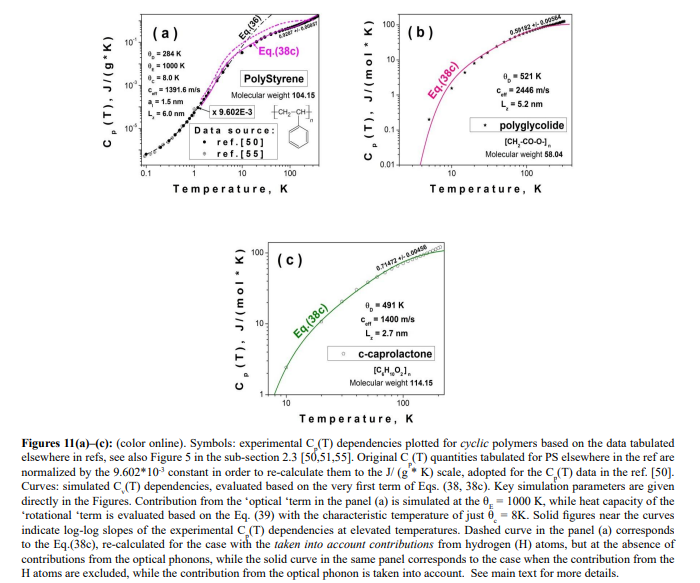
Therefore, the contribution(s) from the linear ‘backbone’ chain of PS and that from the ‘out-plane’ vibrations of its ‘terminal’ benzene ring yields linear (in the temperature) terms, which are hardly distinguishable at relatively high temperatures. On the other hand, features of the ‘low-temperature anomalies’ originated from the linear ‘backbone’ chain and from the aromatic ring would be apparently defined by the typical spatial extents of aforementioned structural fragments. Such extent of the linear ‘backbone’ chain is generally expected to be significantly larger (with the typical quantity of ~5–6 nm) than that of the benzene ring (with the ‘diameter’ of just ~0.3 nm); thus, the length of the ‘backbone’ chain eventually defines experimentally recorded Cp(T) behavior in this temperature range, see Figure 11(a). As for contribution from the ‘in-plane’ vibration of benzene ring into low-temperature heat capacity of the PS, it is generally expectedto be quite negligible, due to relatively fast decline of the C p(T) µ T2 function with the temperature diminishment. In other words, in spite of essential differences in the structural features and vibrational spectra of the linear (e.g., PE) polymeric ‘chains’ (MWs), and those of the branched (e.g., PP) and even cyclic (e.g., PETF, PαMS, PS) polymers, behavior of their low-temperature Cp(T) and Cv(T) dependencies would be eventually defined by the largest spatial extent of their linear molecular sub-structures, which could be identified often as the length of the linear ‘backbone’ chain(s). This explains naturally appearance of the common features of the low-temperature parts of the Cp(T) dependencies for all aforementioned polymeric structures: see particularities of the ‘low-temperature anomalies’ in Cp(T) dependencies in the Figures 9(a)–9(h) for some well-known linear polymers, in the Figures 10(a)-(f) for some branched ones, and Figures 11(a)-(c) for those features of few cyclic polymers. Furthermore, all those common features (including their pronounced ‘low-temperature-anomalies’) could be replicated reasonably well based on the essentially same simulation approach, which is based on the Eqs. (38 – 38c). These equations are ‘designed’ for realistic quantitative evaluations on the Cp(T) quantities obtained experimentally for the linear polymeric chains (MWs), and based solely on energetic characteristics of the spatially confined 1D LA and TA phonons, though some corrections with additional ‘optical’ and ‘rotational’ terms are apparently required for polymeric structures with the relatively long ’backbone’ chins: see, for instance, Figures 9(h), 10(d), 11(a).
It is noteworthy as well, that the quantum atomic movement at relatively low temperatures (well below the Debye’s temperature of the low-dimensional polymers) within the polymeric macromolecules and monomers is expected to involve predominantly relatively heavy carbon (as well as oxygen, nitrogen, chloride, fluorine, etc., atoms) with relatively low vibrational eigenenergies, while substantial involvement of quantum motions (modes) related to the comparatively light hydrogen atoms is generally expected mainly at elevated temperatures [40]. This implies, that at our simulations, the NATmnm quantity, incorporated into the Eqs. (38, 38c) (see also the fifth columns in the Tables 1-4) might be rather associated with the number(s) of relatively heavy carbon (as well as of chlorine, nitrogen, oxygen, etc.) atoms embedded into the monomer, than to its total atomic number. As it is revealed in the Figure 11(a) above, this ‘alteration’ might yield significant improvement in the approximation of the experimental Cp(T) data with the simulated Cv(T) dependencies, especially at relatively low temperatures.
The Figures 12(a), (b) show experimental Cp(T) and simulated Cv(T) dependencies, obtained for two simplest aminoacids. As it is seen from the Figures 12(a), (b), implementation of appropriate combination(s) of Eqs. (38, 38c, 39) yield reasonably good approximation of the experimental Cp(T) dependencies reported both for the poly-L-alanine-alpha (see Figure 12(a)) and poly-L-valine (Figure12(b)). It is noteworthy to recall, that all three aforementioned equations are obtained merely based on the vibrational and rotational characteristics of individual (and presumably) non-interacting linear macromolecules. However, as it is illustrated in the Table 4 above, monomers of both mentioned above aminoacids contains oxygen and nitrogen atoms as well (alongside with the very common for polymers carbon and hydrogen ones), which eventually originate significantly different local electrical charges of such atoms as compared to those of their neighboring carbon and hydrogen atoms, and their ‘electronegativities, as well as – eventually – to the ‘ionicity‘ of the C-O, C-N and C-H bonds, and their significant dipolar (dynamic) electric moments, associated with the presence of such polar covalent chemical bonds [39,57,58]. Indeed, so-called ‘Pauling’s electronegativity’ of the hydrogen, carbon, nitrogen and oxygen atoms are of 2.2, 2.55, 3.04, and 3.44 units, respectively [58]. These differences would originate both (long-range in its nature though ‘screened’ repulsive and/or attractive) directs Coulomb interactions among all locally charged atoms in the zwitterionic polymeric macromolecules, as well as among significant dipolar moment of the C-O, C-H, and C-N bonds in the polymeric chains of the poly-L-alanine-alpha and poly-L-valine. It is noteworthy, that the non-vanishing though relatively weak dipolar moments of the multiple C-H bonds (due to the electronegativity difference of the carbon and hydrogen atoms of just ~0.35) of any polymeric macromolecule are generally expected for all polymers. Those dipolar momentums might interact (mainly via the Coulomb mechanism) among similar momentums of neighboring C-H bonds, as well as with such momentums of other polar chemical bonds both within individual macromolecules and among neighboring polymeric chains [39,58].
In general, the dipolar moments of chemical bonds are expected to be dynamic (time-dependent) due to apparent involvement of all polymeric atoms and chemical bonds among them in the longitudinal and especially ‘optical’ (group) vibrations at any finite temperature [16].
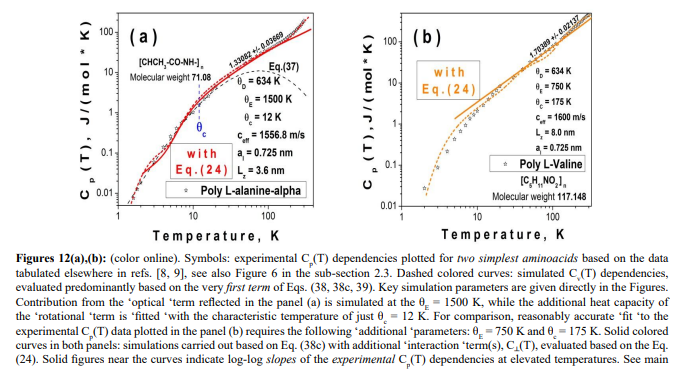
Therefore, more appropriate simulation approach might be implemented in these particular cases in order to take into account effect polyof aforementioned (Coulomb) interactions among neighboring MWs. In particular, Eqs. (23 – 25) from the sub-section 2.1 (see also original forms of those equations in the refs. [8, 9]) have to be added to the basic set of equations, required for appropriate simulations on the Cp(T) dependencies poly-L-alanine-alpha and poly-L-valine: the Eq. (24) is used in our particular case: see color solid curves in Figures 12(a), (b); see also caption(s) to them refs. [8,9].
The contribution(s) from the vibrational states confined within the molecular wires (MWs), C||(T), combined with those from interactions among neighboring MWs, CII(T), yield(s) reasonably good approximation(s) of the experimental Cp(T) dependencies at temperatures exceeding ~(5 – 10) K, even though the ‘rotational’ and ‘optical’ terms are excluded from the set of simulation equations: see solid colorful curves in the Figures 12(a), (b). These eventually imply, that reasonably good approximations(s) of the experimental Cp(T) dependencies reported for the linear, branched, and cyclic polymers might be achieved predominantly based on the basic equations of 1D GSM model, expressed by the Eqs. (38 – 38c) herein, though – in many cases – additional contributions from the ‘intra-chain’ ‘optical’ and rotational terms have to be taken into account rigorously. Moreover, for the case of two simplest amino-acids, convincing approximation(s) for the experimental Cp(T) dependencies might be achieved via implementtation(s) of two alternative approximation(s).
The first one is based on assumptions (see result(s) of its implementation plotted with dashed colorful curves in the Figures 12(a), (b)) that all (though different in their physical nature) contribution(s) to the lattice thermal capacity of polymeric MWs essentially originate from the atomic and molecular vibrations located (confined) within the same linear polymeric MW, while the second approximation (which incorporates essentially Eq. (24) into the basic set of simulation equations) presumes substantial (predominantly Colombian in nature) interactions among those vibrations located (confined) within neighboring MWs. Therefore, the ‘low-temperature’ anomalies are generally expected to be ‘retained’ even in such a case. When, however, the ‘fractal theory’ of the lattice heat capacity of polymers becomes valid, the ‘low-temperature’ Cv(T) dependence, depicted by the Eq. (43) above in this section is expected for the solid polymer(s) [48].
On the other hand, log-log slop of the Cv(T) dependence, defined by the ‘fractal’ Eq. (43) above in this section, becomes fractional (i.e., non-integer), and equals to the ‘fractal ‘dimension of the polymer, D. Therefore, this slop is expected to be of D = 1.64 ± 0.08 for the ‘bottle-brush’ polymeric macromolecules, described, for instance, elsewhere in the ref; see also references therein. This quantity does not deviate drastically from the log-log slope(s) of experimental Cp(T) dependencies reported for the poly-L-alanine-alpha and elsewhere in the ref. [38], see also Figures 6, 12(a), and 12(b) herein. Indeed, the D = 1.64 ± 0.08 quantity obtained in the ...ref. [38] for the ‘bottle-brush’ macromolecules lies between the ~1.33 slope evaluated for the Cp(T) dependence reported for the poly-L-alanine-alpha (see Figure 12(a)) and that of ~1.70, defined for the similar dependence reported for the poly-L-valine: see Figure 12(a) [38,47].
It is noteworthy as well, that the fractional slope(s) of the Cv(T) dependence, predicted by the Eq. (43) for the polymers with the fractal molecular structures, and evaluated numerically for the experimental Cp(T) dependencies plotted Figures 12(a), 12(b)) for the two simplest aminoacids, are eventually attributed to inter-molecular interactions within the aforementioned polymers. However, those interactions for the ‘bottle-brush’ macromolecules originate from ‘…steric overcrowding of the side chains in the densely packed brush...’, causing attractions and/or repulsion among ‘…side chains…’ (brunches) of those macromolecules, spatially arranged based on their (roughly) cylindrical symmetry, while in the case of two simplest aminoacids, illustrated in the Figures 12(a), 12(b)), interactions rather occur among their parallel linear (‘backbone’) chains (MWs), as it is illustrated in the Figures 2(a), (b), in the sub-section 2.1 herein; see also figures presented elsewhere in refs. [8,9,38]. Consequently, basic equations describing aforementioned interactions (as well as their contributions to the lattice heat capacity of aforementioned polymers) turn out to be essentially different as well: the inter-chain interactions are described by Eqs.(22 – 27) herein (see also their original form(s) elsewhere in refs), while Eq.(43) could be used at approximation on the Cv(T) dependencies, expected for the ‘bottle-brush’ macromolecules – though for a limited temperature range only – corresponding to their ‘super-linear’ behavior(s) [8,9].
Discussion
In general, the phonon ‘confinement length’, denoted as Lz in Eqs. (38 – 38c), becomes comparable (at list in its ‘geometrical’ gist) with the nanometer-scaled ‘Kuhn length’, LK, of the one-dimensional polymeric chains. Indeed, traditional interpretation of meaning of the ‘Kuhn length’ as the spatial extent of the ‘rigid’ – and, therefore, literally linear (in the Cartesian space) – ‘…statistical segment…’ of a polymeric chain, could be comprehended as well as the Casimir length of the 1D MWs, where the phonon scattering occurs only on their edges (ends) [14]. Very close concept of ‘coherence length’ of non-disruptive propagation of LA and TA phonons (within the 1D polymeric MWs in this particular case) should be credited to T. Skettrup [13]. However, the Lz quantity in Eqs. (38 – 38c) specifies spatial extent of 1D ‘phonon confinement’, related intimately to the energetic and statistical characteristics of confined 1D LA and TA phonons, rather than to their propagation length alone. Thus, such interpretation of the meaning of the ‘Kuhn length’ of the linear polymeric chains (MWs) brings in physically more comprehen-sive characterization of such polymers, which now incorporates not only purely ‘mechanical’ (like ‘rigidity’ and length) characteristics of polymeric chains, but also their vibrational (i.e., fre-quencies of confined phonons, those of the atomic and molecular vibrations, etc.) and thermal (Debye temperature) parameters, sound velocity, dispersion relation(s), etc. On the other hand, both formalism of (1D) ‘Generalized Skettrup Model (1D GSM), and – in particular – that of the Eqs. (38 – 38c), implemented earlier in ref. [16] (see also references therein) valids for crystalline and amorphous 1D chains, and even for a mixture of those fraction.
Strictly speaking, identification of the Lz parameter of 1D GSM as the ‘Kuhn length’ of poly-meric MWs might not be really meaningful even for many real polymers with the linear molecular structures. First of all – since the ‘Kuhn length(s)’ for majority of well-known linear polymers (except those of DNA molecules) are typically varying in the range from ~0.8 nm to just below 4 nm (see, for instance, Table 2.1 in the second chapter of the ref. [1], and the Tables 25.1, 25,2, and 25.3, presented in the 25th chapter of the ref. [2]. – significant quantum effects (e.g., penetration of the confined vibrational wavefunction(s) in the ‘longitudinal’ direction of the MWs beyond the purely ‘geometrical’  Cs extent) are generally expected [1,2]. Secondly, as it is illustrated in the Figure 13 below, vibrational wavefunctions of the ‘freely joined’ fragments of the polymeric chains (MWs) might interact with neighboring ones at the ends (joinings) of these neighboring fragments of the MW. Eventually, aforementioned interactions, might affect the ‘resonance’ characteristics of the confined – within every individual fragment – thermal vibration(s) phonons.

Figure 13: Schematic illustration of key spatial extents in the MWs, composed of linear ‘freely joined’ fragments. The ‘geometrical’ – Casimir (Cs) – and ‘effective’ (eff) lengths of those fragments are also shown for comparison. See main text for more details.
In such situation, the physically meaningful confinement length, customarily evaluated for the individual linear fragments (MWs) based on their ‘geometrical’ spatial extent(s), Cs , has to be replaced with its ‘effective’ counterpart (Mean-Free-Path, MFP), eff , which could be, for instance, specified as [57]:
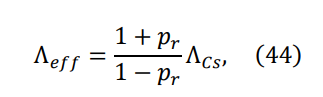
here, pr is the probability of a (LA and/or TA) phonon to be specularly reflected on the end(s) of the linear fragment of the MW, Cs , is the so-called ‘Casimir’ (geometrical) MFP, evaluated based on the assumption of dominance of phonon scattering on the borders (ends) of the linear polymeric fragments, as well as on the absence of significant phonon-phonon inter-actions within each linear fragment of the MW [57]. In our notations, the effective Casimir MFP, eff , simply equals to Lz length, see Eqs. (38 – 38c) and comments to Figure 13. The pr = 0 in Eq. (44) corresponds to the ‘purely diffusive’ case, while the pr = 1 corresponds to the ‘purely specular ‘one; see also comment to Eq.(2) in ref. [57]. Based on Eq. (44), at pr = 0.25, the eff (or Lz) length becomes by ~1.66 times longer than the Cs one. Thus, the physically meaningful spatial extent (length) of the 1D phonon confinement within a polymeric MWs is actually defined not only by the geometrical (Casimir) length(s) of its linear fragment(s), but also by inevitable manifestation of the quantum effects in nano-scaled MWs, and by particularities of ‘conjugation ‘among those neighboring fragments: see Figure 13. The Eq. (44) had been originally intended for evaluation on parameters of thermal transport in ‘corrugated’ silicon nano-wires (SiNWs) [57]. Though features of phonon confinement within SiNWs of ‘corrugated’ cylindrical morphology are expected to be defined by its 3D geometry (morphology), the same Equation could be apparently implemented for the1D case(s) of polymeric MWs. Thus, the essentially quantum nature of the confined atomic and molecular vibrations (phonons) and (potential) interference among the vibrational wavefunctions from the neighboring joined linear fragment(s) of linear polymeric chains might amend significantly the actual confinement length of the quantized vibrations as compared to the purely ‘geometrical’ length(s) of those linear fragments [57].
In other words, their actual length(s) of spatial confinement might (and actually should) differ considerably from their (defined predominantly in an essentially ‘statistical’ manner) ‘Kuhn length(s)’, though – in general – both lengths are obviously expected to be fairly close to each other. It is noteworthy as well, that in the polymeric chains composed of linear fragments of not-exactly-equal lengths, the ‘effective’ Lz (or eff) quantity could be obtained via appropriate ‘averaging’ procedure; see brief discussion on this issue in comments to Figures 10(a), (b) in the previous section, and more detailed one in elsewhere in the ref. [16]. More complicated topology of polymeric macromolecules of polyethylene terephthalate (PETF) comprises of benzene ring(s) embedded directly into the ‘backbone’ chain: see Table 3 for illustration.
Incorporation of the temperature-dependent ‘free energy of confinement’, Fcnf(T), of the polymeric chain within a cylindrical or rectangular ‘tubes’ (see, for instance Eq. (17) in the sub-section 2.1 herein and ..ref. [26] for further details) in the basic set of equations, used at simulations on the Cv(T) and/or Cp(T) dependencies of the low-dimensional polymers, would apparently bring-in the linear (in the temperature) additional contributions to those Cv(T) and/or Cp(T) dependencies. Thus, appearance of those additional contributions (terms) are not expected to amend the generic linear character of the low-temperature branches of the Cv(T) and/or Cp(T) dependencies, predicted – based, for instance, on 1D version of the well-known Tarasov’s equations, and even from Eqs. (38 – 38c) – for the linear polymers [26]. On the other hand, aforementioned Eq. (17) does not predicted any Fcnf(T) contributions to the non-linear Cv(T) and/or Cp(T) declines with the diminishment in the absolute temperature(s) of the polymers. In other words, this temperature-dependent ‘free energy of confinement’ term(s) will not replicated the ‘low-temperature anomalies’, well documented for all LP studied herein: see Figures 3(a), (b) in the sub-section 2.3, as well as original references with the tabulated ‘recommended’ Cp(T) data for the LP. Thus, the Fcnf(T) term, defined by the Eq. (17) is not linked et all to the well-known confinement phenomenon of the LA and TA phonons, located within linear fragment(s) of MWs, and closely related to them ‘low-temperature anomalies’ of the Cv(T) and/or Cp(T) curves. In contrast, the implementation of the combination of the Eqs.(38 – 38c) replicates readily those ‘low-temperature anomalies’ based on the presumption of existence on the energy ‘gap’ in the vibrational spectra of low-dimensional polymers, incorporated naturally into those equations: see Figures 9(a)-12(b) above. Width of this ‘gap’ is inversely proportional to the confinement length, Lz, embedded routinely in all those equations (see, in particular, Eq. 38(a) and comments to it at the beginning of the sub-section 3.2), and this gap vanishes for an infinitely long linear MWs.
The Figure 14 reveals LK(Lz) dependence of the Kuhn length, LK, reported (predominantly) elsewhere in the Chapter 2 of the ref. [1], of the ref. [2], versus the Lz quantities, obtained via fitting of the simulated Cv(T) curves obtained based on the Eqs. (38 – 38c) to their experimental Cp(T) counterparts, see Figures 9(a)-12(b). As it is seen from the Figure 14, the LK and Lz quantities obtained (via the GSM simulations) for the Linear Polymers (LPs), Branched Polymers (BPs), Cyclic Polymers (CPs), as well as for the simplest amino-acids (AA) could certainly be characterized as ‘correlated’ ones, though this correlation is apparently not of the ‘global’ type: i.e., it could not be established in a ‘universal’ way, pertinent for all points revealed in the latter Figure. However, for two ‘sub-groups’ (marked out as the I – first, and II – second) of the LPs, BPs, and CPs, the LK(Lz) dependences could be approximated with the linear inclines, but of two essentially different slopes. The higher slope evaluated for the first (I) group indicates fairly straightforward relation among the LK and Lz quantities, while the lower (second, II) slope indicate significant differences among purely (classical) mechanical LK quantities and quantum-mechanical Lz ones. It is noteworthy, that the separation of the LK(Lz) dependences in Figure 14 into two distinctive sub-groups obviously is not originated by the particularities of molecular topology of the studied polymers: the LP, BP and CP ‘representatives’ appear both in the first (I) and the second (II) sub-groups.
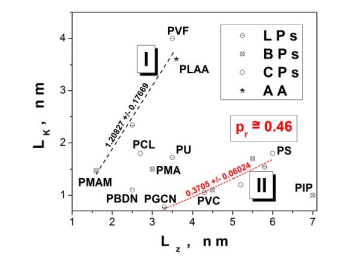
Figure 14: (color online). The Kuhn lengths, LK, of different polymers, plotted against the Lz ones, used at simulations of the Cv(T) dependencies revealed above in the sub-section 3.2 in the Figures 9(a) - 12(b). The LK quantities implemented in this particular figure are (mainly) reported for the Linear Polymers (LPs), Branched Polymers (BPs), and Cyclic Polymers (CPs), elsewhere in the Tables 25.1, 25.2, and 25.3 presented in the 25th Chapter (by L. J. Fetters, D. J. Lohse, and R. H. Colby) of the ref. [2]. Polymer abbreviations are explained in the Tables 1-4 herein; see the sub-section 2.2. Majority of open symbols revealed in this figure are ‘clustered’ in two sub-groups, indicated as I and II in the figure, with (approximately) linear inclines of the LK(Lz) dependencies. Their averaged slopes are evaluated using standard least-square-fit procedure(s), and indicated directly in the figure. The pr quantity for the second (II) group is estimated based on the Eq. (45). See main text for more details.
Instead, the differences in the LK(Lz) slopes within these two sub-groups could be rather related to particularities of vibrational wavefunctions, confined within MWs of different topology, and interpreted readily based on the Eq. (44) above. Indeed, if the contribution from the quantum interferences among confined vibrational wave-functions on the edges of freely joined segments of the polymeric chains (MWs) are expected to be relatively weak, then the (approximate) LK ≈ Lz equality is generally expected based on the Eq. (44). This is the case, ‘represented’ by the (first, I) sub-group of LK(Lz) points with the linear incline, revealed in the Figure 14. When, however, quantum interferences become significant, the ‘effective’ MFP, eff , (and the effective phonon confinement length, Lz) could differ significantly from the ‘geometrical’ (Casimir) Cs length, as it is revealed in Figure 13.
In the latter cases, actual spatial extent of the one-dimensional (linear) confinement of the LA and TA vibrations, Lz (or eff) embedded into the basic equation(s) of the 1D GSM, it is generally expected to correlate (though not really coincide) with the Kuhn length, LK, of the linear polymeric chain(s). In such a case, Eq. (44) above could be ‘inverted’ readily in order to estimate the effective pr quantity based on the (presumably) known Lz and LK values:
with the (averaged) rL ratio defined as follows: rL =
At the same time, the LK(Lz) points, plotted based on the data evaluated for the linear PBDN, PGCN and PU, as well as for the ‘cyclic’ PCL do not really belong either of the aforementioned groups of points in the Figure 14. This could indicate presence of significant fractions of MWs composed both of freely joined linear sections (fragments), as well as of spatially ‘isolated’ (dangling) such section(s), with no attachment(s) to the neighboring sections (fragments) at least at one of their ends. Thus, in the latter case the effect(s) of quantum interference among vibrational wavefunctions on the end(s) of the joined fragments are apparently weakened – or even completely absent, which makes the actual confinement length, Lz , for the wave functions of the LA and TA phonons to be approximately equals to the ‘geometrical’ (Casimir) length, Cs (or LK one), of the linear molecular fragments, see group (I) in the Figure14. Thus, the latter Figure illustrates close relationship established convincingly among the Lz length – (which is defined essentially based on a quantum mechanical concept of phonon confinement and closely related to them essentially ‘non-classical’ phenomena: the ‘low-temperature anomalies‘, contributions (evaluated via calculations on the probability of quantum-mechanical fluctuations) to the lattice thermal capacity of low-dimensional polymer(s), etc.), – with the Kuhn length, introduced many decades ago entirely based on purely classical-mechanical (though very intuitive!) concept(s) of rigidity of one-dimensional polymeric chain(s), length of its ‘statistical segment’, which manifests ‘…crossover to the large-scale random-walk behavior…’, etc. [1-3,7,15]. Since the persistence length of the polymeric chain(s) – which is well defined within framework of the KP model – is closely related to the Kuhn length of those chain(s) (see, for instance, Eq. (16) in the sub-section 2.1, comments to it, and references therein), some quantum mechanical aspects of the persistence length could be established and discussed as well within framework of the 1D GSM approximation.
Conclusion
Results of semi-empirical simulation on features of isochoric temperature-dependent lattice thermal capacity, Cv(T), of low-dimensional polymeric solids of essentially different molecular structures, spatial extents and dimensionalities are presented in this article, and discussed in details in comparison with their experimental isobaric counterparts, Cp(T), reported for several linear, branched, and cyclic polymers, as well as for two simplest amino-acids. Both the experimental, Cp(T) dependences, and simulated Cv(T) ones, reveal sub-linear, nearly-linear, and super-linear enlargements with the temperature at relatively high temperatures (typically exceeding ~50 K), alongside with the pronounced ‘low-temperature anomalies’: relatively sharp (and essentially non-linear) decline(s) in the isobaric heat capacity of those polymers with the temperature diminishment: see details in the sub-section 2.3. Furthermore, in general, fairly reasonable quantitative agreements have been achieved among the simulated Cv(T) dependencies based on the provided and verified 1D version(s) of the GSM equation(s) without adjustment – at least for the case of the studied above linear polymeric chains with dominant contribution from the quantized acoustic vibrations, and their experimental counterparts, Cp(T), for all aforementioned groups of low-dimensional solid polymers, both at the ‘elevated temperatures’, as well as within the temperature sub-ranges, corresponding to the ‘low-temperature anomalies’, see the simulation results in the sub-section 3.2 and detailed discussion in the previous section.
The basic set of implemented simulation equations incorporate as a key parameter the one-dimensional (1D) spatial extent (length) of confinement of LA and TA phonons, located within the linear (straight) fragments of molecular wires (MWs). Moreover, contribution(s) from their ‘optical’ (with Einsteinian spectrum) and rotational terms (wherever they are necessary), as well as those from interactions among neighboring linear MWs are also incorporated into the basic set of equations implemented at these simulations. Features of revealed herein experimental Cp(T) and simulated Cv(T) dependencies are also discussed in comparison with predictions of some others well-known approximations: ‘fractal theory’ of heat capacity of polymers, Tarasov’s and Stockmayer-Hecht (with Genensky-Newel amendments) equations, as well as contribution(s) from the temperature-dependent ‘free energy of confinement’. Notably, that all these well-known theoretical approximations do not incorporate implicitly lengths (spatial extents) of the phonon confinement within the low-dimensional polymeric solids, and – therefore – do not allow one to replicate unambiguously behavior of the Cv(T) and Cp(T) dependencies within temperature sub-ranges, corresponding to the ‘low-temperature anomalies.
On the other hand, the persistence, Kuhn, entanglement length(s) (etc.) of the low-dimensional polymeric macromolecules are known as universal characteristics of their structural, topological and classical-mechanical behavior(s) for more than seven decades: see the sub-section 2.1 and references therein for brief review on the history and physical meanings of aforementioned length(s). Institution of those lengths (sizes of the spatial extent) as key structural and topological characteristics of the real low-dimensional polymers manifested important achievements in interpretation of their key structural, mechanical, and other macroscopic properties, and allowed one to establish generic understanding and explanation(s) of quite complicated – in general – features of the linear, branched and cyclic macromolecular solids. Therefore, incorporation of the nano-scaled confinement length(s) of acoustic phonons in a key set of structural, topological mor-phological parameters of those polymers just follows the aforementioned ‘tend’, and – in a certain sense – develops it even further: brings-in essentially quantum-mechanical description of statistical characteristics of their spatially confined acoustic and optical atomic vibrations. Furthermore, discussed in the previous section inter-relation(s) among the aforementioned well-established structural and topological characteristics (lengths) of different types of polymeric solids and their length(s) of phonon confinement, which also affect(s) straightforwardly other key vibrational characteristics of those polymers, allows one to clarify several important issues regarding intimate relationship(s) among the microscopic (atomistic), and mesoscopic (mono-meric) structural and even macroscopic thermal characteristics of different types of those solids.
In particular, linear correlation(s) among the nano-scaled lengths of 1D spatial confinement(s) of the LA and TA phonons (used at our simulation(s) on the Cv(T) behavior) and the Kuhn (as well as the persistence) lengths of low-dimensional polymers (collected for those polymers from several well-reputable monographs and textbooks) is established convincingly for majority of studied herein solid low-dimensional polymers: please see details in the end of the previous section. This inspire us to discuss traditional meaning of the Kuhn length in a wider context: it could be treated not only as a classical-mechanical (though nano-scaled) length of rigid ‘statistical’ segment of a polymeric chain, but also as a length defining the actual size of essentially quantum spatial confinement of one-dimensional LA and TA phonons, which eventually delineates behavior(s) of the Cv(T) and Cp(T) dependencies, evaluated for those polymeric chains – especially within the temperature sub-ranges corresponding to their ‘low-temperature anomalies’ – and, potentially, becomes of significant importance even for characterization of the length(s) and lifetime(s) of phonon-based thermal transport in all those low-dimensional nano-scaled polymeric solids. Thus, presented, analyzed, and interpreted herein simulation results allows one to extend significantly scope of traditional understanding of several key concept(s) of the thermal physic and features of well-known structural models of the low-dimensional and nano-scaled polymers, as well as provide a profound inside into actual roles of their structural, topological and morphological characteristics in ‘shaping’ of the vibrational and thermal properties of various low-dimensional polymeric solids.
References
- Rubinstein, M., Colby, R. H., (2003). Polymer Physics, (Oxford University Press), ISBN: 019852059X.
- Mark, J. E. (2007). Physical properties of polymers handbook (Vol. 1076, p. 825). J. E. Mark (Ed.). New York: springer.
- Van Krevelen, D. W. (2009). (Revised by Nijenhuis, K. Te.). Properties of Polymers—Their Correlation with Chemical Structure; Their Numerical Estimation and Prediction from Additive Group Contributions.
- Kuhn, W. (1934). Über die gestalt fadenförmiger moleküle in lösungen. Kolloid-Zeitschrift, 68(1), 2-15.
- Flory, P. J. (1975). Spatial configuration of macromolecular chains. Science, 188(4195), 1268-1276.
- Kratky, O., & Porod, G. (1949). Röntgenuntersuchung gelöster fadenmoleküle. Recueil des Travaux Chimiques des Pays-Bas, 68(12), 1106-1122.
- Svaneborg, C., Karimi-Varzaneh, H. A., Hojdis, N., Fleck, F., & Everaers, R. (2016). Multiscale approach to equilibrating model polymer melts. Physical Review E, 94(3), 032502.
- Stockmayer, W. H., & Hecht, C. E. (1953). Heat capacity of chain polymeric crystals. The Journal of chemical physics, 21(11), 1954-1958.
- Genensky, S. M., & Newell, G. F. (1957). Vibration spectrum and heat capacity of a chain polymer crystal. The Journal of Chemical Physics, 26(3), 486-497.
- Tarasov, V. V., & Yunitskii, G. A. (1950). Theory of heat capacity of chain and layer structures. Zh. fiz. khim, 24(1), 111-128.
- Berman, R., & Berman, R., Thermal Conduction in Solids (Clarendon Press, Oxford, 1976) 208 pages, ISBN: 0198514298.
- Kittel, C. (2005). Introduction to Solid State Physics; Wiley, Hoboken.
- Skettrup, T. (1978). Urbach's rule derived from thermal fluctuations in the band-gap energy. Physical review B, 18(6), 2622.
- Casimir, H. B. G. (1938). Note on the conduction of heat in crystals. Physica, 5(6), 495-500.
- Ligatchev, V. (2022). Size-dependent thermal capacity of graphene nano-ribbons. AIP Advances, 12(12), 125010 (2022), 7 pages, doi: 10.1063/5.0123567.
- Ligatchev, V. (2025). Quantitative Evaluations on Harmonic and Anharmonic Lattice Thermal Capacity of Polymers. Recent Progress in Materials, 7(2), 1-37.
- Ligatchev, V (2025), On Experimental Evidences on Existence of Spatial Confinement in Industrial Polymers, accepted keynote talk on International Conference on Materials, Science, Engineering and Technology, Paris, France, 28–30 May; see also pp. 125–126 in the Book of Abstract of the Conference.
- Demydiuk, F., Solar, M., Meyer, H., Benzerara, O., Paul, W., & Baschnagel, J. (2022). Role of torsional potential in chain conformation, thermodynamics, and glass formation of simulated polybutadiene melts. The Journal of Chemical Physics, 156(23).
- Wunderlich, B., (2005), Thermal Analysis of Polymeric Materials, Springer-Verlag, Berlin-Heidelberg (2005), ISBN 3-540-23629-5.
- Rosenbaum, J.F., Bulk Acoustic Wave Theory and Devices, Artech House, Boston, 1998, 480 pages, ISBN: 978-0890062654 (089006265X)
- Cheng, C. F., McCraw, T. J., Solomon, T. H., Yan, M. R., Wnek, G. E., Olah, A., & Baer, E. (2024). High elastic modulus polyethylene: Process-structure-property relationships. SPE Polymers, 5(3), 366-381.
- Hsu, H. P., Paul, W., & Binder, K. (2011). Breakdown of the Kratky-Porod wormlike chain model for semiflexible polymers in two dimensions. EPL (Europhysics Letters), 95(6), 68004.
- Kilanowski, H. P., March, P., & Šamara, M. (2019). Convergence of the Freely Rotating Chain to the Kratky-Porod Model of Semiflexible Polymers: HP Kilanowski et al. Journal of Statistical Physics, 174(6), 1222-1238.
- Kratky, O., & Porod, G. (1949). Diffuse small-angle scattering of X-rays in colloid systems. Journal of colloid science, 4(1), 35-70.
- Everaers, R., Karimi-Varzaneh, H. A., Fleck, F., Hojdis, N., & Svaneborg, C. (2020). Kremer–Grest models for commodity polymer melts: Linking theory, experiment, and simulation at the Kuhn scale. Macromolecules, 53(6), 1901-1916.
- Wang, J., & Li, K. (2019). Statistical behaviors of semiflexible polymer chains stretched in rectangular tubes. Polymers, 11(2), 260.
- Tarasov, V. V. (1953). Heat capacity of chain and layer structures. Zh Fiz Khim, 27, 1430-1435.
- Tarasov, V. V. (1955). Anisotropic atomic vibrations and the heat capacity of layer and chain structures. In Dokl. Akad. Nauk. SSSR (Vol. 100, p. 307).
- Thybring, E. E. (2014). Explaining the heat capacity of wood constituents by molecular vibrations. Journal of materials science, 49(3), 1317-1327.
- Debye, Peter. "Zur theorie der spezifischen wärmen." Annalen der Physik 344.14 (1912): 789-839.
- Born, M., & Von Kármán, T. (1967). Über schwingungen in raumgittern.
- Born, M., Von K, T., (1913). Zur Theorie der Spezifis chen Waermen, Physik. Zeits., 14, 15 – 19.
- Novikov, V. U., & Kozlov, G. V. (2000). Structure and properties of polymers in terms of the fractal approach. Russian Chemical Reviews, 69(6), 523-549.
- Munakata, F., Ogiya, T., & Sato, Y. (2024). Thermal conductivities and complex network properties of fractal self-assembled/self-organized texture in binary composite materials. Applied Physics A, 130(7), 522.
- Roman, H. E. (2024). Polymers in physics, chemistry and biology: behavior of linear polymers in fractal structures. Polymers, 16(23), 3400.
- Bronskaya, V. V., Garifullina, E. V., Ignashina, T. V., Aminova, G. A., Manuyko, G. V., Kharitonova, O. S., & Balzamov, D. S. (2022, February). Calculation of the main characteristics of polymer branching taking into account the exchange of activity between polymerization centres. In IOP Conference Series: Earth and Environmental Science (Vol. 981, No. 4, p. 042023). IOP Publishing.
- Zheng, Y., Li, S., Weng, Z., & Gao, C. (2015). Hyperbranched polymers: advances from synthesis to applications. Chemical Society Reviews, 44(12), 4091-4130.
- Rathgeber, S., Pakula, T., Wilk, A., Matyjaszewski, K., & Beers, K. L. (2005). On the shape of bottle-brush macromolecules: Systematic variation of architectural parameters. The Journal of Chemical Physics, 122(12), 124904, 13 pages, http://dx.doi. org/10.1063/1.1860531.
- Phillips, J. C. (1970). Ionicity of the chemical bond in crystals. Reviews of modern physics, 42(3), 317.
- Wunderlich, B. (1992) Heat Capacity of Solid Polymers, in “Thermal Analysis in Metallurgy.” edited by R. D. Shull and A. Joshi, Proc. of the TMS Meeting in Anaheim, CA 1991, The Minerals, Metals and Materials Soc., 2, 77 – 91.
- Schliesser, J. M., & Woodfield, B. F. (2015). Lattice vacancies responsible for the linear dependence of the low-temperature heat capacity of insulating materials. Physical Review B, 91(2), 024109.
- Pyda, M., & Wunderlich, B. (1997). Computation of heat capacities of solid state benzene, p-oligophenylenes and poly-p-phenylene.Journal of Thermal Analysis and Calorimetry, 49(2), 685-692.
- Zhang, G., & Wunderlich, B. (1997). Heat capacity of solid-state proteins: I. Thermal analysis. Journal of Thermal Analysis and Calorimetry, 49(2), 823-829.
- Di Lorenzo, M. L., Zhang, G., Pyda, M., Lebedev, B. V., & Wunderlich, B. (1999). Heat capacity of solid-state biopolymers by thermal analysis. Journal of Polymer Science Part B: Polymer Physics, 37(16), 2093-2102.
- Gaur, U., & Wunderlich, B. (1981). Heat capacity and other thermodynamic properties of linear macromolecules. II. Polyethylene.Journal of Physical and Chemical Reference Data, 10(1), 119-152.
- Gaur, U., Wunderlich, B. B., & Wunderlich, B. (1983). Heat capacity and other thermodynamic properties of linear macromolecules.VII. Other carbon backbone polymers. Journal of Physical and Chemical Reference Data, 12(1), 29-63.
- Gaur, U., Lau, S. F., Wunderlich, B. B., & Wunderlich, B. (1983). Heat capacity and other thermodynamic properties of linear macromolecules. VIII. Polyesters and polyamides. Journal of Physical and Chemical Reference Data, 12(1), 65-89.
- Smirnova, N. N., Kandeev, K. V., Markin, A. V., Bykova, T. A., Kulagina, T. G., & Fainleib, A. M. (2006). Thermodynamics of linear polyurethanes on basis of 1, 4-diisocyanatobutane with 1, 4-butanediol and 1, 6-hexanediol in the range from T→ 0 to 490K. Thermochimica acta, 445(1), 7-18.
- Gaur, U., Lau, S. F., Wunderlich, B. B., & Wunderlich, B. (1982). Heat capacity and other thermodynamic properties of linear macromolecules VI. Acrylic polymers. Journal of Physical and Chemical Reference Data, 11(4), 1065-1089.
- Gaur, U., & Wunderlich, B. (1981). Heat capacity and other thermodynamic properties of linear macromolecules. IV. Polypropylene.Journal of Physical and Chemical Reference Data, 10(4), 1051-1064.
- Gaur, U., & Wunderlich, B. (1981). Heat capacity and other thermodynamic properties of linear macromolecules. IV. Polypropylene.Journal of Physical and Chemical Reference Data, 10(4), 1051-1064.
- Zhou, J., Chen, C., Sun, J., Fielitz, T. R., Zhou, W., Cahill, D. G., & Braun, P. V. (2025). Reduction of the thermal conductivity of polyurethanes by fluorination: impact of crystallinity, atomic density, and sound velocity. Angewandte Chemie, 137(25), e202503497.
- Ligatchev, V. (2023). Harmonic and anharmonic lattice thermal capacities of molecular wires and 0001-oriented cylindrical ZnO nano-wires. J. Nanosci. Res. Rep. 5: 1–10 (2023), DOI: doi.org/10.47363/JNSRR/2023(5)155.
- Ligatchev, V. (2023). Harmonic and anharmonic lattice thermal capacities of molecular wires and cylindrical ZnO nano-wires. Chapter in: Prime archives in physical sciences. Hyderabad, India: Vide Leaf; 1 – 39. doi:1037247.
- Stephens, R. B., Cieloszyk, G. S., & Salinger, G. L. (1972). Thermal conductivity and specific heat of non-crystalline solids: Polystyrene and polymethyl methacrylate. Physics Letters A, 38(3), 215-217.
- Ligatchev, V. (2020). The ‘Generalized Skettrup Model ‘and lattice thermal capacity of graphene, h-BN, MoS2, and WS2 Flakes.ECS J Solid State Sci Technol. 9(9): 093014. doi: 10.1149/2162-8777/abba04.
- Blanc, C., Rajabpour, A., Volz, S., Fournier, T., & Bourgeois, O. (2013). Phonon heat conduction in corrugated silicon nanowires below the Casimir limit. Applied Physics Letters, 103(4).
- Pauling, L. (1932). The nature of the chemical bond. IV. The energy of single bonds and the relative electronegativity of atoms.Journal of the American Chemical Society, 54(9), 3570-3582.
- MartoÅ?ák, R., Paul, W., & Binder, K. (1998). Orthorhombic phase of crystalline polyethylene: A constant pressure path-integralMonte Carlo study. Physical Review E, 57(2), 2425.
- Wigner, E. (1932). On the quantum correction for thermodynamic equilibrium. Physical review, 40(5), 749.
- Kirkwood, J. G. (1933). Quantum statistics of almost classical assemblies. Physical Review, 44(1), 31.
- Mondescu, R. P., & Muthukumar, M. (1998). Brownian motion and polymer statistics on certain curved manifolds. Physical Review E, 57(4), 4411.
- Huang, J., Li, S., Zhang, X., & Huang, G. (2020). Neural network model for structure factor of polymer systems. The Journal of Chemical Physics, 153(12), 124902, htpps://doi.org/10.1063/5.0022464.