

International Journal of Endocrinology Research and Reviews(IJERR)
ISSN: 2993-656X | DOI: 10.33140/IJERR


Research Article - (2023) Volume 3, Issue 1
Quality assessment of the YouTube source of information on parasomnias by age groups
Received Date: Feb 09, 2023 / Accepted Date: Feb 22, 2023 / Published Date: Mar 07, 2023
Copyright: ©©2023 Vivian M. Correa. This is an open-access article distributed under the terms of the Creative Commons Attribution License, which permits unrestricted use, distribution, and reproduction in any medium, provided the original author and source are credited.
Citation: Vivian M. Correa (2023). Quality assessment of the YouTube source of information on parasomnias by age groups, Int J Endo Res & Rev, 3(1), 15-19.
Abstract
Purpose To evaluate YouTube videos as a source of information on the phenomenology of sleep-related movements and behav- iors, especially in parasomnias.
Methods Analyze the phenomenology of sleep-related behavior on YouTube by the keywords “sleepwalking”, “sleep talking”, and “REM sleep behavior disorder”. DISCERN quality assessment was evaluated by a 5-point scale system by two PhD reviewers. Person Chi-square was applied to find the statistically significant association between the estimated age (child, middle-aged, elderly) groups in the videos and the keywords.
Results and Discussion 170 videos were found from 2010 to 2022: 78.24% from individual experiences, 8.24% from TV news/ documentaries, 10.59% from journals, and 2.94 % from a professor's class. The highest proportion of videos posted on YouTube was sleep-talking complete sentences together with uttering meaningless words/sounds, laughing, or crying (65.52%, adults), followed by aggressive movements (punching, hitting, and kicking) (54.84%, middle-aged and elderly). DISCERN evaluation showed a poor score for the quality of the informa- tion source raising the importance of the improvement in this regard.
Conclusions Nowadays social media became an effortless way to access any information needed by patients. The DIS- CERN quality assessment of parasomnia data on YouTube videos found the need to share a better epidemiol- ogy description, and treatment options for online patient education.
Keywords
YouTube, Patient education, Sleep talking, Sleepwalking, REM sleep behavior disorder.
Introduction
Social media became a fast and sophisticated adopted healthcare platform that pharmacists can utilize for educational purposes [1]. Wikipedia, Facebook, blogs, and YouTube are the most used applications to expand health information [2]. Internet accessi¬bility has transformed YouTube into a popular platform for ac¬quiring information through videos; used even in universities for medical acknowledgment [3]. Although YouTube is an uncom¬plicated way to share education through videos [4], it is still hard to find an excellent channel with a decent-quality explanation of sleep disorders in different languages. The rate of sleepwalk¬ing patients with sleep talking and/or other parasomnias is high worldwide [5], and sometimes failing to provide correct informa¬tion can affect patient-physician relationships and decision-mak-ing [6]. Parasomnias are abnormal behavior characterized by undesirable physical and/or cognitive experiences during REM (rapid eye movement) or NREM (non-rapid eye movement) [7, 8]. Sleepwalking is the most common NREM-related parasom¬nias sleep disorder corresponding to undesirable behavior that is initiated during partial arousal from deep slow-wave sleep that can cause injuries to the patient or to somebody else [9]. On the other hand, REM sleep Behavior Disorder (RBD) is a REM parasomnia that involves the absence of muscle atonia, which causes dream-enacting behaviors, even though, the REM sleep stage is characteristically defined by muscle atonia [10]. This disorder is supposed to be a male-predominant that can lead to aggressive behavior and a considerable risk of injuries [11] or even murder [12]. The literature relates some patients develop-ing dementia or synucleinopathies diseases [13], and the motor events significantly increase when associated with patients' neu-rological disorders [14].
However, the literature had shown few articles evaluating the quality assessment of parasomnias in YouTube videos. Restless legs syndrome is a sleep disorder that is characterized by the un¬wanted movements of the legs during the evening or before sleep and it was evaluated in the useful online videos category by the author, even though some videos provided misleading informa¬tion, or a not complete epidemiology description, and treatment risk factors [15]. For the Obstructive Sleep Apnea (OSA) educa¬tional videos it was categorized as was as a high-quality source of information for patients [16]. OSA is characterized by at least 10 seconds of the cessation of airflow during sleep in the supine position [17]. It can cause health consequences such as obesi¬ty, diabetes, cardiovascular, decrease in energy metabolism, and motivation that can lead to comorbidities such as anxiety and depression [18].
Nevertheless, videos on YouTube do not have any filter or rat-ing of the quality content provided by the website [19]. Sleep disorders misleading information on video-sharing websites can lead to catastrophic engagement by patients or their relatives in their search for education [20]. In this research, we evaluate the reliability and quality of the video publications concerning the sleep behavior phenomenon. We analyzed sleep-related behav¬ioral patterns such as movements, speech/emotional episodes, and dangerous/aggressive behavior to catalog its frequency by age group.
Methods
The collection of internet-based videos on YouTube channels was performed on 2022 November, 21 using the following key-words: sleep talking, REM sleep behavior disorder and sleep-walking. When the videos contained more than one sleep-relat-ed behavior, we scored it for each different variable per person, sometimes in the same video. After the collection, the videos were listed by the following sleep-related behavior performanc-es list (TABLE 1).
We applied a 5-point scale DISCERN video quality assessment, to measure quality and appropriate consumers´ treatment choic¬es source of information [21] by two independents reviewers. For the approximate age group assessment, we used the classifi¬cation of 0 to 18 years; 19 to 49 years; and more than 50 years. In the DISCERN total score, it was categorized as: excellent (63 to 75 points), good (51 to 62 points), fair (39 to 50 points), poor (27 to 38 points), and very poor (16 to 26 points) where the criteria were unfulfilled [22]. Regarding the total YouTube video sourc¬es, the frequency was found as a categorical variable. Pearson chi-square was run for the age group proportion, P<0.05 as a statistically significant result.
Table 1: Sleep-related behavior performances list
Criteria
The number of videos considered sufficient data for analysis was defined as more than 20 different individuals per each keyword.
Exclusion Criteria
Videos announced as entertainment that shows an imitation of sleep-related activities; advertisements; training videos; cours-es; documentaries that did not show a real person performing the phenomenology of sleepwalking, sleep talking or showing aggressive movements during sleep were not included in the re-search.
Statistical Analysis
Analyses performed on the STATA package (StataCorp. 2019 Statistical Software, StataCorp LLC), and Microsoft excel to calculate mean ± standard deviation in the DISCERN evaluation results. Discern scoring system was assessed by 16 questions scored from 1 to 5. The average score was indicated as inade¬quate quality when less than 2; fair quality for a score of 3; and good and appropriate information source for a score higher than 4.
Results
A total of 170 were collected following by the database meth-odology (TABLE 2); 4 YouTube videos were excluded by the exclusion criteria for the reason the videos producer commented they were faking sleep-related behavior on the videos.
Table 2: Total of sleep-related individual’ performances, n (%)
|
Total sources |
170 |
|
Individual user |
133 (78.24%) |
|
TV news/documentaries |
14 (8.24%) |
|
Journals channels |
18 (10.59%) |
|
University class |
5 (2.94%) |
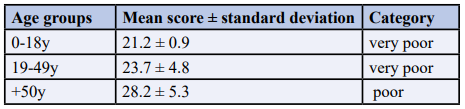
The DISCERN evaluation showed a very low score for the qual-ity of the information sources. However, a higher rate scale was found in the +50y age group (28.2 ± 5.3), and in the first and second DISCERN question about achieving the clear aim in all the videos (mean score was 3,5 and 4). The questions 3 to 7 had shown a mean score of 1.5 when investigated the addi¬tional sources and relevant source of information, and a poor information was found about the treatments, and its risks and benefits (question 8 to 16, mean score 1) (FIG 1). The mean score showed poor reliability of the parasomnias content quality (TABLE 3) in a satisfactory level of agreement by the two in-dependent reviewers; 0.72 Cohen's Kappa coefficient at 0.35 to 1.00 (95% CI), SE 0.19.
Table 3: DISCERN evaluation of the mean score by age groups (n: 170)
|
Age groups |
Mean score ± standard deviation |
Category |
|
0-18y |
21.2 ± 0.9 |
very poor |
|
19-49y |
23.7 ± 4.8 |
very poor |
|
+50y |
28.2 ± 5.3 |
poor |
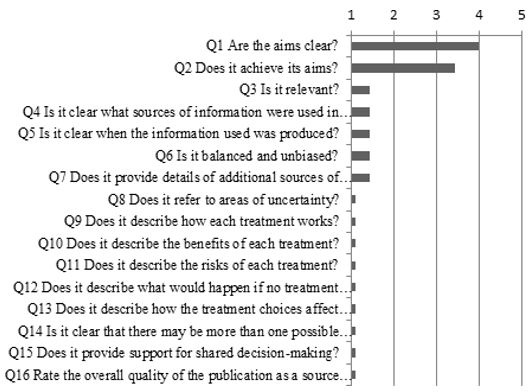
Figure 1: DISCERN evaluation system by 16 questions (5-point scale system) showing the sleep-related behavior performances mean scores for all 170 videos by two PhD reviewers
Person Chi-square results found the statistical significance between the age groups in the videos and the proportion of the posts for each keyword (TABLE 4).
Table 4: Results of Person Chi-square proportion of age groups found in the videos of the YouTube posts for each keyword (n=170)
|
Keywords / age groups |
0-18y |
19-49y |
50+y |
Total (%) |
P-value |
|
Sleepwalking and/or just sitting in the bed |
40.38 % |
48.28 % |
6.45 % |
65 (38.24) |
0.001 |
|
Complex behaviors during sleepwalking e.g., eating or handling objects |
25.00 % |
41.38 % |
6.45 % |
51 (30.00) |
0.001 |
|
Uttering meaningless words/sounds, laughing, or crying |
50.00 % |
65.52 % |
19.35 % |
89 (52.35) |
0.001 |
|
Sleep talking complete sentences |
40.38 % |
65.52 % |
16.13 % |
83 (48.82) |
0.001 |
|
Aggressive movements (punching, hitting, and kicking) |
1.92 % |
4.60 % |
54.84 % |
22 (12.94) |
0.001 |
• Our most important findings by age groups in the YouTube posts (TABLE 4), were the followings:
• The higher proportion of videos posted on YouTube was the individuals uttering meaningless words/sounds, laughing, or crying.
• Middle-aged and elderly had more posts of aggressive, or injurious videos.
• Adults had shown more videos of the potentially dangerous activities during sleepwalking.
• Adults were in the videos of sleep talking complete sentenc-es more frequently.
Discussion
The DISCERN quality assessment is usually used to measure the appropriate consumers´ treatment choices in the published sources. In this case, the YouTube channels on parasomnias in¬formation did not provide sufficient content on specific issues concerning treatment choices.
The mean score for the first and second questions had fair qual¬ity once the videos achieved their aims. However, from Q3 to Q16, the mean score was poor. It must be associated with the fact of online videos are not providing details such as how the infor¬mation was produced, or treatment choices. Treatment choices should be discussed between patients and their physicians [23]. Online medical information has provided information to patient and thus allow them to discuss their own care. The suggestion for sleepwalking (sleep eating) patients with potentially danger¬ous activities is to make the bedroom as safe as possible to min¬imize the risk of injury. Sleeping on the ground floor, closing doors and windows, and removing obstructions and food in the bedroom are recommended. Physicians should advise patients with sleep-related problems to follow the sleep hygiene concept, which means maintaining a regular sleep schedule with a healthy diet and regular exercises. YouTube channel can be a important tool for these advises, such as sleeping in a cool, dark, and quiet room, avoiding television, cellphone, or computer close to bed¬time [24].
In this research, just 12.94 % out of the total videos showed aggressive behavior during sleep. However, 29% of the videos were from YouTube journal channels, university classes, and documentaries. There is a higher possibility of REM sleep be-havior disorder (RBD) in those videos recorded by an individual user, where the patient did not share a diagnosis which is found in elderly males and has the implications of the violent abnor-mal movements during sleep [25]. We have not found elderly females, just males, performing aggressive activities in bed; showing the importance of the age and biological sex difference in the diagnoses, especially in RBD. As the link between RBD and neurodegenerative disorders, such as Alzheimer's and Par¬kinson's disease is increased after the diagnosis with idiopath¬ic RBD. Women showing signs of this sleep disorder must be investigated and treated by a physician. A proper evaluation of parasomnias is required, such as a detailed psychiatric, and med¬icines usage investigation [26].
Limitations
The categorization of the videos and the analysis of the results can be interpreted subjectively by different researchers’ back-grounds, although the result had an elevated level of agreement by the two independent reviews. The database cannot be shared in the public domain, which makes it difficult to reproduce the study without asking the author.
Conclusion
In assessing the quality of YouTube information for parasom-nias, a complete description of the pathogenesis and treatment choices of patients was not found. The DISCERN quality assess-ment of parasomnia videos on YouTube videos emphasizes the importance of social media in providing quality and fast infor¬mation to parasomnia patients, suggesting that good knowledge can have a positive effect on patients' health.
In conclusion, the present work is necessary to point out that the ideas presented here are based on Internet video research. Here, we only present the elements that can serve as an incentive for the development of technological filters in the video application, where the quality of video assessment for online patient educa¬tion can be improved.
Ethical Approval and Consent to Participate: Not applicable.
Consent for Publication: Not applicable
Availability of Dataset: Available from the corresponding au-thor on reasonable request
Conflict of Interest: None
Funding: Semmelweis University
Acknowledgment: Tempus Public Foundation, Stipendium Hun-garicum program
Human Subjects: This study did not have human participants or tissue.
Animal Subjects: This study did not have animal subjects or tissue.
References
- Alkhateeb, F. M., Clauson, K. A., & Latif, D. A. (2011). Pharmacist use of social media. International journal of pharmacy practice, 19(2), 140-142.
- Madathil, K. C., Rivera-Rodriguez, A. J., Greenstein, J. S., & Gramopadhye, A. K. (2015). Healthcare information on YouTube: a systematic review. Health informatics journal, 21(3), 173-194.
- Rabee, R., Najim, M., Sherwani, Y., Ahmed, M., Ashraf, M., Al-Jibury, O., ... & Ahmed, A. (2015). YouTube in medical education: a student's perspective. Medical Education Online, 20(1), 29507.
- McNab, C. (2009). What social media offers to health professionals and citizens. Bulletin of the world health organi-zation, 87, 566-566.
- Pavlova, M. K., & Latreille, V. (2019). Sleep disorders. The American journal of medicine, 132(3), 292-299.
- Robillard JM, Jun JH, Lai J-A, Feng TL. The QUEST for quality online health information: validation of a short quantitative tool. BMC Medical Informatics and Decision Making 2018;18:87.
- Sateia, M. J. (2014). International classification of sleep disorders. Chest, 146(5), 1387-1394.
- Stieglitz S, Heppner HJ, Netzer N. Abnormal things happening during sleep: parasomnias. Zeitschrift Für Gerontol-ogie Und Geriatrie 2020;53:119–22.
- Arnulf I. Sleepwalking. Curr Biol 2018;28:R1288–9.
- Bugalho, P., & Salavisa, M. (2019). Factors influencing the presentation of REM sleep behavior disorder: the relative importance of sex, associated neurological disorder, and context of referral to polysomnography. Journal of clinical sleep medicine, 15(12), 1789-1798.
- Ohayon, M. M., & Schenck, C. H. (2010). Violent behavior during sleep: prevalence, comorbidity and consequences. Sleep medicine, 11(9), 941-946.
- Mahowald, M. W., & Schenck, C. H. (2000). Parasomnias: sleepwalking and the law. Sleep Medicine Reviews, 4(4), 321-339.
- Stefani, A., & Högl, B. (2020). Sleep in Parkinson’s disease. Neuropsychopharmacology, 45(1), 121-128.
- Dauvilliers, Y., Schenck, C. H., Postuma, R. B., Iranzo, A., Luppi, P. H., Plazzi, G., ... & Boeve, B. (2018). REM sleep behaviour disorder. Nature reviews Disease primers, 4(1), 19.
- Arikanoglu, A., Demir, M., & Aluclu, M. U. (2020). Analysis of YouTube as a source of information for restless leg syndrome. Arquivos de Neuro-Psiquiatria, 78, 611-616.
- Gottlieb, D. J., & Punjabi, N. M. (2020). Diagnosis and management of obstructive sleep apnea: a review. Jama, 323(14), 1389-1400.
- Karagoz, B., Bakir, M., & Kececi, T. (2022). Evaluation of the Accuracy and Quality of Information in Videos About Lateral Epicondylitis Shared on Internet Video Sharing Services. Cureus, 14(2).
- Hunasikatti, M. (2020). Benefits of Treating Obstructive Sleep Apnea. JAMA, 324(11), 1110-1110.
- Malik, T. A. M., Heywood, E. G., O’Connor, T. J., Baker,D. M., Marshall, J. H., & Beasley, N. (2019). YouTube™ as a source of information for patients undergoing laryngec-tomy: a thematic analysis. European Archives of Oto-Rhi-no-Laryngology, 276, 3213-3219.
- Ventola, C. L. (2014). Social media and health care professionals: benefits, risks, and best practices. Pharmacy and therapeutics, 39(7), 491.
- Elangovan, S., Kwan, Y. H., & Fong, W. (2021). The usefulness and validity of English-language videos on YouTube as an educational resource for spondyloarthritis. Clinical Rheumatology, 40, 1567-1573.
- Rees, C. E., Ford, J. E., & Sheard, C. E. (2002). Evaluating the reliability of DISCERN: a tool for assessing the quality of written patient information on treatment choices. Patient education and counseling, 47(3), 273-275.
- Hellenthal, N., & Ellison, L. (2008). How patients make treatment choices. Nature Clinical Practice Urology, 5(8), 426-433.
- Chan, C. (2020). How pharmacists can help patients avoid insomnia caused by the pandemic. Pharmacy Today, 26(11), 16.
- Trotti, L. M. (2010). REM sleep behaviour disorder in older individuals: epidemiology, pathophysiology and management. Drugs & aging, 27, 457-470.
- Galbiati, A., Rinaldi, F., Giora, E., Ferini-Strambi, L., & Marelli, S. (2015). Behavioural and cognitive-behavioural treatments of parasomnias. Behavioural neurology, 2015.