

Journal of Marine Science Research and Oceanography(JMSRO)
ISSN: 2642-9020 | DOI: 10.33140/JMSRO

Impact Factor: 1.8

Research Article - (2025) Volume 8, Issue 3
Puzzle of World’s Earthquake Cycle in Connection with Hale Cycle
Received Date: Oct 03, 2025 / Accepted Date: Oct 27, 2025 / Published Date: Nov 05, 2025
Copyright: ©©2025 Aysegul YILMAZ. This is an open-access article distributed under the terms of the Creative Commons Attribution License, which permits unrestricted use, distribution, and reproduction in any medium, provided the original author and source are credited.
Citation: YILMAZ, A. (2025). Puzzle of World
Abstract
In present, we plot Number of World’s Earthquakes NWEQK vs Year as done in previous study, but by extending the period of year from 1976 to 2019 [1,2], i.e., period of two consecutive Hale Cycles .We find that parts of our present plotting during odd-numbered Solar Cycles and during even-numbered Solar Cycle corresponding to both Hale Cycle of our interest, have the same number pieces with similar shapes, respectively. However, their sizes get larger from first Hale Cycle to second Hale Cycle in sequence. Referring to pieces of our present plotting, we find local variations in NWEQKs per Year corresponding to the period of Top Flat Galactic Cosmic Ray (GCRs)Maxima belonging to both Hale Cycles correlate with Solar Polar Field outward in North to South direction (SPFNS), but anti-correlate with T.F.GCR. And local variations corresponding to period of Sharp GCR Maxima correlate with Shrp GCR, but anti-correlate with Solar Polar Field inward in the South (SPFNS) [3]. On the other, general trends of NWEQKs per Year during whole T.F.GCR maxima period except for the years of T.F.G.R – peak value and during Shrp GCR period are to incline (decline) as both of SPFNS Maxima and Shrp Maxima incline (decline), respectively. In terms of effective SPF of both kind of polarities and GCR- effects of both kinds we propose, we define a World’s Earthquake Cycle in connection in Hale Cycle which ascends from one Hale Cycle to the next one by means of our present plotting.
Introduction
As known, the 22-year Solar Cycle, so-called Hale Cycle, consists of two consecutive Solar Maxima which are odd-numbered and the even-numbered in our study [4].
• Ascending phase of the odd-numbered Solar Maxima (SCodd#) is related to direction of Solar Polar toward the North. As the even- numbered Solar Maxima descends, the direction of Solar Polar reverses toward the South [5].
• During ascending phase of even-numbered Solar Maxima (SCeven#), the direction of Solar Polar Field is inward in the North, i.e., negative polarity. As the even-numbered Solar Maxima descends, its polarity is reversed, i.e., once more becomes outward in the North, i.e. positive polarity [5].
During the reversal of solar magnetic field, the galactic cosmic rays (GCRs) penetrating from interstellar medium in our galaxy to heliosphere have also been affected [4]. Therefore, there exists a GCR Cycle with the 11-year period and in anti-phase with Solar Cycle.
• Bulk of the GCRs comes from the polar region of the heliosphere when the solar magnetic field is outward in the North. Hence, during the odd-numbered Solar Minima, more broadly., Top Flat GCRs Maxima are observed [6].
• The GCRs comes from horizontal direction to the heliosphere when the solar magnetic field is inward in the North. Therefore, Sharply Peaked GCR Maxima are observed during the even-numbered Solar Minima [6].
Heliosphere acts a giant shield protecting our Solar System’s planets from most of cosmic ray radiation and Earth’s magnetic field also protect from reaching cosmic rays. Earth is constantly bombarded by GCRs which are high-energy particle accelerated to nearly light-speed by supernova explosion, and other violent events in the galaxy. Most are intercepted by Earth and atmosphere. But some are sufficiently energetic to reach Earth’s surface [6].
The radiogenic heating of Earth’s interior which results on geo-neutrinos are produced by radioactive decay within the Earth and possible extra-terrestrial sources of anti-neutrinos such supernove explosion and solar flare. There are several mechanisms by which heat and material are exchanged between the core and mantle including. Conduction leading to transfer heat through the core-mantle boundary by conduction and Convection related to the movement of the hot material from the core-mantle boundary to the Earth’s surface drives tectonics [7].
Also, Earth’s seismicity decreases toward the polar areas. Both the number of earthquakes and their energy release increases toward the low altitudes, although their maximum does not coincide with the geographic equator, rather shows two peaks [7].
In the following sections, we define a World’s Earthquake Cycle in connection with SPF and GCR and determine its characteristics.
Method
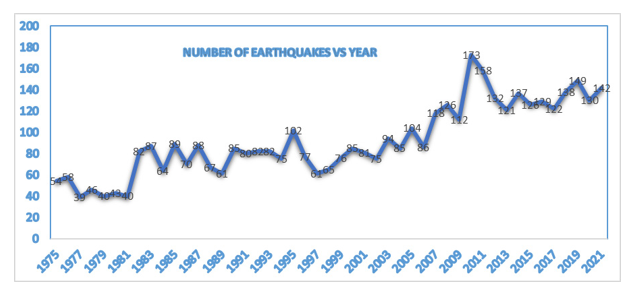
After we plot NWEQKs vs Year for a period of two consecutive Hale Cycles, i.e., from the year 1976 to the year 2019, we consider the 5 pieces and 4 pieces of our plotting corresponding to the periods of T.F.GCR and Shrp GCR, respectively, during SCodd and SCeven of both Hale Cycles related to our plotting. Then, we recall Maxima of SPF with both kind of polarities and GCR of both kinds to research the connection of NWEQK per Year with SPF and GCR [2,3].
To research the connections, we compare local variations indicated by pieces corresponding to the periods of both kinds of GCR with the related variations in SPF of both kind of polarities and both kinds of GCR as a first. As a second, we compare general tendencies of NWEQKs per Year with variations SPF of both kind and GCR of both kind during the whole period of T.F.GCR Maxima and Shrp GCR Maxima.
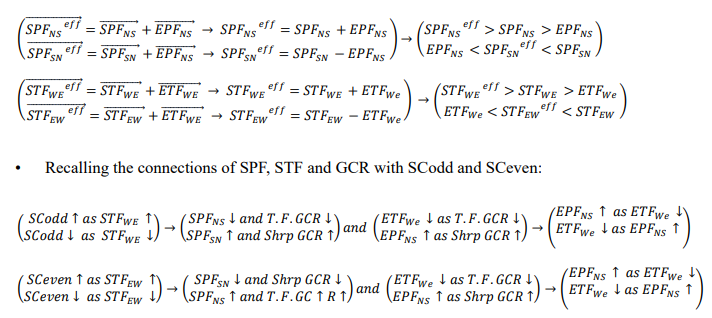
Once more, we refer to modeling Earth’s outer core’s fluid in our previous study [8]. Also, we define effective SPFNS in terms of SPFNS and EPFNS and effective SPFSN in terms of SPFSN and EPFNS
In this study, we propose effect of T.F.GGR leading to incline ETFWE in turn, to decline EPFNSwhere’s effect of Shrp GCR leading to incline EPFNS.
Results
Local variations (↑°.e., increasing, ↑, and decreasing, ↓,) of NWEQK per Year in connection with SPF and GCR and the corresponding pieces to deep (D) and peak(P) values as well as secondary peak (SP) and local peak (LP) and deep (D) values of SPF and GCR can be summarized for the corresponding periods as the following:
SCodd#:SC21 & SC23
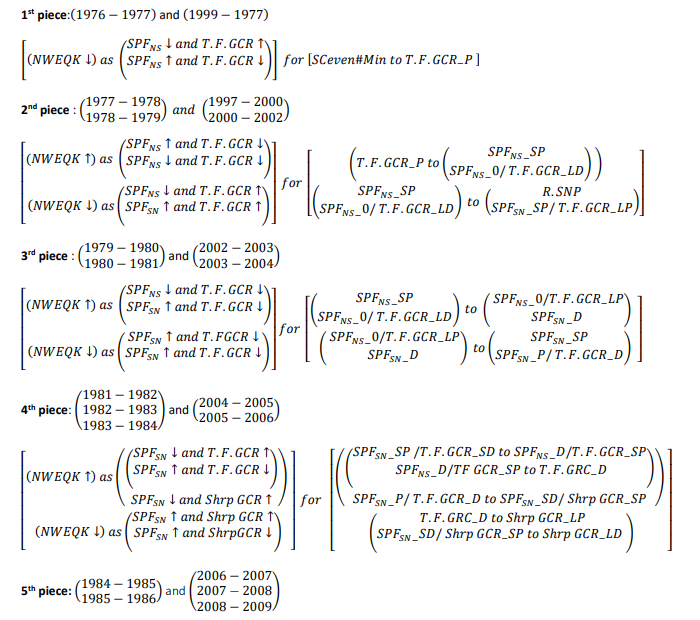
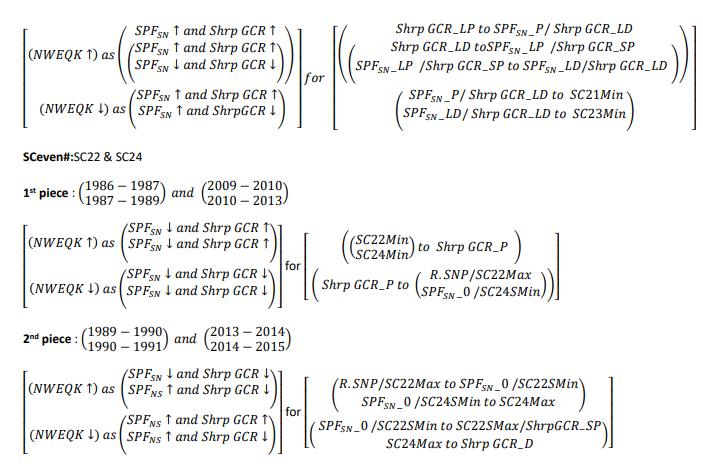
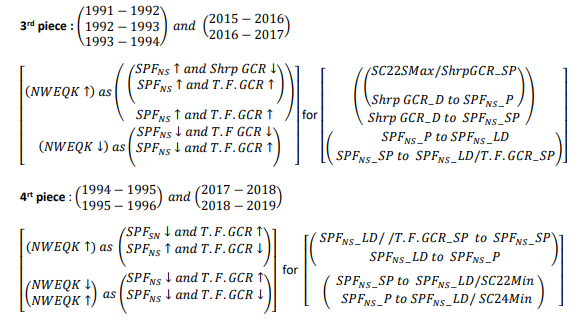
They indicate a World’s Earthquake Cycle (WEQK_C) with ascending phase continuing from one Hale Cycle to next one.
During two consecutive Hale Cycles of our interest, WEQK_C exhibits the following characteristic behaviors:
• During both first and second Hale Cycles (HC1 and HC2, NWEQKs per Year makes main deep in the year of T.F.GCR Maxima- Peak values as well as its primary and secondary peak of whole cycle, respectively, in the year of Shrp GCR Maxima-Peak values.
• During HC1, primary peak value of NWEQKs per Year appears in the year corresponding to secondary peak of SPFNS –Maxima.
• During HC1, primary peak value of NWEQKs per Year appears in the year corresponding to secondary peak of SPFNS–Maxima.
• During HC2, secondary peak value of NWEQKs per Year appears in the year corresponding to primary peak of SC25–Minimum.
• Peaks and Deeps of both HCs reflect the competition between T.F.GCR-effect and SPFNS in the periods of T.F.GCR-Maxima and between Shrp GCR-effect and SPFNS –effect, respectively.
• From HC1 to HC2, all kind of peaks related to NWEQKs per Year get larger as the deeps get smaller
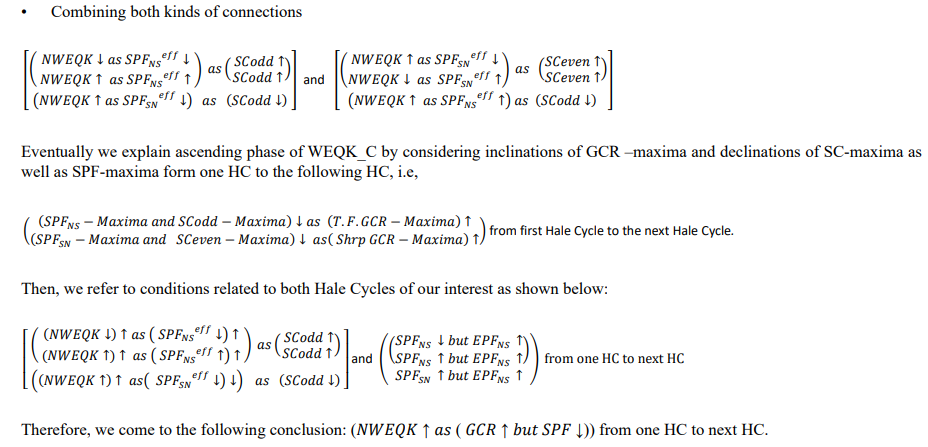
• From HC1 to HC2, NWEQKs per Year continues to ascend as maxima of GCR corresponding to both kind of fluxes also ascends whereas maxima of SPF with two kind of polarities descend.
• The similar variation patterns are repeated for the corresponding pieces of our plotting during SCodd-period and SCeven-period of both Hale Cycles of interest.
• Even, general tendency of our plotting is the same during periods of T.F.GCR Maxima and Shrp GCR Maxima related to both HCs of our interest.
Discussion
We can define a World’s Earthquake Cycle through the following items:
• Defining effective SPF and effective GCR as the following:
Conclusion
In this study, we modify the proposals of our previous study about effects of Solar Axial Dipole Fields of both kind of polarities although to the same modeling of Earth’s conductive fluid of outer core in the previous study is referred once more in present study as summarized in the following items step by step:
• We propose the effects of T.F.GCR flux and Shrp GCR on the flows of the outer core’s fluid generating the EPF with polarity NS and ETF with polarity WE to incline during entering Earth.
• Hence these processes change strengths of both the effective SPF and effective STF with two kind of polarities
• Also, from one Hale Cycle to next one, as both T.F.GCR flux and Shrp GCR flux ascend, SPF of both kind of polarities descend, in turn, strengths of both the effective SPF and effective STF with two kind of polarities are modified [2,6].
Eventually, like pieces of a puzzle, we combine the variations corresponding to the pieces of our present plotting to define a World’s Earthquake Cycle vs Hale Cycle which continues to ascend from one Hale Cycle to next Hale Cycle by combining of two proposals given in the items above.
Ascending NWEQK per Year continues and tells us that as the NWEQKS per Year inclines, the connected hazard we are going to meet more often as time goes on.
References
- List of Earthquakes, https://earhquake.usgs.gov.
- WSO Solar Polar Field Obervations-1976-Present, http://wso.stanford.edu.
- Cosmic Ray Observations, http://cosmicrays.oulu.fi.
- Hale Cycle https://en.wikipedia.org/w/index.php?title=Hale%27s_law&oldid=1244163473
- Solar Cycle Progression http://www.swpc.noaa.gov/products/solar-cycle-progression
- Cosmic Rays/ National Centers for Environmental Information (NCEI) http://ww.ncei.noaa.gov
- Engdahl, E.R.,Villasenor, A. (2002). Global Seismicity: 1900-1999. In: Lee, H.K., Kanamori, H., Jennings, P.C., et al., Eds.,International Handbook of Earthquake and Engineering Seismology, Part A, Academic Press, Amsterdam.
- Yilmaz, A. (2024). Influence of Solar Dipole Field on Earthquake Occurrence. J Mari Scie Res Ocea,7(2), 01-04.