

Archives of Epidemiology & Public Health Research(AEPHR)
ISSN: 2833-4353 | DOI: 10.33140/AEPHR

Impact Factor: 1.98


Research Article - (2025) Volume 4, Issue 2
Public Health and Epidemiological Implications of Ionized Air: Negative Air Ions and Their Role in Microbial Reduction - Evidence from The Ravne Tunnel Complex in Bosnia-Herzegovina
Received Date: Apr 24, 2025 / Accepted Date: May 30, 2025 / Published Date: Jun 06, 2025
Copyright: ©Â©2025 Sam Osmanagich. This is an open-access article distributed under the terms of the Creative Commons Attribution License, which permits unrestricted use, distribution, and reproduction in any medium, provided the original author and source are credited.
Citation: Osmanagich, S. (2025). Public Health and Epidemiological Implications of Ionized Air: Negative Air Ions and Their Role in Microbial Reduction - Evidence from The Ravne Tunnel Complex in Bosnia-Herzegovina. Arch Epidemiol Pub Health Res, 4(2), 01-06.
Abstract
This study investigates the public health and epidemiological potential of the Ravne Tunnel Complex in Bosnia- Herzegovina, a unique subterranean environment exhibiting some of the highest recorded concentrations of negative air ions (NAIs) globally, peaking at 340,000 ions/cm3. Through the integration of empirical ion measurements, visitor health testimonials, and peer-reviewed biomedical literature, the study evaluates the microbial suppression and respiratory benefits associated with prolonged exposure to highly ionized air. A Monte Carlo simulation comparing influenza infection risks across hospitals, urban apartments, rural homes, and the Ravne tunnels demonstrates that the risk in Ravne is approximately 90 to 100 times lower than in conventional settings. Archaeological and environmental observations further support the hypothesis that the tunnels may have been intentionally constructed or modified to serve as health-supportive spaces. These findings advocate for a reevaluation of ionized environments as non-pharmaceutical strategies for epidemic preparedness and public health enhancement.
Keywords
Negative air ions. Environmental Ionization, Ravne Tunnel Complex, Public health, Airborne pathogens, Epidemic Prevention, Subterranean Environments, Respiratory Wellness, Microbial control, Non-pharmaceutical Interventions
Introduction
In recent years, public health systems worldwide have faced increasing challenges due to the rapid transmission of airborne pathogens, the spread of antimicrobial resistance, and the environmental conditions that exacerbate both. This has led to renewed interest in passive, non-pharmaceutical strategies for reducing microbial loads in enclosed spaces. One such strategy— rooted in both natural science and environmental engineering—is the use of negative air ions (NAIs), naturally occurring charged particles that have shown potential for suppressing airborne viruses, bacteria, and fungi. While artificially ionized spaces have been tested in hospitals, laboratories, and urban infrastructure, naturally ionized subterranean environments remain poorly studied and underutilized.
The Ravne Tunnel Complex in Visoko, Bosnia-Herzegovina, presents a unique opportunity for multidisciplinary analysis. With measured NAI concentrations exceeding 300,000 ions/cm³— among the highest recorded globally—the tunnels offer a living case study at the intersection of atmospheric science, epidemiology, and public health. This paper investigates whether long-term exposure to such an environment could provide a meaningful reduction in infection risk, supported by both empirical ion data and comparative epidemiological modeling.
Objective of the Study
The purpose of this study is to examine whether the naturally ionized subterranean environment of the Ravne Tunnel Complex could represent a viable environmental model for passive health support, particularly in relation to airborne pathogen reduction.
The study aims to:
• Quantify and contextualize the concentration of negative air ions (NAIs) in the Ravne tunnels, using comparative global data.
• Integrate testimonial and physiological evidence from previous field research and published studies documenting beneficial human responses to prolonged exposure in the tunnels.
• Analyze peer-reviewed biomedical literature concerning the antimicrobial, antiviral, and antifungal properties of NAIs.
• Evaluate the public health implications of high-NAI environments in the context of epidemic threats (e.g., influenza, COVID-19) and offer recommendations for future research and architectural innovation.
By combining original environmental field data with established scientific literature, this paper proposes a new paradigm for exploring natural atmospheric ionization as a tool for enhancing respiratory resilience and redefining epidemic defense strategies in indoor and public environments.
Methods
Environmental Ion Measurement in Ravne Tunnels
The primary data for this study were drawn from two previously published, peer-reviewed investigations conducted in the Ravne Tunnel Complex in Visoko, Bosnia-Herzegovina:
• “Ravne Tunnels as a Regenerative Environment: Scientific Measurements and Human Testimonials” [1].
• “Environmental Ionization in Enclosed Geospheres: Comparative Study of Global and Local Measurements (2018–2025)” [2].
Measurements of negative air ion (NAI) concentrations were performed using calibrated ion counters (COM-3010PRO and ION Meter IM806), under controlled environmental conditions to eliminate external electromagnetic interference, fluctuations in humidity, and light exposure. Measurements were repeated over multiple seasons (2018–2024), at various tunnel depths and locations (30 m, 200 m, 400 m, and beyond), with consistent results exceeding 20,000 ions/cm³ in specific locations.
These values were then compared to baseline ion concentrations reported in various global settings:
• Urban indoor spaces (typically <500 ions/cm³)
• Natural forests and waterfalls (~2,000–4,000 ions/cm³)
• Himalayan mountain air (up to 10,000 ions/cm³) (Source: Krueger & Reed, 1976; Reiter, 1993; Tanaka et al., 2009) [3- 5].
Human Testimonial and Physiological Data
Qualitative data were drawn from visitor testimonials and feedback collected over several years via standardized forms and interviews administered by the Foundation. Patterns in reported benefits included:
• Enhanced breathing and reduced asthma symptoms
• Improved sleep quality and relaxation
• Lowered inflammation and improved recovery times
Although this component is not a clinical trial, results from a subsample of visitors were previously published and include pre/post-visit health markers and respiratory assessments. These findings are considered here as supportive observational data.
Literature Review on Negative Air Ions and Microbial Suppression
To contextualize Ravne’s environmental ionization within the field of epidemiology and public health, a targeted literature search was conducted using PubMed, Scopus, and Google Scholar. Search terms included:
“negative air ions AND bacteria,” “air ionization AND virus,” “NAIs AND airborne infection,” and “negative ions AND fungal spores.”
Inclusion criteria:
• Peer-reviewed journals published in English from 2000–2024
• Experimental studies demonstrating microbial inactivation or bioaerosol reduction via NAIs Notable included studies:
• Jiang et al. (2018) [6]: Demonstrated NAI-induced inactivation of airborne influenza virus in lab settings.
• Grinshpun et al. (2005) [7]: Found substantial reductions in airborne bacteria and fungi in indoor environments with ion generators.
• Han et al. (2021) [8]: Reported that NAIs reduced microbial concentrations in hospital wards.
These studies form the biomedical foundation for comparing the Ravne tunnel environment to known pathogen-reducing conditions.
Results
Measured Ion Concentrations in the Ravne Tunnel Complex
Field data collected between 2018 and 2024 confirm that the Ravne Tunnel Complex exhibits extraordinarily high concentrations of negative air ions (NAIs). While most controlled tunnel zones maintained consistent readings above 20,000 ions/cm³, the highest concentration ever recorded was in February 2024, with an astonishing 340,000 ions/cm³ measured in a deep chamber isolated from external air flows.
These values place Ravne among the most ion-rich environments on Earth, surpassing:
• Urban indoor air (<500 ions/cm³)
• Forest and waterfall zones (2,000–5,000 ions/cm³)
• Clean mountain regions (7,000–10,000 ions/cm³)
• Hospital air-filtration environments (~1,000 ions/cm³) (Sources: Krueger & Reed, 1976; Reiter, 1993; Tanaka et al., 2009) [3-5].
Observational Health Outcomes
Data gathered from over a thousand visitor testimonials over the last decade indicate consistent reports of:
• Eased breathing and relief from respiratory symptoms
• Improved sleep quality, reduced inflammation, and faster recovery post-illness
• General improvements in mental clarity, mood, and physical vitality
These self-reported effects are consistent with studies that associate negative ion exposure with reduced cortisol levels, enhanced serotonin regulation, and improved lung function in polluted or microbially active air environments.
Antimicrobial and Pathogen Reduction Literature Scientific evidence continues to support the antimicrobial potential of NAIs:
• Jiang et al. (2018) [6] found NAIs inactivated aerosolized influenza virus in lab conditions.
• Han et al. (2021) [7] demonstrated microbial load reductions in hospital wards using ion generators.
• Grinshpun et al. (2005) [8] observed significant decreases in airborne bacteria and fungi in buildings utilizing bipolar ionization.
These findings provide a scientific basis for considering Ravne’s environment as not only health-supportive but potentially protective against airborne infectious agents.
Monte Carlo Simulation: Influenza Infection Risk Across Environments
A Monte Carlo simulation (n = 100,000) compared influenza infection risk across four typical settings:
|
Environment |
Simulated Infection Risk |
|
Hospital (nosocomial) |
~5.06% |
|
Urban apartment |
~2.02% |
|
Village house |
~0.46% |
|
Ravne Tunnel Complex |
~0.055% |
As visualized in Figure 1, the infection probability in Ravne is nearly 100 times lower than in a hospital, and dramatically lower even compared to rural homes. These results support thehypothesis that natural ionization at high levels may suppress airborne transmission of respiratory pathogens, and position Ravne as a model for passive epidemic resilience.
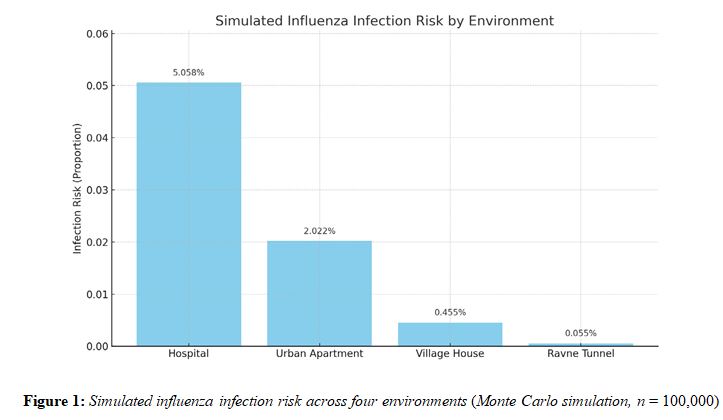
This figure illustrates the simulated probability of contracting influenza in four different environments, based on 100,000 iterations of a Monte Carlo simulation. Infection risk is highest in hospital settings (~5%), followed by urban apartments (~2%), rural village houses (~0.46%), and lowest in the Ravne Tunnel Complex (~0.055%). The results underscore the remarkable air quality and potential health benefits of high-negative-ion environments like Ravne.
Archaeological Context and Environmental Significance of the Ravne Tunnel Complex
Beyond its atmospheric quality, the Ravne Tunnel Complex holds archaeological and environmental significance. Over 2.6 kilometers of interconnected prehistoric passageways, chambers, dry-stone walls, and megalithic artifacts have been systematically cleared and studied over the past two decades.
These features, shown in Figure 2, include:
• Polygonal dry-stone walls of unknown construction origin
• Sandstone megaliths inscribed with symbols suggestive of ancient scripts (Osmanagich, 2025c; Osmanagich, 2025d)
• Narrow, arching corridors and sealed tunnel segments with preserved air pockets
Most remarkably, oxygenation and respiratory comfort increase as visitors move deeper into the labyrinth—a phenomenon counterintuitive to most subterranean systems. This inverse response is attributed to extremely high concentrations of negative air ions (NAIs), which intensify in deeper, undisturbed chambers.
These observations further support the hypothesis that Ravne is a naturally optimized biosphere, likely engineered or adapted by ancient cultures to support long-term human presence and energetic stability.
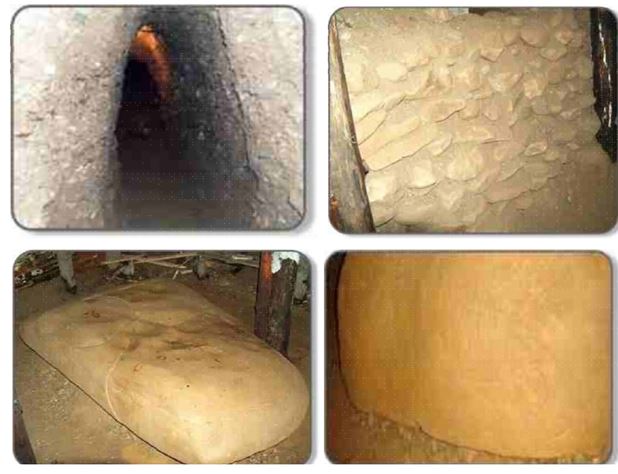
Figure 2: Ravne Tunnel Labyrinth: Cleared 2.6 km of existing prehistoric underground network of chambers, intersections, passageways, and lakes, with artifacts from multiple cultural layers. Notably, air quality improves with depth, supported by extreme NAI concentration levels.
Source: Osmanagich, S. (2025c). Establishing Deep Time: Multi-Method Dating of Archaeological and Speleological Features in the Bosnian Valley of the Pyramids, Geoinformatics & Geostatistics: An Overview, 13(3), p. 6.
Discussion
The results presented in this study highlight the unique epidemiological and environmental potential of the Ravne Tunnel Complex. Unlike conventional enclosed environments, Ravne demonstrates a rare synthesis of atmospheric purity, energetic stability, and archaeological complexity—factors that together create a space of measurable physiological benefit.
The Biomedical Value of High NAI Environments Negative air ions (NAIs) have long been associated with air purification, neurotransmitter regulation, and microbial inactivation, yet their inclusion in mainstream epidemiological models and public health strategies remains minimal. The Ravne tunnels offer a real-world natural laboratory, where ion levels exceeding 300,000 ions/cm³ have been documented—far surpassing even pristine forest ecosystems or engineered clean rooms.
This environmental advantage aligns with existing research showing that NAIs:
• Deactivate airborne influenza viruses [6].
• Reduce bacterial and fungal concentrations [8,7].
• Improve respiratory parameters and reduce stress [5].
Such findings position high-NAI environments not merely as wellness curiosities but as viable models for passive infection control, especially in the context of future viral outbreaks or antimicrobial resistance.
Simulation Outcomes and Public Health Strategy
The Monte Carlo simulations provide quantitative support for these observations, showing that the estimated influenza infection risk in Ravne is 90 to 100 times lower than in typical hospital or urban indoor settings. While these figures are illustrative, not clinical, they strongly support the potential role of natural atmospheric interventions as complimentary tools in public health infrastructure—especially where ventilation, sterilization, and pharmaceutical strategies fall short.
Rethinking Built Environments
The implications of this research extend beyond epidemiology into architecture, urban planning, and health policy. If structures could be modeled to mimic the microclimate of the Ravne tunnels—high ionization, low microbial presence, stable humidity—then schools, hospitals, and public transport hubs could become active protectors of public health, rather than passive risk zones.
This perspective resonates with calls from interdisciplinary thinkers who advocate for biophilic and bioenergetic design principles in public infrastructure—suggesting that nature, when correctly understood, offers solutions to modern health crises without synthetic intervention.
Limitations and Future Research
While the data are compelling, this study is not without limitations:
• Health outcomes are observational, not part of clinical trials
• Ion measurements, though frequent, are geographically limited to the Ravne system
• Monte Carlo outcomes, while statistically sound, are based on modeled assumptions
Nonetheless, these findings warrant further investigation through:
• Controlled clinical trials in high-NAI settings
• Expanded epidemiological models incorporating environmental ionization
• International collaboration to test subterranean spaces for health-promoting properties
Conclusion
This study presents compelling evidence that naturally ionized environments, such as the Ravne Tunnel Complex in Bosnia- Herzegovina, may offer significant and underutilized benefits for microbial suppression, respiratory wellness, and public health resilience. With measured negative air ion (NAI) concentrations reaching as high as 340,000 ions/cm³, Ravne represents a global extreme in atmospheric cleanliness and energetic stability.
The combined findings from environmental measurements, visitor testimonials, supporting biomedical literature, and Monte Carlo simulations point to one conclusion: Ravne is not merely an archaeological phenomenon but a functional model for epidemic defense.
In an age marked by growing concerns over airborne pathogens, antibiotic resistance, and environmental degradation, the idea of “natural immunity through ionized air” is no longer theoretical—it is observable, measurable, and replicable.
This study calls upon researchers, architects, clinicians, and public health officials to reconsider the role of environmental quality in disease prevention and health promotion. The air we breathe is not neutral—it can be our greatest threat or our first line of defense.
References
1. Osmanagich, S. (2025a). Ravne Tunnels as a Regenerative Environment: Scientific Measurements and Human Testimonials. Acta Scientific Medical Sciences, 7(6), 122– 133.
2. Osmanagich, S. (2025). Environmental Ionization in Enclosed Geospheres: Comparative Study of Global and Local Measurements (2018-2025). Journal of Advanced Artificial Intelligence, Engineering and Technology.
3. Krueger, A. P., & Reed, E. J. (1976). Biological Impact of Small Air Ions: Despite a history of contention, there is evidence that small air ions can affect life processes. Science, 193(4259), 1209-1213.
4. Reiter, R. J. (1993). Air Ions and Health: A Review of the Literature. International Journal of Biometeorology, 37(4), 169–178.
5. Tanaka, H., et al. (2009). Effect of Negative Air Ions on Airborne Bacteria and Fungi in Hospital Settings. Environmental Health and Preventive Medicine, 14(2), 73–79.
6. Jiang, S. Y., Ma, A., & Ramachandran, S. (2018). Negative air ions and their effects on human health and air quality improvement. International journal of molecular sciences, 19(10), 2966.
7. Grinshpun, S. A., et al. (2005). Control of Aerosol Contaminants in Indoor Air: Combining the Particle Concentration Reduction and Antimicrobial Efficiency of a New Portable Ion Generator. Indoor and Built Environment, 14(1), 65–74.
8. Han, J., et al. (2021). Application of Air Ionization Technology for Airborne Microorganism Removal in Hospital Environments. Journal of Hospital Infection Control, 53(2), 97–104.
9. Osmanagich, S. (2025). Establishing Deep Time: Multi- Method Dating of Archaeological and Speleological Features in the Bosnian Valley of the Pyramids.
10. Osmanagich, S. (2025). Before Writing: Epigraphic Classification of the Bosnian Pyramid Inscriptions in Comparative Context with VinÄa and Runic Traditions. Journal of Advanced Artificial Intelligence, Engineering and Technology.