

Archives of Infectious Diseases & Therapy(AIDT)
ISSN: 2577-8455 | DOI: 10.33140/AIDT
Impact Factor: 1.385


Research Article - (2025) Volume 9, Issue 1
Profile of Patients Attending HIV-Care Facilities in Kinshasa, Drc: A Five-Year Longitudinal Trend Study (2017 – 2022)
2Department of Paediatrics and Midwifery, Faculty of Health Sciences, National Pedagogical University, Congo, the Democratic Republic of the
3Department of Public Health, Faculty of Medicine, University of Mbujimayi, Eastern Kasai Province, Congo, the Democratic Republic of the
Received Date: Jan 14, 2025 / Accepted Date: Feb 21, 2025 / Published Date: Mar 07, 2025
Copyright: ©2025 Jose Gaby Tshikuka, et al. This is an open-access article distributed under the terms of the Creative Commons Attribution License, which permits unrestricted use, distribution, and reproduction in any medium, provided the original author and source are credited.
Citation: Tshikuka, J. G., Lohale, M., Ngalula, B. B. C., Kongo, F., Esako, O. M., et al. (2025). Profile of Patients Attending HIV-Care Facilities in Kinshasa, Drc: A Five-Year Longitudinal Trend Study (2017
Abstract
The rapid increase of HIV healthcare facilities in Kinshasa, DRC, coincides with a rising prevalence of overweight/obesity, and related comorbidities among people living with HIV in the city. It remains uncertain whether this trend will continue to rise annually.
This study aimed to investigate the types of ART used in HIV healthcare facilities in Kinshasa and determine whether overweight, obesity, and related comorbidities are continuing to rise.
A five-year retrospective longitudinal study was conducted to analyse trends among 1,199 ART recipients admitted to HIV healthcare facilities in Kinshasa between January 2017 and December 2021. The study included data from Kitambo Referral Hospital, AKRAM Hospital Centre, and IK Clinics. Longitudinal trend analysis was performed to assess annual changes in overweight/obesity and associated comorbidities. Straight-line trends, slopes, and linear equations were determined, and Chi-square tests for trends were conducted.
The study hypothesized that (i) the prevalence of overweight/obesity would show an increasing trend and (ii) the rate of related comorbidities among ART recipients would also rise over time. Statistical significance was set at p < 0.05. The first-line regimen used by 78% of the study population was Tenofovir/Lamivudine/Dolutegravir. The analysis confirmed an increasing trend in overweight/obesity, while comorbidities showed a decreasing trend.
It is imperative for HIV healthcare facilities in Kinshasa to regularly monitor overweight/obesity and related comorbidities among patients, along with ART regimens, viral load (copies/ml), CD4 count, and other relevant factors like biochemistry markers. This proactive approach will help identify areas requiring intervention in a timely manner to improve the well-being of people living with HIV (PLHIV).
Keywords
PLHIV, ART, Trends, Overweight/Obesity, Related Morbidities
Background
Antiretroviral treatment (ART) has significantly improved the health profile of people living with HIV (PLHIV), enabling them to live longer lives comparable to the general population [1]. To maximise the benefits of these drug combinations, the city of Kinshasa, DRC, has been providing free ART for some time, along with clinical, laboratory, and psychological care for PLHIV.
However, long-term ART use has been linked to overweight/ obesity, to toxicities and various metabolic abnormalities, including dyslipidemia, abnormal fat redistribution, hypertension, and insulin resistance, which are frequently associated with treatment [2,3]. These effects are particularly notable in regimens containing protease inhibitors such as Aluvia (Lopinavir boosted with Ritonavir) [4]. Despite these concerns, adequate attentionhas not been given to managing these side effects, leading to unexpectedly high rates of overweight/obesity among patients.
Objectives
This study aimed to: (i) identify the ART regimens used in the management of PLHIV in HIV care facilities in Kinshasa, (ii) estimate the prevalence of overweight/obesity and related comorbidities among ART recipients, and (iii) analyse the trends in overweight/obesity rates and associated comorbidities over time.
Hypothesis
We hypothesised that: (i) the prevalence of overweight/obesity among ART recipients would show an increasing trend, and (ii) the rate of related comorbidities among ART recipients would also increase over time.
Methods
We conducted a longitudinal trends study using a retrospectiveapproach to analyze 1,199 ART recipients admitted to HIV care facilities between January 2017 and December 2021. None of the patients was overweight/obese before admission to the study. The study was carried out in three HIV healthcare facilities in Kinshasa: Kitambo Referral Hospital, AKRAM Hospital Centre, and IK Clinics. Longitudinal trend analysis was performed to assess annual changes in overweight/obesity and associated comorbidities. Outcome slopes were determined using straight- line trends and linear equations, whilChi-square tests for trends were conducted. The level of significance was set at p < 0.05.
Results
Results revealed that: (i) 78% of ART recipients were on the first- line regimen, Tenofovir/Lamivudine/Dolutegravir, (ii) 21% re- ceived the second-line regimen, Tenofovir/Lamivudine/Efavirenz, and (iii) 0.6% were on the third-line regimen, Abacavir/Lamivu- dine/Dolutegravir (see Figure -1 below).
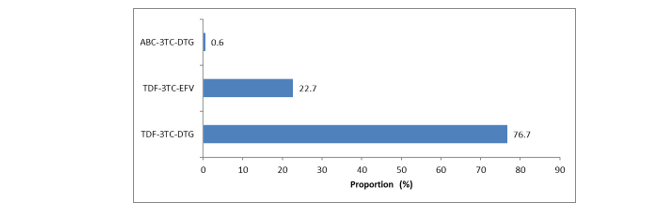
Figure 1: Proportion of Overweight/Obesity among patients by ART regiment in Kinshasa, DRC, 2017 - 2021 (N = 1199).
The study confirmed an increasing trend in overweight/obesity among ART recipients; however, no significant increasing trend was observed for comorbidity related to overweight/obesity. The linear equation, straight-line trend, and slopes for both overweight/ obesity and comorbidity are presented in Figure-2 below. Here,"morbidity" refers to the combined prevalence of major overweight/ obesity-related conditions, including hypertension (HTN), diabetes mellitus (DM), tuberculosis (TB), and skin diseases.
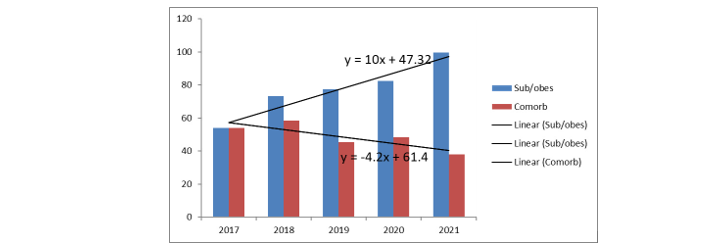
Figure 2: Trends in Overweight/Obesity and associated comorbidities among ART recipients in 3 HIV-care facilities in Kinshasa, DRC, (2017 – 2021) (N = 1199).
Discussion
While these results confirmed the hypothesis that the prevalence of overweight/obesity followed an upward trend, supporting existing literature, the second hypothesis was rejected. Despite reports in the literature suggesting an upward trend in comorbidities among HIV- positive patients [5,6], our findings did not confirm a significant trend thus, lending support to others [7]. This discrepancy may reflect the impact of lower viral loads among recipients, which in turn increased CD4 counts and immune resilience, leading to better control of comorbidities [4]. These results underscore the urgent need for HIV healthcare facilities in Kinshasa to regularly monitor overweight/obesity, biochemistry markers and related comorbidities. This includes tracking ART regimens, viral load, CD4 count, and other relevant factors to identify and address issues in a timely manner, ensuring the well-being of people living with HIV
Declaration
Ethical Approval
The School of Public Health Ethical Commission provides general oversight and ethical approval in DRC. This commission does not require a formal submission for ethical approval for research using secondary data.
Data Availability
The data underlying the findings of this study are not publicly available in order to maintain patient confidentiality. The data includes potentially identifying demographic and clinical care information. However, the data can be requested from the corresponding author, who must obtain permission from the HIV care centres where the study was conducted before sharing.
Competing of Interest
The authors have no conflict of interest to declare.
Funding
The study was funded by the research and dissertation grants provided to the students by their academic advisor and principal investigator in this study.
Authors Contribution
The study was designed by JGT, LM, NBBC, and KF, who also supervised data collection at the HIV centres and contributed toall stages of the study, from proposal preparation to report writing. EOM, PPP, BNKZ, KA, NF, and KNN were involved in reviewing the study proposal, data analysis, and writing the report. All authors reviewed and agreed that the paper was sufficiently developed for publication.
References
- Wandeler, G., Johnson, L. F., & Egger, M. (2016). Trends in life expectancy of HIV-positive adults on antiretroviral therapy across the globe: comparisons with general population. Current Opinion in HIV and AIDS, 11(5), 492-500.
- Chawla, A., Wang, C., Patton, C., Murray, M., Punekar, Y., de Ruiter, A., & Steinhart, C. (2018). A review of long-term toxicity of antiretroviral treatment regimens and implications for an aging population. Infectious diseases and therapy, 7, 183-195.
- Tshikuka, J. G., Rankgoane-Pono, G., Magafu, M. G. M. D., Masupe, T., Molefi, M., Nsikungu-Kalukul, M., ... & Setlhare,V. (2018). Relationship between combination antiretroviral therapy regimens and diabetes mellitus-related comorbidities among HIV patients in Gaborone Botswana. BMC public health, 18, 1-9.
- Tshikuka, J. G., Boitshwarelo, M., Hamda, S. G., Tapera, R., Bukonda, N. K. Z., & Onokoko, M. E. (2024). The Prevalence of Overweight/Obesity and Related Comorbidities among HIV-Positive and HIV-Negative Patients Attending the Same Clinics in Gaborone, Botswana. Advances in Infectious Diseases, 14(3), 523-540.
- Koliaki, C., Dalamaga, M., & Liatis, S. (2023). Update on the obesity epidemic: after the sudden rise, is the upward trajectory beginning to flatten?. Current Obesity Reports, 12(4), 514-527.
- Gomes, A., Reyes, E. V., Garduno, L. S., Rojas, R., Mir Mesejo, G., Del Rosario, E., ... & Taylor, B. S. (2016). Incidence of diabetes mellitus and obesity and the overlap of comorbidities in HIV+ hispanics initiating antiretroviral therapy. PloS one, 11(8), e0160797.
- Tripathi, A., Liese, A. D., Jerrell, J. M., Zhang, J., Rizvi, A. A., Albrecht, H., & Duffus, W. A. (2014). Incidence of diabetes mellitus in a populationâ?based cohort of HIVâ?infected and nonâ? HIVâ?infected persons: the impact of clinical and therapeutic factors over time. Diabetic medicine, 31(10), 1185-1193.