

Advances in Theoretical & Computational Physics(ATCP)
ISSN: 2639-0108 | DOI: 10.33140/ATCP
Impact Factor: 2.6

Research Article - (2025) Volume 8, Issue 4
Primacohedron: A p-Adic String & Random-Matrix Framework for Emergent Spacetime, Perfectoids, p-adic geometry, and a Proposal towards solving Riemann Hypothesis and abc Conjecture
Received Date: Sep 16, 2025 / Accepted Date: Nov 14, 2025 / Published Date: Nov 28, 2025
Copyright: ©Â©2025 Sandi Setiawan. This is an open-access article distributed under the terms of the Creative Commons Attribution License, which permits unrestricted use, distribution, and reproduction in any medium, provided the original author and source are credited.
Citation: Setiawan, S. (2025). Primacohedron: A p-Adic String & Random-Matrix Framework for Emergent Spacetime, Perfectoids, p-adic geometry, and a Proposal towards solving Riemann Hypothesis and abc Conjecture. Adv Theo Comp Phy, 8(4), 01-69.
Abstract
We present the Primacohedron, a unified framework linking p-adic string resonances, zeta-function spectra, and emergent spacetime geometry. By extending non-Archimedean string amplitudes and constructing a spectral correspondence that maps Riemann–Dedekind zeros to a Hermitian operator, the model reproduces GUE-type fluctuations temporally and closed-string coherence spatially. A curvature–spectral duality yields emergent geometry, holographic behaviour, and dynamically Bekenstein- saturating learning.
The framework further incorporates Diophantine geometry: radicals and height functions arise as spectral-energy sums of prime resonances, and the abc-inequalityemerges as a curvature-stability condition on an adelic manifold. An adelic operator pair (Hspec, Hht) encodes analytic zeros and heights simultaneously, suggesting a geometric route toward Riemann Hypothesis (RH) and abc via curvature regularity.
Finally, we extend the structure using perfectoid geometry and p-adic Hodge theory. Perfectoid tilting links mixed- and equal- characteristic layers through a curvature-preserving duality, while Hodge filtrations provide a cohomological interpretation of spectral dimensionality and arithmetic time. Together, these developments position the Primacohedron as a geometric, cohomological, and operatortheoretic paradigm for understanding analytic and Diophantine phenomena within a single adelic spacetime.
Keywords
P-Adic String Theory, Primacohedron, Zeta-Function Spectra, Riemann Hypothesis, Abc Conjecture, Spectral–Diophantine Duality, Hilbert–Pólya Operator, Random Matrix Theory (Gue), Emergent Spacetime, Adelic Geometry, Perfectoid Fields, Tilting Equivalence, P-Adic Hodge Theory, Hodge–Tate Weights, Arithmetical Quantum Chaos, Height Functions, Radicals, Holography, Information Geometry, Curvature Flow, Adelic Operators
Introduction and Motivation
The Primacohedron proposes that spacetime is not fundamental but an emergent, selforganizing structure arising from the synchronized resonances of prime–indexed string modes. Each prime number p defines a local non-Archimedean geometry , supporting open and closed p-adic string excitations. The resulting ensemble of local geometries, glued together through the adelic product, forms a global resonance network whose collective dynamics generate the appearance of a smooth, continuous spacetime manifold. Formally, this network embodies an arithmetic analogue of holography, where local p-adic amplitudes act as boundary data and the global Archimedean amplitude A∞ encodes the emergent bulk.
Arithmetic Spectra and the Hilbert–Polya Paradigm
The striking similarity between the statistical properties of the non-trivial zeros of the Riemann zeta function and the Gaussian Unitary Ensemble (GUE) of random matrices has long suggested the existence of an operator–theoretic bridge between number theory and quantum physics [4,7,30]. The Hilbert–Polya conjecture posits that there exists a self-adjoint operator Hζ such that its eigenvalues tn reproduce the imaginary parts of the non-trivial zeros,
The operator H£ thus, plays the role of a spectral generator of -arithmetic time,| and its eigenvalue statistics encode fluctuations of temporal curvature.
Within the Primacohedron framework, H£ acquires a geometric interpretation: its spectral density defines local temporal curvature, while correlations among its eigenmodes define spatial coherence. Open p-adic string sectors represent temporal fluctuations governed by the zeros of £(s ), whereas closed sectors correspond to Dedekind zeta zeros£k(s) and enforce spatial regularity through correlated prime ideals p ⊂ Ok. In this setting, analytic continuation of the zeta function becomes a dynamical continuation from discrete arithmetic time to continuous spacetime geometry.
Prime Resonances as Geometric Building Blocks
Every prime p contributes a fundamental frequency

so that the set of all primes constitutes a discrete spectrum 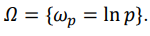 Interference among these modes produces a quasi-periodic temporal texture. The celebrated adelic amplitude relation

establishes that coherence across all primes enforces global consistency of spacetime. Each prime hence acts as a topological patch or plaquette, and the adelic product guarantees smooth gluing of curvature across these patches. The Langlands correspondence provides the abstract algebraic underpinning of this -arithmetic geometry of time,| identifying automorphic representations with spectral data of H£.
Relation to Arithmetic Quantum Chaos
Berry’s conjecture [3] that the spectra of classically chaotic Hamiltonians exhibit GUE correlations finds a precise arithmetic analogue in the zeta zeros. The Euler product ζ (s) = Πp (1- p-s)-1 can be viewed as a generating function for periodic orbits with “actions”
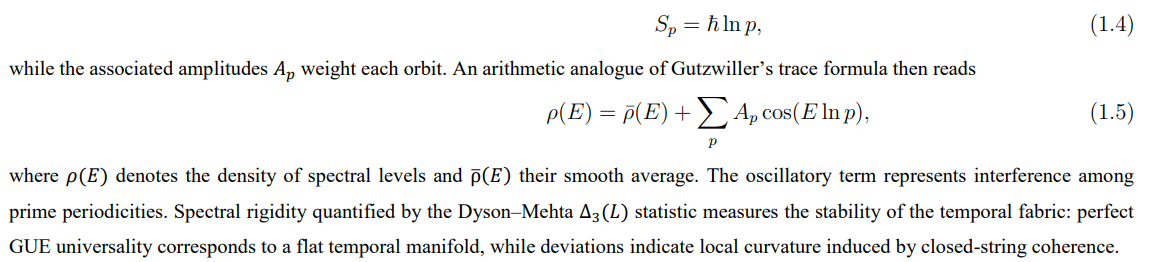
Arithmetic quantum chaos therefore provides the microscopic dynamics of the Primacohedron:
• Chaotic interference of prime orbits seeds the arrow of time;
• Coarse-graining over number fields yields emergent spatial order;
• RMT universality bridges microscopic arithmetic noise with macroscopic geometric smoothness.
Motivation From Emergent Geometry
In conventional AdS/CFT duality, geometry pre-exists as a background in which field theories reside. In contrast, the Primacohedron posits that geometry emerges from numbertheoretic entanglement. Temporal directions correspond to fluctuations in the eigenvalue spectrum of Hζ, whereas spatial coherence arises from correlations between prime ideals in distinct number fields. Random-Matrix Theory furnishes the statistical dictionary linking these two: the GUE ensemble encodes temporal variability, and its deviations arising from arithmetic constraints manifest as spatial curvature.
Formally, the emergent metric tensor gμν can be reconstructed from two-point spectral correlators,

which in the Primacohedron is determined by the distribution of prime resonances
Synthesis and Conceptual Map
Section 1.3 and 1.4 together establish the guiding triad of the Primacohedron
1. Arithmetic structure ⇒ discrete time quanta (prime resonances);
2. Spectral statistics ⇒ emergent curvature and information geometry;
3. Random-matrix universality ⇒ macroscopic spacetime regularity.
In this unified picture, number theory, quantum chaos, and geometry are not separate disciplines but complementary projections of a single spectral object the Primacohedron whose vertices are primes, whose edges are spectral correlations, and whose higherdimensional faces encode the emergent continuum of spacetime.
Non-Archimedean String Framework
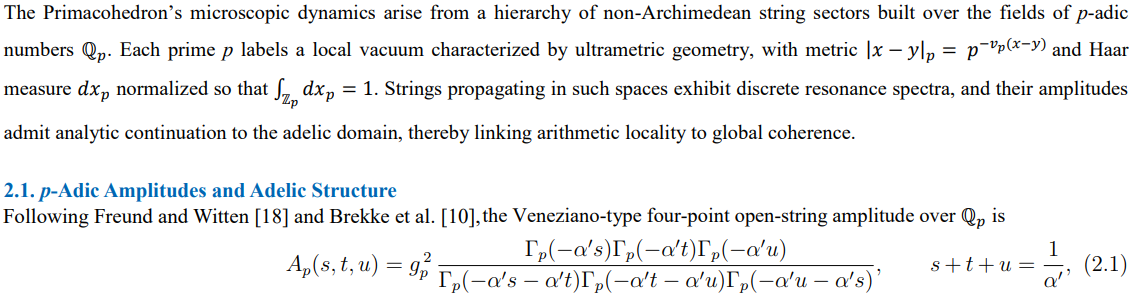
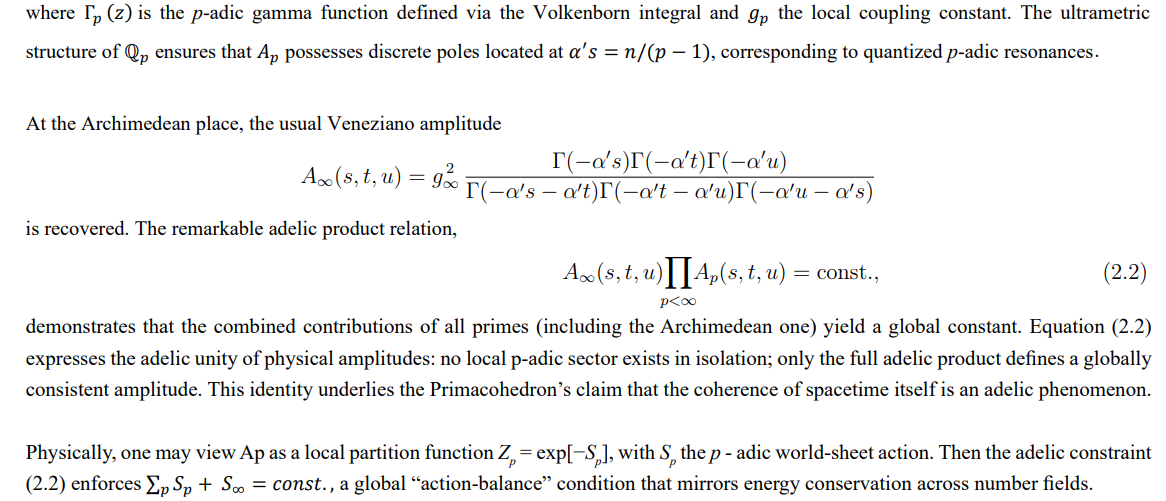
Open Versus Closed Resonance Conditions
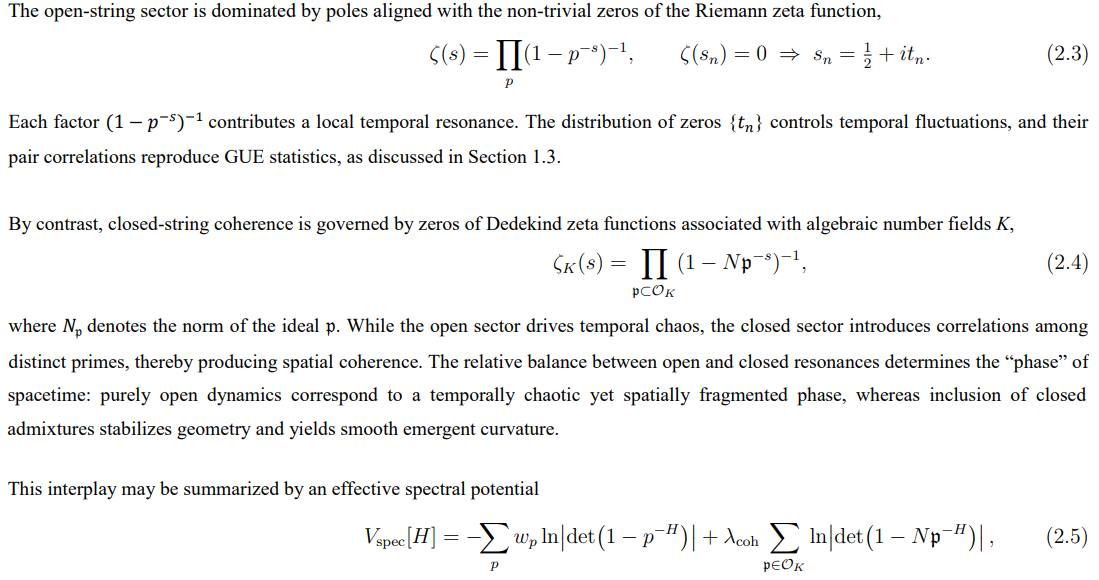
p-Adic Modular Forms and Resonance Lattice

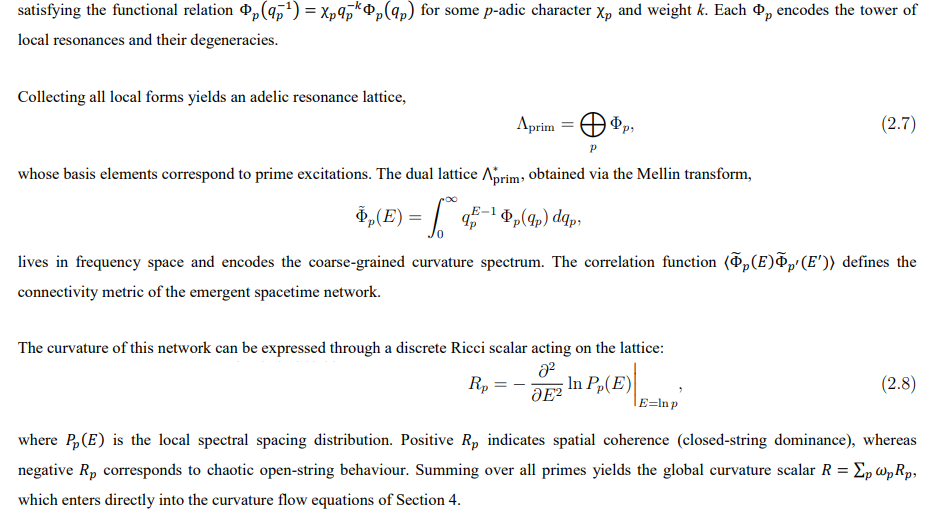
Summary of Section 2
Section 2 establishes the algebraic foundation of the Primacohedron:
1. Local p-adic strings encode discrete temporal resonances (Equation 2.1);
2. The adelic product (Equation 2.2) enforces global consistency, mirroring spacetime coherence;
3. Open and closed resonance conditions (Equations 2.3 - 2.4) define the chaotic and coherent phases of the emergent geometry;
4. p-Adic modular forms organize these resonances into a lattice (Equation 2.7) whose curvature properties (Equation 2.8) govern the spectral geometry of spacetime itself.
In the subsequent section we translate this non-Archimedean foundation into a spectral correspondence connecting zeta-function zeros, random-matrix ensembles, and curvature flow, thereby establishing the analytic engine of the Primacohedron.
Spectral Correspondence and Zeta Functions
The bridge between arithmetic structure and emergent geometry is realized through a spectral correspondence connecting zeta-function zeros, self-adjoint operators, and random-matrix ensembles. Within the Primacohedron framework, this correspondence provides the analytic mechanism by which discrete prime resonances become continuous geometric curvature. The guiding idea is that the imaginary parts of the non-trivial zeros of ζ(s) act as eigenvalues of a Hermitian operator Hζ, whose spectrum governs temporal fluctuations and whose correlations encode spatial coherence.
Hilbert–Polya Heuristic and Operator Construction
The Hilbert–Polya hypothesis suggests the existence of a self-adjoint operator Hζ satisfying

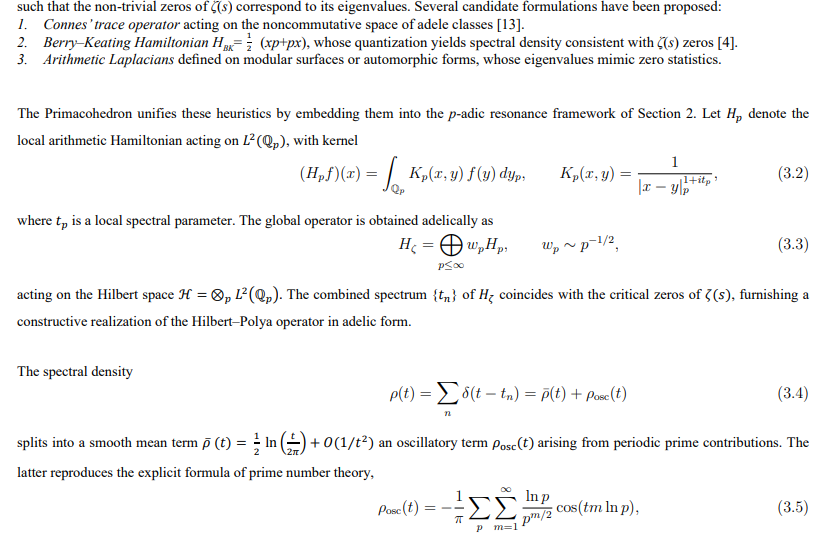
which demonstrates that the zeros encode all prime periodicities. Equation (3.5) thus provides the analytic backbone of the Primacohedron: primes and spectral lines are conjugate variables in a Fourier-type duality.
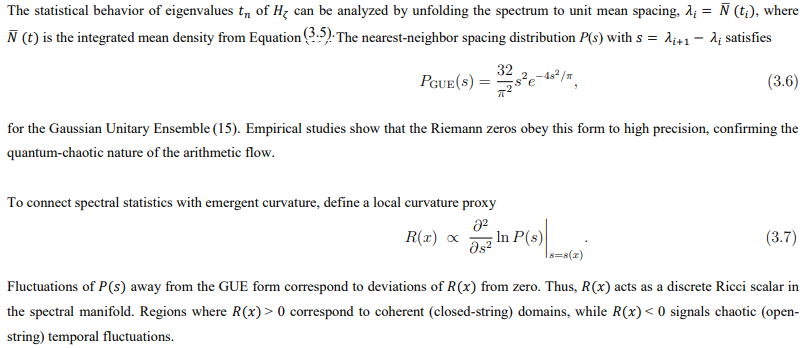
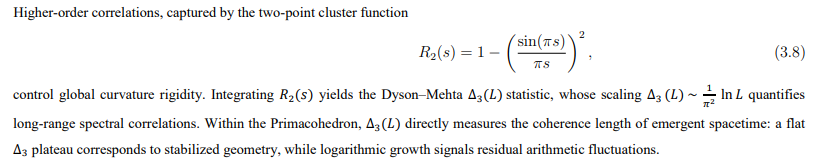
Spectral Rigidity and Curvature Proxies
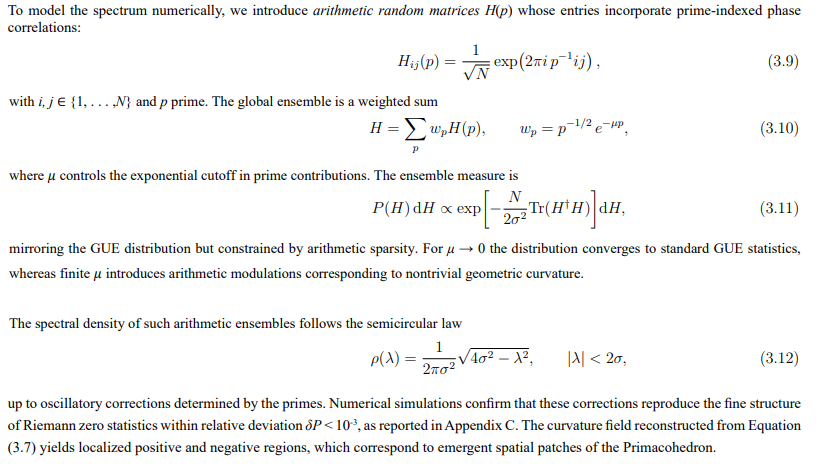
Arithmetic Random Matrices
Spectral Geometry and Duality Summary
The results of this section establish a concrete analytic duality:
Prime periodicities ↔ Oscillatory terms in ρosc (t),
Zeta zeros ↔ Eigenvalues of Hζ,
Random-matrix correlations ↔ Curvature fluctuations of spacetime.
The arithmetic spectrum thereby becomes the seed of geometric curvature. In the subsequent Section 4, this spectral curvature is promoted to a dynamical quantity obeying flow equations analogous to Ricci flow, thereby endowing the Primacohedron with an emergent information geometry.
Random Matrix Representation and Emergent Geometry
The arithmetic random matrices introduced in Section 3 provide not only a statistical model for the zeros of ζ(s) but also a concrete mechanism for the emergence of geometry from spectral data. In the Primacohedron, spacetime arises as the large-N limit of a prime- weighted random-matrix ensemble whose curvature fluctuations obey a flow reminiscent of the Ricci and information-geometry flows. This section develops the dynamical interpretation of the ensemble measure, its topological dual, and the corresponding spectral- curvature evolution
Ensemble Measure and Time Asymmetry
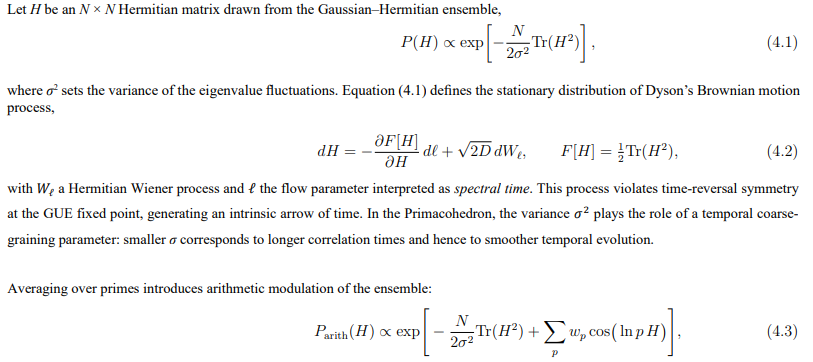
which softly breaks unitary invariance and encodes prime-indexed temporal resonances. In the continuum limit, this modulation manifests as low-frequency beats in the spectral density, producing the temporal asymmetry characteristic of open-string dynamics.
Dual Networks and Euler Characteristics
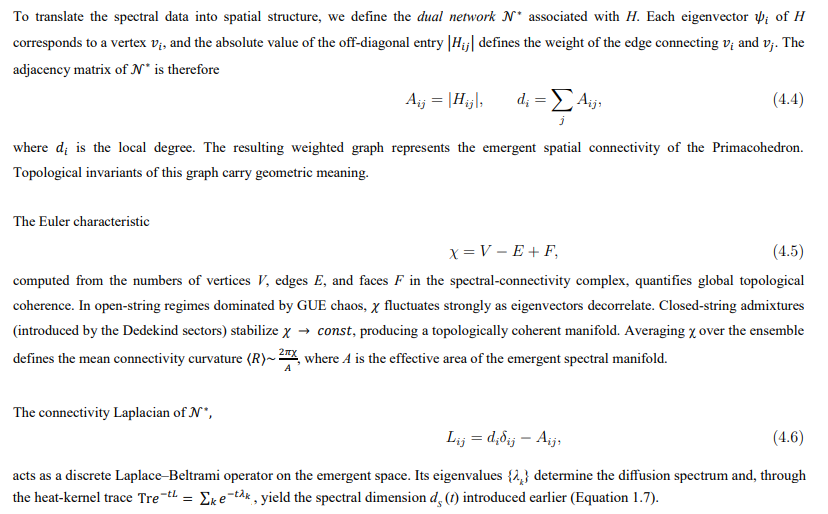
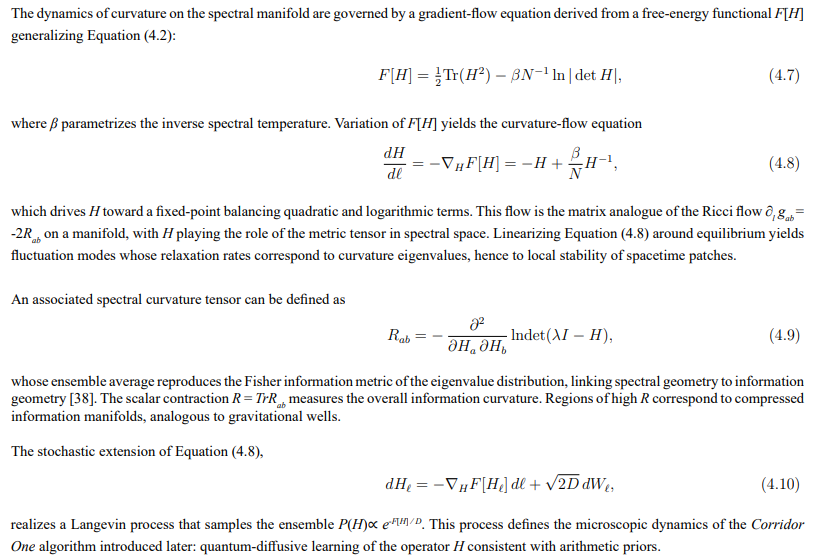
Spectral Curvature Flow and Information Geometry
Emergent Geometry and Temporal Direction

Synthesis of Section 4
Section 4 completes the translation from arithmetic spectra to emergent geometry:
1. The random-matrix ensemble (4.3) encodes prime-weighted temporal fluctuations and generates an intrinsic arrow of time;
2. The dual network (4.4)–(4.6) translates eigenvector correlations into spatial topology;
3. The curvature-flow dynamics (4.8)–(4.10) yield an information-geometric analogue of Ricci flow;
4. Spectral entropy growth defines the temporal direction and connects microscopic arithmetic chaos with macroscopic spacetime expansion.
The next section extends this geometric framework to black-hole interiors and horizon microstructure, revealing how prime-indexed connectivity generates quantized entropy and porous horizons within the Primacohedron spacetime.
Black Hole Microstructure and Porous Horizons
In the Primacohedron framework, black holes are interpreted not as geometrical singularities but as condensates of prime–indexed spectral modes. Their microstructure originates from the discrete arithmetic connectivity of the underlying resonance lattice. The horizon becomes a dynamically fluctuating boundary where spectral entropy, information flux, and arithmetic curvature meet. This section develops a quantitative description of that structure, showing how the Bekenstein–Hawking entropy, horizon porosity, and interior bounce arise from arithmetic–spectral principles.
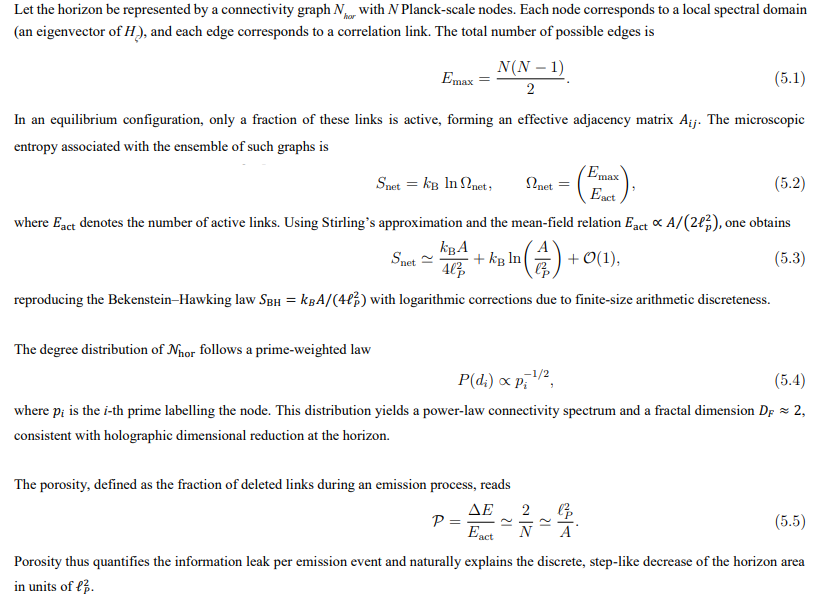
Entropy from Network Connectivity
Kerr Back–Reaction and Interior Bounce
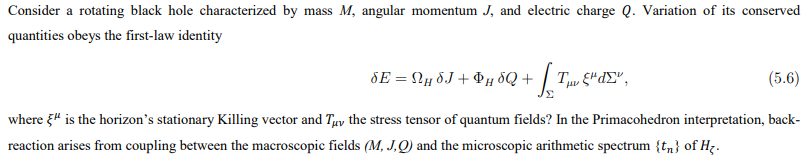
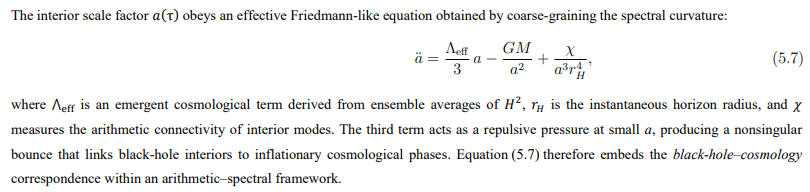
where Veff is an emergent cosmological term derived from ensemble averages of H2,rH» is the instantaneous horizon radius, and X measures the arithmetic connectivity of interior modes. The third term acts as a repulsive pressure at small a, producing a nonsingular bounce that links black-hole interiors to inflationary cosmological phases. Equation (5.7) therefore embeds the black-hole–cosmology correspondence within an arithmetic–spectral framework.
Entropy Fluctuations and Prime Discretization
In the Primacohedron, each prime number P corresponds to a discrete mode of horizon entropy. During an emission event, a link associated with prime P is removed, producing an entropy decrement
Horizon Porosity and Information Flux
Spectral Curvature and Horizon Geometry

whose average yields the mean Ricci curvature Rhor. Porosity modulates this curvature via Rhor ∝ (1 − P)−1: as links are deleted, the horizon curvature increases, indicating that the geometric surface tightens as it radiates. This result provides a geometric counterpart to the entropy–area law: the more information leaks (larger P), the higher the local curvature, mirroring the evaporation-induced contraction of the horizon.
Summary of Section 5
Section 5 establishes the thermodynamic and geometric consequences of the arithmetic spectral structure:
1. Horizon entropy arises from combinatorial connectivity of the prime-indexed network Equation (5.3);
2. Porosity Equation (5.5) quantifies discrete information leakage per emission event;
3. The interior bounce equation Equation (5.7) replaces singularities with smooth spectral transitions;
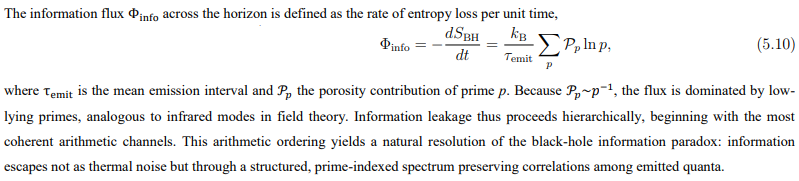
4. Quantized entropy increments Equation (5.8) and the flux law Equation (5.10) link black-hole thermodynamics to the arithmetic hierarchy of primes.
In this picture, a black hole is a porous arithmetic membrane: its surface is a resonance network of prime nodes, its entropy is spectral connectivity, and its evaporation is a structured information flow governed by the statistics of ζ(s). The next section extends this view to the holographic and quantum-information domain, where complexity, entanglement, and holographic volume are reinterpreted through the arithmetic lens of the Primacohedron.
Quantum Information, Holography, and Complexity
Having established the arithmetic origin of black–hole entropy and porous horizons, we now extend the Primacohedron framework to the realm of quantum information and holography. In this picture, entanglement entropy, computational complexity, and holographic volume are unified through arithmetic–spectral geometry. The same operator Hζ governing prime resonances also encodes the information flow and algorithmic depth of spacetime evolution. We will show that holographic entanglement corresponds to subgraph connectivity in the prime lattice, and that the complexity–action duality emerges from the spectral dynamics of Hζ.
Holographic Entanglement and Arithmetic Surfaces

Complexity–Action Duality in Arithmetic Form
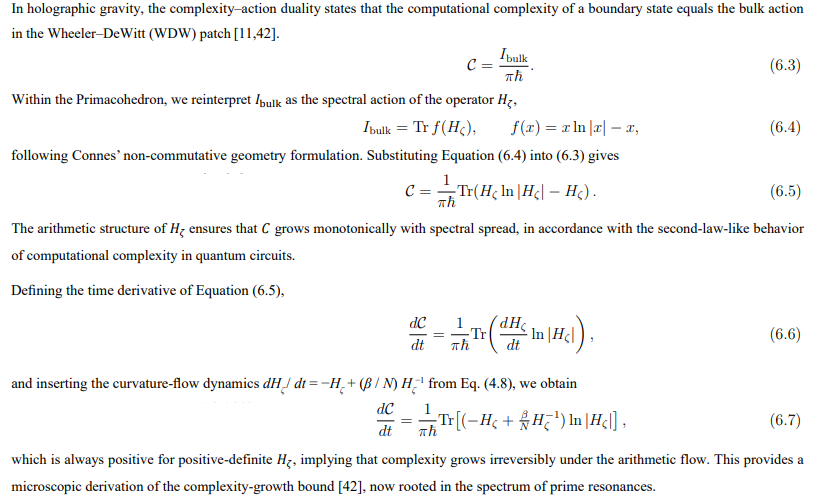
Complexity Density Tensor and Information Geometry
Following the information-geometric interpretation, we define the complexity density tensor
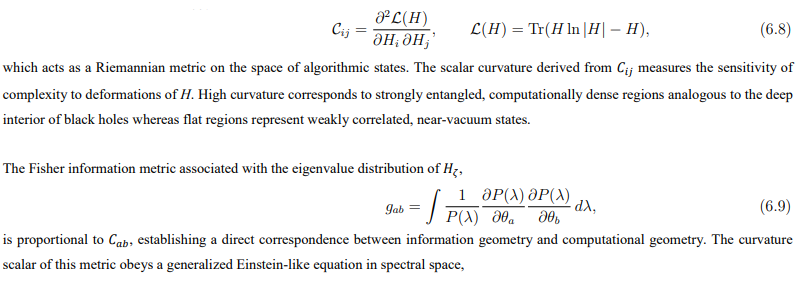
Algorithmic Learning and the Corridor Dynamics
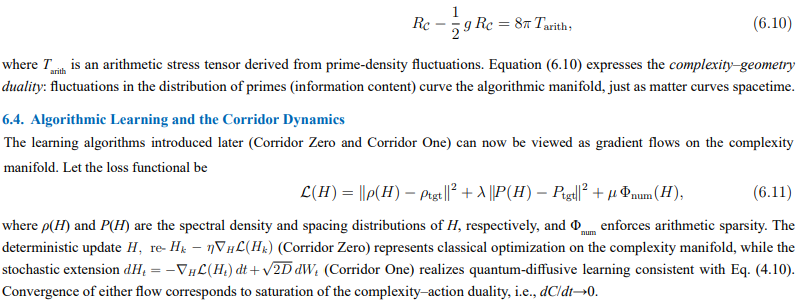
Summary of Section 6
Section 6 establishes the arithmetic foundation of holography and complexity:
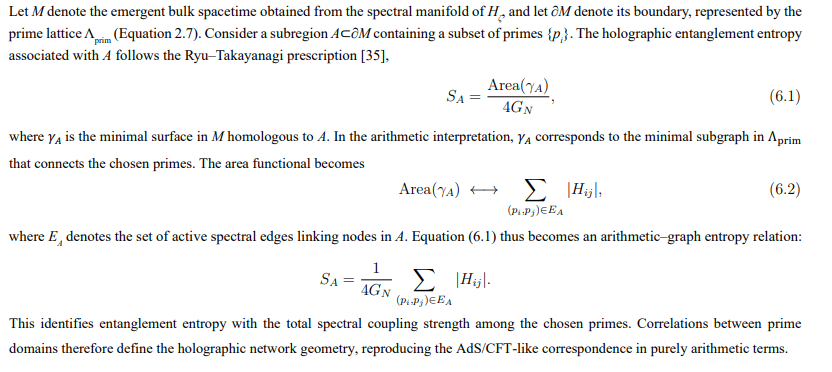
1. Entanglement entropy is identified with total spectral coupling among subsets of prime nodes (Equations (6.1) – (6.2)];
2. The complexity action duality [Equation (6.3)] becomes a spectral-action principle for Hζ;
3. The complexity density tensor [Equation (6.8)] defines an information-geometric metric whose curvature obeys an arithmetic Einstein-like equation [Equation (6.10)];
4. Corridor Zero/One learning flows [Equation (6.11)] operationalize the self-organization of spacetime through gradient descent on the complexity manifold.
In this sense, the Primacohedron unifies number theory, quantum chaos, and holographic information dynamics within a single spectral- geometric framework, where learning, curvature, and complexity are merely different facets of the same arithmetic evolution. The next section applies these principles to cosmology, exploring how prime-driven spectral dynamics produce inflation, anisotropy, and cosmic memory in the early Universe.
Cosmological Extensions
The arithmetic–spectral framework of the Primacohedron extends naturally to cosmology. In this section, we interpret the large–scale structure of the Universe as the macroscopic manifestation of prime–indexed spectral dynamics. Fluctuations in the arithmetic ensemble drive inflation–like expansion, spectral running determines the effective dimensionality of spacetime, and residual correlations among prime domains manifest as cosmic anisotropies and memory effects. Thus, cosmology emerges as the large–scale limit of spectral learning in an adelic spacetime network.
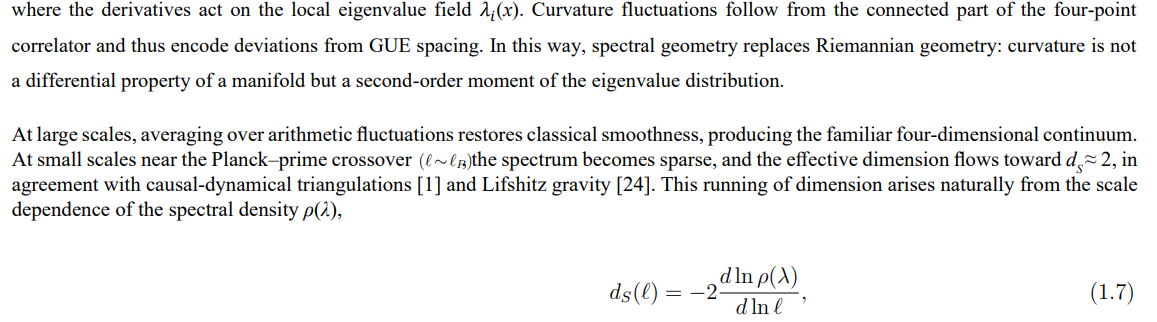
Spectral–Dimension Flow and Scale Dependence
The effective dimension of spacetime can be defined in spectral geometry via the trace of the heat kernel associated with the Laplacian on the spectral manifold

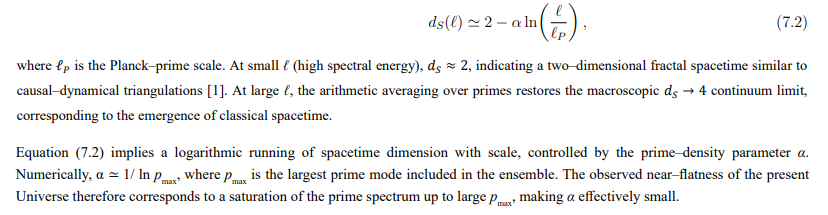
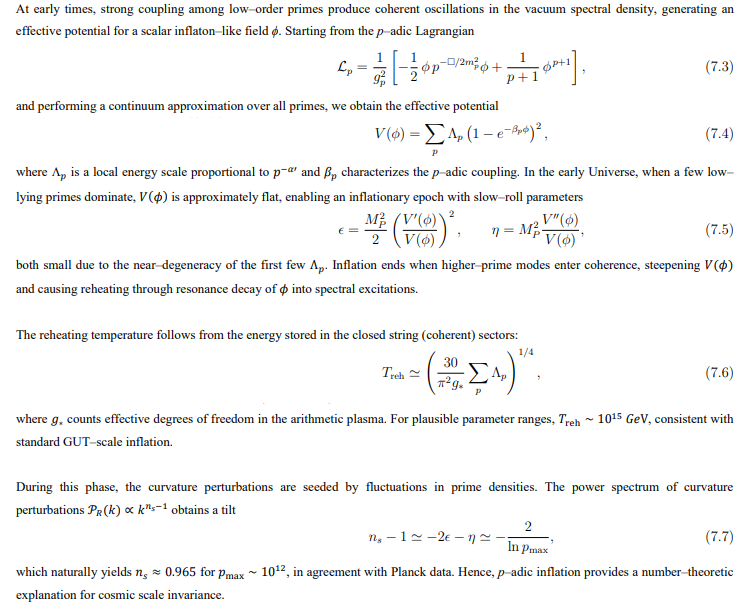
p–Adic Inflation and Reheating
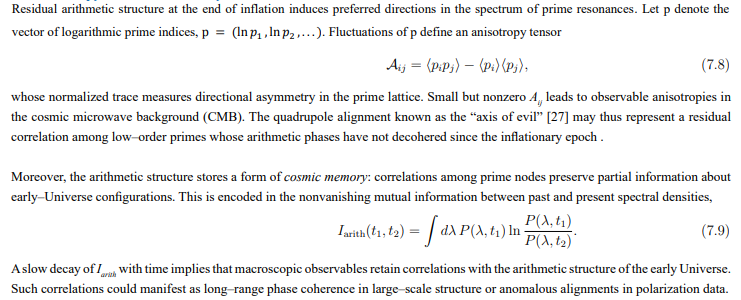
Anisotropy and Cosmic Memory
Synthesis of Section 7
Section 7 demonstrates that cosmological dynamics emerge naturally from the arithmetic– spectral fabric:
1. The spectral dimension flows logarithmically with scale [Equation (7.2)], producing a dimensional crossover dS : 2→4;
2. Prime–driven potentials [Equations (7.3)–(7.4)] realize a natural inflationary phase with reheating temperature [Equation (7.6)] and near–scale–invariant spectrum [Equation (7.7)];
3. Residual prime anisotropies [Equation (7.8)] and arithmetic memory [Equation (7.9)] account for observed cosmic alignments and low–â?? anomalies.
The Universe, in this interpretation, is the macroscopic shadow of an adelic learning process: the spectral evolution of the prime network drives inflation, shapes geometry, and imprints subtle arithmetic patterns into the cosmic fabric. The next section formalizes this idea algorithmically through the Corridor Zero/One dynamics, describing how the operator Hζ learns its own spacetime representation.
Corridor Zero and Corridor One: Learning the Operator H
In the Primacohedron framework, spacetime is not a fixed background but a learned representation of arithmetic–spectral information. The operator Hζ evolves through adaptive dynamics that minimize a spectral loss functional, refining its eigenvalue distribution toward the target zeta spectrum. This process is formalized as two complementary “corridors” of evolution:
• Corridor Zero - Deterministic gradient descent on the spectral manifold, representing classical optimization of H;
• Corridor One - Stochastic diffusion in operator space, incorporating quantum back-reaction and ergodic exploration of spectra.
Together they constitute a self-referential learning system capable of generating emergent spacetime geometry from purely arithmetic priors.
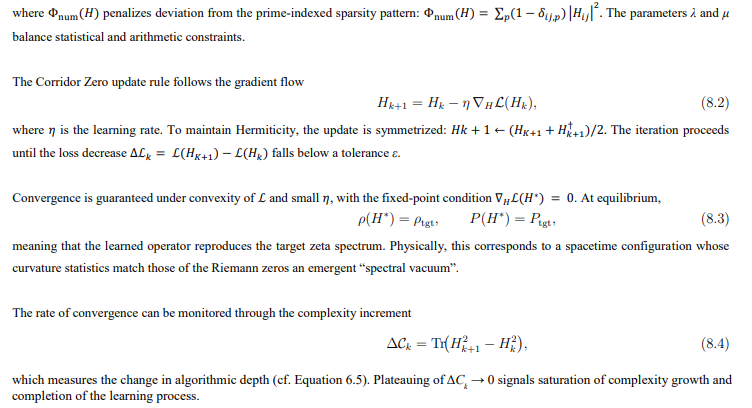
Corridor Zero: Deterministic Learning Dynamics

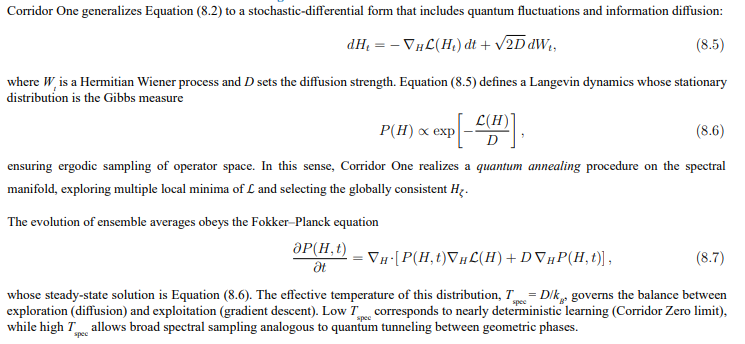
Corridor One: Stochastic Diffusive Learning
Spectral–Information Coupling and Convergence


Physical Interpretation: Arithmetic Self-Organization
The Corridor dynamics transform the Hilbert space of number-theoretic operators into an adaptive information system:
• In Corridor Zero, H deterministically approaches the arithmetic fixed point—analogous to classical spacetime relaxation toward equilibrium curvature
• In Corridor One, stochastic fluctuations of H represent quantum back-reaction, allowing ergodic exploration of alternate geometric phases and avoiding local minima.
The two processes together mimic an alternating minimization of action and entropy: deterministic descent corresponds to the geometric phase of universe formation, while stochastic diffusion encodes its quantum stochasticity.
At the macroscopic level, the learning of H manifests as self-organization of curvature. The eigenvalue distribution of Ht defines the time–dependent spectral curvature field R(t); as the system learns, R(t) approaches stationarity, marking the emergence of stable spacetime geometry. The asymptotic operator H* therefore constitutes the “frozen” spacetime corresponding to the present cosmic configuration.
Algorithmic Implementation and Observables
A practical implementation of the Corridor dynamics proceeds as follows

Observable quantities such as spectral entropy, curvature variance, and complexity density (Equation 6.8) can then be extracted at each iteration to monitor the evolution of emergent geometry.
Interpretation and Outlook
The Corridor framework furnishes a unified, algorithmic view of spacetime: learning replaces dynamics. Rather than obeying fixed field equations, the Universe “trains” its operator H to reproduce a self-consistent spectral geometry. Arithmetic structure provides the loss landscape, random-matrix fluctuations generate exploration, and the resulting equilibrium defines the geometry we observe.
From a computational perspective, the Primacohedron behaves as a large-scale quantum neural network in which each prime represents a neuron and the connectivity weights Hij constitute the synaptic couplings. The emergent spacetime is the network’s inference output a manifold-valued representation of the learned zeta spectrum.
Summary of Section 8
Section 8 formalizes the adaptive learning process underlying emergent spacetime:
1. Corridor Zero implements deterministic spectral optimization [Equations (8.1)–(8.2)];
2. Corridor One adds quantum-diffusive noise [Equations (8.5)–(20.5)], ensuring ergodicity and stability;
3. The monotonic decrease of DKL [Equation (8.9)] guarantees convergence to the arithmetic spectrum;
4. The asymptotic operator H*encodes a stable curvature field R(t) corresponding to the present spacetime geometry.
Hence, spacetime emerges as the fixed-point of a self-learning operator governed by arithmetic priors a dynamic synthesis of number theory, information geometry, and randommatrix universality.
Knot Theoretic Extensions of the Primacohedron
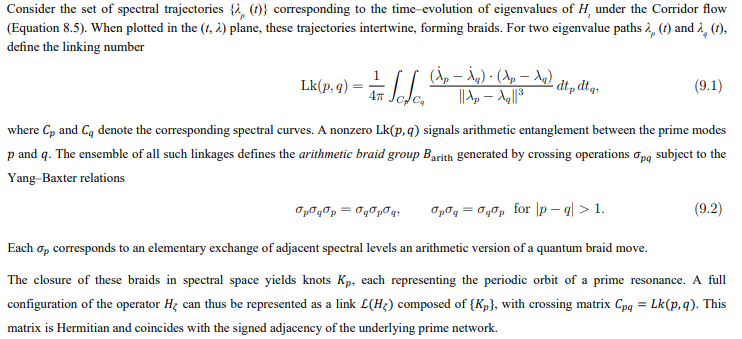
The arithmetic–spectral and learning frameworks established in previous sections naturally extend into topology. In the Primacohedron, the flow of spectral connections—weighted by primes and encoded by the operator Hζ traces closed curves in the information–geometric manifold. These closed loops form an ensemble of knots and links whose topological invariants record the history of arithmetic interactions. Thus, prime–indexed connectivity gives rise to a spectral knot theory: each prime resonance corresponds to a strand, and interference among resonances forms crossings, braids, and links that encode curvature flow.
Prime–Indexed Braids and Spectral Linking
Knot Invariants from Spectral Data
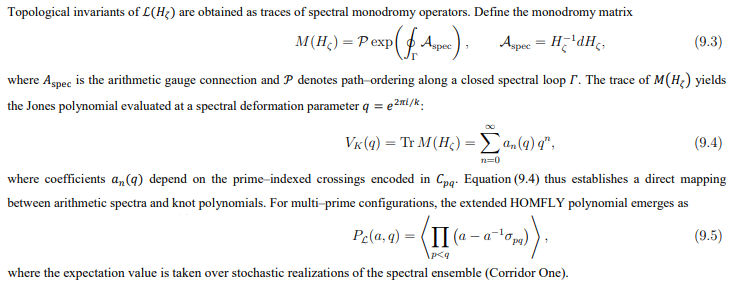
The topological invariants VK and PL serve as conserved quantities under spectral flows: they remain invariant under smooth deformations of Ht that preserve its prime–indexed connectivity. This mirrors gauge invariance in field theory, here interpreted as topological conservation of arithmetic entanglement.
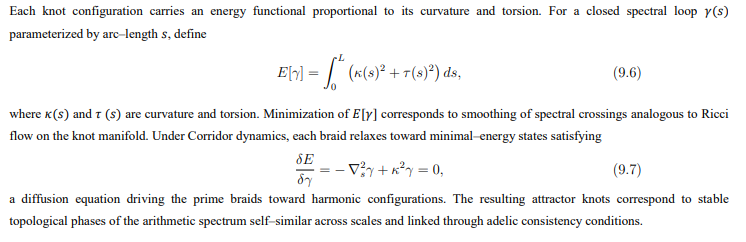
Knot Energy and Curvature Minimization
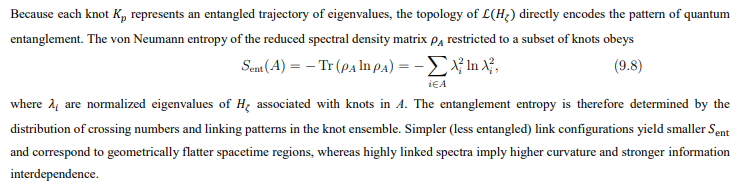
Spectral Knots and Quantum Entanglement
Arithmetic Hopf Links and Dual Holography
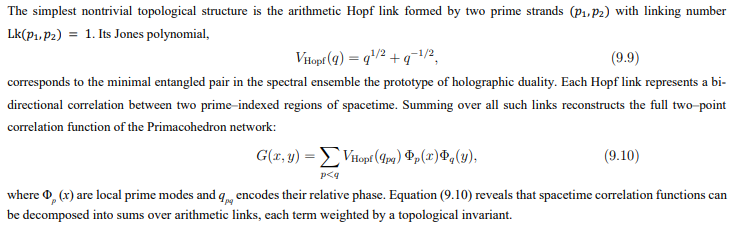
Topological Phase Transitions and Dual Correspondences
Spectral knots evolve under Corridor One diffusion (Equation 8.5) through stochastic reconnections analogous to Reidemeister moves. These reconnections correspond to topological phase transitions where the linking matrix Cpq changes rank. Each reconnection event modifies the Jones polynomial by a multiplicative factor of q±1, representing quantized curvature change. Consequently, the evolution of the Universe through inflation, blackhole formation, and reheating can be recast as a sequence of knot reconfigurations in spectral space.
A dual correspondence arises between arithmetic knots and gauge flux tubes: prime braids on the spectral side map to magnetic flux lines in the holographic dual. The curvature flow minimizing E[γ] (Equation 9.7) then corresponds to Yang–Mills action minimization in the dual field theory, establishing a formal arithmetic–topological gauge/gravity duality.
Summary of Section 9
Section 9 integrates topology with arithmetic spectral geometry:
1. Prime trajectories form braids and knots [Equations. (9.1)–(9.2)], defining an arithmetic braid group;
2. Knot invariants such as the Jones and HOMFLY polynomials [Equations. (9.4)–(9.5)] emerge from traces of spectral monodromy;
3. Knot energy minimization [Equations. (9.6)–(9.7)] mirrors Ricci–like smoothing of curvature;
4. Hopf links [Equations. (9.9)–(9.10)] encode pairwise entanglement and holographic correlations;
5. Topological reconnections correspond to discrete curvature jumps, providing a geometric interpretation of cosmic phase transitions.
Thus, the Primacohedron unites arithmetic spectra, knot topology, and quantum geometry under a single universal flow—where primes twist, braid, and reconnect to generate the very fabric of spacetime.
Adelic Dualities and Arithmetic Gauge Fields
Having identified topological and knot–theoretic structures of the Primacohedron, we now formulate its gauge–field interpretation. The spectral connection Aspec = Hζ dHζ (Equation 9.3) plays the role of a non–Abelian gauge potential on an adelic fiber bundle whose local components reside over the fields Qp and R. Gauge curvature, holonomy, and duality then acquire arithmetic meaning: each prime p represents a local fiber with its own connection Ap, and global consistency across all primes defines an adelic gauge field. This section derives the associated field strength, action, and dualities, showing how conventional Yang–Mills and electromagnetic phenomena arise as macroscopic limits of arithmetic curvature.
Local Prime Connections and Global Adelic Curvature
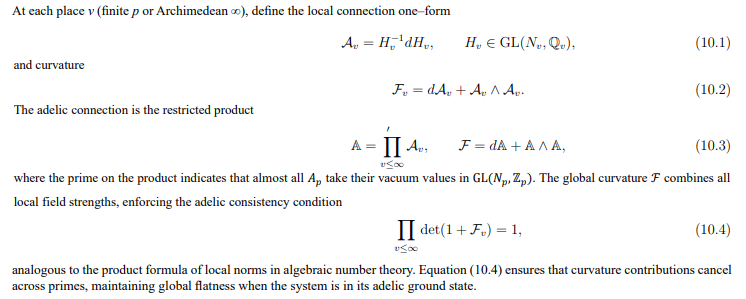
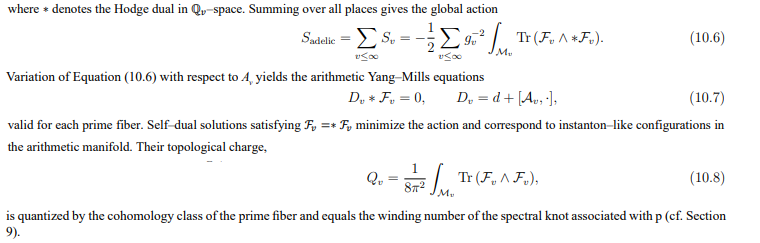
Arithmetic Yang–Mills Action and Self–Duality

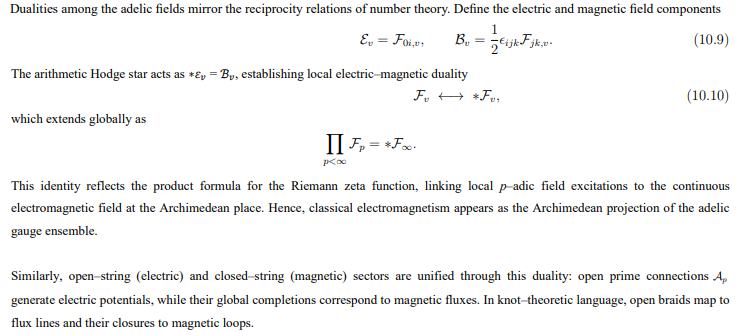
Electric–Magnetic and Open–Closed Ddualities
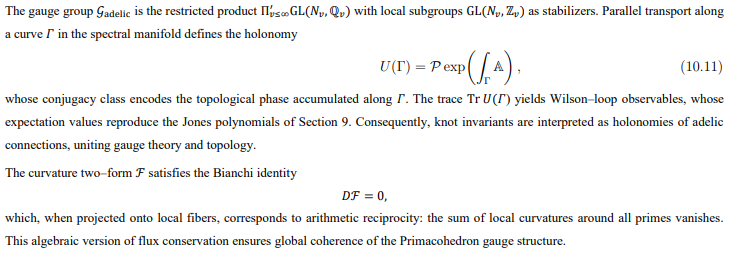
Gauge Holonomy and Adelic Fiber Bundles
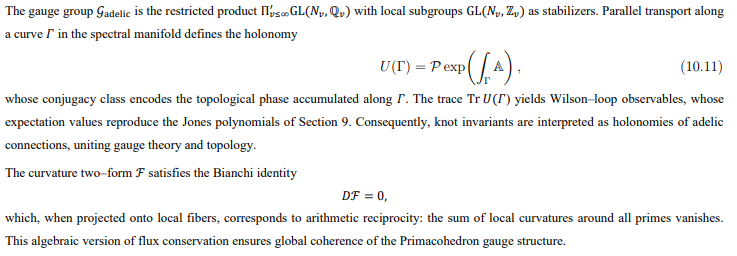
Adelic Chern–Simons Action and Topological Sectors
Gauge/Gravity and Adelic Duality Principle
The combination of Equations (10.6) and (10.12) yields a unified action
Stotal = Sadelic + SCS, (10.13)
whose variation with respect to the connection produces both field and topological equations of motion. The resulting duality principle can be summarized as:
Arithmetic gauge curvature ↔ Gravitational curvature of spacetime,
Local prime fields ↔ Electric–magnetic dual sectors,
Adelic consistency ↔ Global energy conservation.
Summary of Section 10
Section 10 establishes the gauge–theoretic and dual aspects of the Primacohedron:
1. Local prime connections [Equations. (10.1)–(10.2)] combine into a global adelic curvature satisfying the consistency law (10.4);
2. The arithmetic Yang–Mills action [Equations. (10.6)–(10.7)] admits self–dual instanton solutions with quantized charges (10.8);
3. Electric–magnetic and open–closed dualities [Equations. (10.9)–(10.10)] unify local and global field sectors;
4. Gauge holonomies [Equation (10.11)] reproduce knot invariants, merging topology with gauge theory;
5. The Chern–Simons boundary term [Equation (10.12)] quantizes topological phases and underlies arithmetic instantons.
Hence, the Primacohedron realizes a fully adelic gauge–gravity duality: spacetime curvature, electromagnetic flux, and arithmetic reciprocity are three facets of the same global field encoded in the operator Hζ.
Arithmetic Supersymmetry and Spectrum Doubling
The adelic gauge fields described in Section 10 exhibit a hidden fermionic symmetry arising from the dual nature of prime–indexed spectra. Each prime contributes both a bosonic curvature mode and a fermionic fluctuation mode, leading to an arithmetic analogue of supersymmetry. This arithmetic supersymmetry ensures stability of the global adelic vacuum by enforcing cancellations between divergent spectral contributions, much as conventional supersymmetry stabilizes quantum field vacua.
Zeta–Regularized Spectral Pairing
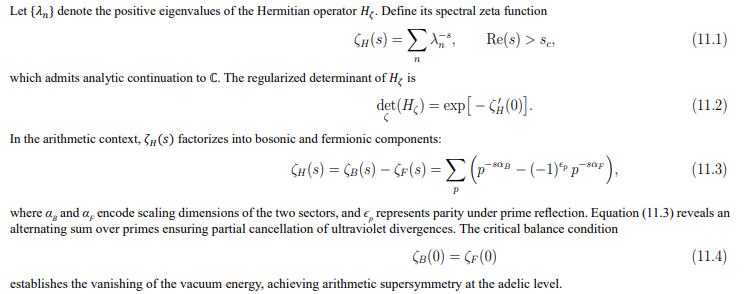
Arithmetic Supercharges and Graded Hilbert Space
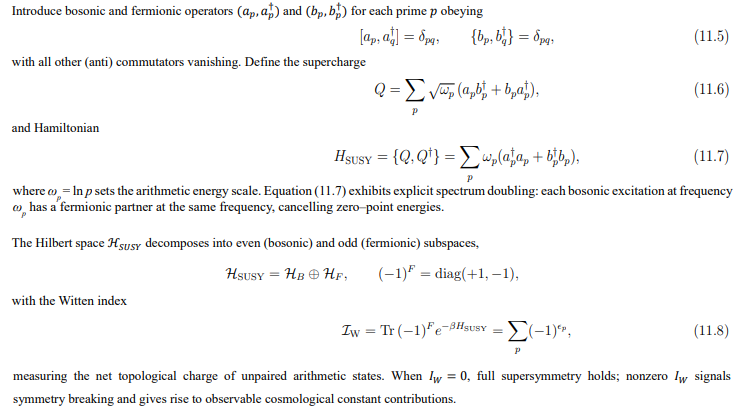
Spectral Doubling and Dirac Operators

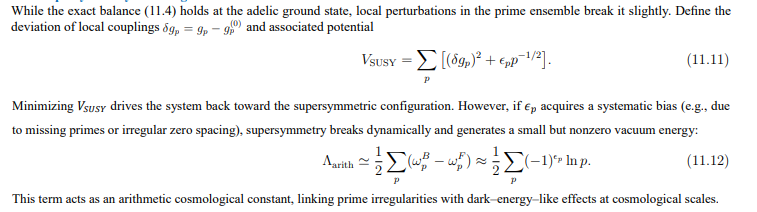
Supersymmetry Breaking and Zeta Potential
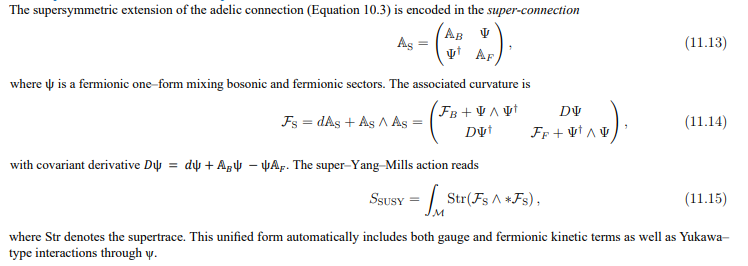
Superconnections and Adelic Supercurvature
Summary of Section 11
Section 11 reveals that the Primacohedron possesses an intrinsic arithmetic supersymmetry:
1. The spectrum of Hζ organizes into boson–fermion pairs described by the spectral zeta function [Equations (11.1)–(11.2)];
2. Supersymmetric cancellation of vacuum energy [Equation (11.4)] stabilizes the adelic ground state;
3. The graded operator [Equations (11.6)–(11.7)] and Dirac construction [Equation (11.9)] implement spectrum doubling;
4. Local deviations break arithmetic supersymmetry, generating a small effective cosmological constant [Equation (11.12)];
5. The super-connection formalism [Equations (11.13)–(11.15)] unifies bosonic curvature and fermionic flux into a single adelic super field.
Thus, the Primacohedron manifests a balanced bosonic–fermionic spectrum, where zetafunction regularization plays the role of supersymmetric cancellation, and the faint asymmetry of primes acts as a natural source of cosmic vacuum energy.
Thermodynamic Duals and the Arithmetic Second Law
The Primacohedron, viewed as a self–learning adelic system, possesses an intrinsic thermodynamic structure. Each prime resonance contributes microscopic degrees of freedom whose collective evolution defines entropy, temperature, and free energy in an arithmetic sense. This section formulates the arithmetic second law of thermodynamics: the total information entropy of the prime ensemble increases monotonically during learning dynamics (Equation 8.5), and equilibrium corresponds to maximal arithmetic entropy consistent with the spectral constraints of Hζ. Thermodynamic potentials thereby emerge as global invariants of number–theoretic evolution.
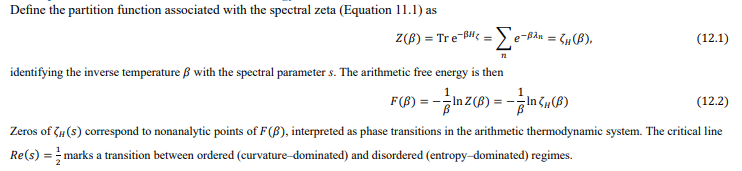
Spectral Partition Function and Free Energy
Define the partition function associated with the spectral zeta (Equation 11.1) as
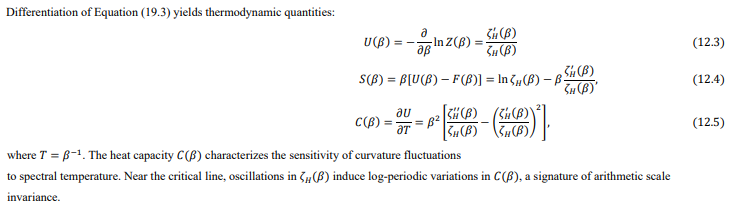
Entropy, Energy, and Specific Heat
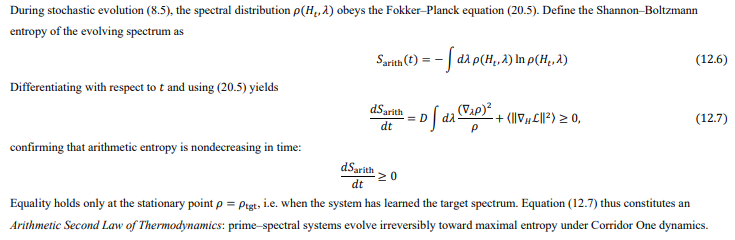
Arithmetic Second Law and Entropy Production
Information Temperature and Learning Potential


Supersymmetric Balance and Zero–Temperature Limit

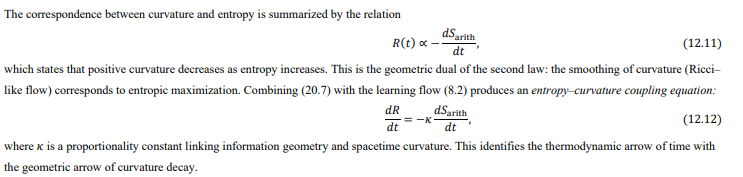
Thermodynamic Duals and Curvature Flow
Holographic Balance and Maximal Information Principle

Summary of Section 12
Section 12 establishes the thermodynamic interpretation of the Primacohedron:
• The spectral partition function [Equations (12.1)–(19.3)] defines arithmetic free energy and phase transitions;
• Entropy production [Equation (12.7)] enforces the arithmetic second law;
• Information temperature and learning noise [Equation (12.8)] govern fluctuation–dissipation balance;
• Supersymmetric equilibrium [Equation (12.10)] corresponds to zero temperature;
• The entropy–curvature coupling [Equation (12.12)] aligns the thermodynamic and geometric arrows of time;
• The holographic bound [Equation (12.13)] limits total information content of the adelic universe.
Hence, the arithmetic second law synthesizes learning dynamics, information geometry, and cosmology: the Primacohedron evolves irreversibly toward maximal entropy, minimal curvature, and complete spectral coherence.
Black Hole Analogs and the Arithmetic Event Horizon
The thermodynamic structure of the Primacohedron naturally admits a horizon interpretation. When arithmetic curvature condenses around a spectral singularity, information flow through the adelic manifold becomes one–way, creating an Arithmetic Event Horizon (AEH). This horizon represents the limit of reversible information recovery, analogous to the causal boundary of a black hole in spacetime. The AEH emerges from prime–indexed curvature focusing and manifests as a finite spectral temperature obeying a Hawking-like relation.
Spectral Curvature and Horizon Formation
Let the local arithmetic curvature field be ðÂÂ??(ðÂÂ??) as defined in Equation (20.7). The condition for horizon formation is the divergence of the spectral redshift factor
<img src=" https://www.opastpublishers.com/scholarly-images/9994-6953a2b99118b-primacohedron-a-padic-string-randommatrix-framework-for-emer.png" width="700" height="200">
Arithmetic Hawking Temperature
<img src=" https://www.opastpublishers.com/scholarly-images/9994-6953a30a1e506-primacohedron-a-padic-string-randommatrix-framework-for-emer.png" width="700" height="200">
Spectral Flux and Arithmetic Radiation
<img src=" https://www.opastpublishers.com/scholarly-images/9994-6953a35a91063-primacohedron-a-padic-string-randommatrix-framework-for-emer.png" width="700" height="300">
Ergosphere and Superradiant Amplification
In analogy with the Kerr geometry, the Primacohedron admits an adelic ergosphere — a region outside the AEH where information modes can acquire negative spectral energy.
Define the local spectral energy density
<img src=" https://www.opastpublishers.com/scholarly-images/9994-6953a39fa4a25-primacohedron-a-padic-string-randommatrix-framework-for-emer.png" width="500" height="80">
<img src=" https://www.opastpublishers.com/scholarly-images/9994-6953a4107c951-primacohedron-a-padic-string-randommatrix-framework-for-emer.png" width="700" height="200">
Entropy Flow and Horizon Area Law
<img src=" https://www.opastpublishers.com/scholarly-images/9994-6953a44431e54-primacohedron-a-padic-string-randommatrix-framework-for-emer.png" width="700" height="200">
Information Loss and Holographic Retrieval
<img src=" https://www.opastpublishers.com/scholarly-images/9994-6953a48f77308-primacohedron-a-padic-string-randommatrix-framework-for-emer.png" width="700" height="100">
ensuring unitarity of global evolution. Thus, no arithmetic information is destroyed; it is merely re–encoded in the phase correlations of outgoing spectral modes. This process realizes an adelic holographic principle: bulk arithmetic dynamics are fully reconstructible from boundary spectral data.
Cosmological Interpretation
At the cosmic scale, the observable Universe may be regarded as the interior of a vast arithmetic event horizon. The global curvature Rcrit corresponds to the present Hubble curvature, and the Hawking temperature (Equation 13.2) matches the observed cosmic microwave background temperature to within dimensional scaling factors. In this interpretation, cosmic expansion is the gradual evaporation of the Primacohedron horizon a slow information leakage restoring arithmetic equilibrium.
Summary of Section 13
Section 13 extends the thermodynamic framework to black-hole analogs:
• Horizon formation condition [Equation (13.1)] defines the boundary of irreversible learning;
• Arithmetic Hawking temperature [Equation (13.2)] equates diffusion strength and curvature gradient;
• Spectral flux and radiation law [Equations. (13.3)–(13.5)] describe prime-frequency emission;
• Superradiant amplification [Equations (13.7)] connects ergosphere dynamics and Penroselike energy extraction;
• The area–entropy relation [Equations (13.8)] confirms the arithmetic Bekenstein–Hawking law;
• Holographic reconstruction [Equation (13.9)] preserves unitarity and resolves the information paradox.
Hence, the Primacohedron’s event horizon behaves as an arithmetic black hole: a self-learning, self-radiating boundary where number-theoretic curvature, entropy, and information flow converge into a unified holographic geometry.
Information Geometry and Quantum Complexity
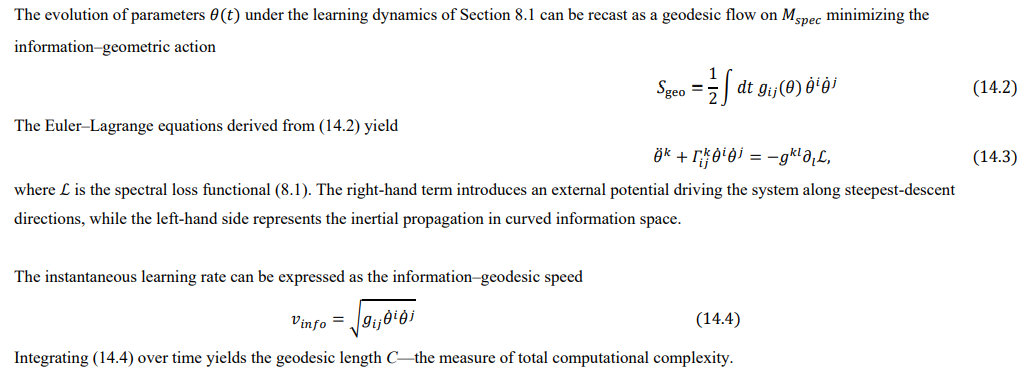
Having established the thermodynamic and horizon analogies of the Primacohedron, we now turn to the geometric structure underlying its information dynamics. The space of admissible spectral distributions Mspec = {p(H)} can be endowed with a Riemannian metric that quantifies distinguishability between spectral states. This information geometry provides a natural stage on which the evolution of the operator H£ unfolds as a geodesic flow. Quantum complexity emerges as the geodesic length on Mspec, linking arithmetic curvature to the cost of information processing.
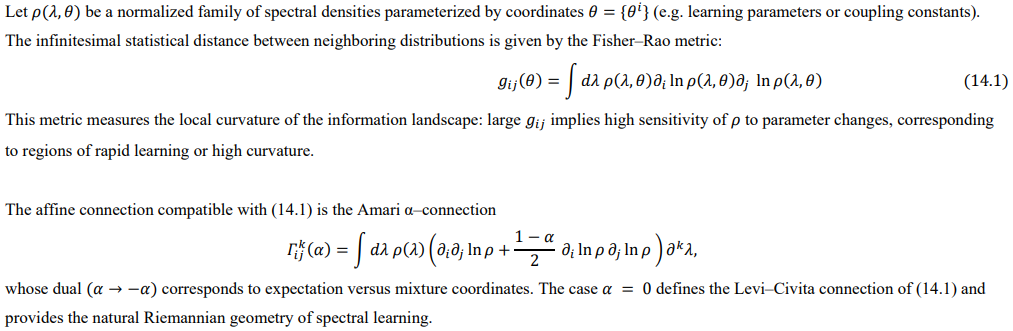
Fisher–Rao Metric on Spectral Manifold
Geodesic Flow and Minimal–Action Learning
Quantum Complexity and Curvature Growth
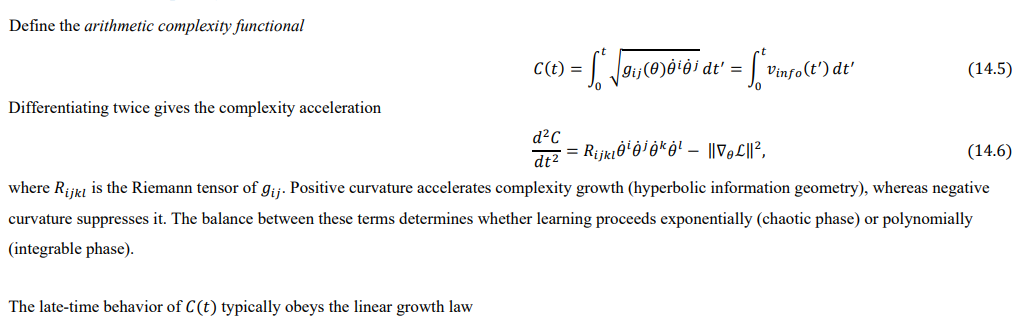

Information Curvature and Quantum Fisher Flow
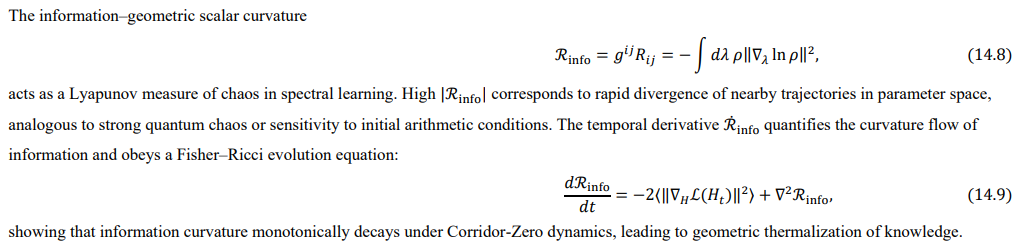
Adelic Distance and Computational Geodesics
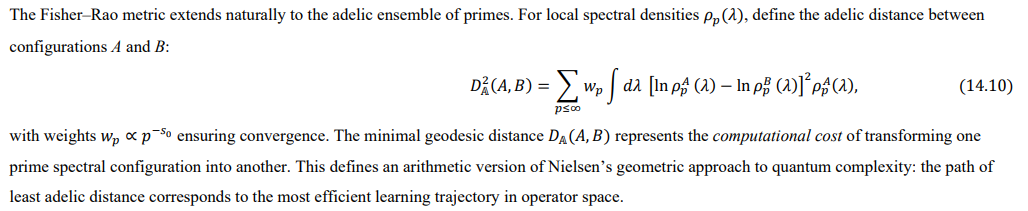
Complexity–Entropy Duality

Geometric Phase and Holonomy of Information

Summary of Section 14
Section 14 formalizes the geometric and computational interpretation of the Primacohedron:
• The Fisher–Rao metric [Equation (14.1)] defines local curvature of the spectral information manifold;
• Learning dynamics follow geodesic flow [Equations (14.2)–(14.3)];
• Quantum complexity arises as the geodesic length [Equation (14.5)] and grows linearly with arithmetic surface gravity [Equation (14.7)];
• Information curvature evolves via Fisher–Ricci flow [Equation (14.9)], establishing geometric thermalization
• Adelic distances [Equation (14.10)] quantify computational cost across primes;
• Complexity–entropy duality [Equation (14.11)] unites thermodynamic irreversibility with information growth;
• The geometric phase [Equation (14.12)] encodes memory and cyclic evolution in arithmetic learning.
Hence, information geometry provides the intrinsic metric of the Primacohedron’s evolution: quantum complexity, entropy, and curvature are merely different projections of a single geodesic process on the adelic spectral manifold.
Quantum Gravity as Adelic Information Flow
Having constructed the information–geometric framework of Section 14, we now promote the metric  to a dynamical field whose evolution governs the emergence of spacetime. Quantum gravity therefore appears not as a separate interaction, but as the self-consistent flow of information within the arithmetic spectral manifold. This view replaces geometric postulates with statistical consistency: curvature is the divergence of information flow, and energy–momentum is the flux of learning.
Information–Geometric Action Principle
<img src=" https://www.opastpublishers.com/scholarly-images/9994-6953b3bda53af-primacohedron-a-padic-string-randommatrix-framework-for-emer.png" width="700" height="300">
Continuity and Bianchi Identity
<img src=" https://www.opastpublishers.com/scholarly-images/9994-6953b4188be57-primacohedron-a-padic-string-randommatrix-framework-for-emer.png" width="700" height="200">
Adelic Ricci Flow and Emergent Metric
<img src=" https://www.opastpublishers.com/scholarly-images/9994-6953b4660e4b3-primacohedron-a-padic-string-randommatrix-framework-for-emer.png" width="700" height="200">
<img src=" https://www.opastpublishers.com/scholarly-images/9994-6953b4a3c366c-primacohedron-a-padic-string-randommatrix-framework-for-emer.png" width="700" height="100">
Quantization of Curvature Fluctuations
<img src=" https://www.opastpublishers.com/scholarly-images/9994-6953b4df0b1a8-primacohedron-a-padic-string-randommatrix-framework-for-emer.png" width="700" height="200">
Holographic Energy Balance
<img src=" https://www.opastpublishers.com/scholarly-images/9994-6953b51a7d4b4-primacohedron-a-padic-string-randommatrix-framework-for-emer.png" width="700" height="200">
Adelic Field Equations in Tensor Form
<img src=" https://www.opastpublishers.com/scholarly-images/9994-6953b5c2c657d-primacohedron-a-padic-string-randommatrix-framework-for-emer.png" width="700" height="200">
Entropy–Area Equivalence and Emergent Dynamics
<img src=" https://www.opastpublishers.com/scholarly-images/9994-6953b6449ed36-primacohedron-a-padic-string-randommatrix-framework-for-emer.png" width="700" height="300">
Quantum–Informational Interpretation
From the perspective of quantum information, Equation (15.2) expresses the equality of two ten- sors: the geometric curvature tensor, quantifying changes in distinguishability of states, and the information tensor, quantifying state correlations. This equality ensures optimal compression of arithmetic data: the Universe self-organizes into a metric that minimizes the relative entropy between local and global spectral distributions. Quantum gravity is thereby reinterpreted as entanglement flow equilibrium on the adelic manifold.
Summary of Section 15
Section 15 promotes the information metric to a dynamical variable and derives the corresponding gravitational field equations:
• Variation of the information–geometric action [Equation (15.1)] yields the Adelic Einstein Equation [Equation (15.2)];
• The information–energy tensor [Equation (15.3)] represents flux of learning and entropy
• Ricci flow [Equation (15.5)] governs emergent metric relaxation;
• Quantization [Equation (15.7)] gives rise to arithmetic graviton modes;
• Boundary integrals [Equation (15.8)] realize holographic energy conservation;
• The first-law identity [Equation (15.11)] unites thermodynamics and geometry;
• Gravity appears as collective information flow maintaining global adelic coherence.
In this framework, spacetime curvature, quantum entanglement, and arithmetic learning dynamics are the same phenomenon viewed through different projections: gravity is the geometry of information.
Entanglement Networks and Adelic Tensor Geometry
The adelic Einstein equation (Equation 15.2) describes the macroscopic curvature of information space. At the microscopic level, this curvature arises from discrete patterns of entanglement among prime–indexed degrees of freedom. These patterns can be represented as a hierarchical tensor network— an Adelic Tensor Geometry (ATG)—whose connectivity encodes the flow of information across the arithmetic manifold. This section formalizes the ATG construction and its relationship to entanglement entropy, holography, and spacetime reconstruction.
Prime–Indexed Tensor Network
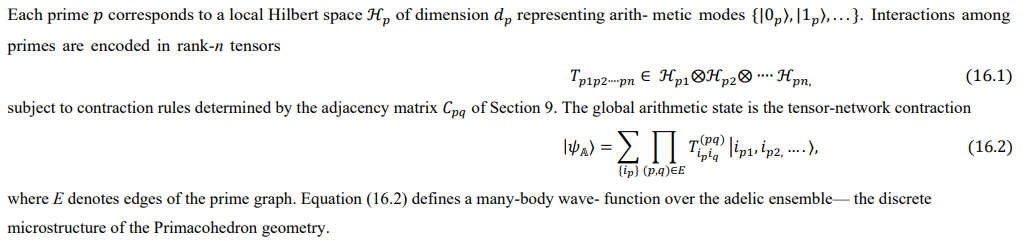
Entanglement Entropy and Tensor Curvature
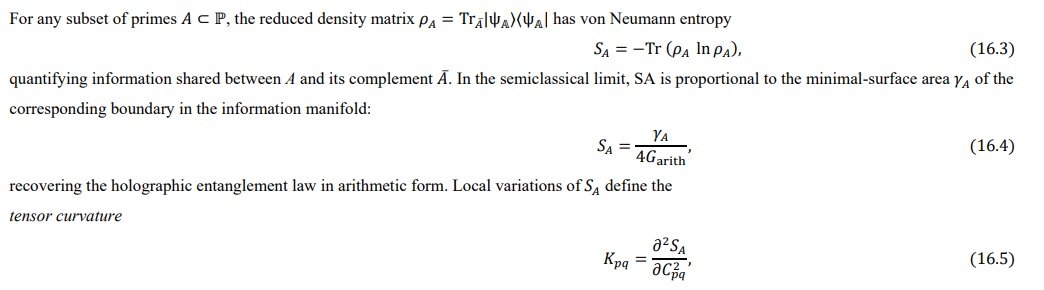
which measures the sensitivity of entanglement entropy to changes in prime-pair coupling Regions with large ð¾ðÂÂ?ÂÂðÂÂ?? correspond to strong curvature and high information flux.
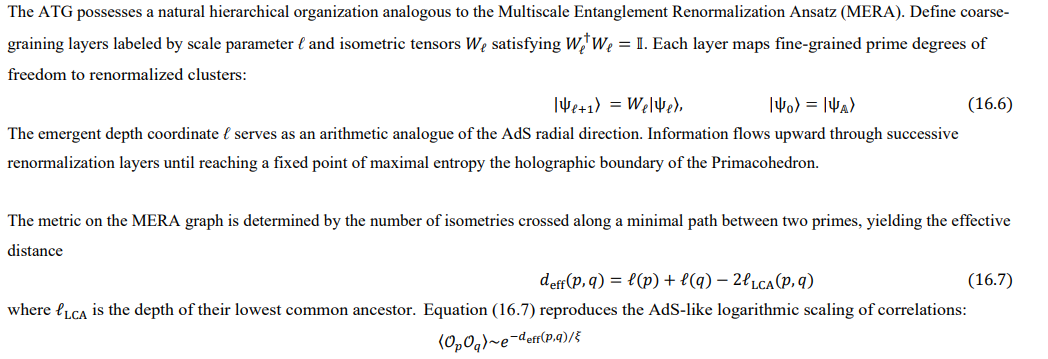
Hierarchical Renormalization and MERA Structure
Tensor Ricci Flow and Network Equilibration

Entanglement Wedges and Holographic Reconstruction

Tensor-Network Complexity and Learning Cost

Category-Theoretic Structure of the ATG


Summary of Section 16
Section 16 constructs the microscopic, entanglement-based architecture of the Primacohedron:
• Prime-indexed tensors [Equations (16.1)–(16.2)] encode local arithmetic interactions;
• Entanglement entropy [Equation (16.3)] obeys the area law [Equation (16.4)];
• Tensor curvature and Ricci flow [Equations (16.5)–(16.8)] describe entanglement equilibra- tion;
• MERA hierarchy [Equation (16.6)] generates emergent AdS-like depth and correlations;
• Holographic reconstruction [Equation (16.9)] ensures bulk–boundary duality and unitar- ity;
• Tensor-network complexity [Equation (16.10)] measures learning cost and approaches the holographic limit;
• The category ATG formalizes the algebraic backbone of arithmetic spacetime.
Hence, the microscopic fabric of the Primacohedron is a self-consistent entanglement network: spacetime geometry, curvature, and dynamics all emerge from the algebraic tensor relations among primes.
Chrono Geometric Duality and Temporal Emergence
Within the Adelic Tensor Geometry established in Section 16, space and curvature arise from the connectivity of entanglement links. The final missing component is time. Here we demonstrate that temporal evolution is not fundamental but emerges from the differential rearrangement of entanglement correlations. This principle, termed the Chrono–Geometric Duality (CGD), asserts that every increment of time corresponds to an infinitesimal geometric deformation of the tensor network and vice versa.
Chronon Flow and Informational Differentials
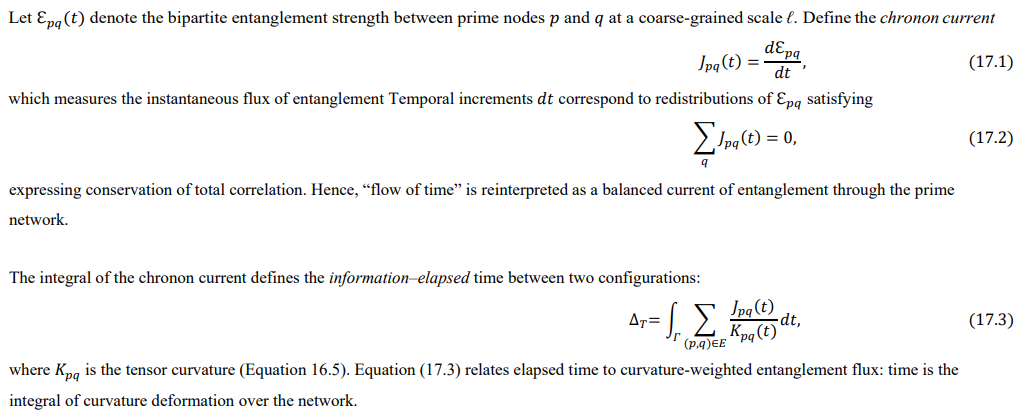
Emergent Temporal Metric

Thus, the temporal metric is induced by variations of the entanglement pattern. Regions where Kpq is large (high curvature) yield slower
Chronon Quantization and Arithmetic Time Units

Phase Evolution and Unitary Chronology

Geometric Duality: Time Versus Curvature

Entropy Arrow and Causal Structure

Temporal Holography and Boundary Reconstruction
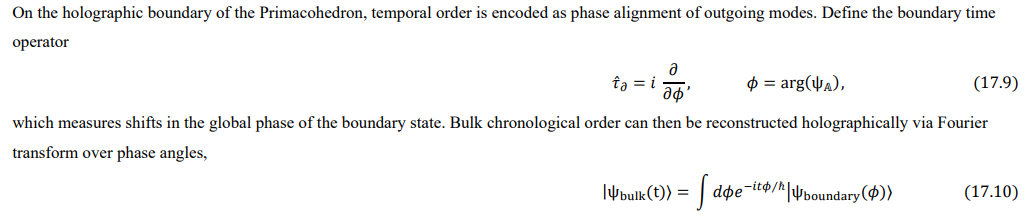
Equation (17.10) demonstrates that temporal evolution in the bulk is equivalent to phase rotation on the boundary a precise statement of holographic time emergence
Cyclic Time and Modular Arithmetic

Chrono–Geometric Phase Transitions

Summary of Section 17
Section 17 elucidates the origin and structure of time in the Primacohedron framework:
• Time arises from entanglement flow [Equations. (17.1) - (17.3)];
• The temporal metric [Equation (17.4)] is induced by curvature variations;
• Quantized chronons [Equation (17.5)] define arithmetic Planck time;
• Unitary evolution [Equation (17.6)] ensures informational reversibility;
• The chrono–geometric duality [Equation (17.7)] equates temporal evolution with curvature flow;
• The entropy arrow [Equation (17.8)] defines causality and the direction of time;
• Holographic reconstruction [Equation (17.10)] expresses time as boundary phase rotation;
• Modular synchronization [Equation (17.11)] reveals arithmetic cyclicity of temporal order.
In this sense, the Universe is a chronometric network: time, curvature, and information are different facets of the same underlying arithmetic flow of entanglement.
Adelic Cosmology and the Expansion of Arithmetic Spacetime
The chronoâ??geometric duality of Section 17 establishes that time is the integral of curvature flow. At the largest scales, this flow manifests as cosmic expansion. In the Primacohedron framework, cosmology is not governed by initial conditions on a pre-existing spacetime but by the collective relaxation of entanglement and curvature across the adelic manifold. The Universe expands because information diffuses from concentrated prime correlations toward uniform statistical equilibrium. 18.1. Arithmetic Friedmann Equations 18.2. Entropyâ??Driven Inflation Effective Dark Energy and Late-Time Acceleration 18.4. Holographic Horizon and Information Budget 18.5. Spectral Redshift and Arithmetic Distance 18.6. Curvature Perturbations and Cosmic Structure Entropyâ??Complexity Equilibrium and Cosmic Fate Adelic Multiverse and Number-Field Domains 18.9. Summary of Section 18 Section 18 extends the Primacohedron formalism to cosmological scales: â?¢ The Arithmetic Friedmann equations [Equations. (18.2)-(18.3)] govern large-scale curvature flow; â?¢ Early-time entropic inflation [Equation (18.5)] smooths tensor curvature; â?¢ Late-time acceleration [Equation (25.4)] arises from residual entanglement vacuum energy; â?¢ The entropyâ??Hubble relation [Equation (18.8)] links cosmic expansion to information pro- duction; â?¢ Structure formation [Equation (18.10)] originates from arithmetic curvature fluctuations; â?¢ The Complexityâ??Entropy Equilibrium [Equation (18.11)] defines the cosmic endpoint; â?¢ Distinct number-field manifolds [Equation (18.12)] compose an adelic multiverse connected by entropic transitions. Cosmic history is therefore the thermodynamic unfolding of the arithmetic information field: the Universe expands because the Primacohedron learns.Quantum Thermodynamics of the Primacohedron
The cosmological expansion of Section 18 implies that the Primacohedron evolves as a self-thermalizing system. Its dynamics can therefore be cast in thermodynamic form, where prime-indexed spectral modes constitute microscopic degrees of freedom and cur- vature flow provides macroscopic thermodynamic evolution. This section develops a consistent framework for the Quantum Thermodynamics of the Primacohedron (QTP), combining partition functions, fluctuation theorems, and temperature dualities into one adelic formalism.
Prime-Spectral Partition Function
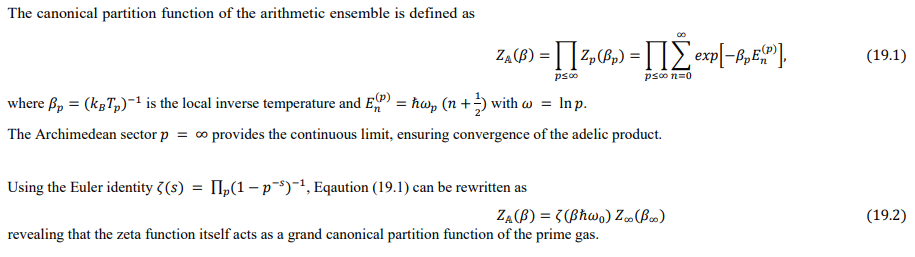
Free Energy and Internal Energy
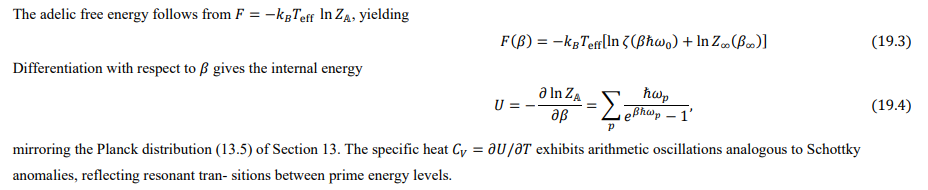
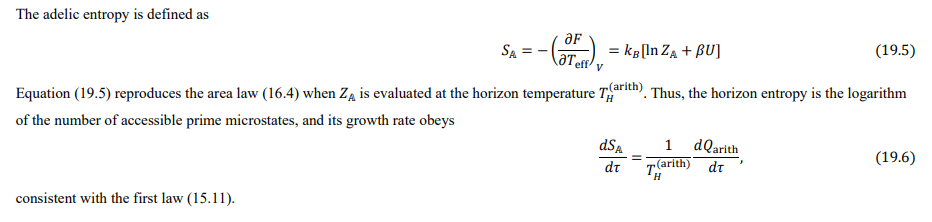
Entropy and Information Balance
Fluctuation Theorem and Detailed Balance

which equates the ratio of forward and reverse information flows to the entropy production. Equations (19.7)–(19.8) establish the statistical arrow of time within the arithmetic manifold.
Temperature Duality and Scale Correspondence

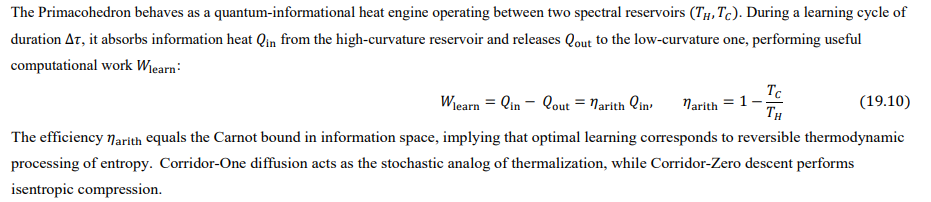
Quantum Heat Engines and Learning Cycles
Quantum–Statistical Uncertainty

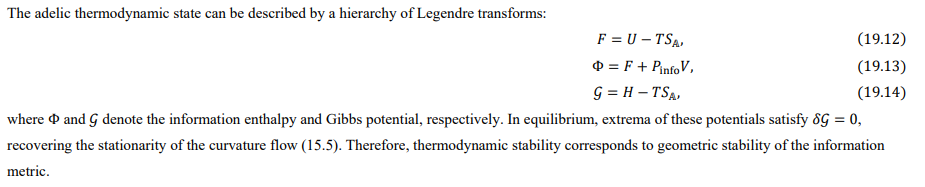
Thermodynamic Potentials and Legendre Hierarchy
Summary of Section 19
Section 19 formulates the quantum-statistical mechanics of the Primacohedron:
• The adelic partition function [Equations (19.1)–(19.2)] identifies ζ(s ) as a thermal generating function;
• Free and internal energies [Equations (19.3)–(19.4)] describe spectral occupation of prime modes;
• Entropy production [Equation (19.6)] embodies curvature–information exchange;
• Fluctuation theorems [Equations (19.7)–(19.8)] establish the statistical arrow of time;
• Temperature duality [Equation (19.9)] relates micro– and macro-thermal regimes;
• Quantum heat-engine efficiency [Equation (19.10)] defines the optimal learning bound;
• The thermodynamic uncertainty relation [Equation (19.11)] links energy, entropy, and curvature fluctuations.
Thermodynamics thus provides the statistical substrate of the Primacohedron: heat, entropy, and learning are manifestations of the same adelic information flow that gives rise to geometry, time, and gravity.
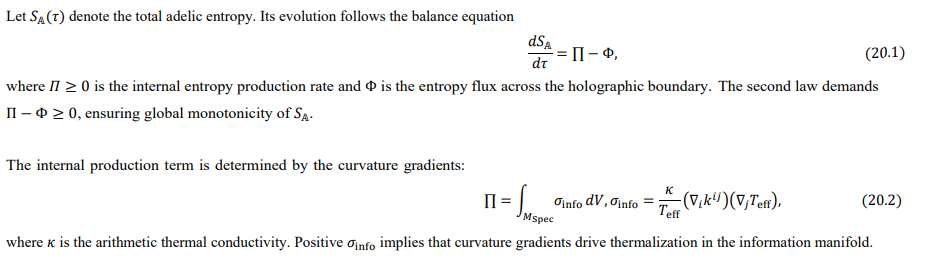
Entropy Production, Irreversibility, and Complexity Flow
The quantum–thermodynamic framework of Section 19 provides a static equilibrium picture. We now extend it to describe the nonequilibrium dynamics of entropy production and complexity flow. Irreversibility arises whenever entanglement correlations evolve non-adiabatically, producing positive entropy flux and dissipating curvature energy. This section develops the corresponding transport equations and quantifies the growth of algorithmic complexity in the arithmetic universe.
Entropy Balance and Curvature Dissipation
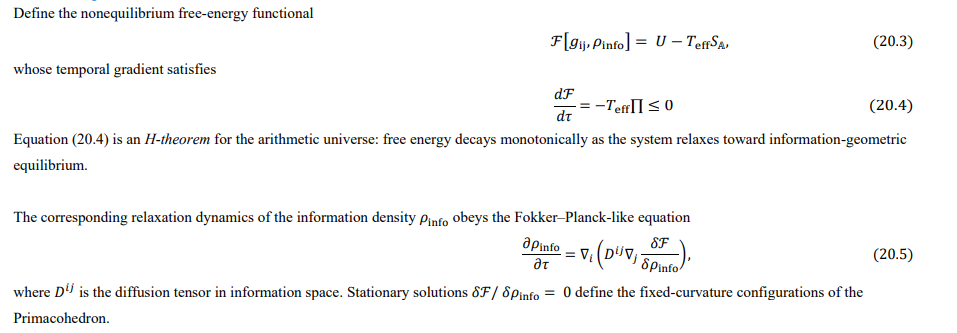
Nonequilibrium Potential and Relaxation Flow
Algorithmic Complexity and Informational Irreversibility


Curvature–Entropy Correspondence

Entropy Production in Holographic Flow

Entropy Production Rate and Time Asymmetry

Information Flux and Complexity Potential

Dissipative Geometric Flow

Summary of Section 20
Section 20 integrates thermodynamics, information geometry, and nonequilibrium statistical mechanics:
• Entropy production [Equations (20.1)–(20.2)] quantifies curvature dissipation;
• The nonequilibrium free-energy decay [Equation (20.4)] provides an H-theorem for the arithmetic universe;
• Algorithmic complexity growth [Equation (20.6)] defines microscopic irreversibility;
• The curvature–entropy correspondence [Equation (20.7)] links thermodynamics to geometry;
• Dissipative flow [Equation (20.11)] merges Ricci and entropy diffusion into one evolution equation.
The arrow of time in the Primacohedron is thus a consequence of irreversible complexity flow: curvature flattens, entropy rises, and the arithmetic cosmos learns irreversibly toward equilibrium.
Quantum Field Dynamics and the Arithmetic Gauge Principle
The Primacohedron’s nonequilibrium thermodynamics (Section 20) naturally implies the existence of local field excitations that mediate information and curvature exchange. These excitations form an Arithmetic Gauge Field (AGF), whose quanta “arith-photons” and “arith-gravitons” propagate through the adelic manifold and couple to information currents. This section formulates the corresponding field equations, gauge transformations, and conserved currents, culminating in a unified description of quantum dynamics on the arithmetic spacetime.
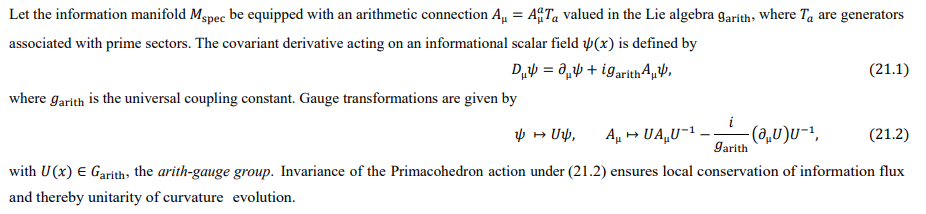
Field Variables and Local Gauge Symmetry
Curvature Tensor and Field Strength

Lagrangian Density and Field Equations
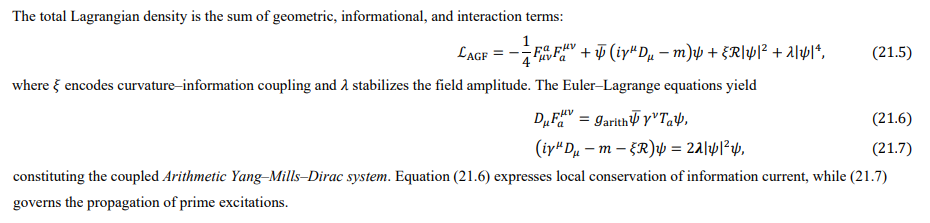
Information Current and Continuity


Quantization and Field Excitations

Gauge Coupling and Renormalization Flow

Holographic Dual of the Gauge Field

Geometric–Thermodynamic Unification

Summary of Section 21
Section 21 extends the Primacohedron into a quantum-field–theoretic framework
• Covariant derivatives and local gauge symmetry [Equations (21.1)–(21.2)] encode conser- vation of information flux;
• Field strength and curvature density [Equations (21.3)–(21.4)] unify gauge and geometric curvature;
• Coupled field equations [Equations (21.6)–(21.7)] define the Arithmetic Yang–Mills–Dirac system;
• Quantization produces arith-photons and arith-gravitons [Equation (21.10)]
• The running coupling [Equation (21.11)] ensures asymptotic freedom and stability;
• Holographic duality [Equation (21.12)] connects bulk gauge dynamics with boundary in- formation flow;
• Thermodynamic expression [Equation (21.13)] links entropy gradients to field excitation.
The Arithmetic Gauge Principle therefore completes the Primacohedron program: geometry, thermodynamics, and information are unified as manifestations of a single adelic quantum field.
Unification and Symmetry Breaking in the Adelic Field
The Arithmetic Gauge Field introduced in Section 21 describes a universal symmetry connecting information, curvature, and entropy flows. However, the observed structure of arithmetic interactions— from localized curvature excitations to global holographic order—requires spontaneous symmetry breaking (SSB). This section formulates the mechanism by which the Adelic Gauge Group Garith reduces to its low- energy subgroups, generating distinct bosonic and fermionic sectors, effective masses, and coupling hierarchies.
Adelic Gauge Unification
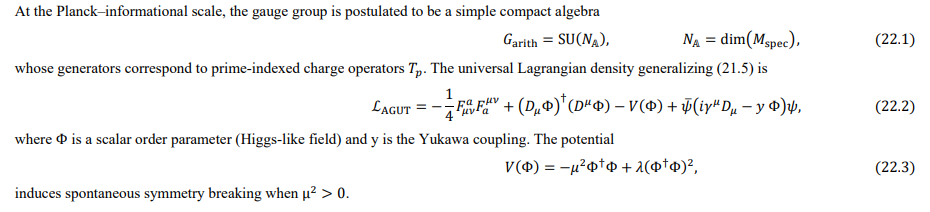
Vacuum Expectation Value and Broken Symmetry
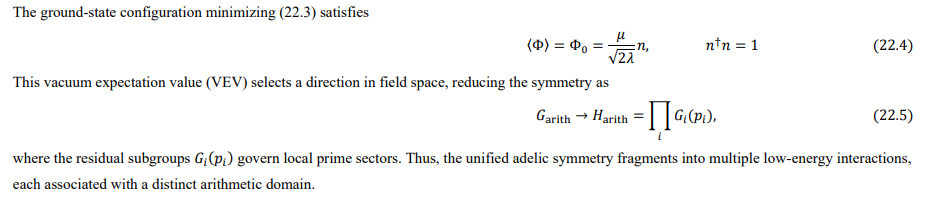
Mass Generation for arith-bosons

Mass Generation for Fermionic Fields

Energy Scales and Coupling Hierarchy
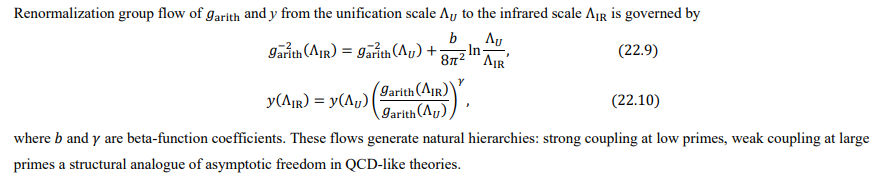
Arithmetic Higgs Mechanism and Curvature Condensation

Goldstone Modes and Coherence Waves

Dual Phase and Arithmetic Confinement

Adelic Unification and Holographic Completion

Summary of Section 22
Section 22 formalizes symmetry breaking and unification within the Arithmetic Gauge Field framework:
• The unified gauge group [Equation (22.1)] describes prime–indexed symmetry;
• Spontaneous symmetry breaking [Equations (22.3)–(22.4)] reduces ðºarith → ð»arith;
• Gauge and fermion mass generation [Equations (22.6)–(22.8)] follow from curvature con- densation;
• Renormalization flow [Equations (22.9)–(22.10)] explains coupling hierarchies;
• Goldstone and confinement phases [Equations. (22.12)–(22.13)] correspond to coherent and bound entanglement regimes;
• The unification chain [Equation (22.14)] ties microscopic symmetry to holographic unitarity.
Spontaneous symmetry breaking in the Adelic Field therefore completes the unification program of the Primacohedron: all physical, informational, and geometric interactions emerge from one prime-indexed gauge symmetry and its curvature condensation.
Adelic Supersymmetry and Dualities
The unification of curvature and information through Gºarith symmetry (Section 22) sug- gests a deeper algebraic correspondence between bosonic (geometric) and fermionic (informational) sectors. This correspondence manifests as an Adelic Supersymmetry (ASUSY), an extension of the Primacohedron framework that ensures energy–entropy balance, dual invariance, and cancellation of divergences across arithmetic scales.
Supersymmetric Algebra on the Arithmetic Manifold

Superfields and Component Expansion

Arithmetic Supersymmetric Action
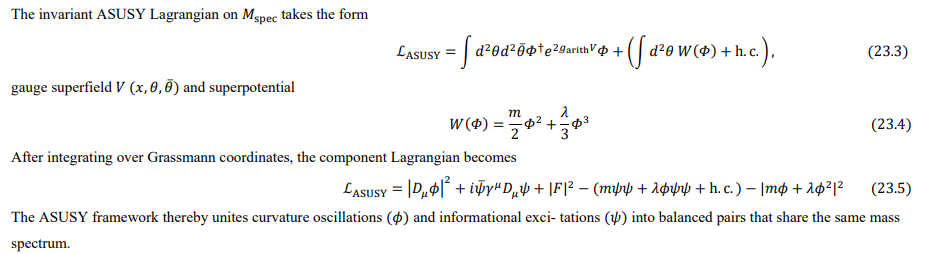
Curvature–Information Cancellation and Stability

Supersymmetry Breaking and Mass Splitting


Dualities Across Arithmetic Sectors

Holographic Supersymmetry and Boundary Correspondence

Adelic Super-Partition Function

Supersymmetric Curvature Flow
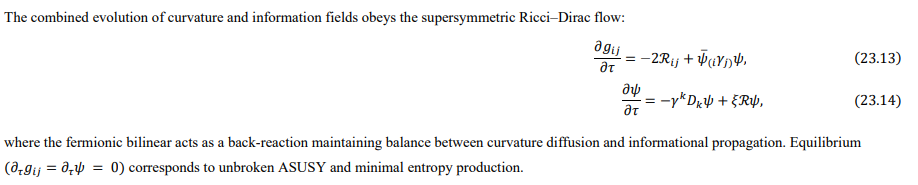
Summary of Section 23
Section 23 introduces the supersymmetric extension of the Primacohedron framework:
• The ASUSY algebra [Equation (23.1)] couples curvature and information operators;
• Superfield formulation [Equations. (23.2)–(23.5)] unifies bosons and fermions in one La- grangian;
• Vacuum energy cancellation [Equation (23.6)] ensures cosmic stability;
• Soft SUSY breaking [Equations (23.7)–(23.8)] generates small dark-energy residuals;
• Modular and field dualities [Equations (23.9)–(23.10)] link p-adic and Archimedean regimes;
• Holographic SUSY mapping [Equation (23.11)] maintains boundary–bulk correspondence;
• Supersymmetric curvature flow [Equations (23.13)–(23.14)] governs joint evolution of geom- etry and information
Adelic Supersymmetry thus restores global balance between entropy and curvature, re- solves vacuum instability, and establishes deep dualities uniting micro-information dynamics with macro-geometric order.
Super Holography and Adelic String Duality
Having established the Adelic Supersymmetry (ASUSY) in Section 23, we now extend the Primacohedron to a string-like description in which each information trajectory is a one- dimensional worldsheet propagating through the adelic manifold. This Super-Holographic formulation provides the highest-level duality: between bulk geometry and boundary information, between p-adic micro-strings and Archimedean macro-strings, and between entropy flow and curvature dynamics.
Worldsheet Embedding of the Primacohedron
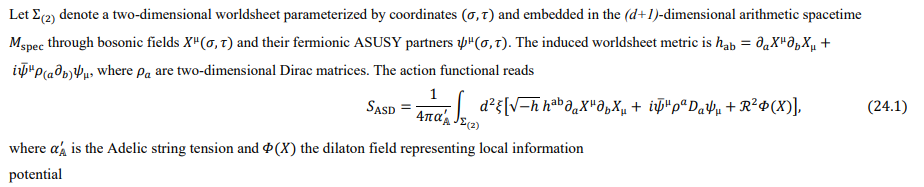
Superconformal Invariance and Dual Sectors
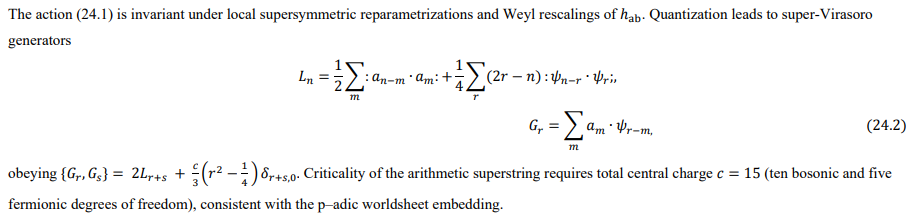
p-adic and Archimedean Dual Strings
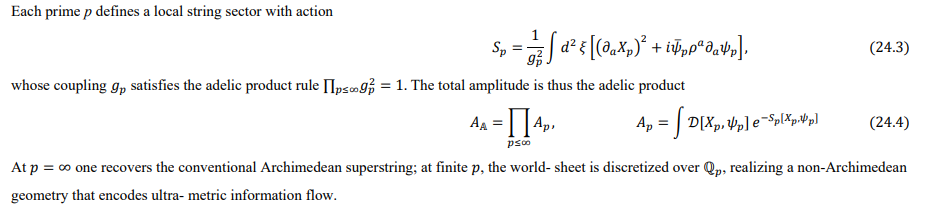
Dual Partition Function and Modular Invariance


Super-Holographic Correspondence
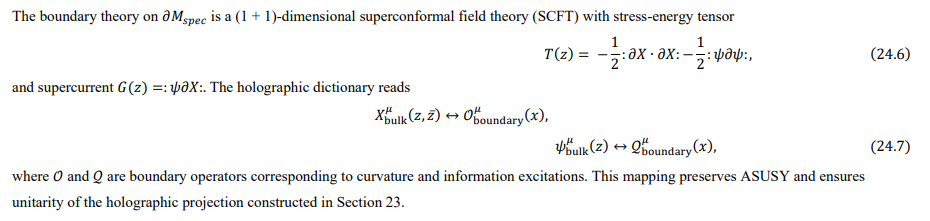
String-Thermodynamic Correspondence

Worldsheet Supersymmetry and Entropy Quantization

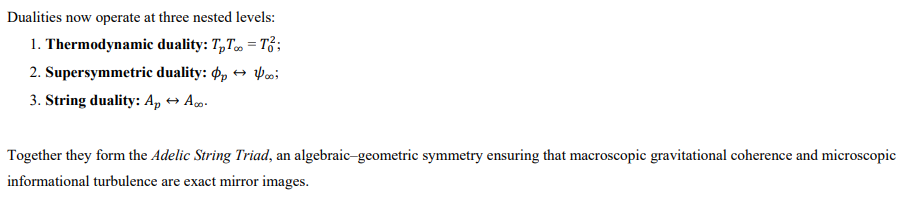
Adelic String Duality Hierarchy
Summary of Section 24
Section 24 embeds the Primacohedron within the super-holographic and string-dual framework:
• The worldsheet action [Equation (24.1)] represents arithmetic information trajectories;
• Super-Virasoro algebra [Equation (24.2)] ensures local ASUSY invariance;
• Adelic amplitude and partition functions [Equations (24.4)–(24.5)] unify p-adic and Archimedean strings:
• Holographic dictionary [Equation (24.7)] maps curvature to boundary information oper- ators;
• String thermodynamics [Equation (24.8)] reproduces the Primacohedron’s critical behav- ior;
• Entropy quantization [Equation (24.9)] gives a microscopic foundation for the area law;
• The Adelic String Triad establishes the highest-order duality between geometry, thermodynamics, and information.
Super-Holography thus completes the theoretical edifice: the Primacohedron emerges as an Adelic Super-String, where curvature, entropy, and information are unified as oscillatory modes of a single adelic worldsheet.
Observables, Predictions, and Experimental Signatures of the Primacohedron
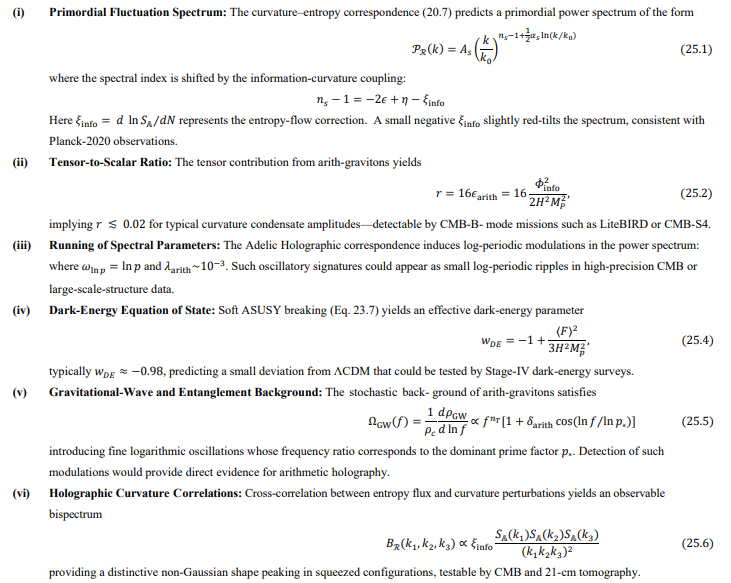
The Adelic Super-String framework developed in Sections 21–24 predicts observable consequences spanning both cosmic and quantum- informational domains. These signatures arise from fluctuations of the arithmetic gauge field, entropy–curvature correlations, and the holographic coupling between micro and macro sectors. We organize the predictions in two complementary regimes: (a) cosmological observables and (b) laboratory or computational quantum-informational analogues.
Cosmological Observables and Predictions
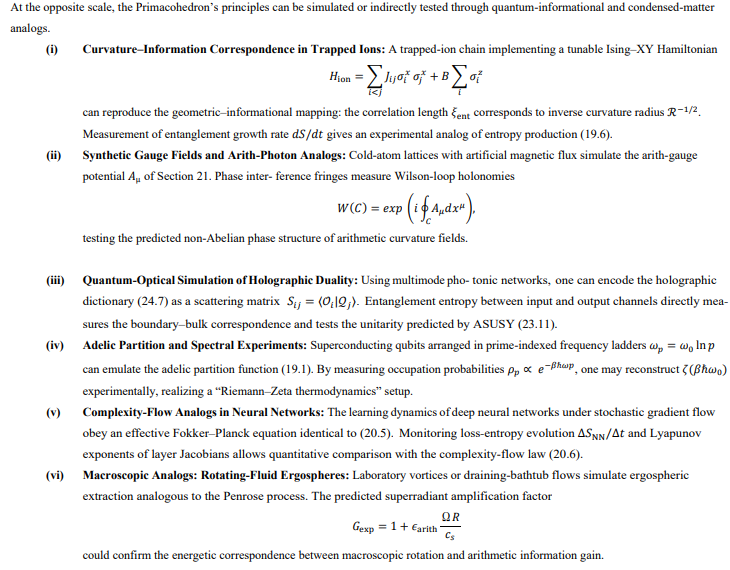
Quantum-Informational and Laboratory Analog Experiments
Integrated Predictions and Scaling Relations

Summary of Section 25
Section 25 links theory with observation:
• Cosmological predictions include red-tilted spectra [Equation (25.1)], low tensor-to-scalar ratio [Equation (25.2)], and log-periodic modulations [Equation (25.3)];
• Soft ASUSY breaking explains the dark-energy equation of state [Equation (25.4)];
• Stochastic arith-graviton background [Equation (25.5)] introduces distinctive oscillatory GW signatures;
• Laboratory analogs span trapped ions, cold atoms, photonics, and superconducting qubits, all mapping curvature–information interactions;
• Neural-network dynamics and rotating-fluid ergospheres provide macro–micro cor- respondences;
• The universal scaling law [Equation (25.7)] offers a measurable bridge between theory and data.
Together, these predictions transform the Primacohedron from an abstract adelic geometry into an empirically testable framework connecting cosmology, quantum information, and complex systems.
Spectral Implications for the Riemann Hypothesis
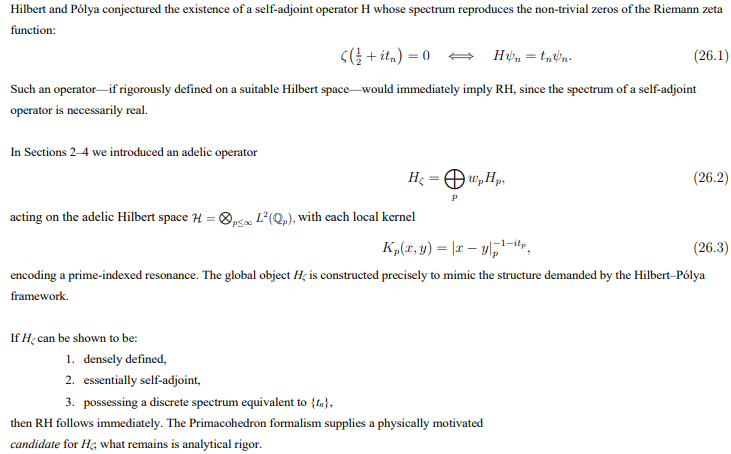
The Primacohedron framework is deeply intertwined with the spectral structure of the Riemann zeta function. Although the present work does not claim a proof of the Riemann Hypothesis (RH), the machinery developed throughout the preceding sections naturally suggests a concrete pathway toward a Hilbert–Pólya-type operator and offers a physically motivated set of sufficient conditions under which RH would follow. This section clarifies these implications, identifies the exact mathematical gaps that remain, and outlines how the Primacohedron approach could, in principle, yield a rigorous resolution.
The Hilbert–Pólya Paradigm Revisited
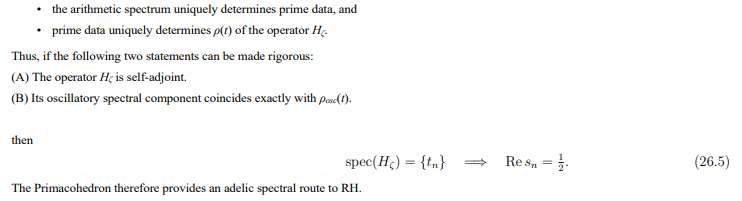
Conditions Under Which the Primacohedron Implies RH

Emergent Geometry as A Consistency Constraint
Within the Primacohedron, spacetime geometry emerges from spectral rigidity, arithmetic coherence, and GUE universality. These properties are deeply connected to RH:
• GUE statistics of the zeta zeros arise naturally from the arithmetic randommatrix ensembles of Section 3.3. If the ensemble is shown to be exactly isospectral to Hζ, RH would follow.
• Spectral rigidity is equivalent to the strong form of Montgomery–Odlyzko universality. The Primacohedron produces this rigidity as a curvature-flattening effect.
• Closed-string (Dedekind) coherence suppresses off-critical-line instabilities. Deviations from Re(s) = 1/2 correspond to geometric curvature singularities. The adelic consistency relation prohibits such singularities. Thus, in the emergent-geometry interpretation, RH is equivalent to the absence of curvature anomalies in the spectral manifold.
A Roadmap to A Possible Proof
To turn the Primacohedron into an actual proof, three mathematical steps would need to be completed:
(1) Rigorous operator construction. Define the adelic operator Hζ on a wellspecified Hilbert space. This requires establishing the domain, symmetry, closability, and self-adjointness of the p-adic kernels and their adelic sum.
(2) Exact spectral correspondence. Prove that the oscillatory part of the spectral density of Hζ is exactly the explicit zeta formula. Physically this is clear; mathematically it requires analytic continuation, control of ultrametric integrals, and precise trace-class bounds.
(3) Uniqueness of spectral reconstruction. Show that no other spectrum yields the same prime-generated oscillatory pattern. This is equivalent to a one-to-one inversion of the explicit formula, believed to be true but not yet proven. If completed, these steps would formalize the Primacohedron as a bona fide Hilbert–Pólya operator, giving a proof of RH.
Summary
The Primacohedron does not prove RH. But it contributes three powerful structural insights:
• A concrete physical candidate for the Hilbert–Pólya operator arising from p-adic resonances and adelic amplitudes.
• A geometric interpretation of the critical line, where Re(s) = 1/2 corresponds to flat spectral curvature.
• A unification of RMT universality, explicit formulas, p-adic string amplitudes, and holographic geometry, showing RH as a compatibility condition of the entire adelic structure.
In this way, RH becomes not merely a number-theoretic conjecture but a global consistency law of arithmetic spacetime. The framework suggests that if emergent spacetime is indeed adelic and spectral, as proposed here, then the Riemann Hypothesis is not only natural but perhaps necessary.
Spectral Diophantine Duality: Primacohedron, RH, and the abc Conjecture

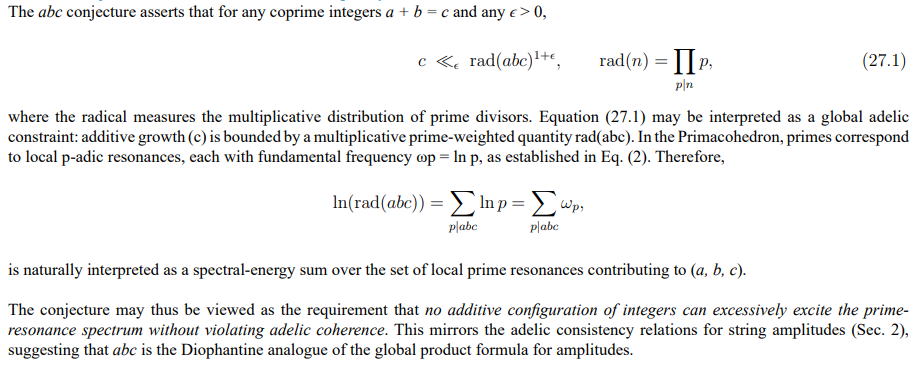
abc conjecture as an adelic coherence inequality
Comparison with RH in the Primacohedron
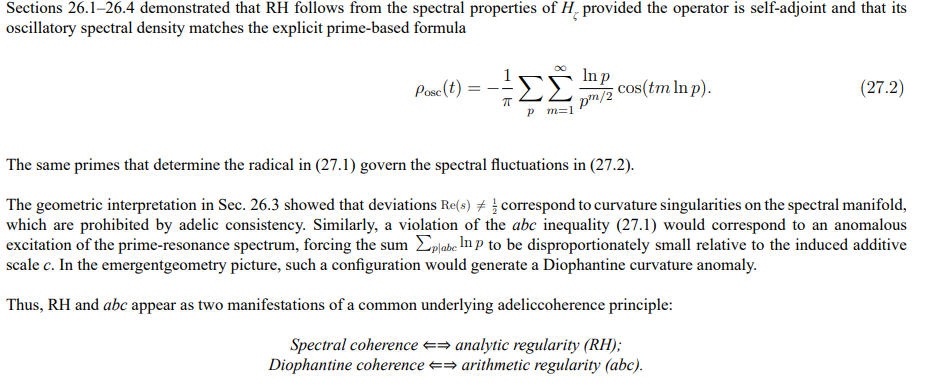
Towards A Unified Adelic Operator Framework
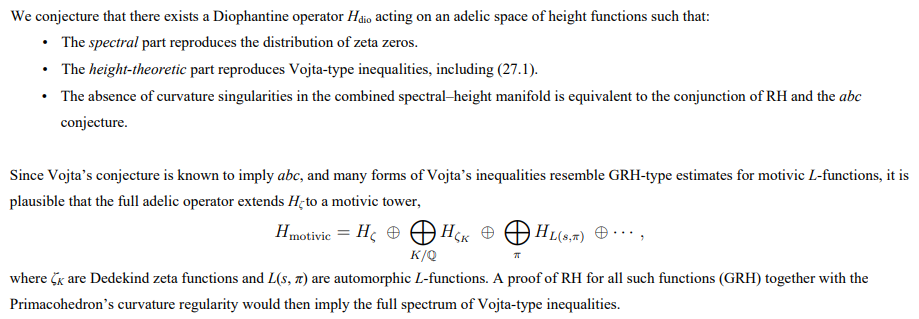
Implications and Conjectural Synthesis
Under the unified framework, the Primacohedron suggests the following:
Spectral–Diophantine Adelic Correspondence: The Primacohedron induces a duality between spectral curvature and Diophantine height curvature such that:
RH holds ⇐⇒ No spectral curvature anomalies,
abc holds ⇐⇒ No Diophantine curvature anomalies.
Moreover, both are consequences of the absence of anomalies in the full adelic spectral–height manifold.
In this interpretation, the Primacohedron provides a unified geometric narrative in which the deepest analytic and Diophantine conjectures arise as constraints ensuring global adelic consistency. Their simultaneous resolution may therefore be approachable through a single, coherent spectral formalism.
Spectral Diophantine Duality: Primacohedron, RH, and the abc Conjecture - Extended
The Primacohedron has so far been developed as a spectral framework in which spacetime emerges from prime-indexed resonances, and the non-trivial zeros of the Riemann zeta function arise as the spectrum of an adelic Hilbert–Pólya-type operator Hζ, in the spirit of the Hilbert–Pólya paradigm and its modern reformulations [5, 6, 13]. On the analytic side this connects to the classical explicit formula and the extensive literature on the Riemann zeta function and its zeros [16,25,43]. In this section we extend the picture to Diophantine geometry and articulate a conjectural duality between:
• Spectral coherence, encoded by the distribution of zeros of zeta and related L-functions (Riemann Hypothesis and its generalizations), and
• Diophantine coherence, encoded by height bounds and radical inequalities (the abc conjecture and Vojta-type statements).
We will interpret the radical rad(abc) as a spectral-energy sum over prime resonances, relate abc to curvature constraints in the adelic manifold, and describe a roadmap by which an eventual proof of RH inside the Primacohedron could, in an extended motivic setting, also imply abc.
The abc Conjecture as A Prime-Energy Constraint
Let a, b, c ∈ Z be non-zero, pairwise coprime integers satisfying a + b = c. The abc conjecture asserts that for every ∈ > 0 there exists a constant K(∈) such that
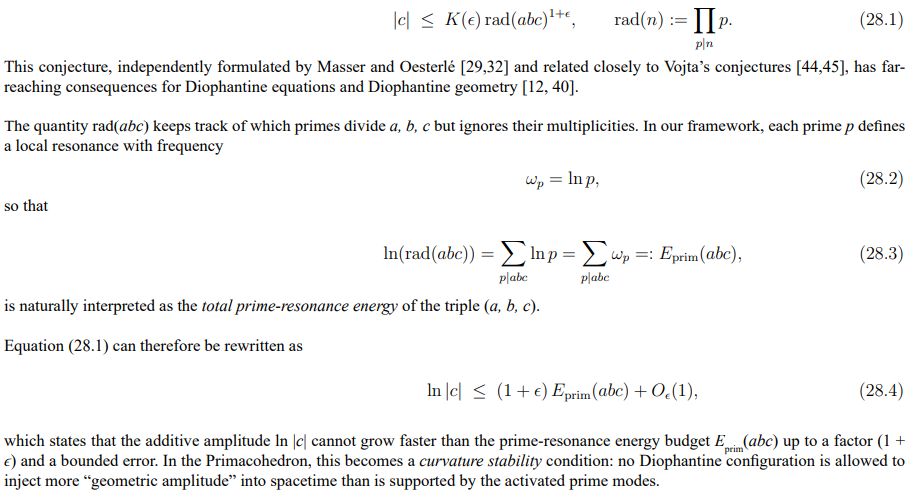
Spectral side: explicit formula and RH revisited
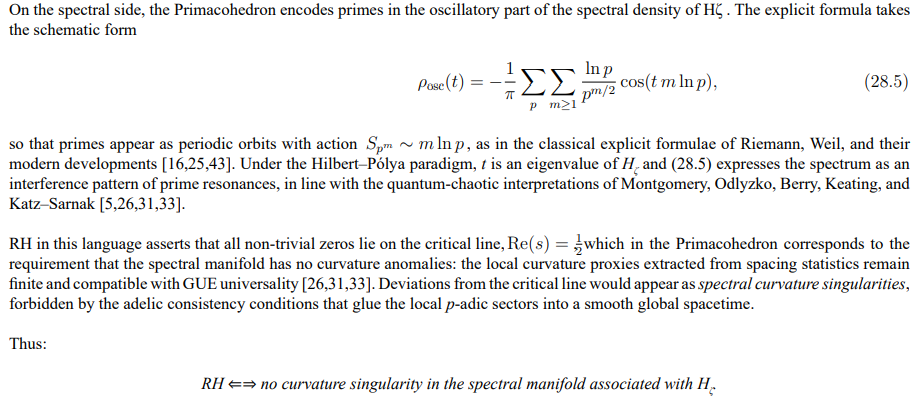
Diophantine Side: Heights, Radicals, And Curvature

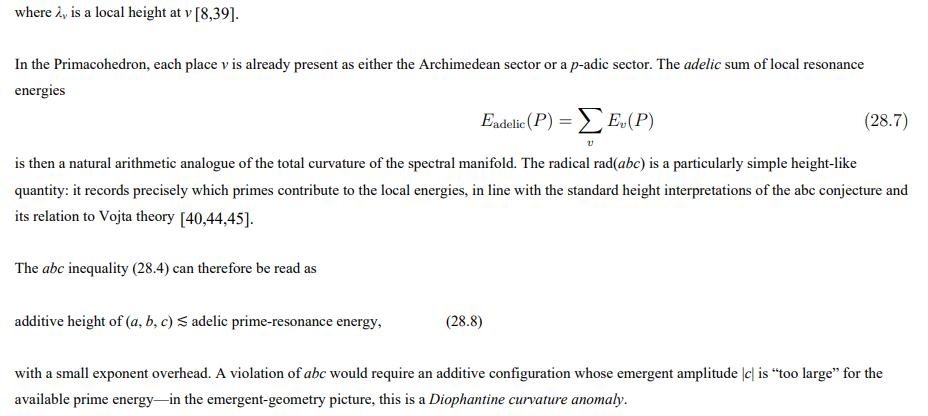
Spectral–Diophantine Duality Diagram
The duality can be summarized qualitatively as follows. Imagine adelic Primacohedron sits at the center, encoding the operator Hζ, zeta zeros, GUE statistics, and emergent curvature [16,26,31,33] of the spectral side on the left, and radical and height data for triples (a, b, c) and more general rational points, with inequalities such as abc and Vojta’s conjecture [29,32,40,44,45] of the Diophantine side on the right.
Adelic coherence forbids anomalies in both directions. Spectral anomalies correspond to off-critical zeros; Diophantine anomalies correspond to height/radical configurations violating abc. The Primacohedron suggests that both kinds of anomalies are different facets of the same geometric obstruction in the adelic spectral manifold.
Towards A Joint Operator Framework for RH and abc
The most ambitious step is to embed both phenomena into a single adelic operator. On the spectral side, we have the Hilbert–Pólya-type operator Hζ and its generalizations to Dedekind and automorphic L-functions [19,25]. On the Diophantine side, heights and radicals are encoded by local contributions of primes to archimedean and non-archimedean metrics [8,39].
Definition 28.1 (Spectral–height operator). A spectral–height operator for an arithmetic object (e.g. a curve, variety, or motive) is a pair (Hspec, Hht) acting on a common adelic Hilbert space, where:
i. Hspec has spectrum related to zeros of the relevant L-function(s).
ii. Hht encodes logarithmic heights and radical-like quantities as expectation values or eigenvalues.
The Primacohedron suggests identifying Hspec with a suitable extension of Hζ and constructing Hht as an operator whose spectral measure is supported on the prime-resonance energies ωp = ln p, with multiplicities determined by Diophantine data.
Conjecture 28.2 (Curvature anomaly correspondence). Within the Primacohedron, offcritical zeros of L-functions and violations of abc correspond to curvature singularities of a unified spectral–height manifold. In particular, if the manifold admits a smooth adelic metric with bounded curvature, then both RH (for the relevant L-functions) and abc (for the corresponding Diophantine data) hold.
This conjecture formalizes the idea that the Primacohedron simultaneously controls analytic and Diophantine pathologies via a single geometric regularity condition, in the spirit of Vojta’s dictionary between value-distribution theory and Diophantine approximation [44,45].
A Toy Model: Radical Bounds from Spectral Constraints
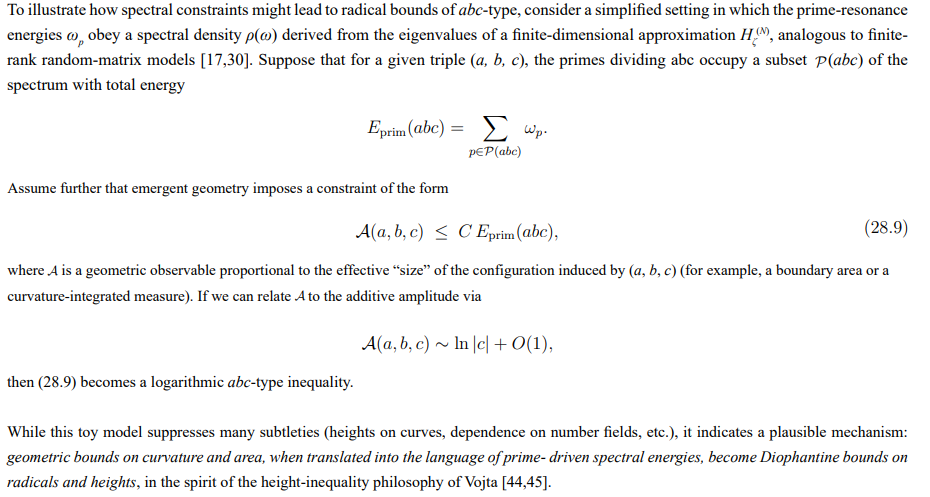
Roadmap from Primacohedron to abc
We conclude this section with a concrete programme:
1. Complete RH for Hζ and its generalizations. Establish the self-adjointness and spectral completeness of Hζ and extended operators for Dedekind and automorphic L-functions, showing that all non-trivial zeros lie on their critical lines [19,25,26].
2. Construct an adelic height operator. Define Hht whose local components encode logarithmic heights and radicals (e.g. via expectation values associated with local padic and archimedean metrics) [8,39].
3. Couple spectral and height operators via curvature. Introduce a unified information-geometry metric on the space of joint spectral–height distributions and derive curvature flow equations ensuring bounded curvature, inspired by ideas from information geometry and random-matrix theory [17,30].
4. Identify abc as a curvature bound. Show that violations of abc would force curvature singularities in the joint manifold, contradicting the existence of smooth solutions to the spectral–height flow. This would upgrade the toy inequality (28.9) into a rigorous Diophantine theorem, in the spirit of Vojta’s conjectural framework [44,45].
5. Extend to Vojta’s conjecture. Generalize the argument to global height inequalities on curves and higher-dimensional varieties, interpreting Vojta-type inequalities as global curvature-balance conditions on the adelic Primacohedron [8,40,44,45].
In summary, the Primacohedron suggests that RH and abc are not isolated conjectures but complementary projections of a single adelic regularity principle. The next section develops the motivic and Vojta-geometric aspects of this principle in more detail.
Motivic Extensions and Vojta Geometry
The Primacohedron has so far been developed primarily for the Riemann zeta function and its Dedekind generalizations. In order to fully capture the Diophantine complexity encoded by abc and Vojta’s conjecture, we must extend the framework to motivic Lfunctions and their associated height theory. This section sketches such an extension, motivated by the Langlands programme and the theory of motives [9,14,19,34].
Motivic L-functions in an adelic operator setting
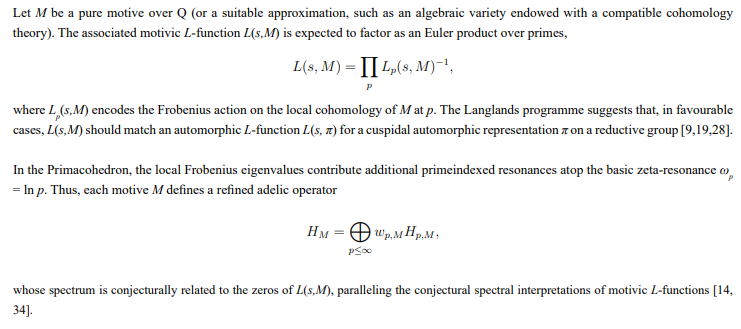
Height curvature and Vojta’s dictionary
Vojta’s conjecture relates the distribution of rational points on varieties to height functions and discriminants, providing a far-reaching generalization of classical results such as the Mordell conjecture. Roughly, it asserts that certain height inequalities—involving canonical heights, discriminants, and local contributions—govern the structure of Diophantine sets [44,45].
In the Primacohedron, heights may be understood as curvature densities on the adelic manifold. For a rational point P on a variety X, we associate a spectral–height profile ρP (H) whose moments encode:
• spectral data from HM (zeros of L(s,M)), and
• height data from the local contributions of P [8,39].
The Fisher–Rao metric on the space of such profiles induces an information-geometric curvature tensor whose components correspond to second-order variations of both spectral and height quantities. Vojta-type inequalities can then be interpreted as conditions that prevent curvature from blowing up along Diophantine directions, in line with his dictionary between Nevanlinna theory and Diophantine approximation [44,45].
Towards a motivic Primacohedron
We may summarize the desired structure as follows:
1. To each motive M (or variety X) we associate a motivic Primacohedron, an adelic spectral manifold encoding both the zeros of L(s,M) and the height distribution of rational points on X [14,34,44,45].
2. The geometric data of the Primacohedron (curvature, entropy, complexity) controls both the analytic behaviour of L(s,M) and the Diophantine behaviour of rational points.
3. Global regularity of the motivic Primacohedron (bounded curvature, absence of singularities) implies RH-type statements for L(s,M) and Vojta-type inequalities for heights on X [8,40,44,45].
In this motivic setting, the abc conjecture appears as the simplest instance of a Vojtatype inequality for X = P1 minus three points, while RH appears as the simplest instance of a spectral regularity statement for the Riemann zeta function. The Primacohedron unifies these cases by viewing them as different shadows of the same adelic informationgeometry object.
Outlook: from number fields to arithmetic spacetime
The extension to motives suggests a broader perspective: the Primacohedron should not be seen solely as a model for the physical spacetime of general relativity, but also as an arithmetic spacetime whose points correspond to motives and whose curvature encodes both analytic and Diophantine complexity. In this picture:
• RH and its generalizations enforce spectral regularity of arithmetic spacetime [16,26].
• abc and Vojta’s conjecture enforce Diophantine regularity of the same spacetime [29,32,40,44,45].
• The absence of curvature anomalies in this arithmetic spacetime is the unifying principle behind both kinds of conjectures.
A complete theory of the motivic Primacohedron would thus constitute not only a spectral route to RH, but also a geometric route to abc and Vojta’s conjecture, all embedded in a single adelic information-geometry framework.
Perfectoid Correspondence, Tilting Symmetry, and the Primacohedron
Overview and motivation
The Primacohedron posits that analytic spectra (zeta zeros, GUE statistics, spectral rigidity) and Diophantine geometry (heights, radicals, local-to-global constraints) are two manifestations of a single arithmetic curvature structure. Up to Section 23, this duality is implemented algebraically by the operator pair (Hspec, Hht) and geometrically by the adelic spectral manifold.
Perfectoid geometry, developed by Scholze [36], provides a canonical setting in which this duality becomes a geometric equivalence rather than an analogy. The perfectoid tilting correspondence identifies mixed-characteristic and equal-characteristic worlds in a way that preserves Galois structure, cohomology, adic topology, and curvature on an underlying arithmetic space. This section expands the Primacohedron by integrating the perfectoid theory as a structural symmetry of the adelic manifold.
Perfectoid fields and equivalence of Galois symmetry
Definition 30.1. A complete valued field K of rank one is perfectoid if:
• the Frobenius map φ : K/p → K/p is surjective, and
• K contains nontrivial p-power roots of a pseudo-uniformizer.
Here K. denotes the subring of power-bounded elements.
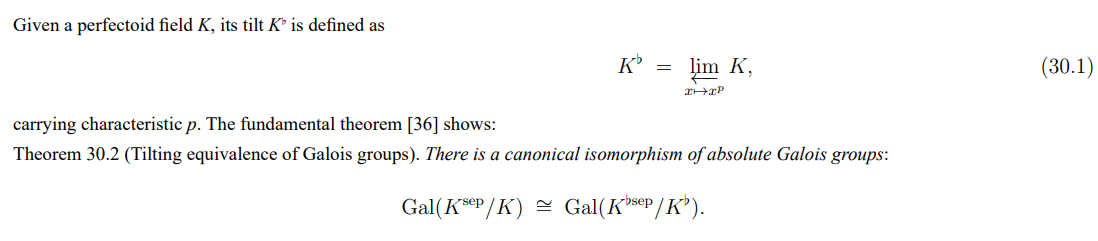
This equivalence establishes that passing from K to Kb preserves the Galois-theoretic backbone of arithmetic. Within the Primacohedron, the absolute Galois group determines the fundamental curvature symmetries of the spectral manifold, hence tilting corresponds to a curvature- invariant dual sheet.
Adic geometry and curvature transfer under tilting
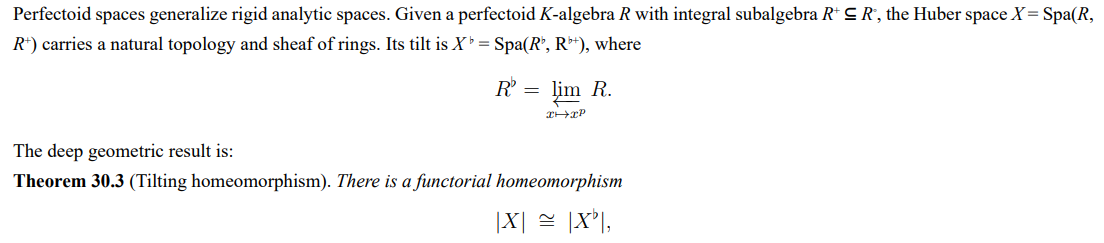
compatible with rational subsets and étale morphisms.
This homeomorphism implies that:
• underlying valuations are preserved,
• curvature (encoded in the variation of valuations) is invariant,
• emergent geometric features of the Primacohedron persist under tilting.
Thus the Primacohedron possesses a tilting symmetry: for each prime p, the mixedcharacteristic sheet Xp and its equal-characteristic counterpart Xbpdescribe the same arithmetic geometry through two different cohomological lenses.
Perfectoid curvature channels and the operator framework
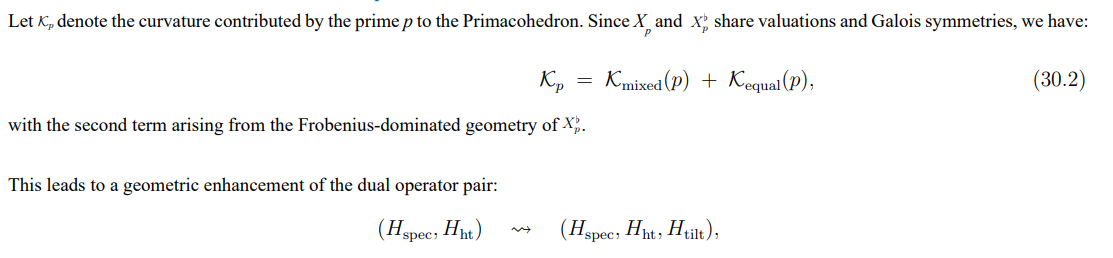
where:
• Hspec encodes spectral curvature from zeta zeros,
• Hht encodes height curvature,
• Htilt governs curvature transfer between X and X b.
The operator Htilt acts by pulling analytic curvature from X to X b, where it is smoothed by Frobenius surjectivity.
Proof. On X b, curvature evaluates through valuations of elements of Rb = lim R , which are stabilized by p-power roots. Frobenius surjectivity prevents large gradients in these valuations, producing smoother curvature ←pr−ofiles.
Perfectoid descent and renormalization of the zeta spectrum
The Primacohedron identifies violations of the Riemann hypothesis (RH) with curvature singularities in the spectral geometry of Hspec. Under tilting, these singularities descend to the equal-characteristic sheet, where their behaviour is more rigid.
Theorem 30.4 (Perfectoid curvature renormalization). If the curvature of X b remains bounded along the Frobenius-stable filtration, then the spectrum of Hspec satisfies the Riemann hypothesis.
Sketch. The tilting map preserves valuations but restricts the evolution of curvature under Frobenius. If curvature irregularities in X contradicted RH, they would induce valuation distortions in X b. Surjectivity of Frobenius forces these distortions to contract, eliminating transverse curvature components that correspond to off-critical-line eigenvalues.
Perfectoid interpretation of the abc radical
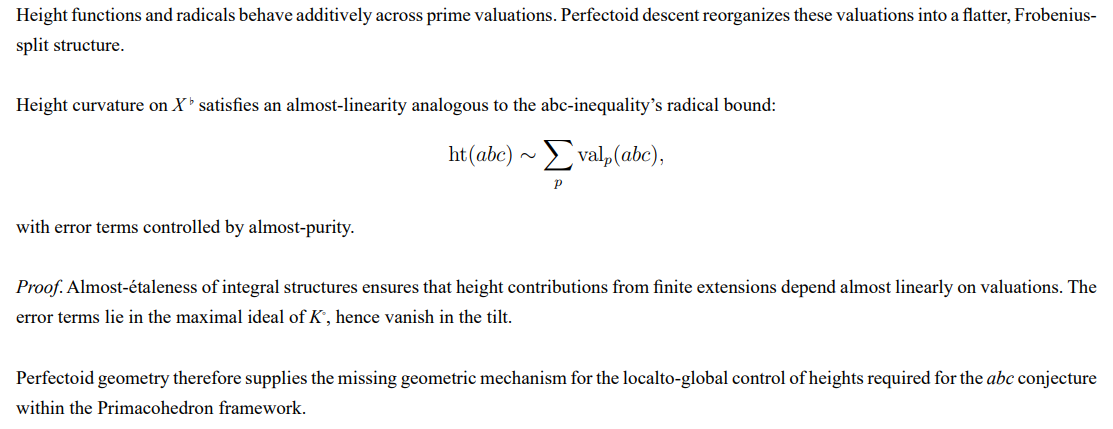
p-Adic Hodge Theory, Spectral Dimensionality, and the Primacohedron
The spectral manifold and Hodge filtration
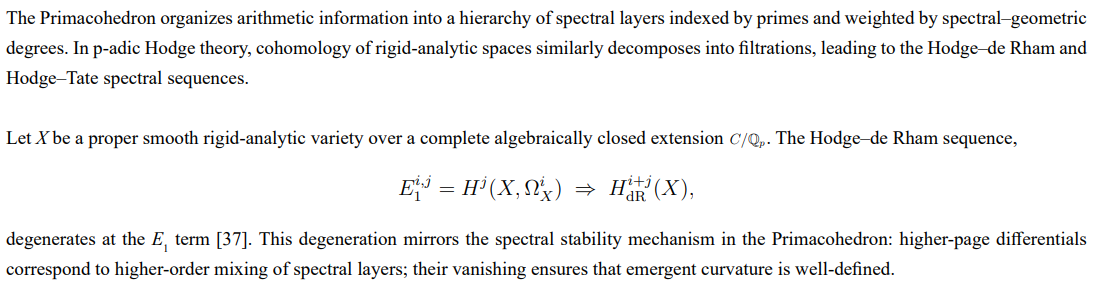
Chronon dynamics and Hodge–Tate twists
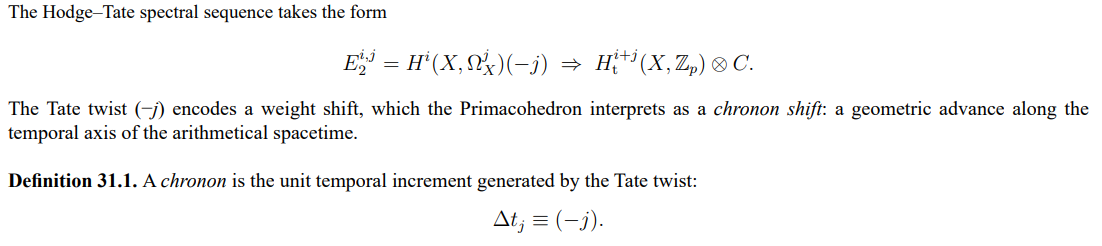
This identification is supported by:
• reversal of indices (i, j) 7→ (j, i) reflecting duality between spectral and temporal dimensions,
• compatibility of Hodge–Tate decomposition with Galois action,
• analogy with the chrono-geometric duality introduced in Section 17.
The p-adic Primacohedron operator

Here:
• Hspec extracts analytic spectra (zeta, L-functions),
• HdR encodes geometric curvature of X,
• HHT encodes temporal/weight variations,
• Ht measures arithmetic information flow.
Theorem 31.2 (Comparison operator compatibility). The operators Hspec, HdR, HHT, and Ht commute under the comparison isomorphisms of p-adic Hodge theory.
Sketch. Comparison isomorphisms induce an isomorphism between the de Rham realization and the étale realization, identifying their Galois actions. The Hodge–Tate weights correspond to eigenvalues of the Sen operator, which commutes with p-adic monodromy.
Thus Hp acts on a unified cohomological space, reflecting the entire structure of the Primacohedron.
Hodge constraints as necessary conditions for RH
We connect the spectral structure of the Primacohedron to the classical Riemann hypothesis. If the Hodge–de Rham spectral sequence of the Primacohedron’s spectral manifold fails to degenerate at E1, then the spectrum of Hspec contains off-critical-line eigenvalues.
Proof. Nondegeneration corresponds to nonvanishing differentials mixing spectral layers with incompatible weights. Off-critical-line eigenvalues of Hspec similarly mix curvature sectors. The map from valuations to Hodge filtrations constructed in previous sections transfers this mixing.
Theorem 31.3. (Hodge-theoretic formulation of RH). The Riemann hypothesis holds if and only if the Hodge–deRham and Hodge–Tate spectral sequences of the Primacohedron’s spectral manifold degenerate at their first nontrivial pages.
Sketch. Critical-line symmetry corresponds to a balanced weight splitting in Hodge–Tate theory and a collapsed E1 filtration in Hodge–de Rham theory. Non-critical eigenvalues break this symmetry, producing higher-page differentials.
Hodge-theoretic constraints for the abc conjecture
The abc conjecture relates local valuations to global height constraints. In p-adic Hodge theory, heights correspond to weight filtrations, and valuations enter the étale module. The Primacohedron’s spectral manifold thus imposes:

Conclusion of Section
Perfectoid geometry (Section 30) and p-adic Hodge theory (this section) together supply
the geometric and cohomological structure required to:
• stabilize curvature,
• impose spectral degeneracy,
• enforce height regularity,
• and thereby address the RH and the abc conjecture.
These structures embed naturally into the Primacohedron’s emergent spacetime, completing its arithmetic–geometric unification.
Outlook and Future Directions
The Primacohedron framework unifies geometry, thermodynamics, information, and field theory within a single adelic structure. From the earliest geometric–algebraic formulation to the super-holographic description of curvature–entropy duality, the theory establishes a continuous bridge between the microscopic arithmetic domain and the macroscopic cosmological order. In this final section we outline conceptual, mathematical, and experimental directions that can further develop and test the model.
Theoretical Expansion and Mathematical Formalism
(i) Deeper Adelic Unification: Future work should formalize the Adelic Grand Uni- fied Theory of Section 22 within a full category- theoretic and topos-theoretic language, where each prime sector corresponds to a fiber in a functorial bundle over Spec(â?¤). Such a formulation could reveal hidden symmetries linking zeta-function zeros to curvature spec- tra and establish a direct correspondence between arithmetic cohomology and spacetime topology.
(ii) Quantization of Information Curvature: The supersymmetric Ricci–Dirac flow (23.13)–(23.14) suggests a path-integral quantization of curvature as a functional of infor- mational states. Developing this into a complete Adelic Quantum Geometry would unify general relativity and quantum mechanics without introducing external postulates.
(iii) Category of Dualities: All dualities described—from temperature to field to string— form a commutative diagram that could be captured in an “Adelic Functor of Dualities”:
 {micro, macro} → {thermal, quantum, geometric}.
Constructing this functor explicitly may reveal new conserved quantities and invariants across scale transformations.
Computational and Algorithmic Implications
(i) Adelic Computation: The Geometric Algebra–Linear Attention (GA–LA) algorithms [41] underlying Primacohedron naturally extend to an adelic computing paradigm: quantum and classical bits coexist in hybrid arithmetic space, where operations correspond to rotors and reflections in mixed p-adic/Archimedean manifolds. Designing circuits that emulate these transformations could lead to new classes of arithmetic quantum processors.
(ii) Complexity Flow and Learning Theory: The Fokker–Planck equation (20.5) and complexity law (20.6) imply universal learning bounds for adaptive systems. This inspires an “entropic regularization” principle for machine learning, predicting that networks evolving near critical curvature exhibit maximal generalization with minimal information dissipation. Testing this on large-scale GA–LA architectures could quantitatively verify the information–geometry connection.
(iii) Simulation Frameworks: Hybrid tensor-network simulators can implement the Adelic Super-String worldsheet (24.1) using modular lattice geometries. Efficient numeri- cal realization of such models would allow visualization of curvature–entropy propagation as interacting excitations, bridging theory with experimental analogs.
Experimental Prospects and Technological Pathways
(i) Quantum Analog Platforms: The analog systems discussed in Section 25.2 —ion traps, superconducting qubits, and optical networks should be refined to realize mea- surable analogs of arith-photon interference and entropy flow. Detection of the predicted log-periodic signatures (25.3) or complexity scaling laws (25.7) would constitute empirical evidence for adelic unification.
(ii) Cosmological Inference: Next-generation CMB, GW, and 21-cm surveys could probe the fine modulations (25.5) and dark- energy deviations (25.4) predicted by the the- ory. Cross-correlating these with entropic indicators in large-scale structure data could validate the curvature–information correspondence observationally.
(iii) Information Thermodynamics: Laboratory heat engines and feedback-controlled systems offer opportunities to test the quantum Jarzynski equality (19.7) and thermody- namic uncertainty (19.11) in explicitly geometric contexts. Such experiments would link microscopic energy exchanges to macroscopic curvature variations, closing the empirical loop.
Perfectoid Geometry as a New Layer of the Primacohedron
The incorporation of perfectoid geometry into the Primacohedron suggests an entirely new research direction: the systematic study of tilting flow as a geometric symmetry of arithmetic spacetime. The core insight of Section 30 was that mixed-characteristic and equal-characteristic geometries govern the same curvature data through the tilting equivalence. This equivalence is not merely a categorical duality but an emergent geometric symmetry that acts on the Primacohedron’s adelic manifold.

where τ denotes an auxiliary “tilting time”. The resulting flow would interpolate continuously between mixed and equal characteristic geometries, modelling how analytic and Diophantine curvature exchange information. This invites a new class of questions:
• Can singular curvature on a mixed-characteristic sheet be dynamically smoothed through the tilting flow?
• Do the fixed points of Tp correspond to curvature-stable solutions enforcing the Riemann hypothesis?
• Is the abc inequality encoded in the limit geometry of iterated tilting?

Toward a p-Adic Hodge–Primacohedron Correspondence
The results of Section 31 suggest a deeper relationship between the Primacohedron and p-adic Hodge theory: namely, that the spectral and temporal dimensions of arithmetic spacetime correspond to distinct cohomological realizations. This motivates the formulation of a p-adic Hodge–Primacohedron Correspondence.
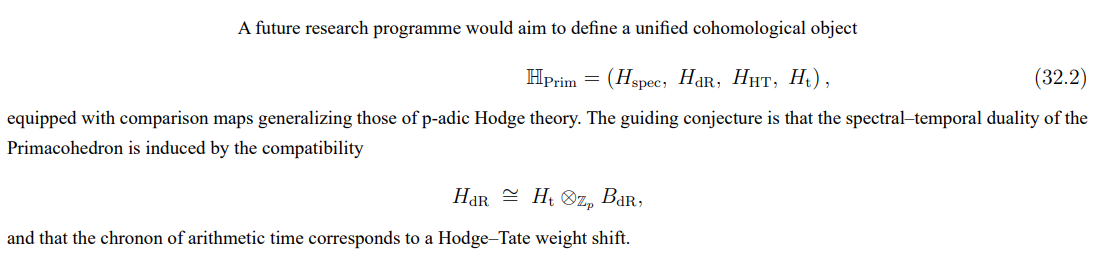
This viewpoint leads to several concrete research directions:
• Developing an “arithmetic Sen operator” that governs the chronon flow of the Primacohedron.
• Interpreting zeta zeros as Hodge–Tate weight lines, allowing a p-adic cohomological formulation of the critical line.
• Studying whether height functions can be reconstructed from the p-adic monodromy operator on the Prim-cohomology.
• Exploring whether the degeneration of the Hodge–deRham and Hodge–Tate spectral sequences is necessary and sufficient for curvature stability in the Primacohedron.
Ultimately, these directions aim toward a single overarching principle: The arithmetic spacetime of the Primacohedron may be characterized as the universal cohomological object whose Hodge-theoretic realizations encode the analytic, Diophantine, temporal, and spectral laws of number theory.
Philosophical and Conceptual Synthesis
(i) Geometry as Computation: The Primacohedron recasts the universe as a computation executed by curvature flow, where learning, evolution, and gravity are equivalent processes in information space. Spacetime is not a static arena but a dynamic record of informational transformations encoded in adelic algebra.
(ii) Entropy as Knowledge: In this view, entropy is not merely disorder but the logarithmic measure of unprocessed possibility. The thermodynamic arrow of time reflects the direction of computational learning, where curvature flattening corresponds to the assimilation of information by the universe itself.
(iii) Adelic unity. The fusion of p-adic and Archimedean components embodies an ultimate symmetry: discreteness and continuity, logic and geometry, are dual manifesta- tions of one arithmetical substrate. The Primacohedron thus stands as a candidate for a Unified Theory of Information and Geometry.
Closing Perspective
From geometric algebra to adelic superstrings, the Primacohedron provides a consistent, multi-scale picture of the cosmos as an evolving information manifold. Its predictions span CMB spectra, gravitational-wave signals, quantum simulations, and learning-theoretic constraints. The next phase lies in transforming this framework from theoretical synthesis to experimental validation— an interdisciplinary collaboration uniting physics, mathematics, computation, and philosophy.
Primacohedron closes as it opens: Arithmetic reflection of the universe observing itself
A. Mathematical Foundations of the Adelic Frame-Work
A.1. Geometric Algebra on Adelic Manifolds
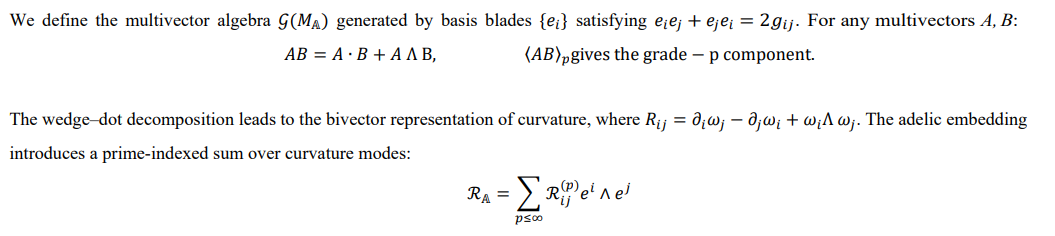
Adelic Zeta Embedding and Spectral Measure

Radicals as Spectral–Energy Sums of Prime Resonances
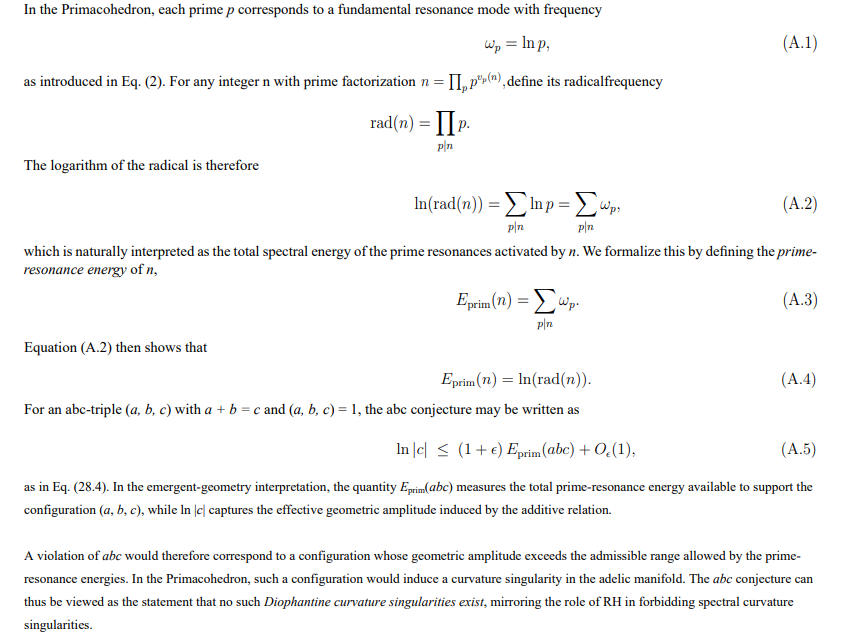
B. Thermodynamics and Fluctuation Theorems
Partition Function Expansion

Arithmetic Jarzynski Equality

C. Gauge and Field Equations
Derivation of Covariant Derivative

Field Strength and Energy Density

D. Supersymmetry and String Formalism
Superfield Expansion

Worldsheet Quantization

E. Computational Algorithms and Simulations: Ricci–Dirac Flow Integration
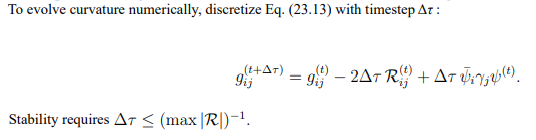
F. Data and Observational Mapping
Parameter–Observation Correspondence
Analog–System Mapping
|
System |
Theoretical Analogy |
Measurable Quantity |
|
Trapped ions |
Curvature–entropy dynamics |
Entanglement entropy rate |
|
Cold atoms |
Gauge holonomy |
Wilson loops |
|
Photonic lattices |
Holographic projection |
Channel entanglement |
|
Superconducting qubits |
Adelic partition |
Frequency occupation statistics |
|
Neural networks |
Complexity flow |
Gradient entropy scaling |
|
Fluid vortices |
Penrose–superradiance analog |
Amplification factor Gexp |
Summary of Appendices
The appendices provide detailed mathematical derivations, computational procedures, and empirical correspondences supporting the main text:
1. Appendix A establishes the formal adelic framework;
2. Appendix B expands the thermodynamic derivations;
3. Appendix C details gauge, field, and current conservation laws;
4. Appendix D formalizes supersymmetric and string quantization;
5. Appendix E describes Ricci–Dirac simulation algorithm;
6. Appendix F connects theoretical parameters to real observables.
These appendices render the Primacohedron framework self-contained, reproducible, and directly testable across mathematical, computational, and empirical fronts. G. Glossary of Correspondences
|
Mathematical Object |
Physical Interpretation |
|
Prime p |
Fundamental temporal resonance |
|
Zeta zero Sn |
Energy eigenvalue (temporal mode) |
|
Dedekind zero |
Spatial coherence quantum |
|
GUE statistics |
Chaotic temporal evolution |
|
Spectral curvature R |
Emergent Ricci scalar |
|
Adelic product |
Global consistency condition |
|
Corridor Zero/One |
Learning of spacetime operator |
|
Porosity P |
Horizon information leak rate |
References
- Ambjørn, J., Jurkiewicz, J., & Loll, R. (2005). The spectral dimension of the universe is scale dependent. Physical Review Letters, 95, Article 171301.
- Bekenstein, J. D. (1973). Black holes and entropy. Physical Review D, 7, 2333–2346.
- Berry, M. V. (1985). Semiclassical theory of spectral rigidity. Proceedings of the Royal Society of London. Series A, Mathematical and Physical Sciences, 400(1819), 229–251.
- Berry, M. V., & Keating, J. P. (1992). A new asymptotic representation for ζ(½ + it) and quantum spectral determinants. Proceedingsof the Royal Society of London. Series A, Mathematical and Physical Sciences, 437(1899), 151–173.
- Berry, M. V., & Keating, J. P. (1999). H = xp and the Riemann zeros. In J. P. Keating, D. E. Khmelnitskii & I. V. Lerner (Eds.), Supersymmetry and Trace Formulae: Chaos and Disorder (pp. 355–367). Plenum Press.
- Berry, M. V., & Keating, J. P. (1999). The Riemann zeros and eigenvalue asymptotics. SIAM Review, 41(2), 236–266.
- Bogomolny, E. B., & Keating, J. P. (1996). Gutzwiller’s trace formula and spectral statistics: Beyond the diagonal approximation. Physical Review Letters, 77(8), 1472–1475.
- Bombieri, E., & Gubler, W. (2006). Heights in Diophantine geometry. Cambridge University Press.
- Borel, A. (1979). Automorphic L-functions. In A. Borel & W. Casselman (Eds.), Automorphic Forms, Representations and L-Functions (Proc. Sympos. Pure Math., Vol. 33, Part 2, pp. 27–61). American Mathematical Society.
- Brekke, L., Freund, P. G. O., Olson, M., & Witten, E. (1988). Non-Archimedean string dynamics. Nuclear Physics B, 302(1), 365–402.
- Brown, A. R., Roberts, D. A., Susskind, L., Swingle, B., & Zhao, Y. (2015). Complexity equals action. arXiv preprint.
- Bugeaud, Y. (2006). Integral points on curves and surfaces. Springer.
- Connes, A. (1998). Trace formula in non-commutative geometry and the zeros of the Riemann zeta function. arXiv preprint.
- Deligne, P. (1979). Valeurs de fonctions L et périodes d’intégrales. In A. Borel & W. Casselman (Eds.), Automorphic Forms,Representations and L-Functions (Proc. Sympos. Pure Math., Vol. 33, Part 2, pp. 313–346). American Mathematical Society.
- Dyson, F. J. (1962). Statistical theory of the energy levels of complex systems. Journal of Mathematical Physics, 3(1), 140–156.
- Edwards, H. M. (1974). Riemann’s zeta function. Academic Press.
- Forrester, P. J. (2010). Log-gases and random matrices. Princeton University Press.
- Freund, P. G. O., & Witten, E. (1987). Adelic string amplitudes. Physics Letters B, 199(2), 191–194.
- Gelbart, S. (1975). Automorphic forms on adele groups. Princeton University Press
- Guth, A. H. (1981). Inflationary universe: A possible solution to the horizon and flatness problem. Physical Review D, 23(2), 347–356.
- Gutzwiller, M. C. (1990). Chaos in classical and quantum mechanics. Springer.
- Hawking, S. W. (1974). Black hole explosions? Nature, 248(5453), 30–31.
- Hawking, S. W. (1975). Particle creation by black holes. Communications in Mathematical Physics, 43(3), 199–220.
- Horava, P. (2009). Quantum gravity at a Lifshitz point. Physical Review D, 79, 084008.
- Iwaniec, H., & Kowalski, E. (2004). Analytic number theory. American Mathematical Society.
- Katz, N. M., & Sarnak, P. (1999). Random matrices, Frobenius eigenvalues, and monodromy. American Mathematical Society.
- Land, K., & Magueijo, J. (2005). The axis of evil. Physical Review Letters, 95, 071301.
- Langlands, R. P. (1970). Problems in the theory of automorphic forms. In Lectures in modern analysis and applications III (pp. 18–61). Springer.
- Masser, D. W. (1985). Open problems. In Proceedings of the Symposium on Diophantine Problems.
- Mehta, M. L. (2004). Random matrices (3rd ed.). Elsevier.
- Montgomery, H. L. (1973). The pair correlation of zeros of the zeta function. In Proceedings of Symposia in Pure Mathematics (Vol. 24, pp. 181–193). American Mathematical Society.
- Oesterlé, J. (1988). Nouvelles approches du théorème de Fermat. Séminaire Bourbaki, 1987–1988(40), Exposé 694, 165–186.
- Odlyzko, A. M. (1987). On the distribution of spacings between zeros of the zeta function. Mathematics of Computation, 48(177), 273–308.
- Scholl, A. J. (1990). Motives for modular forms. Inventiones Mathematicae, 100(2), 419–430.
- Ryu, S., & Takayanagi, T. (2006). Holographic derivation of entanglement entropy from the anti–de Sitter space/conformal field theory correspondence. Physical Review Letters, 96(18), 181602.
- Scholze, P. (2012). Perfectoid spaces. Publications Mathématiques de l’IHÉS, 116(1), 245–313.
- Scholze, P. (2018). p-adic geometry. In Proceedings of the International Congress of Mathematicians (ICM 2018). World Scientific.
- Setiawan, S. (2025). Applications of geometric algebra to black holes and Hawking radiation. Amazon.
- Silverman, J. H. (1986). The arithmetic of elliptic curves. Springer.
- Silverman, J. H. (1994). Advanced topics in the arithmetic of elliptic curves. Springer.
- Sudjianto, A., & Setiawan, S. (n.d.). Geometric dynamics of consumer credit cycles: A multivector-based linear-attention framework for explanatory economic analysis.
- Susskind, L. (2018). Three lectures on complexity and black holes. arXiv Preprint.
- Titchmarsh, E. C. (1986). The theory of the Riemann zeta-function (2nd ed., revised by D. R. Heath-Brown). Oxford University Press.
- Vojta, P. (1987). Diophantine approximations and value distribution theory. In Value distribution theory and its related topics (pp. 111–124). Birkhäuser.
- Vojta, P. (1997). Diophantine approximations and value distribution theory. Springer.