

Journal of Electrical Electronics Engineering(JEEE)
ISSN: 2834-4928 | DOI: 10.33140/JEEE
Impact Factor: 1.2


Research Article - (2026) Volume 5, Issue 5
Physico-Mathematical Errors in Einstein’s 1905 Derivation of the Lorentz Transformation
Received Date: Sep 09, 2026 / Accepted Date: Oct 19, 2026 / Published Date: Oct 29, 2026
Copyright: ©2026 Hyoungseok Koh. This is an open-access article distributed under the terms of the Creative Commons Attribution License, which permits unrestricted use, distribution, and reproduction in any medium, provided the original author and source are credited.
Citation: Koh, H. (2026). Physico-Mathematical Errors in Einstein’s 1905 Derivation of the Lorentz Transformation. J Electrical Electron Eng, 5(5), 01-10.
Abstract
The Lorentz transformation is obtained in the same form both in Lorentz’s ether-based framework and in Einstein’s ether- free framework. Starting from this paradox, we rigorously distinguish two paradigms of spacetime measurement: the mechanical rest frame, constructed from rigid rods, atomic clocks, and light, and the optical moving system, constructed from atomic clocks and light alone. A rest frame is defined as an inertial frame in which the round-trip light time is the same at every position and in every direction. We further distinguish measured coordinates, read directly at stationary points, from borrowed coordinates, which a moving point takes over from the stationary points it passes. Within this framework the invariance of the speed of light is asymmetric: the rest frame exhibits round-trip invariance, whereas the moving system exhibits only borrowed-speed invariance. On this basis we reconstruct the Lorentz transformation and its inverse, using the absolute time dilation of moving atomic clocks and the dilation of the longitudinal coordinate measured with a light ruler. The reconstruction shows that the time of the moving system is the sum of the atomic-clock dilation effect and a time-correction effect required to keep the borrowed speed of light constant. We then reconstruct, step by step, the derivation in Secs. 1–3 of Einstein’s 1905 paper and identify six key errors: (i) an operational asymmetry that treats rigid rods as equivalent to light rulers; (ii) a domain collapse in which the Galilean auxiliary variable is combined with a light-ray condition, reducing the domain of analysis to a one-dimensional ray; (iii) an unjustified extension of relations valid only on that ray to all of spacetime; (iv) an event mismatch in which two distinct events are combined in the construction of the transverse coordinates; (v) a circular parameter fixing in which the invariance of rigid rods is presupposed when the undetermined coefficient is fixed; and (vi) a category mistake in which the ellipsoidal contraction of a rigid sphere is interpreted as a physical deformation. These results indicate that relativistic spacetime relativism originates from a confusion of measuring instruments and from optical illusion. The Lorentz transformation is valid not because spacetime itself is distorted, but because it encodes inter-point relativity and the geometry of borrowed coordinates referred to an absolute rest frame. We therefore propose an interpretation of spacetime founded on an absolute rest frame and on a measurement mechanics that keeps rigid rods and light rulers distinct.
Keywords
Special Relativity, Lorentz Transformation, Einstein 1905, Operational Definition, Clock Synchronization, Category Mistake, Absolute Rest Frame
Introduction
Classical mechanics adopted the Galilean transformation, which presupposes absolute space and absolute time, as the standard rule for transforming coordinates between inertial frames. With the rapid development of electromagnetism, however, this rule was brought to the point of abandonment by the Michelson–Morley interferometer experiment of 1887 [1], which was designed to detect an absolutely stationary ether [1]. The null result—the absence of any ether wind—exposed a fundamental contradiction between the Galilean transformation and the form of the wave equation of Maxwell’s electromagnetism [2]. The physics community accordingly began to seek a new coordinate transformation under which the electromagnetic wave equation is covariant.
In this process a decisive historical divergence arose in how the ether hypothesis and the physical reality of the coordinate transformation were viewed. H. A. Lorentz retained the stationary-ether hypothesis, introduced correction factors into the Galilean transformation, and, adopting FitzGerald’s idea, proposed the contraction hypothesis for rigid bodies to second order in v/c [3,4]. He then introduced the concept of “local time” to account for the Doppler effect and the Fizeau experiment [5], among others, but fell short of achieving full covariance for the transformation of charge density and velocity [6,7]. H. Poincaré, by contrast, held that a state of absolute rest is physically meaningless because it can in principle never be detected. He therefore proclaimed the principle of relativity as a universal law of nature [8] and rigorously proved the mathematical covariance of the Lorentz transformation [9]. Finally, Albert Einstein, discarding the ether hypothesis entirely, derived the Lorentz transformation in an original manner from two postulates—the principle of relativity and the principle of the constancy of the speed of light—by means of a clock-synchronization procedure [10-12]. This resolved the long¬standing conflict between electromagnetism and mechanics, and the modern relativistic paradigm attained a firmly established status.
Here, however, a fundamental question arises that cannot be overlooked. Why do Einstein’s ether-free framework and Lorentz’s ether-based framework yield the Lorentz transformation in identical form, despite their diametrically opposed positions on the existence of an absolute rest frame? From the epistemological standpoint that the “absolutism” inherent in the classical and quantum-mechanical domains coexists with the “relativity” manifested in electromagnetic phenomena, the present paper points out that the algebraic derivation in Einstein’s original paper contains critical logical leaps and structural defects.
Accordingly, this study rigorously distinguishes the essential difference, established in previous work, between the mechanical rest frame (absolute rest frame), in which rigid rods, atomic clocks, and light are combined, and the optical moving system, which consists of atomic clocks and light alone. That is, we point out the category mistake [13] by which mainstream physics has conflated mechanical and optical measuring instruments, and we critically reassess Secs. 1–3 of the English translation of Einstein’s 1905 paper [10] from a new measurement-mechanical perspective. Rather than merely refuting the validity of the existing theory, this paper reconstructs, on the new measurement-mechanical paradigm, the genuine process by which the Lorentz transformation and its inverse are obtained. Furthermore, we identify in detail six key physico-mathematical errors that Einstein committed in carrying through his own postulates: operational asymmetry, domain collapse, unjustified extension, event mismatch, circular parameter fixing, and category mistake. We thereby demonstrate that the spacetime relativism of special relativity in fact originates from a confusion of measuring instruments and from optical illusion.
Two Paradigms of Measuring Instruments: The Mechanical Rest Frame and the Optical Moving System
Methods of surveying spacetime coordinates divide into a mechanical and an optical paradigm of measuring instruments, according to the nature of the physical medium used in the measurement. By overlooking the fundamental difference between these two kinds of instruments, or by indiscriminately identifying them, mainstream physics has concealed a critical logical leap in the derivation of special relativity. In this section we rigorously distinguish and establish the mathematical and physical reality of the mechanical rest frame (rigid rods, atomic clocks, and light) and of the optical moving system (atomic clocks and light).
A. Mechanical Rest Frame
Einstein asserts that a rest frame and a uniformly moving frame cannot be distinguished among inertial frames [10]. This is a claim of classical mechanics, which could distinguish only inertial from noninertial frames, and it was adopted in electromagnetism without verification. A rest frame and a moving frame can in fact be distinguished by a round-trip light experiment, because the round-trip light times coincide in a rest frame, where isotropy and homogeneity hold, but do not coincide in a moving frame, where relativity and linearity hold. In this paper, an inertial frame in which the round-trip light time is the same regardless of position and direction is called a rest frame, and any other inertial frame is called a moving frame. That is, the speed of light can be measured by a round-trip light experiment only in the rest frame K. If the round-trip light time is T and the length of the rigid rod is L, the speed of light c is measured as

Determining the rest frame by the round-trip light experiment alone means that a rest frame can be constructed with rigid rods, atomic clocks, and light. We call this the mechanical rest frame.
A rigid rod (or rigid ruler) is an instrument that measures physical spatial intervals (lengths) on the basis of the interatomic binding forces and stresses within it, and it serves as the standard defining length [14,15]. A rigid rod maintains its intrinsic spatial invariance irrespective of the state of motion of the inertial frame, and rigid rods in relative motion are assigned the same length when their ends coincide. A length measured with a light ruler, however, agrees with this length only when the times at the two ends of the rigid rod are simultaneous.
An atomic clock is an instrument that measures time on the basis of the periodic oscillation frequency of local particles, and it serves as the standard defining time [15]. It accumulates time as a local entity at each point, without relying on arbitrary round trips of light signals across spacetime. The periods of atomic clocks at rest relative to one another coincide, but the period of an atomic clock in a moving frame is longer than that of an atomic clock in the rest frame [16,17].
In the rest frame, a stationary point is measured directly with rods and clocks, whereas a moving point is described by borrowing the coordinates of the stationary points it passes. We call the former measured coordinates and the latter borrowed coordinates. For a moving point to use borrowed coordinates, the times of the stationary points are made to agree by means of rigid rods and light. When light emitted from the stationary origin O at t = t0 reaches a stationary point P(x , y , z , t) a distance r away, the atomic clock at P is synchronized as

We call this a one-way light clock [18,19]. When the clocks of the rest frame are synchronized with light clocks, the entire rest frame becomes simultaneous. Once the clocks of the rest frame are synchronized, distances can be measured with atomic clocks synchronized by light. We call this a light ruler:

B. Optical Moving System
To construct a moving frame that travels with velocity v, (>0) along the x axis of the rest frame, it is equipped with light and atomic clocks. Unlike the rest frame, the moving frame cannot determine the speed of light by a round-trip experiment, and the moving-frame observer P' (ξ, η, ζ , τ) uses light and atomic clocks to match himself to the rest-frame observer P(x, y, z, t); we therefore call it an optical moving system. Light emitted simultaneously from the light source O(0,0,0,0) of the rest frame and the light source O0 ' (0,0,0,0) of the moving frame propagates rectilinearly in discrete fashion and arrives together at the rest-frame observer P(x, y, z, t) and the movingframe observer P' (ξ, η, ζ , τ). The moving-frame observer P' therefore assigns the speed c to light, following the rest-frame observer P. This is because, by coordinate borrowing, the moving-frame observer regards the two light rays as having left the same source and arrived at the same observer.
However, the relation

is mathematically an equivalence, but its physical content differs on the two sides? The left-hand equation uses the measured speed of light obtained from a round-trip experiment, whereas the right-hand equation uses a borrowed speed of light transcribed according to the borrowed coordinates. That is,
The law of the constancy of the speed of light holds in inertial frames, but it is asymmetric: in the rest frame it is round-trip invariance of the speed of light, whereas in the moving frame it is invariance of the borrowed speed.
Because linearity holds for inertial frames, the following equations hold between the moving-frame observer P' (ξ, η, ζ , τ) and the rest-frame observer P(x, y, z, t):
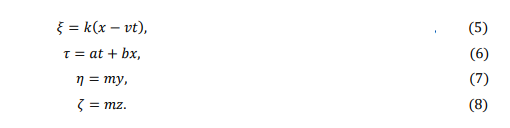
We first determine the transverse coordinates. The points at which the planes passing through the moving-frame observer P' (ξ, η, ζ, τ) and the rest-frame observer P(x, y, z, t), respectively, and perpendicular to the longitudinal axis meet that axis are called the moving-frame simultaneity point Q' (ξ,0,0,τ) and the rest-frame simultaneity point Q(x,0,0,t). Since the ends of the moving-frame rigid rod Q' P' and of the rest-frame rigid rod QP coincide, the lengths of the two rods agree:
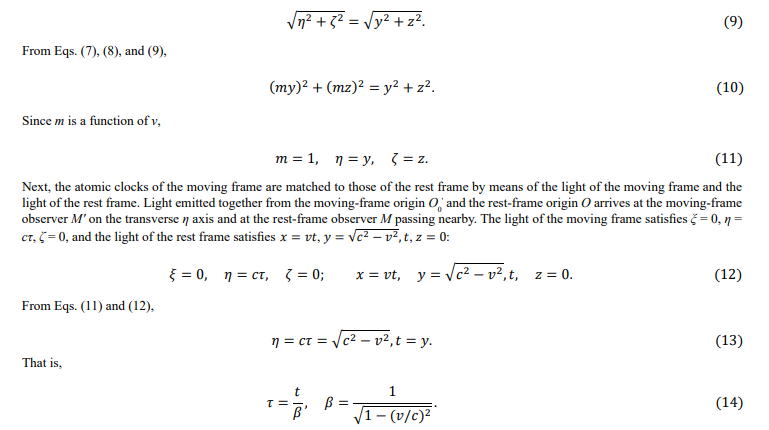
Equation (14) shows that the atomic clock of the moving frame exhibits a time dilation by a factor 1/β relative to the atomic clock of the rest frame.
The time dilation of the moving frame relative to the rest frame is not relative but absolute [20].
We now determine the longitudinal coordinate.
A rigid rod of length x' = x - vt is placed on the ξ axis of the moving frame, with one end at the origin O0' and the other at P0'. Light rays leaving the two origins O0' and O are reflected by the mirrors P1' and P1, respectively, and return to the original origin O0' and to the rest-frame observer O0. From the standpoint of the rest frame, light traveling parallel to the direction of motion takes
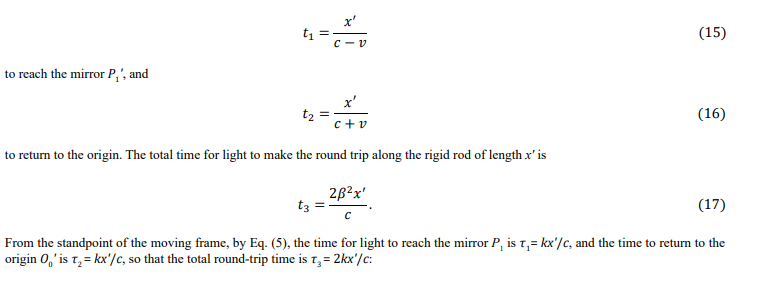

When the longitudinal length is measured with a light ruler in the moving frame, it comes out larger by a factor β than when measured with a rigid rod. This means that, in order for the light of the moving frame to maintain the borrowed speed c, the atomic clock undergoes time dilation (t / β) and the coordinate ξ along the axis of motion is dilated by a factor β. Lorentz, conversely, taking the light ruler as the standard, claimed that a moving body contracts by a factor 1/β in the direction of motion [6], and Einstein interpreted this as a deformation of physical spacetime [10].
Finally, we determine the time coordinate.
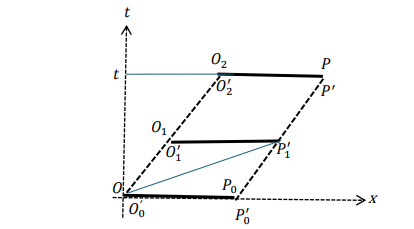
Figure 1: Schematic representation, in the x – t plane, of the synchronization process when a rigid rod of length x' moves with velocity v along the axis of motion (x). At t = 0 the rigid rod O0' P0' passes the two points O and P0; at t = x'/(c - v) the rigid rod O1' P1' passes the two points O1 and P1; and at time t the rigid rod O2' P' passes the two points O2 and P.
The figure depicts, in the x – t plane, a rigid rod fixed in the moving frame that moves along the x axis with velocity v while maintaining its length x' = x - vt. A light source and an observer of the moving frame are fixed at the two ends of the rod. By Eq. (18), the separation between the source and the observer measured with the light ruler is constant:

When the rest-frame clock reads t = 0, by Eqs. (6) and (20) the ends O0' (0,0,0,0) and P0' (βx',0,0,bx) of the rigid rod pass O(0,0,0,0) and P0 (x',0,0,0), respectively. At t1 = x'/(c - v), by Eqs. (14), (15), and (20) the ends O1' (0,0,0, x'/[β(c - v)]) and P1' (βx',0,0,βx'/c) pass the rest-frame observers O1 (vx'/(c - v),0,0, x'/(c - v)) and P1 (cx'/(c - v),0,0, x'/(c - v)), respectively. At time t, by Eqs. (14) and (20) the ends O0' (0,0,0, t/β) and P' (βx', 0,0, τ) pass the rest-frame observers O0 (vt, 0,0, t) and P(x,0,0, t), respectively.
Since the rigid rod O1' P1' moves to the rigid rod O0' P', the time taken to move from O1' to O0' equals the time taken to move from P1' to P':

Hence

Rearranging Eq. (22) yields the time equation of the Lorentz transformation,

From Eqs. (11), (20), and (23), the Lorentz transformation of the moving-frame observer P' (ξ, η, ζ, τ) with respect to the rest-frame observer P(x, y, z, t) is

Accordingly, the inverse Lorentz transformation of the rest-frame observer P(x,y,z,t) with respect to the moving-frame observer P' (ξ, η, ζ, τ) is

Equations (24) and (25) exhibit inter-point relativity, or observer relativity.
However, from Eqs. (11), (20), and (22),

Equations (14) and (26) show that the time τ of the moving-frame observer P' (ξ, η, ζ, τ) consists of the sum of the time-dilation term of the moving-frame atomic clock (t/β) and the time-correction term of the moving frame (-vξ/c2) required to maintain the borrowed speed c of light. Here the light ruler of the moving frame and that of the rest frame are relative to each other, but a comparison of the atomic clocks of the two frames shows that the moving frame is clearly distinguishable from the rest frame.
The inverse Lorentz transformation can then be rewritten as

This shows that Eq. (27) is an equation that restores the dilation term of the atomic clock (t/β) and the light-travel-time correction term (-vξ/c2) introduced to maintain the borrowed speed of light (c) in the moving frame.
In short, the mechanical rest frame provides an absolute standard that measures space and time directly by means of rigid rods, light, and atomic clocks, whereas the optical moving system must rely on round-trip light times and borrowed coordinates. Overlooking this essential difference between the two measurement systems and indiscriminately identifying optical coordinates with mechanical reality is the decisive cause of the critical physico-mathematical errors in Einstein’s derivation discussed in the following section.
Reconstruction and Critical Analysis of Einsteins 1905 Derivation
A. Step-by-Step Analysis of Einstein’s Derivation (Reconstruction of Equations and Premises)
Before criticizing the physico-mathematical errors that Einstein committed in deriving the Lorentz transformation and its inverse, we reconstruct, in order, the derivation given in Sec. 3 of Ref. [10].
Synchronization and the Partial Differential Equation for τ
Section 1 of Ref. [10] defines the synchronization of clocks at two points A and B through the round-trip time of a light signal:

In Sec. 3, Eq. (4) of Ref. [10] is applied to a light signal emitted from the origin of the coordinate system k in the ξ direction, reflected at a mirror located at x' = x - vt, and returned. Since the outbound and return time intervals observed in the rest frame K are x'/(c - v) and x'/(c + v), respectively,

Taking x' to be infinitesimal and expanding to first order gives


Longitudinal Coordinate ξ
For a ray of light emitted at τ = 0 from the origin of the moving system along the positive ξ axis, the light postulate in that system assigns ξ = cτ along the ray. In the stationary frame, the ray recedes from the moving origin with speed c - v, so that
<img src="https://www.opastpublishers.com/scholarly-images/11383-6ae2d864a73bf-physicomathematical-errors-in-einsteins-derivation-of-the-lo.png" width="500" height="70">
Substituting Eq. (33) into Eq. (32) and using ξ = cτ, Ref. [10] obtains
<img src="https://www.opastpublishers.com/scholarly-images/11383-6ae2d8d7a6535-physicomathematical-errors-in-einsteins-derivation-of-the-lo.png" width="500" height="50">