

International Journal of Forensic Research(IJFR)
ISSN: 2767-2972 | DOI: 10.33140/IJFR
Impact Factor: 1.9

Research Article - (2025) Volume 6, Issue 2
Performance of Lumbricus Rubellus (Red Worm) on Different Animal Wastes
2Genetic Engineering and Biotechnology Research Institute (GEBRI )University of Sadat City, Egypt
Received Date: Sep 15, 2025 / Accepted Date: Oct 06, 2025 / Published Date: Oct 16, 2025
Copyright: ©©2025 Ahmed Badia Badwy, et al. This is an open-access article distributed under the terms of the Creative Commons Attribution License, which permits unrestricted use, distribution, and reproduction in any medium, provided the original author and source are credited.
Citation: Nower, A. A., Rizk, A. M., Badawey, A. B. (2025). Performance of Lumbricus Rubellus (Red Worm) On Different Animal Wastes. In J Fore Res, 6(2), 01-06.
Abstract
A study was conducted to investigate the comparative of animal wastes on the., lumbricus rubellus mass production and efficiency. In this study, worm, s growth performance, numbers of worms and physic-chemical characteristics of produced vermicompost were tested at in The Environmental studies and Research Institute(ESRI), Genetic engineering and Biotechnology Research Institute (GEBRI )University of Sadat city. Sadat city, Egypt. during the period from 2018 and 2019.
The epigiec earthworm Lumbriscus Rubellus (Red Worm) was provided by Central Laboratory for Agricultural Climate (CLAC), Agricultural Research Center (ARC), Indoor system of vermicomposting was used in this investigation for producing the vermicompost, The experiment was counducted under ( 30 -34 oC) and (70-74%) Humidity, the examined animal waste were (Cow dung – Horse waste –Sewage sludge –Rabbit droppings).
Results revealed that horse waste showed the highest values of Growth performance, number of worms was(91.67, 87.33, 87, 62.67)respectively, number of cocoons was(182.3, 179, 173.3, 133.3) respectively, during the process of composting.Total element of nutrient whereas recorded from ( horse waste, rabbit dropping, sewage sludge and cow dung), respectively. on the other hand the lowest values Growth performance, number of worms, number of cocoons resulted with sewage sludge composted.
Keywords
Design and Economical Analysis of a Battery-less AC - Photovoltaic Driven Pumping System for Irrigation in Ethiopia
Introduction
Vermicomposting (Worm composting)is defined as a process in which earthworms play a major role with microbes in the conversion of organic solid waste into more stabilized dark, earth- smelling soil conditioner and nutrient-rich compost that is rich in major and micronutrients [1]. During vermicomposting, organic matter is stabilized by the enhanced decomposition (humification) in presence of earthworms, but by a non-thermophilic process [2- 4]. The great advantage of worm composting is that this can be done indoors and outdoors, thus allowing year round composting. It also provides apartment dwellers with a means of composting. Vermicomposting allows obtaining organic sources of nutrients for the crops in relatively less time, which are physically, nutritionally and biochemically improved over composts. Vermicomposting is defined as a low cost technology system for processing or treatment of organic waste Having established their efficiency in converting organic substances to composts, they are widely used in vermicomposting for waste management, production of soil amendment and other uses [5]. The conversion of organic waste into vermicomposting started in the United State and United Kingdom in the 1980s [6]. Whole or portions of earthworms are traditionally used as fish bait in the United State. Their commercial production or permaculture for fish bait was stated in the 1950. Vermicomposts, especially those from animal waste sources,usually contained more mineral elements than commercial plant growth media, and many of these elements were changed to forms more that could be readily taken up by the plants, such as nitrates, exchangeable phosphorus, and soluble potassium, calcium, and magnesium. The main objective of this study was to evaluate the performance of vermicompost production via ( Red worm) Lumbriscus Rubellus on different (animal Wastes), .
Materials and Methods
Earth Worm Type
The epigiec earthworm Lumbriscus Rubellus (Red Worm) was provided by Central Laboratory for Agricultural Climate (CLAC), Agricultural Research Center (ARC), Indoor system of vermicomposting was used in this investigation for producing the vermicompost, Twelve holed plastic boxes (35 x 52 x 15 cm) were established as indoor system of vermicomposting. Each three of holed plastic boxes had 60 worm divided to three replicates for every Animal Waste. Which contained one species of epigiec earthworms (Red Worm) and four Treatments contained three replicates for each waste. Worm diameter: 0.4 – 6 mm and worm length: 80 – 120 mm.
Pre-Composting The Raw Materials
The final mix of raw materials soaked in water for 0.5 to 1 hour to make sure it is not any drier before feeding the worms. Worms should be avoiding the thermophilic stage (increase temperature above 35 oC cause the death of earthworms in vermicompost systems) through control the feeding rate of earthworm. The epigiec earthworm consume as much as their weight of different wastes, the feeding rate of earthworm was 90% of the earthworm weight [7].
Feeding of Earth Worm
The substrate for vermicomposting was prepared by mixing pre- composted (rice straw – Animal Wastes -) [8]. Animal Wastes(Cow dung – Horse waste) was collected from a private farm in Bader city, Behaira Governorate, Egypt. Rabbit droppings was collected from Genetic engineering and Biotechnology Research Institute (GEBRI ), University of Sadat city, Sadat city, Egypt. Sewage sludge was collected from Wadi El-Natroun Drain off station, Wadi El-Natroun Governorate, Egypt [9,10] Each tray was filled with 1000 gm of substrate, respectively 700gm, 300gm, Thereafter, a total of adult worms of lumbricus Rubellus, were introduced into respective designated experimental trays. Each tray was covered with jute cloth to protect the worms from predators. Temperature and moisture content were maintained by sprinkling water twice a day, In each tray, porous plastic sack were made at the bottom to facilitate good drainage and aeration. The process of vermicomposting was carried out for 100 days.
Experimental Design
Twelve holed plastic boxes (35 x 52 x 15 cm) were established as indoor system of vermicomposting. Each three of holed plastic boxes had 60 worm divided to three replicates for every Animal Waste. Which contained one species of epigiec earthworms (Red Worm) and four Treatments from three replicates for each waste. and four plastic boxes without using any earthworms as a control. whereat The plastic box contains on one waste.
Sample Collection and Physico-Chemical Analysis
Physico-chemical analysis was done in The Environmental and food biotechnology laboratory, Genetic engineering and Biotechnology Research Institute (GEBRI ), University of Sadat city, Sadat city, From each replicate, about 200g of sample was taken at the end of the process. To analysis Nitrogen (N), , potassium (K) and organic carbon (OC). Electrical conductivity (EC) and pH of harvested vermicompost were also recorded at the end of the process. The N content was determined by Kjeldahl method while, Determination of total kjeldahl in explant (NH4-N). (APHA, 2005). Kjeldahl method was used for determination of total nitrogen contents in plant materials.
• Digestion Unit
About 1 gram of grounded plant materials were mixed with 10 ml conc H2SO4 and the mixture was digested for I h at 400 oC with digester (Behr- Germany).
• Distillation Unit
The reaction was distilled and 45 ml 40% NaOH was added. The net result solutions were received in flask containing 50 ml 4% Boric acid solution. This solution was neutralized with 0.02 N H2SO4 [11].
Metal Determination by ICP-MS
For metals determination Harvested waste materials were dried at 65 â?¦C for 72 h and then ground with a mill. A total of 0.5 g of each sample was then digested with 10 ml of a mixture of 69% HNO3, conc HCl (3:1v/v) in a heating digester (DK 20, VELP Scientifica, Milan, Italy).
Plant extracts were filtered through disposable 0.2 µm PTFE syringe filters (DISMIC-25HP, Advantec, Tokyo, Japan). The metal concentrations in these extracts were determined by means of inductively coupled plasma-mass spectroscopy (ICP-MS) (iCAP, Thermo, Germany). Certified reference materials (Merck, Germany) were included in the analyses. The recovery of metals was within the certified limits.Qtegra software was used for average and relative standard deviation calculation [12].
|
Rabbit. d |
Cow dung |
H. waste |
Sewage |
unit |
Parameter |
|
69.8 |
79.56 |
76.82 |
5.67 |
% |
Humidity |
|
30.2 |
20.44 |
23.18 |
94.33 |
% |
Total solid |
|
7.56 |
7.66 |
7.73 |
7.51 |
(wt/v) |
pH (2:5) |
|
124.00 |
863.00 |
156.00 |
720.00 |
Us/cm(wt/v) |
EC (2:5) |
|
78.0 |
47.5 |
48.0 |
98.0 |
% |
Ash(wt/100g) |
|
33.80 |
49.80 |
35.90 |
45.20 |
% |
Total protein (wt/100g) |
|
18.4734 |
17.64 |
20.0934 |
13.6134 |
% |
TOM (wt/100g) |
|
7.563 |
11.163 |
9.8 |
10.263 |
% |
TOC (wt/100g) |
|
22.38 |
22.42 |
27.30 |
22.71 |
% |
C/N ratiowt/100g) |
|
0.1222 |
0.1009 |
0.429 |
0.7026 |
|
SAR |
Table 1: The Chemical and Physical Characteristics of Animal wastes presented in Table 1
|
N |
Element |
Sewage |
Horse waste |
Cow dung |
Rabbit droppings |
|
1 |
7Li |
2.88 |
0.13 |
0.66 |
0.33 |
|
2 |
11B |
14.10 |
15.45 |
8.91 |
2.44 |
|
3 |
23Na |
290.84 |
47.71 |
47.78 |
20.80 |
|
4 |
24Mg |
232.37 |
61.84 |
206.63 |
99.01 |
|
5 |
27Al |
1255.46 |
206.26 |
510.29 |
102.54 |
|
6 |
39K |
1355.54 |
727.65 |
543.59 |
128.04 |
|
7 |
44Ca |
342.55 |
92.40 |
423.55 |
138.40 |
|
8 |
48Ti |
660.27 |
165.07 |
693.40 |
195.57 |
|
9 |
52Cr |
11.54 |
1.54 |
4.18 |
1.13 |
|
10 |
55Mn |
38.13 |
11.81 |
56.65 |
13.10 |
|
11 |
57Fe |
3304.16 |
591.64 |
1536.92 |
317.03 |
|
12 |
59Co |
1.34 |
0.05 |
0.42 |
0.44 |
|
13 |
60Ni |
8.77 |
1.30 |
2.12 |
1.04 |
|
14 |
63Cu |
25.89 |
3.97 |
10.82 |
4.60 |
|
15 |
66Zn |
137.81 |
26.21 |
133.93 |
21.67 |
|
16 |
71Ga |
13.43 |
2.76 |
3.11 |
2.75 |
|
17 |
88Sr |
43.10 |
16.41 |
47.10 |
21.37 |
|
18 |
107Ag |
2.28 |
7.94 |
16.17 |
16.74 |
|
19 |
111Cd |
0.73 |
0.06 |
0.69 |
0.72 |
|
20 |
115In |
52.12 |
12.47 |
9.83 |
9.61 |
|
21 |
137Ba |
29.21 |
24.04 |
26.28 |
9.40 |
|
22 |
208Pb |
45.93 |
3.22 |
18.75 |
4.93 |
|
23 |
209Bi |
102.49 |
63.25 |
124.04 |
124.85 |
Table 2: All of Nutrients and Heavy Metals Indicated in Table 2
• Statistical Analysis
The randomized factorial design was applied, and data were the examination of variation. Separation of means between treatments was determined using LSD test at 5% [13].
Results and Discussion
The Reproductive of L.rebellus on Different Animal Wastes
Results in Table (3) showed that the highest number of produced worms of L.rebellus was on Horse waste followed by Rabbit This waste had the lowest number of produced worms, whereas Horse waste, Rabbit droppings and Cow dung had nonsignificant effects but Sewage sludge had a significant effect, (produced worms means= Adult worms + Juvenile worms not baby worms ) irrespective of The Rate of mortality whereas it had a resemble circumstances(passive method), Moreover Cocoons had a Similar results [15,16].
|
Treatment |
No.worms |
No.cocoons |
|
Horse waste |
91.67A |
182.3A |
|
Sewage sludge |
62.67B |
133.3B |
|
Rabbit droppings |
87.00A |
173.3A |
|
Cow dung |
87.33A |
179.0A |
|
LSD value |
15.05 |
15.42 |
Table 3: Growth Parameters of L.rebellus on Different Animal Wastes
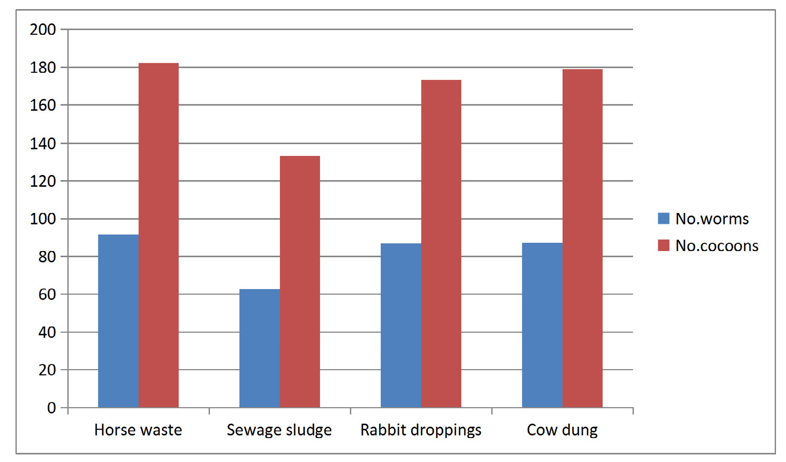
Figure 1: Means of Growth Parameters of L.rebellus on Different Animal Wastes
This Results may be attributed to the aeration of These wastes(Horse waste, Rabbit droppings and Cow dung) Conversely of Sewage sludge, or That attributed to The highest Level of organic matter of These wastes.
The Effect of L.rebellus on Organic matter(animal wastes)
|
Element |
Sewage fixed by(RW) |
Horse waste fixed by(RW) |
Cow dung fixed by(RW) |
Rabbit droppings fixed by(RW) |
|
Li |
0.193 |
0.220 |
0.134 |
0.237 |
|
B |
1.186 |
1.185 |
0.781 |
1.166 |
|
Na |
387.28 |
465.64 |
359.40 |
450.66 |
|
Mg |
268.82 |
317.47 |
167.33 |
319.99 |
|
Al |
11.05 |
13.08 |
9.09 |
8.96 |
|
K |
175.21 |
192.47 |
132.63 |
189.29 |
|
Ca |
35.94 |
43.13 |
21.75 |
41.73 |
|
Ti |
4.658 |
5.628 |
2.779 |
5.280 |
|
Cr |
0.625 |
0.554 |
0.523 |
0.443 |
|
Mn |
4.370 |
3.392 |
2.151 |
1.879 |
|
Fe |
15.092 |
22.380 |
13.967 |
12.689 |
|
Co |
0.544 |
0.622 |
0.246 |
0.601 |
|
Ni |
0.490 |
0.549 |
0.313 |
0.348 |
|
Cu |
13.105 |
10.543 |
8.521 |
8.128 |
|
Zn |
13.640 |
53.808 |
10.811 |
15.731 |
|
Ga |
4.221 |
0.356 |
0.255 |
0.397 |
|
Sr |
25.462 |
30.709 |
15.857 |
30.099 |
|
Ag |
31.308 |
2.287 |
1.982 |
0.747 |
|
Cd |
0.132 |
0.058 |
0.071 |
0.106 |
|
Ln |
19.597 |
1.130 |
0.715 |
1.270 |
|
Ba |
17.461 |
14.117 |
9.295 |
10.335 |
|
Pb |
20.712 |
10.224 |
4.636 |
4.362 |
|
Bi |
123.850 |
18.775 |
2.794 |
4.265 |
Table 4: Chemical Characteristics of Vermicompost Produced by The Epigiec Earthworms Lumbriscus Rubellus (Red Worm) on different Animal Wastes
|
Parameter |
Unit |
Sewage fixed by(RW) |
Horse waste fixed by(RW) |
Cow dung fixed by(RW) |
Rabbit droppings fixed by(RW) |
|
Humidity |
% |
18.242 |
33.585 |
18.618 |
20.502 |
|
Total solid |
% |
81.758 |
66.415 |
81.382 |
79.498 |
|
PH(2:5) |
(wt/v) |
7.230 |
7.560 |
7.120 |
7.190 |
|
EC(2:5) |
Us/cm(wt/v) |
389.0 |
523.0 |
366.0 |
411.0 |
|
Ash(wt/100gm) |
% |
71.0 |
51.0 |
65.2 |
68.0 |
|
Total protein (wt/100gm) |
% |
29.5 |
25.1 |
22.9 |
30.1 |
|
TOM(wt/100gm) |
% |
23.760 |
25.614 |
22.322 |
23.296 |
|
TOC(wt/100gm) |
% |
13.200 |
14.230 |
12.401 |
12.942 |
|
C/N Ratio(wt/100gm) |
% |
44.746 |
56.693 |
54.153 |
42.997 |
|
SAR |
% |
0.205 |
0.181 |
0.168 |
0.208 |
Table 5: Physico - Chemical Characteristics of Vermicompost Produced by the Epigiec Earthworms Lumbriscus Rubellus (Red Worm) On Different Animal Wastes
Results in Table ( 4 ) indicated that all nutrients generally decreased after earth worms treatment, This Results may be attributed to the metabolic of earthworms. Vermicomposts are products derived from the accelerated biological degradation of organic wastes by earthworms and microorganisms. Earthworms consume and fragment the organic wastes into finer particles by passing them through a grinding gizzard and derive their nourishment from microorganisms that grow upon them.This minerals are detained inside their tissues. The process accelerates the rates of decomposition of the organic matter, alter the physical and chemical properties of the material, leading to a humification effect in which the unstable organic matter is fully oxidized and stabilized [17,18].
Consequently heavy metals had a resemble results, The similar differences in chemical compositions of the vermicompost based on the substrate used, the highest elemental values were recorded in vermicomposts from horse waste, rabbit dropping, sewage sludge and cow dung, respectively) [19,20]. This results may be attributed to The highest Level of organic matter of These wastes vermicomposts contained adequate amounts of macronutrients and trace elements of various kinds but were dependent on the sources of the earthworm feedstock, (Erratic results) [21,22]. The highest elemental concentrations were recorded in horse waste With (7.560) PH, (523.0 us/cm) EC, (25.1%) Total protein (25.614%) Total organic matter, (14.230%) Total organic carbon, (56.693%) C/N Ratio and The lowest elemental concentrations were recorded in Cow dung with only (7.120) PH, (366.0 us/ cm) EC, (22.9%) Total protein, (22.322%) Total organic matter, (12.40 %) Total organic carbon, (54.153 %) C/N Ratio, except for The highest level of Ash was(71.0) in sewage but The lowest level of Ash was(51.0) in horse waste, The highest level of Total protein was(30.1) in Rabbit droppings but The lowest level of Total protein was(22.9) in Cow dung, The highest level of C/N Ratio was(56.693%) in horse waste but The lowest level of C/N Ratio was(42.997%) in Rabbit droppings [23-26].
Conclusion
In the present study, L. Rubellus (Red Worm), showed better growth performance of earth worm number in Horse waste, Rabbit droppings and Cow dung compared with Sewage sludge, it had the lowest number of produced worms whereas all nutrients generally decreased after earth worms treatment and the highest elemental values were recorded in vermicomposts from horse waste, rabbit dropping, sewage sludge and cow dung, respectively. It could be conclude that “ when animal wastes contained high level from organic matter, earth worm number and quality of vermicompost would be increase”.
Acknowledgement
The authors Acknowledge The Environmental Studies & Research Institute and Genetic engineering and Biotechnology Research Institute, University of Sadat city, Egypt.
References
- Abul-Soud, M., Hassanein, M. K., Ablmaaty, S. M., Medany, M., & Abu-Hadid, A. F. (2009). Vermiculture and vermicomposting technologies use in sustainable agriculture in Egypt. J. Agric. Res, 87(1).
- Atiyeh, R. M., Arancon, N. Q., Edwards, C. A., & Metzger, J.D. (2002). The influence of earthworm-processed pig manure on the growth and productivity of marigolds. Bioresource technology, 81(2), 103-108.
- Elvira, C., Goicoechea, M., Sampedro, L., Mato, S., & Nogales, R. J. B. T. (1996). Bioconversion of solid paper-pulp mill sludge by earthworms. Bioresource Technology, 57(2), 173-177.
- Elvira, C., Sampedro, L., Benitez, E., & Nogales, R. (1998). Vermicomposting of sludges from paper mill and dairy industries with Eisenia andrei: a pilot-scale study. Bioresource technology, 63(3), 205-211.
- Hand, P., Hayes, W. A., Satchell, J. E., & Frankland, J. C.(1988). The vermicomposting of cow slurry (pp. 49-63).
- Guerrero R.D. (2009). Vermnicompost and vermimeal production. MARID agribusiness technology Guide 22p.
- Abul-Soud M.A, Emam M.S.A, Abdrabbo M.A.A, Hashem F.A, Abd-Elrahman Shaimaa H., (2014) Sustainable urban horticulture of sweet pepper via vermicomposting in summer season. J. adv. Agric. 3:pp.110-122.
- Gandhi and U. S. Sundari, (2012). “Effect of Vermicompost Prepared from Aquatic Weeds on Growth and Yield of Eggplant ( Solanum melongena L.), ” Biofertilizers and Biopesticides, vol. 3, no. 5, pp. 5–8.
- Yadav, A., Gupta, R., & Garg, V. K. (2013). Organic manure production from cow dung and biogas plant slurry by vermicomposting under field conditions. International Journal of Recycling of organic waste in agriculture, 2(1), 21.
- Ludibeth, S. M., Marina, I. E., & Vicenta, E. M. (2012). Vermicomposting of sewage sludge: earthworm population and agronomic advantages. Compost Science & Utilization, 20(1), 11-17.
- American Public Health Association[APHA] (2005) StandardMethods for the Examination of Water and Wastewater 22nd ed. APHA, Inc. Washington, D.C.
- Lambers, H., Chapin III, F. S., & Pons, T. L. (2008). Plant physiological ecology. Springer Science & Business Media.
- Steel, R.G.D. and Torrie, J.H. 1980. Principles and proceduresof statistics, a biometrical approach. Second Edition. McGraw-Hill Book Co., New York, NY, 137-177.
- Piya, S., Shrestha, I., Gauchan, D. P., & Lamichhane, J. (2018). Vermicomposting in organic Agriculture: Influence on the soil nutrients and plant growth. International Journal of Research, 5(20), 1055-1063.
- Loh, T. C., Lee, Y. C., Liang, J. B., & Tan, D. (2005).Vermicomposting of cattle and goat manures by Eisenia foetida and their growth and reproduction performance. Bioresource technology, 96(1), 111-114.
- Fadaee, R. (2012). A review on earthworm Esienia fetida and its applications.
- Albanell, E., Plaixats, J., & Cabrero, T. (1988). Chemical changes during vermicomposting (Eisenia fetida) of sheep manure mixed with cotton industrial wastes. Biology and fertility of soils, 6(3), 266-269.
- Orozco, F. H., Cegarra, J., Trujillo, L. M., & Roig, A. (1996). Vermicomposting of coffee pulp using the earthworm Eisenia fetida: effects on C and N contents and the availability of nutrients. Biology and fertility of soils, 22(1), 162-166.
- Angelova, V. R., Akova, V. I., Artinova, N. S., & Ivanov,K. I. (2013). The effect of organic amendments on soil chemical characteristics. Bulgarian Journal of Agricultural Science, 19(5), 958-971.
- Abu Bakar Azizi, A. B. A., Choy MayYee, C. M., Zalina Mahmood Noor, Z. M. N., & Abdullah Noorlidah, A. N. (2015). Effect on heavy metals concentration from vermiconversion of agro-waste mixed with landfill leachate.
- Businelli, M., Perucci, P., Patumi, M., & Giusquiani, P. L. (1984). Chemical composition and enzymic activity of some worm casts. Plant and Soil, 80(3), 417-422.
- Werner, M., Cuevas, R., (1996) Vermiculture in Cuba.Biocycle. Emmaus, PA., JG Press. 37:pp. 61-62.
- Piya, S., Shrestha, I., Gauchan, D. P., & Lamichhane, J. (2018). Vermicomposting in organic Agriculture: Influence on the soil nutrients and plant growth. International Journal of Research, 5(20), 1055-1063.
- Anindita Gogoi, A. G., Sudipta Biswas, S. B., Janumoni Bora,J. B., Bhattacharya, S. S., & Manish Kumar, M. K. (2015). Effect of vermicomposting on copper and zinc removal in activated sludge with special emphasis on temporal variation.
- Sahariah, B., Goswami, L., Kim, K. H., Bhattacharyya, P., & Bhattacharya, S. S. (2015). Metal remediation and biodegradation potential of earthworm species on municipal solid waste: A parallel analysis between Metaphire posthuma and Eisenia fetida. Bioresource Technology, 180, 230-236.
- Angelova, V. R., Akova, V. I., Artinova, N. S., & Ivanov,K. I. (2013). The effect of organic amendments on soil chemical characteristics. Bulgarian Journal of Agricultural Science, 19(5), 958-971.