

Advances in Bioengineering and Biomedical Science Research(ABBSR)
ISSN: 2640-4133 | DOI: 10.33140/ABBSR
Impact Factor: 1.7

Research Article - (2023) Volume 6, Issue 3
Participation of Na + Channels in Epilepsy: A Bibliometric Analysis of the Scientific Production in the World
2Instituto Politécnico Nacional Escuela Nacional de, Medicina y Homeopatía. Ciudad de, Mexico
3Universidad Michoacana de San Nicolás de Hidalgo. Michoacán, Mexico
4Benemérita Universidad Autónoma de Puebla. Puebla,, Mexico
5Departamento de Neuroquímica, Instituto Nacion, al de Neurología y Neurocirugía “MVS”. Ciudad de, Mexico
Received Date: Feb 24, 2023 / Accepted Date: Mar 10, 2023 / Published Date: Mar 31, 2023
Copyright: © 2026 This is an open-access article distributed under the terms of the Creative Commons Attribution License, which permits unrestricted use, distribution, and reproduction in any medium, provided the original author and source are credited.
Citation: Rubio, C., Piñón, E., García, J. M., Portilla, A., Osornio M. R. (2023). Participation of Na + Channels in Epilepsy: ©2023 Moisés Rubio Osornio, et al. This is an open-access article distributed under the terms of the Creative Commons Attribution License, which permits unrestricted use, distribution, and reproduction in any medium, provided the original author and source are creditedA Bibliometric Analysis of the Scientific Production in the World. Adv Bioeng Biomed Sci Res, 6(3), 33-41
Abstract
Background: Bibliometric analysis can be used to measure and evaluate scientific activities in certain areas, so we know where to focus our efforts. Epilepsies are mostly idiopathic and genetic, as in Dravet’s syndrome, linked to sodium channels. With this in mind, this paper delves into the published articles related to the involvement of sodium (Na+) channels in epilepsy, to get a better perspective of this specific area.
Methods: The analysis was carried out by means of the scientific follow-up of epilepsy and the study of Na+ channels in the SCOPUS databases. The information was extracted from original articles between 2000 and 2022, using epilepsy, seizure, epileptic, Na, sodium, channel, channelopathy, and channelopathies, as keywords. From the articles obtained, these were filtered and categorized (mechanisms, drugs, genetics, clinical cases, tumors, diagnosis and models), to analyze the data.
Results: 290 original works were produced from 2000 to 2022. The largest contribution comes from the United States specializing in mechanisms, followed by the United Kingdom with a greater interest in antiepileptic drugs, as well as the Netherlands. Overall, the most researched areas are mechanisms and antiepileptic drugs. Additionally, the type 1 sodium channel is the most studied, with unnamed drugs accounting for 50% of this output. On the other hand, we found that Nature Neuroscience is the top-cited journal with only one article, while Epilepsia Journal has 23 articles and 170 citations. Finally, the authors' number per article ranges from one to sixty-four and 90% of publications belong to the experimental type.
Conclusion: Epilepsy is a disease that significantly affects developing countries. The poorest countries have the highest rates of suffering from this neurological condition, which is in stark contrast to their scientific production in this field. This is probably due to technology, or the absence in SCOPUS database the articles.
Keywords
Bibliometric, Sodium Channel, Seizure, Epilepsy, Model.
Introduction
Bibliometrics has been used to create a series of indicators that allow the examination of the scientific activity, as detailed throughout this paper. Sodium (Na+) channels have been im-plicated in the study of epilepsy, particularly genetic epilepsy, because their activation has the proclivity to generate seizures which are produced primarily by a neurotransmitter and an ion such as Na+, and which play a critical role in the onset and spread of epileptic activity, affecting more than 50 million peo-ple worldwide [1-3]. At least 80% of people with epilepsy live in low- and middle-income countries, many of them in Latin America or Africa (4); hence, bibliometric analyses may be the best tool to assess how scientific communities around the world have contributed to Na+ channel research. This would allow us to quantify the number of papers published internationally and to assess in a simple way how each country has contributed, as well as which nations may have contributed to a better under-standing of the role of Na+ channels in epileptic seizures. It has been postulated that the subunits encoding the Na+ channel via the N-methyl- D-aspartate receptor are responsible for the grad¬ual depolarization of paroxysmal depolarization changes a sub¬strate of epilep to genesis that notably occurs when any of the Na+ channel subunits are mutated [5,6].
In recent years, one fact that has gained popularity is that ep-ileptic seizures that do not have an etiology could be suspect-ed, among others, due to an alteration in the ion channels, [7]. These Na+ channels are formed by three subunits, one α, encod-ed by nine different genes SCN1A, SCN2A, SCN3A, SCN4A, SCN5A, SCN6A, SCN7A, SCN8A, and SCN9A encoding the channel subtypes NaV1.1, NaV1.2, NaV1.3, NaV1.4, NaV1.5, NaV1.6, NaV1.7, NaV1.8, and NaV1.9 respectively. NaV 1.1 to 1.3 and NaV 1.8 are the most abundant in the central ner¬vous system (CNS) [8]. The conformation of these channels also includes one or two gene- encoded β- subunits (SCN1B-SCN4B) (9), although the α subunit alone is sufficient to form a fully functional Nav channel, β subunits play crucial roles in fine-tuning channel kinetics and channel expression at the cell surface [9,10]. Mutations found in the SCN1(Nav1 .1) and SC-N2A (Nav1.2) genes, can cause various types of generalized ep-ilepsy [11]. The SCN2A, SCN3A, and SCN8A genes are mainly expressed in excitatory neurons, whereas inhibitory interneu-rons predominantly express SCN1A [11-13]. The α subunit is made up of four domains that form the Na+ pore. Each domain consists of six transmembrane segments (S1-S6), the first four segments form the voltage sensor and the fourth segment is pos¬itively charged, the fifth and sixth segments of the four domains compose the channel pore with the sixth segments being the ones that move to open or close the pore [14].. The β1 subunit of voltage- gated sodium channels have a transmembrane re¬gion and a prominent extracellular amino-terminal domain that regulate channel closure and may accelerate its activation and inactivation of the Na+ channel [15,16]. The α subunit plays an important role in epileptic activity, in addition to being the most abundant ion in the CNS [17]. It is in these channels that many of the antiepileptic drugs such as carbamazepine, lacosamide, lamotrigine, phenytoin, Topiramate, Valproate, Zonisamide, and eslicarbazepine acetate act [18]. In particular, voltage dependent Na+ channels participate in the initiation and propagation of ac¬tion potentials [19]. The propagation of these potentials is cru¬cial for optimal neuronal function, and disruption in the function of these potentials results in seizures [20]. These channels can be in three different states, remaining closed during the resting membrane potential, then opening rapidly after depolarization, and finally closing to an inactive state [21]. It is known that an alteration in the genes encoding subunits for the Na+ channel, specifically SCN1A mutations is responsible for Dravet’s syn¬drome, patients generally present with severe epilepsy and sig¬nificant cognitive deficit [22,23]. Likewise, Na+ channels are relevant in the appearance of febrile convulsions plus in which Na+ flux is increased [24]. Autosomal dominant nocturnal fron¬tal lobe epilepsy also appears to be due to an alteration in the gene coding for the α subunit [25]. Although there is knowledge of Na+ channels and their relationship with epilepsy, up to now the research contribution of each of the countries, which have the highest incidence of this pathology, is so far unknown.
The involvement of Na+ channels in epilepsy has not been re¬solved yet and, as a society, we have a way to go to fully under¬stand epileptogenic mechanisms [26]. However, epilepsy biblio¬metrics accurately indicate what could be the research tasks that still require knowledge about Na+ channels and epilepsy. There¬fore, the aim of this paper is to perform a bibliometric study on the scientific production related to epilepsy and Na+ channels in the existing literature worldwide in the last 22 years. The present article is also helpful to know what the interests of researchers have been regarding epilepsy and Na+ channels in the region. The results can be conclusive; however, it is worth mentioning that not all the countries in the world have the same budget as¬signed to invest in research, nor the necessary equipment for the development of science.
Methods
Data for this research were gathered from the SCOPUS data-base between 2000 and 2022 by searching all papers published in scientific journals. We chose publications with authors from various nations using MeSH keywords such as: “epilepsy”, “sei-zures”, “sodium channel”, “Na+ channel”, and “Na+". We also searched for all the published articles dealing with the descrip¬tion of Na+ channels and epilepsy, involved in the mechanisms, diagnosis, or treatment of such pathology.In general, we aimed to cover all the topics studied that may be the subject of research. To categorize an article in the "epilepsy and Na+ channels" cat¬egory, we began by evaluating the titles and selecting those that had a word linked to epilepsy and Na+ channels, such as the ones described above. In a second iteration, we looked for such phrases in the abstract and keywords provided by the SCOPUS platform. Thereafter, for better control of our indicators, we sub¬divided the broad topic of Na+ channels and epilepsy into cate¬gories according to the main topic of the articles, allowing us to know where the efforts are most concentrated.
We consider including in the neuroscience studies category all those covering the pathophysiology or neuronal mechanisms in¬volved in epilepsy.
Another subdivision was made with the paper contributing to the development of new drugs aimed at counteracting epileptic ac¬tivity. In addition, we introduced a subcategory to divide genetic reports from the rest. Additionally, for these purposes, we made a classification sorting country of publication. After categorizing all the countries whose research focuses on epilepsy and Na+ channels, we made a subdivision regarding other topics within the publications. For instance: We divided it into 7 categories (neuroscience, drugs, genetics, case reports, tumors, diagnosis, and models) to analyze and compare output.
Even though we found several publications dealing with two or more topics, we gave priority to the main topic regarding Na+ channels, the data were tabulated and analyzed. To widen our search and database, we also searched for specific terms in the ti-tles, keywords, and abstracts provided by SCOPUS. The above, in addition to dividing our data by indicators such as document type, comprises original articles, reviews, book chapters, and letters to the editor. In summary, the variables in our analysis were the following: publication year, document title, citation count, source, and document type were collected.
Results
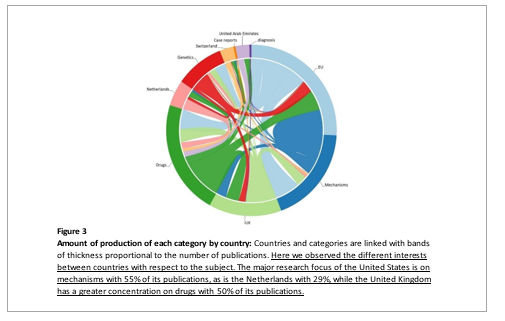
Thereby, we tracked SCOPUS output and the impact of these publications from around the globe in the field of epilepsy and the study of Na+ channels. A total of 290 papers were produced in the period from 2000 to 2022, with 2013 and 2019 being the more productive years. Only original articles were considered for this publication, which we separated into 7 categories (Neu¬roscience, Drugs, Genetics, Case reports, Tumors, Diagnosis, and Models). We were able to identify the highest number of publications per country and found that the countries that have contributed the mostto the topic are the USA with 128 publica¬tions of which 55% focus on mechanisms, followed by UK with 68 publications of which 29% focus on antiepileptic drugs, and the Netherlands with 26 publications of which 50% also focus on antiepileptic drugs, some of them sometimes partnered with each other to make these contributions to the study of epilepsy and Na+ channels. Besides that, we found that mechanisms and antiepileptic drugs are the most investigated areas, moreover, the most studiedNa+ channel types are 1 and 2 while the most studied antiepileptic drugs are phenytoin, carbamazepine, and lacosamide. On the other hand, analyzing the mainjournals, and citation numbers, we found Nature Neuroscience is the most cit¬ed with750 cites and only one article, while Epilepsia is at the top of articles with 23, but just170 citations. Additionally, we identified the number of authors per article, which ranges from one to sixty-four. We also found that 90% of these publications are experimental and the rest are clinical.
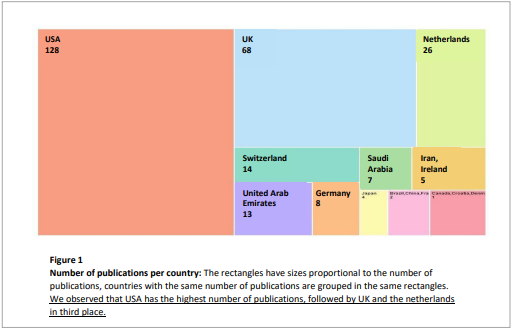
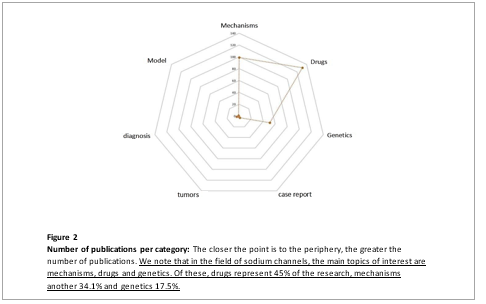
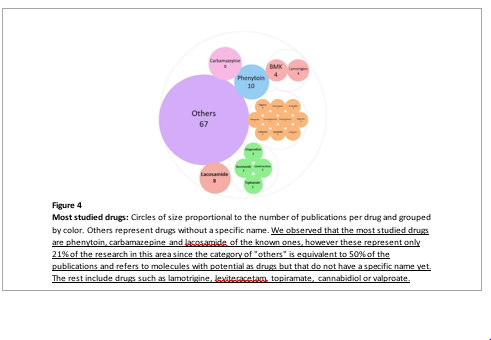
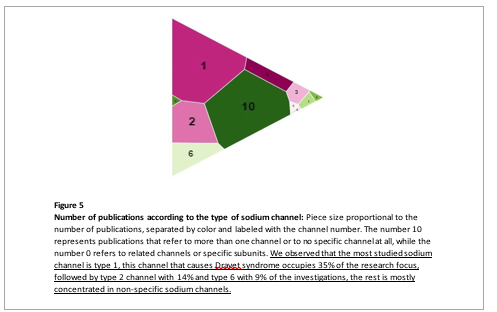
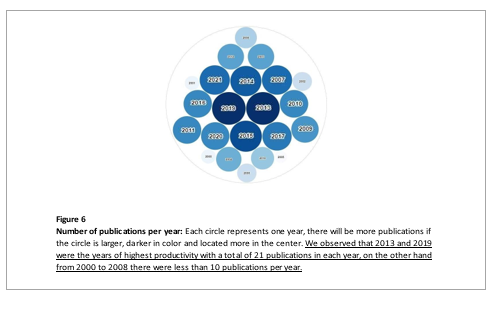
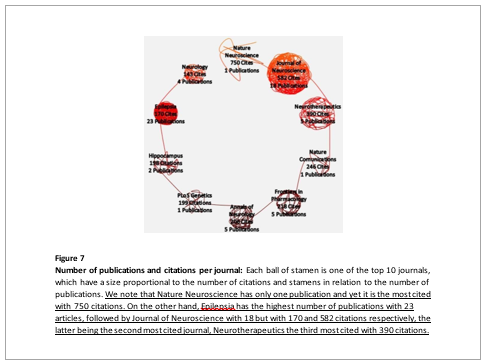
During the study period, a total of articles on Na+ were pub-lished, creating an average of 228 articles per country. We ob¬served that the United States is the country with the most pub¬lications, followed by the United Kingdom and the Netherlands in third position (Figure 1). We highlight that the primary topics of interest in the field of sodium channels include mechanisms, drugs, and genetics. Drugs represent 45%, mechanisms 34.1%, and genetics 17.5%. (Figure 2). Production of each category in each country: Countries and categories are linked by bands of varying thicknesses depending on the number of articles. In this case, we observe how the interests of different countries differ in the matter. The United States focuses strongly on mechanisms (55% of its articles), as does the Netherlands (29%), whereas the United Kingdom focuses more on antiepileptic drugs (50% of its papers) (Figure 3). The most studied drugs: We Found that the most used drugs are phenytoin, carbamazepine, and lacosamide, but these only account for 21% of the research in this field be¬cause the “others” category accounts for 50% of the publications and refers to molecules with pharmacological potential but with¬out specific names. The remaining drugs include lamotrigine, le-vetiracetam, topiramate, cannabidiol, and valproate (Figure 4). We found that the most investigated sodium channel is type 1, which causes Dravet syndrome, accounting for 35% of the re¬search emphasis, followed by type 2 (14%), and type 6 (9%). The remainderis primarily focused on non-specific sodium chan¬nels (Figure 5). Number of publications each year: We found that the years 2013 and 2019 had the highest production, with a totalof 21 publications in each, whereas the years 2000 to 2008 had less than 10 publications each year (Figure 6). The number of citations and publications per journal: Nature Neuroscience has only one paper, however, it has received the most citations (750). Epilepsia, on the other hand, is the journal with the most publications with 23, followed by Journal of Neuroscience with 18, but with 170 and 582 citations, respectively, the latter being the second most cited journal, and Neurotherapeutics with 390 citations (Figure 7).
Discussion
Epilepsy is a disease that has been shown to have a substan¬tial impact on developing nations. The poorest nations have the highest prevalence of this neurological disorder [27]. As a result, it is reasonable that scholars from such areasare uninterested in delving into the fundamental mechanisms of the illnessesafflict-ing their populations. Consequently, the past decade has seen an increase in the scientific output of literature addressing the involvement of Na+ channels in epilepsy in developed nations. The United States of America and the UnitedKingdom have been the two
most prolific countries on this subject. As a consequence, these are the same nations that have the most international coopera-tion throughout the investigated time. The preceding might be related to the increasing population of these civilizations and the urgent need for institutions capable of identifying and treating neurological illnesses such as epilepsy.
Most of the scientific output was devoted to the creation of orig-inal papers, with neurology and the activation of Na+ channels, and epilepsy being the most reviewed topics. Results from our databases indicated that the Gross Domestic Product (GDP)of each nation correlates with the scientific productivity of these countries; the United States of America is the country with the most publications, followed by the United Kingdom. As GDP allows nations to invest in science and technology, this associa¬tion may have an explanation. Despite this, high-income nations such as India, Slovakia, Canada, Denmark, Greece, Croatia, South Korea, and Sweden have shown little interest in studying the involvement of Na+ channels in epilepsy.
Additionally, there are nations in Latin America and Africa with one of the lowest GDPs that contribute to neither article on this subject. In the SCOPUS database, wedid not find articles on the involvement of Na+ channels in epilepsy for Latin Americaand Africa countries. However, the incidence map of epilepsy in Latin America and Africa reveals that it is more prevalent than in the United States and the United Kingdom [28]. It should be recognized that non-production of a country with a high preva¬lence of of the disease may have an impact on each nation's sci-entificadvancement. The work of Makinson C.D., Tanaka B.S., Lamar T., Goldin A.L., Escayg A., “Na+ currents that were re¬versed by mutations linked with Dravet’s Syndrome of epilepsy” is one of the most referenced publications (750 citations).
Despite having the highest number of citations, this study does not belong to any of the research lines developed by this re¬search in the United States. We still have a long way to go to properly comprehend neurode-generative illnesses in nations heavily affected by epilepsy. For example, we have not been able to develop this line of research in Latin America or Africa. The contribution to the knowledge of this illness and the role of Na+ channels should be much bigger since we know that 30 to 35% of patients do not have appropri¬ate seizure control [29]. Research is a tool for making discover¬ies public and for developing better diagnoses and treatments.
Our findings suggest that the regional trending topics in scien-tific output concerning epilepsy and its relationship with Na+ are mostly concerned with the pathophysiology of the illness. This could mean that other areas, such as genetic mutations and diagnosis, are less investigated, and therefore a sector with many prospects for neuroscience. It is also worth noting that the major¬ity of the publications have been experimental research, which is why we believe that the creation of clinical papers should be expanded. Although there is some cooperation between Latin American and African nations for the creation of papers on epi¬lepsy and Na+, we believe that it is vital to expand intra-regional collaboration for a greater global effect and a better life quality for people suffering from this neurological disorder
Conclusion
Despite the increased research output from what used to be con¬sidered “first world countries” such as the United States and the United Kingdom on epilepsy and sodium channels, more effort is needed to address the high prevalence of such an ailment in other countries. All of the following could be possible if efforts are made to expand networks and collaborative activities, partic¬ularly across borders.
References
- Armijo, J. A., Shushtarian, M., Valdizan, E. M., Cuadrado, A., & Adin, J. (2005). Ion channels and epilepsy. Current pharmaceutical design, 11(15), 1975-2003.
- Bromfield, E. B., Cavazos, J. E., & Sirven, J. I. (2006). Basic mechanisms underlying seizures and epilepsy. In An Introduction to Epilepsy [Internet]. American Epilepsy Society.
- Khateb, M., Bosak, N., & Herskovitz, M. (2021). The effect of anti-seizure medications on the propagation of epileptic activity: a review. Frontiers in Neurology, 12, 674182.
- Espinosa-Jovel, C., Toledano, R., Aledo-Serrano, Á., García-Morales, I., & Gil-Nagel, A. (2018). Epidemiological profile of epilepsy in low income populations. Seizure, 56, 67-72.
- Hansen, K. B., Yi, F., Perszyk, R. E., Menniti, F. S., & Tray-nelis, S. F. (2017). NMDA receptors in the central nervous system. NMDA receptors: Methods and protocols, 1-80.
- Kubista, H., Boehm, S., & Hotka, M. (2019). The paroxysmal depolarization shift: reconsidering its role in epilepsy, epileptogenesis and beyond. International journal of molecular sciences, 20(3), 577.
- Wei, F., Yan, L. M., Su, T., He, N., Lin, Z. J., Wang, J.,... & Liao, W. P. (2017). Ion channel genes and epilepsy: functional alteration, pathogenic potential, and mechanism of epilepsy. Neuroscience bulletin, 33, 455-477.
- Ademuwagun, I. A., Rotimi, S. O., Syrbe, S., Ajamma, Y. U., & Adebiyi, E. (2021). Voltage gated sodium channel genes in epilepsy: mutations, functional studies, and treatment dimensions. Frontiers in neurology, 12, 600050.
- Buraei, Z., & Yang, J. (2010). The β subunit of voltage-gated Ca2+ channels. Physiological reviews, 90(4), 1461-1506.
- Brackenbury, W. J., & Isom, L. L. (2011). Na+ channel β subunits: overachievers of the ion channel family. Frontiers in pharmacology, 2, 53.
- Ademuwagun, I. A., Rotimi, S. O., Syrbe, S., Ajamma, Y. U., & Adebiyi, E. (2021). Voltage gated sodium channel genes in epilepsy: mutations, functional studies, and treatment dimensions. Frontiers in neurology, 12, 600050.
- Oliva, M., Berkovic, S. F., & Petrou, S. (2012). Sodium channels and the neurobiology of epilepsy. Epilepsia, 53(11), 1849-1859.
- Ogiwara, I., Miyamoto, H., Morita, N., Atapour, N., Maza-ki, E., Inoue, I., ... & Yamakawa, K. (2007). Nav1. 1 localizes to axons of parvalbumin-positive inhibitory interneu-rons: a circuit basis for epileptic seizures in mice carrying an Scn1a gene mutation. Journal of Neuroscience, 27(22), 5903-5914.
- de Lera Ruiz, M., & Kraus, R. L. (2015). Voltage-gated sodium channels: structure, function, pharmacology, and clinical indications. Journal of medicinal chemistry, 58(18), 7093-7118.
- Pozdnyakov, I., Matantseva, O., & Skarlato, S. (2018). Diversity and evolution of four-domain voltage-gated cation channels of eukaryotes and their ancestral functional determinants. Scientific Reports, 8(1), 3539.
- Mangold, K. E., Brumback, B. D., Angsutararux, P., Voelk-er, T. L., Zhu, W., Kang, P. W., ... & Silva, J. R. (2017).Mechanisms and models of cardiac sodium channel inactivation. Channels, 11(6), 517-533.
- Scharfman, H. E. (2007). The neurobiology of epilepsy. Current neurology and neuroscience reports, 7(4), 348-354.
- Kim, H., Kim, D. W., Lee, S. T., Byun, J. I., Seo, J. G., No,Y. J., ... & Yang, K. I. (2020). Antiepileptic drug selection according to seizure type in adult patients with epilepsy. Journal of Clinical Neurology (Seoul, Korea), 16(4), 547.
- Kress, G. J., & Mennerick, S. (2009). Action potential initiation and propagation: upstream influences on neurotrans-mission. Neuroscience, 158(1), 211-222.
- Bromfield, E. B., Cavazos, J. E., & Sirven, J. I. (2006). Basic mechanisms underlying seizures and epilepsy. In An Introduction to Epilepsy [Internet]. American Epilepsy Society.
- Arnett, Mark W., and Peter M. Larkman. The Action Potential. Practical Neurology 7 (2007): 2-7.
- Depienne, C., Trouillard, O., Saint-Martin, C., Gourfin-kel-An, I., Bouteiller, D., Carpentier, W., ... & Leguern,E. (2009). Spectrum of SCN1A gene mutations associated with Dravet syndrome: analysis of 333 patients. Journal of medical genetics, 46(3), 183-191.
- Anwar, A., Saleem, S., Patel, U. K., Arumaithurai, K., & Malik, P. (2019). Dravet syndrome: an overview. Cureus, 11(6).
- Mullen, S. A., & Scheffer, I. E. (2009). Translational re-search in epilepsy genetics: sodium channels in man to in-terneuronopathy in mouse. Archives of neurology, 66(1), 21-26.
- Heron, S. E., Smith, K. R., Bahlo, M., Nobili, L., Kaha-na, E., Licchetta, L., ... & Dibbens, L. M. (2012). Missense mutations in the sodium-gated potassium channel gene KCNT1 cause severe autosomal dominant nocturnal frontal lobe epilepsy. Nature genetics, 44(11), 1188-1190.
- Reid, C. A., Berkovic, S. F., & Petrou, S. (2009). Mechanisms of human inherited epilepsies. Progress in neurobiol-ogy, 87(1), 41-57.
- Birbeck, G. L. (2010). Epilepsy care in developing countries: part I of II. Epilepsy currents, 10(4), 75-79.
- Beghi, E. (2020). The epidemiology of epilepsy. Neuroepi-demiology, 54(2), 185-191.
- Picot, M. C., Baldy-Moulinier, M., Daurès, J. P., Dujols, P., & Crespel, A. (2008). The prevalence of epilepsy and pharmacoresistant epilepsy in adults: a population-based study in a Western European country. Epilepsia, 49(7), 1230-1238.