

Journal of Agriculture and Horticulture Research(JAHR)
ISSN: 2643-671X | DOI: 10.33140/JAHR
Impact Factor: 1.12

Research Article - (2024) Volume 7, Issue 2
Oyster Mushroom and its Value Added Products
Received Date: Oct 21, 2024 / Accepted Date: Nov 12, 2024 / Published Date: Dec 06, 2024
Copyright: ©Â©2024 Tanmay Kotasthane. This is an open-access article distributed under the terms of the Creative Commons Attribution License, which permits unrestricted use, distribution, and reproduction in any medium, provided the original author and source are credited.
Citation: Kotasthane, T. (2024). Oyster Mushroom and its Value Added Products. J Agri Horti Res, 7(2), 01-07.
Abstract
Cultivation of mushroom is biotechnological process.Two oyster mushroom studied for its consumption and value added products. Pleurotus sajor caju is good in taste and favorite among people as a food.Soup powder made from Pleurotus sajor caju and other ingredients has good flavor and taste.Tomato-mushroom ketchup made from Pleurotus ostreatus and other ingredients has good aroma and taste.Dried oyster mushrooms can be stored for longer period and used in preparation of curries.Oyster mushroom are rich source of proteins, vitamins and minerals.Oyster mushroom cultivation has short duration than other mushroom which makes its good alternative as a food.
Keywords
Mushroom, Pleurotus, Value Addition, Biotechnology
Introduction
Cultivation of edible mushrooms is a biotechnological process for lingo-cellulosic organic waste conversion. It might be the only current process that combines the production of protein-rich food with the reduction of environmental pollution [1]. The production of mushrooms is regarded as the second most important commercial microbial technology next to yeast [2].
The nutritional and medicinal values of mushrooms have long been recognized.Mushrooms are rich source of proteins, vitamins and minerals. Mushroom is considered to be a complete and safest food, suitable for all age groups.The oyster mushroom got its name from its strikingly similar resemblance to a fresh schucked oyster [3].
This nutrient dense versatile food can be taken as a substitute of meat, fish, fruits, and vegetables [4]. Recently, however, mushrooms have assumed greater place in the diets due to nutritional values. For example, they are being marketed along major highways and urban centers where the trade now booms. According to the Food and Agriculture Organization (FAO) of the United Nations statistics China is the world’s leading mushroom producer, while the United States and Italy are second and third [5].
Edible mushrooms mostly oyster mushrooms is favorite among farmers because of the taste, morphology, growth habit, texture, and habitat. In addition to the above, the natives have observed saprophytic nature of many fungi and have named each fungus after the wood on which it grows. In India, there has been greater interest in mushrooms not only because of protein rich health vegetable (food) but also due to presence of medicinal active compounds. This new class of compounds, termed mushroom nutriceuticals represent an important component of the expanding mushroom biotechnology industry. Fungi are the source of anti¬biotics old (penicillin) and new (cephalosporins), the cholesterol-lowering drug lovastatin, and cyclosporins for supporting patients after organ transplants [6]. Vitamin D was estimated by HPLC method [7].Vitamin C was determined by Indophenol method as per the procedure as outlined by Food Analysis Laboratory Manual [8].Cultivation of pleurotus, shitake, milky and paddy mushroom are favorite among growers. This mushroom has been widly used in traditional medicine and reported to posseses various biological activities, including anti microorganisms, antitumor, antioxidant, anti-hypertension, antidiabetic, and anti-inflammation. It has been shown that constant intake of either mushrooms people fitter and healthier. In addition to this mushroom cultivation convert agricultural and forest wastes into useful matter and reduce pollution in the environment.
Therefore, mushroom cultivation gives nutritive food reduction of environmental pollution with extra income to farmers. Mushrooms are among the largest fungi, which have attracted the attention of naturalists before microscopes, or even simple lenses had thought of. Mushroom farming is believed to have started in 600 A.D.
Materials and Methods
Oyster mushroom spawn (Pleurotus sajor-caju) was obtained from College of Agriculture pune. Pleurotus ostreatus spawn was obtained online.
Following materials were used in the experiment
1. Metal drum to pasteurize the substrate 2. Heater 3. Substrates (sorghum stalk, wheat straw or maize stover) 4. Devices for chopping the substrate 5. Water 6. Bricks or stones to submerge the substrate 7. 2 x Plastic sheets (at least 1.5 m x 1.5 m) 8. Wheel barrow (optional) 9. Garden fork 10. Jik bleach/ disinfectant 11. 6inch nails 12. Plastic bag in which to pack the substrate 13.Mushroom spawn 14. Racks 15. Scissors 16. Two buckets 17.Mushroom house / structure 18.Nozzle sprayer 19. Muslin cloth 20. Broom
Substrate used is mixture of Maize stalk and sorghum stalk,saw dust and paddy straw were soaked in water with bavastin, bleaching powder and 5% formalin overnight. Substrate were kept for sun dry to remove excess water.6X4 polythene bags filled with substrate.
Preparation and Formulation of Potato– Mushroom–Tomato Soup Powder
Soups are commonly used as appetizers. Experiments were conducted to prepare good quality ready-tomake mushroom soup powder using quality mushroom powder produced from the sun dried oyster mushroom. Whole oyster mushrooms were finely ground in mixer grinder. Mushroom soup powder is prepared by mixing this powder with tomato-potato powder and other ingredients (Figure C and D).10-15 grams of powder mixed with water to make one bowl soup with characteristic aroma and taste. The oyster mushroom soup powder can also be used in curry preparation. The moisture content of the newly developed soup was lower than the reports of other studies [9].

Figure 1: Pleurotus Sajor-Caju
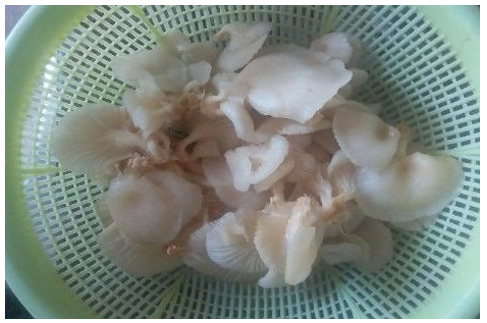
Figure 2: Pleurotus Ostreatus
Cooking Procedures of Soup Powders
Twenty-five gram of the newly developed soup powder was added into 350 ml water and boiled for 5–6 min, and readied for serving of two persons. Dried mushroom (Figure F) can be stored for upto one year and can be used in preparation of curries.

Figure 3: Soup Powder
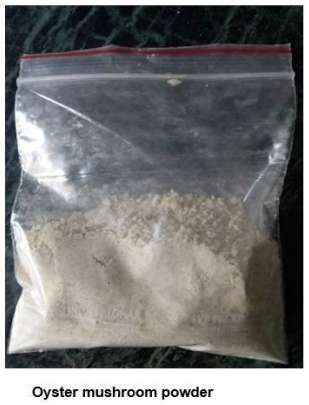
Figure 4: Oyster Mushroom Powder
Mushroom Ketch-Up
Ketch-up is made by concentrating the pulp of the fruits/ vegetables without seeds.It should be highly viscous in nature.They also contain more of sugar and less of acid. Freshly harvested oyster mushrooms and tomatoes are washed, sliced and cooked in 50% of water for 20 minutes. Mushroom paste is prepared using a mixer grinder.Corn flour and other ingredients are mixed in the paste and cooked to bring it viscous.Then the ketch-up is filled in the sterilized bottles or jars (Figure.E).

Figure 5: Tomato-Mushroom Ketchup
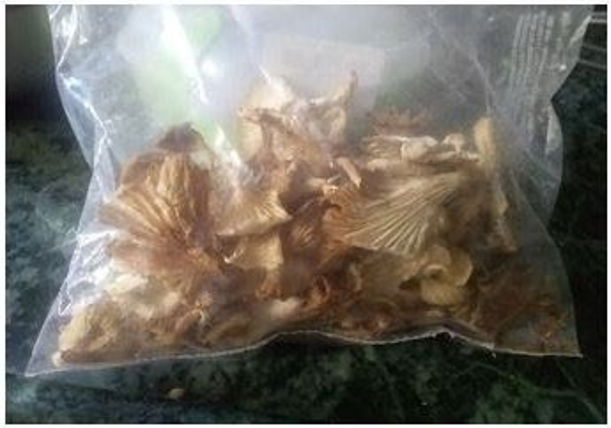
Figure 6: Dehydrated Mushroom

Results
Growth Stages in Number of Days
Pleurotus Sajor Caju

Pleurotus Ostreatus

*Poor spawn run and fruit body formation on saw dust as substrate
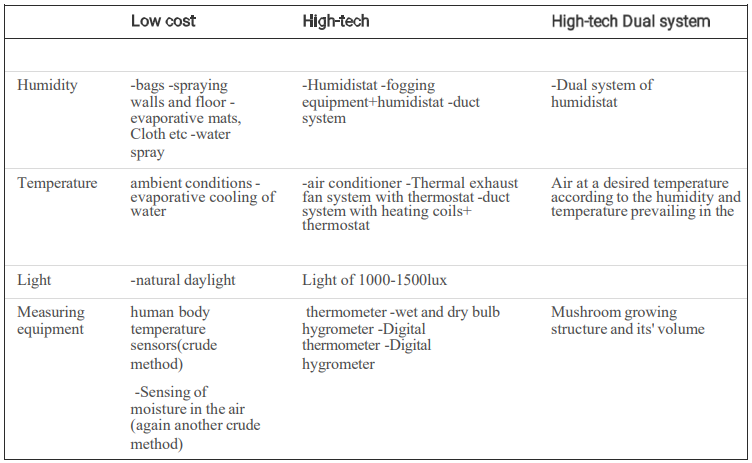
Growth Conditions for Oyster Mushroom and Equipments
Discussion
Pleurotus spp. mushroom can degrade and grow on any kind of agricultural or forest wastes, which contain lignin, cellulose and hemicellulose. Reported that there are about 200 kinds of waste in which edible mushrooms can be produced [10]. White button,crimini, and portabella varieties, is especially common in todays culinary repertoire. The next most common commercial species are shiitake (Lentinus edodes), straw (Volvariella volvacea), oyster (Pleurotus ostreatus), and enoki (Flammulina ostreatus). Mycelium growth of Pleurotus depends on several factors such as growing media, different media concentration, pH, temperature, nutrient element and some environmental factors. Among all the cultivated mushrooms Pleurotus has maximum number of commercially cultivated species suitable for round the year cultivation. Moreover, variation in texture, shape, colour, and aroma are also available.
Quality of soup processed with added Moringa leaf powder has implication on texture and microbiological [11]. Oyster mushroom is healthy food, low in cholesterol and higher proteins, vitamins and minerals are good for children,women and diabetic patient. The protein content of the developed soy–mushroom–moringa soup powder was higher than that of the results of other studies [12-15]. Protein rich mushroom powder can be taken in diet with wheat and other grain flour.Microbial analysis of soy– mushroom–moringa soup powder were carried out according to the procedure of Bacteriological Analytical Manual [16-18].
Tomato-mushroom Ketchup made from Pleurotus ostreatus has good taste and can be stored upto 12 days whereas, it can be stored for longer period if preservatives are added. Pleurotus mycelium can grow on fresh and fermented straw and it does not require composted substrate for growth. Substrate preparation for oyster mushroom is very simple. Further this mushroom does not require controlled environmental conditions like A.bisporus as most of the species have very wide temperature, relatively humidity and CO2 tolerance. P. ostreatus is also known as “oyster mushroom”, “hiratake”, “shimeji”, or “houbitake” [19-21].
White button mushroom,has longer cultivation period in comparison to oyster mushroom.The oyster mushroom fruit bodies can be easily dried and stored.It can be stored upto one year in dried and powder form.In general, mushrooms contain 90% water and 10% dry matter [22, 23]. Dried oyster mushrooms can be instantly used after soaking in hot water for 5 to 10 minutes or it can be used in powdered form for several preparations. Fresh mushrooms have a shelf life of 24-48 h even at room temperature.
Conclusion
Oyster mushroom is mushroom of economic importance could be grown in 25 0C to 35 0C. Oyster mushroom is rich source of proteins vitamins and minerals.Various value added products could be made from Pleurotus ostreatus and Pleurotus-sajor-caju. Mushroom soup powder,mushroom powder and ketchup can be produced on large scale.White oyster and colored oyster mushroom has short cultivation period and favorite among people.Oyster mushroom cultivation can fetch good economic returns [24-27].
References
- Beetz, A., Kustudia, M. (2004) Mushroom cultivation and marketing. Horticulture production guide.
- Pathak, R., Joshi, N., & Dwivedi, R. R. (2009). Eco-friendly production of Agaricus bisporus (lange) imbach (white button mushroom). Nat Sci, 6, 57-60.
- Beltran-Garcia, M. J., Estarron-Espinosa, M., & Ogura, T. (1997). Volatile compounds secreted by the oyster mushroom (Pleurotus ostreatus) and their antibacterial activities. Journal of Agricultural and Food Chemistry, 45(10), 4049-4052.
- Kakon, A. J., Choudhury, M. B. K., & Saha, S. (2012). Mushroom is an ideal food supplement. Journal of Dhaka National Medical College & Hospital, 18(1), 58-62.
- Zhang, Y., Geng, W., Shen, Y., Wang, Y., & Dai, Y. C. (2014). Edible mushroom cultivation for food security and rural development in China: bio-innovation, technological dissemination and marketing. Sustainability, 6(5), 2961-2973.
- Watkinson, S. C., Boddy, L., & Money, N. P. (2015). The Fungi, 3rd edn. Elsevier, Amsterdam 418-420.
- Kaushik, R., Sachdeva, B., Arora, S., & Wadhwa, B. K. (2014). Development of an analytical protocol for the estimation of vitamin D2 in fortified toned milk. Food chemistry, 151, 225-230.
- Zvaigzne, G., Karklina, D., Seglina, D., & Krasnova, I. (2009). Antioxidants in various citrus fruit juices. Chemine Technologija, 3(52), 56-61.
- Poppe, J. (2000). Use of the agricultural waste materials in the cultivation of mushrooms. Mushroom Sci, 15, 3-23.
- Singh, V., & Chaudhary, G. (2015). Quality evaluation of dried vegetables for preperation of soups. Indian Research Journal of Genetics and Biotechnology, 7(02), 241-242.
- Sengev, A. I., Abu, J. O., & Gernah, D. I. (2013). Effect of Moringa oleifera leaf powder supplementation on some quality characteristics of wheat bread. Food and nutrition sciences, 4(3), 270.
- Rahman, M. A., Saifullah, M., & Islam, M. N. (2012). Fish powder in instant fish soup mix. Journal of the Bangladesh Agricultural University, 10(1), 145-148.
- Rekha, M. N., Yadav, A. R., Dharmesh, S., Chauhan, A. S., & Ramteke, R. S. (2010). Evaluation of antioxidant properties of dry soup mix extracts containing dill (Anethum sowa L.) leaf. Food and Bioprocess Technology, 3, 441-449.
- Rubilar, M., Morales, E., Contreras, K., Ceballos, C., & Acevedo, F., et al. (2012). Development of a soup powder enriched with microencapsulated linseed oil as a source of omega-3 fatty acids. European Journal of Lipid Science and Technology, 114(4), 423-433.
- Singh, S., Ghosh, S., & Patil, G. R. (2003). Development of a mushroom-whey soup powder. International journal of food science & technology, 38(2), 217-224.
- Feng, P., Weagant, S. D., Grant, M. A., & Burkhardt, W. (2013). Enumeration of Escherichia coli and the Coliform Bacteria. In U.S. Food and Drug Administration (Ed.), Bacteriological Analytical Manual, 8th ed. United States: AOAC International.
- Maturin, L., & Peeler, J. P. (2001). Aerobic Plate Count. In Bacteriological Analytical (Ed.), Manual, 8th ed.. United States: AOAC International.
- Tournas, V., Stack, M. E., Mislivec, P. B., Koch, H. A., & Bandler, R. (2001). Yeasts, molds and mycotoxins. Bacteriological analytical manual, 8.
- Mizuno, T., & Zhuang, C. (1995). Maitake, Grifola frondosa: pharmacological effects. Food Reviews International, 11(1), 135-149.
- Bononi, V. L. R., Capelari,M., Maziero, R., Trufem, S. F. B. (1995) Cultivo de Cogumelos Comestíveis. Icone Editora LTDA Brasil Agrícola, São Paulo, 206.
- Rühl, M., Fischer, C., & Kües, U. (2008). Ligninolytic enzyme activities alternate with mushroom production during industrial cultivation of Pleurotus ostreatus on wheatstraw-based substrate. Current Trends in Biotechnology and Pharmacy, 2(4), 478-492.
- Morais, M. H., Ramos, A. C., Matos, N., & Oliveira, E. J.S. (2000). Note. Production of shiitake mushroom (Lentinus edodes) on lignocellulosic residues/Nota. Cultivo del hongo shiitake (Lentinus edodes) en residuos lignocelulósicos. Food science and technology international, 6(2), 123-128.
- Sánchez, C. (2004). Modern aspects of mushroom culture technology. Applied microbiology and biotechnology, 64, 756-762.
- Ahmad, I., Fuad, I., & Khan, Z. K. (2015). Mycelia growth of pink oyster (Pleurotus djmour) mushroom in different culture media & environmental factors. Agriculture and Food Sciences Research, 2(1), 6-11.
- ST, C. (1996). Mushroom research and development, equality and mutual benefit. In International Conf. mushroom biology and mushroom products, 1996 (pp. 1-10). The Pennsylvania State University Press.
- “History of the mushroom”, Mychampi, Accessed on April 1, 2018.
- Thanintorn, Y., Ureporn, K. L., Carl, S., Pannawich, S., & Aratee, A., et al. (2020) Enhancing Activity of Pleurotus sajor-caju (Fr.) Singβ-1,3-Glucanoligosaccharide (Ps-GOS) on Proliferation, Differentiation, and Mineralization of MC3T3-E1 Cells through the Involvement ofBMP2/Runx2/ MAPK/Wnt/β-CateninSignaling Pathway Biomolecules 2020,10,190.