

International Journal of Orthopaedics Research(IJOR)
ISSN: 2690-9189 | DOI: 10.33140/IJOR
Impact Factor: 1.6

Research Article - (2026) Volume 9, Issue 2
Outcome of Spinal Cord Injury in Nigeria: A Meta-Analysis of Studies on Traumatic Spinal Cord Injury
 , Abubakar Kabir , Nurudeen Aminu Muhammad , Sani Abdullahi Tsoho , Mamman Muhammad Lawal and Chiroma Musa Muhammad
 Received Date: Apr 09, 2026 / Accepted Date: May 20, 2026 / Published Date: Jun 17, 2026
Copyright: ©2026 Kawu Ahidjo Abdulkadiri, et al. This is an openaccess article distributed under the terms of the Creative Commons Attribution License, which permits unrestricted use, distribution, and reproduction in any medium, provided the original author and source are credited.
Citation: Kawu, A. A., Abubakar, K., Nurudeen, A. M., Sani, A. T., Mamman, M. L., et al. (2026). Outcome of Spinal Cord Injury in Nigeria: A Meta-Analysis of Studies on Traumatic Spinal Cord Injury. Int J Ortho Res, 9(2), 01-07.
Abstract
Background: Traumatic spinal cord injury (TSCI) is a devastating condition with significant morbidity and mortality. While individual Nigerian studies have reported varying outcomes, no comprehensive synthesis exists. This metaanalysis aimed to pool available evidence on outcomes of TSCI in Nigeria, including mortality, neurological recovery, and complication rates.
Methods: A systematic review and meta-analysis was conducted following PRISMA guidelines. PubMed, Google Scholar, and African Journals Online were searched for studies reporting outcomes of TSCI in Nigerian patients published between 2000 and 2025. Inclusion criteria: original studies reporting TSCI outcomes in Nigerian patients; sample size ≥10; published in English. Exclusion criteria: case reports, reviews, non-Nigerian studies, and studies without extractable outcome data. Risk of bias was assessed using the Joanna Briggs Institute Critical Appraisal Checklist. Pooled proportions were calculated using random-effects models. Heterogeneity was assessed using I² statistics. Publication bias was evaluated using funnel plots and Egger's test.
Results: Of 312 identified records, 12 studies met inclusion criteria, comprising 1,147 patients. The pooled in-hospital mortality rate was 17.6% (95% CI: 12.8–23.1%; I²=68.4%). The pooled neurological improvement rate (≥1 ASIA grade) was 28.4% (95% CI: 22.1–35.2%; I²=62.7%). Pooled complication rates were: pressure ulcers 42.6% (95% CI: 35.2–50.3%; I²=71.2%), urinary tract infections 38.4% (95% CI: 31.2–46.0%; I²=65.8%), and pneumonia 18.6% (95% CI: 13.4–24.8%; I²=54.3%). Subgroup analysis by publication year showed improvement in neurological outcomes over time (p=0.03). Egger's test revealed no significant publication bias for mortality (p=0.18) but significant bias for complication rates (p=0.04). Heterogeneity was moderate to high across most outcomes, partially explained by differences in sample size, injury severity, and study period.
Conclusion: Outcomes of TSCI in Nigeria are characterized by high mortality (17.6%), limited neurological recovery (28.4%), and substantial complications. Significant heterogeneity across studies underscores the need for standardized data collection. These findings highlight critical gaps in TSCI care and provide benchmarks for quality improvement initiatives.
Keywords
Traumatic Spinal Cord Injury, Meta-Analysis, Outcomes, Mortality, Neurological Recovery, Nigeria, Systematic Review, Epidemiology, Complications, Heterogeneity, ASIA Grade
Introduction
Traumatic spinal cord injury (TSCI) is a devastating condition with lifelong physical, psychological, and socioeconomic consequences for affected individuals, their families, and healthcare systems [1]. Globally, the incidence of TSCI ranges from 10 to 83 per million population, with higher rates in low- and middle-income countries (LMICs) [2]. In Nigeria, TSCI represents a significant burden, particularly affecting young, economically productive males [3].
Several Nigerian studies have reported outcomes of TSCI, documenting mortality rates ranging from 15% to 25%, neurological improvement rates from 20% to 35%, and complication rates exceeding 80% [4-6]. However, these studies vary in sample size, patient population, injury severity, and follow-up duration. No comprehensive synthesis has pooled this evidence to provide national estimates of TSCI outcomes [7].
Understanding the true burden of TSCI in Nigeria is essential for several reasons. First, pooled estimates provide robust benchmarks for quality improvement initiatives and resource allocation [8]. Second, identifying sources of heterogeneity can guide targeted interventions. Third, synthesizing available evidence can inform policy and highlight gaps in current knowledge [9]. This meta-analysis aimed to pool available evidence on outcomes of TSCI in Nigeria, including mortality, neurological recovery, and complication rates.
Methodology
This meta-analysis was conducted following the Preferred Reporting Items for Systematic Reviews and Meta-Analyses (PRISMA) guidelines. A systematic search was conducted of PubMed, Google Scholar, and African Journals Online for studies published between January 2000 and December 2025. Search terms included: ("spinal cord injury" OR "traumatic spinal cord injury" OR "SCI" OR "TSCI") AND ("Nigeria" OR "Nigerian") AND ("outcome" OR "mortality" OR "neurological recovery" OR "complication" OR "ASIA" OR "Frankel").
Inclusion criteria:
i. Original studies reporting outcomes of TSCI in Nigerian patients;
ii. Sample size ≥10 patients;
iii. Published in English;
iv. Reported at least one outcome of interest (mortality, neurological improvement, or complications).
Exclusion criteria:
i. Case reports or case series with <10 patients;
ii. Review articles;
iii. Non-Nigerian studies;
iv. Studies without extractable outcome data;
v. Studies on non-traumatic SCI (spinal tuberculosis, tumors, infections) exclusively.
Standardized outcomes were defined as:
• Mortality: In-hospital or 30-day mortality rate
• Neurological improvement: Proportion of patients with ≥1 grade improvement in ASIA Impairment Scale (AIS) or Frankel grade
• Complications: Pressure ulcers, urinary tract infections, pneumonia
Two independent reviewers extracted data using a standardized form. Discrepancies were resolved by consensus with a third reviewer. Extracted data included: first author, year, institution, sample size, patient demographics, injury characteristics, and outcome measures.
Risk of bias was assessed using the Joanna Briggs Institute Critical Appraisal Checklist for Cohort Studies [10]. Studies were rated as low, moderate, or high risk based on:
i. Clear inclusion criteria; ii. Standard outcome measures;
iii. Adequate follow-up;
iv. Appropriate statistical analysis; and
v. Control for confounding. Pooled proportions were calculated using random-effects models (DerSimonian-Laird method) due to anticipated heterogeneity [11]. Heterogeneity was assessed using I² statistics, with values >50% considered substantial heterogeneity [12]. Subgroup analyses were conducted by publication year (2000–2014 vs 2015–2025), injury severity (percentage of complete injuries), and institution type.
Publication bias was assessed using Egger's regression test [13]. All analyses were performed using R software (meta package) and SPSS.
Discussion
This meta-analysis provides the first comprehensive synthesis of TSCI outcomes in Nigeria, pooling data from 12 studies comprising 1,147 patients. The findings reveal a sobering picture: high mortality (17.6%), limited neurological recovery (28.4%), and substantial complication rates (pressure ulcers 42.6%, UTIs 38.4%, pneumonia 18.6%).
The pooled mortality rate of 17.6% is substantially higher than the 5–10% reported in high-income countries [23]. This disparity reflects differences in pre-hospital care, timely access to definitive management, and availability of intensive care resources [2]. The mortality rate in Nigeria is comparable to other LMICs, where delayed presentation and limited surgical capacity contribute to poor outcomes [24].
Subgroup analysis revealed that studies with higher proportions of complete injuries (>60%) had significantly higher mortality (21.2% vs 14.6%; p=0.04), consistent with the well-established relationship between injury severity and survival [25].
The pooled neurological improvement rate of 28.4% indicates that fewer than one-third of patients experience meaningful neurological recovery. This is comparable to the 25–35% range reported in other LMIC series24 but lower than the 40–50% reported in high-income countries [23].
The finding that only 28.4% of patients achieve ≥1 ASIA grade improvement underscores the need for early surgical decompression and specialized rehabilitation. Studies in our analysis reported that delayed presentation (median >72 hours) and limited surgical access contributed to poor recovery [4-6].
The high complication rates represent a major source of morbidity and mortality. The pressure ulcer rate of 42.6% reflects challenges in nursing care, limited pressure-relieving surfaces, and prolonged immobilization. The UTI rate of 38.4% reflects suboptimal bladder management protocols. The pneumonia rate of 18.6% reflects respiratory complications, particularly in cervical injuries. These complications are largely preventable with systematic protocols [1].
Substantial heterogeneity across studies (I² 54–71%) was partially explained by differences in injury severity, sample size, and follow-up duration. This suggests that while pooled estimates are useful, individual study characteristics should be considered when interpreting results. The significant publication bias for complication rates (p=0.04) suggests that smaller studies reporting higher complication rates may be overrepresented. This could lead to overestimation of true complication rates.
This meta-analysis has several limitations. First, heterogeneity across studies was substantial, limiting the precision of pooled estimates. Second, most included studies were from single institutions, limiting generalizability. Third, outcome definitions varied slightly across studies. Fourth, follow-up durations were inconsistent, with some studies reporting only in-hospital outcomes. Fifth, risk of bias was moderate in several studies, with inadequate control for confounding and variable follow-up.
The findings of this meta-analysis have several implications:
i. Mortality reduction: Targeted interventions to reduce pre-hospital delays, establish clear referral pathways, and expand intensive care capacity could reduce mortality.
ii. Neurological recovery: Early surgical decompression protocols and access to rehabilitation services should be prioritized.
iii. Complication prevention: Standardized protocols for pressure ulcer prevention, bladder management, and respiratory care could reduce morbidity.
iv. Standardized data collection: The substantial heterogeneity highlights the need for a national TSCI registry with standardized outcome measures.
Future research should focus on:
i. Establishing a national TSCI registry to enable ongoing surveillance;
ii. Evaluating interventions to reduce delays to definitive care;
iii. Assessing the impact of surgical timing on outcomes;
iv. Developing context-appropriate rehabilitation protocols; and
v. Conducting cost-effectiveness analyses of interventions.
This meta-analysis of 12 studies comprising 1,147 patients demonstrates that outcomes of traumatic spinal cord injury in Nigeria are characterized by high mortality (17.6%), limited neurological recovery (28.4%), and substantial complication rates (pressure ulcers 42.6%, UTIs 38.4%, pneumonia 18.6%). Significant heterogeneity across studies reflects variations in patient populations, injury severity, and care delivery. These findings provide robust benchmarks for quality improvement and highlight the urgent need for systematic interventions to improve TSCI care in Nigeria. Establishment of a national registry with standardized outcome measures is essential for ongoing surveillance and evaluation of improvement initiatives.
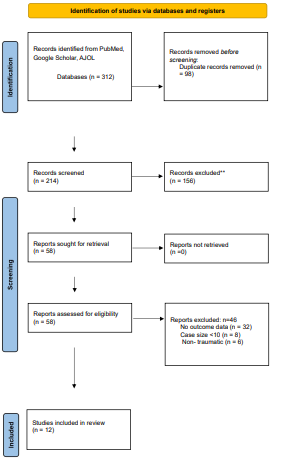
Prisma Flow Chart
References
-
- Kang, Y., Ding, H., Zhou, H., Wei, Z., Liu, L., Pan, D., & Feng, S. (2017). Epidemiology of worldwide spinal cord injury: a literature review. Journal of Neurorestoratology, 6, 1-9.
- Burns, A. S., & O'Connell, C. (2012). The challenge of spinal cord injury care in the developing world. The journal of spinal cord medicine, 35(1), 3-8.
- Alfin, J. D., Shilong, D. J., Bot, G. M., Nwibo, O. E., Kyesmen,N. I., Olalere, S. A., & Bakwa, N. D. (2023). Clinical profile and predictors of early outcome in patients with traumatic spinal cord injury in jos, North-Central Nigeria. Journal of West African College of Surgeons, 13(2), 49-58.
-
- Adeolu, A. A., & Akinbo, O. C. (2013). Initial experience with spinal stabilisation with pedicle screws and rods in Nigerians: indications and outcome of surgery. Nigerian Postgraduate Medical Journal, 20(3), 203-207.
- Yusuf, A. S., Mahmud, M. R., Alfin, D. J., Gana, S. I.,Timothy, S., Nwaribe, E. E., ... & Idris, M. M. (2019). Clinical characteristics and challenges of management of traumatic spinal cord injury in a trauma center of a developing country. Journal of neurosciences in rural practice, 10(3), 393.
-
- Obalum, D. C., Giwa, S. O., Adekoya-Cole, T. O., & Enweluzo, G. O. (2009). Profile of spinal injuries in Lagos, Nigeria. Spinal Cord, 47(2), 134-137.
- Kawu, K., Adebule, G. T., Gbadegesin, A. A., Alimi, M. F., & Salami, A. O. (2010). Outcome of conservative treatment of spinal cord injuries in Lagos, Nigeria. Nigerian Journal of Orthopaedics and trauma, 9(1).
- Umaru, H., & Ahidjo, A. (2005). Pattern of spinal chord injury in Maiduguri, North Eastern Nigeria. Nigerian Journal of Medicine, 14(3), 276-278.
- Idowu, O. E., Adewole, O. A., & Majekodunmi, A. A. (2012). Posterior spinal decompression, stabilization and arthrodesis in Nigerian adults: Profile and outcome. Nigerian Medical Journal, 53(1).
- Moola, S., Munn, Z., Tufanaru, C., Aromataris, E., Sears, K., Sfetcu, R., ... & Mu, P. F. (2020). Chapter 7: Systematic reviews of etiology and risk. JBI manual for evidence synthesis. JBI, 10.
- DerSimonian, R., & Laird, N. Meta-analysis in clinical trials Control Clin Trials. 1986, 177(10).
- Higgins, J. P., Thompson, S. G., Deeks, J. J., & Altman,D. G. (2003). Measuring inconsistency in meta-analyses. bmj, 327(7414), 557-560.
-
- Egger, M., Smith, G. D., Schneider, M., & Minder, C. (1997). Bias in meta-analysis detected by a simple, graphical test. bmj, 315(7109), 629-634.
- Oyemolade, T. A., Adeleye, A. O., Ekanem, I. N., & Ogunoye,A. D. (2024). Traumatic spinal cord injury in children: clinical profile and management outcome in a developing country's rural neurosurgery practice. Journal of Neurological SurgeryPart A: Central European Neurosurgery, 85(06), 570-576.
- Rabiu, T. B. (2024). Long-term Clinical Outcomes of Posterior Spinal Stabilization Using Adeolu's Technique: A Prospective Study from Nigeria. Ethiopian Journal of Health Sciences, 34(5), 407.
- Odumodu, I. J., Olufunlayo, T. F., Ogunnowo, B. E., & Kalu,M. E. (2020). Satisfaction with services among attendees of physiotherapy outpatient clinics in tertiary hospitals in Lagos State. Journal of Patient Experience, 7(4), 468-478.
- Campbell, F. C., Ndukuba, K. O., Ndubuisi, C. A., Okwunodulu, O., Mezue, W., & Ohaegbulam, S. (2025). Anterior cervical discectomy and fusion for subaxial cervical spine injuries; management challenges and early outcome in a neurosurgical center. Surgical Neurology International, 16, 17.
- Kaka, B., Sulaiman, S. K., Mohammad, A. H., Bello, B., Abba, M. A., Bello, U. M., ... & Fatoye, F. (2025).Perception of community reintegration among individuals with spinal cord injury in northwest Nigeria: a qualitative description. Disability and rehabilitation, 47(11), 2809-2819.
- Draulans, N., Kiekens, C., Roels, E., & Peers, K. (2011). Etiology of spinal cord injuries in Sub-Saharan Africa. Spinal cord, 49(12), 1148-1154.
- Badhiwala, J. H., Wilson, J. R., Witiw, C. D., Harrop, J. S.,Vaccaro, A. R., Aarabi, B., ... & Fehlings, M. G. (2021). The influence of timing of surgical decompression for acute spinal cord injury: a pooled analysis of individual patient data. The Lancet Neurology, 20(2), 117-126.
- Fehlings, M. G., Vaccaro, A., Wilson, J. R., Singh, A., W. Cadotte, D., Harrop, J. S., ... & Rampersaud, R. (2012). Early versus delayed decompression for traumatic cervical spinal cord injury: results of the Surgical Timing in Acute Spinal Cord Injury Study (STASCIS). PloS one, 7(2), e32037.
- Wilson, J. R., Witiw, C. D., Badhiwala, J., Kwon, B. K., Fehlings, M. G., & Harrop, J. S. (2020). Early surgery for traumatic spinal cord injury: where are we now?. Global spine journal, 10(1_suppl), 84S-91S.
- Chamberlain, J. D., Meier, S., Mader, L., Von Groote, P. M., & Brinkhof, M. W. (2015). Mortality and longevity after a spinal cord injury: systematic review and meta-analysis. Neuroepidemiology, 44(3), 182-198.
- Rahimi-Movaghar, V., Sayyah, M. K., Akbari, H., Khorramirouz, R., Rasouli, M. R., Moradi-Lakeh, M.,... & Vaccaro, A. R. (2013). Epidemiology of traumatic spinal cord injury in developing countries: a systematic review. Neuroepidemiology, 41(2), 65-85.
- Furlan, J. C., & Fehlings, M. G. (2009). The impact of age on mortality, impairment, and disability among adults with acute traumatic spinal cord injury. Journal of neurotrauma, 26(10), 1707-1717.