

International Journal of Forensic Research(IJFR)
ISSN: 2767-2972 | DOI: 10.33140/IJFR
Impact Factor: 1.9

Review Article - (2022) Volume 3, Issue 1
Organized Crime in Drugs
Received Date: Dec 31, 2021 / Accepted Date: Jan 03, 2022 / Published Date: Jan 17, 2022
Copyright: ©Copyright: ©2022 Qi Yaping. This is an open-access article distributed under the terms of the Creative Commons Attribution License, which permits unrestricted use, distribution, and reproduction in any medium, provided the original author and source are credited.
Citation: Qi Yaping (2022) Organized Crime in Drugs. In j Fore Res, 3(1), 93-99.
Abstract
Due to the differences of historical traditions and observation angles, drug-crime is treated differently in criminal laws. A key difference is whether drug crimes committed by criminal groups are included in drug crimes. In fact, drug crimes should include many situations, and criminal judicial procedures should be treated differently. Individual possession and sale of drugs and individual drug-abuse has absolutely inconsistent social harm. The manufacture, possession, transportation and trafficking of drugs by drug criminal groups may cause great social harm and even threaten national security. The legalization of soft drugs seems to show tolerance for drug users, but if these soft drugs are still controlled by criminal organizations, the harm caused by soft drugs may not be as bad as heroin. There is a big gap in the penalty application of drug policies in various countries, but the understanding of organized drug crime should be basically the same. Drug trade is not a normal commodity trade. In fact, there is the mental control and utilization of drug addicts by drug dealers. If this kind of mental control and use of drug addicts falls into the hands of criminal organizations, it will cause great harm to national security.
Keywords
Organized Drug Crime, Death penalty, Globalization
Introduction
Guilhem Fabre (Chinese name Pugilan) have two influential works in China: PROSPERING ON CRIME: MONEY LAUN- DERING AND FINANCIAL CRISES and BLACK GOLD IN THE 21ST CENTURY [1-4]. In my understanding, the later can be regarded as an upgraded version of the previous. These two books mainly studied in economic analysis on drug crimes in India, China, Brazil, Mexico and other countries. Guilhem adhered drug crimes as economic crimes, and proposaled the non-existence of organized crimes in drugs. Guilhem reflected on the root causes of drug crime and tried to put forward more effective countermeasures. Though Guilhem fully affirmed Chi- na's experience in dealing with drug organized crime and even too radical to criminalize drug-abusing, he still insisted that drug cases belong to economic crimes, and even equated organized drug crimes with trademark infringement, peddlers selling com- mercial discs and pirated books.
We China do not recognize that drug crime as economic crime. We believe that the drug problem includes many aspects, in- cluding non-criminal problems, minor crimes and very serious crimes. Even in crimalization, the span of crime identification and sentencing should be large, including minor zero-gram drug trafficking, allowing others to take drugs, more serious drug manufacturing, drug transportation and the most serious drug organized crime et al. However, when referring to drug-related crimes, we actually refer to the problem of drug-related orga- nized crime, not drug abuse. Then, why drug crimes should not belong to economic crimes and how to treat drug crimes are the problems that this paper wants to analyze.
What is Drug-Related Crime
Due to the differences of historical traditions and observation angles, countries have different standards of Drug-Related crime in their criminal law. So, Drug-Related crime remains defrent scope and features of social harm. Some countries may believe that possession and smoking cocaine and other "soft drugs" in person do not constitute a crime, and even allow a specific number of "soft drugs" to be sold publicly. In China, we lookes things from defrent angle, that is distinguishing between indi- vidual drug problem and gang drug problem in terms of harm- fulness. From the perspective of drug abuse, Chinese criminal law does not punish the perpetrator himself for taking drugs, with stipulating the compulsory detoxification procedure in the administrative law. However, those who shelter others to take drugs organize others to take drugs or take drugs in groups be- long to acts under the norms of criminal law. The cultivation, production, transportation and sale of drugs by individuals or groups constitute a crime. Based on the influence of Late Qing Dynasty, China's criminal law classifies drug-related crimes in all links of drug manufacturing, transportation, trafficking and possession, without distinction between individuals and criminal groups. So, the most obvious similarity lies between Chinese criminal law and foreign criminal laws specially in drug-abuse, "zero package drug trafficking" and in organized drug crime. At the same time, it still seems difficult for countries to reach a consensus on the actual operation agreement of drug crime, the scale of international drug crime and the criminal methods to combatie drug crime.
(1) What is Abused-Drug
According to” Nullum crimen sine poena legali”, there must be a clear definition of the drugs in criminal law. But, it is still very difficult for all countries to define the legal scope of drugs. Some drugs is easy to identified Including heroin, cocaine and methamphetamine, also many other kinds is difficult for ordi- nary people to distinguished, and still some other kinds ordinary people never heard of or being invented to evade the attack of criminal law. According to the latest report of the office of the United Nations Office on drugs and crime, the number of drug users worldwide continued to break even during the period of COVID-19 [5]. In 2015 annual report of the international nar- cotics control board, as of October 2015, 602 new psychoactive substances had been detected worldwide, an increase of 55% in one year compared with 388 substances reported in October 2014 [6]. All countries need governments to clearly list which substances belong to drugs and which do not--which is why people tend to call drug crimes administrative crimes. The rec- ognition that administrative crime does not constitute a crime obviously reduces the social harm of drug crime. In fact, all drug crimes are more or less harmful to society.
Before the 1940s, European and American countries regarded drug abuse as a criminal act and generally imposed penalties. Before and after World War II, drug abuse was gradually regard- ed as a personal problem, and countries no longer imposed pen- alties. In the late 1980s, because of the increasingly serious drug abuse, the issue of criminalization of drug abuse in European and American countries was raised again, but it was not adopted by the countries. After the 21st century, some countries began to legalize small doses of some "soft drugs". So far, the problem of drug abuse has been successfully decriminalized, and drug crimes are limited to drug manufacturing, trafficking, transporta- tion, money laundering and other links. At first, "decriminaliza- tion of drug abuse" used the term "legalization". Later, in order to prevent people's misunderstanding, it was changed to the term "decriminalization" [7].
(2) What is crime in Drug
Drug crimes include many kinds of crimes, including individual drug crimes and group crimes. Individual crimes include indi- vidual possession, manufacture, transportation, sale of drugs, etc. Drug group crime refers to drug manufacturing, drug pos- session, drug transportation, drug sales, money laundering and other criminal acts manipulated by criminal groups. Among drug crimes, organized drug crime is the main form of crime that countries fight against [8].
These reasons are: For the first, stimulated by the high profits of drugs, drug crim- inal organizations will eventually form violent criminal gangs [9]. The cost of drug cultivation and manufacturing is very low, and the drug profits comes from "anti order profits". That is, the circulation channels of drugs determine the huge profits of drugs,and such profits always associated with the degree of ero- sion of the state's social control.So, individual drug traffickers is difficult to carry out this erosion behavior. Therefore, violent criminal gangs can occupies a monopoly position in drug crimes. Therefore, once drugs begin to circulate in society, it indicates that drug organized crime has begun to rise, and there is a gap in the country's social reality control ability. The emergence of a certain scale of drug in market(underground) will represent the circulation of drugs in normal society, represent the beginning of the country's control coming out of control, or falling into dis- order. Organized drug crime is committed to eroding, corrupt- ing and contaminating national control, and seeking drug sales opportunities through various means to obtain drug profits. The drug in market(underground) and drug circulation(underground) pose a serious threat to national order.
For the second, drug-related organized crime has led to an in- crease in violent crime. The erosion of drugs on national control not only increases the opportunities of drug-related crimes, but also increases other violent crimes. After the destruction of state control, the social order will decline, resulting in a surge in all kinds of crimes. Drug crime confronts the national efforts to ar- rest drug cases. Criminal gangs in drug cases gain drug profits by fighting with the national forces to arrest drug cases. Drug crime has a distinctive anti state and anti social cultural color. These gangs often use violent means to deal with problems such as drugs, competition in the drug market and internal strife among drug trafficking groups. Drugs and violence often have a natural close relationship, and drug-related cases are generally antiso- cial and violent.
For the last, organized drug criminal gangs promoted the "mar- ketization" of drugs. In fact, it is difficult for individual drug traffickers to carry out conscious long-term market planning, but drug organizations can. Drug criminal organizations often use some means to continuously attract and expand drug users; The high profits of drugs are obviously related to the dependence of drug users on drugs. Expanding drug users has become a "mod- erate market training" way for drug criminal gangs. This "mar- ket training" has potential and long-term social harm. If, under the pressure of drug case investigation, a certain range of drug legalization is carried out, although the crackdown on organized crime is strengthened, does the mild drug market form? Fourth, it is difficult to collect evidence in organized drug cases.
Based on the new communication technology and new logistics technology, the "trafficking" circulation link of drug cases has changed greatly, and the investigation and evidence collection methods of traditional drug cases are facing great pressure. It can only be drug criminal organizations, not individual drug crimes, that promote the change of this way of drug crime. Drug criminal organizations have larger funds, deeper networks and greater social destructive power than individual drug traffickers, so they will be more adapted to this change in the drug world .The traditional opium and heroin comes from the processing and refining of cultivated drugs, and the drug production process is relatively dependent on natural conditions; However, chemi-cal synthetic drugs can be completed by laboratory processing of some chemical raw materials, which makes the production and manufacture of drugs more hidden and easier to spread. The network sales mode makes the drug sales take place in a cer- tain cyberspace, showing the concurrency of multiple regions and links, involving many personnel and difficult to collect ev- idence; The network provides a "trading platform" [10]. The manufacturing, circulation and sales of drugs are characterized by irregular connections. The hidden and multi meaning of the network language is difficult to be used as evidence; Evidence collection, fixation, and even the proof of the case have changed significantly.
(3) How to Prove Drug Crimes
In drug-related crimes, it is difficult to prove the crime. Drug-re- lated crimes is under the potential normal society, it is difficult to find the crime and obtain the evidence. For the police and pros- ecutors, it is always the greatest difficulty where drug cases and how to find drug-related criminal organizations. The difficulties of investigation and evidence collection exists not only in crim- inal groups, but also in individual drug crimes.
First, the detection of drug cases has long relied on the way of interception and blocking, and the source of case information is very limited. It is not only difficult to comprehensively control the information of drug crimes, but also difficult to capture and prove the organizational link of drug crimes and the circulation link of drug black money. Drug investigation has to rely heavily on "special information" and "informants", while these "special information" often bing drug addicts. Based on the harassment and temptation of the police, they provide online drug source information or inquire about information.
Second, informants are not reliable. On one hand, the informa- tion of these "special circumstances" has obvious "profit orienta- tion". In order to obtain the bonus, they don't care about the au- thenticity of the case or the rules for the use of evidence. On the other hand, there are indeed some risks and concerns for these people to appear in court, but the fact that they are all handled by the case handling police shows that they are prone to wrong cases due to the difficulty of evidence verification. In the past judicial practice, due to the use of some "special" testimony, wrong cases and false cases appear in judicial practice, which endangers the credibility of criminal justice.
The third and most important is, the quality of evidence collect- ed by the police in drug cases still uneven, easy to lead to unjust cases or easy to indulge criminals. The concealment of drug sub- culture leads to the defect of information source of drug cases, which further leads to the great evidence risk in the investigation methods used in drug investigation. Even sometimes, the inves- tigation methods are actually between the edge of legality and illegality, but they will not be publicized because of the alien- ation and disgust of the ordinary people for the drug-related per- sonnel. The persistence of this situation is not conducive to the normative development of police behavior, and may even lead to police personnel using their power to participate in or organize drug crimes. Third, the cross-examination process of drug cases is more "formalized" than other cases. Technical investigation evidence has been "evidence transformed" for a long time, or documents such as "situation description" are used to explain the evidence collection process. It is difficult for the prosecution, defense and trial to investigate the implementation process of technical investigation. Some judges hold a superstitious atti- tude towards expert opinions, and it is difficult to preside over the evidence investigation of expert opinions. It is still difficult for investigators, witnesses and experts to appear in court, and the evidence examination procedure is lack of guarantee.
Drug inspection measures
(1) Drugs and sub Society
There are some unique phenomena of applications of evidence in drug cases. Drug criminals and drug addicts alienate from the normal society and hide under the normal society to form a drug subculture. This subculture uses people's desire to erode power organs, grab social funds, and constantly enhance their antisocial ability. Drug addicts are also regarded as part of the drug subculture and are easy to be driven away and ignored by the mainstream culture. The gap and indifference between drug subcultures and normal social members make it very difficult to collect clues and intelligence of drug cases. The ways of crime discovery, investigation opening and evidence acquisition in drug cases have to rely heavily on the technical investigation (in- cluding "informant") of the investigation organ [11]. According to the principle of presumption of innocence, no specific citizen can be identified as a crime without evidence, which makes a considerable number of cases can not actually enter the criminal justice process every year, which is the main source of informa- tion about drug crimes [12].
On one hand, it is difficult for ordinary people to detect or find the existence of drug-related crimes, rare in drug cases that or- dinary people can testify. The manufacture and sale of drugs has a high anti social ability to avoid the attention of ordinary peo- ple. After the emergence of drug crimes such as "separation of people and goods", "separation of money and goods" and "zero packaging sales", the discovery of clues of drug crimes is ex- tremely dependent on special investigation methods such as in- formants; The ability of drug criminal groups in organization and capital is beyond the response possibility of ordinary people.
On the other hand, the sources of information about drug cases are very limited, and the public lacks a basic understanding of drug crime. The information of drug cases from all walks of life basically depends on the notification and report of the case han- dling organ. In order to prevent information leakage or ensure the safety of investigators, the case handling organs often hide the specific forms of drug crimes and the main circulation links of drugs. Ordinary people are used to alienating people or things related to drugs, which makes it difficult for the public security organs to continue to rely on the "passive" investigation method in the discovery of criminal clues and evidence collection when handling drug cases, and the probability of reporting, charging, reporting and surrender of cases is almost zero. At the same time, this alienation also makes the ordinary people confused about the handling methods and investigation means of drug cases. Even some judges are not familiar with the investigation process of drug cases. The evidence in drug cases is often hidden in the investigation files, and there are great risks in the use of court evidence: Drug cases have become the most suitable cas- es for the death penalty and the most suitable cases for special investigation methods; At the same time, drug cases are actually becoming cases that ordinary people and even ordinary judges do not understand [13].
(2) Drugs and Organized Crime

The data in the figure is from China drug control report from 1998 to 2017 [14]. The total amount of drugs does not include ecstasy and other quantities, because the data are expressed by "pieces". The illustration can not show the specific types of drugs. The main drugs in the 1990s were heroin, followed by new drugs such as methamphetamine.
From 1991 to 2017, the index of the number of drug cases and the index of the number of people involved in drug cases fluctu- ated relatively gently, but the index of the total amount of drugs seized in cases has been increasing continuously and rapidly. Among them, the total amount of drug seizures reached the highest value of 102.5 tons in the current chart in 2015. The total number of drug seizures decreased in a short period from 2000 to 2004, 2009 to 2011 and 2015 to 2016, indicating that the cen- tralized drug crackdown measures in these periods had a certain implementation effect. However, from the chart, the duration of the decline in the total amount of drugs is 5 years, 3 years and 2 years respectively, that is, the decline time is getting shorter and shorter. Does it mean that the existing anti-drug measures are be- coming more and more difficult to produce a sustainable effect.
From the chart, the number of people involved reached 244000 persons in 1997 and 40000 persons in 1999. After 2000, the number of people involved continued to increase to 150000 per- sons in 2013, with an average annual increase of more than 7000 persons. There was basically no increase from 2014 to 2016. Before 1998, the growth trend of the number of people involved in cases was lower than that of the number of drugs involved in cases, but after 1998, the growth of drugs involved in cases was significantly higher than that of the number of people. This shows that the number of drugs involved in single person cases is increasing rapidly, the number of drug cases has not increased sharply, but the scale of drug trafficking is increasing. Does this mean that drug organized crime is growing rapidly under the existing drug control measures.
(3) Drugs and coercion
In order to identify drug transport and trafficking, the investiga- tion measures taken by the police of various countries are be- coming more and more severe [15]. The measures such as naked inspection and Telecommunications inspection did make the relationship between the suspect and the police disharmonious [16]. Evidence determines the source of fairness in the investiga- tion, review, prosecution and trial of criminal cases, and also de- termines whether the decision-making of specific litigation acts in criminal proceedings is reasonable and acceptable or not. Po- lice in drug cases should not only be equipped with appropriate police equipment and resonable police conduct to collect vital evidence. Ensure that the evidence they collect can be accepted by prosecutors and judges in various procedures after investiga- tion. Prosecutors and judges should know some basic training on drug evidence collecting to understand the specific difficulties faced by the police in collecting evidence under specific circum- stances. The above training can also enable judges and prosecu- tors to have a basic understanding of the possible mistakes of the police in collecting evidence.
In drug cases, the distribution of evidence between the prosecu- tion and the defense is uneven. The prosecution generally has the vast majority of evidence, while the defense is almost difficult to produce influential evidence. Different from other criminal cases, the evidence in drug crime cases mainly comes from the investigation organ. According to what we know, a consider- able number of drug cases have adopted technical investigation methods. In drug cases, it is difficult for the defense to grasp the evidence such as alibi. Although judges often conduct in- vestigations out of court, it is generally difficult to conduct on-site investigation in ordinary criminal cases because many drug crime scenes can not be recovered. The inherent closeness of drug subculture makes the process of drug crime generally iso- lated from the mainstream society. The drug and drug capital cir- culation channels built by drug addicts, drug manufacturers and drug traffickers are often hidden in normal social and economic exchanges. The antisocial nature and huge profits of drugs make the evidence collection and verification of drug cases dangerous. The professional risk and difficulty of evidence collection must be considered in the evidence collection process of drug cases. This characteristic of evidence source determines some local characteristics of evidence in drug cases.
From Which Point to Look at Drug Crime
(1) Organized Crime in Drugs

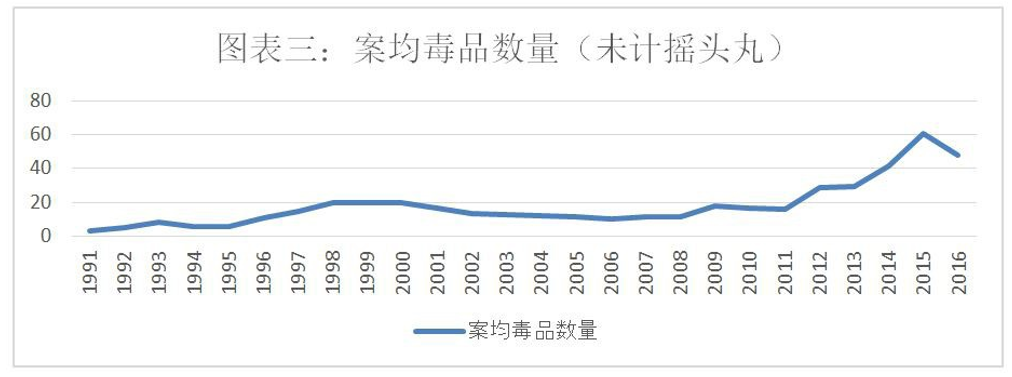
According to the current data, drug crimes in mainland China have actually experienced different development stages. In the 1980s, there were only a small number of sporadic drug traf- ficking, which obviously has the characteristics of individual drug trafficking: a large number of drug cases, but a small num- ber of drug-related cases. For example, in 1991, the per capita amount of drugs involved was 3.19 grams. For a period of time after the 1990s, the number of drug cases and the number of drugs involved increased significantly, which should be the ini- tial formation of the organization of drug crime. For example, according to the per capita drug-related quantity, the per capi- ta drug-related quantity in 1998 was 22.274 grams, which was the highest record in the 1990s and nearly seven times the per capita drug-related quantity in 1991. After 2000, the number of drugs involved in drug cases increased more than the number of drug cases. It should be that a strong drug organization has been formed. For example, the number of drugs involved per capita in 2015 was 59.5g, 2.67 times that in 1998 and nearly 19 times that in 1991. In terms of the number of drugs per case, the num- ber of drugs per case was small from 1991 to 1997 (less than 10 g), less than 20 g from 1998 to 2011, and more than 50 g since 2011 (60.95 g in 2015). From 1991 to 2017, the number of drugs per case increased more than five times. There is the problem of drug capital expansion caused by drug profits, but from the per- spective of the slow increase in the number of drug cases but the rapid growth in the number of drugs involved, the main reason should be that the form of drug-related criminal organizations has changed greatly.
In addition, in terms of the diffusion process of new drugs, the diffusion of new drugs in the Mainland mainly presents three stages: the first stage is the secret establishment of factories along the border between Myanmar, Thailand and China, and the ants move to sell all over the country; In the second stage, foreign drug criminals employed unknown domestic person- nel to manufacture drugs in the name of investment and spread drugs in major cities across the country; In the third stage, there are underground illegal drug processing centers all over the country, colluding with drug criminals at home and abroad, hir- ing people with expertise to make drugs and sell them on the spot. At first, criminals involved in drug production mainly came from Hong Kong, Macao, Taiwan, Guangdong and other eastern coastal areas.
(2) Drug Market Underground
Now, illegal drug producers are everywhere in inland provinces and cities, such as Henan, Hebei, Jiangsu, Zhejiang and Shang- hai; Drug makers have absorbed and digested the imported drug making technology, developed it to a certain extent, and real- ized the localization of drug making technology. According to the development context of drug-related criminal organizations in mainland China, drug-related criminal cases show a devel- opment trend from individual crime and multi person crime to gang crime with relatively fixed personnel. There is a close re- lationship between criminals, and many members are relatives or fellow townships, which has strong mutual shielding, which has brought great challenges to the trial of cases. In order to prevent intelligence investigators and "special information" and "informants" of public security border defense departments from entering the drug-related criminal organizations, drug-re- lated criminal groups (have begun) have a strict organizational structure and hierarchical system, and formulate a set of strict "rules" to manage the internal of the group; Most of the internal personnel of drug-related criminal organizations live in scattered places, with single line contact, forming a "honeycomb" contact network.
Conclusion
First, the sources of information on drug cases are limited. Al- though drug cases have great social harm, there are few direct victims. When the sponsors and participants of drug crimes par- ticipate in the manufacture, cultivation, trafficking and sale of drugs, they often have the knowledge of drug crimes at the be- ginning of their behavior. In fact, in addition to innocent people involved in drug cases and drug addicts, everyone involved in drug crimes is not only the beneficiary of drug cases, but also the active perpetrator of drug crimes.
Second, drug sellers are in a dominant position in the drug mar- ket. First of all, drug cases have huge profits. Drug producers, traffickers and transporters often do not hesitate to take risks, and drug cases are difficult to stop for the time being. Secondly, drug users are dependent on drugs, which leads to the fact that drugs are actually a seller LED market. Finally, evidence col- lection in drug cases mainly refers to the collection of evidence from drug sellers.
There are no fixed trading places and trading objects in the drug market. The complexity of drug sources de- termines the complexity and randomness of drug sellers. The traditional way of evidence collection is difficult to deal with the changeable characteristics of drug sellers. Third, drug evidence collection is accidental. The crime of drug cases is "hidden" and "closed", the source of information is lim- ited, and the evidence collection is accidental. The organizers and participants of drug cases understand the great social harm of drugs and the severe crackdown policy of the state on drug crimes. Participants in drug crimes are very clear about the final legal results and the penalty results once the crime is exposed at the beginning of participation.
Therefore, effective drug control measures must solve three ma- jor problems: how to reduce the profits of drug crimes, how to reduce the accumulation of drug trafficking funds, and how to ef- fectively reduce drug users, that is, the market problem of drugs must be taken into account in combating drug crimes. The cur- rent drug investigation and seizure work is mainly aimed at the process of drug manufacturing and trafficking, that is, "blocking and blocking", and there is a lack of research and pertinence on the drug market.
References
- Dr. Qi Yaping, China University of Political Science and Law, No. 25, XituchengRoad, HaidianDistrict, Beijing, China.
- A French social economist began to pay attention to drug crime from the perspective of globalization because he pre- sided over the United Nations project on global drugs in 1997. From 1997 to 2001, Professor Guilhem Fabre and Professor Michel Hille jointly served as the subject mod- erator of the international cooperative research project "in- ternational drug problem and economic and social change" jointly organized by UNESCO and the International Nar- cotics Control Commission.
- Guilhem Fabre (2003) Prospering on Crime: Money Laun- dering and Financial Crises, beijing: Social sciences aca- demic press.
- Guilhem Fabre (2006) Black Gold in the 21st Century, bei- jing: Social sciences academic press.
- World Drug Report (2021) (United Nations publication, Sales No. E.21.XI.8), EXECUTIVE SUMMARY POLICY IMPLICATIONS 12.
- United Nations: International Narcotics Control Board (INCB), Report of the International Narcotics Control Board for 2015. 2016: 10.
- America's Habit (1986) Drug Abuse, Drug Trafficking, and Organized Crime, Report to the President and the Attorney General.
- Chen Xingliang (2013) Judicial control over the application of death penalty -- from the perspective of the first batch of criminal guidance cases. J Law 2: 43-57
- A typical case in this regard is the Pingyuan incident in (1992) Drug trafficking, gun trafficking and other criminal activities have always been rampant in Pingyuan, ignoring the local military police and laws. Under the instructions of the central political and Legal Commission and the Min- istry of public security, the Public Security Department of Yunnan Province launched a crackdown on serious illegal and criminal activities in Pingyuan. On August 29, 1992, the arrest team entered Pingyuan. See Anonymous: the Be- ginning and End of the Collapse of the Underworld and Evil Forces in Pingyuan: the first Large-scale Armed Anti-Drug Incident in China, HowNet, and website: https://www.zhi- hu.com/market/paid_column/1254423885912961024/sec- tion/1322885398704861184.
- Mo Hongxian (2012) The challenge of drug crime and the response of criminal law [J] Politics and law, 10: 79-88.
- Qi Yaping (2020) "General negation" of technical investi- gation behavior. [J] Journal of Gansu University of political science and law 1: 102-112.
- Qi Yaping (2019) Evidence Theory and Evidence Practice in Drug Cases [M] China University of political science and Law Press, Beijing.
- Christopher Contreras, John R Hipp (2020) Drugs, Crime, Space, and Time: A Spatiotemporal Examination of Drug Activity and Crime Rates. Justice Quarterly 37: 187-209.
- China's drug control report released in the current year. Since 2013, China's National Narcotics Control Commis- sion has publicly released the handling data of drug cases in the previous year in China. At present, the Chinese gov- ernment has two authoritative reports on drug cases, one is China's drug control report and the other is China's drug situation report. The data in the chart are from the reports from 2013 to 2018.
- Google LLC (2020) Researchers Submit Patent Applica- tion, Personal Search Result Identifying A Physical Loca- tion Previously Interacted With By A User, for Approval (USPTO 20200285680) [J]. Internet Business Newsweekly.
- Tim Newburn, Michael Shiner & Stephanie Hayman (2004) Race, Crime, and injustice? Strip Search and the Treatment of Suspects in Custody. Brit J Criminology 44: 677-679.