

Space Science Journal(SSJ)
ISSN: 2997-6170 | DOI: 10.33140/SSJ


Research Article - (2025) Volume 2, Issue 1
On the Alternative Special Theory of Relativity Applicable to Physical Theorems of Rotation in the Uniform Rotating Frames
Received Date: Jan 22, 2025 / Accepted Date: Feb 24, 2025 / Published Date: Feb 27, 2025
Copyright: ©Â©2025 Pu Guangyi. This is an open-access article distributed under the terms of the Creative Commons Attribution License, which permits unrestricted use, distribution, and reproduction in any medium, provided the original author and source are credited.
Citation: Guangyi, P. (2025). On the Alternative Special Theory of Relativity Applicable to Physical Theorems of Rotation in the Uniform Rotating Frames. Space Sci J, 2(1), 01-09.
Abstract
Albert Einstein formulated the Special Theory of Relativity in 1905 based on the principles of relativity and constancy of light velocity principles. The Lorentz transformation, applicable to inertial frames, ensures the form of physical laws remains the same when transformed between them. It should be noted that the viewpoints expressed in this paper are merely the personal insights of the authors and do not necessarily represent absolute correctness. This paper notes that physical rotation theorems of structural bodies (such as a rigid disk) have the same form in uniform rotating frames (Alternative Principle of Relativity). Relativity states no object can exceed light speed. Similarly, this paper postulates that the rotational angular speed of a "structural body" in nature has a maximum limit. Photons in vacuum are the "structural body" with the fastest rotational angular velocity (Ωmax = c/2π, unit: rad/s), called the principle of constancy of light angular velocity. Using analogy, the paper obtains the Alternative Lorentz Transformation for rotational physics of structural bodies in uniform rotating frames and derives the Alternative Special Theory of Relativity within angular displacement space - time. Photons thus have dual properties: the fastest - moving "particles" and the "structural body" with the fastest rotational angular velocity.
This theory may offer new insights into rotational physical phenomena in uniform rotating frames and photon behavior. It could bridge the gap between the special theory of relativity for linear motion and the field of rotational motion. Future research should focus on experimentally validating predicted phenomena, like the maximum angular velocity limit and the effects of the Alterna- tive Lorentz Transformation. Exploring its application in other physics areas, such as rotating celestial bodies in astrophysics, could also bring new understandings. Although this work is just a start with many uncertainties, the authors hope to contribute to scientific progress.
Keywords
Inertial Frames of Reference, Uniform Rotating Frames, Maximum Angular Velocity, Alternative Lorentz Transformation, Alternative Special Theory of Relativity
Introduction
The Special Theory of Relativity, based on the principles of relativity and the principle of constancy of light velocity, has existed for more than a century. Theory of relativity has changed people's traditional concept of space-time, and the form of physical theorem has also changed from Galilean transformation to Lorentz transformation. Lorentz transformation is based on inertial frames, Feynman & Landau clearly point out that Lorentz transformation is not suitable for uniform rotation frames [1-3]. Shu xinghai argued that as long as the concept of space-time has not been completely changed, the rotational frames have no relativity [4]. Moreover, the physical theorems of rotation, such as the differential equation of rotation of a rigid body about a fixed-axis, the theorem of angular momentum, and the theorem of angular momentum about the mass center of a particle system, all have the same form in the uniform rotating frames (Equation 5).
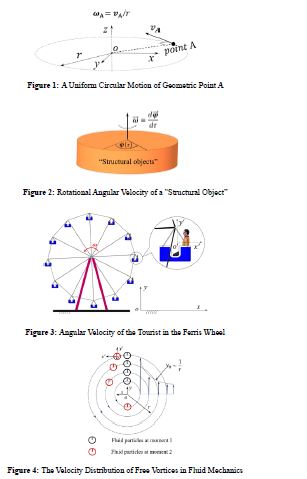
In addition, the theory of relativity explicitly states that the light velocity (c) is the maximum speed limit of the motion of any object in nature (that is, the maximum limit value of velocity is the light velocity (c)), and is independent of the motion of the light source. Landau had provided some explanation of why physical quantities in nature (such as light velocity) must have certain limit values [3]. However, is there a maximum limit value for angular velocity in nature as well? Does it not change with the motion of the "rotating source"? That is, is there also a principle of constancy of object angular velocity? If so, what is the value of the maximum limit angular velocity in the universe? (Note: In this paper, the angular velocity (ω) is the angular velocity of an object (such as a rigid disk) with a certain "structural shape", rather than the "rotational angular velocity" of a point (or particle) when it moves in a circle around another point in a pure mathematical (geometric) sense, as shown in Figure 2.) Furthermore, since the laws of rotational physics have the same form in the uniform rotating frames (Equation 5), does that indicate that there is also an "Alternative Lorentz Transformation" applicable to laws of rotational physics? However, all the above issues were seldom reported in the current publicly published literature.
This paper postulates that the rotational angular velocity of objects which have a certain "structural shape" (such as a rigid disk) in nature also has the maximum limit value. Photons in vacuum are the "structural body" with the fastest angular velocity (Ωmax) in nature, and its value is c/2π (Ωmax=c/2π, unit: rad/s), where c is the light velocity, also independent of the motion of the light source, which is called the Principle of Constancy of Light Angular Velocity in this paper.
Based on the Principles of Alternative Relativity another postulate in this paper, Equation 5ï¼?and the Principle of Constancy of Light Angular Velocity, using analogy method, we derived the expression of the Alternative Special Theory of Relativity within angular displacement space-time (φ(τ)). Therefore, photons in vacuum have dual properties: they are both the fastest moving “particles” and the "structure body" with the fastest rotating angular velocity at the same time in nature! When we begin to explore the Alternative Special Theory of Relativity, we are acutely aware that we are merely attempting to expand the boundaries of our understanding of rotational physics. This new theory might potentially integrate some concepts across different physical areas. For instance, in astrophysics, the rotation of celestial bodies is a key aspect, and in micro - scale physics, the rotational dynamics of nanoparticles and molecules are drawing increasing attention. We hope that this exploration could contribute to further research, both theoretical and experimental.
In theoretical research, we can try to clarify the postulates, examine the mathematical consistency of the derived equations, and gradually apply the theory to more complex situations. Experimentalists may explore new ways to test the predictions of the maximum angular velocity limit and the effects of the Alternative Lorentz Transformation. Overall, we sincerely hope that this work can slightly deepen our understanding of the fundamental laws of nature and encourage the next generation of physicists to engage in scientific exploration. We recognize that our efforts are just a small step in the vast journey of scientific discovery, and there is still a long way to go.
Classical Space-Time Review
The classical space-time relation in the inertial frames can be expressed by the space-time coordinate r (r = r(t)), r is the dis-placement (linear displacement, Unit: meter) , t is the time (Unit: seconds) in the linear displacement space-time. In the study of space-time relations, an event can be expressed as p (x, y, z, t), in the space-time Cartesian coordinate system. Besides the rep- resentation of an event, for multiple physical quantities in these systems, we can derive them based on linear displacement r and time t, some physical quantities can be directly derived, for exam-ple, linear velocity v (v=r) dot is the derivative with respect to time) is the first derivative of displacement r with respect to time (t), Acceleration (Ã = v = r) is the first derivative of ve-locity with respect to time, which is also the second derivative of displacement r with respect to time. Of course, there are other indirect physical quantities such as the linear momentum (mv) of a particle, where m is the mass (unit: kg) of an object (such as a par- ticle). In addition, there are some typical physical theorems such as Newton's second law of motion (F = mr =mv = ma). At present, the concept of space-time has developed from Newton's absolute view of space-time to the current Einstein’s relativistic view of space-time [1].
The alternative space-time relationship in the rotating frames can be expressed as φ(τ), where φ is the angular displacement (Unit: rad), and τ is the time (Unit: seconds) in the angular displacement space-time. An event also can be expressed as P (φ,τ) in the alternative space-time. Based on the angular displacement φ and time τ, some physical quantities can also be directly derived, for example, angular velocity w (w = φ) is the first derivative of angular displacement φ over time τ, and angular acceleration ß (ß = w = φ) is the first derivative of angular velocity ω over time, that is, the second derivative of angular displacement φ over time τ. Similar, there are other indirect physical quantities such as the angular momentum (Jc ω) of an object, where Jc is the mass moment of inertia of the object (unit: Kgm2). In addition, there are also some typical physical theorems of rotation, such as the differential equation of rotation of a rigid body about a fixed-axis (Mc (F) = Jcφ = Jcω = Jcß).
Note: Regarding time, in this paper, for the convenience of distinguishing, the time in the linear displacement space-time (r(t)) is denoted as t, and in the angular displacement space-time (φ(τ)) is denoted as τ. Here we define a new variable named “Time” which is related to the previous defined t and τ as:
Time=t+iτ (*)
In other words, in formula (*), the real part t represents time in the linear displacement space-time (r(t)), while the imaginary part τ represents time in the angular displacement space-time (φ(τ)), this paper called τ is the Alternative time.
About Angular Velocity
The angular velocity ω in this paper, refers to the rotational angular velocity of an object with a certain "structural shape". Figure 1 shows a uniform circular motion of geometric point A (or particle A) around point O, with a radius of r and a velocity magnitude value of vA; the " point rotational angular velocity" of point A is ωA (ωA=vA/r). However, this type of “point angular velocity” (ωA=vA/r) is not within the scope of this paper. In this paper, the angular velocity ωA (ωA = v / r) refers to that of an object (like a rigid disk) with a certain "structural shape" in alternative space-time (φ(τ), Figure 2), rather than that of a point (or particle) moving in a circle around another point in a pure mathematical (geometric) sense (as shown in Figure 1.) As shown in Figure 3, when the Ferris wheel rotates at a constant speed of ω, however, the rotational angular velocity of the tourist in the Ferris wheel is equal to 0 (not ω) [5]. Similarly, in fluid mechanics, as shown in Figure 4, the characteristic of free vortices is that the velocity of fluid particles is inversely proportional to the radius of rotation, at this time, the rotational angular velocity of fluid particles (except for the vortex center) is equal to 0 [6,7].
Relativity in Classical Mechanics


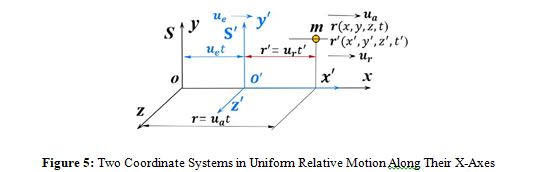
The relationship of the coordinates in the two systems is clear from the diagram. After time t origin of S' has moved a distance ve t, and if the two systems originally coincided. For the sake of convenience, the mathematical expression of Galilean transformation's mechanical relativity principle for the movement in the horizontal axis direction were given [5]:
In other words, the velocities are taken to add linearly (which is in agreement with “common sense”). Note, t'=t, which asserts that time is not affected by relation motion. We substitute this transformation of coordinates into Newton’s second laws:

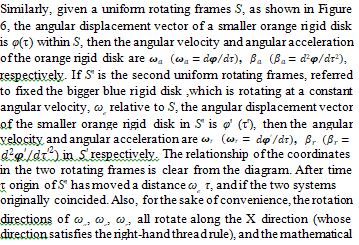
expression transformation's mechanical relativity principle were given [5]:
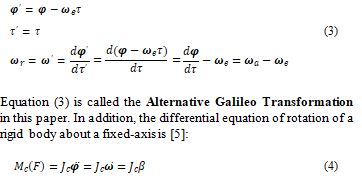
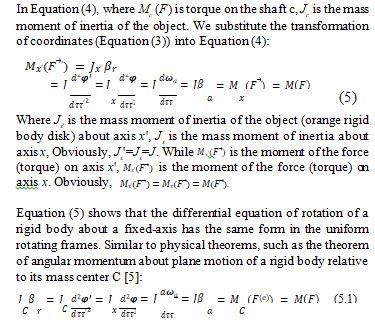
In Equation 5.1, JC is the moment of inertia of the rigid body relative to its mass center C, andð??ð¶ (ð¹â??(ð??))is the moment of external force to the mass center C. In fact, various the rotational physics theorems of structural bodies (such as rigid body disks), such as the theorem of angular momentum about the mass center of a particle system, the theorem of angular momentum, the conservation theorem of angular momentum, etc., all also have the same form in the uniform rotating frames [2,5]. We postulate that all rotational physics theorems of structural bodies (such as rigid body disks) about a fixed point or center of mass have the same form in the uniform rotating frames. This paper calls this property the Alternative Principle of Relativity which is applicable to the rotational physics theorems of structural bodies. Note that the corresponding physical quantities in uniform rotating frames should be: angular displacement (φ), angular velocity (ω), angular acceleration (β), moment of inertia (J), moment of momentum (L) (angular momentum (Jω)), moment of the force (or couple), etc
Note: In angular displacement space (φ(τ)), forces (Unit: N) including centrifugal force and Coriolis force are no longer physical quantities, but moments or couples (Unit: Nâ??m) are "forces" in angular displacement space.
The Lorentz Transformation
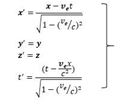
The Lorentz transformation is a set of equations that describe how measurements of space-time between two inertial reference frames are related when they are moving relative to each other at constant velocities. As shown in Figure 2, the Lorentz transformation equations are as follows:
The Alternative Lorentz Transformation
Firstly, this paper postulates that the rotational angular velocity of an object with a certain "structural shape" in nature also has a maximum limit value. Photons in vacuum are the "structures body" with the fastest rotational angular velocity (Ωmax) in nature and its value is c/2π (Ωmax=c/2π, unit: rad/s), where c is the ligh velocity, also independent of the motion of the light source, which is called the Principle of Constancy of Light Angular Velocity in this paper. In addition, the rotational physical laws of structural bodies, have the same form in the uniform rotating frames. In this paper, it is referred to as the Alternative Principle of Relativity which is applicable to the rotational physical laws of structural bodies.
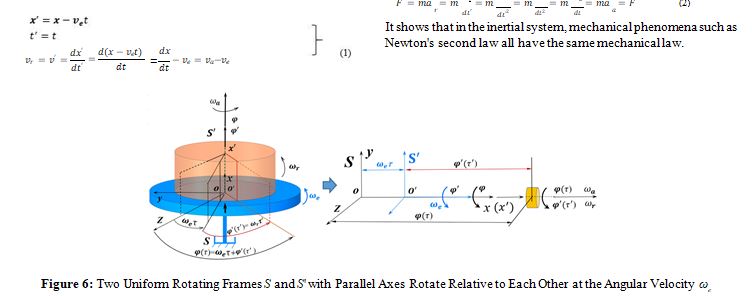
As shown in Figure 6, there are two uniform rotating frames S and S'. The S' system moves at a uniform angular velocity of ωe relative to the S system. The two systems originally coincided, that is τ'=τ=0, The angular displacement coordinates of the orange rigid disk in the S is (φ,τ), while in the S', is (φ',τ'). The transformation of (φ,τ) and (φ',τ') is based on the following two points: 1, The space-time (φ,τ) transformation in uniform rotating frames is “linear”.
2, At low angular velocity, The transformation(φ,τ) should be degenerated into Alternative Galileo transformation (Equation (3)).
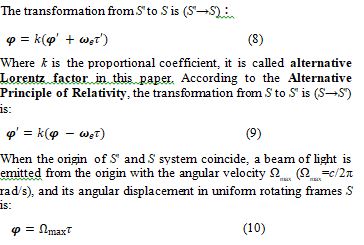
Similarly, according to the principle of constancy of light angular velocity, the angular displacement in in uniform rotating frames S' is:
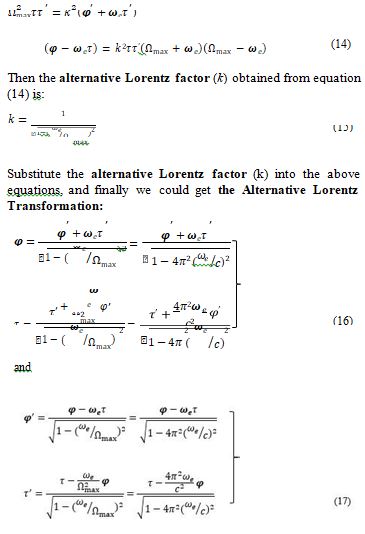
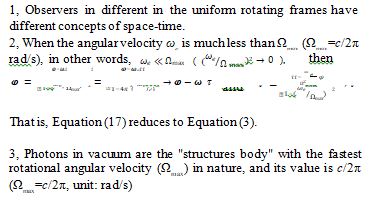
Equation (17) is called forward transformation ((φ,τ) → (φ',τ')), while equation (16) is inverse transformation ((φ',τ') → (φ,τ)). From formulas (16) and (17), it is not difficult to know that:
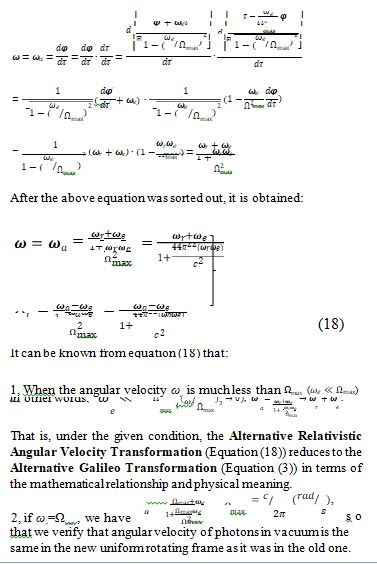
Alternative Relativistic Angular Velocity Transformation
From the Alternative Lorentz Transformation (Equation (16) and Equation (17)), we could derive the Alternative Relativistic Angular Velocity Transformation
Alternative Relativity of Simultaneity, Time Dilation and Length Contraction
First, there are two arbitrary events, which are expressed as event 1
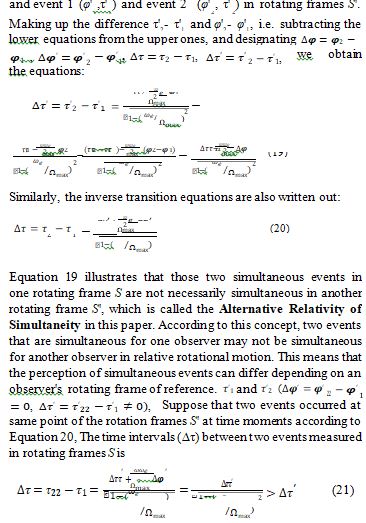
Which (Equation 21) is called Alternative Time dilation in this paper, it refers to the phenomenon where time appears to pass at different rates for observers rotating at different rotational angular speed. According to the theory, as an object's rotational angular speed approaches the speed of Ωmax, time for that object appears to slow down relative to a stationary observer. This effect becomes more pronounced as the object's rotational angular speed increases.
Similarly, suppose a “ruler” is at rest in the rotation frames S' and the coordinates of its ends are φ'1and φ'2, the “length” (Unit: rad) of the ruler equal to φ'2-φ'1. The proper “length” of the ruler is designated by φ0, i.e., φ0=φ'2-φ'1. Since the ruler is motionless in S', one may not worry about the simultaneity of measurements of the coordinates of its ends. While, at a certain moment in the uniform rotating frames S, the coordinates of the ruler’s ends are measured as φ1 and φ2, the “length” of the ruler measured in S is φ=φ2-φ1, According to the Alternative Lorentz Transformation, we obtain

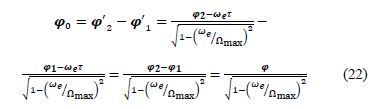
Which (Equation 22) is called Alternative Length contraction in this paper, it refers to the idea that an object in rotating motion will appear “shorter” in the direction of rotating motion (whose direction satisfies the right-hand thread rule) compared to the same object at rest. This effect is a consequence of the Alternative Relativity of Simultaneity and Alternative Time dilation.
Conclusion
In this paper, we proposed two key postulates. The first postulate asserts that the rotational physical laws of structural bodies (such as rigid body disks), such as the differential equation of rotation of a rigid body about a fixed-axis, are the same in the uniform rotating frames of reference. The fundamental rotational physics laws remain unchanged. This paper calls this property the Alternative Principle of Relativity. The second postulate states that the rotational angular speed of a "structural body" in nature also has a maximum limit value, Photons in vacuum are the "structures body" with the fastest angular velocity (Ωmax) in nature, and their value is c/2π (Ωmax=c/2π, unit: rad/s), where c is the light velocity, also independent of the motion of the light source, which is called the Principle of Constancy of Light Angular Velocity in this paper. Therefore, photons in vacuum have dual properties: they are both the fastest moving “particles” and the "structural body" with the fastest rotating angular velocity at the same time in nature!
Based on the above two postulates, we obtain the Alternative Lorentz Transform applicable to the laws of rotational physics, and then derive the expression of the Alternative Special Theory of Relativity. In fact, by using analogy, many similar concepts within Special Theory of Relativity in linear displacement space time (r(t)) could be extended to Alternative Special Theory of Relativity in angular displacement space-time (φ(τ)), However, these concepts are only applicable to the rotational physical laws of structural bodies in the uniform rotating frames.
The newly developed Alternative Special Theory of Relativity might potentially open up some interesting directions for further exploration. From an experimental perspective, figuring out ways to test the proposed maximum rotational angular velocity limit and the predictions of the Alternative Lorentz Transformation is both a challenging task and a possible opportunity. For example, conducting high - precision measurements in ultra - fast rotating micro - mechanical systems or studying certain exotic materials with unique rotational properties could perhaps offer some clues about the validity of these concepts, although there are many difficulties to overcome.
Theoretically, attempting to integrate this theory with other branches of physics, like quantum mechanics in the context of rotating systems, might contribute to a more complete understanding of the fundamental nature of matter and energy. Also, applying this theory to astrophysical scenarios, such as rapidly rotating neutron stars or accretion disks around black holes, may provide some new ways of looking at their internal structures and dynamic behaviors. However, we are well aware that these are just preliminary speculations.
In conclusion, this paper simply tries to lay a basic foundation for a new approach to the rotational physical laws of structural bodies in uniform rotating frames. There is still a long way to go to fully explore the implications, test the predictions, and incorporate it into the broader body of physical knowledge. We sincerely hope that this initial effort can inspire some follow - up research and make a small contribution to the progress of our understanding of the complex physical phenomena in the universe. It should be emphasized that the content and viewpoints presented in this paper are solely the personal insights of the authors. They are based on theoretical speculation and analogical reasoning, and have not been fully comprehensively verified by a large number of experiments and the academic community. Therefore, they do not necessarily represent absolute correctness. We sincerely hope that this paper can inspire more in - depth research and discussions in the field, and contribute to the exploration of the mysteries of the physical world in a positive way.
References
1. Taylor, A. E. (1921). Relativity, the Special and the General Theory: A Popular Exposition.
2. GuangYi, P. U., & Cheng-Xi, P. (2021). The curl of angular velocity and its mechanical significance.
3. Hayhoe, R., Li, J., Lin, J., & Zha, Q. (2012). Portraits of 21st Century Chinese Universities:: In the Move to Mass Higher Education (Vol. 30). Springer Science & Business Media.
4. Qu, J. C. (1998). Chinese physicists educated in Germany and America: their scientific contributions and their impact on China's higher education (1900-1949). The Ohio State University.
5. Kai-Yuan, Y. (Ed.). (2012). Progress in Applied Mechanics: The Chien Wei-zang Anniversary Volume (Vol. 6). Springer Science & Business Media.
6. Wang, H. (2014). Fluid mechanics as I understand it. National Defense Industry Press, Beijing.
7. Sun, B. H. (2023). An equivalent form of the Navier-Stokes equations. Acta Mechanica Sinica, 39(2), 322241.
Supplementary Materials
Question 1: This article proposed that the angular momentum theorem, the differential equation of rigid body rotation about a fixed axis, and the angular momentum theorem relative to the center of mass - these rotational physics theorems of structural bodies in rotating reference frames - have the same form. Some scholars have questioned this, arguing that rotating reference frames are non - inertial frames, which will inevitably introduce inertial forces such as centrifugal force and Coriolis force, thus requiring additional consideration of inertial torque effects.
Answer: Since the reference frame is a uniformly rotating (non- variable rotating) reference frame and the object of study is structural body (such as a rigid disk) rather than a moving point, we can take the differential equation of rigid body rotation about a fixed axis as an example. All points on the rigid body only experience normal centrifugal force, and thus there is no tangential inertial force. Because all the normal centrifugal force acts through the rotation axis, the torque of all normal centrifugal forces about the rotation axis is zero! Moreover, the object of study is a structural body, for instance, a rigid disk. Also, there is no relative motion of moving points, so there is no Coriolis force. In summary, in a uniformly rotating reference frame (which is a non - variable rotating reference frame), for the structure (such as a rigid disk), the torques from centrifugal force and Coriolis force are all zero.
In summary, in angular displacement space (φ(τ)), as mentioned in the paper, "force" refers to moments or couples (units: N•m). In a uniformly rotating reference frame, the rotational physical laws of structural bodies (such as rigid body disks) do not need to consider the effects of inertial forces such as centrifugal force and Coriolis force. The fundamental rotational physics laws of structural bodies remain unchanged. This is the Alternative Principle of Relativity.
Question 2: Some people propose that the space - time characteristics of the rotating reference frame have already been described by the general theory of relativity. Therefore, there are questions about the compatibility of our new theory with general relativity, suggesting that it may duplicate existing theories or lead to contradictions. bodies exceeds Ωmax; however, there are indeed such reports in the artificial nano-field, as referenced: Quantum control and Berry phase of electron spins in rotating levitated diamonds in high vacuum. Nat Commun 15, 5063 (2024). https://doi.org/10.1038/ s41467-024-49175-3. We believe:
As mechanical engineering professionals, we do not understand the experimental principles, detection methods, etc. reported in doi.org/10.1038/s41467-024-49175-3. It is only known from the original text that a specific device is used to drive nano- diamonds levitated in a vacuum, with a maximum driving angular frequency of 20 MHz. For nano-sized diamonds rotating at high speed in a vacuum, their motion state is extremely complex, often accompanied by various vibrations and other conditions. For the complex motion state of the nano-diamonds, the angular frequency may not necessarily equal the angular velocity of the diamond! Furthermore, the paper mentions monitoring the motion of the centroid C of the nano-diamond and estimating the radius of the levitated nano-diamond. In this case, even if the angular velocity at the centroid C point can be obtained, this point's angular velocity does not necessarily equal the rotational angular velocity of the nano-diamond.
Due to the complexity and specificity of the microscopic field, it is theoretically possible for the rotational angular velocity of nano- diamonds to exceed Ωmax.
In conclusion, based on the reasons mentioned above, we are currently unable to give a definitive answer regarding whether the rotational angular velocity of nano-diamonds truly exceeds Ωmax.Question 4: Our hypothesis of the "maximum angular velocity" of photons conflicts with the description of photon spin in quantum field theory. Spin is a quantized property and is unrelated to classical rotation.
Answer: This situation is indeed true. However, if we consider it from a different perspective, there are many aspects in which general relativity and quantum mechanics are also incompatible. If future experiments can indeed confirm the "maximum angular velocity" hypothesis, then re-examining the properties of photons from a new angle may yield further insights.
Question 5: We define time as a complex number Time = t + iτ, where the real part represents time in linear displacement space, and the imaginary part represents time in angular displacement space, specifically in uniformly rotating reference frames. Some scholars have pointed out that time in physical measurements must be a real number, and the introduction of imaginary time does not provide verifiable physical effects, leading to a detachment from physical reality.
Answer: The reason for introducing the complex number Time= t + iτ is simply for the sake of convenience and simplicity in mathematical description. Taking the example of a rigid disk rotating uniformly around its center C, in linear displacement space- time (r(t)), for two points A and B on the disk at different distances from the center C, if the radii of points A and B are different, then the speeds of points A and B will also be different. According to special relativity, the passage of time t at points A and B will be different. However, in the angular displacement space-time (φ(τ)), the angular velocity at any point on the rigid disk is the same; thus, according to the alternative special relativity, the passage of time τ at any point on the rigid disk is the same! This indicates that the same problem can yield different results when approached with different theories. Using time τ in this context clearly results in a more concise and convenient outcome. In summary, by introducing the complex number Time = t + iτ, people gain an additional choice, a suitable choice, where the resulting form may be simpler and more convenient. However, it should be noted that if time τ is used, it is theoretically suitable for physical quantities in angular displacement space-time, such as moments or couples (units: N•m), and cannot be applied to physical quantities in linear displacement space-time, such as forces including centrifugal force and Coriolis force (units: N). This is the essence of what Pu Guangyi is expressing, without any further implications.
Answer: We believe that general relativity mainly describes the rotational motion of point masses, whereas our theory studies the motion of structures (such as rigid disks) in uniformly rotating frames (angular displacement). We assert that there is no contradiction between the two.
Question 3: We believe that in nature, the rotational angular velocity of structural body cannot be infinite and should have a maximum limit value, denoted as Ωmax = c/2π, with units of rad/s, where c is the speed of light. It should be noted that the angular velocity referred to here is the rotational angular velocity of an object with a certain "structural shape" (such as a rigid body disk), rather than the "angular velocity" of a point (or particle) moving around another point in a pure mathematical (geometric) sense! Some scholars have pointed out that there are reports in the artificial nano-field indicating that the rotational angular velocity of nano-diamonds has exceeded Ωmax, as detailed in Jin, Y., Shen, K., Ju, P. et al. Quantum control and Berry phase of electron spins in rotating levitated diamonds in high vacuum. Nat Commun 15, 5063 (2024). https://doi.org/10.1038/s41467-024-49175-3.
Answer: No reports have been found so far in the macro natural world indicating that the rotational angular velocity of structural