

World Journal of Forest Research(WJFR)
ISSN: 2994-5569 | DOI: 10.33140/WJFR



Research Article - (2025) Volume 4, Issue 2
Ocean Energy with Linkages to Earth’s Environmental Mechanisms, and Approach to a Total Renewable Energy Structure Plan
Received Date: Sep 01, 2025 / Accepted Date: Oct 02, 2025 / Published Date: Oct 17, 2025
Copyright: ©2025 Robert Kempton. This is an open-access article distributed under the terms of the Creative Commons Attribution License, which permits unrestricted use, distribution, and reproduction in any medium, provided the original author and source are credited.
Citation: Kempton, R. (2025). Ocean Energy with Linkages to Earth
Abstract
The universal force of attraction between all matter fundamentally governs Earth's environmental systems, particularly through the influence exerted by the Moon's orbit and the concept of gravitational forces. This relationship creates complex interactions among energy flows and planetary ecosystems, including processes such as photosynthesis, geothermal activity, biogeochemical cycles, and hydrological systems. These dynamic processes contribute to both the stability and evolution of Earth's systems. The Moon’s gravitational force is pivotal in regulating tidal movements, which significantly impact marine ecosystems and coastal environments.
Covering more than 70% of the planet’s surface, the oceans remain in perpetual motion due to Earth’s natural environmental mechanisms, serving as extensive reservoirs for kinetic energy resources on a global scale. The advancement of fluid mechanics in scientific research offers significant potential for sustainable energy development, supporting long-term human well-being. The vast kinetic energy resources are available for mankind, once additional methodologies have been developed for near future projects.
However, human activities are increasingly affecting major ecosystems and the biogeochemical cycles they regulate, highlighting the urgent need for systematic identification and analysis. This situation calls for the implementation of new international regulations addressing climate change and ocean related environmental challenges that pose substantial risks to all forms of matter on Earth. It is essential to reassess current human approaches to natural biogeochemical cycles in accordance with established physical and chemical principles, including considerations informed by the modern understanding of the Periodic Table.
Keywords
Environmental Mechanisms, Fluid Mechanics, Boundary Conditions, Stratification, Kinematic Viscosity, Energy, Biogeo- chemical Process, Matter, Periodic Table
Introduction
The universal force of attraction between all matter dominates Earth’s environmental mechanisms, with the Moon’s location prominent.
This gravitational concept embraces the intricate relationships between energy flow and the planet’s ecosystems, such as pho- tosynthesis, geothermal activity, biogeochemical cycles, and hy- drological cycles. Indeed, it provides an approach towards a better understanding of these mechanisms in a sustainable manner.
Long-term sustainable energy may only be achieved through a per- manent (24/ 7) total supply of green renewable energy, harnessed from earth’s natural energy forces. Over two thirds the surface of the planet is available, and Man now holds the knowledge to ad- dress such a global project. Proven fluid mechanics techniques monitored and controlled by the latest ‘advanced project man- agement solutions’ (APMS)1 represent the approach towards for- mulating a global structure plan for harnessing the kinetic energy stored in our Oceans. This to co-ordinate a framework for a range of proposed methodologies for harnessing energy, covering both the coastal waters and the high seas.
The United Nations held a Convention on the Law of the Sea in 1982, to set out a legal framework for the Seas and Oceans, to define the rights and obligations of Countries with respect to the marine environment and in 2023 formed an Agreement on the Conservation and Sustainability use of Marine Biological Diversity of Areas Beyond National Jurisdiction, which is not in force until ratified by 60 Countries2, of the 143 Countries who have signed the Treaty. The 60 Countries ratification was achieved on 19 September 2025, and in accordance with article 68(1)3 the Agreement comes into force on 17 January 2026. For each state or organization, a following 30 days are required for individual acceptance.
At present the Agreement lacks any structure for essential jurisdiction to support the harnessing of huge quantities of the earth’s stored kinetic energy.
Oceans4
The Sun’s energy is directly responsible for the stratification process to earth’s oceans, which creates the environmental mech- anisms to produce layers of transition boundaries through the ocean’s depths, vital for all marine life, as we know and under- stand it.
In Lakes and small bodies of water, the warm surface layer is less dense and forms a thermocline boundary condition, above which is the ‘epilimnion’, with the cooler water disconnected below as the ‘hypolimnion’. In the Oceans, the thermocline's environmental mechanism is influenced by the depth of the ocean’s waves, which creates a mixing process boundary layer condition in the upper 100 metres. The temperature decreases rapidly from the mixed upper layer of the ocean (epipelagic zone) to the much colder deep water in the thermocline (mesopelagic zone).
Below the thermocline are colder, denser waters, and below 3,300 feet to a depth of about 13,100 feet, the water temperature remains constant5. The deeper (stratified) layers contain colder, denser bottom waters where rare and unknown life forms exist6.
The relationship between depth and temperature is significant, as different marine species thrive in specific layers. This environmental mechanism may be a key area for studying the origins of life. Creatures who live at great depths do not have air in their bodies such as the swim bladders found in fish that live in more shallow waters. Without air in their bodies, the pressure problem is solved. Fish, crab, octopus, worms, limpets and clams are just some of the creatures found in the depths of the oceans7.
Despite its central role in the global climate, the Southern Ocean circulation is still one of the least understood ocean circulation systems of the planet8The term El Niño (Spanish for 'the Christ Child') refers to a warming of the ocean surface, or above-average sea surface temperatures, in the central and eastern tropical Pacific Ocean9. The low-level surface winds, which normally blow from east to west along the equator (“easterly winds”), instead weaken or, in some cases, start blowing the other direction (from west to east or “westerly winds”). El Niño recurs irregularly, from two years to a decade, and no two events are exactly alike. El Niño events can disrupt normal weather patterns in the United States and globally.
The structural intricacies of ocean layers are further influenced by nutrient cycles and biological activity. In the epipelagic zone, where sunlight penetrates most effectively, primary producers like phytoplankton perform photosynthesis, generating the foundation of oceanic food webs. These upper layers are teeming with life due to nutrient upwelling, a phenomenon driven by ocean currents and the movement of tectonic plates. As depth increases, the availability of sunlight diminishes, creating stark contrasts in biodiversity and energy dynamics between the epipelagic and mesopelagic zones.
The mesopelagic zone, often referred to as the "twilight zone," hosts unique adaptations among its inhabitants, such as bioluminescence and specialized feeding mechanisms, enabling survival in low- light conditions.
This zone also serves as a transitional environment where carbon and nutrients are sequestered, playing a critical role in the global carbon cycle.
For example, phytoplankton, which are tiny plant-like organisms, flourish in sunlight-rich zones, whereas, zooplankton, which feast on these nutrients, occupy various depths depending on the time of day.
The ‘high seas’ is in perpetual motion, embracing vast kinetic en- ergy resources10, sufficient for long-term sustainability, and the Oceans are earth’s ‘natural Energy Storage reservoirs’ for all mankind. Man’s Science is now sufficiently developed to co-ordi- nate and organise a Structure Plan embracing the additional meth- odologies11 to harness all earth’s natural energy resources, based on ‘Fluid Mechanics’ concepts.
New Environmental Laws12 to embrace the high seas vast energy resources are beyond the scope of this paper, but mention should be made that the high seas remain beyond national jurisdiction, at this time, and the new laws, when ratified, will require expansive amendments in future to embrace these natural energy resources.13
Coastal Management: A ‘Global Environmental Coastal Management Structure Plan Model’ is urgently required, to combat ‘climate change’ and other serious anthropological effects, which cause serious harm to the footprints of the ‘continental shelves, their margins’, and the less saline coastal waters. The concept for ‘Integrated Coastal Zone Management’ (ICZM) was first introduced at the national policy scale in the Coastal Zone Management Act (CZMA), enacted by the Congress of the United States in 1972, though a Master Plan for coastal management remains incomplete.
An expansive structured framework is necessary, which must identify new important limbs, for a co-ordinated ‘Global Coastal Plan Structure’, namely, Environment / Total Renewable Energy / multi-national Legislative regulatory powers. The three branches to embrace existing main topics are identified as, coastal erosion, flooding, pollution (rivers discharges controls & beach), shoreline management (SMPs), ecology and habitats, climate change, and coastal adaptation also linked to potential energy tidal projects.
Ocean Pollution: Major harm is already taking place to the Oceans which represent the majority of our planet’s surface, resulting from anthropogenic behaviour. While ‘Climate Change’ has been clearly identified, it is equally important to highlight, embrace and address the two severe forms of Man’s pollution, and intrinsically linked to earth’s environmental mechanisms, causing real damage, namely Plastics and ‘aggressive Agricultural processes.
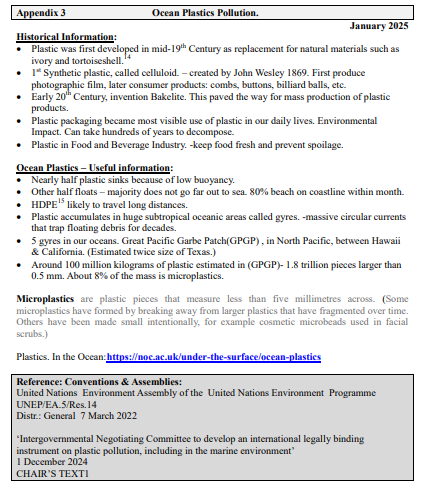
Plastics: The ‘Resolution adopted by the United Nations Environment Assembly’ on 2 March 2022, to ‘End plastic pollution’14, recalled the United Nations Environment Assembly resolutions 1/6, 2/11, 3/7, 4/6, 4/7 and 4/9.
They affirmed the urgent need to strengthen global coordination, cooperation and governance to take immediate action towards the long-term elimination of plastic pollution in marine and other environments, and to avoid detriment from plastic pollution to ecosystems and the human activities dependent on them15.
“The Intergovernmental Negotiating Committee to develop an internationally legally binding instrument on plastic pollution including the marine environment”, noted with concern the high and rapidly increasing levels of plastic pollution.16
Major quantities of plastic accumulate in our Oceans, particularly in huge subtropical oceanic areas called ‘gyres’. – these are massive circular currents that trap floating debris for decades17.
The draft ‘Chair’s Text’18, stated, in December 2024, the objective of this Convention is to protect human health and the environment from plastic pollution.19
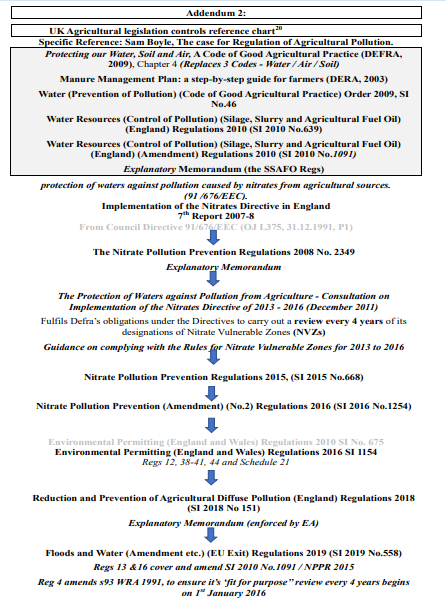
Water Pollution from Agricultural land sources remains the major pollution discharge from rivers and estuaries into coastal waters20.
Environmental Mechanisms
Environmental Mechanisms, embracing Photosynthesis, Geothermal activity, Biogeochemical cycles, Hydrological systems, and including fluid mechanics. techniques.
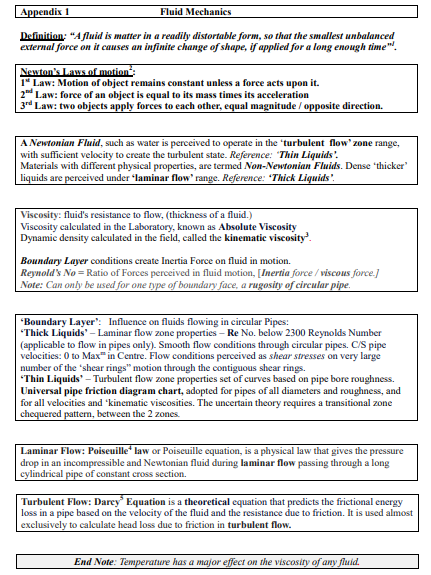
Fluid Mechanics21: Under man’s perceived mechanism, if a fluid is moving slowly, within a constrained space, a shear stress is created within the liquid, called ‘viscosity’. Sir Isaac Newton22 referred to this as the ‘coefficient of molecular viscosity’23. “All forms of life on earth are immersed in a fluid or another, either the air of the atmosphere or the water of a river, lake or ocean; even soils are permeated with moisture. So, it is no exaggeration to say that life, including our own, is bathed in fluids. A slightly closer look at the situation further reveals that it is the mobility of fluids that makes them so useful to the maintenance of life, both internally and externally to living organisms”.24
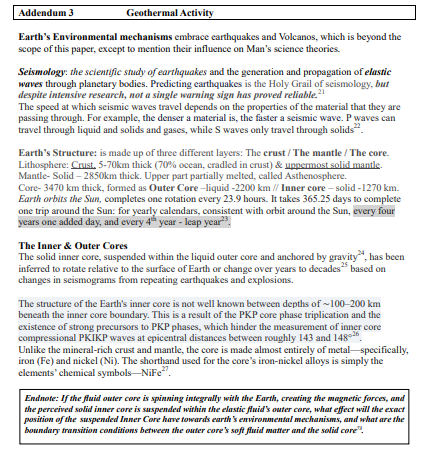
Even Earth’s solid inner core is surrounded by a perceived molten outer core25, though remains outside the general principles of Man’s science, and beyond the scope of this paper. (Reference, Endnote: a general perception, in Addendum 3)
The study of ‘matter’ and its transformations26 is not merely academic; Man’s Laws of Science needs to underpin technological advancements and solutions to pressing global challenges, such as renewable energy and long-term sustainable resource management.
Matter is anything that occupies space, has mass, and is made up of substances called elements, which are composed of extremely small particles called atoms27, and have specific chemical and physical properties. Man’s Science classifies three ‘body states’ of matter as, gaseous / fluid / solid states, with the Science ‘Fluid Mechanics’28, embracing gaseous as elastic fluids.
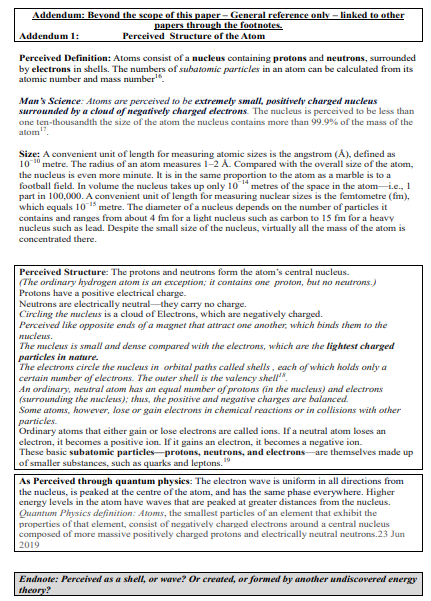
Man’s Science explains the atom structure as comprising, protons, neutrons, and electrons, perceived within a sphere of influence, controlled by ‘attraction’ and ‘repulsion’ forces, and not by a boundary condition around that perceived sphere of influence.
Size (Space): Man has no ‘real perception’ of size related to the world’s surroundings and our environment. He is unable to understand the sheer magnitude of the Universe when related to the conceived size of the perceived atom, and is beyond the scope of this paper, except to mention a general observation in Addendum 1, Endnote.
The complete tabular array of all chemical elements is classified under the ‘Periodic Table’29. The structure co-ordination of the chemical elements, organized by atomic number, is from the element with the lowest atomic number, hydrogen, to the element with the present highest atomic number, ‘oganesson’30.
The fundamental elements interact dynamically to form molecules, which are the building blocks of matter. For example, water (Hâ??O), a critical molecule for life, exhibits unique properties like high ‘specific heat’ capacity, ‘cohesion’, and ‘surface tension’, which are essential for regulating Earth's climate and supporting ecosystems.
Energy / Matter Interactions
Energy, the capacity to do work, is intricately connected to matter. In physics, the ‘Law of Conservation’ states that energy cannot be created or destroyed but only transformed. This principle governs natural processes and Classifications31, from the photosynthesis that powers ecosystems, through biogeochemical processes, and to the geothermal activity driving tectonic shifts.
Fresh approaches towards a long-term Sustainable future: The connection between energy and matter is crucial in understanding Earth's systems and environmental mechanisms, as it determines the flow of nutrients, the cycling of carbon, and the dynamics of climate regulation.
Global Long term Sustainability Energy Project (Embracing Environmental Mechanisms)
At last, Man has the knowledge to develop new innovative methodologies required to harness earth’s natural energy resources. Vast kinetic energy reserves are available in the high seas, which cover over 70% of the surface of earth.
An early example of Man’s Innovative ideas, was recorded in the late 60s, following research work into ‘fluid mechanics’ relating to ‘thick liquids’ for municipal sewage sludges. Research studies32 were successfully carried out on site to ascertain the effective range of ‘kinematic viscosity’ of ‘thick liquid’ municipal sludges, embracing the importance of ‘boundary conditions’, and ‘shear stress’ mechanisms within a fluid. (Table 1) The kinematic viscosity of water was recorded at 0.000012 ft2/sec. (Reference Appendix 1) A research paper33 was presented to the UK, Institution of Civil Engineers in 1971 and awarded recognition in July 1972. The results were adopted in the Leicester City Corporation’s Sludge Disposal Project design works, to replace temporary facilities with a permanent structure, adjacent to their Compost Plant, and was successfully completed in 1970.
Table 1 furnishes the range of ‘Kinematic Viscosity’ figures used in the Design Works calculations for their successful “Sludge Tankering Project” at Leicester City Corporation’s Wanlip Sewage Treatment Works. 
Range of Kinematic Viscosity values for Municipal Sludge
– Wanlip STW Sludge Project, 1971
(Imperial Units)
Table 1
Ocean Methodologies & Legislation: With the Advent of the ‘Biodiversity Before National Jurisdiction’ (BBNJ)34 Agreement being ratified, further important legislation is now required to embrace the additional methodologies for harnessing the natural kinetic energy storage in the Regional High Seas.
This Agreement recalled the relevant provisions of the United Nations Convention on the Law of the Sea (UNCLOS)35 of 10 September 1982 and covered just the global surface for the territorial sea and its contiguous zone36. New legislation must include the regional areas of the High Seas for coastal nations, and to be embraced under the UNCLOS ‘high seas sections’37, to embrace the methodologies for harnessing natural kinetic energy storage zones.
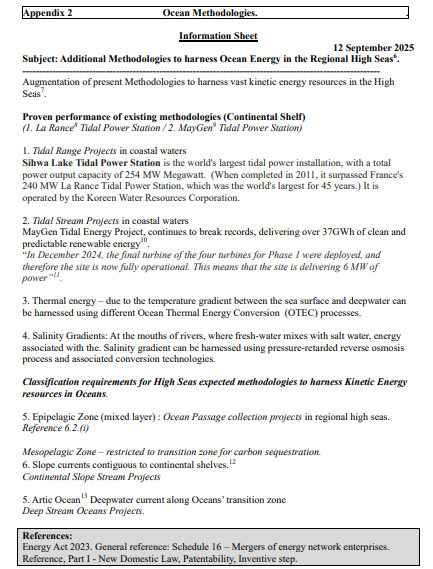
One methodology to identify is in the ‘Epipelagic Zone’38 of the high seas, which could embrace the traversing of sailing vessels over vast areas. Example: Fluid mechanics design techniques to be adopted to provide hulls of ships to be fitted with equipment during their passage journeys through the surface waters, to ‘create / collect / hoover / transfer / store’ the continuous kinetic energy produced. Major Energy Companie39 to then be set up to prepare programmes / schedules for multiple passages across the regional seas, with destinations to multiple energy ports within the separate coastal management zones.
Slope Currents contiguous to the Continental Shelves.
- Japan’s Kuroshio currents: Japan’s coastline, due to unstable Teutonic plates, appear unsuitable for fixed turbines to the seabed. Reference ‘Experimental verification of a floating ocean current turbine with single rotor for use in the Kuroshio current.’40
- European “Slope Current around the British Isles, is a potential location for a European Slope Current Project, embracing stabilised bathymetric seabed profiles41.
A more comprehensive range of identified methodologies are furnished in Appendix 2 – Information Sheet – Ocean Methodologies.
Summary, and Linkages to Relevant Environmental References
The Incompleteness and uncertainties of Man’s Laws of Science towards a Long-term Sustainable Future have revealed much about the complexities of Earth's systems, and they also underscore the fragility of our small planet. By highlighting the principles of mat- ter, energy, and environmental mechanisms, a sustainable future may be envisioned. This involves not only technological innova- tion but also a harmonious integration of human activities with the planet's natural cycles, ensuring that the balance essential for life is maintained for generations to come.
Pressure: Relentless increase in ‘pressure’s mechanism’ through- out Earth’s Ocean depths produce multiple linkage to other mech- anisms, creating ever evolving environmental conditions which may be key areas for studying the origins of life as we currently understand it. Life’s stratified layers, down to the Mariana Trench depth, are vital research areas for mankind.
Vast Kinetic Energy resources are available, once additional meth- odologies have been developed, to harness earth’s natural energy resources, as it will provide a long-term sustainability for all man- kind, once the World’s legislation has been ratified, restructured and brought into force42. An approach towards a Structure Plan Model for Oceans total energy methodologies is recommended, based on proven modern project management services techniques. (APMS)43.
Fluid Mechanics embraces the major ‘environmental mechanisms’44 within ‘Man’s Science’, and is an essential tool to analyse, review, monitor and understand the actions and integration linkages’ related to the multiple range of earth’s mechanisms.
A new Global Organization must be established for the protection, care and maintenance of our planet, structured across the five
Bibilography
Table of Legislation (& related topics):
1. Oceans and Law of the Sea, Division for Ocean Affairs and the Law of the Sea, United Nations Convention on the Law of the Sea of 10 December 1982. / Ibid, PART II, Territorial Sea and Contiguous Zone, Sections 1-4, Articles 2-33. / Ibid, Part VII, High Seas, Sections 1-2, Articles 86-120.
2. Agreement under the United Nations Convention on the Law of the Sea on the Conservation and Sustainable use of Marine Biological Diversity of Areas Beyond National Jurisdiction (BBNJ), New York, 20 September 2023 (BBNJ ratified 19 September 2025).
3. High Seas Treaty Ratification Tracker.
4. Congress, U. S. (1972). Coastal Zone Management Act. In Public Law; US Congress: Washington, DC, USA (Vol. 583).
5. Patents Act 1977, UK Public General Acts, 1977c. 37, Part 1, Patentability, 4 Industrial application.
6. Energy Act 2023, UK Public General Acts, 2023 c. 52, Schedule 16 – Mergers of energy network enterprises
References
- Francis, J. R. D. (1969). A textbook of fluid mechanics forengineering students. (No Title).
- Addendum 1 – Periodic Table - Basic Format / Structure.
- Appendix 3, Ocean Plastics Pollution, orders@plasticonline. com.au
- Kempton, R. (2024). Approach Towards a Total UK Environmental Energy Master Plan for Clean Renewable Energy, Reviewing the Incompleteness of the British Energy Security Strategy after Brexit, and Embracing Tidal Waters and other Innovative Sources. Reviewing the Incompleteness of the British Energy Security Strategy after Brexit, and Embracing Tidal Waters and other Innovative Sources (May 17, 2024).
- Cushman-Roisin, B., Gualtieri, C., & Mihailovic, D. T. (2008). Environmental Fluid Mechanics: Current issues and future outlook. In Fluid mechanics of environmental interfaces (pp. 1-14). Taylor & Francis.
- Darcy, 17th century Paris: Darcy measured the discharge of a tube by measuring the volume of water that flows out the outlet during a fixed period of time.
- Earth Labs, Earth System Science, Lab 4: It’s all connected; Global Circulation, Part A: Tracing Pathways.
- Flow Conditions in Pipes due to Thick Liquids, 1971. Paper presented at the North-West Institution of Civil Engineers Student and Graduate Meetings in March 1971. It received ICE Miller Prize Award recognition in July 1972. (Paper submission No: AM/S 1444).
- Francis J.R.D, A Textbook on Fluid Mechanics, The Properties of Fluids, p 2-3
- Howarth, W., & McGillivray, D. WATER POLLUTION AND WATER QUALITY LAW.
- Atomic structure - AQA Structure of the atom.
- McGrayne, S. B., Bertsch, G. F., & Trefil, J. (2008).Atom. Encyclopedia Britannica.
- Intergovernmental Negotiating Committee to develop an international legally binding instrument on plastic pollution, including in the marine environment, 1 December 2024, Chair’s Text, Preamble.
- Kempton, R. (2025). The High Seas in Perpetual Motion. International Journal Evolving Sustainable and Renewable Energy Solutions. Int J Evol Sus Renew Energy Sol, 1(1).
- Kempton, R. (2024). Approach Towards a Total UK Environmental Energy Master Plan for Clean Renewable Energy, Reviewing the Incompleteness of the British Energy Security Strategy after Brexit, and Embracing Tidal Waters and other Innovative Sources. Reviewing the Incompleteness of the British Energy Security Strategy after Brexit, and Embracing Tidal Waters and other Innovative Sources (May 17, 2024).
- M Auger, P Prandi, JB Sallée - Scientific Data, 2022 - search.ebscohost.com.
- Michigan Technological University.
- NASA Science (gov), Facts about Earth – NASA Science.
- NASA, ‘Glen Research Center’ 27 June 2024 - Sir Isaac Newton worked in many areas of mathematics and physics. He developed the theories of gravitation in 1666 when he was only 23 years old. In 1686, he presented his three laws of motion in the “Principia Mathematica Philosophiae Naturalis.”
- National Geographic, Education.
- Nienke A, Blom, Arwen Deuss, Hanneke Paulssen, Lauren Waszek, Inner Structure behind the PKP core phase triplication, Geophysical Journal International, Volume 201, Issue 3, June 2015, pages 1657-1665.
- Poiseuille was a physician who had been trained in physics and mathematics. In 1846, Jean Louis Poiseuille published a paper on the experimental research of the motion of liquids in small diameter tubes.
- Reference to early Fluid Mechanics Text-Book, “A Textbook of Fluid Mechanics”, Francis J.R.D, B Sc (Engineering) London, Assoc. I.C.E, with Contribution on Gas Flow from Jackson M.A. (Cantab), 1958.
- Reference, Appendix 2, Information Sheet: Information Sheet – Additional Methodologies / Regional High Seas and Oceans.
- Reference: Appendices, 6.4 Explanatory Note: AdvancedProject Management Solutions (APMS).
- References: “Approach to ‘Climate Change’ Sustainability Project, for Our common future” New Global Organization, page 7, 20 March 2025 / International Journal Evolving Sustainable and Renewable Energy Solutions, IP Prime Open Access Research Article / SSRN: , Conclusions, 8.2.1.
- Kempton, R. " A Concept of Energy, embracing Earth's Environmental Mechanisms.
- Rheology is the study of the deformation and flow of matter, focusing on the relationships between stress, strain, temperature, and time. Science Direct.com.
- Sam Boyle, The case for Regulation of Agricultural Pollution.
- Sands P et al, Principles of International Environmental Law, fourth Edition, Chapter 11, Oceans, Seas and Marine Living Resources.
- See Appendix 1: Fluid Mechanics definition and terminology.
- See Addendum 1: Structure of the Atom. [Man’s Laws of Science conception]
- See Addendum 2. – UK Agricultural legislation controls reference chart.
- See, Appendix 3 – Ocean Plastics Pollution
- Seismic Waves and Determining Earth’s Structure, University of Hawai’i at Manoa, https://manoa.hawaii.edu/ exploringourfluidearth/physical/ocean-floor/layers-earth/compare-contrast-connect-seismic-waves-and-determining-earth-s-structure#:~:text=The%20speed%20at%20which%20 seismic,waves%20only%20travel%20through%20solids.
- Shen, H. H., Cheng, A. H., Wang, K. H., Teng, M. H., & Liu,C. C. (Eds.). (2002). Environmental fluid mechanics: theories and applications. ASCE Publications.
- Specific Note: At that time literature and knowledge available was somewhat limited to movement of ‘thin liquids’ through circular pipes. Flow charts were readily available to the student or engineer, giving a variety of curves for flow through pipes of various roughness, age, and material.
- Tethys Footnote 53, Ibid, 5.2,1.
- Tethys, Footnote 53, Ibid, 5.2 .1, last line. / Also, Japan’s Kuroshio currents (hindered by unstable Teutonic plate conditions
- Tethys.
- The Role of Oceanic Thermoclines in Marine Biology / https://www.nature.com › articles
- Tom Howarth, “Something very strange is happening to Earth’s core”, July 2024.
- Towards a Total UK Environmental Energy Master Plan,Embracing Tidal Waters, 5.2.1 slope current, footnote 34.
- UN BBNJ, Article 68(1) states “This Agreement shall enter into force 120 days after the date of deposit of the sixtieth instrument of ratification, approval, acceptance or accession”
- UN Environment Assembly of the United Nations Environment Programme, 7 March 2022, UNEEP/EA.5/Res.14, Resolution adopted by the United Nations Assembly on 2 March 2022.
- UNCLOS Approach towards New Priority Legislative Regulatory Powers, para 7.4, Agreement under UNCLOS, on the Conservation and sustainable use of Marine Biological Diversity of Areas Beyond National Jurisdiction (BBNJ).
- UNEEP/EA, 5/14, End plastic pollution: recalling UNEA resolutions, front page.
- UNEEP/EA, CHAIR’S TEXT, Preamble, The Parties to this Convention, opening sentence, 1 December 2024.
- UNEEP/EA, footnote 1, This draft text….
- Vidale, J. E., Dodge, D. A., & Earle, P. S. (2000). Slow differential rotation of the Earth's inner core indicated by temporal changes in scattering. Nature, 405(6785), 445-448.
- Volcanos and molten lava pasta viscosities, with medium silica content, range 10,000 to 100,000 times water. Bridgewater State University.
- Water Pressure at Ocean depths.
- Your step-by-step guide to find valence electrons, last updated May29, 2024 by Nourhan Essam.
- Your step-by-step guide to find valence electrons, last updated May29, 2024 by Nourhan Essam.
- Zhang, J., Song, X., Li, Y., Richards, P. G., Sun, X., & Waldhauser, F. (2005). Inner core differential motion confirmed by earthquake waveform doublets. Science, 309(5739), 1357- 1360.
Foot notes
1Kempton R C,” Approach towards a total UK Environmental Energy Master Plan for clean renewable energy, reviewing the incompleteness of the British Energy Security Strategy, after Brexit, and embracing tidal waters and other innovative sources.”, Appendix 2, Explanatory Note, Advanced Project Management Solutions (APMS).
2High Seas Treaty Ratification Tracker, https://highseasalliance.org/treaty-ratification/
3UN BBNJ, Article 68(1) states “This Agreement shall enter into force 120 days after the date of deposit of the sixtieth instrument of ratification, approval, acceptance or accession”
4Ibid, Article 68(2) requires a state, or regional economic integration organization to ratify, approve or accept this Agreement, a further 30 days, to enter into force.
5Sands P et al, Principles of International Environmental Law, fourth Edition, Chapter 11, Oceans, Seas and Marine Living Resources.
6The Role of Oceanic Thermoclines in Marine Biology / https://www.nature.com › articles
7Water Pressure at Ocean depths https://www.pmel.noaa.gov/eoi/nemo1998/education/pressure.html
8M Auger, P Prandi, JB Sallée - Scientific Data, 2022 - search.ebscohost.com
9Earth Labs, Earth System Science, Lab 4: It’s all connected; Global Circulation, Part A: Tracing Pathways.
10Kempton R C,” Approach towards a total UK Environmental Energy Master Plan for clean renewable energy, reviewing the incompleteness of the British Energy Security Strategy, after Brexit, and embracing tidal waters and other innovative sources.”, 5.0 Identify Research into various methodologies to harness tidal energy, https://ssrn.com, written: May 17, 2024
11Ibid, 6. Energy and Power Supply Statistics, Forms of known Energy / Addendum A, Information Sheet, - Energy / Addendum B -Information Sheet – Energy storage.
12Reference: Howarth W, McGillivray D, Water Pollution and Water Quality Law, 2001, Chapter 18 International Marine Environmental Law.
13Ibid, 7. Approach towards New Priority Legislative Regulatory Powers, para 7.4, Agreement under UNCLOS, on the Conservation and sustainable use of Marine Biological Diversity of Areas Beyond National Jurisdiction (BBNJ).
14UN Environment Assembly of the United Nations Environment Programme, 7 March 2022, UNEEP/EA.5/Res.14, Resolution adopted by the United Nations Assembly on 2 March 2022.
15Ibid, 5/14, End plastic pollution: recalling UNEA resolutions, front page
16Intergovernmental Negotiating Committee to develop an international legally binding instrument on plastic pollution, including in the marine environment, 1 December 2024, Chair’s Text, Preamble.
17See, Appendix 3 – Ocean Plastics Pollution
18Ibid, footnote 1, This draft text….
19Ibid, CHAIR’S TEXT, Preamble, The Parties to this Convention, opening sentence, 1 December 2024
20See Addendum 2. – UK Agricultural legislation controls reference chart. / Ref: Sam Boyle, The case for regulation of Agricultural Pollution.
21Appendix 1: Fluid Mechanics definition and terminology
22NASA, ‘Glen Research Center’ 27 June 2024 - Sir Isaac Newton worked in many areas of mathematics and physics. He developed the theories of gravitation in 1666 when he was only 23 years old. In 1686, he presented his three laws of motion in the “Principia Mathematica Philosophiae Naturalis.”
23“A Textbook of Fluid Mechanics”, Francis J.R.D, B Sc (Engineering) London, Assoc. I.C.E, with Contribution on Gas Flow from Jackson M.A. ( Cantab ) , 1958, p3, top of page.
24Cushman-Roisin B et al “Environmental Fluid Mechanics: Current issues and future outlook”, 1st Edition, 2008, Abstract, 1st paragraph
25Tom Howarth, “Something very strange is happening to Earth’s core”, July 2024 https://www.sciencefocus.com/news/earths- coreslowing- down#:~:text=According%20to%20a%20USC%20press,slower%20than%20the%20Earth's%20surface.
26Volcanos and molten lava pasta viscosities, with medium silica content, range 10,000 to 100,000 times water. Bridgewater State University, https://www.bridgew.edu/
27Addendum 1: Structure of the Atom. [Man’s Laws of Science conception]
28Reference to early Fluid Mechanics Text-Book, “A Textbook of Fluid Mechanics”, Francis J.R.D, B Sc (Engineering) London, Assoc. I.C.E, with Contribution on Gas Flow from Jackson M.A. ( Cantab ) , 1958.
29Addendum 1 – Periodic Table - Basic Format / Structure.
30Research Article: A Concept of Energy, Embracing Earth’s Environmental Mechanisms, Addendum 1, Periodic Table – Basic Format / Perceived Structure, - World Journal of Forest Research ISSN: 2994-5569, - August 2025
31” Approach towards a total UK Environmental Energy Master Plan for clean renewable energy, reviewing the incompleteness of the British Energy Security Strategy, after Brexit, and embracing tidal waters and other innovative sources.”, 6. Addendum A, Information Sheet, - Energy: Classification Types, https://ssrn.com, written: May 17, 2024,
32At that time literature and knowledge available was somewhat limited to movement of ‘thin liquids’ through circular pipes. Flow charts were readily available to the student or engineer, giving a variety of curves for flow through pipes of various roughness, age, and material.
33Title: “Flow Conditions in Pipes due to Thick Liquids”, 1971. Paper presented at the North-West Institution of Civil Engineers Student and Graduate Meetings in March 1971. It received ICE Miller Prize Award recognition in July 1972. (Paper submission No: AM/S 1444)
34Agreement under the United Nations Convention on the Law of the Sea on the Conservation and Sustainable use of Marine Biological Diversity of Areas Beyond National Jurisdiction, New York September 2023.
35Oceans and Law of the Sea, Division for Ocean Affairs and the Law of the Sea, United Nations Convention on the Law of the Sea of 10 December 1982
36Ibid, PART II, Territorial Sea and Contiguous Zone, Sections 1-4, Articles 2-33
37Ibid, Part VII, High Seas, Sections 1-2, Articles 86-120
38Reference, Appendix 2, Information Sheet: Information Sheet – Additional Methodologies / Regional High Seas and Oceans.
39Patents Act 1977, UK Public General Acts, 1977c. 37, Part 1, Patentability, 4 Industrial application.
40 https://doi.org/10.20944/preprints202312.0085.v1 , “Towards a Total UK Environmental Energy Master Plan, Embracing Tidal Waters”, 5.2.1 slope current, footnote 34
41Ibid, footnote 33.
42International Journal Evolving Sustainable and Renewable Energy Solutions, Vol 1, Issue 1, 20 March 2025, The High Seas in Perpetual Motion, para 1, p7,
43International Journal Evolving Sustainable and Renewable Energy Solutions, Volume 1, Issue 1, Research Article, 20 March 2025, 6.4 Explanatory Note: Advanced Project Management Solutions (APMS).
44Shen HH et al2002, books, google.com, “Environmental fluid mechanics: theories and applications”
45References: “Approach to ‘Climate Change’ Sustainability Project, for Our common future” New Global Organization, page 7., 20 March 2025, International Journal Evolving Sustainable and Renewable Energy Solutions, IP Prime Open Access Research Article / SSRN: http://dx.doi.org/10.2139/ssrn.4831998, Conclusions, 8.2.1 /
46Francis J.R.D, A Textbook on Fluid Mechanics, page 1. Edward Arnold (Publishers) Ltd, London, 2nd 1962.
47NASA, 'Glen Research Center' 27 June 2024 - Sir Isaac Newton worked in many areas of mathematics and physics. He developed the theories of gravitation in 1666 when he was only 23 years old. In 1686, he presented his three laws of motion in the "Principia Mathematica Philosophiae Naturalis."
48Francis J.R.D, A Textbook on Fluid Mechanics, The Properties of Fluids, p 2-3
49Poiseuille was a physician who had been trained in physics and mathematics. In 1846, Jean Louis Poiseuille published a paper on the experimental research of the motion of liquids in small diameter tubes.
50Darcy, 17th century Paris: Darcy measured the discharge of a tube by measuring the volume of water that flows out the outlet during a fixed period of time.
51Kempton, Robert, Approach Towards a Total UK Environmental Energy Master Plan for Clean Renewable Energy, Reviewing the Incompleteness of the British Energy Security Strategy after Brexit, and Embracing Tidal Waters and other Innovative Sources (May 17, 2024). Available at SSRN: https://ssrn.com/abstract=4831998 or http://dx.doi.org/10.2139/ssrn.4831998
52Ibid, Reference to, Appendix 4 - Information Sheet, MayGen tidal power project, footnote 69.
53Ibid, Appendix 3, Facts Sheet - La Rance Tidal Power Station
54Ibid, Appendix 4, Information Sheet - MayGen Tidal Power Project
55Tethys, https://tethys.pnnl.gov/project-sites/meygen-tidal-energy-project
56https://tethys.pnnl.gov/
57Footnote 53, Ibid, 5.2 .1, last line. / Also, Japan's Kuroshio currents (hindered by unstable Teutonic plate conditions
58orders@plasticonline.com.au
59HDPE, High Density Polyethylene.
60Ref: The number of subatomic particles in an atom can be calculated from its atomic weight number and mass number
61The number is perceived to be less than one ten thousandth the size of the atom
62Your step-by-step guide to find valence electrons, last updated May29, 2024 by Nourhan Essam.
63https://www.britannica.com/science/atom
64Reference: "Approach to "Climate Change" Sustainability Project. For"Our common future", 20 March 2025, International Journal Evolving Sustainable and Renewable Energy Solutions, Volume 1, Issue 1, Research Article."IP Prime Open Access.
65Michigan Technological University. https://www.mtu.edu/geo/community/seismology/learn/seismologystudy/#:~: text=Seismology%20is%20the%20study%20of,studies%20earthquakes%20and%20seismic%20waves.
66Seismic Waves and Determining Earth's Structure, University of Hawaii at Manoa, https://manoa.hawaii.edu/exploringourfluidearth/ physical/ocean-floor/layers-earth/compare-contrast-connect-seismic-waves-and-determining-earth-s-structure#:~:text=The%20 speed%20at%20which%20seismic,waves%20only%20travel%20through%20solids.
67NASA Science (gov), Facts about Earth â?? NASA Science, https://science.nasa.gov/earth/facts/#:~:text=Orbit%20and%20 Rotation&text=It%20takes%20365.25%20days%20to,years%20we%20add%20one%20day.
68Zhang, J. et al. Inner core differential motion confirmed by earthquake waveform doublets. Science 309, 1357-1360 (2005).
69Vidale, J. E., Dodge, D. & Earle, P. S. Slow differential rotation of the Earth's inner core indicated by temporal changes in scattering. Nature 405, 445-448 (2000).
70Nienke A, Blom, Arwen Deuss, Hanneke Paulssen, Lauren Waszek, Inner Structure behind the PKP core phase triplication, Geophysical Journal International, Volume 201,Issue 3, June 2015, pages 1657-1665, https://doi.org/10.1093/gji/ggv103
71National Geographic, Education, https://education.nationalgeographic.org/resource/core/
72Rheology is the study of the deformation and flow of matter, focusing on the relationships between stress, strain, temperature, and time. Science Direct.com.
73Ibid, Article 68(2) requires a state, or regional economic integration organization to ratify, approve or accept this Agreement, a further 30 days, to enter into force.