

Advances in Bioengineering and Biomedical Science Research(ABBSR)
ISSN: 2640-4133 | DOI: 10.33140/ABBSR

Impact Factor: 1.7

Research Article - (2024) Volume 7, Issue 2
Numerical Simulation of Heat Transfer in a Solar Flat Plate Collector using Nano-Fluids
Received Date: Mar 01, 2024 / Accepted Date: Mar 25, 2024 / Published Date: Mar 29, 2024
Copyright: ©Â©2024 Anahita Moghtadaei. This is an open-access article distributed under the terms of the Creative Commons Attribution License, which permits unrestricted use, distribution, and reproduction in any medium, provided the original author and source are credited.
Citation: Moghtadaei, A. (2024). Numerical Simulation of Heat Transfer in a Solar Flat Plate Collector using Nano-Fluids. Adv Bioeng Biomed Sci Res, 7(2), 01-06.
Abstract
Solar energy is a source of clean and free energy that has been used by humans in various ways. The recent energy crisis has made countries around the world approach energy issues differently. The heat and light emitted by the sun is called solar energy. Solar energy is the light and heat that is radiated from the sun and can be harnessed using a range of technologies, such as photovoltaic systems and solar thermal energy. One of the most important applications of solar energy is the use of photovoltaic panels to convert solar energy into electrical energy. Solar collectors are used to harness the thermal energy (heat) from solar energy. In this study, the heat exchange by nanofluid in pipes, screw, and absorber plate in the flat plate collector were examined. Nanofluids are fluids that have particles suspended between 1 and 100 nanometers in size in the base fluid. The addition of nanofluids significantly increases heat transfer and thermal conductivity. In this study, silicon carbide nanofluids with percentages of 1%, 2%, 3%, and 4% in the base fluid (ethylene glycol) were used. The thermal properties, such as Nusselt number, conductive heat transfer coefficient, and transfer rate of the nanofluids were investigated.
Introduction
Conventional solar flat plate collectors can retain heat up to 80°C. The efficiency of flat plate collectors can reach up to 60% [1]. Flat plate solar collectors (FPSCs) are the most commonly used type of collectors, which convert solar energy to thermal energy using a solid surface called an ”absorber plate”. The surface of the absorber plate is usually painted with black matter or selectively coated spectrally to achieve a high absorptivity of the solar spectrum with low emissivity [2].
Researchers carried out an experiment on a cylindrical solar collector with a tube receiver and found that the collector’s efficiency increased by 25.6% compared to water when using nanofluid CuO with a flow rate of 0.1 kg/s and 0.0083 kg/s. Similarly, AV. Dasaien et al studied the effect of CuO water nanofluid on FPC efficiency and concluded that there is an optimal mass flow rate that maximizes the efficiency of the collector [3, 4].
Yousefi et al. investigated water nanofluid Al2O3 and used 100-Triton X as a surfactant to increase the stability of nanofluid. They found that their nanofluid with 0.2 z = 28.3% higher efficiency than water [2].
Overall, the use of nanofluids has been found to improve the efficiency of solar collectors. It was determined, based on previous studies, that a CuO-based nanofluid would be used for the current research. However, the previous works employed a pump to force the circulation of the nanofluid. The potential of nanofluids in improving heat transfer in refrigeration systems was investigated by P Kalidossr et al [5]. They concluded that further studies are required to understand the reasons for the significant improvement in heat transfer with only a slight increase in pressure. In Parvin et al designed a closed two-phase thermosyphon solar collector with a shell and tube heat exchanger [6]. The effect of cooling water flow rate, water inlet temperature and the number of tubes on the collection performance, the agent was studied experimentally. Parvin et al studied the effects of Soret and Dufour on doubly diffuse natural convection using they studied nanofluids with different solar collectors filled with nanoparticles [6]. The major fraction of the incident solar radiation passing through the FPSC’s trans- parent cover is absorbed by the absorber plate. The bottom and sides of the collector’s absorber plate are fully insulated to minimize the heat losses by conduction and natural convection. The collector’s glass cover diminishes the heat losses by convection via containment of an air layer and by radiation in that it is transparent to the sun’s shortwave solar radiation but practically non-transparent to the long-wave thermal. Xuan and Li investigated the convective heat transfer and flow features of nanofluids, effect of volume concentration, convective heat transfer coefficient, friction factor, and flow features [7].
In a study conducted by Albadr et al, the heat transfer and flow characteristics of nanofluid were experimentally investigated in a heat exchanger [8]. The results showed that increasing the volume concentration of Al2O3-water increased both the viscosity and friction factor. Meanwhile, Natarajan and Sathish in analyzed the heat transfer properties of nanofluids and compared them with conventional fluids [9]. They found that the thermal conductivity of carbon nanotubes/sodium dodecyl sulfate (CNT/SDS) dispersion depended on the volume fraction of the suspended particle and the thermal conductivity of the base fluids. The experiment also proved that nanofluids were more effective than conventional heat transfer fluids. Additionally, Lambert et al. in proposed the use of oscillatory laminar currents to increase heat transfer from solar collectors [10]. They performed advanced heat transfer using oscillatory currents in solar collectors. The study suggested that this method could help increase the efficiency of solar water heaters.
This work aims to explore the feasibility of transferring collected heat from a solar device to a storage tank using a zero-temperature oscillating liquid contained in a tube. In Kazeminejad analyzed two-dimensional parallel flow flat plate solar collectors numerically [11]. The temperature distribution on the absorber plate of a flat parallel flow solar collector plate was analyzed using one and two-dimensional steady-state conduction with heat generation equations. Researchers in investigated forced convection heat transfer in wave solar heaters and found that the use of nanofluids improved heat transfer [12]. In Bargaards conducted experimental research on heat transfer in flat plate solar collectors [13]. To test the advanced solar collector and compare it with a standard, a side-by-side solar collector test bed was designed and built by Kolb et al. who also experimentally studied solar air collector with a metal matrix absorber [14].
Classification of nanofluid
In, the classification of nanoscale is defined based on four

Figure 1: classification of nanofluid
Problem Formulation
Dead Reynolds is the ratio of inertial forces to adhesive force. The Reynolds number is a dimensionless number that is used for the Classification of Fluid Systems, where the effect of viscosity is important in controlling the velocity or flow pattern of the fluid. The Reynolds number is used to determine whether the fluid is in a calm or turbulent flow, if Reynolds, less or equal to 2100, indicates a calm flow, if more or equal to 2100 the flow is turbulent. Reynolds number, was first described by Reynolds in 1883 to describe the fluid transfer properties of the particle moving in the fluid It’s very important [17].
LC = V body/Asurface (1)
For example, in calculating the flow through circular and non-circular tubes, in order to check the conditions (the number Reynolds) in these cases the length is characteristic of the diameter of the pipe and in non-circular pipes the diameter is hydraulic.

In this study geometry is a non circular problem:
Re = puL/M (3)
Heat transfer, the Nasalt number represents the rate of heat transfer of displace- ment to conductive heat transfer, so the nasalt number that is close to 1 means that the conductive heat transfer and displacement are close together. Naslat numbers greater than 1 indicate greater displacement heat transfer. The Naslat number can be defined the ratio of displacement heat transfer to thermal conductivity.
NU = hL/k (4)
that L is the characteristic length. Therefore, for a certain amount
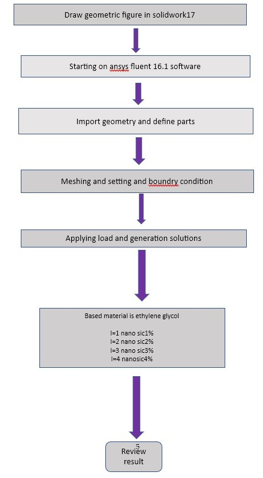
Figure 2: work flow schematic
of nasalt, the increase in thermal conductivity corresponds to The increase is the heat transfer coef- ficient. In any of the existing correlations, if the naslat is used as a function of The Reynolds number stated that the results indicate that.
h = kNu/L (5)
h increases with k and nastelet number
Methodology
Geometric figure was done with solidworks software and analysis was done by ansis- fluent and explain more about methodology in Fig. 3

Figure 3: meshing of the computational domain
The temperature data was used to validate the meshing. The temperature was studied in three stages: coarse, medium, and fine meshing. The results are shown in Table 1
|
Mesh type |
Number of elements |
T1 |
T2 |
|
Coarse |
343.956 |
303.24 |
328.13 |
|
Medium |
6,612,923 |
303.24 |
328.15 |
|
Fine |
1,216,996 |
303.24 |
328.15 |
Table 1: Information about grid independence test
Boundary Condition
After preparing the grid of the problem, it is time to process the boundary conditions in the Fluent software. For this purpose, to solve the problem, it is necessary to determine the boundary conditions in the Fluent software, which can be found in Table model is used to consider the process of heat transfer through thermal radiation, the surface-to-surface model governs equation and limitations of the Ansys software guide have been done.
|
Thermal flux |
1000(w/m2) |
|
Inlet temperature |
30(c) |
|
Heat transfer coefficient |
9.89(w/m2k) |
|
Speed of ethylene glycole |
30m/s |
|
Reinolds flow |
10 − 150 |
Table 2: boundary condition data
For discretization, reaching convergence, the outlet pressure boundary condition is use:
|
Mass debbie |
0.6 |
|
Absolute down limit pressure |
100500 |
|
Heat transfer coefficient |
96000 |
Table 3: Data of pressure boundary condition
Figure 4: convergence results
Result and Discussion
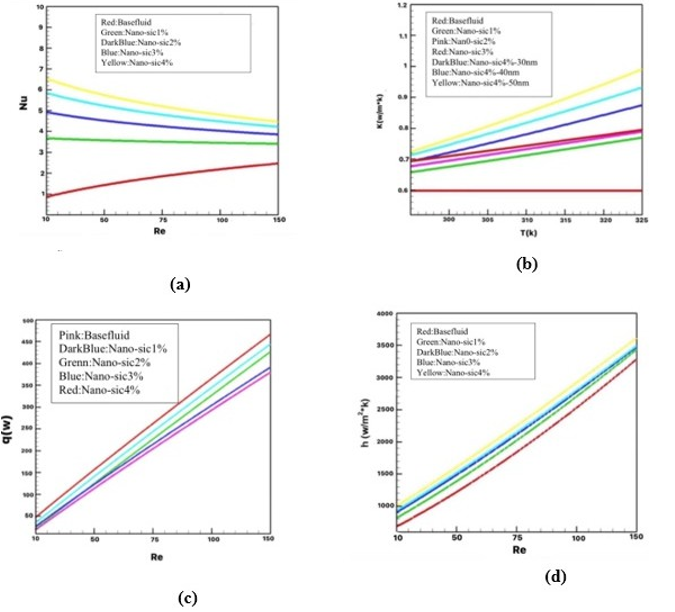
a. This diagram illustrates the Nusselt number in terms of Reynolds. The base fluid is ethylene glycol with the nanofluid SiC 1,2,3,4%. The Nusselt number and heat transfer coefficient increase with all volume concentrations of nanofluid.
• b. This Diagram show The result of the conductivity coefficient is presented in terms of temperature. 1, 2, 3, 4% nanofluid along with the base fluid ethylene glycol with the volume of 30, 40, 50 nm has been investigated. As the temperature increases, the conductivity heat transfer coefficient increase
• c. The result shows the heat transfer rate of 1, 2, 3, 4% nanofluid with ethylene glycol base fluid, the heat transfer rate increases with the increase in volume concentration
• d. The heat transfer coefficient of goat is according to Reynolds. Nano silicon car- bide and base fluid ethylene glycol have been investigated. Increasing the volume concentration of nanofluid results in increasing the heat transfer coefficient. the temperature, Reynolds number and Nusselt number increased, and with the increase of Nusselt number, the heat transfer increased.
Figure 5: convergence results
Conclusion
As outlined above the simulation has been done, nanofluids increase heat transfer, with the increase of Reynolds number, Nusselt increases, with the increase of Reynolds, the heat transfer coefficient and the transfer coefficient Conductive heat increases, and with the increase in volume concentration of nanofluid, heat transfer also increases.
References
- Ghasemi, S. E., & Ranjbar, A. A. (2016). Thermal performance analysis of solar parabolic trough collector using nanofluid as working fluid: A CFD modelling study. Journal of Molecular Liquids, 222, 159-166.
- Nasrin, R., Parvin, S., & Alim, M. A. (2014). Heat transfer by nanofluids through a flat plate solar collector. Procedia Engineering, 90, 364-370.
- Goodarzi, S., Perera, H. N., & Bunn, D. (2019). The impact of renewable energy forecast errors on imbalance volumes and electricity spot prices. Energy Policy, 134, 110827.
- Dasaien, A. V., & Elumalai, N. (2017). Performance enhancement studies in a thermosyphon flat plate solar water heater with CuO nanofluid. Thermal science, 21(6 Part B), 2757-2768.
- Kalidoss, P., Venkatachalapathy, S., & Suresh, S. (2020). Optical and thermal properties of Therminol 55-TiO2 nanofluids for solar energy storage. International Journal of Photoenergy, 2020, 1-9.
- Parvin, S., Nasrin, R., & Alim, M. A. (2016). Effect of solid volume fraction on forced convective flow of nanofluid through direct absorption solar collector. Applications and Applied Mathematics: An International Journal (AAM), 11(3), 2.
- Li, Q., & Xuan, Y. (2002). Convective heat transfer and flow characteristics of Cu-water nanofluid. Science in China Series E: Technolgical Science, 45, 408-416.Al-Badri, A. R., Gebauer, T., Leipertz, A., & Fröba,A. P. (2013). Element by element prediction model of
- condensation heat transfer on a horizontal integral finned tube. International Journal of Heat and Mass Transfer, 62, 463-472.
- Natarajan, E., & Sathish, R. (2009). Role of nanofluids in solar water heater. The International Journal of Advanced Manufacturing Technology, 1-5.
- Lambert, A. A., Cuevas, S., & Del Río, J. A. (2006). Enhanced heat transfer using oscillatory flows in solar collectors. Solar energy, 80(10), 1296-1302.
- Kazeminejad, H., Ghamari, M., & Yaghoubi, M. A. (1996). A numerical study of convective heat transfer from a blunt plate at low Reynolds number. International journal of heat and mass transfer, 39(1), 125-133.
- Akbarzadeh, M., Rashidi, S., Karimi, N., & Ellahi, R. (2018). Convection of heat and thermodynamic irreversibilities in two-phase, turbulent nanofluid flows in solar heaters by corrugated absorber plates. Advanced Powder Technology, 29(9), 2243-2254.
- Bårdsgård, R., Kuzmenkov, D. M., Kosinski, P., & Balakin,B. V. (2020). Eulerian CFD model of direct absorption solar collector with nanofluid. Journal of renewable and sustainable energy, 12(3).
- Kolb, G. J. (2008). CONCEPTUAL DESIGN OF AN ADVANCED TROUGH UTILIZING A MOLTEN SALT WORKING FLUID (No. SAND2008-0547C). SandiaNational Lab.(SNL-NM), Albuquerque, NM (United States).
- Ali, A. R. I., & Salam, B. (2020). A review on nanofluid: preparation, stability, thermophysical properties, heat transfer characteristics and application. SN Applied Sciences, 2(10), 1636.
- Eastman, J. A., Phillpot, S. R., Choi, S. U. S., & Keblinski,P. (2004). Thermal transport in nanofluids. Annu. Rev. Mater. Res., 34, 219-246.
- Rott, N. (1990). Note on the history of the Reynolds number. Annual review of fluid mechanics, 22(1), 1-12.