

Journal of Gastroenterology & Digestive Systems(JGDS)
ISSN: 2640-7477 | DOI: 10.33140/JGDS
Impact Factor: 1.13


Research Article - (2025) Volume 9, Issue 1
New Very Promising Method of Exaction of Biofuels from Fermentation Fluids Used for their Manufacture
Received Date: May 09, 2024 / Accepted Date: Dec 16, 2024 / Published Date: Jan 03, 2024
Copyright: ©©2025 Michael Vladislavovich Tyurin. This is an open-access article distributed under the terms of the Creative Commons Attribution License, which permits unrestricted use, distribution, and reproduction in any medium, provided the original author and source are credited.
Citation: Tyurin, M. V. (2025). New Very Promising Method of Exaction of Biofuels from Fermentation Fluids Used for their Manufacture. J Gastro & Digestive Systems, 9(1), 01-09.
Abstract
The Author claims he created Acetogens-biocatalysts capable to excret to the fermentation liquid final products of the CO2 bicatalysis fuel isobutanol up to 11-12 g/L and fuel Acetone up to 9.5-10 g/L. Among the methods for said biofuels extraction, the Author discusses the most economical from his point of view methods extraction of the fuel Isobutanol with the help of ethyl-hexanol and fuel Acetone with the help of aqueous solutions of K2HPO4 or K4P2O7. The Author has tested his Carbon Negative biofuels as the components of the fuel mixture suitable to power ether gasoline cars engines or diesel fuel cars engines. Said mixture includes 30% fuel Isobutanol, 20% fuel butanol; 30% DAA and 20% Mesityl oxide. Diacetyl alcohol and Mesityl oxide are the products of the aldol condensation of the fuel acetone. The Author offers his biofuel mixture at his new type of the gas stations offering to customers not only Carbon Negative fuels, but also Carbon Negative genetically engineered foods and distilled water along with the regular staff also available at the regular gas stations: windshield wipers, motor oils, electric wires to start the car, etc.
Keywords
Biofuels from Air CO2, Fuel Isobutanol, Fuel Acetone, Aldol Condensation of Two or More Fuel Acetone Molecules to Diacetyl Alcohol or Mesityl Oxide
Introduction
Climate change has recently become a major global issue for energy production and risen to the forefront as motivation for renewable energy research and development. President Mr. Barack Obama has stated, “climate change is a massive problem... a generational problem. It's a problem that by definition is just about the hardest thing for a political system to absorb” [1]. After years of denying humanity’s contribution to globally rising temperatures, Mr. Vladimir Putin, President of Russia, recently declared, “Climate change has become one of the gravest changes humanity has ever faced” [2]. Mr. Elon Musk, Founder of Tesla and Space X, related the current Syrian refugee crisis to future climate change refugee crises by stating “today, the challenge is in terms of millions of people, but in the future, based on what the scientific consensus is, the problem will be in the hundreds of millions and much more severe”. Geopolitics and big business aside, 97% of climate scientists agree that global warming is caused by human activities involving the release of greenhouse gases into the atmosphere [3].
Air CO2 accumulated recently to the enormous levels creates the shortage of the fresh water. Fresh water goes to the outer Space and travels there to the unknown direction away from the planet Earth. Here are the numbers of the fresh water loss to the outer Space: the current loss figure is equivalent ~25,920 liters per day, or 9,467 m3 per year. That would correspond to a total loss over Earth's history of 42,000 km3 of water, equivalent to about 12 cm of sea level change [4,5]. The shortness of the fresh water ultimately means the shortness of corps and the livestock production. We are not herein to discuss the moral attitudes of the people of that near future but what seems very reasonable, that when the Global starvation will hurt the Humankind people would kill for the glass of water and the piece of hamburger. That all comes from the elevation of the air CO2 to the levels causing shortness of the fresh water, and that will come in the next 10-25 years or sooner. We are not the mediums to make any medium predictions. We just document the need to decrease substantially the air CO2 to the levels of the year 1900 or before that time, specifically before the intense petroleum use for the energy production. There are other methods of energy production, but we are concerned about the motors of multiple commercial ships. Commercial air crafts, commercial cars, etc. That creates that extra CO2 along with the breathing of people whose number is going to increase to 15 billion by 2050 and other living beings [5].
Fossil fuel extraction for energy production, livestock production and industrialization, and mass deforestation efforts have all severely exacerbated the effects of climate change, and it is becoming an increasing problem for the world’s population to continue these habits. Human nature makes it difficult to want to change the simplest aspects of everyday life, but advancements in renewable energy technology and sustainable practices make combating climate change possible. With the recent shift towards renewable energy resources, the ability of biofuel production to incorporate waste as a feedstock makes biofuels the attractive resource. Although Isobiobutanol was not originally accepted as a promising fuel source, applications of Isobiobutanol in the chemical industry were implemented several decades prior to petrochemical and fossil fuel commercialization. Isobutanol applications first became viable for large-scale production in 1912 with Charles Weizmann’s patent of acetone-butanol- ethanol (ABE) fermentation using Clostridium acetobutylicum [6]. ABE fermentation was widely used during World War I to make acetone for ammunition and during World War II to make lacquer for automobile coatings. After World War II, ABE fermentation declined drastically due to advancements in petrochemical technology [7].
We have already published in the peer-reviewed journals the design of our Horizontal Bioreactor for Carbon Negative Fuels manufacture for the nominal volume 60 tons [8]. The food for the Acetate biocatalyst we has inventedis the gas mixture composed of 20% of extracted from the air CO2 and 80% of H2 produced by our proprietary technology for the electrolysis of the fresh water. The source for the fermentation process for the Carbon Negative biofuels manufacture is the air CO2 concentrated to 20% of the total volume of the gas mixture used to feed the horizontal fermentor. The rest of said gas mixture is the gas Hydrogen, produced by the electrolysis of the distilled fresh water by our proprietary technology offering 1 kg of Hydrogen (500 moles of gas) for about $20 if we use our proprietary combination of modern solar panels and alkaline batteries for the overnight operations.
One of the biofuels produced is the Gasoline replacement fuel Isobutanol, or butanedione, or butane-2,3-dione, and the other one is the replacement for the Diesel fuel Acetone and the product of its conversion to the best Diesel fuel replacement we offer Diacetyl alcohol (DAA) with the chemical formula (CH3CO)2 is manufactured from the named fuel Acetone outside of the named horizontal fermentor using procedure [9,10]. It is produced from the acetone by the US Patent US1550792A which recites the method of the Diacetyl alcohol production as Sated below. Dry acetone, at room temperature, is placed in a suitable vessel and one-tenth its weight of finely divided calcium hydroxide is added. The mixture is violently agitated for about one to two hours, at the end of which time the reaction has reached equilibrium and about 100% of DAA is present in the stainless-steel cube noted below in this original article.
The levels if fuel Isubutanol achieved in the continuous fermentations with the Acetogen biocatalysts which now we have invented are about 11-12 fuel Isobutanol g/l of the fermentation fluid and about 9-10 g/l of Acetone the fermentation fluid [9,10]. Naturally, extraction of fuel Isobutanol or fuel acetone from the water phase of the fermentor content is the problem which we have solved as described in this original article by the most economically acceptable and therefore our commercial method.
The economic recovery methods of the named Carbon Negative fuels are the chemical extraction of fuel Isobutanol from the fermentation fluid using chemical solvent - ethyl-hexanol From the fermentor fluid we extract fuel Isobutanol using 2-ethyl-1-hexanol as extractant, the distribution coefficient of the extractant to isobutanol is the largest, indicating that the extraction capacity of iso-octyl alcohol to fuel Isobutanol is the largest [11]. Therefore, 2-ethyl-1-hexanol is more beneficial to the phase separation of isobutanol among all extractants [11]. Isobutanol, also known as 2-methyl-1-propanol, is a four-carbon alcohol with a branched structure and a platform compound that is widely used in the chemical industry. The boiling point of isobutanol is 108 â??, the melting point is −108 â??, and the relative density at 20 â?? is 0.802. At 25 °C, the vapor pressure of Isobutanol is 10.43 mm Hg or 13.9 hPa, and the solubility of it in pure water is 85 g/L [12,13]. There are other methods of fuel Isobutanol extraction already discussed in the literature, but for the economic reasons we do not use them at your corporate facility [14].
The other Carbon negative biofuel we produce is fuel Acetone which is used for conversion to DAA outside of the fermentor. Major method of fuel Acetone or fuel n-Butanol extraction from the fermentor fluid is the separation using aqueous solutions of K2HPO4 or K4P2O7 [15]. Both 600 g/kg of K2HPO4 and 550 g/ kg of K4P2O7 drove the fuel Acetone or fuel n-Butanol recovery high into even 100.00%. When the initial concentration of K4P2O7 was equal or greater than 400 g/kg, the desalination of the organic phase was satisfied. More than 96% of water from the aqueous acetone solution was removed. The reported efficient aqueous two-phase system can be applied to recover acetone from fermentation broths efficiently to manufacture DAA [16]. Therefore, we use the above method for extraction of the fuel Acetone from the fermentor fluid.
The method of obtaining of DAA from the fuel Acetone [16]. Dry acetone, at room temperature, is placed in a suitable vessel and one-tenth its weight of finely divided calcium hydroxide is added. The mixture is violently agitated for about one to two hours, at the end of which time the reaction has reached equilibrium and about 100% of DAA is present in the cube. Agitation is then ceased and after the lime has settled, the clear liquid is drawn off through a filter press to collect the DAA. Since there are no impurities present, the residual liquid is substantially pure DAA. The recovered acetone is returned to the mixing vessel and agitated with the catalyst for the production of more DAA.
Materials and Methods
So we are in the need to extract fuel Isobutanol and fuel Acetone from the 60 tons of fermentor fluids at our corporate plants. The extraction methods for biofuels include fermentor fuel distillation and the processes where most of them are energy inefficient and therefore, not economical, or not used at our corporations. Extraction of fuel Isobutanol and fuel Acetone from the fermentor fluids require optimization of energy and material costs at the reaction volumes of 60 tons per each fermentor module as well as the purity of the separation. To maintain profit margins, it is not beneficial to utilize more energy than the profit of the fuel Isobutanol or the fuel Acetone produced. There are currently investigated the applicability of several methods for these biofuels extraction in our corporate setting with the most energy- efficient methods being distillation, liquid-liquid extraction, gas stripping, and supercritical carbon dioxide extraction. There are multiple methods of extraction from the fermentation fluid. Such methods include distillation of the fermentor content, liqid-liqiuid extraction procedure, and GIFT process where it is subject to low-pressure evaporation and isobutanol flashes off the broth, resulting in a vapor concentration nearly 20X greater than what was in the fermentor [14]. And other methods. We have found economical extraction of fuel Isobutanol from the fermentor fluid with 2-ethyl-1-hexanol as extractant. Distillation of the resulting fuel Isobutanol is the method of its purification from the extactant. However, the traces of the extractant in the fuel Isobutanol do not compromize its fuel properties in the internal combustion engines of both Gasoline and Diesel-fueled cars absolutely [17]. We have noted above the main methods we use for the extraction of fuel Isobutanol with the chemical 2-ethyl-1-hexanol. Residual amounts of said extractant in the fuel Isobutanol do not compromise its use for both Gasoline and Diesel fuel engines as we have noted above.
Extracted Acetone is near 100% purity and we are never concerned about any additions to that fuel Acetone due to its extraction technology we have used. The most important is the use of the fule Acetone foir creation of the DAA which is a Diacetone alcohol (DAA), an organic compound with the formula CH3C(O)CH2C(OH)(CH3)2 (Figure 1):
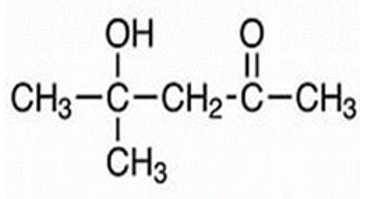
Figure 1: Formula of DAA
Fuel n-Butanol is obtained by the earlier described procedure [18]. Its formula is shown in Figure 2.
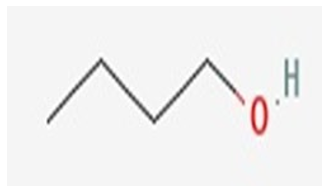
Figure 2: n-Butanol [18]
Mesityl Oxide is typically synthesized by the dehydration condensation of fuel acetone. Fuel Acetone undergoes an aldol condensation reaction to form diketone alcohol, which is subsequently dehydrated to produce Mesityl oxide [19]. Mesityl oxide is a recognized Diesel fuel [20]. Mesityl oxide has the heat of combustion energy of about -14,400 BTU/lb = -8,000 Cal/g [21]. Extracted as recited above dry acetone at 20-22 o C (68-72 o F) is transferred to a stainless steel (AISI 316 stainless steel) oval cube connected to a concentrator (i150 Gravity Concentrator) with the capacity 2 tons per hour with the active stirrer at the top of it and one tenth of added fuel Acetone weight of fine powdered Amberley’s A26OH is added to the cube connected to the Concentrator [22]. The resulting mixture is violently agitated for about 3.5 hours in said Concentrator / shaker. At the end of that time the reaction has reached equilibrium and about 100% of Diacetone alcohol is now present in the mixture of said stainless steel cube. This procedure is conducted simultaneously at forty stainless steel cubes of noted size to accommodate all 60 tons of the content of the fermentor over the working day. Agitation is then ceased and after the lime has settled, the clear liquid is drawn the middle size filter press to collect resulting DAA. Since there are no impurities present, the residual liquid is substantially pure DAA which now can be added to said Carbon Negative fuel mixture to power Gasoline and Diesel fuel cars and trucks.
The overall chemistry of the process of the aldol reaction using Amberlyst A26-OH catalyst is shown below in Figure 3.
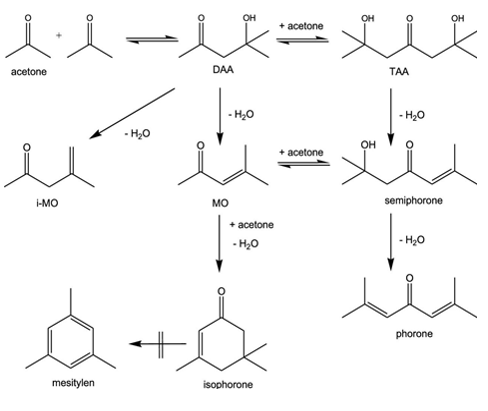
Figure 3. Aldol reactions converting fuel Acetome to DAA, Mesityl Oxide and so on
If DAA is further dehydrated, the Mesityl Oxide is formed and can be used to form the Carbon Negative fuel mixtures as we claim they will satisfy completely our goal and the most fastidious customers we ever had to bring the air CO2 to the air CO2 content of the pre-petroleum ear at the level of about the year of 1900. The extracted biofuels were tested on the corporate cars 2024 Porsche Cayenne Turbo and 2024 Toyota Camry SE (Gasoline cars) and 2024 Chevrolet Silverado 5500 HD (Diesel fuel car) for the distance of 15,000 miles. The cars were tested by the mechanics we have invited from respective cars dealerships and transported to our corporate site to test said vehicles on any damages to their engines, the engine gaskets, the motorâ??s exhaust was controlled and overall driving experience was estimated by said certified mechanics. For the note of the readers: we always had the 4 spare 20L canisters filled at the corporate facility in the tested Gasoline powered cars and the tested Diesel fuel powered truck with the fuel mix stated above as the spare amounts of fuel for the gas tank refills if wed rove outside of the close access to our gas stations, which we still have to distribute around the Nation when the corporate funds would allow us.
Results and Discussion
Again, we have to note herein that we have used the mixture of gases for the fermentor modules feeding CO2 - 2- vol % and H2 - 80 vol %. The hydrogen was produced by us via the electrolysis of distilled water we also produce at our corporate setting using the electric energy of the modern solar power panels connected in series and in parallel to provide required voltages. The CO2 was obtained at our corporate facility by concentrating the air CO2 for about 50 times since the air CO2 levels are now extremely high. We have used the proprietary technology of the CO2 concentration from the air CO2 using the proprietary technology we have purchased somewhere [5]. The Author was really surprised when all his planned herein experimental parts with the Carbon Negative replacement of Gasoline and Diesel fuel worked as described before [8-10].
Data on testing of the Carbon Negative fuel using real Gasoline fuels vehicles 2024 Toyota Camry SE and 2024 Porsche Cayenne Turbo. Results on no any visible defects of the vehicle motors or vehicles misbehavior while driving. The certified mechanics from the respective car dealerships have meticulously tested the respective corporate cars at the corporate manufacturing site and drove said cars on the roads nearby the manufacturing site meticulously to reveal any damages caused by the replacement of the Gasoline or the Diesel fuel by the offered by the Author of this original article Carbon Negative mixture of the Carbon Negative fuels comprising 30% fuel Isobutanol, 20% fuel butanol; 30% fuel DAA and 20% fuel Mesityl oxide. The cars were also placed on the treadmill with the separate device attached to the treadmill to check the engine’s emissions.
No Unusual Emissions in the Car’s Exhausts were Ever Detected
No unusual engine emissions were noted by said mechanics for all tested corporate cars. Then the mechanics made the test drives of the each said vehicle. No any mechanical or any other damages to the engines of the all said cars were ever revealed upon said thorough testing. Test drives of each said vehicle by the certified mechanics did not reveal any abnormal driving behavior in any of said cars. The mechanics still did not make any further recommendations on the following use of the Gasoline and the Diesel fuel replacement leaving for the Author the possibility of reporting this very good news to the general public. The gas mileages of the cars used to test the mixture of the Carbon Negative fuels were 37 mpg on the highway and 32 mpg in the city of Brownsville. You can easily calculate the average gas mileage from said numbers. But the overall picture looks to us very promising since the gas mileage even slightly exceeded the Gasoline from petroleum use mileage in Toyota Camry SE and Porsche Cayenne Turbo. Due to the limited number of the tested cars, we cannot make any predictions for the other car makes and the cars made before the year of 2024. This will become the risk of the other car owners, who will decide to replace their Gasoline with the produced from the air CO2 mixture of the Carbon Negative fuels. If you remember our corporate goal is to replace all the petroleum use by the use of the air CO2, initially to resolve the issue of the transportation problems, substantially increasing the air CO2 content via the air CO2 accumulation and eventually to decrease the air CO2 content causing the fresh water loss to the outer Space vacuum as stated before.
Fuel Efficiency of the New Carbon Negative Replacement of the Diesel Fuel
We have tested plenty of the Diesel fuel trucks for the use of our Carbon Negative fuel mixture described above: mixture of the Carbon Negative fuels comprising 30% fuel Isobutanol, 20% fuel butanol; 30% DAA and 20% Mesityl oxide. For this specific taste we have tested the Diesel fuel powered corporate truck 2024 Chevrolet Silverado 5500 HD for the distance of 15,000. The gas mileage we have calculated from this diesel powered truck using our Carbon Negative fuel mix was in the city of Brownsville TX 28 mpg and the highway driving was approximately 30.5 mpg when we have used the sated above carbon negative fuel mix to fill the gas tank of said truck all the time. These numbers of the gas mileage were slightly above the diesel fuel from petroleum numbers for the said truck: 26 mpg for the city driving and 29 mpg for the highway driving.
The new gas stations selling Carbon Negative fuel mix along with the genetically engineered foods and normal foods for home cooking of the customers showed promising tendencies of improved sales of both the Carbon Negative fuel and the foods, both genetically engineered and regular. Apparently, customers really appreciated the opportunity to save their time while visiting said new version of the gas stations selling also foods for the households. Saving of the customers time was our primary priority and the new route to improve sales of the carbon negative fuels. Basically, we have reached our goal; the new kind of the gas stations will probably replace the existing gas station selling only snacks and Gasoline and Diesel fuel manufactured from petroleum.
The schematic plan of the new type of the gas station shown below in Figure 4.

Figure 4: The Schematic Plan of the New Type of the Gas Station
Figure 4 Our new type of the gas stations saving plenty of time to our valued customers. Along with the Carbon Negative fuel mixture and the regular automotive accessories like coolants, windshield wipers, motor oils, etc. We offer also the Carbon Negative genetically engineered foods for home cooking and vegetables / fruits, candies of various type to save our valuable customer’s time for traveling to the grocery stores, the distilled water for drinking only. We are anticipating the coming shortly in the next 21-25 years shortness of crops and livestock production and the therefore coming relatively soon starvation of the Humankind. Therefore the anticipated shortness of the fresh water makes us offer also the distilled water for doing laundry and washing of our bodies. However, we are still discussing these options without top Executive Councelors to have this option justified commercially and therefore profitable for your corporations.
This article is another the Author’s move in the war which has started by SHELL International Petroleum Corporation some time back by attempted murder of the Author. The people hired by SHELL has totaled the Author’s corporate car and did some other illegal things to the Author which have concluded the Author that the war with the international petroleum corporations has started already. No Houston FBI or Houston Police investigation of said attempted murder has happened and this is behind the responsibility of the Texas Governor with all the legal remedies the Author might use in his fight to sue the State and its Governor Gregory Abbott. The attempted murder has the statute of limitations 20 years, and there are jurisdictions above the level of the State of TEXAS. The Author had certain legal problems with the at that time Attorney General of the State of Texas in 2013, now Texas Governor, Greg Abbott and the Author is going to resolve all the legal problems with the Texas Governor, regardless would he be dismissed or not. The corporate Author’s website http://syngasbiofuelsenergy.com was destroyed by the person, the Attorney of Hirsch and Wertheimer Law Firm, PC by the last name Levy. She belongs to the same family which owned or owns the grocery stores chain named “Fiesta” in Houston Texas.
The Author was unable to find a lawyer in Texas to file the respective federal lawsuit and recover his corporate website, but the Author has the US Constitutional right to recite this website in the references herein. Therefore, the Author has multiple legal problems with the State of Texas and the Author is going to resolve said legal problems at the respective Court level in the US. The Author is already involved into the war which has been started by the International Petroleum Corporation SHELL. The Author has approached SHELL offering them for the commercialization the proprietary technology of Gasoline or Diesel fuel manufacture from the air CO2, not from petroleum which SHELL and other international petroleum corporations use. SHELL representative met the Author, got his draft of the at that time in publication article on creation Gasoline from the air CO2 [1,4,5,23,24].
Then SHELL hired two Mexicans to kill Dr. The Author in the car accident, paying the possibly around $6,000 for this dirty job, which has been done in Houston TEXAS at the US59 down South (9494 Southwest Fwy). The Houston FBI and the Houston Police were contacted by the Author multiple times over his mobile phone however there was no any detailed and thorough Police or the FBI investigation of said attempted murder of the Author since as the Author trusts, both Houston FBI and Houston Police are totally corrupted by the international petroleum corporations. Therefore, any law is not used in the State of Texas to hurt said corporations. Therefore, the Author has to look for the law enforcement outside of the State of Texas, at the National level and he will do that to affect the Texas Governor Abbott for his actions of 2013 and have him resign from his position. Therefore, the Author has conflict of interests with the State of Texas, TEXAS Governor Gregg Abbott, Texas FBI and Texas Police. Since that time more scientific publications of the Author on the Gasoline and Diesel fuel production from the air CO2 came out. The US patents are extremely expensive; therefore, the Author uses instead of patents scientific publications. Publications are as good as the US patents, each the US patent has to claim something better than the Author already did in his scientific publications. The Author working on the Acetogens- biocatalysts has no any competition in the world because of his prior invention, the electroporation / electrofusion Generator, already sold as a sample (with no right for reproduction) to the US corporation BTX, Inc. / Genetronics, Inc. (San-Diego, CA). Said Generator and the invented by the Author genome tailoring technology make him proud to be with no any competition in the whole World.
Mentioning of names Dr. Gak, Dr. Kiriukhin, Dr. Padda in certain publications herein and elsewhere.
1. (Tyurin MV, Padda RS. (2019) Nitrogen gas reducing commercial acetogen biocatalyst suitable for direct and selective reduction of CO2 inorganic carbon to organic carbon and atmospheric nitrogen to fuel isobutanol during continuous fermentation of CO2 + H2 + N2 gas blend. International Research Journal of Applied Sciences, Engineering and Technology. V.3, 4, 1 - 10;
2. Tyurin MV, Padda R, Huang K-X, Wardwell S, Caprette D, Bennett GN (2000) Electrotransformation of Clostridium acetobutylicum ATCC 824 using high-voltage radio frequency modulated square pulses // J Appl Microbiol. 88(2):220-227; Gak E, Tyurin MV, Kiriukhin M (2014) Genome tailoring powered production of isobutanol in continuous CO2 / H2 blend fermentation using engineered acetogen biocatalyst. J Ind Microbiol Biotechnol. 41(5):763-781 http://www.ncbi.nlm.nih. gov/pubmed/24659176
3. Kiriukhin M, Tyurin MV, Gak E (2014) UV-induced mutagenesis in acetogens: resistance to methanol, ethanol, acetone, or n-butanol in recombinants with reduced genomes during continuous CO2 / H2 gas blend fermentation. World Journal of Microbiology and Biotechnology. 30(5):1559-1574. https://link.springer.com/article/10.1007/s11274-013-1579-7;
4. Berzin V, Kiriukhin M., Tyurin M. (2012) Elimination of acetate production to improve ethanol yield during continuous synthesis gas fermentation by engineered biocatalyst Clostridium sp. MTEtOH550. Appl Biochem Biotechnol. 167 (2):338-347. https://link.springer.com/article/10.1007/s12010-012-9697-5;
5. Berzin V, Tyurin M. (2012). Acetogen biocatalyst Clostridium sp. MTEtOH871 engineered with our proprietary electrotransformation technology and equipment: continuous synthesis gas fermentation for selective ethanol production. Journal of Biotech Research. 4:54-64.
6. Berzin V, Kiriukhin M, Tyurin M. (2013) “Curing” of plasmid DNA in acetogen using microwave or applying an electric pulse improves cell growth and metabolite production as compared to the plasmid-harboring strain. Arch. Microbiol. 195(3), 181-188;
7. Berzin V, Kiriukhin M, Tyurin M. (2013) Selective n-butanol production by Clostridium sp. MTButOH1365 during continuous synthesis gas fermentation due to expression of synthetic thiolase, 3-hydroxy butyryl-CoA dehydrogenase, crotonase, butyryl- CoA dehydrogenase, butyraldehyde dehydrogenase and NAD- dependent butanol dehydrogenase. Appl Biochem Biotechnol. 169(3), 950-959. https://link.springer.com/article/10.1007/ s12010-012-0060-7
8. Berzin V, Kiriukhin M, Tyurin M (2013) Cre-lox66/lox71- based elimination of phosphotransacetylase or acetaldehyde dehydrogenase shifted carbon flux in acetogen rendering selective overproduction of ethanol or acetate. Appl Biochem Biotechnol. 195(3):181-8. https://link.springer.com/article/10.1007/s12010- 012-9864-8;
9. Tyurin M, Kiryukhin M, Berzin V. (2012) Electrofusion of untreated cells of the newly isolated acetogen Clostridium sp. MT351 with integrated in the chromosome erm(B) or cat leading to the combined presence of these antibiotic resistance genes in the chromosome of the electrofusion products. Journal of Biotech Research. 4:1-12;
10. Tyurin M, Kiriukhin M. (2013). Expression of amplified synthetic ethanol pathway integrated using Tn7-tool and powered at the expense of eliminated pta, ack, spo0A and spo0J during continuous syngas or CO2 /H2 blend fermentation. J Appl Microbiol. 114(4):1033-45. https://ami-journals.onlinelibrary. wiley.com/doi/abs/10.1111/jam.12123.
11. Berzin V, Kiriukhin M, Tyurin MV (2012) Selective production of Acetone during continuous synthesis gas fermentation by engineered biocatalyst Clostridium sp. MAceT113. Letters of Appl Microbiol. 55(2):149-54. . https://doi.org/10.1111/j.1472- 765X.2012.03272.x. https://ami-journals.onlinelibrary.wiley. com/doi/10.1111/j.1472-765X.2012.03272.x
12. Tyurin MV, Kiriukhin M. (2013). Selective methanol or formate production during continuous CO2 fermentation by the acetogen biocatalysts engineered via integration of synthetic pathways using Tn7-tool. World Journal of Microbiology and Biotechnology. 29 (9)1611-1623. https://www.semanticscholar. org/paper/Selective-methanol-or-formate-production-during- CO2-Tyurin-Kiriukhin/84f55f6505b1757dcab27f93a532001f03 5eb53b
13. Tyurin MV, Kiriukhin M (2013). 2,3-Butanediol production by engineered acetogen biocatalyst during continuous fermentation of syngas or CO2/H2 blend. Appl Biochem Biotechnol. 170 (6): 1503-1524. doi: 10.1007/s12010-013-0285-0.
14. Kiriukhin M, Tyurin MV, Gak E (2014) UV-induced mutagenesis in acetogens: resistance to methanol, ethanol, acetone, or n-butanol in recombinants with reduced genomes during continuous CO2 / H2 gas blend fermentation. World Journal of Microbiology and Biotechnology. 30(5):1559-1574. https://link.springer.com/article/10.1007/s11274-013-1579-7.
15. Kiriukhin M, Tyurin MV (2013) Mevalonate production by engineered acetogen biocatalyst during continuous fermentation of syngas or CO2/H2 blend. Bioprocess Biosyst Eng. 2014 Feb;37(2):245-260. doi: https://pubmed.ncbi.nlm. nih.gov/24415498/;
16. Kiriukhin M, Tyurin MV (2013) Mevalonate production by engineered acetogen biocatalyst during continuous fermentation of syngas or CO2/H2 blend. Bioprocess Biosyst Eng. 2014 Feb;37(2):245-260. Doi: https://pubmed.ncbi.nlm.nih. gov/24415498/;
17. Gak E, Tyurin MV, Kiriukhin M (2014) Genome tailoring powered production of isobutanol in continuous CO2 / H2 blend fermentation using engineered acetogen biocatalyst. J Ind Microbiol Biotechnol. 41(5):763-781 http://www.ncbi. nlm.nih.gov/pubmed/24659176) has no practical authorship of said publications meaning since said individuals got paid by the Author significant amounts of cash for doing research for the Author per the topics he ordered them to investigate and provide the detailed reports to him. However, their names are included in said specific publications since they have worked on said topics. Name of Vel G. Berzin is also included and has no scientific meaning since Mr. Berzin was a friend of the Author some time back, Mr. Berzin paid his own $300 for starting the corporation Syngas Biofuels Energy, Inc. for which he did not provide any scientific input including the corporate website http://syngasbiofuelsenergy.com. Mr. Berzin has retired from the public life when he became 65 and he keeps his current location at the nursing home very confidential for the Author.
Authors Contributions
The Author has conducted all the experiments himself. The Author has planned, wrote this original article and edited the written text, including proper placement of the illustrations mentioned which the Author owns. The Author read, edited and approved the final manuscript. The Author is the only owner of all materials disclosed in this original article. The Author has plans to distribute his proprietary products after their approval as needed. The Author might be contacted for the data and materials at PO Box 300230, Houston, TX, 77230, drmtyurin76@aol. com. The Author contributed to the study conception and design. Material preparation, data collection and analysis were performed by the Author. The first draft of the manuscript was written by the Author. The Author read and approved the final manuscript.
The Author has designed the ideology of this article by himself. The Author intends to develop the detailed structure and location of his Carbon Negative corporations to be in charge for the establishing and running testing trials of his inventions he plans to commercialize additionally to his major business of manufacture of Carbon Negative fuels and Carbon Negative genetically engineered foods for the nationwide distribution.
The Author has conducted all the experiments himself. The Author has planned, wrote this original article and edited the written text, including proper placement of the illustrations mentioned which the Author owns. The Author read, edited and approved the final manuscript. The Author is the only owner of all materials disclosed in this original article. The Author has plans to distribute his proprietary products after their approval as needed. The Author might be contacted for the data and materials at PO Box 300230, Houston, TX, 77230, drmtyurin76@aol. com. The Author contributed to the study conception and design. Material preparation, data collection and analysis were performed by the Author. The first draft of the manuscript was written by the Author. The Author read and approved the final manuscript.
The Author has designed the ideology of this article by himself. The Author intends to develop the special structure at his Carbon Negative corporations to be in charge for the establishing and running clinical trials of his inventions he plans to commercialize additionally to his major business of manufacture of Carbon Negative fuels and Carbon Negative genetically engineered foods for the Nationwide distribution.
The Author conceived of the presented idea. The Author developed the theory and performed the computations. The Author verified the analytical methods. The Author investigated therapeutic effects of “Mixture” and supervised the findings of this work. The Author discussed the results and contributed to the final manuscript. The Author carried out the experiment. The Author wrote the manuscript. The Author supervised the project. The Author conceived the original idea. The Author supervised the project. The Author developed the theoretical formalism, performed the analytic calculations and performed the numerical simulations. The Author contributed to the final version of the manuscript. The Author supervised the project. The Author conceived and planned the experiments. The Author carried out the experiments. The Author planned and carried out the simulations. The Author contributed to sample preparation. The Author contributed to the interpretation of the results. The Author took the lead in writing the manuscript. The Author provided critical feedback and helped shape the research, analysis and manuscript.
The Author designed the model and the computational framework and analyzed the data. The Author carried out the implementation. The Author performed the calculations. The Author wrote the manuscript. The Author conceived the study and were in charge of overall direction and planning. The Author designed and performed the experiments, derived the models and analyzed the data. The Author wrote the manuscript in consultation with other corporate employees, devised the project, the main conceptual ideas and proof outline. The Author worked out almost all of the technical details, and performed the numerical calculations for the suggested experiment. The Author worked out the bound for quantum mechanics. The Author analyzed the data. The Author wrote the paper. The Author designed and directed the project; the Author performed the experiments; the Author analyzed spectra; the Author. Made the simulations; the Author developed the theoretical framework; the Author wrote the article. The Author performed the measurements. The Author. was involved in planning and supervised the work, the Author processed the experimental data, performed the analysis, drafted the manuscript and designed the figures.
Acknowledgements
The Author does have the other parties to acknowledge. Ms. Joany Kerr, the International Sales Director of BTX, Inc./ Genetronics, Inc., and the CEO of BTX, Inc./ Genetronics, Inc. Dr. Gunter A. Hoffman for giving to the Author his copy of the Electrofusion / Electro transformation Generator prior to that sold to BTX, Inc./ Genetronics, Inc. The Author confirms herein the help of the Third Secretary of the US Embassy in Moscow at that time (1995) Mr. James Winkelman for his help to receive funds for the transportation of said Generator from Moscow to San-Diego via UPS in 1995. The Author herein confirms help of Dr. Nikita Tamm from the Moscow State University for his help in receiving cash in $ in Moscow, the Russian Federation, from San-Diego, CA in 1995.
Originality-Significance Statement
The Author has written this original article based on his originality of the business approach and the existing resistance of the International Petroleum corporation to the technology of manufacturing carbon negative fuels to replace their production of fuels originating from petroleum. The reduction of the air CO2 levels towards the pre-petroleum era of the year 1900 is paramount, Since our planet loses fresh water to the outer Space vacuum. NASA has confirmed that in 2010 sating that the Earth has reached the “Point of No Return” to the healthy environmental conditions suitable for life on our planet. The new family of the gas stations selling not only Carbon Negative fuels but also foods for cooking at home and commodity chemicals for the households will save a lot of time for the customers of said new gas stations.
The Author Dr. Michael V Tyurin is the Author of this original article. In 2017 after tragic death of his wife Prof. Dr. Tyurina Aleksandra Nicolaevna his father Prof. Dr. Tyurin Vladimir Inljich decided to change his first name from “Vladimir” to “Vladislav”. Therefore the Author Dr. MV Tyurin had to change his second name from “Vladimirovich” to “Vladislavovich”. ORCID # is 0000-0001-6943-6556. Contact address: Dr. Michael Vladislavovich Tyurin, CEO, Executive Chairman, President Microbial Biocatalyst International, Inc. and Inorgcarbdiesel, Inc. PO Box 300230, Houston, TX 77230. Contact Email drmtyurin76@aol.com.
Article Summary
• Fresh Water Shortage is anticipated in the next 10 - 25 years.
• The Solution: replacement of current economy with Carbon Negative economy and Carbon Negative fuels use only might take about 30-70 years.
• Anticipated Global Starvation on Earth might be resolved via massive manufacture of genetically engineered Carbon Negative foods.
Declaration of Interests Statement
Ethics Approval and Consent to Participate
The Author has received all the proper documents granting the Ethical Approval and the Consent to Participate from the State of Texas officials. The Author has made sure that the ethical approval and his consent to participate in preparation and submission for publication of this article were properly approved by the respective authorities of the State of Texas.
Consent for Publication
The Author has expressed his complete consent to participate in work with this article and its publication in this Journal.
Availability of Data and Materials
The Author makes all his data and materials herein available for any third party. The data and materials might be obtained from the Author at PO Box 300230, Houston, TX, 77340. Email drmtyurin75@gmail.com. If any third party needs any materials used to publish this article, please, do contact the Author.
References
- Peralta, E. (2015). Obama On Climate Change: “I Actually Think We”re Going To Solve This Thing’ : The Two-Way : NPR. Retrieved December 21, 2015, from http://www.npr. org/sections/the twoway/2015/12/01/457986043/obama-urges-turkey-russia-to-lessen-tensions-focus-on-islamic-state fight.
- The New York Times. (2015). The Road to a Paris Climate Deal. Retrieved December 21, 2015, http://www.nytimes. com/interactive/projects/cp/climate/2015-paris-climate- talks.
- Tenenbaum, L., & Shaftel, H. (2015). Scientific Consensus: Earth’s Climate Is Warming. Retrieved December 21, 2015, from http://climate.nasa.gov/scientific-consensus/.
- https://earthscience.stackexchange.com/questions/9488/how-much-water-is-the-atmosphere-losing-to-space.
- http://syngasbiofuelsenergy.com.
- Weizmann, C. (1919). Production of Acetone and Alcohol by Bacteriological Processes. United States Patent Office. Retrieved from http://www.google.com/patents/ US1315585.
- Zverlov, V. V., Berezina, O., Velikodvorskaya, G. A., & Schwarz, W. H. (2006). Bacterial acetone and butanol production by industrial fermentation in the Soviet Union: use of hydrolyzed agricultural waste for biorefinery. Applied microbiology and biotechnology, 71, 587-597.
- Tyurin, M. V. (2024). Carbon Negative Gasoline and Diesel fuel replacements: Mesityl oxide, Diacetyl alcohol, fuel Isobutanol and their mixtures as the Carbon Negative fuels. Clinical Medicine Insights, 5(2).
- Tyurin, M. V., & Padda, R. S. (2019). Nitrogen gas reducing commercial acetogen biocatalyst suitable for direct and selective reduction of CO2 inorganic carbon to organic carbon and atmospheric nitrogen to fuel isobutanol during continuous fermentation of CO2+ H2+ N2 gas blend. International Research Journal of Applied Sciences, Engineering and Technology, 3(4), 1-10.
- Berzin, V., Kiriukhin, M., & Tyurin, M. (2012). Selective production of acetone during continuous synthesis gas fermentation by engineered biocatalyst Clostridium sp. MAceT113. Letters in applied microbiology, 55(2), 149- 154.
- Fu, C., Li, Z., Jia, C., Zhang, W., Zhang, Y., Yi, C., & Xie, S. (2021). Recent advances on bio-based isobutanol separation. Energy Conversion and Management: X, 10, 100059.
- Daubert, T. E., & Danner, R. P. (1985). Data compilation tables of properties of pure compounds. American Institute of Chemical Engineers, New York.
- Valvanix, S. C., Yalkowsky, S. H., & Roseman, T. J. (1981). Solubility and partitioning IV: Aqueous solubility and octanol-water partition coefficients of liquid nonelectrolytes. Journal of pharmaceutical sciences, 70(5), 502-507.
- Lakshmi, N. M., Binod, P., Sindhu, R., Awasthi, M. K., & Pandey, A. (2021). Microbial engineering for the production of isobutanol: current status and future directions. Bioengineered, 12(2), 12308-12321.
- Xie, S., Song, W., Fu, C., Yi, C., & Qiu, X. (2018). Separation of acetone: From a water miscible system to an efficient aqueous two-phase system. Separation and Purification Technology, 192, 55-61.
- https://patents.google.com/patent/US1550792A/en.
- https://www1.eere.energy.gov/hydrogenandfuelcells/tech_ validation/pdfs/m03r0.pdf.
- Berzin, V., Tyurin, M., & Kiriukhin, M. (2013). Selective n-butanol production by Clostridium sp. MTButOH1365 during continuous synthesis gas fermentation due to expression of synthetic thiolase, 3-hydroxy butyryl-CoA dehydrogenase, crotonase, butyryl-CoA dehydrogenase, butyraldehyde dehydrogenase, and NAD-dependent butanol dehydrogenase. Applied biochemistry and biotechnology, 169, 950-959.
- Faba, L., Gancedo, J., Quesada, J., Diaz, E., & Ordonez,S. (2021). One-pot conversion of acetone into mesitylene over combinations of acid and basic catalysts. Acs catalysis, 11(18), 11650-11662.
- Li, S., Li, N., Li, G., Wang, A., Cong, Y., Wang, X., &Zhang, T. (2014). Synthesis of diesel range alkanes with 2-methylfuran and mesityl oxide from lignocellulose.Catalysis Today, 234, 91-99.
- https://pubchem.ncbi.nlm.nih.gov/compound/Mesityl- oxide.
- https://link.springer.com/article/10.1007/s11144-022- 02168-z.
- Tyurin MV (1992). Russian Patent RU 2-005776-2. Plate-parallel polished electrodes and the process of their manufacture from the titanium-based metal alloy VK-2.
- Tyurin MV (1992) Russian Patent RU 2-005776. Generator for electrotransformation and electrofusion/ electrodistruction of various cells: microbial, animal, plant and the process of its manufacture, and the set of plate-parallel polished electrodes and the process of their manufacture from the titanium-based metal alloy VK-2.