

Current Research in Vaccines Vaccination(CRVV)
ISSN: 2834-880X | DOI: 10.33140/CRVV


Research Article - (2023) Volume 2, Issue 2
Mycobacterium Effects of Traits for Microscopy
Received Date: Mar 13, 2023 / Accepted Date: Apr 20, 2023 / Published Date: Apr 27, 2023
Copyright: ©Â©2023 Solomon Ubani. This is an open-access article distributed under the terms of the Creative Commons Attribution License, which permits unrestricted use, distribution, and reproduction in any medium, provided the original author and source are credited.
Citation: Ubani, S. (2023). Mycobacterium Effects of Traits for Microscopy. Curr Res Vaccines Vaccination, 2(2), 44-46.
Abstract
Research was to study mycobacterium a species of pathogenic bacteria. The research question was impervious to Gram staining resultant of either negative or positive effects. The method involve studies of mycobacterium an etiologic parasite. These were 2 to 4 micrometers in length and 0.2 to 0.5μm in width. The results showed the bacteria settlement in the cytoplasm of the plants and growth. This suggested it can be transferred to other eukaryotes. Plants were immunoprevention treatment 15mL each day for a month. Eukaryotic with possibility of mycobacterium should be considered for treatment at least 15mm of induration or had a Gram-positive result. It concluded the treatment had streptomycin production a synthesis inhibitor. It combined to small 16S rRNA of the 30S subunit prevention of binds of formyl-methinonyl-tRNA to the sequence.
Keywords
Microscopy, Traits, Mycobacterium
Introduction
The initial phase of mycobacterium was the treatment phase, but this was impervious to streptomycin reports with high frequency. This was no longer being considered interchangeable with etham-butol unless the stain was susceptible to the plants (Streptomycin Sulfate, n.d.).
Mycobacterium was an obligate aerobe. The bacterium was facul-tative intracellular parasite, usually of macrophages and had a slow development time, 15 to 20 hours, a physiological characteristics contribution to its virulence. Antimicrobial activity was known as a mode of process. The products had led to speculation on devel¬opment of microbial resistance, in particular antibiotic prevention.
Methods And Materials
Infection with Mycobacterium avium complex provided special treatment challenges. There were 3 to 4 treatment with ethambutol and streptomycin continued until the culture resulys were negative for 1 year. The typical duration was 18 to 24 months.
Experiment
This involved cross-fertilization of a purebred plants with another, these crosses yielded cells resemblance with the initial plant but not mixture of the two. The progeny of new cells had similar traits.
Amino Sequence Stains
Amino stains such as auramine were used instead for identi cation of Mycobacterium with a microscope. This was the most frequent method of treatment of cultures. It took 4 to 6weeks for visualiza¬tion on either cells.
Detection of Mycobacterium
In a sputum sample, an excess of 10000 organism per ml were needed for visualization of bacilli with a 100 magni cation micro¬scope objective .
Bacille
The high percentage of mycobacterium were infected with resis¬tant. This was ongoing transfer of antimicrobe treatment and pro¬cedures were implemented for the results.
Four subspecies were recognized mitis, intermedius, gravis and belfanti. This differed in structure and properties for conversion of nutrients.
Results
Diptheria was a bacterial infection effects on the membrane of the cytoplasm. This condition transferred from culture-to-culture of the plants. There was a 3 to 1 ration of a phenotype to another. The results showed the crosses:
315 plants with round, yellow seeds
108 plants with round, green seeds
101 plants with rumpled, yellow seeds
32 plants with rumpled, green seeds
These phenotypes had 9:3:3:1 ratios.
Mycobacterium divided every 15 to 20 hours. This was delayed in relation with another bacteria and division in 20 minitutes.
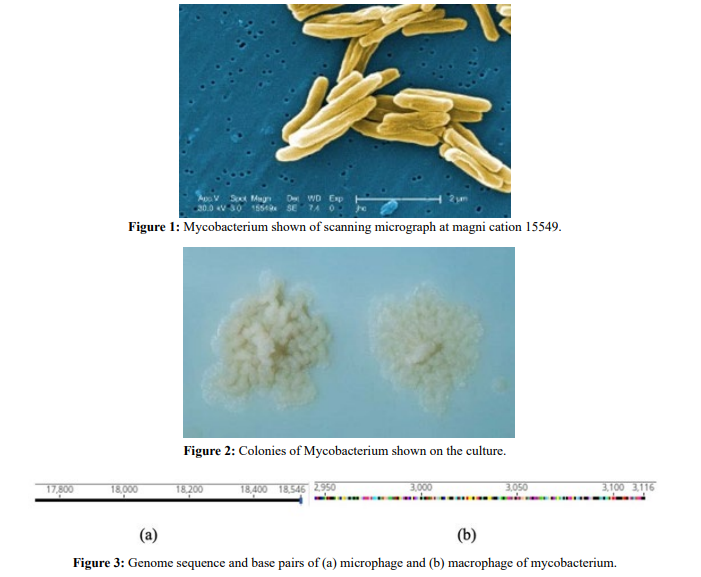
Figure 3 showed the difference of traits of mycobacterium at the micro and macro level. This indicated Gram-stain was only visi-ble at the macrophage. Therefore the positive result was found for a low than high magni cation. The mycobacterium therefor test¬ed positive for pathogens. The base pair at the microphage was 6 times more than in the macrophage. The proposition of green and yellow seeds were found for indication of biodiversity of the mcycobacterium.
The capability to develop mycobacterium mutants and test gene products for speci c function of pathogenesis. The deletion of im-pairs growth in macrophages.
Discussion
The intracellular pathogen mycobacterium was exposed to differ- ent cells. This was reactive and produced up to double strands. The treatments included antimicrobe for 7 to 14 days of each month, al¬ternation for 7 to 10 days with free times of 7 to 10 days of a long¬term daily dose. The differentiation of the antimicrobial treatment for micro and macro regions. It was indicative the micro had a sta¬ble and had a positive effect according to treatment. This contained free regions of binding of treatment. However this was a false-pos-itive measurement. The macrophage showed for a treatment was negative result. It contained free binding regions after does.
The laboratory con rmation in polymerase reaction or viral culture. The consideration minimized by falsepositive or false-negative re¬sults.
Conclusion
Mycobacterium evolved in with plant population between 40000 and 70000 years. The genome sequences of complex membranes was extracted from different cultures. This suggested the binding of the molecule to the 30S subunit prevented 50S mixture with the mRNA strand. Streptomycin was an antimicrobial inhibited both Gram-positive and Gram-negative bacteria treatment [1-9].
Declarations
Conflict of Interest
On behalf of all authors, the corresponding author states that there is no conflict of interest.
References
- Streptomycin Sulfate. (n.d.). Retrieved 5 30, 2022, from The American Society of Health-System
- Corynebacterium Diphtheriae. (n.d.). Retrieved 5 30, 2022, from Wikipedia
- Diphtheria. (n.d.). Retrieved 5 30. 2022.
- Fact Sheets. (n.d.). Retrieved 5 30, 2022
- How, T. B. Spreads. (n.d.). Retrieved 5 30. 2022. from Center for Disease Control
- Miko, I. (2008). Gregor Mendel and the principles of inheritance. Nature Education, 1(1), 134.
- Mycobacterium Tuberculosis. (n.d.). Retrieved 5 30, 2022, from Wikipedia
- Streptomycin. (n.d.). Retrieved 5 30, 2022, from Wikipedia
- Todar, K. (n.d.). Mycobacterium tuberculosis and Tuberculo