

Journal of Veterinary Health Science(JVHS)
ISSN: 2831-3887 | DOI: 10.33140/JVHS
Impact Factor: 0.762

Research Article - (2022) Volume 3, Issue 3
Multidimensional Poverty Analysis in Coastal Region of Sindh Province, Pakistan; a Case Study of Thatta and Badin Districts
1Land Resource Managemnt, Nanjing Agriculture University, China
2Department of Biotechnology, Sindh Agriculture University Tandojam, China
3Depatment of veterinary Surgery and Obstertrics, Sindh Agriculture University Tando Jam, China
Received Date: Jul 19, 2022 / Accepted Date: Jul 25, 2022 / Published Date: Aug 23, 2022
Copyright: ©Copyright: ©2022 Jing Wang. This is an open-access article distributed under the terms of the Creative Commons Attribution License, which permits unrestricted use, distribution, and reproduction in any medium, provided the original author and source are credited.
Citation: Dahri G N, Talpur B A, Wang J, Hu L , Tabassum S & Khoso A S. (2022). Multidimensional Poverty Analysis in Coastal Region of Sindh Province, Pakistan; a Case Study of Thatta and Badin Districts. J Vet Heal Sci, 3(3), 275-282
Abstract
Multidimensional measures provide an alternative lens through which poverty may be viewed and understood deeply. It is argued that monetary variables (such as income or expenditure) are unable to truly evaluate human well-being. It is an emerging phenomenon in the South Asian countries where 49% of people are multidimensional poor. The dimension wise breakdown shows the cooking fuel; flooring, nutrition, electricity, child mortality and schooling have major contributors among overall multidimensional poverty. Across 107 developing countries, 1.3 billion people are suffering from acute income poverty with a certain disparity in magnitude. While the dilemma of poverty has become a leading challenge in the history of the developing world, due to its extensive impact on the developmental process. Analysis of Multidimensional poverty in the coastal region of Sindh; Thatta and Badin. To identify the impact of multidimensional poverty on socioeconomics conditions in the coastal region. To analyze the Multidimensional poverty in districts Thatta and Badin and examine the key factor influencing the multidimensional poverty in the study area. Primary data was collected to achieve targets and meet the objectives of the study. A random sampling technique used for the data collection procedure, total sample size of the respondents was 100. Data entered and arranged in a coding system, analyzed through SPSS software and MS Office. The Alkire and Foster method was used for the poverty analysis. We observed that Badin is more derivate as compare to the district Thatta in almost all indicator set by OPHI. Basic facilities needed for improvement through public private partnerships, daily earning source should be increase, and water availability should be improved specially in tail area of Badin district.
Keywords
Multidimensional, Poverty, Costal Region, Badin, Thatta & Sindh
Introduction
Poverty is a complex phenomenon that is characterized by uni-dimensional and multidimensional poverty. Therefore, the Uni-dimensional measurement of poverty is not possible and there is a need of multidimensional poverty approach in order to measure the deprivation among individuals in real sense. Multidimensional measures provide an alternative lens through which poverty may be viewed and understood deeply. It is argued that monetary variables (such as income or expenditure) are unable to truly evaluate human well-being. It is an emerging phenomenon in the South Asian countries where 49% of people are multidimensional poor. The dimension wise breakdown shows the cooking fuel; flooring, nutrition, electricity, child mortality and schooling have major contributors among overall multidimensional poverty. Across 107 developing countries, 1.3 billion people are suffering from acute income poverty with a certain disparity in magnitude. While the dilemma of poverty has become a leading challenge in the history of the developing world, due to its extensive impact on the developmental process. According to most economists poverty is a multidimensional phenomenon, yet in practice for poverty assessment, the majority of the researchers use the uni-dimensional index to analyze an individual’s wellbeing by per capita income or usually expenditures [1]. However, poverty has a variety of signs, like shortage of income and lack of productive resources, which should be sufficient for ill health, livelihoods, hunger, malnutrition, and lack of access to educational facilities, and mortality from illnesses, social judgment, insufficient shelters, and insecure environment [2]. According to Word Bank Report 2021, the global extreme poverty rose in 2020 for the first time in over 20 years as the disruption of the COVID-19 pandemic compounded the forces of conflict and climate change, which were already slowing poverty reduction progress. About 100 million additional people are living in poverty because of the pandemic. In Pakistan, rural areas there is relatively high poverty concentration among non-farming rural households, more reduction in poverty among farming households and the largest contribution to overall rural poverty can be distinguished by major cropping zones using the Poverty Equivalent Growth Index (PEGR). The Multidimensional Poverty Index (MPI) evaluates poverty based on a household’s deprivation in three basic dimensions—education, health, and living standards. These dimensions have ten indicators: two for health, two for education, and six for living standards. A person is identified as poor according to the MPI if the person is deprived in one-third or more of the ten weighted indicators. The first characteristic is that person is identified as poor depending upon the achievements of the entire household. The second is that MPI considers only the deprivations of the multidimensional poor. This process is called censoring since it ignores deprivations of people that do not reach the poverty cut¬off, people who experience some deprivation but are not deprived in 1/3 of the weighted indicators [3].
Table 1: The Dimensions, Indicators, Deprivation Cutoffs and Weights of the MPI
|
Dimensions |
Indicators |
Descriptions: (all indicators equally weighted) |
Weight |
|
Health |
Child Mortality |
A child died in the family |
1/6 |
|
Nutrition |
Any family members are malnourished |
1/6 |
|
|
Education |
Year of schooling |
Anyone from the family who has not been completed the primary education |
1/6 |
|
Child Enrolment |
Between the 1 to 8 years child out of school |
1/6 |
|
|
Living Standard |
Electricity |
No electricity is short |
1/18 |
|
Drinking-Water |
Does not anyone household access to clean drinking water according to the MDG |
1/18 |
|
|
Sanitation/ Toilet Facility |
The sanitation facility has been improved according to the MDG |
1/18 |
|
|
Flooring |
Dirt or Katcha / sand or dung is poor |
1/18 |
|
|
Roofing |
No roof/ palm /leaf/ Bamboo/ Kane are poor |
1/18 |
|
|
Cooking Fuel |
Straw / shrubs/ grass/ animal dung/ agricultural crop |
1/18 |
|
|
Assets |
If don’t own more than one radio, television, telephone, bicycle, motorbike, and animal-drawn cart |
1/18 |
|
|
Source: Alkire, Conconi and Seth MPI 2014 Methodological |
|||
Statement of Purpose
Multidimensional poverty has captured the attention of researchers and policymakers. The key direction for research has been the development of a coherent framework for measuring poverty in the multidimensional environment that is analogous to the set of techniques developed in uni-dimensional space [4, 5]. Recent efforts have identified several classes of multidimensional poverty measures discussed their properties and raised important issues for future work. However, has two significant challenges that discourage the empirical use of these conceptually attractive measures, first, the measurement methods are largely dependent on the assumption that variables are cardinal, when, in fact, many dimensions of interest are ordinal or categorical. The second method for identifying the poor remains understudied: either most presentations leave identification unspecified or select criteria that seem reasonable over two dimensions, these challenges are especially pertinent given that many countries are actively seeking multidimensional poverty measures to supplement or replace official income poverty measures.
Research objectives
i. Analysis of Multidimensional poverty in the coastal region of Sindh; Thatta and Badin
Sub-objective
ii. To identify the impact of multidimensional poverty on socioeconomics conditions in the coastal region.
iii. To analyze the Multidimensional poverty in districts Thatta and Badin.
iv. To examine the key factor influencing the multidimensional poverty in the study area.
Thereotical Framework
The multidimensional poverty analyses the impact of various dimensions over socioeconomic conditions of the people of coastal region of Sindh province. This paper addresses some exceptional understandings of poverty within key theoretical paradigms in order to contextualize the research findings. The paper, as a whole, is framed and structured by three key focus areas, which highlights the significance of multidimensional poverty. Concerning the theoretical framework, the research focuses on health, education and living standard of coastal region of Sindh province; Thatta and Badin. These three dimensions have ten indicators: two for health, two for education, and six for living standards. The conceptual framework presented in Figure 1.1 shows that how the multidimensional poverty influence over the socioeconomic conditions. For instance, it starts from multidimensional poverty [6, 7]. The next step involves the key factor influencing the multidimensional poverty. Based on the factor influencing, this paper analysis the impact of multidimensional poverty over coastal region in Sindh province. A person is identified as poor according to the MPI if the person is deprived in one-third or more of the ten weighted indicators. The first characteristic is that person is identified as poor depending upon the achievements of the entire household. The second is that MPI considers only the deprivations of the multidimensional poor. This process is called censoring since it ignores deprivations of people that do not reach the poverty cut¬off, people who experience some deprivation but are not deprived in 1/3 of the weighted indicators. Increase in income has little impact on the increase in the standard of living of the people due to the presence of multidimensional deprivations. Therefore, from this view, point Uni-dimensional measurement of poverty is not possible and there arises a need for multidimensional poverty approach in order to measure the deprivation among individuals in real sense [8-10].

Methodology
This study is aimed to explore Multidimensional poverty analysis in the coastal region of Sindh Province, with a focus on coastal districts Thatta and Badin. Primary data was collected to achieve targets and meet the objectives of the study. A random sampling technique used for the data collection procedure and through the Random sampling technique we will find maximum aspects and real issues related to poverty. The total sample size of the respondents will be 100 and data collected from distending districts of Sindh provinces. The selected respondent interviewed through a well-designed questionnaire. Data entered and arranged in a coding system, analyzed through SPSS software and MS Office. The Alkire and Foster method was used for the poverty analysis.
Results and Discussion
Table 2: Age and Education of the Respondents
|
Badin |
Thatta |
|||
|
Age |
No: of respondent |
% |
No: of respondent |
% |
|
Age in years |
||||
|
1 to 20 |
1.0 |
2.0 |
4.0 |
8.0 |
|
21 to 40 |
30.0 |
60.0 |
30.0 |
60.0 |
|
41 and above |
19.0 |
38.0 |
16.0 |
32.0 |
|
Overall |
50.0 |
100.0 |
50.0 |
100.0 |
|
Education in years |
||||
|
Illiterate |
31.0 |
62.0 |
18.0 |
36.0 |
|
Primary |
1.0 |
2.0 |
15.0 |
30.0 |
|
Middle |
1.0 |
2.0 |
1.0 |
2.0 |
|
Matric |
5.0 |
10.0 |
5.0 |
10.0 |
|
College |
4.0 |
8.0 |
4.0 |
8.0 |
|
Bachelors |
6.0 |
12.0 |
3.0 |
6.0 |
|
Masters |
2.0 |
4.0 |
4.0 |
8.0 |
|
Overall |
50.0 |
100.0 |
50.0 |
100.0 |
Conclusion
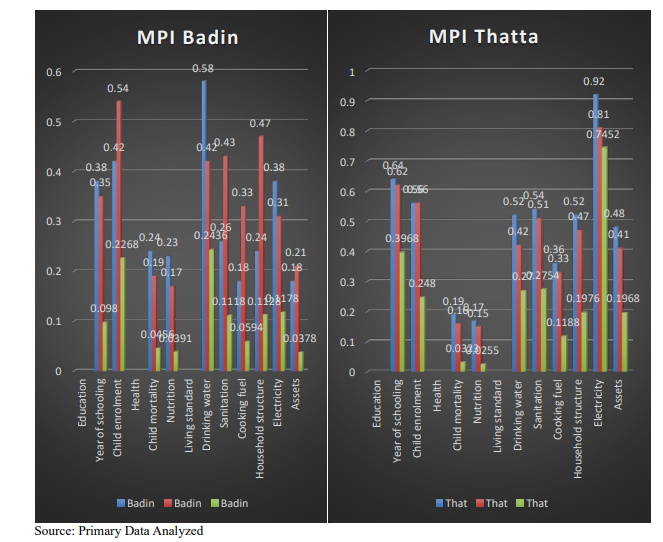
This study applies Alkire-Foster model (2007) approach for the measurement of multidimensional poverty analysis of costal area of Sindh province. Through this approach uses headcount measure which is adjusted by average deprivation suffered by poor, we observed that Badin is more derivate as compare to the Thatta district in almost all indicator set by OPHI. Living standard of both district is not sufficient need to improve their living standard [21, 22].
Policy recommendations
• Basic facilities needed be improvement through public private partnerships, daily earning source should be increase, and water availability should be improved specially in tail area of Badin district.
References
- Duclos, J. Y., Sahn, D., & Younger, S. D. (2006). Robust multidimensional spatial poverty comparisons in Ghana, Madagascar, and Uganda. The World Bank Economic Review, 20(1), 91-113.
- Ahmed, R., Khan, A.U. (2020). Empirical Analysis of Correlates of Education in the Slum Population: Evidence from Karachi, Pakistan. International Transaction Journal of Engineering, Management, & Applied Sciences & Technologies, 11(11), 11A11E, 1-9.
- Ali, I., Barrientos, A., & Saboor, A. (2015). Pro-poor growth across different agro-climatic zones of rural Pakistan. Pakistan Journal of Agricultural Sciences, 52(2).
- Alkire, S., & Roche, J. M. (2013). How multidimensional poverty went down: Dynamics and comparisons.
- Alkire, S. and Santos, M.E. (2013). “Acute Multidimensional Poverty: A new Index for Developing Countries”, Human Development Initiative (OPHI) working paper No.38, Oxford Department of International Development Queen Elizabeth House (QEH), University of Oxford, pp.1-133.
- Foster, J. E. (2008). Counting and multidimensional poverty. In Measurement, Oxford Poverty & Human Development Initiative, OPHI. ð8Þ 123 K. Roelen et al.
- Alkire, S., & Foster, J. (2009). Counting and Multidimensional Poverty Measurement (Short Version) (No. 7_5). Queen Elizabeth House, University of Oxford.
- Amjad, R., & Kemal, A. R. (1997). Macroeconomic policies and their impact on poverty alleviation in Pakistan. The Pakistan development review, 39-68.
- Arif, G. M. (2000). Recent rise in poverty and its implications for poor households in Pakistan. The Pakistan Development Review, 1153-1170.
- Awan, M. S., & Aslam, M. A. (2011). Multidimensional poverty in Pakistan: case of Punjab province. Journal of Economics and Behavioral Studies, 3(2), 133-144.
- Chaudhry, I. S., Malik, S., Hassan, A., & Faridi, M. Z. (2010). Does education alleviate poverty? Empirical evidence from Pakistan. International Research Journal of Finance and Economics, 52, 134-141.
- Jamal, H. 2009. “Estimation of Multidimensional Poverty in Pakistan”, SPDC Research Report No. 79, Social Policy and Development Centre, Karachi.
- Khan, A., Saboor, A., Ahmad, S., & Ali, I. (2011). Mapping and measuring of multidimensional poverty in Pakistan: empirical investigations. Pakistan Journal of Life and Social Sciences, 9(2), 121-127.
- Khan, A. U., Saboor, A., Hussain, A., Sadiq, S., & Mohsin, A.Q. (2014). Investigating multidimensional poverty across the regions in the Sindh province of Pakistan. Social indicators research, 119(2), 515-532.
- Nasir, Z. M., & Nazli, H. (2000). Education and earnings in Pakistan. Working Papers & Research Reports, RR-No.
- Patlagean, E. (1977). Pauvreté économique et pauvreté sociale à Byzance: 4e–7e siècles (Vol. 48). Walter de Gruyter GmbH & Co KG.
- Qureshi, S. K., & Arif, G. M. (2001). Profile of poverty in Pakistan, 1998-99 (MIMAP Technical Paper Series No. 5). Islamabad, Pakistan: Pakistan Institute of Development Economics.
- Von Maltzahn, R., & Durrheim, K. (2008). Is poverty multidimensional? A comparison of income and asset based measures in five Southern African countries. Social Indicators Research, 86(1), 149-162.
- Falak, S. H. E. R., Abbas, A., & Awan, R. U. (2014). Aninvestigation of multidimensional energy poverty in Pakistan: A province level analysis. International Journal of Energy Economics and Policy, 4(1), 65-75.
- United Nations Development Program. 2013. The Rise of the South Human Development Report.
- World Bank. (2009). the World Bank Annual Report 2009: Year in Review. The World Bank.
- World Bank. 2021. The world Bank Annual Report 2021. Washington, D.C.