

Archives of Clinical and Medical Microbiology(ACMMJ)
ISSN: 2835-9968 | DOI: 10.33140/ACMMJ
Impact Factor: 1.0


Research Article - (2024) Volume 3, Issue 3
Molecular Diagnosis of Occult Hepatitis B Virus (HBV) Infection Among Hemodialysis Patients in Khartoum State, Sudan from December 2019 to October 2020
2PHD of Microbiology Assistant Professor of Microbiology 2020, Sudan
Received Date: Nov 18, 2024 / Accepted Date: Dec 17, 2024 / Published Date: Dec 19, 2024
Copyright: ©Ã©2024 Zinab Abdellatef Osman Blal, et al. This is an open-access article distributed under the terms of the Creative Commons Attribution License, which permits unrestricted use, distribution, and reproduction in any medium, provided the original author and source are credited.
Citation: Dawood, F. A. M., Abusnina, H. M. M., Blal, Z. A. O., Marouf, L. O. I. (2024). Molecular Diagnosis of Occult Hepatitis B Virus (HBV) Infection Among Hemodialysis Patients in Khartoum State, Sudan from December 2019 to October 2020. Archives Clin Med Microbiol, 3(3), 01-04.
Abstract
Introduction: Occult hepatitis B virus (HBV) infection (OBI) is the persistence of viral genome in the liver tissue in individuals negative for HBsAg. Hemodialysis patients are at risk of acquiring parenterally transmitted infections such as HBV, OBI, because of the large number blood transfusions they receive, invasive procedures they undergo, shared dialysis equipment, impaired host immune response, and lower response rates to HBV vaccination.
Objectives : To detect occult Hepatitis B Virus (HBV) Infection among Hemodialysis Patients using molecular technique
Materials and Methods: This study was a cross-sectional study conducted in National public health laboratory in Khartoum state ,Sudan following strict inclusion and exclusion criteria , Antigen capture Enzyme linked immunosorbent assay (ELISA) to detect hepatitis B surface antigen (HBsAg) , if give negative sequentially to make polymerase chain reaction (PCR) to detect hepatitis B virus (HBV) DNA were used in this investigation .
Results: Out of the 100 plasma sample collected , 69 were males, 31 were females, and their ages ranged between 12-86 years, (100) of patient sample were negative for HBsAg , Were 85 of patients negative for HBV DNA (85%) ,and 15 showed positive to HBV DNA (15%).
Conclusion: The study detected occult hepatitis B virus infection in hemodialysis patients. Molecular studies on HBV are of fundamental importance because they identify patients that had been considered virus-negative but who, in reality, host the virus and have the ability to transmit it to other patients and staff.
Keywords
Occult Hepatitis B Virus, Hemodialysis Patient, Polymerase Chain Reaction
Introduction and Literature Review
Hepatitis B virus (HBV) is a species of the genus Orthohepadnavirus, which belongs to the family of Hepadnaviridae virus [1]. BV is highly contagious, and is considered as the most commonly transmitted blood borne virus in the health care setting worldwide [2].The risk for infection in chronic hemodialysis (HD) patients because of the process of HD requires vascular access for prolonged periods is high [3]. HBV affects all age groups and can lead to liver disease, liver cancer and death in many of those afflicted. The morbidity and mortality of these infections in the dialysis population is difficult to quantify [4]. The prevalence of occult HBV infection is most common in regions of the world where HBV is endemic, while it is less common in regions with intermediate HBV prevalence rates and least common in areas, where HBV is relatively uncommon, However, the trend of the prevalence is not yet documented in Sudan since only few studies have been conducted , Occult hepatitis B has been observed in patients with cryptogenic chronic liver disease, in patients with hepatocellular carcinoma (HCC), in patients with chronic hepatitis C, and in patients with fulminate hepatitis ,When Occult hepatitis B becomes established, however, the presence of severe liver injury that was due to hepatitis B infection might be preserved obscuring the original cause of injury , Many epidemiological and molecular studies indicate that HBV presence may play a critical role in the development of HCC ,The use of hemodialysis (HD) for end-stage renal disease (ESRD) has increasingly expanded in the past decades. Hemodialysis patients are at risk of acquiring parenterally transmitted infections such as HBV, because of the large number of received blood transfusions invasive procedures they undergo, shared dialysis equipment, impaired host immune response and their lower response to HBV vaccination [5]. Occult HBV infection is defined as the absence of a detectable HBsAg with or without hepatitis B core antibody (anti-HBc) or hepatitis B surface antibody (anti-HBs) in the presence of HBV-DNA. Among HD patients occult HBV infection is also highly prevalent, those undergoing frequent blood transfusions, blood donors, and intravenous drug users [6-9]. The diagnosis for HBV infection is made following serologic tests for the virus, such as ELISA by molecular biological techniques such as polymerase chain reaction (PCR). On the other hand, diagnosis of occult HBV infection requires sensitive HBV-DNA PCR assay [10].
Objective
Main : To detect occult Hepatitis B Virus (HBV) Infection among Hemodialysis Patients using molecular technique
Special :
• to achieve practical using of PCR in detection of occult Hepatitis B Virus (HBV) Infection among Hemodialysis Patients.
• to minimize risk of infection of Hepatitis B Virus (HBV) among Hemodialysis Patients.
• to establish routin screening (HBV) using molecular technique .
Materials and Methods
Study Design and Sampling: This is a cross-sectional study was conducted on hemodialysis patients in Khartoum state, Sudan. A hundred negative screened serum samples for HBsAg by ELISA collected from a hemodialysis patients show negative ELISA HBVsAg, would be taken from National public health laboratory. All participating patients were given a written informed consent; data included age, gender, date of sample collection and length of time in dialysis.
Methodology: Polymerase chain reaction (PCR) techniques were used to detect occult HBV infections for all collected specimens, after screened by serological test (ELISA) using a sensitive HBV-DNA PCR assay.
DNA Extraction: DNA was extracted from patient’s materi-als using commercial Kit (Vivendi's, Malaysia) according to man- ufacture instructions. The extracted DNA was stored at -20°C until used. Polymerase Chain Reaction (PCR) The PCR was performed by processing the extracted DNA from plasma with primers that are specific for the HBsAg gene of HBV. The primers used consist¬ed of forward primer primer 5'TCGGAAATACACCTCCTTTC-CATGG3' (HBVgenome1353-1377) and reverse primer, 3’GCCT-CAAGGTCGGTCGTTGACA-5' (HBV genome1 702-1681).
DNA extraction steps: according to SOPs of national university molecular institute : all step done for total 100 samples :We take 250 μl from sample add to it 500 μl 5% Sodium Dedyal Sulfonate add 15 μl R then Incubate 56o c then add 500 μl chloroform mix centrifuge 12000 R/M for 10 min , Pike the upper layer to new appendof tubes incubate 95oc 10 min , Add 1000 μl cold ethanol incubate -20oc 2 hrs ,Centrifuge 16000 R/M for 15 min , discharge superante left dry , Add 200 μl 70 % ethanol mix , centrifuge 16000 R/M 15 min and Discharge super layer left dry , add 250 μl water store at -20oc .
PCR: The reaction are performed in 20 μl total volume using Solis Bio dyne master mix. The volume included 4 μl master mix, 1 μl forward primer, 1 μl reverse primer, 5 μl extracted DNA and 9 μl distilled water. The DNA are amplified in thermo- cycling conditions using PCR machine (Techno, Japan) as follow: initial denaturation at 94°C for 5 min, followed by 35 cycles of denaturation at 94°C for 1 min, annealing at 62°C for 1 min and extension at 72°C for 1 min, with a final extension 72°C for 7 min. 10 μl of the amplified product are subjected to direct analysis by gel electrophoresis in 2% Agarose, the gel are prepared by adding 0.7 g of Agarose to 35 ml 5X Tris Borate EDTA buffer. The product are visualize by staining with 0.15% Ethidium bromide using UV gel documentation system INGeNius , The expected size of surface antigen gene (sAg gene) amplicon was 350 bp[11].
Statistical Analysis: the collected data was computerized through an electronic template for data entry. The master data base was then converted into Excel format for easy data retrieving through the statistical package for social science (SPSS. version 23) using data collected after doing PCR.
Results
Out of the 100 patients sampled, ninety six (69) were males, thirty one (31) were females, and their ages ranged between 12-86 years. Eighty five (85/100) of samples were negative for HBV DNA (85%), and fifteen (15/100) were positive to HBV DNA (15%), (figure 1 and 2). Fifteen male (15/69) were show positive to HBV DNA and fifty four (54/69) were negative. All female samples (31/31) were show negative to HBV DNA, (table 1). 1

Figure (1): Hbv Dna (350 Bp) Comparing With Ladder
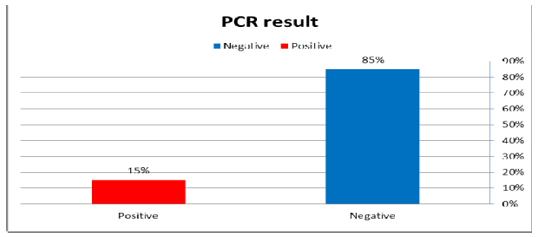
Figure (2): This Show Average Of Negative Result (85%) Hbvs Dna Compring With Positive Result (15%) Hbvs Dna Using Polymerize Chain Reaction (Pcr) Technique
|
Gender |
PCR HBs Ag gene |
Total |
|
|
|
Positive |
Negative |
|
|
Male |
15 |
54 |
69 |
|
Female |
0 |
31 |
31 |
Table (1): Distribution Of Pcr Result According To Gender
Discussion
The study detected occult hepatitis B virus infection in hemodialysis patients. Molecular studies on HBV are fundamental importance because they identify patients that had been considered virus-negative but who, in reality, host the virus and have the ability to transmit it to other patients and staff. in our study we found that occult hepatitis B virus out of 100 sample 15 (15%) was positive for HBV-DNA, This percentage is low compared with other finding study conducted with West Kurdufan State 17.5%, and high when compared with other findings studies conducted with in Khartoum State in which the frequencies of OHB among hemodialysis patients was 3.3%, [12].
Comprise with last east researches, In 2015 conducted thesis about Prevalence of occult Hepatitis B Virus (HBV) Infection among Hemodialysis Patients in Northern State, Sudan resulting show out of the 90 patients sampled Two of patients (2/90; 2.2 %) were positive for HBsAg and were subsequently excluded from the study while (88/90; 97.8%) were negative for HBsAg and which 14 (82.3%) tested positive to HBV DNA [2]. In other studies conducted in 2006 and 2005 occult HBV was not detected [13]. On the other hand, other studies have revealed a higher prevalence of occult HBV in hemodialysis patients. For example,a study Siagris et al reported that HBV DNA was detected by PCR in 10/49 (20.4%) hemodialysis patients [14].
Conclusion
The level of occult HBV infection observed in this study clearly indicates that testing for HBSAg should always be backed up with HBV DNA PCR testing to investigate possible occult HBV infection and that every effort should be made to introduce PCR test as a routine in to investigating HBV infection in hemodialysis centers in Sudan to prevent virus transmission. Furthermore ,we recommend the level of occult HBV infection observed in this study clearly indicates that testing for HBSAg should always be backed up with HBV DNA PCR testing to investigate possible occult HBV infection and that everyeffort should be made to introduce PCR test as a routine in to investigating HBV infection in hemodialysis center in Sudan to prevent virus transmission.
References
- Souza, B. F. D. C. D., Drexler, J. F., Lima, R. S. D., Rosário,M. D. O. H. V. D., & Netto, E. M. (2014). Theories about evolutionary origins of human hepatitis B virus in primates and humans. Brazilian Journal of Infectious Diseases, 18(5), 535-543.
- Sahar Hagmohamed, S. A., Isam, M. E., Mohamed Elhasseein,A. R., Khalid, A. E. (2019). Prevelance of occult Hepatitis B Virus (HBV) Infection among Hemodialysis Patients in Northern State, Sudan. Virol Immunol J, 3(2), 000212.
- Elamin, S., & Abu-Aisha, H. (2011). Prevention of hepatitis B virus and hepatitis C virus transmission in hemodialysis centers: review of current international recommendations. Arab journal of nephrology and transplantation, 4(1).
- Johnson, D. W., Dent, H., Yao, Q., Tranaeus, A., Huang, C. C., Han, D. S., ... & Qian, J. (2009). Frequencies of hepatitis B and C infections among haemodialysis and peritoneal dialysis patients in Asia-Pacific countries: analysis of registry data. Nephrology Dialysis Transplantation, 24(5), 1598-1603.
- Fang, Y., Shang, Q. L., Liu, J. Y., Li, D., Xu, W. Z., Teng, X.,... & Gu, H. X. (2009). Prevalence of occult hepatitis B virus infection among hepatopathy patients and healthy people in China. Journal of Infection, 58(5), 383-388.
- Georgiadou, S. P., Zachou, K., Liaskos, C., Gabeta, S., Rigopoulou, E. I., & Dalekos, G. N. (2009). Occult hepatitis B virus infection in patients with autoimmune liver diseases. Liver International, 29(3), 434-442.
- Ramezani, A., Banifazl, M., Eslamifar, A., & Aghakhani, A. (2010). Serological pattern of anti-HBc alone infers occult hepatitis B virus infection in high-risk individuals in Iran. The Journal of Infection in Developing Countries, 4(10), 658-661.
- Shire, N. J., Rouster, S. D., Rajicic, N., & Sherman, K. E.(2004). Occult hepatitis B in HIV-infected patients. JAIDS Journal of Acquired Immune Deficiency Syndromes, 36(3), 869-875.
- Tamori, A., Hayashi, T., Shinzaki, M., Kobayashi, S., Iwai, S., Enomoto, M., ... & Kawada, N. (2009). Frequent detection of hepatitis B virus DNA in hepatocellular carcinoma of patients with sustained virologic response for hepatitis C virus. Journal of medical virology, 81(6), 1009-1014.
- Ajisa, A., Ibrahim, T. I., Omar, Y. A., Abdalhafeez, A. M.,Ashraf, I., Abdel Rahim, M., Isam, M. E., Khalid, A. E. (2016). Prevalence of Occult Hepatitis Bq Virus Infection in Febrile Patients in West Kurdofan State, Sudan. EC Microbiology, 4(3), 671-6771.
- Abdahafeez, A. M., Khalid, A. E., Osama, M. K., Mohamed,O. H., Abdel Rahim, M. E., Issam, M. E. from 2012 to 2016. prevalence of occult hepatitis B virus (HBV) infection in haemodialysis patients in Khartoum state, sudan journal of Medical Laboratory and Diagnosis, 6(4), 22-26.
- Goral, V., Ozkul, H., Tekes, S., Sit, D., & Kadiroglu, A. K. (2006). Prevalence of occult HBV infection in haemodialysis patients with chronic HCV. World journal of gastroenterology: WJG, 12(21), 3420.
- Siagris, D., Christofidou, M., Triga, K., Pagoni, N., Theocharis,G. J., Goumenos, D., ... & Labropoulou-Karatza, C. (2006). Occult hepatitis B virus infection in hemodialysis patients with chronic HCV infection. Journal of nephrology, 19(3), 327-333.