

International Journal of Natural Sciences and Interdisciplinary Research(IJNSIR)
ISSN: 3143-1046 | DOI: 10.33140/IJNSIR


Research Article - (2026) Volume 1, Issue 2
Mind the Knowledge Gap: Mapping Critical Deficits in Global Dementia Education and Care Infrastructure

Received Date: Aug 04, 2026 / Accepted Date: Sep 07, 2026 / Published Date: Sep 22, 2026
Copyright: ©2026 Peter John Carey. This is an open-access article distributed under the terms of the Creative Commons Attribution License, which permits unrestricted use, distribution, and reproduction in any medium, provided the original author and source are credited.
Citation: Carey, P. J. (2026). Mind the Knowledge Gap: Mapping Critical Deficits in Global Dementia Education and Care Infrastructure. Int Nat Sci Int Rese, 1(2), 01-11.
Abstract
Dementia is a major global health, social-care and public-health challenge, yet important gaps remain in the educational infrastructure needed to translate dementia knowledge into prevention, timely recognition, appropriate care and sustained support. This conceptual paper examines three interconnected domains in which these deficits are particularly consequential: the dementia capability of the healthcare and aged-care workforce, preparedness among informal family caregivers, and dementia health literacy in the general public. Drawing on contemporary evidence and conceptual scholarship, the paper argues that dementia education should not be understood primarily as the transfer of information or the acquisition of knowledge. Rather, educational value depends on whether knowledge can be interpreted, made actionable, translated into capability, and supported by the contexts and systems in which people live and work. The paper’s unique contribution is to bring workforce capability, caregiver preparedness and public dementia health literacy together within a common translation-and-implementation framework, while positioning educational infrastructure as part of the wider capacity required for effective dementia prevention and care. The resulting three-pillar framework identifies a cross-cutting translation gap between evidence availability and the ability of individuals, professionals, communities and systems to act on that evidence. The paper also considers life-course risk reduction, midlife preventive capacity, digital dementia education and implementation in lower-resource settings. It concludes that strengthening dementia outcomes requires coordinated investment in educational capability across professional, family and population levels, supported by context-sensitive implementation strategies rather than information provision alone.
Keywords
Dementia Education, Healthcare Workforce, Family Caregivers, Modifiable Risk Factors, Public Health Literacy, Dementia Knowledge Assessment Scale WHO Guidelines, Implementation
Introduction and Background
Dementia is a major medical, social and health-system challenge. WHO estimates that about 57 million people were living with dementia globally in 2021, with more than 60% living in low-and middle-income countries; nearly 10 million new cases occur each year (WHO, 2026a, 2026b) [1,2]. The scale of the problem extends beyond diagnosis and treatment to workforce capability, family caregiving, public understanding and the capacity of health systems to turn evidence into practical action. The WHO's updated guidance explicitly positions dementia risk reduction as a public-health and health-system concern requiring integration into policies, services and programmes (WHO, 2026a) [1].
Dementia should not be framed simply as an unavoidable consequence of ageing. Although ageing is the strongest known risk factor, a substantial proportion of dementia risk is associated with potentially modifiable exposures across the life course. Prevention therefore depends not only on scientific evidence but also on whether individuals, families, professionals and systems can interpret and implement that evidence in real-world settings (Livingston et al., 2024; WHO, 2026a) [3,1].
The 2024 Lancet Commission identified 14 potentially modifiable dementia risk factors spanning the life course, including less education, hearing loss, high LDLcholesterol, depression, traumatic brain injury, physical inactivity, diabetes, smoking, hypertension, obesity, excessive alcohol use, social isolation, air pollution and untreated vision loss. Collectively, these factors were estimated to be associated with approximately 45% of dementia cases at a population level; this is a population-attributable estimate and should not be interpreted as meaning that 45% of individual cases are preventable (Livingston et al., 2024) [3].
The evidence base was further expanded in July 2026 with WHO's second edition of its Guidelines on Risk Reduction of Cognitive Decline and Dementia. The updated guideline covers healthy behaviours, management of health conditions and biological states, environmental exposures and multidomain approaches, and addresses 19 potentially modifiable risk factors or intervention domains. Importantly, WHO also identifies areas in which evidence remains insufficient and calls for risk reduction to be integrated into policies, services and programmes rather than communicated only as general (WHO, 2026a, 2026b) [1,2].
These developments expose a translation problem. The evidence concerning dementia risk and care has expanded more quickly than the educational and implementation infrastructure required to make that evidence usable. The issue is therefore not simply whether information exists, but whether it can move through a pathway from evidence to understanding, interpretation, capability and sustained action. This paper examines that pathway across three groups that are often studied separately: the professional workforce, informal caregivers and the general public (Zabihi et al., 2025; Widiyaningsih et al., 2025; Aravena et al., 2025) [4-6].
Nature and Positioning of This Paper
This is a conceptual paper rather than a systematic, scoping or narrative review. It does not claim exhaustive evidence identification and does not apply formal inclusion and exclusion criteria. Instead, it draws selectively on major contemporary evidence syntheses and guidelines, supplemented by illustrative empirical and conceptual literature, to develop an explanatory account of dementia education. The three-pillar framework, translation-gap concept and distinction between evidence and implementation capacity are therefore presented as conceptual heuristics and propositions for subsequent testing (Pawson & Tilley, 1997) [7].
Unique Conceptual Contribution
The paper's unique contribution is the integration of three educational domains that are commonly considered separately—workforce capability, informal caregiver preparedness and public dementia health literacy—within a shared translation-and-implementation framework. The contribution is therefore not the claim that deficits exist in each domain; those deficits are already documented. Rather, the paper argues that they can be understood as connected expressions of a broader translation problem: evidence does not become sustained action simply because it is available or communicated. The framework links evidence with interpretation, capability and implementation conditions, while preserving the different mechanisms and practical requirements of each population. In addition, the paper places educational infrastructure within implementation capacity and connects this proposition with two testable conceptual extensions developed in the author's related work: Midlife Preventive Capacity and a realist-informed CMO/COM-B approach to digital dementia educations (Carey, 2026a, 2026c) [8,9].
Discussion: The Three Pillars of Educational Deficits
The Healthcare and Aged-Care Workforce
Dementia-capable care depends on a workforce that extends well beyond specialist neurologists and geriatricians. Primary-care clinicians, hospital staff, nurses, allied-health professionals, social-care workers and community providers all contribute to recognition, assessment, communication, treatment, support and coordination. Recent evidence indicates both uneven dementia-training provision and persistent implementation challenges across professional and social-care settings (Alzheimer's Association, 2026; Giebel et al., 2026; Muralidhar et al., 2025; Zabihi et al., 2025) [10-12,4].
Figure 1 should therefore be read as an illustrative representation of a structural problem rather than a precise international workforce ratio. Specialist expertise constitutes only one component of dementia care capacity, while much routine recognition, communication, coordination and support occurs across generalist and multidisciplinary settings. The defensible conclusion is that dementia capability must extend across the wider workforce because specialist capacity is limited and unevenly distributed (Alzheimer's Association, 2026; Zabihi et al., 2025) [10,4].

Figure 1: The Medical Workforce Dementia Gap
Figure 1. Specialist clinicians represent only one component of the workforce required for dementia-capable care; generalist, multidisciplinary and direct-care providers deliver much of the day-to-day care. The figure is illustrative rather than a validated international workforce ratio.
The broader evidence supports this interpretation. Dementia capability involves more than factual knowledge; it also requires communication, assessment, behavioural and psychosocial skills, coordination and the ability to apply learning in context. Systematic reviews identify considerable variation in educational content, delivery and outcome assessment, while implementation barriers—including time, staffing, organisational support and resource constraints—can prevent learning from being translated into practice practice (Giebel et al., 2026; Muralidhar et al., 2025; Surr et al., 2020; Zabihi et al., 2025) [11,12,13 and 4].
• Curricular Deficiencies
Dementia education is commonly incorporated into wider professional curricula, but its content, duration, pedagogy and assessment vary. Recent systematic evidence suggests that dementia education across the multidisciplinary student healthcare workforce remains uneven and that experiential, reflective and practice-oriented approaches warrant greater attention (Muralidhar et al., 2025) [12]. Evidence from the social-care workforce similarly shows substantial variation in training content and delivery, reinforcing the need to develop capability for communication, assessment, care planning, behavioural support, family engagement and interprofessional coordination rather than treating dementia as a discrete knowledge topic (Giebel et al., 2026) [11].
• The “Tick-Box” Training Paradigm
Short online modules can increase access, but completion is not equivalent to transfer into practice. Evidence on dementia education indicates that implementation is shaped by capability, motivation, opportunity, available time, staffing, organisational support and the fit between education and professional roles (Surr et al., 2020; Zabihi et al., 2025) [13,4]. Recent systematic evidence from social-care settings likewise indicates that delivery mode alone does not determine impact; context, workforce needs and implementation arrangements matter (Giebel et. al., 2026) [11].
Accordingly, completion of dementia education should not be equated with dementia capability. Capability requires the interaction of knowledge, practical skills, confidence, role relevance, opportunities to practise and organisational conditions that permit learning to be used (Surr et al., 2020; Muralidhar et al., 2025) [13,12].
• Fragmented Care Transitions
Dementia care crosses primary care, specialist services, hospitals, residential aged care, community services and family settings. Such transitions create opportunities for communication failures, duplication and gaps in responsibility. Workforce education therefore needs to include interprofessional communication and care coordination rather than assuming that dementia knowledge is held independently within professional silos (Alzheimer's Association, 2026; National Academies of Sciences, Engineering, and Medicine, 2021) [10,14].
• Geographic Disparities
Geographical inequity compounds these problems. Rural and underserved communities may have reduced access to specialist expertise, placing greater importance on scalable approaches such as team-based capability building, tele-education and Train-the-Trainer models. Recent evidence suggests that Train-the-Trainer approaches can extend educational reach and facilitate local adaptation, although the evidence base remains heterogeneous and implementation quality matters (Alzheimer's Association, 2026; Zabihi et al., 2025) [10,4].
Informal Family Caregivers
The second pillar is the informal caregiver: family members, partners and friends who provide substantial amounts of unpaid care. Caregiver preparedness is multidimensional. A recent scoping review identifies knowledge, education and training alongside self-efficacy, confidence, resilience and other psychosocial factors as relevant to preparedness (Zimami & Darwish, 2024) [15]. The educational task is therefore broader than transmitting disease facts; it involves preparing people for practical, emotional, relational and navigational demands that change over time.
• Systemic and Navigational Illiteracy Caregiver education should extend beyond disease facts to the practical knowledge required to navigate services and make decisions. This includes recognising changes, accessing assessment and support, communicating with professionals, understanding available services, managing day-to-day care, planning for future needs and knowing when additional assistance is required (Riffin et al., 2022; Zimami & Darwish, 2024) [16,15]. Figure 2 is intended to represent this broader navigational function of education.

Figure 2: What Family Caregivers Need to Know
Figure 2: Six areas of practical and navigational knowledge that can strengthen caregiver preparedness beyond disease facts, including service access, communication, planning and adaptation over time
Evidence supports this multidimensional understanding of caregiver preparedness. (Zimami and Darwish, 2024) [15] identified education and knowledge alongside self-efficacy, confidence, resilience and mental health as relevant factors. More recent meta-analytic evidence strengthens the case for structured dementia-literacy interventions: a synthesis of 40 randomised controlled trials involving 4,336 caregivers found improvements in knowledge, attitudes and self-efficacy and reported a reduction in caregiver burden, although heterogeneity and risk of bias warrant cautious interpretation (Widiyaningsih et al., 2025) [5].
• Delayed Future Planning
Advance care planning, legal and financial decisions and preparation for changing care needs are difficult conversations and can be deferred until circumstances become urgent. Consensus recommendations have therefore called for caregiver identification, assessment, education, training and support to be integrated into routine dementia care rather than offered only after crisis develops (Riffin et al., 2022) [16].
• Lack of Tailored Communication Tools
There is also a participation and accessibility issue. Educational resources need to support people living with dementia and their families to understand information, participate in decisions and communicate preferences. Plain-language and accessible resources are especially important when cognitive, sensory, linguistic or digital barriers affect people's ability to obtain and use information (National Academies of Sciences, Engineering, and Medicine, 2021; WHO, 2026b) [14,2].
Digital education can extend reach and flexibility, but digital delivery is not automatically equitable, usable or effective. A 2025 scoping review of 18 studies identified personalization, cultural sensitivity and technological adaptability as important implementation considerations in digital education for informal carers (Huang et al., 2025) [17]. Broader work on digital informal care also identifies digital-literacy differences, accessibility, technical problems, caregiving burden and privacy or security as relevant barriers (Nittas et al., 2026) [18].
(Carey, 2026a) [8] provides a realist-informed approach to evaluating digital dementia education, drawing on Pawson and Tilley's (1997) [7] central realist question of what works, for whom, in what circumstances and why. The proposed framework combines Context–Mechanism–Outcome reasoning with COM-B and distinguishes engagement with educational material (Carey, 2026a) [8]. from the subsequent interpretation and application of that material. This distinction is consistent with the wider implementation literature: digital education depends on context, usability, capability, motivation, opportunity and the conditions surrounding use rather than content alone (Cho et al., 2026; Huang et al., 2025; Li et al., 2025) [19,17,20].
The Public Health Literacy Deficit
The third pillar is the general public. Public knowledge of dementia remains uneven, and the Dementia Knowledge Assessment Scale (DKAS) was developed to measure dementia knowledge and educational change (Annear et al., 2015) [21]. Australian and international studies continue to identify misconceptions, including the belief that dementia is a normal part of ageing and incomplete understanding of potentially modifiable risk factors (AIHW, 2024; Carey, 2026b; Lazarova & Petrova-Antonova, 2025) [22-24]. Public understanding is also shaped by media and online information environments, making the quality, accessibility and interpretability of public communication important (Alhaj Ahmad et al., 2025) [25].
This should not be reduced to an information-deficit model. Public understanding is influenced by prior beliefs and mental models, health literacy, perceived relevance, emotional responses, self-efficacy and social circumstances ((Alhaj Ahmad et al., 2025; Lazarova & Petrova-Antonova, 2025; National Academies of Sciences, Engineering, and Medicine, 2021) [25,24,22]. Public awareness is therefore a necessary foundation, but it does not guarantee that people will interpret information accurately, regard it as personally relevant or act upon it.
• The Prevention Awareness Gap
The 2024 Lancet Commission and WHO's 2026 guideline provide a substantial evidence base for dementia risk reducation (Livingston et al., 2024; WHO, 2026a) [3,1]. Yet translating population-level recommendations into personally usable decisions remains difficult: people may need to determine what information is relevant, what to prioritise, what support is available and how change can be sustained. Evidence from public-awareness interventions indicates that campaigns can improve knowledge, but effects on risk-reduction awareness and behavioural change remain less certain. A 2025 systematic review of 16 studies involving 34,441 participants found more consistent improvements in knowledge than in risk-reduction awareness, while no included study directly assessed health-behaviour change (Aravena et al., 2025) [6]. Important questions therefore remain insufficiently addressed, including: • whether individuals know if their own blood pressure is adequately controlled;
• when intervention should begin; • what treatment involves;
• whether behaviour change is feasible; or
• where appropriate support can be obtained.
The distance between population-level evidence and personal usability is therefore central to the public-health challenge. Translation requires more than simplifying scientific language; it requires connecting evidence with personal circumstances, decision-making, resources and opportunities for action (WHO, 2026b; Aravena et al., 2025; Van Asbroeck et al., 2021) [2,6,26]. The available campaign evidence supports this caution: increasing knowledge does not, by itself, establish that people will change behaviour.
Carey (2026c) [9] describes this challenge as the midlife dementia risk-management paradox. As the list of potentially modifiable risk factors expands, individuals may face an increasingly complex portfolio of decisions involving physical activity, cardiometabolic health, hearing, smoking, alcohol, social connection, sleep and other domains. Midlife Preventive Capacity (MPC) is proposed as the capacity, supported by relational and structural resources, to recognise, integrate, prioritise, implement, adapt and sustain responses to multiple dementia-related risks. MPC is presented as conceptually distinct from health literacy, self-efficacy, COM-B and prevention burden because it focuses on coordinating preventive work across competing demands (Carey, 2026c) [9].
• Young-Onset Dementia
Dementia education also needs to avoid an exclusively older-age framing. Young-onset dementia, generally defined as dementia with onset before age 65, represents an important clinical and social concern, with implications for employment, family roles, finances and service access. Education and public-health communication that assumes dementia is confined to later life may therefore fail to address relevant experiences and needs (WHO, 2026b) [2].
• Cultural and Social Diversity
Cultural, linguistic and socioeconomic context also shapes whether education can be understood and acted upon. WHO's updated guidance emphasises structural and sociocultural barriers and the importance of integrated, multisectoral and equitable approahes (WHO, 2026b) [2]. Dementia education should consequently be adapted for culturally and linguistically diverse populations, Indigenous communities, rural populations and people experiencing socioeconomic disadvantage rather than assuming that one communication model will work equally across contexts.
A Life-Course Guide to Dementia Risk Reduction
The practical implications of the evidence can be organised across the life course. The Lancet Commission identified 14 potentially modifiable factors, while the 2026 WHO guideline expands the prevention framework to 19 risk-factor or intervention domains. These frameworks overlap but are not identical, so the table below should be understood as a synthesis rather than a direct one-to-one mapping (Livingston et al., 2024; WHO, 2026a) [3,1].
|
Life Stage |
Risk Factor / Domain |
Educational or Risk-Reduction Action |
|
Early life |
Less education |
Support equitable access to quality education |
|
Early/midlife |
Traumatic brain injury |
Promote head-injury prevention, road safety and workplace protection |
|
Midlife |
Hearing loss |
Promote hearing assessment, hearing protection and appropriate intervention |
|
Midlife |
Hypertension |
Detect and appropriately manage high blood pressure |
|
Midlife |
High LDL cholesterol |
Support appropriate lipid management |
|
Midlife |
Obesity |
Support healthy weight and metabolic health |
|
Midlife |
Smoking |
Support smoking cessation |
|
Midlife |
Excessive alcohol use |
Reduce harmful alcohol consumption |
|
Across the life course |
Physical inactivity |
Promote regular physical activity |
|
Across the life course |
Diabetes |
Prevent, detect and manage diabetes |
|
Across the life course |
Depression |
Promote recognition and appropriate treatment |
|
Later life |
Social isolation |
Support social connection and participation |
|
Later life |
Vision impairment |
Detect and address treatable vision impairment |
|
Across the life course |
Sleep, stroke and HIV |
Address these health domains in accordance with contemporary evidence and clinical guidance |
|
Across the life course |
Air pollution |
Reduce exposure where feasible and support cleaner-air policies |
Table 1: Life-Course Dementia Risk-Reduction Domains Informed by the 2024 Lancet Commission and the WHO 2026 Second-Edition Guidelines
The broader WHO framework matters because it explicitly incorporates additional domains such as sleep, stroke, HIV and air pollution and places greater emphasis on environmental exposures and multidomain approaches. It also distinguishes areas where evidence is stronger from those where further researches is needed, reinforcing the need for careful communication that does not overstate prevention certainty (WHO, 2026a, 2026b) [1,2].
Eight Ways to Protect Brain Health in Midlife
Risk-reduction evidence becomes useful only when it can be communicated in forms that people can understand and incorporate into everyday life. Practical messaging can help bridge the distance between population-level evidence and individual action, provided it does not imply that complex dementia risk can be reduced to a simple checklist (Livingston et al., 2024; WHO, 2026a) [3,1].
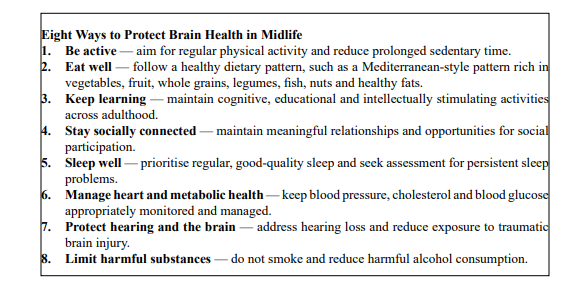
These eight actions are therefore presented as a communication and translation device rather than eight independently proven interventions. The underlying evidence concerns risk factors, health conditions, behaviours and multidomain approaches that interact across the life course. The formulation also needs to recognise that adding risk-reduction messages can increase the coordination demands placed on individuals, which is central to the preventive-capacity argument (Carey, 2026c) [9].
The Three Pillars and the Translation Gap
Taken together, the three pillars describe different educational pathways but reveal a common translation problem. Professionals need to convert evidence into practice; caregivers need to convert knowledge into capability for everyday care; and the public needs to convert risk and health information into personally meaningful decisions. Across all three, outcomes are likely to be shaped by context, resources, interpretation, motivation, opportunity and implementation conditions (Pawson & Tilley, 1997; Zabihi et al., 2025; Widiyaningsih et al., 2025; Aravena et al., 2025) [7,4-6]. The framework therefore links populations that are often examined separately while retaining their different educational needs.

Figure 3: The Three Pillars of Dementia Education
Figure 3: The three pillars represent distinct educational pathways that converge on the shared challenge of translating evidence into sustained capability and action within contextual conditions For the public, the pathway also includes the capacity to coordinate multiple risks and responsibilities over time. This is where Carey’s (2026c) concept of Midlife Preventive Capacity extends the argument: prevention is not only about knowing individual risk factors but about managing a portfolio of actions within real occupational, family, financial and social constraints. The paper's central proposition is that dementia education can be understood as distributed infrastructure spanning professional capability, caregiver preparedness, public health literacy and the systems that make action possible.
Implications for Policy and Practice
Dementia education should be embedded across medical, nursing, allied-health, aged-care and community-care preparation rather than treated as a one-off module. Core educational outcomes should include the following (Muralidhar et al., 2025; Zabihi et al., 2025) [12,4].
• knowledge;
• practical skills;
• communication;
• confidence;
• interprofessional capability; and
• the ability to apply learning within real-world care settings.
The evidence favours interactive, role-relevant and practice-connected approaches, while implementation is constrained by time, staffing, resources and organisational support. Train-the-Trainer approaches may offer one scalable strategy for extending capability and adapting education locally, but they should be evaluated for fidelity, reach, sustainability and effects on care rather than judged only by completion or immediate knowledge gains (Surr et al., 2020; Zabihi et al., 2025) [13,4].
Make Caregiver Education Part of Routine Dementia Care
Caregiver education should be incorporated into routine dementia care rather than treated as an optional information package delivered after diagnosis. It should support recognition, communication, navigation, practical caregiving, decision-making, planning and ongoing adjustment as needs change (Riffin et al., 2022; Zimami & Darwish, 2024) [16,15]. The 2025 meta-analysis of 40 randomised trials provides further evidence that dementia-literacy interventions can improve caregiver knowledge, attitudes and self-efficacy, with potential benefits for burden (Widiyaningsih et al., 2025) [5]. Digital tools can extend access and allow education to be delivered asynchronously or remotely, but they introduce additional implementation requirements. Recent reviews highlight digital-literacy differences, accessibility, technical problems, privacy, security and the need to tailor interventions to caregiving context. Consequently, evaluation should move beyond context (Cho et al., 2026; Huang et al., 2025; Li et al., 2025; Nittas et al., 2026) [19,17,20,18]. gain and examine who engages, how they interpret the material, what contextual conditions enable use, and whether learning translates into sustained capability.
Build Public Dementia Health Literacy
Public-health campaigns should move beyond generic awareness toward actionable dementia health literacy. Figure 4 therefore focuses on the knowledge and interpretive capabilities people need to recognise dementia, understand risk, evaluate information, identify appropriate actions and locate support. Campaign design should also account for education, socioeconomic position, culture, language and digital access because gains in awareness are not necessarily equivalent to gains in behaviour. The recent systematic review by Aravena et al (2025) [6] found that campaign studies more consistently improved knowledge than risk-reduction awareness and identified insufficient evidence about actual health-behaviour change.
Figure 4: What Public Health Literacy Campaigns Need to Cover
Figure 4. Seven components of dementia health literacy intended to move public communication beyond generic awareness toward knowledge and interpretive capability that can support action.
The target should be actionable health literacy rather than information saturation. People need support to understand evidence, judge its relevance, prioritise actions and sustain behaviour within their circumstances. Public-awareness research suggests that campaigns can improve knowledge, but evidence for downstream risk-reduction awareness and behaviour change remains uncertain Carey (2026c) [9] adds that increasing the number of recommended actions without supporting coordination may increase prevention complexity faster than individuals' capacity to manage it.
The target should be actionable health literacy rather than information saturation. People need support to understand evidence, judge its relevance, prioritise actions and sustain behaviour within their circumstances. Public-awareness research suggests that campaigns can improve knowledge, but evidence for downstream risk-reduction awareness and behaviour change remains uncertain Carey (2026c) [9] adds that increasing the number of recommended actions without supporting coordination may increase prevention complexity faster than individuals' capacity to manage it.
Implications for Low- and Middle-Income Countries
The implementation gap is likely to be particularly consequential in low- and middle-income countries, where more than 60% of people living with dementia reside and health-system resources may be constrained (WHO, 2026a; Abdi & Bashir, 2026) [1,27]. Implementation of updated prevention guidance therefore depends on workforce capacity, financing, service infrastructure, information systems, governance and locally appropriate delivery strategies. WHO's 2026 guidance explicitly calls for integration of risk reduction into policies, services and programmes and highlights structural, sociocultural and equity considerations (WHO, 2026a, 2026b) [1,2].
Evidence without implementation capacity is unlikely to produce population-level change. This statement is used here as a conceptual proposition rather than an empirical law: evidence identifies what may work, whereas implementation capacity determines whether interventions can be delivered consistently, accessibly and sustainably at scale (WHO, 2026a; Pawson & Tilley, 1997) [1,7].
Population-level change refers here to measurable change across groups or systems, such as workforce capability, public-health literacy or dementia incidence, rather than change in one individual. The mechanism linking evidence to such outcomes is likely to operate through individual and organisational processes, including engagement, interpretation, behaviour change, service delivery and repeated implementation across populations (Pawson & Tilley, 1997; Nittas et al., 2026) [7,18].
Figure 5 therefore conceptualises evidence and implementation capacity as complementary. Strong evidence does not automatically create trained workers, functioning services, accessible information systems or sustained delivery. Educational infrastructure is one component of implementation capacity, interacting with workforce, service delivery, information, financing and governance. This positioning aligns dementia education with broader health-system strengthening rather than treating it as a communication activity added after policy has been designed (WHO, 2026a; National Academies of Sciences, Engineering, and Medicine, 2021) [1,14].

Figure 5: Evidence, Implementation Capacity and Health-System Strengthening
Figure 5. Evidence and implementation capacity are complementary. Educational infrastructure is positioned within the wider health-system capacity required to translate evidence into population-level change. Educational infrastructure should consequently be treated as more than communication. It is part of the capacity through which evidence becomes usable in practice, particularly when implementation requires workforce capability, service coordination, accessible information and sustained engagement (WHO, 2026a; National Academies of Sciences, Engineering, and Medicine, 2021) [1,14].
Limitations
This conceptual paper has several limitations. First, it is not a systematic or scoping review; the literature is selective and illustrative rather than exhaustive. A formal review may identify evidence that qualifies, extends or contradicts particular claims. Second, several constructs, including Midlife Preventive Capacity and the realist CMO/COM-B framework for digital dementia education, originate in the author's recent conceptual work and remain empirically untested. Third, Figure 1 is intentionally qualitative because a reliable international ratio of specialist to generalist dementia-care capacity is unavailable. Finally, the three-pillar framework and translation-gap argument are conceptual heuristics rather than validated causal models. Their value at this stage is therefore in organizing evidence and generating testable propositions, not in establishing causal effects.
Conclusion
Resolving the dementia challenge requires more than producing additional evidence. The evidence base has advanced substantially,particularly concerning potentially modifiable risk factors and multidomain approaches (Livingston et al., 2024; WHO, 2026a) [3,1]. The next challenge is translation: ensuring that evidence can be understood, interpreted, implemented and sustained across professional, caregiving and public settings.
For professional workforces, this means moving beyond episodic information delivery toward interactive, practice-connected and team-oriented capability development. For caregivers, it means earlier and more comprehensive preparation for navigation, communication, decision-making and long-term adaptation. For the public, it means translating complex life-course evidence into health literacy that is accessible, culturally responsive and actionable (Muralidhar et al., 2025; Widiyaningsih et al., 2025; WHO, 2026b) [12,5,2].
The central issue is therefore not simply whether people possess dementia information. It is whether they can interpret it, judge its relevance, build the capability to act and sustain action within real-world conditions. This perspective is consistent with realist approaches that examine how outcomes vary according to context and mechanism rather than assuming that the same intervention produces the same result everywhere (Pawson & Tilley, 1997) [7].
The more useful question is consequently not only what information should be delivered, but how it becomes meaningful, for whom, under what circumstances it can be acted upon, and what supports its continuation (Pawson & Tilley, 1997) [7]. Framed in this way, the global dementia education gap is partly an implementation problem. Dementia education deserves to be treated as infrastructure that helps make evidence actionable, rather than as an adjunct communication task (WHO, 2026a; National Academies of Sciences, Engineering, and Medicine, 2021) [1,14].
Support & Resources
Readers seeking practical support can be directed towards:
• Alzheimer's Disease International (ADI) — global network of Alzheimer and dementia organisations.
• WHO iSupport — WHO-developed skills training for people providing care or support to someone living with dementia.
• Alzheimer's Association — dementia information, support and helpline services in the United States.
• Dementia Australia — information, advice and referral for people living with dementia, families and carers in Australia.
• This list is illustrative rather than exhaustive.
Ethical Approval
No ethical approval was required because this conceptual paper did not involve human participants or the collection of primary data.
Funding
This research received no specific grant from any funding agency in the public, commercial, or not-for-profit sectors.
Conflict of interest
The author declares no conflict of interest.
Copyright and Generative AI
The figures presented in this article were developed by the author. Generative artificial intelligence (OpenAI ChatGPT, GPT-5.6 Luna) was used to assist with aspects of visual design and refinement of the figures. All conceptual content, interpretation, substantive decisions, and final editing were undertaken by the author, who accepts full responsibility for the content of the figures and the article.
References
- World Health Organization. (2026a). Risk reduction of cognitive decline and dementia: WHO guidelines (2nd ed.).
- World Health Organization. (2026b). Risk reduction of cognitive decline and dementia: WHO guidelines: Executive summary(2nd ed.).
- Livingston, G., Huntley, J., Liu, K. Y., Costafreda, S. G., Selbæk, G., Alladi, S., Ames, D., Banerjee, S., Burns, A.,Brayne, C., Fox, N. C., Ferri, C. P., Gitlin, L. N., Howard, R., Kales, H. C., Kivimäki, M., Larson, E. B., Nakasujja, N., Rockwood, K., … Mukadam, N. (2024). Dementia prevention, intervention, and care: 2024 report of the Lancet standing Commission.TheLancet,404(10452), 572–628.
- Zabihi, S., Delray, S., Muralidhar, M., Banerjee, S., Giebel, C., Harrison Dening, K., Birks, Y., Hunter, R., Rauf, M. A., Kenten, C., Walpert, M., & Cooper, C. (2025). Dementia training for healthcare professionals: A systematic policy andevidence review. International Psychogeriatrics, 37(6), 100088.
- Widiyaningsih, W., Pradana, A. A., Susanto, H., & Chiu, H.-L. (2025). Effectiveness of dementia literacy interventions for caregivers of people with dementia: A meta-analysis of randomized controlled trials. International Journal of Nursing Studies, 171,105191.
- Aravena, J. M., Hamilton, M. I., & Giordano, F. (2025). Efficacy of dementia prevention awareness campaigns inthegeneralpopulation: A systematic review. Alzheimer's & Dementia, 21(Suppl. 6), e103510.
- Pawson, R., & Tilley, N. (1997). Realistic evaluation. Sage.
- Carey, P. (2026a). Beyond information delivery: Towards a realist-informed conceptual framework for the evaluation of digitaldementia education. Journal of Preventive Medicine & Healthcare, 8(2), 1048.
- Carey, P. (2026c). The midlife dementia risk-management paradox: Developing the concept of preventive capacity fordementia prevention. International Journal of Natural Sciences and Interdisciplinary Research, 1(2), 01–12.
- Alzheimer's Association. (2026). 2026 Alzheimer's disease facts and figures. Alzheimer's & Dementia, 22(4), e71345.
- Giebel, C., Caprioli, T., Poole, M., Talbot, C., Cannon, J., Hanna, K., Robinson, L., Rozansky, D., Tetlow, H., Walpert, M., & Gabbay, M. (2026). General dementia training for the social care workforce: A systematic review. Journal of AdvancedNursing, 82(6), 5790–5812.
- Muralidhar, M., Delray, S., Cooper, C., Zabihi, S., Banerjee, S., Giebel, C., Harrison-Dening, K., Birks, Y., Kenten, C., & Walpert, M. (2025). Dementia education and training for the multidisciplinary student healthcare workforce: A systematic review. International Journal of Geriatric Psychiatry, 40(7), e70119.
- Surr, C. A., Parveen, S., Smith, S. J., Drury, M., Sass, C., Burden, S., & Oyebode, J. (2020). The barriers and facilitators to implementing dementia education and training in health and social care services: A mixed-methods study. BMC Health Services Research, 20, 512.
- National Academies of Sciences, Engineering, and Medicine. (2021). Improving care to improve outcomes for people living with dementia. The National Academies Press.
- Zimami, S., & Darwish, H. (2024). Preparedness for caregiving among informal caregivers of people with dementia: A scoping review. Geriatric Nursing, 60, 191–206.
- Riffin, C., Griffin, J., Bangerter, L., Brody, L., Falzarano, F., Pillemer, K., Czaja, S., & Adelman, R. (2022). Supporting dementia caregivers in healthcare delivery: Recommendations from a national consensus conference. Innovation in Aging, 6(Suppl. 1), 632.
- Huang, D., Wu, D., & Moyle, W. (2025). Digital dementia education and training for informal carers: A scoping review. Journal of Clinical Nursing, 34(10), 3981–3994.
- Nittas, V., Bikou, A., Sedlakova, J., Hellmann, A., Von Wyl, V., & Puhan, M. A. (2026). Digital informal care: The use of technology in family care. A scoping review. Public Health Reviews, 46, 1608872.
- Cho, H., Cho, E., You, S. B., Sefcik, J. S., Hodgson, N. A., & Demiris, G. (2026). Understanding digital literacy of persons with dementia and their caregivers: A scoping review and an evolutionary concept analysis of empirical studies. Journal of AppliedGerontology, 45(4), 742–766.
- Li, M., Song, D., Li, M., & Liu, Y. (2025). Implementation elements of web-based interventions for caregivers of individuals with dementia in home: A scoping review. Geriatric Nursing, 66(Part B), 103700.
- Annear, M. J., Toye, C. M., Eccleston, C. E., McInerney, F. J., Elliott, K.-E. J., Tranter, B. K., Hartley, T., & RobinsonA. L. (2015). Dementia Knowledge Assessment Scale: Development and preliminary psychometric properties. Journal of the American Geriatrics Society, 63(11), 2375–2381.
- Australian Institute of Health and Welfare (AIHW). (2024). Dementia awareness survey: Knowledge of dementia.
- Carey, P. (2026b). Public understanding of dementia and modifiable risk factors: A conceptual public health review. InternationalInternal Medicine Journal, 4(2), 01–10.
- Lazarova, S., & Petrova-Antonova, D. (2025). Gaps in dementia knowledge: A nationwide study of public awareness and misconceptions in Bulgaria. Psychogeriatrics, 25(2), e70016.
- Alhaj Ahmad, S., Alhaj Ahmad, M., Mohamedali, L., Al-Kubaisi, M., Habib, A., Huwaijah, H., Mustafa, K., Barqawi,H. J., & Abu-Gharbieh, E. (2025). Arabic translation and validation of the Dementia Knowledge Assessment Scale (DKAS-A) and public knowledge assessment in the United Arab Emirates. Scientific Reports, 15, 43629.
- Van Asbroeck, S., van Boxtel, M. P. J., Steyaert, J., Köhler, S., Heger, I., de Vugt, M., Verhey, F., & Deckers, K. (2021). Increasing knowledge on dementia risk reduction in the general population: Results of a public awareness campaign. Preventive Medicine, 147, 106522.
- Abdi, Y. H., & Bashir, S. G. (2026). Closing the implementation gap for WHO's new dementia risk reduction guidelines in low-and middle-income countries. International Health. Advance online publication.