

Annals of Civil Engineering and Management(ACEM)
ISSN: 3065-9779 | DOI: 10.33140/ACEM


Research Article - (2025) Volume 2, Issue 2
Megalithic Pyramid Engineering: A Comparative Study of Scale, Material Use, and Structural Complexity across Ancient Civilizations
Received Date: May 06, 2025 / Accepted Date: Jun 02, 2025 / Published Date: Jun 06, 2025
Copyright: ©Â©2025 Sam Osmanagich. This is an open-access article distributed under the terms of the Creative Commons Attribution License, which permits unrestricted use, distribution, and reproduction in any medium, provided the original author and source are credited.
Citation: Osmanagich, S. (2025). Megalithic Pyramid Engineering: A Comparative Study of Scale, Material Use, and Structural Complexity Across Ancient Civilizations. Ann Civ Eng Manag, 2(2), 01-15.
Abstract
This study presents a comparative engineering analysis of ten monumental pyramidal structures constructed by diverse ancient civilizations across five continents. It evaluates scale, volume, base dimensions, construction materials, alignment, and logistical challenges as proxies for civil and structural engineering capacity in antiquity. The pyramids examined include the Great Pyramid of Giza (Egypt), Bosnian Pyramid of the Sun (Bosnia-Herzegovina), La Danta (Guatemala), Pyramid of the Sun at Teotihuacan (Mexico), Great Pyramid of Cholula (Mexico), Gunung Padang (Indonesia), Yangling Mausoleum (China), Monks Mound (USA), Akapana Pyramid (Bolivia), and Huaca del Sol (Peru). By focusing on construction volume, geometric planning, orientation, and material manipulation, this article proposes that many of these ancient structures demonstrate engineering sophistication well beyond what is commonly attributed to their respective cultures. Notably, many lack written construction records, yet show remarkable precision in alignment and spatial organization. This raises important questions about the presence of undocumented knowledge systems or lost civilizational technologies. The findings suggest that pyramid size is not merely symbolic but reflects advanced prehistoric planning, surveying, and building capabilities.
Keywords
Megalithic Engineering, Ancient Civil Engineering, Pyramid Construction, Structural Complexity, Construction Materials, Monument Scale, Archaeological Geometry, Comparative Architecture, Load Distribution, Geotechnical Design
Introduction
Monumental pyramidal structures have long fascinated researchers due to their immense scale, geometric coherence, and enduring material stability. Spanning continents and millennia, these megastructures are often interpreted through symbolic, ritualistic, or political frameworks. However, from a civil engineering perspective, they also present an overlooked but crucial dataset: evidence of ancient societies’ capabilities in material science, construction logistics, geometric planning, and environmental adaptation.
This study investigates ten pyramidal structures from ancient civilizations across Africa, Asia, Europe, and the Americas, comparing their engineering characteristics in a systematic framework. These include the Great Pyramid of Giza in Egypt, the Bosnian Pyramid of the Sun, La Danta in El Mirador, Guatemala, the Great Pyramid of Cholula, Mexico, Gunung Padang in Indonesia, the Yangling Mausoleum in China, the Pyramid of the
Sun at Teotihuacan, Mexico, Monks Mound in Illinois, USA, the Akapana Pyramid in Bolivia, and the Huaca del Sol in Peru.
These structures vary widely in material composition-ranging from cut limestone and granite to adobe brick and concrete-like geopolymer mixes. Their orientations often demonstrate alignment with astronomical features or cardinal directions, though not uniformly. Despite these cultural and regional differences, all share a defining characteristic: massive scale and long-term structural integrity, achieved without modern machinery or documented engineering blueprints. Many of these sites exhibit architectural principles relevant to modern civil engineering-such as axial symmetry, tiered loading, platform stabilization, drainage integration, and modular design.
Yet, in nearly all cases, no surviving construction records exist. This absence of technical documentation raises a critical question: how did these societies achieve such feats of megastructure design with what is assumed to be limited technological means? By analyzing parameters such as total volume, base dimensions, estimated material mass, construction phases, and geotechnical setting, this study argues that pyramid size and form function as empirical indicators of ancient engineering capacity. These pyramids are not merely symbolic or religious expressions-they are the surviving physical record of complex knowledge systems that remain partially or wholly unrecognized in mainstream archaeological and engineering discourse.
Methodology
This study employs a comparative engineering framework to analyze ten ancient pyramidal structures, selected based on their monumental scale, architectural complexity, and scholarly documentation. The primary goal is to assess what their physical characteristics reveal about the engineering knowledge and logistical capabilities of the societies that built them.
Selection Criteria
The pyramids included in this analysis span different continents and cultural traditions yet share similar structural typologies. Each monument was selected based on the following criteria:
• Minimum base length of 200 meters or volume exceeding 500,000 cubic meters
• Availability of published scientific data, excavation reports, or geophysical surveys
• Observable evidence of geometric planning and/or material engineering
• Lack of modern construction tools or machinery in the building period
The ten pyramids analyzed are
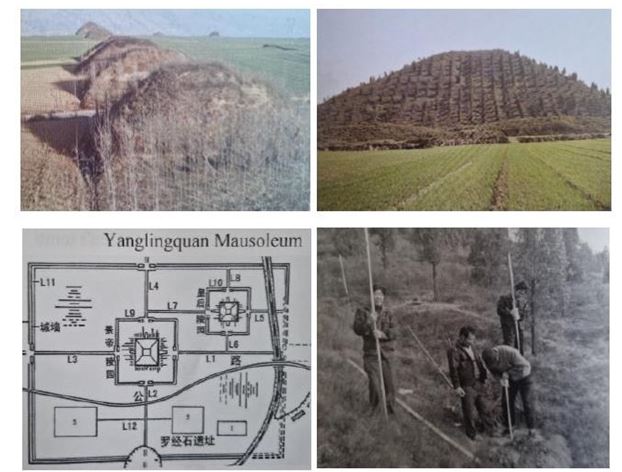
i. Figure 1 Yangling Mausoleum, China
Source: Jiao Nanfeng and Cao Fazhan (2009), and Osmanagich, S (2025) [1,2].
Figure 1: Chinese Pyramid Yanglingquan Mausoleum, located in Shaanxi Province, China. The structure features a square base of approximately 417.15 meters per side and is composed of sandstone and granite blocks. Its estimated height is approximately 32 meters, producing a total volume of around 1.86 million cubic meters. The structure is precisely aligned at 359° 32′ 25.6″, just slightly off true north. Despite official designation as a mausoleum, no inscriptions or construction records have been discovered, and its scale and orientation suggest advanced engineering.
ii. Figure 2 Great Pyramid of Giza, Egypt
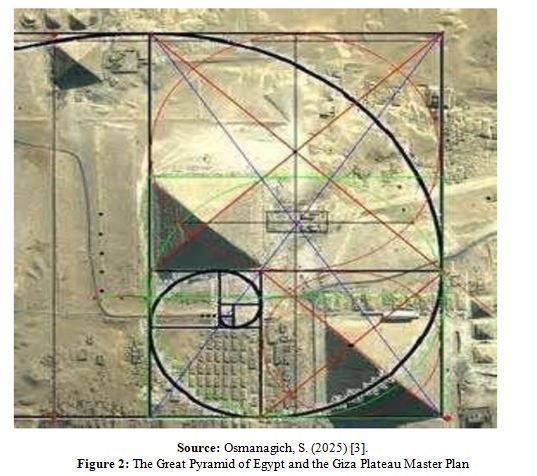
This satellite-based geometric overlay illustrates the deliberate incorporation of sacred geometry including the Fibonacci spiral, Golden Ratio (Φ ≈ 1.618), and pi (π ≈ 3.1416) within the architectural layout of the Giza pyramids. The Great Pyramid, commonly attributed to Pharaoh Khufu of the Fourth Dynasty (despite no surviving papyrus, inscriptions, or reliefs confirming this), exhibits a precise northward orientation of 359° 59′ 58″. Constructed primarily of limestone (outer casing and core) and granite (interior chambers and structural elements), the pyramid originally stood at 146.6 meters tall with a base length of 230.34 meters per side,and a total volume of approximately 2.58 million cubic meters. It is estimated to contain 2.3 million blocks, each weighing between 2.5 and 15 tons, with some granite blocks exceeding 40 tons. The Giza complex reveals a unified, master-planned design, with three major pyramids and several satellite structures aligned according to astronomical and geometric principles. The Great Pyramid’s proportions are believed to encode values such as the mean Earth– Sun distance (1 AU), the Earth–Moon ratio, and the speed of light (299,792,458 m/s), challenging conventional assumptions about the scientific capabilities of dynastic Egypt.
iii. Figure 3 La Danta, El Mirador, Guatemala
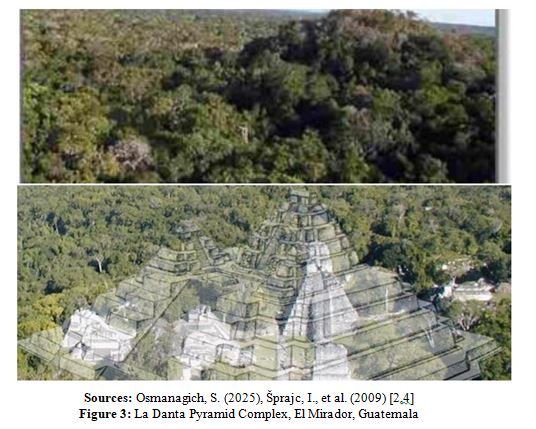
This illustration, adapted from Osmanagich, depicts the monumental La Danta pyramid complex situated within the Preclassic Maya city of El Mirador in northern Guatemala. The structure reaches an approximate height of 72 meters, with a base platform measuring nearly 600 × 300 meters, culminating in an estimated total volume of 2.8 million cubic meters. Constructed primarily from limestone blocks, La Danta exemplifies the triadic pyramid complex architectural style, characterized bya central pyramid flanked by two smaller structures on a single basal platform. Archaeoastronomical studies have revealed that the urban layout of El Mirador exhibits deliberate astronomical alignments, particularly to sunrises and sunsets on specific dates, facilitating observational calendars for agricultural and ritual activities. These findings suggest that complex astronomical and calendrical considerations influenced architectural design and urban planning in the Maya area during the Late Preclassic period.
iv. Figure 4 Great Pyramid of Cholula, Mexico [5]
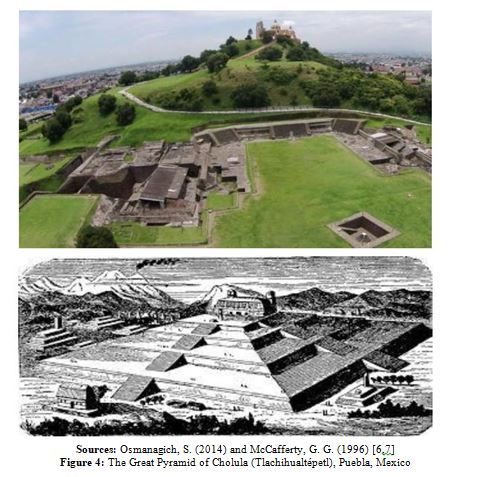
This illustration shows both a modern aerial photograph and a historical reconstruction of the Great Pyramid of Cholula, or Tlachihualtépetl ("man-made mountain"). Built from adobe bricks and covered by centuries of soil and vegetation, the pyramid measures approximately 450 × 450 meters at the base, rising to a height of 66 meters, with an estimated volume of 4.45 million cubic meters. It was constructed in multiple phases and layers, reflecting architectural development over centuries. Its orientation deviates approximately 26 degrees north of west, differing from cardinal alignments and aligning instead with the urban grid of ancient Cholula—suggesting intentional cosmological or ritual significance. The site is one of the largest known pre-Hispanic ceremonial centers in Mesoamerica.
v. Figure 5 Huaca del Sol, Peru [8]
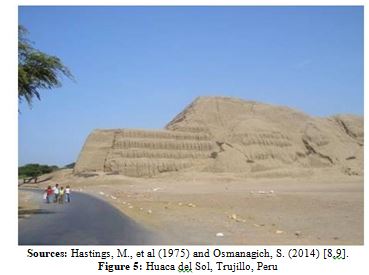
This illustration showcases the Huaca del Sol, a monumental adobe pyramid constructed in the Moche Valley near Trujillo, Peru. Originally, the structure measured approximately 340 meters in length, 160 meters in width, and reached a height of 50 meters, encompassing an estimated volume of 1.2 million cubic meters. It was built using over 130 million adobe bricks, many of which beardistinct makers' marks. During the early 17th century, Spanish colonists diverted the Moche River to facilitate looting for gold artifacts, resulting in severe erosion and the loss of approximately two-thirds of the original structure. Today, the remaining edifice stands at a height of 41 meters.
vi. Figure 6 Akapana, Bolivia [6]
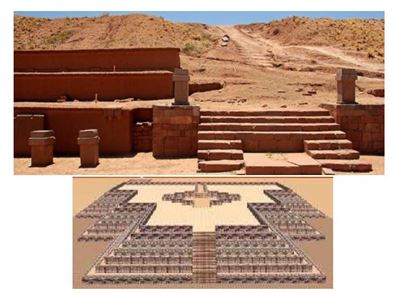
Sources: Osmanagich, S. (2014), Spizzichino, D., et al. (2023), and UNESCO World Heritage Centre. (n.d.) [10-12].
Figure 6: Akapana Pyramid, Tiwanaku, Bolivia
This illustration showcases the Akapana Pyramid, a monumental terraced platform mound constructed by the Tiwanaku civilization in western Bolivia. The structure measures approximately 257 meters in length, 197 meters in width, and rises to a height of 16.5 meters, encompassing an estimated volume of 1.2 million cubic meters. It comprises seven superimposed platforms, originally clad with finely cut sandstone and andesite blocks, reflecting sophisticated engineering and architectural techniques. The Akapana Pyramid is centrally located within the Tiwanaku archaeological complex and is aligned with the cardinal directions indicating its significance in the ceremonial and urban planning of the site. At its summit, there was a sunken court, possibly used for ritual purposes. The construction of Akapana demonstrates advanced knowledge of drainage systems, as evidenced by well- preserved canals surrounding the structure. Over the centuries, the pyramid suffered extensive damage due to looting and stone quarrying, particularly during the colonial period, when materials were repurposed for other constructions. Despite this, Akapana remains a testament to the architectural prowess of the Tiwanaku culture
vii. Figure 7 Monks Mound, USA [7]
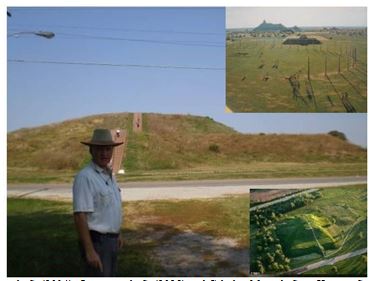
Sources: Osmanagich, S. (2014), Osmanagich, S. (2025) and Cahokia Mounds State Historic Site. (n.d.) [13-15].
Figure 7: Monks Mound, Cahokia Mounds State Historic Site, Illinois, USA
This visual presentation shows Monks Mound, the largest pyramid-shaped structure in the United States and one of the most impressive prehistoric monuments in the Americas. Located within the Cahokia complex near modern-day Collinsville, Illinois, Monks Mound covers an area of approximately 291 × 236 meters at its base and rises to a height of about 30 meters. The estimated volume of the structure exceeds 622,000 cubic meters. The pyramid consists of four primary terraces, built using shaped sandstone blocks, interspersed with pebbles, rocks, and compacted sand and clay, according to local archaeological observations. This construction method indicates a deliberate layering process and reflects significant organizational effort and engineering knowledge. Oriented roughly 5 degrees east of true north, the structure exhibits a clear spatial and possibly astronomical intention, though no written records exist to describe its purpose or construction process. While the Mississippian culture is commonly credited with its creation, no inscriptions, blueprints, or definitive cultural attribution exist for Monks Mound. Furthermore, no thorough archaeological excavations have revealed the presence of internal chambers or tunnels, and much of its interior remains unexplored.
viii. Figure 8 Bosnian Pyramid of the Sun, Bosnia-Herzegovina [2]
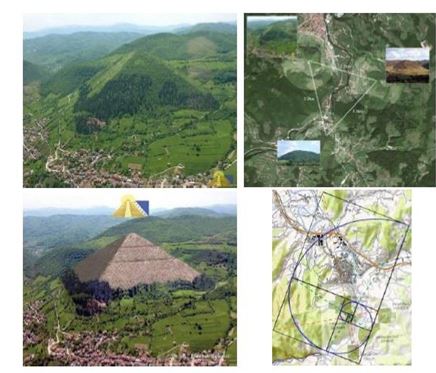
Sources: Osmanagich, S. (2023), Korotkov, K., et al. (2024), Osmanagich, S. (2025) and Osmanagich, S. (2025) [14,16-18].
Figure 8: Bosnian Pyramid of the Sun, Visoko, Bosnia-Herzegovina
The Bosnian Pyramid of the Sun is the tallest known pyramid in the world, reaching a height of 368 meters. Recent calculations based on slope geometry and LiDAR, satellite, and geodetic data confirm a slope angle of 35°, resulting in a rectangular base measuring approximately 1,051 × 876 meters and an estimated volume of
112.9 million cubic meters making it one of the largest pyramid structures globally by volume. Constructed using artificially produced concrete-like blocks, made of breccia, sandstone, and thermally treated clay binder, the pyramid exhibits both material sophistication and structural durability. Its northern face is aligned with true north with an error of only 0° 0′ 12″, exceeding the precision of the Great Pyramid of Egypt. Geometrical and astronomical evidence further supports intentional design. A Fibonacci spiral overlay intersects the summits of the Pyramid of Love, Bosnian Pyramid of the Sun, Temple of Mother Earth, Pyramid of the Dragon, and the Vratnica Tumulus, all forming part of a wider sacred geometrical layout in the Visoko Valley. Additionally, the Pyramids of the Sun, Moon, and Dragon are spaced 2.2 km apart and form an equilateral triangle with internal angles of approximately 60°.
ix. Figure 9 Gunung Padang, Indonesia [14]
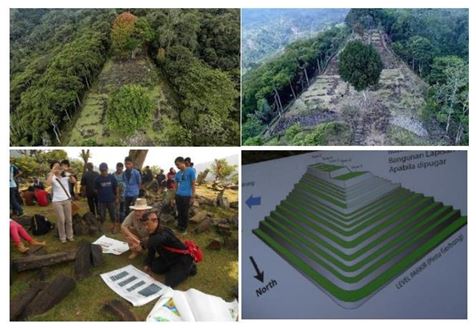
Visuals
• Top Left and Right: Aerial views of Gunung Padang, illustrating its terraced design largely hidden under dense tropical vegetation.
• Bottom Left: Fieldwork discussion between Dr. Danny Hilman and Dr. Sam Osmanagich during an onsite visit.
• Bottom Right: Digital reconstruction of the pyramid model, revealing its stepped, multi-layer architecture and orientation to cardinal directions.
Estimated Volume Calculation
Using a basic stepped-pyramid model:
• Base ≈ 100 × 150 m
• Height ≈ 100 m
• Volume (approximate) = (1/3) × base area × height
• Volume ≈ (1/3) × (100 × 150) × 100 = 500,000 m3
Sources: Osmanagich, S. (2025), Natawidjaja, D. H., et al. (2023) and Osmanagich, S. (2014) [2,19,20].
Figure 9: Gunung Padang Pyramid, West Java, Indonesia: A Multi-Layered Prehistoric Pyramid in the Jungle
Gunung Padang is one of the most controversial and significant megalithic sites in Southeast Asia. Located in West Java, Indonesia, this terraced hill is increasingly recognized as a man-made, multi-layered pyramid built in distinct construction phases. Situated at an elevation of 885 meters above sea level, the site spans approximately 100 × 150 meters at the base, rising to a height of about 100 meters, which gives it an approximate volume of 500,000 cubic meters (modeled as a stepped pyramid). Recent geo-archaeological studies, including deep-core drilling, radiocarbon dating, and ground-penetrating radar, have revealed a complex subsurface structure. According to Dr. Danny Hilman's 2023 study, Gunung Padang consists of four distinct construction units [19].
• Unit 4: The core massive andesite lava was likely sculpted during the last glacial period between 25,000 and 14,000 BCE, forming the base of the structure.
• Unit 3: Built atop Unit 4, constructed around 25,000-14,000 BCE, and buried between 7900 and 6100 BCE.
• Unit 2: Constructed between 6000 and 5500 BCE after a long hiatus.
• Unit 1: The most recent ancient layer, built between 2000 and 1100 BCE.
• A final phase of excavation and soil fill occurred around1393–1499 CE.
This chronological layering demonstrates that Gunung Padang evolved over tens of thousands of years, challenging mainstream archaeological models of Southeast Asian prehistory.
The pyramid's construction uses polygonal andesite blocks, many intentionally placed to create terraces, retaining walls, and flat platforms. The orientation of the structure is aligned approximately northwest–southeast, with clear spatial planning and possibly astronomical considerations. Despite mounting evidence of its antiquity and sophistication, Indonesia's cultural authorities still categorize it as a natural formation with later human modification, focusing only on the upper terrace. As a result, large-scale excavation has been delayed, pending bureaucratic and academic consensus.
x. Figure 10 Pyramid of the Sun, Teotihuacan, Mexico [4]
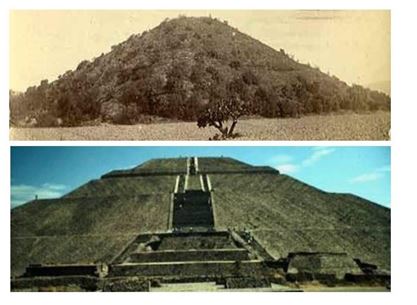
Visuals
• Top: Historical photograph showing the structure prior to excavation and restoration, overgrown and resembling a natural mound.
• Bottom: Post-excavation view revealing the stepped profile and monumental stairway.
The pyramid’s massive scale and enduring structure point to high levels of planning, design, and knowledge of materials and load distribution. However, in the absence of written documentation or direct archaeological evidence of construction techniques, questions remain open regarding the societal organization, engineering strategies, and purpose behind its creation. As such, the Pyramid of the Sun remains a case study in unexplained megalithic engineering and an invitation for further multidisciplinary inquiry.
Sources: Osmanagich, S. (2014) and López Luján, L., et al. (2022) [21,22].
Figure 10: Pyramid of the Sun, Teotihuacan, Mexico: Monumental Scale and Unresolved Origins
The Pyramid of the Sun is one of the largest ancient pyramidal structures in the world and the central monument within the Teotihuacan complex in central Mexico. Its scale, geometry, and integration into a larger ceremonial and urban layout reflect significant engineering knowledge and spatial planning.
Engineering Dimensions
• Base: ~230 meters per side
• Height: ~74 meters
• Estimated Volume: ~1.15 million cubic meters
• Material: Volcanic tuff, adobe fill, limestone and basalt cladding Despite its prominence, many aspects of the pyramid remain undocumented or debated. There are no surviving written records
or inscriptions that clearly indicate the time of construction, construction methods, purpose, or the cultural group responsible. Its orientation deviates from true cardinal alignment, and instead aligns with other architectural axes within the Teotihuacan layout, possibly influenced by topographical, astronomical, or symbolic factors.
Engineering Parameters Analyzed
For each site, the following variables were examined:
• Base area (m²) and structure height (m)
• Estimated volume (m³), calculated where possible using geometric approximations (e.g., pyramid, platform mound, or terraced hill models)
• Primary construction materials, including natural stone, concrete- like binders, or adobe
• Structural layout and orientation, with attention to astronomical or cardinal alignment
• Geometric features, such as tiered platforms, symmetry, or sacred geometry use
• Documented construction phases, including stratigraphy and carbon dating where available
• Presence or absence of written construction records
• Topographic context, including proximity to raw materials and terrain constraints
Data Sources and Limitations
The analysis is grounded in peer-reviewed journal articles, archaeological excavation reports, LiDAR and geophysical survey data, and core drilling results. Key references include Archaeological Prospection on Gunung Padang, Journal of Archaeological Science for Teotihuacan, and UNESCO heritage documentation for Akapana [4,6,14]. Supplementary data were drawn from fieldwork observations, conference proceedings, and comparative studies conducted by the author [2,5,8]. Due to the lack of direct construction records for any of the studied sites, engineering estimates (e.g., volume, labor, material mass) are based on conservative modeling, typically using regular geometric forms and average material densities. Volume calculations are rounded to nearest significant figures for comparative clarity. Where data were not available, conservative extrapolations were made based on published terrain models and site maps.
Comparative Engineering Profiles
This section provides concise engineering summaries of ten major pyramidal structures built by ancient civilizations across four continents. Each profile highlights construction dimensions, material composition, orientation, and relevant design elements, with attention to technical complexity and structural scale.
Yangling Mausoleum, China (Figure 1)
Located in Shaanxi Province, the Yangling Mausoleum-commonly associated with Emperor Jing of Han-features a square base measuring approximately 417 meters per side and a height of 32 meters. Composed primarily of sandstone and granite blocks, its estimated volume is approximately 1.86 million cubic meters. The structure is precisely aligned at 359° 32′ 25.6″, suggesting intentional orientation just shy of true north [1,2]
Great Pyramid of Giza, Egypt (Figure 2)
The most studied of ancient pyramids, the Great Pyramid stands at an original height of 146.6 meters, with a base of 230.34 meters per side and a volume of 2.58 million cubic meters. Constructed from approximately 2.3 million limestone and granite blocks, each weighing 2.5 to 15 tons, the pyramid is oriented with remarkable precision only 2 arcminutes off true north. Despite its fame, no written construction records survive [3,5,14,23].
La Danta, El Mirador, Guatemala (Figure 3)
The La Danta complex includes a central pyramid reaching a height of 72 meters, resting on a massive basal platform approximately 600 × 300 meters. The total estimated volume is 2.8 million cubic meters, exceeding even Giza in total mass when including the full platform. Built during the Preclassic Maya period, the site shows clear solar and calendrical alignments, with construction primarily in limestone [4].
Great Pyramid of Cholula, Mexico (Figure 4)
Known locally as Tlachihualtépetl (“man-made mountain”), this adobe brick structure is the largest known pyramid by volume approximately 4.45 million cubic meters. Measuring 450 × 450 meters at the base and 66 meters in height, it was constructed in layered phases and is aligned 26 degrees north of west. Its long occupation span and complex interior construction reflect evolving engineering methods [8,9].
Huaca del Sol, Trujillo, Peru (Figure 5)
Originally reaching 50 meters in height with a base of 340 × 160 meters, the Huaca del Sol is made of over 130 million adobe bricks, many marked with makers' stamps. Its estimated original volume exceeded 1.2 million cubic meters, though river redirection and erosion have reduced its height to 41 meters. No construction records exist, but its scale and method suggest a coordinated civic engineering effort [8,9].
Akapana Pyramid, Tiwanaku, Bolivia (Figure 6)
The Akapana pyramid is a stepped platform mound measuring 257 × 197 meters and 16.5 meters in height, with a volume near
1.2 million cubic meters. It was clad with sandstone and andesite blocks, features a sophisticated internal drainage system, and is oriented to cardinal directions. Damage from colonial-era looting has obscured some original features [10-12].
Monks Mound, Cahokia, USA (Figure 7)
The largest earthwork pyramid in North America, Monks Mound measures approximately 291 × 236 meters at the base and 30 meters in height, with a volume of over 622,000 cubic meters. Built with compacted layers of clay, sand, and rock, the structure includes four distinct terraces and a summit platform, demonstrating advanced soil stabilization techniques. It is oriented roughly 5° east of true north [13,15].
Bosnian Pyramid of the Sun, Visoko, Bosnia-Herzegovina (Figure 8)
The Bosnian Pyramid of the Sun is the tallest known pyramid in the world, reaching a height of 368 meters. Recent calculations based on slope geometry and LiDAR, satellite, and geodetic data confirm a slope angle of 35°, resulting in a rectangular base measuring approximately 1,051 × 876 meters and an estimated volume of
112.9 million cubic meters - making it one of the largest pyramid structures globally by volume. Constructed using artificially produced concrete-like blocks, made of breccia, sandstone, and thermally treated clay binder, the pyramid exhibits both material sophistication and structural durability. Its northern face is aligned with true north with an error of only 0° 0′ 12″, exceeding the precision of the Great Pyramid of Egypt [16-18,24].
Gunung Padang, Indonesia (Figure 9)
Gunung Padang is a terraced pyramid built atop a volcanic hill, measuring approximately 100 × 150 meters at the base and 100 meters in height, for an estimated volume of 500,000 cubic meters. Recent studies using core sampling and radiocarbon dating suggest the site was constructed in multiple phases, dating back as far as 25,000 BCE. The structure uses polygonal andesite blocks and is oriented northwest–southeast [19,20].
Pyramid of the Sun, Teotihuacan, Mexico (Figure 10) Standing at 74 meters high with a base of 230 × 230 meters, the Pyramid of the Sun reaches a volume of approximately 1.15 million cubic meters. It is composed of volcanic tuff, adobe fill, and limestone facing, though its exact construction date and builder remain unknown due to a lack of inscriptions. The orientation deviates from cardinal north, following Teotihuacan’s broader urban grid [22].
Engineering Complexity vs. Scale
The construction of monumental pyramidal structures presents not only a physical challenge in terms of material mass and volume, but also a sophisticated civil engineering problem requiring systems of planning, labor management, material sourcing, and geometric precision. As structure size increases, so too do the logistical and structural complexities that must be addressed to ensure durability and spatial coherence.
Volume as an Engineering Multiplier
Volume is not merely a measure of size but a compounding factor in construction complexity. For example, the Great Pyramid of Giza and La Danta at El Mirador both exceed 2.5 million cubic meters in volume, implying not just a greater mass of material but a far higher degree of planning required to maintain structural symmetry and gradient stability over larger spans [3]. At such scales, issues like load distribution, differential settlement, and foundation behavior become critical. In contrast, structures like Monks Mound and Gunung Padang, while smaller in volume, reveal complexity through multi-phase construction, terracing, and integration into topographically challenging environments. These features introduce additional engineering considerations such as retaining wall stability, erosion control, and platform leveling.
Material Manipulation and Transport Logistics
The range of construction materials - limestone, sandstone, adobe, volcanic andesite, geopolymeric binders demonstrates not only diversity in resource availability but also variance in engineering technique. The Bosnian Pyramid of the Sun includes artificially bonded concrete-like blocks, indicating advanced knowledge of material synthesis and compressive strength properties. The use of 130 million adobe bricks in Huaca del Sol or 2.3 million limestone blocks in Giza further implies efficient transport systems, stockpile management, and possibly prefabrication strategies. Without iron tools, draft animals, or wheel-based transport, the ability to quarry, shape, move, and place heavy materials at such scale reveals significant ingenuity in mechanical organization.
Geometry, Alignment, and Surveying Accuracy Orientation and layout also reflect engineering precision. Structures such as Akapana, Bosnian Pyramid of the Sun, and the Yangling Mausoleum exhibit near-perfect cardinal alignment, with deviations measured in arc minutes or seconds. In the absence of magnetic compasses or modern geodesy, this alignment likely required solar or stellar observation, horizon-based triangulation, and consistent slope calibration. Pyramids like Cholula and Teotihuacan, which deviate from true north, nonetheless show consistency with local urban grids or solar event tracking. Such planning implies a broader architectural logic and a master plan that transcends individual monument design.
Project Duration and Phased Construction
Multi-layered construction seen at Gunung Padang, Cholula, and Monks Mound reveals that these were not single-phase undertakings. Chronostratigraphic data from Gunung Padang indicates successive construction periods spanning from 25,000 BCE to 1100 BCE, separated by millennia. Phased layering implies not only long-term societal commitment but also continuity of engineering knowledge across generations. Phased construction increases complexity, as future builders must account for subsurface integrity, existing load conditions, and integration with previous structural elements - challenges still relevant in modern civil retrofitting and vertical expansion.
Case Studies in Megalithic Challenge
While all pyramids analyzed in this study present remarkable engineering qualities, several examples stand out for the magnitude of logistical and structural difficulty they pose. These sites—Gunung Padang (Indonesia), La Danta (Guatemala), and Akapana (Bolivia)—illustrate engineering responses to extreme geographic, material, and cultural constraints, revealing layers of complexity beyond their volumetric scale alone.
Gunung Padang, Indonesia (Figure 9)
Located on a remote volcanic ridge at an elevation of 885 meters above sea level, Gunung Padang is a unique example of phased construction atop a naturally elevated base. The structure’s estimated height of 100 meters and volume of ~500,000 m3 are distributed across five terraces, each edged with megalithic polygonal andesite blocks. Recent core drilling and radiocarbon dating suggest construction phases spanning more than 20,000 years from 25,000 to 1100 BCE making it potentially the oldest pyramid structure known. From a civil engineering standpoint, Gunung Padang is notable for:
• Terrain Adaptation: Engineering stabilization of a steep natural slope through stepped terraces and retaining walls
• Material Behavior: Use of volcanic rock with hydrothermal cementing properties, showing knowledge of cohesion and compaction
• Long-Term Durability: Despite seismic activity in the region, the structure remains largely intact, suggesting knowledge of
structural resilience
The engineering challenges of this site are amplified by its lack of proximity to large labor populations, steep elevation, and bureaucratic constraints on excavation.
La Danta, El Mirador, Guatemala (Figure 3)
The La Danta pyramid complex is set deep within the Petén rainforest, approximately 60 km from the nearest modern infrastructure. It features a main pyramid 72 meters tall, set on a platform base of 600 × 300 meters, for a total volume of ~2.8 million m3.
From a civil engineering perspective, La Danta highlights:
• Remote Logistics: Transporting and stacking massive limestone blocks in a rainforest with no draft animals or wheeled carts
• Hydrology: Constructing in a flood-prone basin, requiring careful platform drainage and settlement control
• Urban Integration: Aligning with sunrises and calendrical markers, requiring integrated surveying over dense jungle terrain Its inaccessibility today suggests that ancient planners developed advanced logistical frameworks, perhaps seasonal, for construction material movement and human provisioning.
Akapana Pyramid, Tiwanaku, Bolivia (Figure 6)
Akapana is a terraced pyramid built at 3,850 meters above sea level on the Andean Altiplano. With a volume of approximately 1.2 million m3, it exhibits seven superimposed terraces, stone revetments, and complex drainage systems.
Key engineering features include:
• High-Altitude Adaptation: Material transport and labor mobilization under reduced oxygen and harsh weather conditions
• Drainage Design: A sophisticated series of internal canals and outflows engineered into the pyramid body
• Material Use: Cut andesite and sandstone blocks, many interlocked and precisely fitted—reducing erosion and settlement Its orientation and symmetrical plan further reflect advanced surveying methods in a pre-compass, pre-literate society.
These three sites exemplify engineering that goes beyond monumental ambition they embody adaptive, resilient, and systematic approaches to material management, load control, and environmental integration. Each site presents modern civil engineers with case studies in:
• Working under extreme topographical or environmental stressors
• Managing large volumes with limited mechanical tools
• Achieving long-term structural integrity in dynamic climates Their study may yield lessons applicable to modern challenges in geotechnical stabilization, decentralized construction logistics, and sustainable design under constrained conditions.
Civil Engineering Implications
The comparative analysis of pyramid structures from across ancient civilizations reveals more than historical or archaeological significance; it uncovers foundational engineering practices that remain relevant today. These megalithic monuments, constructed without industrial machinery, standardized tools, or written technical documents, nonetheless demonstrate principles aligned with core civil engineering concerns - material selection, structural stability, hydrological management, surveying accuracy, and long- term durability.
Structural Scaling and Load Management
Pyramid structures excel in static load distribution, leveraging the geometry of a broad base and diminishing vertical mass to manage stress gradients naturally. This tapered form reduces the risk of shear failure and foundation overload, especially in seismic or soft-soil environments. The presence of multiple terraces and interlocking masonry elements at sites like Akapana and Monks Mound mirrors modern design principles used in dam embankments, retaining walls, and earth-sheltered architecture. Modern civil engineering can benefit from re-evaluating these ancient precedents, particularly for applications in passive seismic resistance, earthen construction, and low-maintenance infrastructure in remote or unstable terrains.
Material Engineering and Local Resource Optimization The use of regionally available materials ranging from volcanic andesite at Gunung Padang , limestone at Giza, to adobe bricks at Cholula and Huaca del Sol demonstrates a deep understanding of local geotechnical properties. Some sites, such as the Bosnian Pyramid of the Sun, employed artificially bonded blocks with cementitious binders that suggest early experimentation with synthetic stone or geopolymer composites. Contemporary engineering increasingly prioritizes sustainability and carbon- conscious construction. The study of ancient material systems and their durability over millennia offers valuable insights for developing low-carbon, locally sourced construction technologies especially in the context of climate-adaptive infrastructure.
Surveying and Geometric Precision Without Modern Tools
The cardinal or astronomically aligned orientation of pyramids in Bosnia, China, Egypt, and Bolivia reveals consistent surveying precision, often exceeding 99.99% alignment with true north. The mechanisms behind this precision remain debated, but the repeatability across continents implies standardized observational or geometric techniques. This highlights the feasibility of achieving large-scale spatial accuracy using optical or environmental reference points an approach useful in modern construction under GPS-denied conditions, including remote, mountainous, or subterranean environments.
Project Phasing and Long-Term Design Thinking
Several pyramids, including Gunung Padang, Cholula, and Monks Mound, demonstrate long-term phasing, with construction evolving over centuries or even millennia. Later builders adapted, reinforced, or expanded upon earlier structures while maintaining structural integrity. This implies a deep architectural continuity and the existence of knowledge transfer systems across generations.
In an era increasingly focused on lifecycle engineering and adaptable infrastructure, these examples offer inspiration for phased civil projects designed to be modular, upgradeable, and resilient over centuries.
Summary
The pyramids examined here are not merely symbolic or cultural relics. They are enduring monuments to ancient engineering intelligence—intelligence that, in some aspects, meets or exceeds principles found in modern design manuals. Revisiting these ancient solutions through a civil engineering lens opens up new dialogues in sustainable construction, resilience engineering, and knowledge inheritance.
Discussion
The structural, geometric, and material complexity demonstrated by the ten pyramid sites studied in this article challenges the prevailing archaeological narrative that ancient civilizations were technologically primitive or evolutionarily linear in their development. Although these cultures lacked metallurgy, standardized writing systems, or industrial tools as defined by modern criteria, their architectural outputs reflect strategic, context-sensitive engineering on a monumental scale.
The Absence of Written Records
A striking commonality across the examined pyramid sites - from Giza to Gunung Padang, Visoko, and Monks Mound - is the complete absence of surviving written construction records. No inscriptions, blueprints, or engineering notes have been recovered that explain how such structures were conceived, planned, and built. Yet these monuments exhibit characteristics typically associated with modern civil engineering projects:
• Uniform dimensional scaling
• Material consistency and layering
• Strategic foundation placement
• Advanced surveying and astronomical alignment
This paradox raises the possibility of undocumented or orally transmitted engineering systems. It also invites further consideration of whether technical knowledge was centralized within elite initiatory classes, religious orders, or encoded into mythological or architectural symbolism.
Geometric and Astronomical Coherence
Several pyramids particularly those in Egypt, Bosnia, China, and Bolivia display precise alignment to cardinal directions or celestial events, including solstices and equinoxes. Others, such as Teotihuacan and Cholula, align with regional ceremonial or calendrical systems. These patterns suggest not only advanced geometric logic but also a cultural imperative to integrate architecture with environmental cycles. The repeated use of sacred geometry - Golden Ratio, equilateral triangles, Fibonacci sequences - may indicate knowledge of harmonic design principles far earlier than their documented rediscovery in classical Greece or the European Renaissance. Such principles imply intentionality and mathematical planning rather than accidental or emergent design.
Implications for Lost or Suppressed Knowledge Systems Given the scale, precision, and engineering coherence of these structures, it becomes increasingly plausible that some ancient societies possessed technical capabilities not adequately reflected in the archaeological record. Whether due to organic decay, colonial disruption, academic oversight, or cultural taboo, the intellectual foundations of these achievements remain largely invisible to mainstream history.
This raises important epistemological questions:
• Are current models of prehistoric human capability too limited by presentist assumptions?
• Might there have been transcontinental knowledge diffusion in prehistory, perhaps through now-vanished maritime or oral-tradition networks?
• What methodological biases have prevented civil engineering from engaging more fully with ancient structures as sources of technological insight?
Reassessing Civilizational Complexity
The cumulative evidence suggests that the civilizations responsible for these pyramids whether Maya, Olmec, Tiwanaku, Han, Egyptian, or others operated with planning horizons, technical standards, and organizational capacities that rival those of modern societies. Their ability to mobilize resources across decades or centuries, maintain alignment with geodetic precision, and manage hydrological and geological risks argues for a more nuanced understanding of “ancient engineering.” In this light, pyramid structures should no longer be viewed solely as religious symbols or burial monuments, but rather as civil engineering masterworks each embedded within a broader, and perhaps underrecognized, tradition of prehistoric technical knowledge.
Conclusion
Pyramidal structures are among the most enduring and enigmatic legacies of ancient civilizations. When viewed through the lens of civil engineering, they emerge not only as cultural symbols, but as evidence of sophisticated and highly adapted construction practices. This study has demonstrated that across continents and cultures, ancient builders consistently achieved monumental scale, material efficiency, geometric accuracy, and structural resilience- often without the benefit of written design records, mechanized tools, or modern surveying equipment. By analyzing ten major pyramids across four continents, this research has shown that these structures embody core engineering principles: axial load distribution, modular construction, staged labor logistics, and environmental responsiveness. Whether through the finely dressed limestone of the Great Pyramid of Giza, the geopolymer-like binders of the Bosnian Pyramid of the Sun, the stepped terraces of Gunung Padang, or the hydrological foresight embedded in Akapana’s drainage systems, the evidence points to deep, practical knowledge of materials, geometry, and landscape engineering.
Importantly, many of these structures were constructed in topographically difficult regions, far from modern infrastructure, and often in multiple phases over centuries or millennia. These constraints make their enduring integrity all the more impressive and suggest that ancient engineers were not merely skilled builders, but systems thinkers operating within complex ecological, cultural, and astronomical frameworks. The findings invite a reassessment of prehistoric civilizational capacity - not in mythic or speculative terms, but through the material facts of scale, precision, and resilience. These pyramids are not anomalies. They are data-rich engineering case studies, worthy of further multidisciplinary inquiry across civil engineering, geotechnics, materials science, and history of technology. By reconnecting the fields of archaeology and engineering, we stand to recover valuable lessons from humanity’s distant past -lessons that may prove critical in designing resilient, resource-efficient, and culturally integrated structures for the future.
Author Declarations and Contributions
Dr. Sam Osmanagich is the sole author of this work. He conducted all field research, data analysis, figure preparation, manuscript writing, and final editing.
Ethical Approval
This study did not involve human participants, animals, or biological samples and therefore did not require ethical approval.
Data Availability Statement
All data supporting the findings of this study are included within the article. Additional details and figures are available upon reasonable request from the author.
References
1. Nanfeng, J., & Fazhan, C. (2009). First International Scientific Conference on Bosnian Valley of the Pyramids, Visoko, August 25-30, 2008. In: ICBP Proceedings. Archaeological Park: Bosnian Pyramid of the Sun Foundation, Sarajevo, 37-66.
2. Osmanagich, S. (2025). Pyramids Beneath the Forest: A Global Phenomenon and the Dilemma Between Archaeological Discovery and Ecological Preservation. World Journal of Forest Research.
3. Osmanagich, S. (2025). Spiral Geometry in Ancient Design: Evidence of Fibonacci Proportions in the Egyptian and Bosnian Pyramids. Acta Scientific: Environmental Science Journal.
4. Šprajc, I., Morales-Aguilar, C., & Hansen, R. D. (2009). Early Maya Astronomy and Urban Planning at El Mirador, Peten, Guatemala. Anthropological Notebooks, 15(3), 79-101.
5. Osmanagich, S. (2014). Pyramids Around the World & Lost Pyramids of Bosnia. Archaeological Park: Bosnian Pyramid of the Sun Foundation, Sarajevo, 62-112.
6. Osmanagich, S. (2014). Pyramids Around the World & Lost Pyramids of Bosnia. Archaeological Park: Bosnian Pyramid of the Sun Foundation, Sarajevo, 167-201.
7. McCafferty, G. G. (1996). Reinterpreting the great pyramid of Cholula, Mexico. Ancient Mesoamerica, 7(1), 1-17.
8. Hastings, C. M., & Moseley, M. E. (1975). The adobes of Huaca del Sol and Huaca de la Luna. American Antiquity, 40(2Part1), 196-203.
9. Osmanagich, S. (2014). Pyramids Around the World & Lost Pyramids of Bosnia. Archaeological Park: Bosnian Pyramid of
the Sun Foundation, Sarajevo, 137-147.
10. Osmanagich, S. (2014). Pyramids Around the World & Lost Pyramids of Bosnia. Archaeological Park: Bosnian Pyramid of the Sun Foundation, Sarajevo, 149-152.
11. Spizzichino, D., Amaru, J. C., Lombardi, L., Revilla, J. I. G., Merodo, J. A. F., Vizzini, G., & Margottini, C. (2023). Geotechnical design and mitigation measures for the conservation of Akapana Pyramid in the Tiwanaku Archaeological Site (Bolivia). In Sustainable Conservation of UNESCO and Other Heritage Sites Through Proactive Geosciences (pp. 23-46). Cham: Springer International Publishing.
12. UNESCO World Heritage Centre. (n.d.). Tiwanaku: Spiritual and Political Centre of the Tiwanaku Culture.
13. Osmanagich, S. (2014). Pyramids Around the World & Lost Pyramids of Bosnia. Archaeological Park: Bosnian Pyramid of the Sun Foundation, Sarajevo, 208-210.
14. Osmanagich, S. (2025). True North Across Civilizations: Comparative Study of Pyramid Alignments in Five Continents. Acta Scientific: Environmental Sciences Journal.
15. Cahokia Mounds State Historic Site. (n.d.). Mound 38 - Monks Mound.
16. Osmanagich, S. (2023). Bosnian Pyramids, My Story. Archaeological Park: Bosnian Pyramid of the Sun Foundation, Visoko.
17. Korotkov, K., & Osmanagich, S. (2024). Pyramids: The Influence of Form on the Environment. Part II. Bosnian Pyramids. Acta Scientific Medical Sciences.
18. Osmanagich, S. (2025). Multidisciplinary Evaluation of the Pyramid-Shaped Formation near Visoko, Bosnia-Herzegovina: A Case for Anthropogenic Construction. Journal of Biomedical Research and Environmental Sciences.
19. Natawidjaja, D. H., et al. (2023). Geoâ?archaeological prospecting of Gunung Padang buried prehistoric pyramid in West Java, Indonesia. Archaeological Prospection, retracted, Wiley.
20. Osmanagich, S. (2014). Pyramids Around the World & Lost Pyramids of Bosnia. Archaeological Park: Bosnian Pyramid of the Sun Foundation, Sarajevo, 216-219.
21. Osmanagich, S. (2014). Pyramids Around the World & Lost Pyramids of Bosnia. Archaeological Park: Bosnian Pyramid of the Sun Foundation, Sarajevo, 153-156
22. López Luján, L., et al. (2022). Engineering Features and Urban Planning in Teotihuacan. Journal of Archaeological Science, Elsevier.
23. Swelim, N. (2009), Pyramid Status, What is a Pyramid?, First International Scientific Conference on Bosnian Valley of the Pyramids, Visoko, August 25–30, 2008. In: ICBP Proceedings. Archaeological Park: Bosnian Pyramid of the Sun Foundation, Sarajevo, pp. 23-36.
24. Osmanagich, S. (2014). Pyramids Around the World & Lost Pyramids of Bosnia. Archaeological Park: Bosnian Pyramid of the Sun Foundation, Sarajevo, 221-322.