

Advances in Bioengineering and Biomedical Science Research(ABBSR)
ISSN: 2640-4133 | DOI: 10.33140/ABBSR
Impact Factor: 1.7

Review Article - (2021) Volume 4, Issue 4
Mechanism of Action of Elastic Compression Therapy in Phlebolymphology
Received Date: Nov 10, 2021 / Accepted Date: Nov 24, 2021 / Published Date: Nov 30, 2021
Copyright: ©Copyright: ©2021 Rolando Tasinato, et al. This is an open-access article distributed under the terms of the Creative Commons Attribution License, which permits unrestricted use, distribution, and reproduction in any medium, provided the original author and source are credited.
Citation: Rolando Tasinato, Sebastiano A Pillirone, Gaia Degli Angeli, Corrado Da Lio, Myriam Maritan. Pietro Milo Tasinato (2021) Mechanism of Action of Elastic Compression Therapy in Phlebolymphology. Adv Bioeng Biomed Sci Res 4(4): 119-122.
Abstract
Compression is the best therapy in the treatment of venous ulcers. The intensity of the bandage compression essentially depends on four factors: the physical structure and elastomeric properties of the bandage, the shape of the limb the bandage is applied to, the ability and experience of the doctor or nurse who applies it and the ability of the patient to deambulate [1, 2].
The development of construction technologies can help reduce the variability of inter- and intra-bandage tension: one of the most promising possibilities is the manufacturing of a vari-stretch elastomer, capable of exerting a relatively constant pressure regardless of limited variations in extension.
Introduction
A systematic review of medical literature shows that a high in-tensity multilayer bandage (capable of producing a compression of 35-45 mmHg at the ankle) is preferable for the treatment of venous ulcers.
The multilayer kits consist of four overlapping bandages with different elasticity. The compression system allows the mainte-nance of a high pressure (between 40 and 60 mmHg) for several days and an excellent tolerability at rest. The use of anti-throm-boembolism stocking and 2nd class elastic stocking, superim¬posed during daily activity, is limited to small, non-secreting and uncomplicated ulcers and in the final stages of the skin repair process.
The so-called “advanced” compression systems require further studies on their effectiveness, tolerability and benefit-cost ratio. The most effective therapy in preventing relapses is the ther-apeutic elastic stocking, as long as it exerts a compression of at least 35-45 mmHg at the ankle, and the result is strictly de-pendent on the prescription (type and size of sock) and on the regular renewal of the socks [3].
Mechanism of Action of Elastic Compression Therapy
The mechanism of action and the clinical consequences of com¬pression therapy in phlebolymphology have been described in a large number of scientific papers and can be summarized by their action on the superficial and deep venous system, on the lymphatic system, on blood volume and on the vascular com¬partment [4, 5].
The compression exerted on the lower limbs causes a reduction of the venous caliber. The consequent better collaboration of the valve flaps, altered by the presence of varicose veins, and the reduction of pathological refluxes improve the overall he-modynamics of the limb up to 30-40% (Schoop and coll. 1964; Fischer and coll. 1972; Wilkins and coll. 1972; Lofferer and coll. 1970-1972; Stemmer and coll. 1976).
These effects, added to the strengthening of the squeeze of the venous pumps (at the foot and calf) that happens during walking, cause an increase in the speed of the venous flow up to 5 times, with a reduction of reflux and therefore of stasis (Partsch 1979). Haid, Stöberl and other authors have also shown, with the use of radionuclides, an increase in the rate of lymphatic outflow during compression therapy.
The bandage reduces blood volume in the lower limb by approx¬imately 45% in the lying position and by 62% in the upright po¬sition, with a significant increase in right ventricular filling. The local blood pool, as measured by Partsch et coll. with marked red blood cells, decreases by 30% after the application of a com¬pression bandage of about 40 mmHg on the whole lower limb [6].
Radioisotopic studies have shown that the external pressure exerted by the bandage increases tissue pressure, favouring the reabsorption of fluids towards the venous side, according to Starling’s Law, and therefore determining a reduction of edema, together with the mechanisms already mentioned. Curri et coll. (1989) indicated that compression therapy with an elastic brace causes a decrease in venulo-capillary ectasia, interstitial edema and reactive thickening of the arteriolar basement membrane in patients with severe venous insufficiency.
Bollinger et coll. (1993) and Rashid et coll. (1992) have high-lighted
increased skin oxygenation during compression in venous in-sufficiency.
Allegra et coll. (1995), with a microlymphographic and capil-laroscopic study after the application of a rigid bandage in IVC, showed a fall in endolymphatic pressure, a reduction of intersti¬tial pressure, with a reorganization of microcirculatory hemody-namics, and hematocrit normalization [7-9].
Compression favours the detachment of leukocytes from the endothelium and prevents further adhesion (Abu-Own et coll. 1994). Capillary filtration is also reduced and reabsorption is fa-vored thanks to the higher tissue pressure.
These data show that compression therapy is of fundamental im¬portance in the treatment of chronic venous insufficiency and its complications, reducing edema and pain and promoting the healing of venous ulcers.
The elastic bandage: physical characteristics and method of application
Elastic bandages, as well as stockings, which are constructed with long stretch elastic fibers, maintain a constant pressure, rel-atively independent of muscle activity, on the superficial venous system [10, 11].
Depending on their extensibility, elastic bandages exert different actions during rest and motion, bearing in mind that compres-sion therapy must be associated with the mobilization of the pa¬tient in order to obtain maximum effectiveness:
• Inextensible and short-stretch bandages (<70%), such as oxide boot of Unna zinc or adhesive and medicated ban-dages, determine high pressure at work and low pressure at rest, such that they can be maintained constantly during the 24 hours; in addition, they strengthen the action of the calf muscle pump and seem to have a greater impact on the deep venous system;
• Stretch bandages over 70% and elastic stockings, on the other hand, cause minor pressure at work and higher pres-sure at rest, so that they usually have to be removed at rest because they are not tolerated [12].
• The pressure exerted by a bandage essentially depends on the tension it is applied with, on the number of layers ap-plied and on the curvature of the limb. The relationship be-tween such quantities is expressed by Laplace’s law P=T-n/r. The voltage is determined by the force applied on the bandage during its extension, but the ability of the bandage to maintain a specific tension and therefore the pressure ex¬erted derive from its elastomeric properties, which in turn depend on the type of yarn and the construction methods of the fabric used.
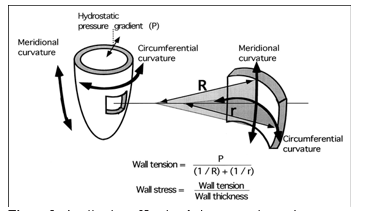
Figure 1: Application of Laplace’s law to tension and compres¬sion produced by an elastic stocking on the surface of the leg.
The ability of a bandage to stretch when subjected to a pulling force is called extensibility and describes the elongation capac¬ity of the elastic material, which in any case, depending on its hysteresis properties, can have different tensile behaviour: the applied pressure increases proportionally to tension, up to a maximum beyond which an overstretching phenomenon occurs, therefore stabilizing pressure [13, 14].
When the bandage is applied, numerous factors determine its compressive effectiveness over time: exploitation of the materi¬al, walking with repeated and continuous stretching and retrac¬tions, eventual reduction of edema and the physical characteris¬tics of the material used.
It is believed that the applied pressure decreases by about 40% already after a few hours of application and these effects are greater the more the bandage applied is short-stretch, while highly elastic materials minimize these effects. The position of the patient also contributes to a variation of the applied pres¬sure: it increases in the upright position compared to the supine position. Most clinical studies on the efficacy of elastic bandages in the treatment of chronic venous insufficiency have been carried out with the use of a clinical air plethysmography test.
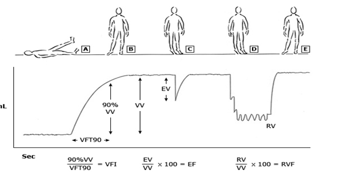
Figure 2: Air plethysmography indirectly measures changes in leg volume by quantifying air displacement within a polyure- thane cuff wrapped around the calf.
The force required to obtain a specific stretch indicates the pow-er. This parameter is decisive in defining the pressure exerted by the bandage at a fixed extension.
Elasticity, on the other hand, defines the ability of the bandage to return to its original length when the pulling force ceases.
The application of the bandage must be carried out while main¬taining constant the tension of the bandage and regularly over¬lapping the coils on top of each other in order to give uniformity to pressure, since with each superposition pressure increases proportionally as explained by Laplace’s Law.
Application techniques can be various (regular coils, eight, eight fixed to the ankle, spontaneous unrolling, etc.) and must be used in a different way according to the case, however always main-taining some fixed rules: the bandage must reach the root of the fingers, it must be applied from the inside to the outside of the limb and it must maintain the characteristics of regularity and uniformity (the bandage must be applied at constant tension while overlapping the coils by about 50% of their width on top of each other), thus avoiding areas of hyperpressure and local constriction [15].
It must be kept in mind that in practice, the material used to be equal, the pressure exerted by the bandage and its effectiveness strictly depend on the tension the bandage itself is subjected to, on the number of overlapping coils and on the technique used: the figure-of-eight bandage, for example, remains in place for a longer period of time without changing and compresses about 30-40% more than the regular coil. Moreover, when fixed to the ankle, the figure-of-eight bandage compresses the medial inter¬nal regions of the leg more and is therefore indicated for ve¬nous pathologies of that region, such as ulcers and hypodermo-dermatitis. On the contrary, the spontaneous unrolling bandage compresses the calf more and is therefore indicated for venous pathologies of the posterior region of the leg.
The use of so-called eccentric compressions with cotton or rub-ber pads is based on the physical principle that any change in the radius of the compressed surface determines a change in the pressure exerted inversely proportional to the ray itself, and its practical utility therefore lies in the possibility of varying the pressure depending on the areas that need to be compressed: a higher pressure is usually required on areas of venous ulcer, where the effects of the venous reflux are greater, while where the surface is flat (for example in areas of indurative hypoderma-titis) or even concave (retromalleolar dimples) the presence of a beam is required to compress the area. This technique is also useful in unifying the rays that have to be compressed or protected (such as the tibial crest, Achilles ten¬don, etc.) in all those legs that present irregular circumferences.
In this case, inelastic bandages with particular characteristics are used: resting pressure is very close to working pressure and therefore a local compressive effect, similar to that of elastic bandages, is obtained [16].
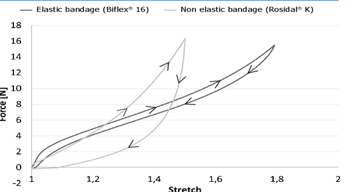
Figure 3: Biomechanical study on the action of compression bandages on the lower leg. Compression bandages are common¬ly used for the treatment of chronic venous insufficiency. They apply a pressure onto the leg, called interface pressure, which is one of the key aspects of the treatment.
An interesting novelty in the field of bandaging is represented by the multilayer system kits (four-layer bandages), which consist in the application of four overlapping bandages with different elasticity: the compression system allows the maintenance of a high pressure (between 40 and 60 mmHg) for several days and an excellent tolerability at rest and is particularly indicated for the reduction of “difficult” edemas, such as indurative and lym¬phatic ones, and in the treatment of venous ulcers. The elastic material provides constant pressure, while the inelastic material provides high working pressure during walking [17].
The practical problems of applying bandages and therefore of their effectiveness are essentially represented by the manual skills of the operator and the choice of suitable material. Manu¬facturers have tried to solve some of these problems by provid¬ing visual guides on the blindfold (lines, circles, rectangles) that change according to the tension exerted, therefore helping the operator apply adequate pressure on the limb.
Conclusion
Elastic compression currently represents the gold standard in the treatment of chronic venous insufficiency of the lower limbs. The development of construction technologies can help reduce the variability of inter- and intra-bandage tension: one of the most promising possibilities is that of manufacturing a vari-stretch elastomer that is able to constantly exert relatively low pressure regardless of limited variations in extension
References
- Partsch H, Flour M, Smith PC (2008) Indications for compression therapy in venous and lymphatic disease consensus based on experimental data and scientific evidence. Under the auspices of the IUP. International Compression Club. Int Angiol 27: 193-219.
- Attaran RR, Ochoa Chaar CI (2016) Compression therapy for venous disease. Phlebology 32: 81-88.
- Lattimer CR, Azzam M, Kalodiki E, Makris GC, Geroula-kos G (2013) Compression stockings significantly improve hemodynamic performance in post-thrombotic syndrome irrespective of class or length. J Vasc Surg 58:158-165.
- Kankam HKN, Lim CS, Fiorentino F, Davies AH, GohelMS (2018) A Summation Analysis of Compliance and Complications of Compression Hosiery for Patients with Chronic Venous Disease or Post-thrombotic Syndrome. Eur J Vasc Endovasc Surg 55: 406-416.
- Boxall SL, Carville K, Leslie GD, Jansen SJ (2019) Controlling compression bandaging pressure in leg ulcer research trials: A summary of the literature. Phlebology 34: 501-514.
- Rabe E, Földi E, Gerlach H, Jünger M, Lulay G, et al. (2021) Medical compression therapy of the extremities with medical compression stockings (MCS), phlebological compression bandages (PCB), and medical adaptive compression systems (MAC) : S2k guideline of the German Phlebology Society (DGP) in cooperation with the following professional associations: DDG, DGA, DGG, GDL, DGL, BVP. Hautarzt. 72: 137-152.
- Dissemond J, Assenheimer B, Bültemann A, Gerber V, Gre-tener S, et al. (2016) Compression therapy in patients with venous leg ulcers. J Dtsch Dermatol Ges 14: 1072-1087.
- Chiang N, Rodda O, Oldham S, Sleigh J, Vasudevan T (2019) Effects of compression therapy and venous surgery on tissue oxygenation in chronic venous disease. Phlebology 34: 474-480.
- Gianesini S, Mosti G, Raffetto JD, Maietti E, Chi YW, et al. (2020) Case-control evaluation of the impact of below 20 mmHg elastic compression stockings on lower limb volume serial variations in standardized flights.. Phlebology 35: 199-206.
- Mayrovitz HN, Partsch H, Vanscheidt W (2015) Comparison of 4-Layer Bandages and an Adaptive Compression Therapy Deviceon Intended Pressure Delivery. J WoundOstomy Continence Nurs 42: 468-473.
- Riebe H, Konschake W, Haase H, Jünger M (2018) Advantages and disadvantages of graduated and inverse graduated compression hosiery in patients with chronic venous insufficiency and healthy volunteers: A prospective, mono-centric, blinded, open randomised, controlled and cross-over trial. Phlebology 33: 14-26.
- Rabe E, Partsch H, Morrison N, Meissner MH, Mosti G, et al. (2020) Risks and contraindications of medical compression treatment - A critical reappraisal. An international consensus statement. Phlebology 35: 447-460.
- Flour M, Clark M, Partsch H, Mosti G, Uhl JF, et al. (2013) Dogmas and controversies in compression therapy: report of an International Compression Club (ICC) meeting, Brussels, May 2011. Int Wound J 10: 516-526.
- Rollo HA, Saliba O, Sobreira ML (2020) Compression stocking prevents increased venous retrograde flow time in the lower limbs of pregnant women. Phlebology 35: 784-791.
- Protz K, Heyer K, Dissemond J, Temme B, Münter KC, et al. (2016) Compression therapy - current practice of care: level of knowledge in patients with venous leg ulcers. J Dtsch Dermatol Ges 14: 1273-1282.
- Orr L, Klement KA, McCrossin L, O’Sullivan Drombolis D, Houghton PE, et al. (2017) A Systematic Review and Meta-analysis of Exercise Intervention for the Treatment of Calf Muscle Pump Impairment in Individuals with Chronic Venous Insufficiency. Ostomy Wound Manage 63: 30-43.
- Mutlak O, Aslam M, Standfield N (2018) The influence of exercise on ulcer healing in patients with chronic venous insufficiency. Int Angiol 37: 160-168.