

Space Science Journal(SSJ)
ISSN: 2997-6170 | DOI: 10.33140/SSJ


Research Article - (2025) Volume 2, Issue 1
Maxwell’s Equations in a Vacuum as a Consequence of the Lorentz Transformation
2Faculty of Natural Science and Informatization, Altynsarin Pedagogical Institute, Arkalyk, Kazakhstan
Received Date: Feb 10, 2025 / Accepted Date: Mar 13, 2025 / Published Date: Mar 20, 2025
Copyright: ©Ã?©2025 Peter M. Enders, et al. This is an open-access article distributed under the terms of the Creative Commons Attribution License, which permits unrestricted use, distribution, and reproduction in any medium, provided the original author and source are credited.
Citation: Enders, P. M., Tulegenova, A. K. (2025). Maxwellâ??s Equations in a Vacuum as a Consequence of the Lorentz Transformation. Space Sci J, 2(1), 01-03.
Abstract
This article considers implications of the Lorentz transformation for Lorentz covariant scalar and real-valued vector field theories. The Maxwell-Heaviside equations in a vacuum appear as a consequence of the restrictions imposed upon the latter ones. This suggests a discrepancy between the historical development of, and the logical relationship between Maxwell’s electrodynamics and special theory of relativity. The results for the Maxwell-Heaviside equations in a vacuum cum grano salis apply to Heaviside’s gravito electromagnetic equations as well.
Introduction
A Lorentz covariant aka manifest Lorentz invariant theory contains only Lorentz scalars, contra- and covariant 4-vectors such as xµ = (ct, r→) and x = (ct, −r→ ) (signature + − −−),respectively and their extensions to 4-tensors. This implies strong restrictions onto admissible theories. In this contribution, we concentrate on scalar and real-valued vector fields to eventually obtain Maxwell’s equations in a vacuum. All functions will be supposed to be sufficiently continuously differentiable.
To begin with the simplest non-trivial case, Section II considers constraints posed by Lorentz covariance upon Lorentz scalar fields. A physically relevant result is the Klein- Gordon equation.
Although this contribution has been inspired by discussions on the relationship between the historical and logical developments of physical theories in general, it constraints itself to this special example. Historically, the special theory of relativity bases on Maxwell equations in a vacuum. Does this corresponds to the logical development? To shed light on that question, Section III explores real-valued vector fields.
Finally, Section IV summarizes and concludes this article.
Scalar Field Theories
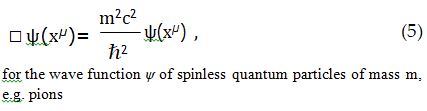
An elementary Lorentz covariant scalar field theory is expected to contain a Lorentz- scalar field amplitude u(xµ) and a Lorentz covariant equation of motion. Since this section only serves as a preparation of the main section III, pseudo-scalars are omitted.
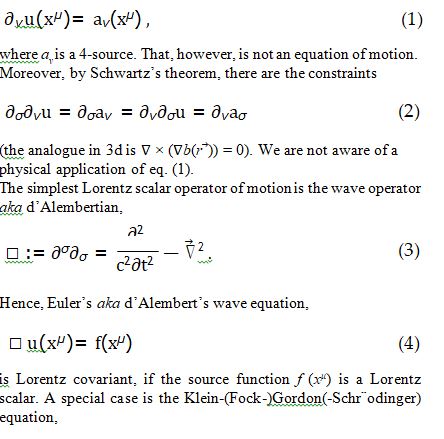
For such a field amplitude, the simplest Lorentz covariant differential equation is
Real-Valued Vector Fields
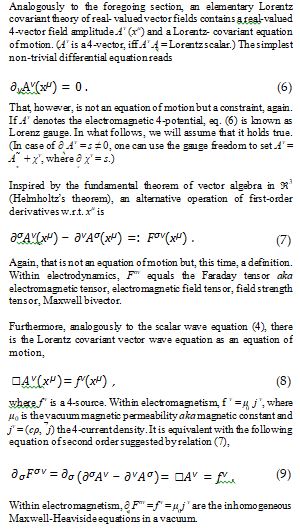
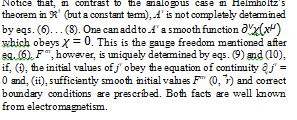
Within electromagnetism, it represents the homogeneous Maxwell- Heaviside equations in a vacuum.
Summary and Conclusions
We have rearranged well-known facts such that the question arises whether, logically, EITHER the Lorentz transformation is a consequence of Maxwell’s theory (historical devel-opment), oR Maxwell equations in a vacuum follow from the restrictions posed by Lorentz covariance as required by Poincar´e’s and Einstein’s special relativity. The simplest way to do so uses the 4-potential Aν = (cΦ, Aâ?? ). The scalar Φ and vector Aâ?? potentials enter Maxwell’s original equations but not the ‘rationalized’ Maxwell- Heaviside equations nowadays taught as “Maxwell equations”. Because the Lorentz transformation can be derived independently of electromagnetism, that reasoning suggests to logically consider the Lorentz transformation to be primary w.r.t. electromagnetism. The results for the Maxwell-Heaviside equations in a vacuum cum grano salis apply to Heaviside’s gravito electromagnetic equations as well.
On the other hand, the structure of Maxwell’s equations in a vacuum can be derived from the continuity equation (see Appendix A). This suggest Maxwell’s equations in a vacuum to be primary against the Lorentz transformation.
Therefore, logically, the Lorentz transformation and Maxwell’s theory should be treated on equal footing.
Measuring the forces between spherical charges (Coulomb) and thin parallel conductors (Amp`ere), respectively, as a function of their distances, it follows that there is a universal constant of dimension velocity. However, this gives not any hint to the fact that that velocity equals the speed of a wave of electric and magnetic fields, nor that light is an electromagnetic wave.
These investigations have been performed in the spirit of Heinrich Hertz’s program, viz., to represent classical mechanics such that all other branches of physics can be derived from it. It is powerful in its concreteness of approach. And it is limited by the fact that one arrives at new relationships, the physical meaning of which is unclear. However, to our knowledge, there is none generalization of an existing theory which does better.
Acknowledgments
This text is a spin-off of explorations on the foundations of the Lorentz transformation done during the guest-professorship of one of us (P.E.) at the Altynsarin Pedagogical Institute in Arkalyk, Kazakhstan. I feel deeply indebted for the hospitality and support over there, in particular, to the then rector Yerzhan Amirbekuly
the then head of the international office Zhanar Bayseitovna Bayseitova, and the colleagues of the chair of mathematics, physics, and informatics.
Appendix
Appendix A: Derivation of the structure of Maxwell’s Equations in a Vacuum from the Continuity Equation
Following Mie’s textbook, one can proceed as follows (recall that all functions are assumed to be sufficiently smooth) [1]. The continuity equation reads (actually, ρ and jâ?? are the free charge and current densities)
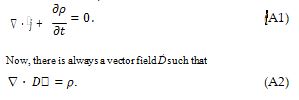
This corresponds to Gauss’ law.
Further, inserting Gauss’ law (A2) into the continuity equation (A1) yields, using Schwartz’s theorem,
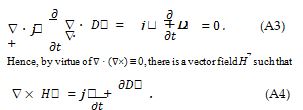
This corresponds to Maxwell’s flux law. Of course, the physical content of the equations does not follow from such kind of derivation. The same holds true for eq. (5), the structure of which follows from setting u ∝ f in the wave equation (4). Similarly, all derivations of the Lorentz transformation not using light imply a characteristic velocity, the value of which can be determined only through experiments or the connection with other theories, notably the Lorentz force.
References
1. G. Mie, Lehrbuch der Elektrizit¨at und des Magnetismus: Eine Experimentalphysik des Welt¨athers fu¨r Physiker, Chemiker und Elektrotechniker, Stuttgart: Enke 31948.