

Open Access Journal of Applied Science and Technology(OAJAST)
ISSN: 2993-5377 | DOI: 10.33140/OAJAST
Impact Factor: 1.08


Research Article - (2026) Volume 4, Issue 2
Machine Shape and Hierarchical Blocking: A Mathematics of Arrays Formalization, with an Open Problem in Hierarchical Shape Occupancy

Received Date: Jul 10, 2026 / Accepted Date: Aug 20, 2026 / Published Date: Aug 26, 2026
Copyright: ©2026 Lenore M. Mullin. This is an open-access article distributed under the terms of the Creative Commons Attribution License, which permits unrestricted use, distribution, and reproduction in any medium, provided the original author and source are credited.
Citation: Mullin, L. M. (2026). Machine Shape and Hierarchical Blocking: A Mathematics of Arrays Formalization, with an Open Problem in Hierarchical Shape Occupancy. OA J Applied Sci Technol, 4(2), 01-10.
Abstract
A companion empirical study found that dense matrix multiplication block sizes calibrated on Apple M1 Pro correspond to two cache-fit formulas that mispredict badly on a different chip’s known cache sizes. This paper formalizes the question that finding raises. We extend the Mathematics of Arrays (MoA) framework’s array-shape derivation operator to a new operator that derives a hierarchical, multi-level blocking and prefetch schedule from a machine’s shape: an ordered sequence of cache-level capacities, bandwidths, and occupancy fractions. This operator recovers the calibrated values on every one of three real machines tested to date as a special case, reducing each machine’s unknowns to a small number of level-specific occupancy fractions. We then state precisely, without claiming to resolve, the paper’s central open problem: whether those fractions are derivable from more primitive properties – co-tenancy, private- cache-level count, associativity, prefetcher behavior – or are fundamentally per-architecture constants. Four falsifiable hypotheses are stated and tested against real hardware, with mixed results. We further state two limits of the framework explicitly: it requires dedicated, non-virtualized hardware access to be well-defined at all, and it extends only partway to a distributed-memory network, where realizing a tile across nodes requires a separate choice of communication algorithm the framework does not itself make. A first, honest attempt at extending the framework toward predicting throughput directly, not just block size, closes the paper: two terms prove derivable from a specification sheet, one requires a single measurement, and one – tested across three machines – does not yet transfer between them.
Introduction
Mathematics of Arrays (MoA) derives, for an array computation, a memory-optimal realization by recursion on the array’s shape ρA: A Denotational Normal Form (DNF) specifying what is computed is transformed by an operator γ into an Operational Normal Form (ONF) specifying how it is realized, with the derivation governed entirely by shape, prior to any commitment to a target architecture [1-3]. This has produced measured performance gains for dense matrix multiplication on CPU architectures and, via the same block-derived approach compiled to OpenACC, on GPU architectures [2,4-6].
A companion empirical study calibrated block sizes MC and NC for a GEBP-style dense matrix multiplication kernel on Apple M1 Pro, and reported, as a retrospective check on newly collected AWS Graviton4 data, that the calibrated values correspond exactly to two cache-fit formulas: MC fills the M1 Pro’s 128 KB private L1 at full occupancy, and NC occupies exactly 1/6 of its 24 MB shared L2 [4]. Applying the same two formulas to Graviton4’s documented cache sizes predicted values 6–16 times larger than what that machine’s own calibration sweep found. This is the specific empirical fact this paper takes as its starting point: a formula that correctly explained one machine’s calibrated values failed to predict another’s.
That failure is more useful than a simple confirmation would have been, because it isolates exactly what is and is not yet understood. The form of the relationship – block size determined by cache capacity, bandwidth, and some occupancy fraction – transferred correctly in spirit: a hierarchical version of the same reasoning, developed in a companion section of the empirical study, correctly reproduced the form of a GPU tile-size conjecture independently derived for a modern NVIDIA data-center GPU [4]. What did not transfer was the specific numerical occupancy fraction. This paper’s contribution is to state that distinction formally, as a property of a general derivation operator, and to pose the resulting open problem precisely enough to be tested rather than merely discussed.
Background: MoAs Existing Derivation Operator
For dense matrix multiplication C = AB, MoA’s DNF accumulates each row of C from one scalar of A at a time, extended by multiplication over a full, contiguous row of B, and contracted by the reduction operator +red over the shared dimension. This access pattern – scalar times contiguous row, accumulated, never accessing either operand by column – is derived directly from the algebra of the reduction, independent of any target machine [4]. Blocking is not a departure from this derivation but its self-similar extension one level up: partitioning A, B, and C into s × s blocks reshapes the DNF so that an s × s block plays exactly the role a scalar played in the unblocked form, and a row of blocks plays the role a row played – the same equations, re-applied at coarser granularity, because MoA algorithms are derived by primitive recursion on shape and blocking is that recursion viewed at one further level of coarseness.
What this self-similar form does not by itself specify is how coarse: at what size s the recursion should stop peeling off further levels and simply compute. That choice is conventionally made by an implementation-specific tuning process – the classical GEBP cache-budget formula, and the fixedNC sweep that corrected it in, are both, in this sense, attempts to answer a question MoA’s existing shape-recursion does not itself pose: not “what is the shape of the array,” but “what is the shape of the machine the array’s realization is being derived for” [4].
The Machine Shape ρM and the Derivation Operator Γ
We propose treating a memory hierarchy as a shape in exactly the sense MoA already gives that word for arrays, and deriving a hierarchical blocking and prefetch schedule from it by an operator that plays the same role for ρM that γ already plays for ρA.
Definition: Machine Shape
Let a machine’s memory hierarchy be described by an ordered sequence, outermost level first (DRAM or HBM) to innermost (registers):

where Ci is the capacity of level i, Bi is the bandwidth into level i from level i + 1 (the level below it, i.e., the level being fetched from), and σi ∈ (0,1] is an occupancy fraction: how much of Ci is available to a single tile once co-resident data, associativity limits, and other concurrently active structures are accounted for. This is deliberately the same kind of object MoA’s ρA already is for an array – an ordered sequence of sizes – applied to the machine rather than the data.
Definition: The Derivation Operator Γ
Let D be a DNF (e.g., the matrix multiplication DNF of Section 2). Define Γ(D,ρM) recursively on ρM:
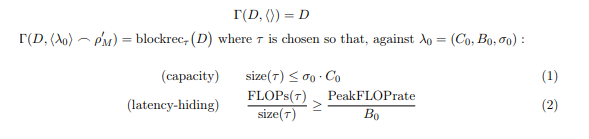
and blockrecτ(D) is the self-similar block-recursive form of Section 2 at tile shape τ, with each tile’s own sub-computation given recursively by Γ(Dτ,ρ′M) – Γ peeling one level off ρM exactly as it peels one level of blocking off D, terminating when ρM is exhausted (Equation 1 is not applicable at the register level, which has no level below it to bound occupancy against; Γ’s base case is simply the register-resident micro-kernel).
Equation 1 is the familiar cache-fit condition. Equation 2 is stated less often but is not optional: it is a level-local restatement of the roofline ridge point, and it is what makes the resulting prefetch policy fall out of the derivation rather than requiring separate justification. If τ satisfies Equation 2, computing on the resident tile is guaranteed to take at least as long as fetching the next tile of the same shape from level i + 1 would take – so double-buffered prefetch, issued asynchronously at the start of each tile’s computation, is guaranteed to be hidden rather than merely attempted. Where Equation 1’s upper bound on τ falls below Equation 2’s lower bound, no tile shape satisfies both, and that level is bandwidth-bound as a property of the architecture, not a symptom of insufficient tuning.
A Precondition: ρM Requires Dedicated Access
Everything above rests on one assumption not yet stated explicitly: that ρM – a machine’s cache capacities and bandwidths – is a fixed, deterministic property of the hardware, knowable in advance from its specifications. On dedicated hardware with exclusive allocation (a SLURM-scheduled HPC node, for instance), this holds exactly: the allocated cores, cache, and bandwidth belong to one job for its duration, with no mechanism for external interference, so ρM is a single, well-defined object matching the datasheet.
On a virtualized, multi-tenant platform, this assumption does not merely become harder to satisfy – it is not clearly well-defined at all. The nominal shape (advertised vCPU count, peak bandwidth) remains fixed on paper, but the achieved cache and bandwidth available to a workload at any given moment depends on co-tenant activity elsewhere on the same physical die, invisible and unpredictable from inside the instance. A companion empirical study observed exactly this on a virtualized cloud instance: a calibration sweep repeated with identical parameters showed one run systematically ∼10% below two later runs, across every configuration tested, not merely at the reported optimum – consistent with a node-wide effect rather than per-measurement noise.
A direct, matched comparison against dedicated hardware under identical conditions has since been completed, and the result is more precise than, and in one respect contrary to, what the virtualization argument alone would predict. An identical configuration run twice, back-to-back, on dedicated Delta hardware showed a mean absolute difference of 15% between the two runs – larger than the virtualized platform’s observed ∼10% shift, not smaller. Simple magnitude, then, does not distinguish dedicated from virtualized access; the earlier claim, stated only in terms of how much variance to expect, is corrected by this result rather than confirmed by it. What does distinguish the two platforms is the shape of the variance, not its size: the virtualized platform’s discrepancy was one-directional, the same run measuring lower at every single configuration tested, the signature of one external cause acting uniformly. Delta’s two runs disagreed on which run was higher at different configurations (higher in one run at 17 of 25 points tested, higher in the other at the remaining 8, with individual swings up to ±29%, larger than any single point on the virtualized platform) – the signature of scattered, uncorrelated noise from several smaller sources rather than one dominant cause. A single systematic shift is mechanistically consistent with shared-die contention specifically; scattered, bidirectional noise of comparable or greater magnitude is not evidence against dedicated access being well-behaved, but it is evidence that exclusive allocation does not, by itself, eliminate run-to-run variation – only its systematic, one-directional form.
The practical consequence is not that Γ cannot be applied to virtualized platforms, but that doing so requires treating ρM itself as uncertain in a specific, identifiable way – a systematic offset, not merely elevated noise – rather than uncertain in the same generic sense dedicated hardware’s own ordinary variance already is. Predictions derived from a virtualized platform’s nominal specifications should be read with this in mind: a single measurement disagreeing with a prediction is now weaker evidence against Γ than the same disagreement on dedicated hardware would be, since a one-off systematic shift, not scattered noise, is the specific, already-observed failure mode on that class of platform; repeated measurements agreeing with each other despite this risk remain the stronger standard of evidence either way.
A Corollary: Predictable Correlation Across Dedicated, Architecturally Diverse Machines
Section 3.3 states what dedicated access guarantees for a single machine: a fixed, well-defined ρM. A stronger claim follows from it, worth stating explicitly rather than leaving implicit in the accumulated results: on dedicated hardware, Γ’s predicted parameters and a machine’s known capacities and bandwidths should stand in a predictable, derivable relationship regardless of the specific architecture measured – CPU or GPU, one vendor or another – provided ρM is accurately characterized for that architecture’s actual memory hierarchy. This is a claim about correlation holding across architecturally diverse dedicated machines, not merely within one. Delta already provides one confirmed instance: MC = 256, derived from its real 512 KB L2 with no free parameters fit after the fact, beat the M1-Pro-inherited MC = 64 by 30–59% at every size tested (Section 4). That result alone establishes the claim for one architecture. The pending A100 prediction from this paper’s companion empirical study (TILE_SIZE≈72, derived from A100’s own 164 KB shared-memory-per-SM figure) is the next, architecturally distinct test of the same corollary: a CPU result and a GPU result, both dedicated, both derived from the identical formula applied to each machine’s own real, independently confirmed capacity. Agreement on both would be evidence the correlation genuinely tracks known hardware sizes and speeds across architecture families, not something specific to cache-based CPU designs; agreement on Delta’s CPU result without a corresponding A100 GPU result would narrow the corollary’s scope to architectures sharing Delta’s specific memory model, still a meaningful but more limited finding.
Recovering Known Results
Γ is only useful if it reproduces what direct calibration already found, on every machine measured to date, as a special case rather than a coincidence restricted to the machine it was reverse-engineered from.

The first two rows are not independent confirmations – they are the values Γ’s occupancy fractions were set to reproduce, stated here only to confirm the recursive machinery of Section 3 outputs them correctly given those occupancy fractions. The third row is the paper’s motivating failure, restated in this notation: Γ applied with M1-Pro-calibrated occupancy fractions transferred to Graviton4’s known capacities overpredicts by 6×. The fourth row states a prediction not yet tested against measurement: a generic double-buffering argument (σ = 1/2, motivated by needing room for both the current and next tile simultaneously, not reverse-engineered from any prior GPU measurement) applied to A100’s real, independently confirmed 164 KB shared-memory-per-SM figure predicts TILE_SIZE=72. This prediction is stated here before the corresponding measurement is available, in keeping with the standard the rest of this table and its companion empirical study hold themselves to.
The Open Problem: Is σi Derivable, or Calibrated?
Section 4 isolates the paper’s actual unresolved question precisely: Γ’s recursive structure and its two governing conditions (Equations 1 and 2) are not in dispute by the evidence gathered so far, but σi is a free parameter in that structure, and only one of the four rows in Table 1 used a σi that was not fit to a specific machine after the fact – and that one row is still pending confirmation. We state four candidate hypotheses for what determines σi, each falsifiable independently, rather than treating the question as open in only a vague sense.
H1: Universal Constant: σi takes a fixed value for all private levels and a fixed (possibly different) value for all shared levels, independent of architecture. This is already falsified by the Graviton4 result in Table 1’s third row: the same shared-level σ = 1/6 that held for the M1 Pro’s L2 overpredicted Graviton4’s NC by 6×.
H2: Co-Tenancy-Scaled: For a shared level accessed by P concurrent threads or cores, σi ∝ 1/P: the occupancy fraction shrinks in proportion to how many consumers must share the level simultaneously. This is not yet falsified, but is not exactly confirmed either: the M1 Pro’s empirical σ = 1/6 at P = 8 is 1.33× the naive 1/P = 1/8 prediction, close enough to suggest co-tenancy is part of the explanation and far enough from exact agreement to suggest it is not the whole explanation. This statement of H2 is itself ambiguous between two distinct readings, tested separately in Section 5.1: (H2-raw) σ as a direct fraction of the level’s total capacity, or (H2-normalized) σ as a fraction applied after first dividing capacity by P, i.e., against each thread’s fair share of the level rather than the level as a whole. The two readings turned out to give different verdicts on real hardware.
H3: Associativity- or Prefetcher-Dependent: σi depends on properties of the cache implementation not captured by capacity, bandwidth, or thread count alone – set-associativity (which determines how much of a cache’s nominal capacity is practically reachable by a given access pattern before conflict misses appear) or hardware prefetcher aggressiveness (which can partially substitute for cache residency on chips with more capable prefetchers, of which Apple Silicon is a documented example, making a smaller occupancy fraction viable there than capacity arguments alone would suggest). Neither property is reliably published by vendors at the level of detail this hypothesis would need to test directly; testing H3 would require inferring these properties indirectly, from architectures with documented differences along one axis while holding others as fixed as possible.
H4: Private-Level-Count-Dependent: σi for a shared level depends on how many private cache levels sit between a thread and that shared level, independent of co-tenancy. The M1 Pro’s shared L2 is reached through a single private level (L1 only); Delta’s and Graviton4’s shared levels are each reached through two (L1 and a second private level – L2 on both, notably large on Graviton4 at 2 MB). Compared on equal footing – raw σ, not mixing raw and per-thread-normalized readings – the direction is consistent across all three machines measured to date: M1 Pro’s single-private-level σ = 1/6 is roughly 5–10× larger than either two-private-level machine’s (1/36 for Graviton4, 1/64 for Delta). The two two-private-level machines do not match each other exactly – a further ∼2× gap remains between them – so H4 does not explain σ completely on its own, but the qualitative pattern (more private absorption before the shared level, smaller occupancy fraction needed there) holds directionally across every machine tested so far, not merely the two that motivated H2’s normalized reading. H4 and H2 are not competing explanations so much as different axes of the same underlying question; a machine with matched private-level count but different co-tenancy, or matched co-tenancy but different private-level count, would be needed to cleanly separate them.
A Specific, Falsifiable Experiment
Delta CPU’s per-CCD structure (Section 4’s source study; 8 cores sharing a 32 MB L3 slice) makes a controlled test of H2 directly available: restricting the fixed-NC sweep to exactly one CCD (8 threads, pinned via taskset to CPUs sharing a single L3 group, confirmed via lscpu -e) and sweeping NC against that CCD’s 32 MB L3 reproduces the M1 Pro’s P = 8 co-tenancy count on a different chip, cache capacity, and microarchitecture entirely.
This experiment has since been run. Pinned to one CCD, at the corrected MC = 256 (Section 4), the empirical optimum is NC = 256, decisively and consistently across all four matrix sizes tested (4–11% ahead of the next-best value at every size, a substantially cleaner signal than any unpinned sweep produced). The two readings of H2 give sharply different verdicts on this result:
• H2-raw is falsified. σ = (NC · KC · 8 bytes)/32MB = 1/64, a 10.7× mismatch against the M1 Pro’s 1/6, despite P = 8 matching exactly on both machines. Co-tenancy count alone, applied as a direct fraction of total capacity, does not determine σ.
• H2-normalized survives. Dividing the CCD’s 32 MB by P = 8 first (each thread’s nominal fair share, 4 MB) and computing σ against that share instead gives σ′ = 1/8 – 0.75× the M1 Pro’s 1/6, the same rough magnitude of discrepancy the M1 Pro’s own empirical value already showed against naive 1/P before this experiment was run. Co-tenancy, correctly normalized, is not falsified by this result.
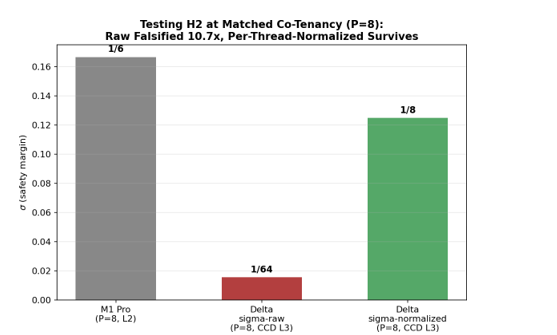
Figure 1: The Two Readings of H2, Tested at Matched Co-Tenancy (P=8) on Delta Against the M1 Pro’s Own Value. The Raw Reading (red) is Off by An Order of Magnitude; The Per-Thread-Normalized Reading (Green) Lands in the Same Range as the M1 Pro (Gray).
The honest reading is that H2 was underspecified rather than simply right or wrong: the ambiguity between these two formulations was not resolved by the M1 Pro data alone, and this experiment is what distinguishes them. Both readings still leave a residual, unexplained gap (10.7× for the raw form’s failure mode; ∼1.3× for the normalized form’s partial success). H4 (Section 5) accounts for part of this directionally – Delta’s two private levels against the M1 Pro’s one is consistent with Delta’s smaller raw σ – without explaining it completely, since Graviton4, with the same privatelevel count as Delta, does not match Delta’s value either. H3’s candidates – Milan’s L3 associativity, or its prefetcher behavior relative to Apple Silicon’s – remain live for whatever H4 does not account for, rather than co-tenancy or private-level count alone explaining σ completely under any reading tested so far.
From Registers Outward: A More Principled Base Case, and the Limits of Extending to a Network
Section 3 defined Γ recursively from the outermost level (DRAM or HBM) inward, terminating arbitrarily when ρM is exhausted. This section reformulates the same recursion in the opposite direction, shows the reformulation changes the justification without changing any derived value, and uses that clearer justification to state precisely how far the framework extends toward a network level – and exactly where it stops extending cleanly.
Reformulation: Registers as a True Base Case
The register-level tile, MR × NR, is not chosen by any capacity or bandwidth argument – it is fixed by the instruction set architecturevector width and the number of architectural registers available to hold accumulators. Every level outward from it exists, physically, to keep the level just inside it fed continuously, without stalling. Restating Γ in this direction: level 0 (registers) is the unconditioned base case, and for each level i + 1 moving outward, τi+1 is chosen so that (a) it satisfies Equation 1 against λi+1, and (b) the time spent computing on level i’s tiles, drawn from a resident τi+1, is at least the time required to fetch the next τi+1-sized tile from level i+2 – the same arithmetic as Equation 2, now justified as “level i + 1 must not itself stall level i’s consumption” rather than “level i + 1 must fit within an externally imposed budget.”
These two formulations compute identical values: applied to the M1 Pro’s two-level hierarchy, both give MC = 64 and NC = 2048, since the underlying equations are unchanged. What changes is which direction is physically motivated. Outward-in leaves the recursion’s termination – why registers need no governing equation – unexplained except by fiat. Inside-out makes registers a true base case (fixed by the ISA, prior to any capacity or bandwidth reasoning) and makes the prefetch policy of Section 3 a direct consequence of keeping a specific, named consumer fed, rather than an abstract latency-hiding argument stated separately from the capacity condition it accompanies.
Extending Outward: A Network Level, and Where the Extension Stops Being Free
Stated inside-out, the natural question is how far the recursion extends past DRAM. Treating a distributed-memory network as one further level, λnet = (Cnet,Bnet,σnet), with DRAM playing the role of “the level being kept fed,” the same two conditions restate without new machinery:

where Cnet is, concretely, local DRAM capacity (reduced to account for whatever else must reside there simultaneously, including the packed buffers for every cache level beneath it), and τnet is how much of the global problem one node holds locally.
This is where the extension stops being free, and stating the limit precisely is more useful than eliding it. Every cache-level transition in Section 3 is point-to-point: level i requests data from level i+1, receives it, and Bi is a fixed physical property of that pair of levels, independent of what algorithm is being executed. Realizing τnet across multiple nodes is not point-to-point in the same sense – it requires an explicit distributed algorithm (SUMMA, Cannon’s algorithm, or a 2.5D variant, among others) specifying which node sends what to whom, and different algorithms realizing the identical τnet achieve different effective bandwidths on the identical physical network, because collective communication patterns (broadcasts, shifts, all-to-all exchanges) have their own, topology-dependent scaling behavior that a single point-to-point Bnet cannot capture. Concretely: Bnet in the equations above is not a fixed hardware constant the way BL1, BL2, and BL3 are – it is a function of which communication algorithm is chosen, and Γ as defined does not choose that algorithm. The capacity and latency-hiding conditions correctly determine how much data a node should hold; they do not, without an additional and separate choice of communication pattern, determine how that data should move between nodes to realize the tiling they prescribe.
A Nearer-Term Test: NUMA as a Miniature Network
A true multi-node cluster is not the only, or the nearest, place this question can be tested. Delta CPU’s dual-socket topology (Section 4’s source study) already contains a smaller version of the same phenomenon: a thread accessing the other socket’s DRAM crosses AMD’s Infinity Fabric, a physically distinct path from local DDR4 channels, with its own bandwidth and latency characteristics. Two sockets are too few to exhibit genuine collective communication – there is only one other node to address, not many – but the core claim of Section 6.2 does not require collectives to be tested: it requires only that achieved bandwidth depend on how data is placed and accessed, not solely on the physical link’s rated capacity.
This experiment has since been run. Thread count was held fixed at 64 throughout, so that only memory placement varied between two conditions, forced via numactl: local (compute and memory both bound to one socket, zero cross-socket traffic by construction) against remote (compute bound to the second socket while memory remains forced to the first, so every single access crosses the socket boundary). Raw STREAM bandwidth differed by under 1% between the two conditions – if bandwidth capacity alone determined achieved performance, cross-socket access would look almost free. The matrix multiplication kernels measured alongside it did not agree: GEBP lost 13.9% and a recursive-classical kernel 15.1% under the remote condition, while an MoA-pipelined kernel lost only 2.4%, a fivefold smaller penalty under the identical remote-memory condition. This is direct, measured evidence for Section 6.2’s claim, not merely smaller-scale support for it: access pattern, not physical bandwidth alone, determines what a level actually delivers, and different kernels computing the identical mathematical result are not equally exposed to that difference. The companion empirical study reports this measurement in full; this section draws the conclusion for the framework specifically that MoA-pipelined’s own access pattern is measurably more resilient to non-local memory access than GEBP’s blocked-and-packed pattern, on this specific hardware – a property neither this paper nor the conjecture it tests predicted in advance, and worth stating plainly as a genuine finding rather than a confirmation of something already expected.
Toward a Predictive Performance Equation
Everything so far predicts parameters – MC, NC, a tile size. This section states, as precisely as the evidence allows, what it would take to predict throughput itself on a machine not yet tested, and reports a first, honest attempt.
The Equation, and Which Terms Are Which
The natural extension of a roofline model, with Γ supplying the blocking rather than leaving it as a free parameter, is
GFLOPS(n, P) = min P · achieved(1) · η(P), AI(MC, KC, NC) · Braw · ρaccess(kernel)
with (MC,KC,NC) given by Γ(ρM), not fit to this equation separately. Each remaining term falls into one of three categories, worth distinguishing sharply rather than treating the equation as uniformly known or uniformly speculative:
• Derivable from a specification sheet, no measurement required: MC, NC (Section 3), and AI(MC,KC,NC), the standard arithmetic-intensity formula for a blocked GEBP-style kernel.
• Requires exactly one real measurement, not derivable from a spec sheet: achieved(1), single-thread throughput on the actual compiled binary. An early attempt at this equation used each machine’s theoretical peak FLOP rate (vector width times clock) in place of a measured baseline, and overshot Delta’s own measured P = 8 throughput by 6.6× – not because parallel efficiency is that poor, but because theoretical peak assumes vectorization no plain, portably-compiled C code achieves. η(P) computed against a measured baseline recovers exactly the values already reported for Delta’s own contention sweep in the companion empirical study [5]; computed against theoretical peak, it silently absorbs a confound that has nothing to do with parallelism. The corrected equation requires the real measurement precisely because skipping it produces a number that is wrong for a specific, identified reason, not merely imprecise. • Not yet reducible to a formula at all, only to discrete measured points: η(P) itself, and ρaccess.
Testing Transferability: Does η(P) Have One Shape?
The most useful question about η(P) is not its value on any one machine but whether its shape, once normalized against each machine’s own single-thread baseline, is shared across machines – which would make it a transferable term rather than one requiring fresh calibration every time. This is directly testable with data already in hand: identical calibration sweeps exist for M1 Pro, Graviton4, and Delta, all at P = 1,2,4,8, all normalizable the same way.
It does not collapse to one curve. Delta stays markedly closer to ideal (η(8) = 0.744) than M1 Pro (0.473) or Graviton4 (0.540), which more closely track each other. This is a real, quantified answer, not an absence of one: η(P) requires genuine per-machine calibration under current understanding, and the equation above cannot be applied to an untested machine using another machine’s η(P) values, even a topologically similar one. A tempting explanation – that η(P)’s decline tracks shared cache size per core – does not hold up against just these three points: Graviton4’s shared L2 (36 MB) is larger than M1 Pro’s (24 MB) yet shows a similar decline, not a shallower one. Three machines is not enough to identify what does drive the difference; it is enough to rule out the first, simplest guess.
A Sharper Comparison: Efficiency at Each Machine’s Own Full Utilization
Comparing η(P) at a fixed P = 8 across machines, as above, compares quantities that mean different things per machine: P = 8 is the entire M1 Pro and the entire Graviton4 instance, but one-sixteenth of Delta’s 128-core node. A more meaningful comparison holds not P fixed but the fraction of each machine’s own total capacity fixed, comparing every machine at its own Pmax:


Figure 2: η(P) Computed Identically (Measured Throughput, Normalized to Each Machine’s Own P=1 Baseline) for all Three Platforms Tested to Date.
|
Machine |
Pmax |
η(Pmax) |
|
M1 Pro |
8 |
0.473 |
|
Graviton4 |
8 |
0.540 |
|
Delta |
128 |
0.150 |
This reverses the ordering the fixed-P = 8 comparison gave in Section 7.2, where Delta appeared to scale best. Using the entirety of a 128-core node costs substantially more relative efficiency than using the entirety of an 8-core one – a result that aligns with, rather than against, the original conjecture’s underlying concern that higher core counts would show more pronounced overhead, even though the specific mechanism predicted (fork/join cost scaling with thread count within a fixed core budget) is not the same claim as this one (efficiency measured against each machine’s own ceiling). The two fixed-P and full-utilization comparisons are not in conflict; they answer different questions, and neither alone is sufficient to characterize η across machines of different scale.
What This Section Does and Does Not Establish
This is not a working predictive model for an arbitrary new machine. It is a precise accounting of what such a model would require: two terms derivable today from nothing but a specification sheet, one term requiring a single cheap measurement rather than a full experimental campaign, and one term – the one this section spent most of its effort on – shown, honestly, not to transfer between machines under the simplest hypothesis tested. Stating this precisely is more useful than either overclaiming a general formula or abandoning the attempt: the next machine tested will extend η(P) from three points to four, and either begin to suggest what actually governs it, or rule out a second hypothesis the way shared-cache-size-per-core was just ruled out.
Conclusion
This paper formalized a question the companion empirical study raised but did not itself resolve: whether known memory-hierarchy sizes can predetermine blocking and prefetching, or only after empirical calibration. The answer, made precise rather than left as a general impression, is split cleanly by the formalization itself. The recursive structure – Γ, derived from a machine shape ρM the same way MoA’s existing γ is derived from an array shape ρA, governed by a capacity condition and a latency-hiding condition applied once per level – appears to transfer correctly across every architecture examined so far, with one prediction pending confirmation: a double-buffered tile bound whose occupancy fraction was derived from architecture-independent reasoning rather than another machine’s fitted value, stated before measurement in the same spirit as every other conjecture in this paper. Restating the same recursion inside-out, from a register-level base case fixed by the instruction set architecture rather than an arbitrary termination, changes no derived value but makes precise exactly how far this reasoning extends: cleanly through every cache level, and only partway to a distributed-memory network, where the equations correctly determine how much data a node should hold but not, without an additional and separate choice of communication algorithm, how that data should move between nodes to realize it – a genuine limit of the framework, stated as such rather than elided. A smaller-scale test of the same underlying claim, run on Delta’s own dualsocket topology rather than requiring a multi-node cluster, confirmed it directly: holding thread count fixed and varying only memory placement, kernels computing the identical mathematical result were not equally exposed to non-local memory access, a fivefold difference in penalty between two kernels under the identical physical condition. The occupancy fractions σi do not transfer across architectures in their naive form: a co-tenancy-matched experiment on real Delta hardware falsified the direct reading of the leading hypothesis decisively, while the same hypothesis, correctly normalized per thread rather than against total capacity, survived with a residual gap comparable to what motivated it on the M1 Pro in the first place. This is not a full resolution – associativity and prefetcher-dependence remain live candidates for that residual gap – but it is a real result rather than a stated intention: the ambiguity between two readings of the same hypothesis was not resolvable from the M1 Pro’s data alone, and required a second, sufficiently different machine to expose. A further corollary follows from the dedicated-access precondition stated alongside Γ’s definition: on hardware where ρM is genuinely well-defined, the correlation between known sizes and speeds and Γ’s predicted parameters should hold across architecturally distinct machines, not merely within one. Delta’s confirmed MC result establishes this for one architecture; a pending, identically derived prediction on A100 – a genuinely different architecture sharing only the property of dedicated access – is the next test of whether that correlation is a property of cache-based design in general or was specific to the CPU architectures examined so far.
Acknowledgement
This work used Delta at the National Center for Supercomputing Applications and Anvil at Purdue University through allocations bibg-delta-cpu and CIS261396 from the Advanced Cyberinfrastructure Coordination Ecosystem: Services & Support (ACCESS) program, which is supported by National Science Foundation grants #2138259, #2138286, #2138307, #2137603, and #2138296 [1]. The Delta advanced computing resource is a collaborative effort between the University of Illinois Urbana-Champaign and its National Center for Supercomputing Applications, supported by the National Science Foundation (award OAC 2005572) and the State of Illinois. Anvil is funded under National Science Foundation award No. 2005632.References
- Boerner, T. J., Deems, S., Furlani, T. R., Knuth, S. L., & Towns, J. (2023). Access: Advancing innovation: Nsf’s advanced cyberinfrastructure coordination ecosystem: Services & support. In Practice and experience in advanced research computing 2023: Computing for the common good (pp. 173-176).
- Goto, K., & Geijn, R. A. V. D. (2008). Anatomy of high-performance matrix multiplication. ACM Transactions on Mathematical Software (TOMS), 34(3), 1-25.
- Mullin, L. M. R. (1988). A mathematics of arrays. Syracuse University.
- Mullin, L. M. (2026). Mathematics of arrays for high-performance dense matrix multiplication: An experimental comparison of blocking and strassen using roofline analysis. Submitted to ACM Transactions on Mathematical Software.
- Mullin, L. M. (2026). Testing the EPYC Conjecture on Real Hardware: MoA-Guided Dense Matrix Multiplication on NCSA Delta (AMD EPYC 7763 Milan). arXiv preprint arXiv:2608.11533. Companion empirical results paper, 2026.
- Mullin, L. M. (2023). From array algebra to energy efficiency on GPUs: Data and hardware shapes with dimension-lifting to optimize memory-processor layouts. arXiv preprint arXiv:2306.11148.