



Research Article - (2026) Volume 9, Issue 2
Limitations of Generative AI for Numerical Aggregation of Apple Health Step Count Data: A Validation Study Using XML Records, Manual Calculation, and Health Auto Export
 and Kenichi Yamamura 1,2 *
 2Transgenic Group, Inc., Fukuoka, Japan
Received Date: May 11, 2026 / Accepted Date: Jun 05, 2026 / Published Date: Jun 16, 2026
Copyright: ©2026 Kenichi Yamamura, et al. This is an open-access article distributed under the terms of the Creative Commons Attribution License, which permits unrestricted use, distribution, and reproduction in any medium, provided the original author and source are credited.
Citation: Li, Z., Yamamura, K. (2026). Limitations of Generative AI for Numerical Aggregation of Apple Health Step Count Data: A Validation Study Using XML Records, Manual Calculation, and Health Auto Export. Adv Neur Sci, 9(2), 01-07.
Abstract
Background: Generative artificial intelligence (AI) tools are increasingly used to assist data handling and research workflows. However, their reliability for numerical aggregation of raw health data has not been fully validated. Objective: This study examined whether generative AI could accurately aggregate Apple Health step count data from original XML records and compared the results with manual calculation and Health Auto Export.
Methods: Step count records were extracted from Apple Health XML data. The original data consisted of multiple measurement records per day. Daily step counts were calculated using four approaches: two independent aggregations using Apple Intelligence plus ChatGPT, Health Auto Export, and manual calculation in Excel from the original XML- derived records. Daily totals and weekly summaries were compared across methods.
Results: The two AI-based aggregations produced different daily and total step counts and did not agree with either Health Auto Export or manual calculation. In contrast, Health Auto Export and manual Excel calculation showed complete agreement for all daily step counts examined. The initial AI-based analysis also incorrectly treated the data as steps per measurement rather than steps per day.
Conclusion: Generative AI was unreliable for primary numerical aggregation of Apple Health step count data, even for simple summation tasks. Health Auto Export, validated against manual calculation, provided reproducible daily step count data suitable for subsequent analysis. Generative AI may be useful for research planning, interpretation, and manuscript preparation, but raw data extraction, numerical aggregation, and statistical calculation should be performed using reproducible computational tools.
Keywords
Generative Artificial Intelligence, ChatGPT, Apple Health, Health Auto Export, Step Count, Wearable Devices, Data Validation, Numerical Aggregation
Introduction
Wearable devices and smartphones provide continuous or semi-continuous health-related data that may be useful for longitudinal assessment of disease progression, daily activity, and treatment response [1-6]. Apple Health data, including step count and gait-related metrics, can be exported as original XML records, and HealthKit provides a centralized framework for health and fitness data collected from iPhone, Apple Watch, and related applications [7,8]. Recent work has also used Apple HealthKit-derived digital phenotyping to identify pharmacological interference in Parkinsonian gait, highlighting the practical value of smartphone-derived health data in clinical research [1]. At the same time, generative artificial intelligence (AI) tools, including ChatGPT-based systems, are increasingly used in research workflows [2]. These tools are useful for summarizing information, organizing methods, drafting manuscripts, and interpreting results. However, their reliability for numerical data extraction and aggregation remains uncertain, particularly because recent studies have shown that large language models can make arithmetic and numerical reasoning errors under certain conditions [3].
This issue is particularly important when dealing with health data. Even apparently simple tasks, such as summing step count records by date, require accurate identification of relevant records, correct grouping by day, and complete aggregation of all values. Errors at this stage directly affect downstream analyses and conclusions. The present study was prompted by discrepancies in initial step count analyses. The original Apple Health XML data consisted of measurement-level records rather than daily totals. Therefore, a validation analysis was performed to determine whether AI-based aggregation could accurately reproduce daily step counts. AI-based results were compared with Health Auto Export and manual calculation from XML-derived records.
Methods
Data Source
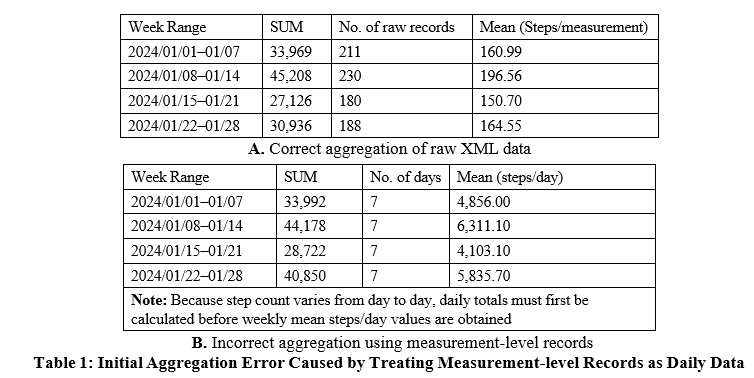
Step count data were obtained from Apple Health XML export files. The XML export did not provide one daily step-count value. Instead, each record represented a measurement-level event and included the record type, source name, device information, unit, creation date, start date, end date, and value. Because several records could occur within the same day, daily totals first had to be calculated by summing all values with the same calendar date before weekly mean steps/day values could be derived for analysis (Table 1). The structure of the original XML records and their conversion into an Excel-based measurement-level table are shown in Table 2. Briefly, the XML text was opened in a text editor, copied into Excel, and separated into columns. Nonessential fields were removed, leaving date, start time, end time, and step-count value, daily totals were then calculated from this measurement-level table.
Step 1. Export the XML file from iPhone.
Step 2. Open the XML file in TextEdit. Each step-count record is displayed as shown below:
sourceName="iPhone 15 plus ky"
sourceVersion="17.1.2"
device="<
hardware:iPhone15,5, software:17.1.2,
creation date:2023-12-03 00:49:48 +0000>" unit="count"
creationDate="2024-01-01 08:35:59 +0900"
startDate="2024-01-01 08:25:49 +0900"
endDate="2024-01-01 08:25:54 +0900"
value="11"/>
|
|
type= |
HKQuantityTypeIdentifierStepCount |
sourceName= |
iPhone |
15plus |
ky |
sourceVersion= |
17.1.2 |
device= |
|
|
type= |
HKQuantityTypeIdentifierStepCount |
sourceName= |
iPhone |
15plus |
ky |
sourceVersion= |
17.1.2 |
device= |
|
|
type= |
HKQuantityTypeIdentifierStepCount |
sourceName= |
iPhone |
15plus |
ky |
sourceVersion= |
17.1.2 |
device= |
|
|
type= |
HKQuantityTypeIdentifierStepCount |
sourceName= |
iPhone |
15plus |
ky |
sourceVersion= |
17.1.2 |
device= |
|
|
type= |
HKQuantityTypeIdentifierStepCount |
sourceName= |
iPhone |
15plus |
ky |
sourceVersion= |
17.1.2 |
device= |
|
< |
name:iPhone, |
manufacturer:Apple |
Inc., |
model:iPhone, |
hardware:iPhone15,5, |
software:17.1.2, |
creation |
manufacturer:Apple |
|
< |
name:iPhone, |
manufacturer:Apple |
Inc., |
model:iPhone, |
hardware:iPhone15,5, |
software:17.1.2, |
creation |
manufacturer:Apple |
|
< |
name:iPhone, |
manufacturer:Apple |
Inc., |
model:iPhone, |
hardware:iPhone15,5, |
software:17.1.2, |
creation |
manufacturer:Apple |
|
< |
name:iPhone, |
manufacturer:Apple |
Inc., |
model:iPhone, |
hardware:iPhone15,5, |
software:17.1.2, |
creation |
manufacturer:Apple |
|
< |
name:iPhone, |
manufacturer:Apple |
Inc., |
model:iPhone, |
hardware:iPhone15,5, |
software:17.1.2, |
creation |
manufacturer:Apple |
|
Inc., zodel:iPhone, |
hardware:iPhone15,5, |
software:17.1.2, |
creation |
date:2023-12-03 |
0:49:48 |
+0000> |
unit= |
count |
creationDate= |
|
Inc., model:iPhone, |
hardware:iPhone15,5, |
software:17.1.2, |
creation |
date:2023-12-03 |
0:49:48 |
+0000> |
unit= |
count |
creationDate= |
|
Inc., model:iPhone, |
hardware:iPhone15,5, |
software:17.1.2, |
creation |
date:2023-12-03 |
0:49:48 |
+0000> |
unit= |
count |
creationDate= |
|
Inc., model:iPhone, |
hardware:iPhone15,5, |
software:17.1.2, |
creation |
date:2023-12-03 |
0:49:48 |
+0000> |
unit= |
count |
creationDate= |
|
Inc., model:iPhone, |
hardware:iPhone15,5, |
software:17.1.2, |
creation |
date:2023-12-03 |
0:49:48 |
+0000> |
unit= |
count |
creationDate= |
|
0xc6a7fed00>, |
startDate= |
2024/1/1 |
8:25:49 |
900 |
endDate= |
2024/1/1 |
8:25:54 |
900 |
value= |
11 |
/> |
|
0xc6a7fed00>, |
startDate= |
2024/1/1 |
8:58:05 |
900 |
endDate= |
2024/1/1 |
8:58:08 |
900 |
value= |
16 |
/> |
|
0xc6a7fed00>, |
startDate= |
2024/1/1 |
9:13:03 |
900 |
endDate= |
2024/1/1 |
9:13:06 |
900 |
value= |
8 |
/> |
|
0xc6a7fed00>, |
startDate= |
2024/1/1 |
9:26:37 |
900 |
endDate= |
2024/1/1 |
9:26:52 |
900 |
value= |
35 |
/> |
|
0xc6a7fed00>, |
startDate= |
2024/1/1 |
10:17:02 |
900 |
endDate= |
2024/1/1 |
10:22:03 |
900 |
value= |
37 |
/> |
Step 4.
After retaining only the required columns, the measurement-level table shown on the left is obtained (January 1 only). This table is the basis for aggregation. Daily totals are then calculated for each date, as shown on the right
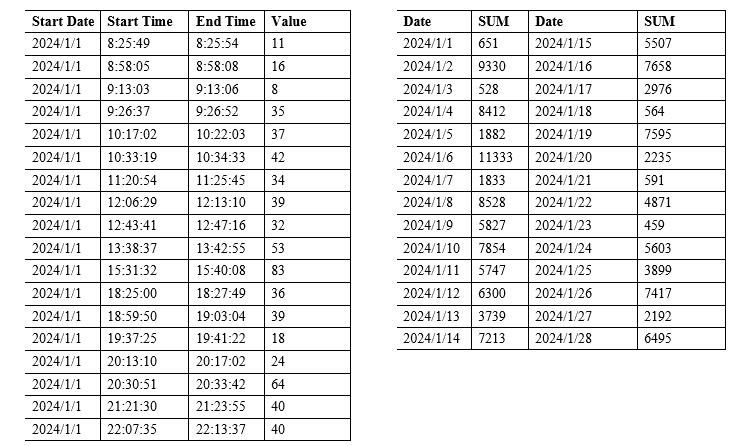
Table 2: Structure of Apple Health XML Records and Conversion into a Measurement-level Excel Table
Aggregation Methods
Daily step count values were calculated using four approaches (Tables 3 and 4):
• First aggregation using Apple Intelligence plus ChatGPT
• Second independent aggregation using Apple Intelligence plus ChatGPT
• Health Auto Export daily step count data. Health Auto Export is a third-party application that exports Apple Health data into structured formats, including daily summary data.
• Manual calculation in Excel from the XML-derived measurement-level records. For the manual calculation, all measurement-level step count values belonging to the same calendar date were summed to obtain the daily step count.
|
Date |
First AI aggregation |
Second AI aggregation |
Health Auto Export |
Manual Excel calculation |
|
2024/1/1 |
628 |
618 |
651 |
651 |
|
2024/1/2 |
8726 |
9176 |
9330 |
9330 |
|
2024/1/3 |
528 |
494 |
528 |
528 |
|
2024/1/4 |
8220 |
7802 |
8412 |
8412 |
|
2024/1/5 |
1828 |
1778 |
1882 |
1882 |
|
2024/1/6 |
11141 |
9760 |
11333 |
11333 |
|
2024/1/7 |
1921 |
1713 |
1833 |
1833 |
|
2024/1/8 |
8412 |
7360 |
8528 |
8528 |
|
2024/1/9 |
7263 |
5801 |
5827 |
5827 |
|
2024/1/10 |
6478 |
7253 |
7854 |
7854 |
|
2024/1/11 |
5589 |
5921 |
5747 |
5747 |
|
2024/1/12 |
5969 |
6240 |
6300 |
6300 |
|
2024/1/13 |
4859 |
3970 |
3739 |
3739 |
|
2024/1/14 |
6610 |
5885 |
7213 |
7213 |
|
2024/1/15 |
5897 |
5374 |
5507 |
5507 |
|
2024/1/16 |
7470 |
6333 |
7658 |
7658 |
|
2024/1/17 |
4087 |
2804 |
2976 |
2976 |
|
2024/1/18 |
688 |
554 |
564 |
564 |
|
2024/1/19 |
7823 |
6890 |
7595 |
7595 |
|
2024/1/20 |
3065 |
2120 |
2235 |
2235 |
|
2024/1/21 |
692 |
563 |
591 |
591 |
|
2024/1/22 |
5381 |
5012 |
4871 |
4871 |
|
2024/1/23 |
520 |
473 |
459 |
459 |
|
2024/1/24 |
7773 |
5355 |
5603 |
5603 |
|
2024/1/25 |
6352 |
4267 |
3899 |
3899 |
|
2024/1/26 |
9500 |
7341 |
7417 |
7417 |
|
2024/1/27 |
2737 |
2122 |
2192 |
2192 |
|
2024/1/28 |
8587 |
6344 |
6495 |
6495 |
|
Total |
148744 |
129323 |
137239 |
137239 |
|
The two Apple Intelligence plus ChatGPT aggregations produced inconsistent results and did not match the Health Auto Export or manual Excel results. Health Auto Export and manual Excel calculation matched exactly. |
||||
Table 3: Comparison of Daily Step Count Totals by Aggregation Method.
|
Week Range |
SUM |
No. of days |
Mean (steps/day) |
|
2024/01/01–01/07 |
33,992 |
7 |
4,856 |
|
2024/01/08–01/14 |
44,178 |
7 |
6,311 |
|
2024/01/15–01/21 |
28,722 |
7 |
4,103 |
|
2024/01/22–01/28 |
40,850 |
7 |
5,835 |
|
Week Range |
SUM |
No. of days |
Mean (steps/day) |
|
2024/01/01–01/07 |
33,492 |
7 |
4,784 |
|
2024/01/08–01/14 |
45,180 |
7 |
6,454 |
|
2024/01/15–01/21 |
28,819 |
7 |
4,117 |
|
2024/01/22–01/28 |
40,850 |
7 |
5,835 |
A. Weekly Summarizes obtained from two independent aggregations using Apple Intelligence plus ChatGPT
|
Week Range |
SUM |
No. of days |
Mean (steps/day) |
|
2024/01/01–01/07 |
33,969 |
7 |
4,852.71 |
|
2024/01/08–01/14 |
45,208 |
7 |
6,458.29 |
|
2024/01/15–01/21 |
27,126 |
7 |
3,875.14 |
|
2024/01/22–01/28 |
30,936 |
7 |
4,419.43 |
|
(1) Manual daily aggregation followed by manual weekly calculation in Excel Week Range |
|||
|
Week Range |
SUM |
No. of days |
Mean (steps/day) |
|
2024/01/01–01/07 |
34,969 |
7 |
4,995.57 |
|
2024/01/08–01/14 |
45,208 |
7 |
6,458.29 |
|
2024/01/15–01/21 |
22,466 |
7 |
3,209.43 |
|
2024/01/22–01/28 |
35,936 |
7 |
5,133.71 |
|
(2) Manual daily aggregation followed by AI-assisted weekly calculation |
|||
B.Comparison of weekly summaries generated from manually curated data
C.. Result (Note):
The two Apple Intelligence plus ChatGPT aggregations produced different weekly summaries, and both differed from the Health Auto Export and manual Excel results. In contrast, Health Auto Export and manual Excel calculation matched exactly.
Weekly Summary
Daily step counts were further summarized into weekly periods. Step count was treated as a descriptive measure of daily walking activity. Because daily step count is strongly influenced by activity opportunity, environmental conditions, rehabilitation days, and daily schedule, standard deviation and statistical significance testing were not applied to step count in the final analysis.
Validation
The daily values obtained by each method were compared. Agreement between methods was evaluated by direct comparison of daily totals and overall totals.
Results
Original Data Structure
The original XML data were not daily summary data. They consisted of multiple measurement-level records for each day (Table 2). Therefore, direct division of weekly total step count by the number of measurement records produced steps per measurement, not steps per day. This was identified as the main methodological error in the initial analysis.
Discrepancy in AI-Based Aggregation
The first and second AI-based aggregations produced different daily values (Table 3). They also differed from both Health Auto Export and manual Excel calculation. This indicated that the AI-based aggregation was not reproducible. For example, daily step counts calculated by AI differed between the first and second attempts, and both differed from the validated values. The total step count for the examined period also differed across AI attempts, whereas Health Auto Export and manual calculation showed identical totals (Table 3).
Agreement Between Health Auto Export and Manual Calculation
Health Auto Export and manual Excel calculation from the XML-derived records showed complete agreement for all examined dates. This confirmed that Health Auto Export accurately reproduced the daily step count values from the original XML records.â?»Therefore, Health Auto Export daily data were considered reliable for subsequent weekly aggregation and descriptive analysis. These findings are summarized in Tables 1-4, which show that the two AI-based aggregations differed from each other and from the validated values, whereas Health Auto Export and manual calculation matched exactly.
Discussion
This study demonstrates a practical limitation of generative AI in numerical aggregation of health data. Although step count aggregation appears to be a simple summation task, AI-based aggregation produced inconsistent and inaccurate results. In contrast, Health Auto Export and manual Excel calculation showed complete agreement. The main reason is that generative AI systems are not designed as deterministic calculation engines. They process text and numbers as language-like tokens and generate plausible outputs based on patterns. When large numbers of records are provided, the model may omit records, duplicate entries, misclassify dates, or produce internally inconsistent results. The resulting values may appear reasonable, but they are not guaranteed to be complete or reproducible. In this study, the problem was not limited to arithmetic. The more important issue was preprocessing. Correct aggregation required identifying all records belonging to each date, extracting the correct value field, summing all values for that date, and distinguishing measurement-level data from daily summary data. An error in any of these steps changes the final daily step count.
The initial analysis also revealed a conceptual problem. Because the original XML data were measurement-level records, dividing weekly total step count by the number of measurement records produced steps per measurement. This is not an appropriate representation of daily physical activity. Step count should be calculated as total steps per day and then summarized descriptively over weekly or monthly periods. These findings do not imply that generative AI is useless in research. Rather, they clarify the appropriate division of labor. Generative AI is highly useful for organizing research questions, identifying methodological problems, drafting manuscript sections, improving clarity of scientific writing, and discussing interpretation. It can also help researchers recognize when the analysis unit is inappropriate, as in the distinction between steps per measurement and steps per day. This interpretation is consistent with current publication guidance, which emphasizes human accountability, transparency, and disclosure when AI-assisted tools are used in scholarly work [4-6].
However, generative AI should not be used as the primary tool for raw data extraction, numerical aggregation, statistical calculation, or final table generation unless the results are independently verified. For these tasks, deterministic and reproducible tools such as Excel, Numbers, R, Python, or validated export software should be used. This distinction is particularly important for medical and health-related research. Numerical errors in primary data aggregation can lead to incorrect conclusions about disease progression, treatment effects, or functional decline. Because AI-generated numerical outputs may look plausible, such errors may not be detected unless compared against reproducible calculation methods. Reporting frameworks for AI-related clinical research also emphasize transparent description of the AI system, its inputs and outputs, human-AI interaction, and error cases [9]. The present validation supports the use of Health Auto Export for daily step count extraction, at least for the examined dataset, because it exactly matched manual calculation from the original XML records. Once validated, such software can reduce the workload of handling large-scale longitudinal health data while maintaining numerical reliability.
Step count itself should also be interpreted cautiously. Unlike gait metrics such as walking speed, step length, double support percentage, or walking asymmetry, step count reflects daily activity volume rather than gait quality. It is influenced by external factors such as weather, appointments, rehabilitation sessions, use of mobility aids, and opportunity to walk. Therefore, in the present analysis, step count was treated as a descriptive activity measure rather than a variable for statistical significance testing. Overall, the present study suggests that generative AI should be used as an intellectual and editorial assistant, not as an unverified numerical data processor. The most efficient and reliable workflow is to use reproducible tools for data extraction and calculation, and to use AI for interpretation, methodological refinement, and manuscript preparation. By combining a concrete error example with a practical validation workflow, the present report may be particularly useful for AI users in health-related research who need to decide which parts of the workflow can be safely assisted by generative AI and which require deterministic validation.
Conclusion
Generative AI produced inconsistent and inaccurate daily step count values when used to aggregate Apple Health XML records. In contrast, Health Auto Export showed complete agreement with manual Excel calculation and was therefore suitable for subsequent analysis. The appropriate role of generative AI in this context is not primary numerical aggregation, but support for study design, interpretation, and scientific writing. For health data analysis, raw data extraction and numerical calculation should be performed using reproducible and independently verifiable methods. Based on these findings, we propose a practical workflow for AI-assisted analysis of wearable-derived health data (Table 5). The key principle is that numerical extraction, aggregation, and statistical calculation should be performed using reproducible tools, whereas generative AI should be used for study planning, interpretation, and manuscript preparation.
|
Step |
Recommended practice |
Rationale |
|
1 |
Export raw or daily health data using a reproducible tool |
Ensures that the same input data can be reanalyzed |
|
2 |
Validate a subset against original records or manual calculation |
Detects extraction or aggregation errors |
|
3 |
Define the correct analytical unit before analysis |
Prevents confusion between measurement-level and daily-level data |
|
4 |
Use deterministic tools for numerical aggregation and statistics |
Avoids non-reproducible AI-generated numerical errors |
|
5 |
Treat generative AI as a support tool for interpretation and writing |
Uses AI where it is strongest while avoiding unsupported numerical processing |
|
6 |
Disclose AI use transparently in the manuscript |
Maintains accountability and publication transparency |
Table 5: Recommended Workflow for AI-Assisted Analysis of Wearable-Derived Health Data
Declaration of Generative AI Use: Generative AI was used to assist with drafting and language editing of this manuscript. Numerical data extraction, validation, and calculation were performed using Health Auto Export and manual Excel calculation, not by generative AI. Final interpretation and responsibility for the manuscript remain with the authors.
Author Contributions: K.Y. conceived the study, interpreted the data, and wrote the manuscript. Z.L. curated the data and contributed to formal analysis. Both authors reviewed and approved the final manuscript.
Funding: This research received no external funding.
Competing Interests: The authors declare no competing interests.
Ethics Approval and Consent to Participate: This study analyzed anonymized self-collected gait data from a single individual. The participant provided informed consent for the use and publication of these data. According to institutional guidelines, analysis of de-identified self-tracked data did not require IRB approval. Consent for Publication: The participant provided consent for publication.
Data Availability: Data are available from the corresponding author upon reasonable request.
References
- Li, Z., & Yamamura, K. (2026). Objective Identification of Pharmacological Interference in Parkinsonian Gait Using Continuous Digital Phenotyping.
- Brown, T., Mann, B., Ryder, N., Subbiah, M., Kaplan, J. D., Dhariwal, P., ... & Amodei, D. (2020). Language models are few-shot learners. Advances in neural information processing systems, 33, 1877-1901.
- Shrestha, S., Kim, M., & Ross, K. (2025). Mathematical reasoning in large language models: Assessing logical and arithmetic errors across wide numerical ranges. arXiv preprint arXiv:2502.08680.
- Zielinski, C., Winker, M., Aggarwal, R., Ferris, L., Heinemann, M., Lapeña, J. F., ... & Habibzadeh, F. (2023). Chatbots, generative AI, and scholarly manuscripts: WAME recommendations on chatbots and generative artificial intelligence in relation to scholarly publications revised May 31, 2023. Philippine Journal of Otolaryngology Head and Neck Surgery, 38(1), 7-7.
- International Committee of Medical Journal Editors. Recommendations for the Conduct, Reporting, Editing, and Publication of Scholarly Work in Medical Journals: Use of Artificial Intelligence by Authors.
- Nature Portfolio. Artificial Intelligence editorial policy.
- Apple Inc. Share your health and fitness data in XML format. Apple Support.
- Apple Inc. HealthKit. Apple Developer Documentation.
- Liu, X., Rivera, S. C., Moher, D., Calvert, M. J., Denniston, A. K., Ashrafian, H., ... & Yau, C. (2020). Reporting guidelines for clinical trial reports for interventions involving artificial intelligence: the CONSORT-AI extension. The Lancet Digital Health, 2(10), e537-e548.