

Archives of Epidemiology & Public Health Research(AEPHR)
ISSN: 2833-4353 | DOI: 10.33140/AEPHR
Impact Factor: 1.98


Review Article - (2026) Volume 5, Issue 2
Lessons Learned: Building the Architecture for a Legionella Impact Spectrum for Malta
 , Liberato Camiller 2 and Lee P. Gary, Jr 3,4 *
 2Department of Statistics & Operations Research, University of Malta, Msida, Malta
3Current Address: Department of Public Health, Faculty of Medicine and Surgery, University of Malta, Msida, Malta
4Current Address: Department of Public Health, Faculty of Medicine and Surgery,, University of Malta, Msida, Malta
Received Date: Jun 01, 2026 / Accepted Date: Jul 24, 2026 / Published Date: Jul 31, 2026
Copyright: ©2026 Lee P. Gary, et al. This is an open-access article distributed under the terms of the Creative Commons Attribution License, which permits unrestricted use, distribution, and reproduction in any medium, provided the original author and source are credited.
Citation: Rahimpour, L., Camilleri, L., Gary Jr., L. P. (2026). Lessons Learned: Building the Architecture for a Legionella Impact Spectrum for Malta. Arch Epidemiol Pub Health Res, 5(2), 01-07.
Abstract
Our study was planned and launched with explicit motivation to identify the triggers that could launch a Legionella Disease outbreak in Malta, enjoying a boon with tourism. The triggers would be used to prepare a first-ever Legionella Impact Spectrum. Our research has generated early surprises, and we share them as Lessons Learned, but not easily.
Our first Lesson Learned was that our work was stymied by missing data in the Maltese Annual Notifiable Infectious Disease Reports (2010-2024), a vital database, essential for surveillance and adequate preparedness. We have undertaken a search to fill the data gaps.
We share our early analysis of Legionnaire cases and deaths in the Maltese Annual Reports for 2010-2024. Our surprise finding is a latent spike in Legionnaire cases for 2023-2024 --and gaps in deaths for the same years. Using data from the Maltese Annual Reports, we can project that the likelihood of someone dying (our Chance of Death) after contracting Legionnaire’s Disease in Malta falls in the range of 3.9% to 12.4%.
Keywords
Legionella Bacteria, Legionnaires’ Disease, Disease Outbreaks, Malta Archipelago, and Legionella Impact Spectrum
Overview
Aim of our research project, as envisioned and launched, was to prepare and to document a first-ever Impact Spectrum (Sources & Consequences) for Legionella Bacteria, specifically designed to assess the public health awareness and preparedness of Malta [1,2]. We were motivated by concern for the adverse impact of Legionella Bacteria on the well-being of the residents due to unfortunate exposure or a sudden disease outbreak [3]. Another dimension of our concern, plus advantage, is strengthening emergency healthcare responsiveness and sustainability for Malta.
Our research project opened with scoping exercises among university faculty and research staff, community health officials, plus local disease experts, to delineate the likely structure and key components of our conceptual Impact Spectrum. This phase continues with an ever-evolving architecture of three (3) interrelated, but different, sources of threats and hazards to format and build a functional impact spectrum, contributing to strengthening surveillance, and to enhancing actionable response decision making with potential disease outbreaks [4]. Next, we expanded our approach to conduct a systematic review of peer literature and data sources to structure and conduct a meta-analysis of likely public health threats and hazards, scouring for historical information on early cases of Legionella Bacteria in Malta [5,6]. The first recorded case and death from Legionella in Malta remain open to our curiosity.
To date, our first findings are quite surprising with an unexpected dearth of peer-published research about potential health threats and hazards, latent and emerging, generated by nasty Legionella Bacteria, specifically for Malta from rogue sources. With curiosity, we extended our search for the neighboring islands, Sicily and Cypress, yielding similar disappointment.
The lack of data from each country is being revisited to add a regional scope to our study.
* Malta is the largest of the Maltese Archipelago, composed of eight islands located in the middle of the Mediterranean Sea. Current estimated population is 551,110 (World Bank Group).
Background
Patiently, perhaps fortuitously, we have acquired access to fourteen (14) years of summary reports describing incidences of infectious diseases (2010-2024) in Malta* Our first SPSS (Statistical Package for Social Sciences) analysis of the annual reports (which cover HIV, Malaria, and Typhoid) has revealed a latent and expanding problematic rise in Legionnaire cases, detailing a troublesome sharp spike of cases of Legionnaires’ Disease during 2023 & 2024. This, with muted caution, could be the precursor of a major outbreak of Legionnaire Diseases for Malta [7].
Our research focused on this spike. A summary of cases and corresponding deaths focused on Legionnaires’ Disease is presented in Table 1, supported graphically by Figure 1.
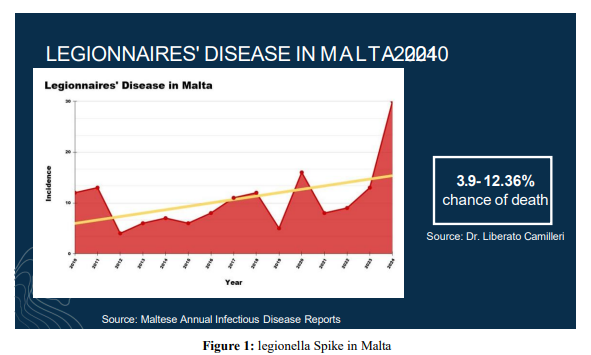
However, to our surprise, deaths for the corresponding cases during 2023 and 2024 are not available from the Maltese Annual Notifiable Infectious Disease Reports. This undermines surveillance and preparedness (8). Similarly, cases and deaths are lagging for 2025 & 2026. Based on our preliminary analysis, using a 95% Confidence Level, we can project that the likelihood of someone in Malta dying after contracting Legionnaire’s Disease falls in the range of 3.9% to 12.4%.
Commitment
Our commitment remains that new, unique or novel information generated by our research, which we are committed to find, will be shared with relevant stakeholders to update, where proper, laws and regulations for the prevention and control of Legionella Bacteria when unleashed or afoot in Malta [9].
* Maltese Annual Notifiable Infectious Disease Reports (2010-2024): Malta Department of Health Promotion & Disease Prevention [1].
|
YEAR |
CASES |
DEATHS |
|
2010 |
12 |
7 |
|
2011 |
13 |
0 |
|
2012 |
4 |
0 |
|
2013 |
6 |
0 |
|
2014 |
7 |
1 |
|
2015 |
6 |
1 |
|
2016 |
8 |
1 |
|
2017 |
11 |
2 |
|
2018 |
12 |
0 |
|
2019 |
5 |
1 |
|
2020 |
16 |
0 |
|
2021 |
8 |
0 |
|
2022 |
9 |
0 |
|
2023 |
13 |
N/A |
|
2024 |
30 |
N/A |
|
2025 |
-- |
N/A |
|
2026 |
-- |
N/A |
|
Totals |
160 |
13 |
|
SOURCE: Maltese Annual Notifiable Infectious Disease Reports (2010-2024): Malta Department of Health Promotion & Disease Prevention. |
||
Table 1: Data Table for Legionella Cases and Deaths in Malta*
IBM/SPSS Comparative Analysis
Our analysis of the data extracted from the Maltese Annual Notifiable Infectious Disease Reports used the Central Limit Theory for clarity and insight.
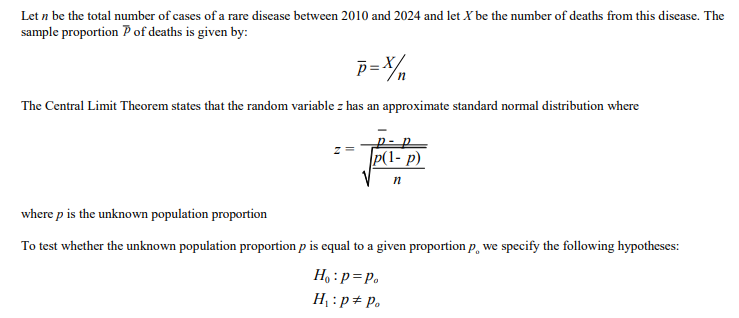
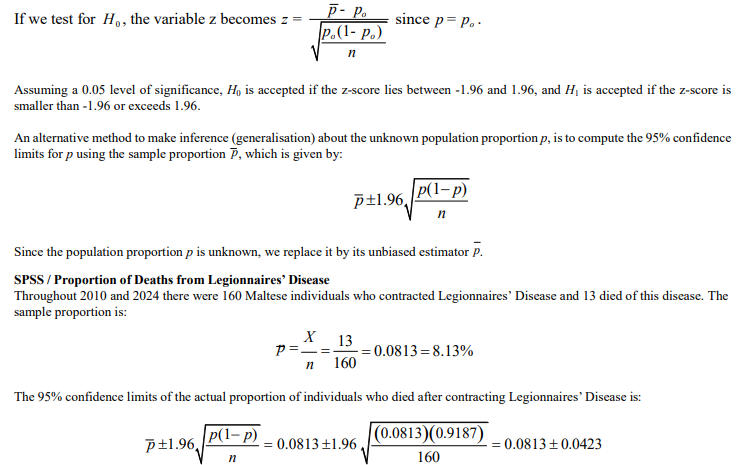
If we had to consider a wider range of years, we are 95% confident that the actual proportion of individuals who died or will die in the future after contracting Legionnaires’ Disease lies between 0.0390 (3.9%) and 0.1236 (12.36%).
It is estimated that in the world around 10% of individuals who contract Legionnaires’ Disease die. To determine whether Malta’s proportion of deaths from Legionnaires’ disease is comparable to 10% (0.1) we specify the following hypotheses:
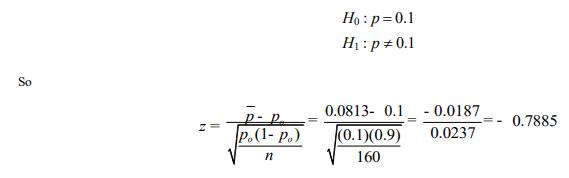
Since the z-score (-0.7885) lies between -1.96 and 1.96 we accept H0, which implies that the proportion of deaths (8.13%) of Maltese individuals from Legionnaires’ Disease is comparable to the international proportion of deaths (10%). In other words, the two proportions do not vary significantly.
SPSS / Proportion of Deaths from HIV/AIDS
Throughout 2010 and 2024 there were 901 Maltese individuals who contracted the HIV Virus and 1 died of this infection. The sample proportion is:
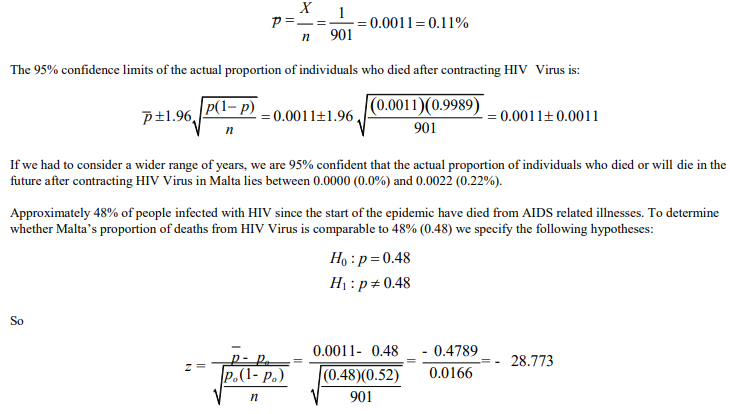
Since the z-score (-28.773) is smaller than -1.96 we accept , which implies that the proportion of deaths (0.11%) of Maltese individuals from HIV Virus is significantly smaller than the international proportion of deaths (48%). It should be noted that the 48% of the people who died after contracting HIV include those who died before the introduction of modern antiretroviral therapy (ART) in 1996. Nowadays, many people living with HIV but got treatment at an early stage have a near-normal life expectancy, significantly reducing annual mortality rate.
SPSS / Proportion of Deaths from Malaria
Throughout 2010 and 2024 there were 95 Maltese individuals who contracted Malaria but none died (0) of this infection.
Since the sample proportion of deaths is 0, the 95% confidence could not be computed.
Approximately 0.25% of people infected with malaria die despite given prompt treatment. To determine whether Malta’s proportion of deaths from Malaria is comparable to 0.25% (0.0025) we specify the following hypotheses:
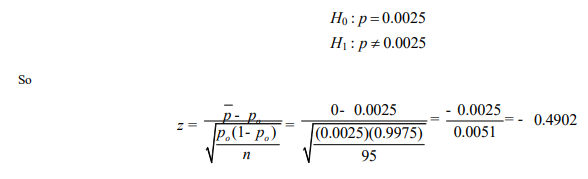
Since the z-score (-0.4902) lies between -1.96 and 1.96 we accept H0, which implies that the proportion of deaths (0%) of Maltese individuals from Malaria is comparable to the international proportion of deaths (0.25%). In other words, the two proportions do not vary significantly
SPSS / Proportion of Deaths from Typhoid
Throughout 2010 and 2024 there were 12 Maltese individuals who contracted Typhoid, but none died (0) of this infection. Since the sample proportion of deaths is 0, the 95% confidence could not be computed.
Approximately 1% of people infected withTyphoid die despite given prompt treatment. To determine whether Malta’s proportion of deaths from Typhoid is comparable to 1% (0.01) we specify the following hypotheses:
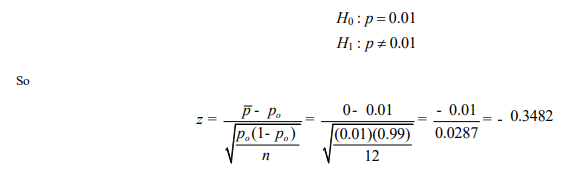
Since the z-score (-0.3482) lies between -1.96 and 1.96 we accept , which implies that the proportion of deaths (0%) of Maltese individuals from Typhoid is comparable to the international proportion of deaths (1%). In other words, the two proportions do not vary significantly.
|
DISEASE |
CASES |
DEATHS |
CHANCE of DEATH |
|
Legionella |
160 |
13 |
3.9% to 12.4% |
|
HIV/AIDS |
901 |
1 |
0.0% to 0.22% |
|
Malaria |
95 |
0 |
0% |
|
Typhoid |
12 |
0 |
0% |
|
SOURCE: Maltese Annual Notifiable Infectious Disease Reports (2010-2024): Malta Department of Health Promotion & Disease Prevention.(1). * IBM / SPSS – Professor Liberato Camilleri, University of Malta. |
|||
Table 2: Comparative Analysis of Proportion of Deaths from Maltese Annual Reports (2010-2024) *
Disclosures
Acknowledgement
Authors acknowledge all advice and guidance provided by Professor Neville Calleja and untiring assistance of Krystle Attard, plus timely encouragement of Professor Pierre Mallia and Professor Charmaine Gauci. Also, we appreciate the expert assistance given by Andrew Camilleri with the Malta Environmental Health Directorate. Lee Garythanks the Fulbright Foreign Scholarship Board for a Visiting Fulbright Teaching and Research Scholar Award at the University of Malta.
Declaration of Conflicting Interest
Authors declare no competing issues nor Conflict of Interest with this project or any other conflict with the content of the manuscript. All agree to journal submission when proper.
Funding Statement
Authors volunteer that their work was independent and not supported by funding from any private organizations or public agencies. Office expenses for production of the manuscript were covered by SMS- USA, owned by Lee P. Gary Jr., Corresponding Author.
Data Availability
All data for our research study is presented within this article and are readily available from the Corresponding Author with a written or electronic request from any interested individual.
The Maltese Annual Notifiable Infectious Disease Reports (2010-2024) are available at file:///E:/2026P%20%20%20HPDP%20--%20 Ten%20Year%20List%20-%20Annual%20Tables/Annual%20Tables%20_%20HPDP.htm
Ethical Approval & Informed Consent Statement
Authors understand no approval or authorization from an Institutional Review Board was required according to the nature and focus of our research project.
References
- Maltese Annual Notifiable Infectious Disease Reports (2010-2024): Malta Department of Health Promotion & Disease Prevention.
- Sylvestre, É., Rhoads, W. J., Julian, T. R., & Hammes, F. (2025). Quantification of Legionella pneumophila in building potable water systems: A meta-analysis comparing qPCR and culture-based detection methods. PLoS Water, 4(1), e0000291.
- Logan-Jackson, A., & Rose, J. B. (2021). Cooccurrence of five pathogenic Legionella spp. and two free-living amoebae species in a complete drinking water system and cooling towers. Pathogens, 10(11), 1407.
- Delaney, S., Arcari, T., & O’Connor, O. (2022). Legionella water testing and the EU Drinking Water Directive: could potentially harmful Legionella bacteria slip through the gaps?. BioTechniques, 72(6), 229-231.
- Simmering, J. E., Polgreen, L. A., Hornick, D. B., Sewell, D. K., & Polgreen, P. M. (2017). Weather-dependent risk for Legionnaires’ disease, United States. Emerging infectious diseases, 23(11), 1843.
- Ciarlo, J., Vella, R., Saliba, M., Ellul, R., Micallef, A., Coppola, E., ... & Mifsud, D. (2025). Insights into climate variability of the meteorological records from a background monitoring station: the Giordan lighthouse, Gozo. Open Research Europe, 5, 37.
- Kirrage, D., Reynolds, G., Smith, G. E., & Olowokure, B. (2007). Investigation of an outbreak of Legionnaires’ disease: Hereford, UK 2003. Respiratory medicine, 101(8), 1639-1644.
- Mentula, S., Kääriäinen, S., Jaakola, S., Niittynen, M., Airaksinen, P., Koivula, I., ... & Lyytikäinen, O. (2023). Tap water as the source of a Legionnaires’ disease outbreak spread to several residential buildings and one hospital, Finland, 2020 to 2021. Eurosurveillance, 28(11), 2200673.
- Environmental Health Malta (2026) Legionella Control, Government of Malta. (Accessed: 12 June 2026).
Authors Contributions:
• Layla Rahimpour: Conceptualization, Investigation, and Formalizing Original Manuscript, and Editing Final Manuscript.
• Liberato Camilleri: Data Management, Methodology, and Data Analysis.
• Lee Presley Gary, Jr.: Co-Conceptualization, Resources, Visualization, and Writing – Restructuring Final Manuscript.
Biographies:
• Layla Rahmpour: Layla is a 2024 Honors Graduate of McMaster University, located in Hamilton, Canada, her hometown. Lyla is a candidate for the Master of Public Health degree (MPH) from the University of Malta, projected for August 2027/Graduation.
• Liberato Camilleri: Liberato is a Professor with the Department of Statistics at the University of Malta. He received a PhD in Applied Statistics from Lancaster University. His research is related to statistical models, including Survival, Multilevel, Latent Class, and Item Response Models, plus Structural Equations.
• Lee P. Gary, Jr.: Lee is Visiting Fulbright Research Scholar at the University of Malta, and he is the Director of the Maltese Legionella Project. Previously,he was a Visiting Fulbright Fellow with the School of Public Health at the University of Makeni in Sierra Leone for 2025.