

Journal of Novel Physiotherapies Research Reviews(JNP)
ISSN: 2771-7739 | DOI: 10.33140/JNP

Research Article - (2022) Volume 3, Issue 2
Knowledge, Attitude, practice, and their associated factor towards Diabetes Mellitus among peoples live in Debre Markos Town, North West Ethiopia, Amhara Regional State, Ethiopia 2020 GC.
2Department of Human Nutrition, Debre Markos University College Health Sciences, Ethiopia
Received Date: May 14, 2022 / Accepted Date: May 19, 2022 / Published Date: Jun 01, 2022
Copyright: ©Copyright: ©2022 Addisu Simachew. This is an open-access article distributed under the terms of the Creative Commons Attribution License, which permits unrestricted use, distribution, and reproduction in any medium, provided the original author and source are credited.
Citation: Addisu Simachew, Habtamu Temesegen .(2022). Knowledge, Attitude, practice, and their associated factor towards Diabetes Mellitus among peoples live in Debre Markos Town, North West Ethiopia, Amhara Regional State, Ethiopia 2020 GC. J Nov Psy, 3(2), 65-75.
Abstract
Background: Diabetes mellitus is a group of metabolic disease in which there is high blood glucose level over a prolonged period of time, chronic multi system disease related to abnormal insulin production, impaired insulin utilization and both. Risk of diabetes are obesity, being young or old age, family history of diabetes, history gestational diabetes, impaired, glucose metabolism, physical inactivity and ethnicity/race respectively. In type one diabetes mellitus insulin injection is needed to control the blood glucose level where as in type two diabetes mellitus the first line treatment is life style modification like diet management, exercise, and weight reduction then if uncontrolled use oral hypoglycemic agent.
Objective: The main aim of the study was to assess Knowledge, Attitude, practice and their associated factor towards diabetes mellitus in Debre Markos town, northwest, Amhara Regional state, Ethiopia 2020 GC.
Methodology: A community based cross-sectional study was conduct from June to July for 403 respondents using systematic random sampling technique to select the household after select the first household by lottery method. Data collected through self administered questions, the collected data process and analysis manually using pen, pencil, tally sheet and present in tables, graphs and charts respectively.
Result: Based on our study 138 (34.6%) of the respondents were classified as having inadequate knowledge, whereas 261(65.4%) of the respondents were deemed to be knowledgeable. from the participant 186(46.6%) had unfavorable attitude while 213(53.4%) had favorable attitude towards diabetes mellitus. Overall practice of the participant was 37.8% good practice and 62.2% poor practice. Single individuals 5.133 times (AOR=5.133, CI=1.737, 15.051) more likely knowledgeable than those divorced. Family history of diabetes mellitus 5.019 times (AOR=5.02- CI=1.59-15.76) more likely had favorable attitude than those who had no family history of DM. secondary educational level were 2.34 times (AOR=2.34, CI=1.14- 0.78) more likely good practice than those with able to read and write and persons in primary educational level. DM patients 2.811 times (AOR=2.81-95%, CI=0.99- 7.97) more likely good practice than non-diabetic.
Conclusion: Majority of the participant’s relatively knowledgeable. The overall attitude of the participant was more than half was favorable attitude. Majority of the study participants were poor practice regarding to DM controlling and management. Knowledge of the participant highly significant association with marital status, income and practice, practice also strong association with level of education and attitude significantly associated with family history of DM.
Background
Diabetes mellitus is a group of metabolic disease in which there is high blood glucose level over a prolonged period of time, chronic multi system disease related to abnormal insulin production, impaired insulin utilization and both. Diabetes mellitus is a serious Health problem throughout the world and its prevalence is increase rapidly. Currently in the United States an estimated 25.8 million people or 8.3% of total population have diabetes mellitus and 79 million more people are pre-diabetes. Diabetes is commonly classified as type one and type two diabetes mellitus which contains 5-10% and 90-95%of all diabetes [1].
In 2014 the international diabetes federation (IDF) reported that 387 million and 22 million adults had diabetes world and Africa respectively. While according to 2015 international diabetes federation 415 million people worldwide or 8.8% of adult aged 20-79 years, if this trend continue by 2040 some 460 million people (one in ten) will have diabetes worldwide [2, 3]. In 2015 IDF estimates that in the Africa region 14.2 million adult aged from 20-79 years had diabetes representing a prevalence of 3.2%. The region has also the highest proportion of previously undiagnosed diabetes over two thirds of people with diabetes being unaware they have the disease. Ethiopia is among the top four countries with the highest adult diabetic population in sub-Saharan Africa [3]. In this study we were investigated the knowledge, attitude, practice and their associated factor towards diabetes mellitus. the main problems of this study were poor knowledge, attitude and practice regarding to diabetes management, symptoms, complication, risk factors prevention and control modalities of diabetes mellitus. Considerable limited knowledge, attitude, and practice and practice about diabetes particularly diabetes symptom and risk factor this is related to awareness towards diabetes is low [4]. The factors that affect the knowledge, attitude and practices towards diabetes mellitus like socioeconomic characteristic, socio-demographic characteristics educational status and DM status. The global prevalence of diabetes greater than18year was 4.7% in 2014 [5].
Many studies generate deferent results related to associate factor with KAP about DM, but still there are gaps KAP related to DM and the factor influences the prevention, therapy and control of diabetes mellitus among Ethiopia country. Now a day’s chronic non communicable disease like diabetes mellitus became a common problem in developing country like Ethiopia. Educational status, family income, and family history of DM are the factor associated with knowledge, attitude, and practice. In our study we would study about knowledge, attitude, practice and their associated factor towards diabetes mellitus in Debre Markos Town to know the level of knowledge, attitude, practice and the factors that affect DM prevention and management.
This study shows that the awareness and knowledge about diabetes mellitus can have a positive influence to attitude and practice of peoples toward diabetes mellitus, so this will be led to good management and control of diabetes mellitus. while there is a gap in attitude, knowledge and practice towards DM management, prevention, control, sign and symptom, complication and also the risk factor, this cannot allow DM patient and care giver to implement the intervention and also those none Diabetic patients cannot prevent them from diabetes mellitus. Knowledge is important for device to prevent diabetes complication, their risk factor and also pharmacological and non- pharmacological management of diabetes mellitus. This study was assessing knowledge gap and also association of knowledge, practice, and attitude in diabetes mellitus in Debre Markos town.
Methods And Materials
Study Area and Setting
Community based cross sectional study was conducted at DMRH. Debre Markos is a capital city of East Gojam Zone. It is 299 km away from Addis Ababa capital city of Ethiopia and 265 km from Bahir Dar the capital city of Amhara regional state. Debre Markos town consists of 7 Keble’s. It has 105326 populations, of which 50337 are male and 54784are females. In Debre Markos town, there are 20KG, 23 primary school, 3 high schools, 2 preparatory, 20 different colleges and one University. It has also1 referral hospital, 4 health center, 20 private pharmacies, 9Private clinic, 2 diagnostic laboratory, and 13 traditional healers, which are from different professional expertise. The study was conduct in Debre Markos town form may 2020G.C to July 2020G.C.
Operational Definition
Knowledgeable: Those participants who answered greater than or equal to the mean of knowledge related questions correctly considered as knowledgeable.
Inadequate Knowledge: Those participants who answered less than or equal to the mean score of knowledge related question will be considered as Inadequate knowledge.
Favorable Attitude: Those participants who were positively worded and scored points more than the mean in the attitude questionnaire considered as favorable attitude.
Unfavorable Attitude: Those participants who were negatively worded and scored points less than the mean in the attitude questionnaire considered to be unfavorable attitude.
Good Practice: Participants who answered the mean or above the mean score of practice related questions will be considered as good practice.
Poor Practice: The respondents who answered below the mean score of practice related questions considered as poor practice.
Sample Size and Sampling Technique
Sample Size Determination
The sample size for this study was calculated using the single population proportion formula:
ni=(Zα/2)p(1−p)
d2
Where n = sample size (the desired sample size)
Z α/2 = standard normal deviation, set at 1.96, to correspond to the 95% confidence interval. p= Good knowledge of diabetes 49% (0.49) taken from study done in Debre Tabor (16)
q = 1.0-p
d = margin of error/an absolute precision = 5% = 0.05 ni = (1.96)2 (0.49) (1-0.49)/ (0.05)2 = 384
By considering 5% non-response rate; the total final sample size was 403.
Debre Markos town administration was selected to our study. First by using lottery method two Keble: kebele02 and 06 will be select which represent the town. Then systematic random sampling technique was used to get the households after selection of the first house through lottery method. The interval K value will determine by dividing the number of household (N) by the desired sample size (n). K=N/n since we collect data from two Kebles was used population proportion allocation formula.
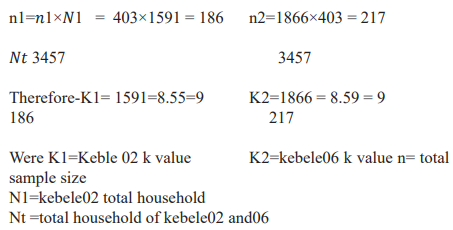
After dividing the town in to kebeles and among seven kebeles; kebele 02 and 06 was selected by lottery method which represents the town. From the selected kebeles 186 households select from kebele 02 and 217 households from kebele06 by using population allocation formula. After this, respondents were selected at every 9th interval, whereas the first respondent was select by lottery method, then continuing to every 9th respondent until the desired sample size was attained.
Data Collection Technique and Procedure
The data was collected by using structured and standard questions. The questions were developed by reviewing pervious literature about Diabetes Mellitus related to knowledge, attitude, practice and their associated factor. Self-administered questions were used to collect data; the questionnaire consists of socio demographic situation like sex, age, marital status, family history of DM, educational status, level of income, and residency. Diabetic related knowledge like symptoms of DM, risk of DM, and complication of DM. Attitude towards diabetes and individuals practice related to the disease diabetes.
Statistical Analysis
After data collection complete, data being entered into epi-data 3.2 and transform to version 25 Statistical packages for the social science (SPSS) for analysis. Then binary logistic regression analysis was used to see the independent variable effect of predicators on the dependent variable and predicates with P-value at 95% CI and Bivariable binary logistic regression was considered as significant at P-value ≤0.25 were entered in multiple logistic regression analysis model to identify the final predicator knowledge, attitude and practice level after controlling another independent variable. Odds ratio and 95%confidence interval was calculated p≤0.05 was considered statistically significant I multivariable logistic regression. Mean score of knowledge, attitude and practice was calculated. To calculate mean score of knowledge participants answered yes was considered correctly answered, No consider as incorrectly answer the mean score of knowledge were 5. The same technique also uses for practice as knowledge the mean score was 5. Liker’s scale was used to classify poor and good attitude set as strongly agree1, agree2, neutral3, disagree4 and strongly disagree5, the mean score was 19. After data analysis was complete the result was present in percent, frequency tables and figures respectively.
Ethical Consideration
The study was carried out after getting approval from Debre Markos University College of health science research and ethical review committee. All the study participants were informing about the purpose of the study and their right to refuse and confidentiality was maintained.
Result
Socio Demographic Characteristics Total response rate of our study was 99%. Based on our study210 (52.6%) of the participant were male and 189(47.4%) Were female and 98.7% Amhara by ethnicity, 284(71.1%) of the respondents were married and 68(17.0%) were single, the mean age of the participant was (39±12.87) years. Among the total participants 84(21.1%) were secondary education level and the remaining 79(19.8%) and 159(39.6%) were attain primary school and above certificate and, 43(10.8%) of the study participants had family history of DM, 25(6.3%) of the respondents had diabetic see (Table1).
Table 1: : Socio demographic characteristics of the respondents to assess knowledge, attitude a, practice and their associated factor towards Diabetes Mellitus in Debre Markos Town northwest, Amhara, and Region, Ethiopia 2019.
|
Variable |
Frequency |
% |
|
|
Age |
19-24 |
47 |
11.8 |
|
|
25-54 |
289 |
72.4 |
|
|
55-64 |
41 |
10.3 |
|
|
65-70 |
22 |
5.5 |
|
Sex |
Male |
210 |
52.6 |
|
|
Female |
189 |
47.4 |
|
Educational status |
Able to read and write |
78 |
19.5 |
|
|
Attain primary school |
79 |
19.8 |
|
|
Attain secondary school |
84 |
21.1 |
|
|
> certificate |
158 |
39.6 |
|
Ethnicity |
Amhara |
394 |
98.7 |
|
|
Oromo |
5 |
1.3 |
|
Religion |
Orthodox |
366 |
91.7 |
|
|
Muslim |
22 |
5.5 |
|
|
Protestant |
11 |
2.8 |
|
Marital status |
Single |
68 |
17.0 |
|
|
Married |
284 |
71.2 |
|
|
Divorced |
47 |
11.8 |
|
income |
<500 |
80 |
20.1 |
|
|
500-1000 |
50 |
12.5 |
|
|
1000-1500 |
82 |
20.8 |
|
|
>1500 |
186 |
46.6 |
|
Family history of DM |
Yes |
356 |
89.2 |
|
|
No |
43 |
10.8 |
|
Occupation |
Housewife |
62 |
15.5 |
|
|
Student |
48 |
12.0 |
|
|
Daily labor |
78 |
19.5 |
|
|
Merchant |
133 |
33.3 |
|
|
Civil servant |
78 |
19.5 |
|
residency |
Urban |
399 |
100 |
|
|
Rural |
0 |
0.0 |
Knowledge of Participants Towards Dm
Based on the correct and incorrect responses each respondent gave, a count was made for each respondent. Then the aggregate scores of each of the respondents were used to calculate mean, median and other descriptive statistics. Based on these results and the operational definition, respondents who have correctly answered more than the mean among the questions that were amid at assessing knowledge about DM were to be considered as knowledgeable. Thus, out of respondents 5 was the mean score knowledge related questions that were asked. Based on this, the respondents were categorized as those who are knowledgeable about DM and those who had inadequate knowledge about DM. Thus, 138 (34.59%) of the respondents were classified as having inadequate knowledge, whereas the remaining 261(65.41%) of the respondents were deemed to be knowledgeable.
According to our finding participants respond correctly as diabetes is higher level of body glucose level 180(45.1%), and diabetes is cause by reduction of insulin production 220(55.1%). On the other hand, the respondents revealed that, overweight 144(36.1%), poor diet habit 230(57.6%) and not getting exercise190 (47.6%) were high-rate risk factors of Diabetes Mellitus. Regarding to the sign and symptom of Diabetes Mellitus frequent urination 210(52.6%), hanger 155(38.8%) and excessive thirsty193 (48.4%) were score rat symptom of diabetes respectively. The respondents also stated that foot ulcer 184(46.1%), limb amputation 165(41.1%), blindness 160(40.1%) and kidney problem150 (37.1%) were high rated DM complication. Other finding summarizes in (Table2.)
Table2: Frequency distribution of respondent’s knowledge towards diabetes Mellitus in Debre Markos Town northwest, Amhara Region Ethiopia2019 n=399)
|
Variable |
Frequency |
% |
|
|
DM status |
Yes |
25 |
6.3 |
|
|
No |
374 |
93.7 |
|
Do you hear before about diabetes mellitus |
Yes |
391 |
98.0 |
|
|
No |
8 |
2.0 |
|
|
|
|
|
|
source of information about DM |
Family |
194 |
48.6 |
|
|
peers/friends |
144 |
36.1 |
|
|
Teachers |
72 |
18.0 |
|
|
Health workers |
158 |
39.6 |
|
Do you know DM definition |
Yes |
323 |
81.0 |
|
|
No |
76 |
19.0 |
|
Meaning of DM? |
Increasing of blood glucose level |
180 |
45.1 |
|
|
DM is a condition of insufficient insulin production |
220 |
55.1 |
|
|
DM is a condition of the body which is not respond to insulin |
86 |
21.6 |
|
|
DM affect all part of the body |
118 |
29.6 |
|
Respondents who know risk of diabetes mellitus |
Yes |
|
344 |
|
|
No |
55 |
13.8 |
|
|
|
|
|
|
risk factors of diabetes mellitus you know |
Overweight/obesity |
144 |
36.1 |
|
|
Pregnancy |
107 |
26.8 |
|
|
Poor dietary habit |
230 |
57.6 |
|
|
Smoking |
137 |
34.3 |
|
|
Not done physical exercise |
190 |
47.6 |
|
|
Age |
116 |
29.1 |
|
Do you know how to measure blood glucose level |
Yes |
295 |
73.9 |
|
|
No |
104 |
26.1 |
|
Can you list sign and symptoms of diabetes mellitus? |
Yes |
352 |
88.2 |
|
|
No |
47 |
11.8 |
|
Sign and symptoms of DM you know |
Frequent urination |
210 |
52.6 |
|
|
Excessive thirsty |
193 |
48.4 |
|
|
Excessive hanger |
155 |
38.8 |
|
|
Weight loss |
143 |
35.8 |
|
|
Blurred vision |
141 |
35.3 |
|
|
High blood sugar |
186 |
46.6 |
|
Can you list down control and management of DM? |
Yes |
303 |
75.9 |
|
|
No |
96 |
24.1 |
|
Controlling and management of DM |
Regular exercise |
207 |
51.9 |
|
|
Health diet |
225 |
56.4 |
|
|
Insulin injection |
131 |
32.8 |
|
|
Use tablets or capsule |
155 |
38.8 |
|
Do you know the complication of DM? |
Yes |
306 |
76.7 |
|
|
No |
93 |
23.3 |
|
Complication of DM you know |
Blindness |
160 |
40.1 |
|
|
Foot ulcer |
184 |
46.1 |
|
|
Kidney failure |
150 |
37.1 |
|
|
Limb amputation |
165 |
41.4 |
|
|
Heart problem |
130 |
32.6 |
|
|
Brain problem |
112 |
28.1 |
Attitude Of Participants Towards Diabetes Mellitus
Scores for each attitude related question was summarized and the responses were then categorized in to two variables, namely favorable attitude and unfavorable attitude. Study participants who were positively worded for each attitude related questions were categorized as having favorable attitude whereas respondents who were negatively worded for each attitude related questions were classified in the unfavorable attitude category. Finally, overall attitude score of the respondents were calculated. Those who score above the mean were considered as having favorable attitude while those who scored below the mean were labeled as having unfavorable attitude. The mean value was 19 among 8 attitude related questions accordingly, 186(46.62%) of the participant had unfavorable attitude while 213 (53.38%) had favorable attitude towards DM.
Based on our study to these study126 31.2(%) of the participant strongly disagree on do you think Diabetes is curable and 151(37.8%) of the participant strongly agree with do you think that DM is control by physical exercise, most of the respondent 167(41.9%) agree with diet planning is important to control and prevent DM. 201(50.4%)Of the participants strongly agree that diabetes mellitus complication is control by controlling blood sugar Most of the participants disagree with do you examine for DM 124(31.1%) while 164(41.1%) agree to examine for DM (table3).
Table 3: Frequency distribution of respondents Attitude towards diabetes Mellitus in Debre Markos Town East Gojjam zone, Amhara Region Ethiopia2019 (n=399)
|
Variable |
Strongly agree (%) |
Agree (%) |
Neutral (%) |
Disagree (%) |
Strongly disagreed (%) |
|
Do you think that DM is curable? |
49(12.30) |
80(20.07) |
63(15.79) |
82(20.54) |
126(31.70) |
|
Do you agree that Exercise can prevent DM and control blood glucose level? |
151(37.8) |
137(34.3) |
48(12.0) |
39(9.8) |
24(6.0) |
|
Do you think that followed planned diet is important to control and prevent DM?? |
150(37.6) |
167(41.9) |
27(6.8) |
37( 9.3) |
18 (4.5) |
|
Do you agree Diabetes mellitus preventable? |
161(40.4) |
142(35.6) |
33(8.3) |
32(8.0) |
31(7.8) |
|
Do you agree that do you examine for diabetes? |
63(15.8) |
164(41.1) |
25(6.3) |
124(31.1) |
23(5.8) |
|
Do you think that avoiding of consumption of too much sugar control DM? |
123(30.8) |
136(34.1) |
37(9.3) |
77(19.3) |
26(6.5) |
|
Do you think Diabetes is not seriously affecting marital status? |
99(24.8) |
121(30.3) |
85(21.3) |
68(17.0) |
26(6.5) |
|
Do you agree DM complication may be prevented if blood glucose well control? |
201(50.4) |
110(27.6) |
15(3.8) |
43(10.8) |
30(7.5) |
Practice Level of The Participant Towards Dm
Overall practice of the participant was 37.8% good practice and 62.2% poor practice with the mean value 5. 259(64.9%) Of the participant consumed fatty food and 309(77.4%) of the participant consumed sweet foods. 126(31.6%) of the participant did physical exercise. Regarding to weight 147(36.8%) of the respondent control their weigh while most of the participant not control their weight 252(63.2%) (Table4)
Table 4: Frequency distribution of respondents practice towards diabetes Mellitus in Debre Markos Town East Gojjam zone, Amhara Region Ethiopia2019 (n=399).
|
Variable |
Frequency |
% |
|
|
How often do you visit health center to check your blood glucose level? |
More than once per year |
55 |
13.8 |
|
|
Once per year |
54 |
13.5 |
|
|
I don’t have habit of check glucose level |
290 |
72.7 |
|
Do you control your weight? |
Yes |
147 |
36.8 |
|
|
No |
252 |
63.2 |
|
Do you follow diet planning? |
Yes |
134 |
33.6 |
|
|
No |
265 |
66.4 |
|
Do you have a habit of regular exercise? |
Yes |
126 |
31.6 |
|
|
No |
273 |
68.4 |
|
Do you smoke cigarette? |
Yes |
6 |
1.5 |
|
|
No |
393 |
98.5 |
|
Do you have expose to passive smoking? |
Yes |
6 |
1.5 |
|
|
No |
393 |
98.5 |
|
Do you take sweaty food? |
Yes |
309 |
77.4 |
|
|
No |
90 |
22.6 |
|
How often you take sweet food? |
Sometimes |
236 |
59.1 |
|
|
Usually |
69 |
17.3 |
|
|
Often |
4 |
1.0 |
|
Do you consume fatty food |
Yes |
259 |
64.9 |
|
|
No |
140 |
35.1 |
|
|
|
|
|
Factors Associated with Knowledge
Single individuals 5.133 times (AOR=5.13, CI=1.73, 15.05) more likely good knowledge than those married. And persons who had good practices 0.55 times (AOR=0.502, 95%, CI=0.31, 0.809) more likely good knowledge than those who have poor practice (table5).
Table 5: Bivariate and multivariate logistic regression predicting diabetes mellitus related to knowledge level among members of DebreMarkos Town 2019 (n=399)
|
Variables |
Knowledge |
COR at 95% CI |
AOR at 95% CI |
P value |
||
|
Poor knowledge |
Good knowledge |
|||||
|
Marital status |
Single |
12 |
56 |
1.24(0.66, 2.32) |
5.11 (1.737, 15.0) |
0.003 |
|
|
Married |
106 |
178 |
3.45(1.47, 8.09) |
1.7 (.859, 3.4) |
0.125 |
|
|
Divorced |
20 |
27 |
1 |
1 |
|
|
Ethnicity |
Amhara |
135 |
259 |
2.87(0.47, 17.43) |
5.2(0.673, 40.70) |
.0011 |
|
|
Oromo |
3 |
2 |
.667 |
1 |
|
|
Practice |
Good practice |
40 |
111 |
0.55, (0.35, 0.85) |
0.50(0.31, 0.80) |
.005 |
|
|
Poor practice |
98 |
150 |
1 |
1 |
1 |
|
Income |
|
|
|
|
|
|
|
|
|
|
|
|
|
|
|
|
<500 |
35 |
45 |
.554(.322, .952) |
0.36(0.193, 0.68) |
0.440 |
|
|
500-1000 |
18 |
32 |
0.76(0.39, 0.47) |
0.75(0.36, 1.554) |
0.959 |
|
|
1000-1500 |
29 |
54 |
0.8(.46, 0.38) |
0.98(.545, 1.778) |
0.002 |
|
|
>1500 |
56 |
130 |
|
1 |
|
Factors associated with attitude
Family history of DM, age, and educational status were highly significant association with attitude at P 0.05. An individual who has family history of DM 5.019 times (AOR=5.019, CI=1.599-15.76) more likely had favorable attitude than those who had no family history of DM, an individual whose income is 500-1000 Birr, 0.8 times (AOR=0.8, CI=0.307- 2.08) less likely good attitude than those who had 1000-1500 Birr. Increase level of education highly significant with good attitude secondary and above school level 0.39 times (AOR=0.39, COR=0.21, 0.74) more likely good knowledge than those who below secondary educational level (table6).
Table 6: Bivariable and multivariable logistic regression predicting diabetes mellitus related to attitude level among members of Debre Markos Town 2019 (n=399).
|
Variables |
Attitude |
COR at 95% CI |
AOR at 95% CI |
P value |
||
|
Poor attitude |
Good attitude |
|||||
|
family history of DM |
Yes |
5 |
38 |
7.81(3.0,20.4) |
5.019(1.5, 15.76) |
0.006 |
|
|
No |
181 |
175 |
1 |
1 |
|
|
Income |
<500 |
49 |
31 |
0.69(0.40,1.2) |
2.072(0.56, 7.55) |
0.270 |
|
|
500-1000 |
25 |
25 |
1.09(0.58, .03) |
0.8(0.307, 2.08) |
0.647 |
|
|
1000-1500 |
41 |
42 |
1.06(0.63, .78) |
0.16(0.05, 0.55) |
0.003 |
|
|
>1500 |
89 |
97 |
1 |
1 |
1 |
|
Educational status |
able to read and write |
49 |
29 |
0.48(0.27,0.84) |
0.52(0.27,0 .99) |
0.048 |
|
|
attain primary school |
38 |
41 |
0.88(.51,0 .15) |
0.80(0.42, 1.55) |
0.515 |
|
|
attain secondary school |
55 |
29 |
0.43(0.25, .74) |
0.39(0.21, 0.741) |
0.004 |
|
|
>certificate |
71 |
87 |
1.22 |
1 |
1 |
Factors Associated with Practice
Educational status, DM status and knowledge were significant association with practice in the multivariate logistic regression analysis: -persons who were in secondary educational level were 2.338 times (AOR=2.33, CI=1.14, 0.78) more likely practice than those with able to read and write and persons in primary educational level. DM patients 2.811 times (AOR=2.81, CI=0.99, 7.97) highly practice than those who were non diabetic one respectively. Those who had inadequate knowledge about DM were 0.54 times less likely practice than those knowledgeable (table7).
Table7: Bivariable and multivariable logistic regression predicting diabetes mellitus related to practice level among members of Debre Markos Town 2019(n=399)
|
Variable |
Practice |
COR at 95% CI |
AOR at 95% CI |
P value |
||
|
Poor practice |
Good practice |
|||||
|
Educational status |
able to read and write |
41 |
37 |
1.89(1.08,3.30) |
0.97(0.52,1.82) |
0.947 |
|
|
attain primary school |
45 |
34 |
1.58(0.90, 0.76) |
1.59(2.81, 0.09) |
0.172 |
|
|
attain secondary school |
55 |
29 |
1.1(0.63, 0.93) |
2.33(1.14,0.78) |
0.002 |
|
|
>certificate |
107 |
51 |
0.477 |
1 |
1 |
|
DM status |
Yes |
5 |
20 |
2.56(0.94, 0.97) |
2.8(0.99, 0.97) |
0.002 |
|
|
No |
228 |
146 |
1 |
0.140 |
0.052 |
|
Knowledge |
Good |
40 |
111 |
0.55(0.35,0.85) |
0.53(0.33,0.86) |
0.010 |
|
|
Poor |
98 |
150 |
1 |
1 |
1 |
Discussion
Current study showed that 65.4% of the respondents were knowledgeable about DM. these is higher than a study done in Pakistan54% Nigeria34.1% Kenya 27.2% Debre Tabor49% Felegehiwot hospital Bahir-Dar 49.8% and Ambo respectively [6-11]. The difference might be due to those studies done in rural area in addition to urban community. Whereas it is relatively low compare with a study done in Saudi-Arabia which was 75% were knowledgeable [12]. These may be due to less participation of media and limited organized diabetes education. To knowledge of participants about DM symptoms the participant high rate which is frequent urination (52.6%), excessive thirsty (48.4%) and excessive hanger (38.3%) were symptoms of diabetes mellitus. These is relatively consistent with a study done in Debre Tabor which was frequent thirsty (48%), frequent urination (44.7% [9]. whereas relatively low to a study done in Bale zone which was excessive hanger (79.6%) [13]. The difference may be due to inadequate level of information, and limited source of information.
In this study, overweight (36.1%), poor diet habit (57.6%) pregnancy 26.8% and age 29.1%were risk factors of Diabetes Mellitus. This supported by study done in Debre Tabor overweight 35.9%, pregnancy 21.9% and age 26%were risk factor of DM whereas higher regarding to dietary style33.7%, respectively [9]. Regarding to controlling and management modality of DM 32.8% of the participants were stated that use insulin injection to control DM, these is relatively low with similar study done in bale zone which was70% [13].
Regarding to complication of DM eye problem40.1%, renal 37.1% and heart problem32.6% were complication of DM. This showed that relatively low compared with studies in Bale zone Ethiopia eye problem43.9% and heart failure39.2% rated by the respondent [7]. The difference may be inadequate level of information, limited source of information and low involvement of media. In this study attitude of the study participant were 53.4% with mean score of 19. This showed that higher as compared with a studies done in Pakistan 28 %, Saudi arbia46 %, kenya49% and Debre Tabor 39.5 % [6, 12, 8, 9]. These are because of time, attitude of community changes time to time. 37.8.% of the participant strongly agree with do you agree to examine for diabetes mellitus these is relatively low with a study done in Bale zone which rates 44% of the participants strongly agree to examine their blood glucose level [13]. In this study showed that 53.4% of the participant was favorable attitude. These is relatively high compare with Study done in Sri Lanka 12% of the study participant were good attitude [14].
According to practice of our study was 37.8% good practice while 62.2% of the participant were poor practice, these is consistent with a study done in Felegehiwot hospital 36.8 % [10]. Based on our finding 64.9% Of the participant consumed fatty food, (31.6%) of the participant did physical exercise and 72.7% of the study participant not check their blood glucose level, relative to other study the habit of consume fatty food is high in our study while habit of physical exercise was law and blood glucose checking practice was low. when compare with study done in Bale zone38.2% consume fatty food, and31.8% did physical exercise 41% of the participant not check there blood glucose [13]. 30% study participants in Sri Lanka were had habit of check their blood glucose level compare with our study were 27.3% and low blood checking practice habit. 31.6% of the participant were had practice physical exercise these is high regarding to a cross-sectional study conducted in Sri Lanka was 20 % [14].
In this study knowledge of the participant highly associated with marital status, practice and income at p=0.003, 0.005 and 0.002 respectively these showed that consistent relative to other studies done Saudi Arabia about diabetes mellitus revealed that knowledge strongly associated with marital status, location, DM status and level of income [12]. Attitude of respondents highly associated with family history of DM, age and educational status and consist with other studies done in Egypt [15]. Educational status was highly significant with P=0.02 with good practice towards DM. practice was also significantly associated with level of education, location, DM status, knowledge and attitude. It is consistent Compared with other study conducted in Feleghiwot hospital about diabetes mellitus showed that lower age and high level of educational status was significantly associated good practice [10].
Conclusion
As reported in this study majority of the participant’s relatively knowledgeable on diabetes but there is also still inadequate knowledge regarding to some aspects of DM. there were a gap in risk factor and management of diabetes. Attitude of the participant towards diabetes mellitus were relatively favorable. And most of the participants not perceived that DM is curable while some participants considered as DM is curable. Majority of the study participants were poor practice regarding to DM controlling and management. Knowledge of the participant high significant association with marital status income and practice, practice also strong association with level of education and attitude strongly associated with family history of DM. Therefore, this study used as baseline for the national diabetes awareness campaign and modify the approach towards education on DM give more emphasis to change their attitude increase practice to control diabetes, especially for the study area. Debre Markos town health administration office bitter to give emphasis on non-communicable disease like DM by create awareness at community level and rise community awareness about DM, controlling and risk factors especially to increase their positive practice to reduce risk of DM. Debre Markos Town administration office should work with collaboration of other health centers and prepare campaign and give health education about prevention, sign and symptom, risk factors and complication of DM at school level, at community by using leaflets, banners and posters. Debre Markos health Science College also gives its concern for that non-communicable disease like DM especially at study area. Researchers to give emphasize on DM to by assess at community level
Strength And Limitation of The Study
Strength of the study was using SPSS to analysis data and calculates mean, median association and other descriptive statistics and use community-based data collection which can represent the community. The main limitation of our study was using self-administration questions these may be led to miss understanding of questions and leads to false felling of the questions and those illiterate persons not included. On the other hand, like other descriptive cross-sectional studies this study cannot detect cause and effect relationship, we cannot also assess homelessness and street peoples.
Acknowledgment
The author would like to thank, for debre markos administration, debre markos university, data collector, respondents and especially the Scientific Advisor Habtamu Temesgen (assistant professor).
Author Contributions
Both authors contributed to data analysis, drafting or revising the article, have agreed on the journal to which the article will be submitted, gave final approval to the version to be published, and agree to be accountable for all aspects of the work
Disclosure
The author reports no conflicts of interest in this work.
References
- Brunner, L. S. (2010). Brunner & Suddarth’s textbook of medical-surgical nursing (Vol. 1). Lippincott Williams & Wilkins.
- da Rocha Fernandes, J., Ogurtsova, K., Linnenkamp, U., Guariguata, L., Seuring, T., Zhang, P., ... & Makaroff, L. E. (2016). IDF Diabetes Atlas estimates of 2014 global health expenditures on diabetes. Diabetes research and clinical practice, 117, 48-54.
- Ogurtsova, K., da Rocha Fernandes, J. D., Huang, Y.,Linnenkamp, U., Guariguata, L., Cho, N. H., ... & Makaroff,L. E. (2017). IDF Diabetes Atlas: Global estimates for the prevalence of diabetes for 2015 and 2040. Diabetes research and clinical practice, 128, 40-50.
- Morrish, N. J., Wang, S. L., Stevens, L. K., Fuller, J. H., & Keen, H. (2001). Mortality and causes of death in the WHO Multinational Study of Vascular Disease in Diabetes. Diabetologia, 44(2), S14-S21.
- Roglic, G. (2016). WHO Global report on diabetes: A summary. International Journal of Noncommunicable Diseases, 1(1), 3.
- Gillani, A. H., Amirul Islam, F. M., Hayat, K., Atif, N., Yang, C., Chang, J., ... & Fang, Y. (2018). Knowledge, attitudes and practices regarding diabetes in the general population: A cross-sectional study from Pakistan. International journal of environmental research and public health, 15(9), 1906.
- Koley, M., Saha, S., Arya, J. S., Choubey, G., Ghosh, S., Chattopadhyay, R., ... & Banerjee, T. (2016). Knowledge, attitude, and practice related to diabetes mellitus among diabetics and nondiabetics visiting homeopathic hospitals in West Bengal, India. Journal of evidence-based complementary & alternative medicine, 21(1), 39-47.
- Maina, W. K., Ndegwa, Z. M., Njenga, E. W., & Muchemi,E. W. (2010). Knowledge, attitude and practices related to diabetes among community members in four provinces in Kenya: a cross-sectional study. Pan African Medical Journal, 7(1).
- Asmamaw, A., Asres, G., Negese, D., Fekadu, A., & Assefa,G. (2015). Knowledge and attitude about diabetes mellitus and its associated factors among people in Debre Tabor town, Northwest Ethiopia: cross sectional study. Science, 3(2), 199-209.
- Feleke, S. A., Alemayehu, C. M., Adane, H. T., Onigbinde, A., Akindoyi, O., & Faremi, F. (2013). Assessment of the level and associated factors with knowledge and practice of diabetes mellitus among diabetic patients attending at FelegeHiwot hospital, Northwest Ethiopia. Clin Med Res, 2(6), 110.
- Daba, A., & Yazew, T. (2020). Associated factors with knowledge, attitude and practices of Type II diabetic patients in Ambo university referral hospital, Ethiopia. American Journal of Laboratory Medicine, 5(4), 102-112.
- Asdaq, S. M. B. (2018). Knowledge, attitude, and practice regarding diabetes mellitus among general public and diabetic patients in Riyadh, Saudi Arabia. Asian Journal of Pharmaceutics (AJP): Free full text articles from Asian J Pharm, 12(01).
- Kassahun, C. W., & Mekonen, A. G. (2017). Knowledge, attitude, practices and their associated factors towards diabetes mellitus among non diabetes community members of Bale Zone administrative towns, South East Ethiopia. A cross-sectional study. PloS one, 12(2), e0170040.
- Herath, H. M., Weerasinghe, N. P., Dias, H., & Weerarathna, T.P. (2017). Knowledge, attitude and practice related to diabetes mellitus among the general public in Galle district in Southern Sri Lanka: a pilot study. BMC public health, 17(1), 1-7.
- Abdo, N. M., & Mohamed, M. E. (2010). Effectiveness of health education program for type 2 diabetes mellitus patients attending Zagazig University Diabetes Clinic, Egypt. J Egypt Public Health Assoc, 85(3-4), 113-130.