

International Journal of Health Policy Planning(IJHPP)
ISSN: 2833-9320 | DOI: 10.33140/IJHPP
Impact Factor: 1.08


Research Article - (2024) Volume 3, Issue 3
Knowledge, Attitude, and Prevention Practice towards Scabies among Haramaya University Health and Medical Science Students, Harar, Ethiopia 2022
2Enarji Enawga Woreda Health Office, Amhara, Ethiopia
3Department of Nursing, Debre Markos University, Ethiopia
4Department of Environmental Health, Debark University, Ethiopia
Received Date: Aug 09, 2024 / Accepted Date: Sep 06, 2024 / Published Date: Sep 16, 2024
Copyright: ©Â©2024 Yideg Abinew, et al. This is an open-access article distributed under the terms of the Creative Commons Attribution License, which permits unrestricted use, distribution, and reproduction in any medium, provided the original author and source are credited.
Citation: Abinew, Y., Simachew, A., Fenta, Y., Nahusenay, H., Alelign, M. (2024). Knowledge, Attitude, and prevention Practice towards Scabies among Haramaya University Health and Medical Science Students, Harar, Ethiopia 2022. Int J Health Policy Plann, 3(3), 01-08.
Abstract
Background: Scabies is a skin disease caused by infestation and sensitization to Sarcoptes scabies mites and is an endemic in tropical and subtropical areas. It is a common skin infestation, endemic in developing countries, usually affecting families and large groups of people living together.
Objective: The study was aimed to assess Knowledge, attitude, and prevention practice towards scabies among Haramaya university health and medical science students, Harar, Ethiopia, 2022.
Methods: Institutional -based Cross-sectional study was conducted from April 25- May 21, 2022 among 417 randomly selected students. Self-administered questioner was used to collect data. The collected data was entered into SPSS version 22 for analysis. Descriptive and analytic data was used to present the finding.
Result: Approximately 62.85% of the students demonstrated a high understanding of scabies, encompassing its transmission, symptoms, and prevention methods. Conversely, 6.1% exhibited poor knowledge. A finding of attitudes towards scabies among students only 36.7% demonstrating good attitude towards the condition. The data provided underscores a significant variation in scabies prevention practices among students with 65.8% exhibiting good practices.
Conclusion: The study highlights the importance of continuous education and awareness programs to enhance knowledge and attitudes, which in turn can lead to better practices. It also underscores the need for targeted interventions to address the gaps identified in both knowledge levels and attitudes to foster a more proactive approach to scabies prevention and management. The findings serve as a valuable benchmark for the university and health authorities to develop tailored strategies that can improve health outcomes related to scabies within the community.
Keywords
Attitude, Knowledge, Practice, Scabies
Abbreviations
AA: Addis Ababa
HUSHMS: Haramaya University School of Health and Medical Science
KAP: Knowledge Attitude and Practice
LMIC: Low and Middle-Income Countries
NTDs: Neglected Tropical Diseases
WHO: World Health Organization
Introduction
Scabies is an intensely scratchy lesions and eruptions of the skin [1]. It is caused by infestation of the skin with a microscopic mite named as Sarcoptes scabies variety hominis. It is a contagious disorder characterized by itch and a skin eruption of variable severity [2]. The major clinical manifestations of scabies are a generalized pruritic rash worsening at night [3]. Usually, persistent direct skin-to-skin contact with a scabies-infected individual allows the scabies mites to spread. Additionally, it is extremely contagious to intimate partners and household members. Sharing clothing, towels, or beds with people who have the disease can occasionally cause scabies to spread indirectly [4].
The wrists, buttocks, fingers, genitalia, axilla, groins, and breasts of females are the most often infested areas. The soles, palms, neck, and face are more frequently affected in young children and newborns [5]. The invasion of this disease may occur in persons of all age groups but predominantly found in children [1]. Scabies develops when a pregnant female mite burrows into the skin's surface layers and creates a slightly raised, narrow tunnel where it lays her eggs and feces. The mite needs human skin to complete its life cycle and cannot remain on the host for longer than two to three days at room temperature [6]. Scabies is a skin infection that spreads by close, prolonged contact with an infected individual and direct skin-to-skin contact. It is a neglected tropical infectious illness that affects people of all ages, ethnicities, genders, and social classes worldwide [7].
Scabies is one of the most prevalent dermatological disorders in the world, affecting people of all nationalities. Many indigenous and third-world populations are dealing with a serious global health issue called scabies. On the WHO's list of Neglected Tropical Diseases (NTDs), it has been included [8]. The highest infestation rates occur in nations with hot, tropical climates, particularly in areas where poverty and congestion coincide and where access to treatment is scarce [9]. Scabies is a serious health issue in Africa, particularly in the sub-Saharan region. Ethiopia is one of the sub-Saharan African nations where scabies is endemic [10]. More than 200 million people worldwide are currently afflicted by scabies. The prevalence of scabies among the population in under developed nations ranges from 0.4% to 31%, according to a narrative study [6]. It remains one of the commonest skin diseases seen in developing countries including Ethiopia [11]. In Ethiopia, 6.2% of the school-age children, 13.6% in under-five children, and 5.6% of the orphan school children are affected by scabies [10].
In tropical regions, it is a serious health issue that primarily affects youngsters. Due to overcrowding and close contact in schools, scabies is a widespread and highly contagious disease that spreads quickly among students [5]. Low and middle-income tropical nations, including those in East Asia, Southeast Asia, and tropical Latin America, have the largest scabies burden. Damage to the skin's natural barrier function encourages secondary bacterial infections, which may result in further, potentially fatal consequences [7]. Scabies affects 1.5 million people who live with a disability because to its effects on the skin alone and it also has significant negative consequences on the heart, kidneys, and other organ systems. Scabies has a large global morbidity due to the considerable variance in its burden. In Africa, particularly in the sub-Saharan region, where Ethiopia is located, scabies is a serious health issue [10]. World Health Organization acknowledges that in order to promote rapid, cost-effective uptake of the plan, the burden of disease and the risk of long-term consequences need to be properly characterized. Control methods also need to connect with existing initiatives [9]. Ethiopia developed a master plan in 2013 and 2016 to address interventions for NTDs [12]. Although the burden of scabies has been estimated in some countries, significant gaps remain in understanding the global distribution of the disease and its contribution to the burdens of impetigo, skin and soft-tissue infections, glomerulonephritis and possibly rheumatic heart disease. Since scabies is neglected skin disorder its complication, severity and determinant factors are not well understood by our community.
Operational Definitions
• Knowledge: It was classified into Poor knowledge (≤50%), Moderate knowledge (50-65%), Good knowledge (65%-80%), and > 80% considered high knowledge [13].
• Attitude: It had 9 item rating scale with the highest score of 5 for each option and total possible score was 45 and it will be categorized into good (≥65%), fair (50-65%), and poor (≤50%) [13].
• Practice: The practice scores were classified into Poor practice (≤50%), Fair practice (50-65%), and (≥65%) considered Good practice [13].
Methods
Study Area and Period
This study was conducted in at Haramaya University Collage of Health and Medical Science (HUCHMS) located in Harar from April 25 to May 21, 2022. Harar is located 526 km away from Addis Ababa, the capital city of Ethiopia. In Harar, there are two governmental health science collage, five none governmental collage which provide health science program. This study was conducted in Haramaya University Collage of Health and Medical Science.
Study Design
Cross sectional study design
Source Population
All nurses, environmental, public health and medicine students of Haramaya University Collage of Health and Medical Science at Harar campus.
Study Population
All nurses, environmental, public health and medicine students of Haramaya University Collage of Health and Medical Science at Harar campus.
Inclusion and Exclusion Criteria
Inclusion Criteria
All nursing, environmental, public health and medicine students who attended and completed their course of graduation
Exclusion Criteria
Students who are not volunteer to participate the study and severely ill students who are unable to communicate were excluded from the study.
Sample Size Determination
The sample size was determine using single population proportion formula
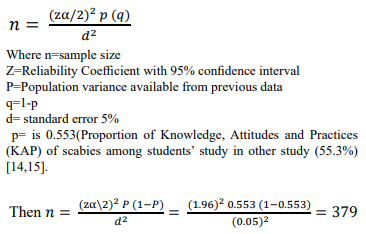
Adding 10% =38. Our total sample size is =417 students were needed to carry out the study.
Sampling Procedure
A systematic random sampling technique was used to select study participants. Accordingly, from the four departments selected for the study. Number of study subjects was allocated to each class proportionally to their total number of students attending a class. Then individual students were identified by calculating sampling interval (N/n=k), where N is the total number of students in the four departments and n is the calculated sample size. Accordingly, every student was selected from each department until getting the final sample size.
Data Collection Instruments and Procedure
The data was collected through self-administered questioner. Consent was taken from each participant before actual data collection. The data collection tool was developed by reviewing different literature which contains four parts:
• Part I: Socio-demographic characteristic of the participants
• Part II: Participants’ Knowledge was assessing as follows each question had true and false choices. Then, 1 awarded for each correct answer and 0 for incorrect. Correct responses were summed up to get a total knowledge scores for each participant was 21 [9].
• Part III: Attitude assessed using a 5-item Likert scale (ranging from strongly agrees 5 to strongly disagree 1. It had 9 item rating scale with the highest score of 5 for each option and total possible score will be 45 [9].
• Part IV: Participants’ Practice assessed as follows: each question has true and false choices. Then, 1 awarded for each correct answer; and 0 for incorrect. Correct responses were summed up to get a total practice scores for each participant. Total score for all questions reached 26 grades [9].
Variables
• Dependent Variable: Knowledge, Attitude and prevention Practice of scabies
• Independent Variable: Socio-demographic and other variables related to knowledge attitude and prevention practice of scabies.
Data Quality Control
Data collectors were trained about data collection methods, tools and how to handle ethical issues before the actual data collection. The questionnaires were distributed after obtaining the informed written consent of the respondents. The collected data from the participants was collected every day to enable to take immediate action in case of inconsistencies or problems that happened on the reported data. Checking a filled questionnaire for completeness and solving problems that was happening during the data collection process was done every day.
Data Processing, Analyses, and Interpretation
Data was checked for its completeness on the day it was collected. Then it was coded and entered to epi data version 4.2, then export to SPSS Version 22 for analysis. The finding was presented using frequency distribution, summary measures, tables, figures, and graphs. Data cleaning was made by removing missing ideas and responses to questions about relevant information. Descriptive analysis such as frequencies, proportions, median and means was used.
Ethical Considerations
The study was conducted after getting ethical clearance from the research ethical clearance committee of Haramaya University Medical and Health Science College, and then the letter was submitted to each school. These schools were approved, and the approval letter was submitted to the department to be allowed to start the data collection from each department. Students were informed that obtained data was only to be used for research purpose, and not for their assessment. Written informed consent was taken after an explanation of the aim of the study during questionnaire administration.
Result
Socio-Demographic Characteristics of Study Participants
From a total of 417 selected participants, 409 were consented for the study yielding a response rate of 98%. More than half, 57.5% of them were females. Around 90.2% of the participants were aged between 20-25 years and the median age of the participants was 23 years. About 46% of the study participants were nurse, followed by public health which accounts 29.5%. All most all (90.5%) of the participants was come from urban and all were currently living with alone at dorm (Table 1)
|
Characteristics |
Frequency (N=409) |
Percentage (%) |
|
|
Sex |
Male |
174 |
42.5 |
|
Female |
235 |
57.5 |
|
|
Age |
20-25 |
369 |
90.2 |
|
25-30 |
40 |
9.8 |
|
|
Residency |
Urban |
370 |
90.5 |
|
Rural |
39 |
9.5 |
|
|
Department |
Nurse |
73 |
17.8 |
|
Environment |
40 |
9.7 |
|
|
HO |
77 |
18.8 |
|
|
Medicine |
219 |
53.7 |
|
|
Religion |
Muslim |
126 |
30.8 |
|
Orthodox |
146 |
35.7 |
|
|
Protestant |
115 |
28.1 |
|
|
Others |
22 |
5.4 |
|
|
Ethnicity |
Oromo |
113 |
27.6 |
|
Amhara |
115 |
28.1 |
|
|
Harari |
44 |
10.8 |
|
|
Others |
137 |
33.5 |
|
|
Living Circumstance |
With family |
125 |
30.6 |
|
Alone |
284 |
69.5 |
|
Other = Tigray, Gurage, Somali, afar
Table 1: Socio-Demographic Characteristics of Study Participants of Knowledge, Attitude, and Practice towards Scabies Transmission Prevention among Haramaya University Health and Medical Science Students (N=409)
Knowledge of Students on Scabies
The investigation into scabies awareness among university students uncovered a notable disparity in knowledge levels. Approximately 62.85% of the students demonstrated a high understanding of scabies, encompassing its transmission, symptoms, and prevention methods. Conversely, 6.1% exhibited poor knowledge, highlighting the necessity for improved public health education to bridge these gaps and avert outbreaks within the university setting. Upon examining individual responses to specific questions, it was found that 70.9% of the respondents correctly identified scabies as being caused by a skin parasite. Additionally, 80.7% of the students recognized that direct body contact can lead to scabies transmission. However, 6.1% of the students erroneously believed that scabies cannot be transmitted through sharing clothes and towels with an infested individual. Furthermore, a majority of 72.6% of the students were unaware of the necessity for environmental disinfection, such as pesticide spray, following a diagnosis of scabies. Category of knowledge illustrated in figure below.

Figure: Study Participants of Knowledge about Scabies among Haramaya University Health and Medical Science Students (N=409)
Student’s Attitude Towards Scabies
A finding of attitudes towards scabies among students at Haramaya University unveiled a notable contrast, with only 36.7% demonstrating a favorable attitude towards the condition. The study also revealed that a majority of 66.7% of the participants strongly agreed that mattresses and pillows should be dried on a weekly basis. In terms of specific attitudes towards scabies, the majority of 51.1% of participants agreed with the statement "Scabies sufferers have to be quarantined," while a similar majority of 47.4% agreed with the notion that seeking treatment at a health facility is the appropriate course of action for scabies patients. Additionally, over two-thirds (67%) of the participants expressed agreement with the statement "I feel compassion but tend to stay away from people with scabies." (Table2).
|
S.no |
Variable |
Strongly Agree |
Agree |
Neutral |
Disagree |
Strongly Disagree |
|
1 |
Mattresses and pillows are dried every week |
273(66.7%) |
122(29.8%) |
14(3.4%) |
0(0%) |
0(0%) |
|
2 |
Scabies sufferers have to be quarantined |
63(15.4%) |
209(51.1%) |
121(29.6%) |
8(2%) |
8(2%) |
|
3 |
Did not exchange clothes, towels and bedding with others |
77(18.8%) |
231(56.5%) |
86(21%) |
0(0%) |
15(3.7%) |
|
4 |
Scabies patients do need to be avoided |
101(24.7%) |
60(14.7%) |
202(49.4%) |
15(3.7%) |
31(7.6%) |
|
5 |
Personal hygiene is very necessary to keep the body from the scabies |
100(24.4) |
182(44.5%) |
80(19.6%) |
14(3.4%) |
33(8.1%) |
|
6 |
Doctor or other medical worker don’t catch by scabies |
83(20.3%) |
40(9.8%) |
10(2.4%) |
244(59.7%) |
32(7.8%) |
|
7 |
Go to health facility is the treatment option for scabies patients |
167(40.8%) |
194(47.4%) |
8(2%) |
24(5.9%) |
16(3.9%) |
|
8 |
I fear scabies patients because they may infect me |
122(29.8)% |
255(62.3%) |
16(3.9%) |
8(2%) |
8(2%) |
|
9 |
Feel compassion but I tend to stay away from these scabies people |
102(24.9%) |
274(67%) |
10(2.4%) |
16(3.9%) |
7(1.7%) |
|
Participants Attitude category |
Good attitude |
Poor attitude |
|
|||
|
150(36.7%) |
259(63.3%) |
|||||
Table 2: Students Attitude on Scabies among Haramaya University Health and Medical Science Students (N=409)
Practice of Students on the Transmission and Prevention of Scabies
The data provided underscores a significant variation in scabies prevention practices among students at Haramaya University Health and Medical Science College, with 65.8% exhibiting commendable practices. A majority of 63.8% of the students reported the practice of assigning scabies patients to private rooms. Furthermore, 89.5% of students recognized the importance of maintaining good personal hygiene as a preventive measure for scabies. Notably, 31.3% of respondents indicated changing clothes three times per week as part of their preventive practices, while 42.1% reported changing clothes twice per week for scabies prevention. Additionally, 13.9% of students indicated bathing once per day as a preventive measure for scabies transmission and treatment. See table 3 below.
|
S.N |
Variable |
Category |
Frequency |
Percentage |
|
1 |
Assign patient to a private room |
Correct |
261 |
63.8 |
|
Incorrect |
148 |
46.2 |
||
|
2 |
Restrict visitors until treatment regimen completed |
Correct |
221 |
54 |
|
Incorrect |
188 |
46 |
||
|
3 |
Scabies can be prevented by maintaining a good personal hygiene |
Correct |
366 |
89.5 |
|
Incorrect |
43 |
10.5 |
||
|
4 |
Treatment should be done quickly to prevent the transmission of disease |
Correct |
316 |
77.3 |
|
|
|
|
||
|
Incorrect |
93 |
22.7 |
||
|
5 |
Change clothes three times prevent scabies |
Correct |
128 |
31.3 |
|
Incorrect |
281 |
68.7 |
||
|
6 |
Change clothes two times prevent scabies |
Correct |
172 |
42.1 |
|
Incorrect |
237 |
57.9 |
||
|
7 |
Change clothes one times prevent scabies |
Correct |
136 |
33.3 |
|
Incorrect |
273 |
66.7 |
||
|
8 |
Bath 1 time per day prevent scabies |
Correct |
57 |
13.9 |
|
Incorrect |
352 |
86.1 |
||
|
9 |
Bath 2 time per day prevent scabies |
Correct |
171 |
41.8 |
|
Incorrect |
238 |
58.2 |
||
|
10 |
Bath 3 time per day prevent scabies |
Correct |
209 |
51.1 |
|
Incorrect |
200 |
48.9 |
||
|
11 |
Wash towel once a week prevent scabies |
Correct |
343 |
83.9 |
|
Incorrect |
66 |
16.1 |
||
|
12 |
Wash towel twice a week prevent scabies |
Correct |
81 |
19.8 |
|
Incorrect |
328 |
80.2 |
||
|
13 |
Wash towel three times a week prevent scabies |
Correct |
72 |
16 |
|
Incorrect |
337 |
84 |
||
|
14 |
Change bed linen < 1 week |
Correct |
299 |
73.1 |
|
Incorrect |
110 |
26.9 |
||
|
Prevention Practice Category |
Poor Practice |
Good Practice |
||
|
264(65.8%) |
145(34.2%) |
Table 3: Shows Prevention Practice of Students Towards Scabies Transmission among Haramaya University Health and Medical Science Students, Eastern Ethiopia 2022 (N=409).
Discussion
A comprehensive study conducted at Haramaya University's Health and Medical Sciences College provided valuable insights into the knowledge, attitudes, and practices of students regarding scabies. The findings revealed that almost two-thirds (62.84%) of the participants demonstrated a high level of knowledge about scabies, indicating a strong foundational understanding of the condition. However, there was a noticeable decline to 25.18% in the proportion of participants categorized as having good knowledge, suggesting a potential gap between high and good knowledge levels. Only a small fraction (5.87%) fell into the moderate knowledge category, and an even smaller percentage (6.11%) displayed poor knowledge, highlighting areas where educational interventions could be beneficial. These findings align with similar studies conducted at Jordan, Nigeria, Metu University, and Addis Ababa [16-18]. This similarity may be attributed to the fact that the study subjects were final year students, representing a period when they are expected to manage the disease autonomously.
Only 36.7% of participants displayed a positive attitude towards scabies, potentially impacting their willingness to adopt effective prevention and treatment measures. A significant 63.3% exhibited a negative attitude, which could impede efforts to control and manage scabies outbreaks.
In a descriptive cross-sectional study conducted in Ambo, Western Shewa Oromia, it was found that students held a positive attitude towards scabies, with over 98% agreeing that individuals suffering from scabies should be quarantined and 99% believing that personal hygiene is essential to prevent the disease. In contrast, our study revealed that only 51.1% and 44.5% of students supported the ideas of quarantining scabies sufferers and the necessity of personal hygiene, respectively. This disparity may be attributed to differences in sample size, grade distribution among participants, and the overall attitude of students towards neglected communicable diseases. Overall, 29.8% of respondents acknowledged that mattresses and pillows are dried weekly; however, a majority (67%) expressed compassion for those with scabies but admitted to avoiding them, which can hinder efforts to prevent the disease's transmission.
The study revealed that 65.8% of participants exhibited good practices concerning scabies, which is encouraging as it indicates that most individuals are taking suitable measures to prevent and manage the condition. Nevertheless, a significant 34.2% displayed poor practices, highlighting the necessity for enhanced health education and resources to ensure everyone is adequately prepared to address scabies effectively. Only 31.8% of participants acknowledged that maintaining personal hygiene is crucial for preventing the transmission of scabies. While the spread of classic scabies without direct contact is uncommon, the presence of mites on chairs and beds in homes of affected individuals underscores the importance of personal hygiene and other environmental interventions. Although there is insufficient data to definitively establish the effectiveness of certain measures in curbing transmission, it is recommended that clothing and bedding be washed at 60°C and dried the day after initial treatment. Most participants concurred that treatment should commence immediately upon diagnosis; these results align with findings from a previous study in Guinea-Bissau, where participants recognized the significance of early treatment but lacked awareness about the role of personal hygiene in preventing scabies and its recurrence. To achieve effective control over scabies infections, it is crucial to treat not only affected individuals but also their contacts.
Conclusion
Overall, the study highlights the importance of continuous education and awareness programs to enhance knowledge and attitudes, which in turn can lead to better practices. It also underscores the need for targeted interventions to address the gaps identified in both knowledge levels and attitudes to foster a more proactive approach to scabies prevention and management. The findings serve as a valuable benchmark for the university and health authorities to develop tailored strategies that can improve health outcomes related to scabies within the community.
Author Contributions
All authors contributed to data analysis, drafting or revising the article, have agreed on the journal to which the article will be submitted, gave final approval to the version to be published, and agree to be accountable for all aspects of the work.
References
- Ahmed, T., Khan, A. A., Khalid, S., Fatima, M., Waseem, H., & et al. (2020). Awareness regarding hygienic practices among patients with scabies visiting Sir Ganga Ram hospital, Lahore. The Annals of Research, 3, 60-65.
- Organization WH. WHO Informal Consultation on a Framework for Scabies Control 2019.
- Hay, R. J., Steer, A. C., Engelman, D., & Walton, S. (2012). Scabies in the developing world–-its prevalence, complications, and management. Clinical microbiology and infection, 18(4), 313-323.
- Sara, J., Haji, Y., & Gebretsadik, A. (2018). Scabies outbreak investigation and risk factors in East Badewacho District, Southern Ethiopia: unmatched case control study.Dermatology research and practice, 2018(1), 7276938.
- Sanei-Dehkordi, A., Soleimani-Ahmadi, M., Zare, M., & Jaberhashemi, S. A. (2021). Risk factors associated with scabies infestation among primary schoolchildren in a low socio-economic area in southeast of Iran. BMC pediatrics, 21(1), 249.
- Worku, E. D., Asemahagn, M. A., & Endalifer, M. L. (2020). Determinants of scabies outbreak in Takusa district of Amhara Region, Northwest Ethiopia. Journal of Public Health in Africa, 11(2).
- Tefera, S., Teferi, M., Ayalew, A., Belete, T., & Hadush, H. (2020). Prevalence of scabies and associated factors among primary school children in Raya Alamata District, Tigray, Ethiopia, 2017/2018. J Infect Dis Epidemiol, 6, 154.
- Yassin, Z. J., Dadi, A. F., Nega, H. Y., Derseh, B. T., & Asegidew, W. (2017). Scabies Outbreak Investigation among “Yekolo Temaris” in Gondar Town, North Western Ethiopia, November 2015. Electronic Journal of Biology, 13(3), 203-209.
- Organization WH. Key facts with Scabies 2022.
- Ejigu, K., Haji, Y., Toma, A., & Tadesse, B. T. (2019). Factors associated with scabies outbreaks in primary schools in Ethiopia: a case–control study. Research and reports in tropical medicine, 119-127.
- Misganaw, B., Nigatu, S. G., Gebrie, G. N., & Kibret, A.A. (2022). Prevalence and determinants of scabies among school-age children in Central Armachiho district, Northwest, Ethiopia. Plos one, 17(6), e0269918.
- Marmara D, Mulugeta H, Thygerson S, Ermias A. Scabies among children in Ethiopia. International Journal of Public Health. 2022;11(3):989-97.
- ALshehri, O. M., Alharb, R. A., & ALsoraya, B. M. (2018). Assessment of knowledge, attitude and practice towards scabies among medical students in Kingdom of Saudi Arabia, 2018. The Egyptian Journal of Hospital Medicine, 73(6), 6897-6899.
- Vivas, A., Gelaye, B., Aboset, N., Kumie, A., Berhane, Y., & Williams, M. A. (2010). Knowledge, attitudes, and practices (KAP) of hygiene among school children in Angolela, Ethiopia. Journal of preventive medicine and hygiene, 51(2), 73.
- <A_Study_on_Knowledge_Attitude_and_Practice_in_Prev. pdf>.
- Yusof, M. B. M., Fitri, S., & Damopolii, Y. (2015). A Study on knowledge, attitude and practice in preventing transmission of scabies in Pesantren Darul Fatwa, Jatinangor. Althea Medical Journal, 2(1), 131-137.
- Seetan, K., Rashdan, Y., Alsharei, A., Al Bashir, S., Almadani, A., Alqa'dan, M., ... & Al Samarah, H. (2021). Assessment of Knowledge toward Scabies, its Transmission and Prevention among Syrian Refugees in North of Jordan.
- Yusof, M. B. M., Fitri, S., Damopolii, Y. (2015). A Study on Knowledge, Attitude and Practice in Preventing Transmission of Scabies in Pesantren Darul Fatwa, Jatinangor. Althea Medical Journal, 2, 131-137.