

Open Access Journal of Applied Science and Technology(OAJAST)
ISSN: 2993-5377 | DOI: 10.33140/OAJAST
Impact Factor: 1.08


Short Communication - (2025) Volume 3, Issue 3
Is the Photon a Self-Energy Flow or a Mutual-Energy Flow?
Received Date: Jul 22, 2025 / Accepted Date: Sep 01, 2025 / Published Date: Sep 05, 2025
Copyright: ©2025 Shuang-Ren Zhao. This is an open-access article distributed under the terms of the Creative Commons Attribution License, which permits unrestricted use, distribution, and reproduction in any medium, provided the original author and source are credited.
Citation: Zhao, S. R. (2025). Is the Photon a Self-Energy Flow or a Mutual-Energy Flow?. OA J Applied Sci Technol, 3(3), 01-10.
Abstract
In classical electromagnetic theory, energy flow density is described by the Poynting vector, while in quantum mechanics, the concept of probability current exists. These flows are all generated by the source and are referred to here as self-energy flows. Traditional theories assume that sinks (e.g., receiving antennas) do not generate electromagnetic fields or that their fields are negligible. However, alternative views exist, including the Wheeler-Feynman absorber theory and Cramer’s transactional interpretation of quantum mechanics, which assert that sinks emit advanced waves. The author supports this viewpoint and finds that the mutual energy flow formed by retarded and advanced waves can describe photons. This article does not derive mutual energy flow from electromagnetic theory but rather compares the possible forms of self- and mutual-energy flows to illustrate that photons should be mutual-energy flows, not self-energy flows. Furthermore, it is shown that Maxwell’s electromagnetic theory has a flaw that necessitates a correction to the phase of the far-field magnetic field. After the correction, the electromagnetic wave represents reactive power and thus does not transfer energy. Instead, the mutual-energy flow carries energy and can be regarded as the photon. The mutual-energy flow is generated at the source and annihilated at the sink, unlike the self-energy flow, which is only generated and not annihilated. Moreover, the generation and annihilation mentioned here refer to spatial generation at the source and spatial annihilation at the sink, which is different from the creation and annihilation operators in quantum field theory, where entire plane waves are created or annihilated. This paper presents six possible forms of self- and mutual-energy flows and concludes that the sixth is the most reasonable. This state requires the electric and magnetic fields of electromagnetic waves to maintain a 90-degree phase difference, making the wave purely reactive with no energy transport. All energy is instead carried by the mutual-energy flow, which is the photon. The idea is also applicable to quantum mechanics.
Keywords
Poynting’s Theorem, Poynting Vector, Reciprocity Theorem, Photon, Electron, Electric Field, Magnetic Field, Electromagnetic Field, Electromagnetic Wave, Quantum, Probability Current, Maxwell’s Equations, Retarded Wave, Advanced Wave, Retarded Potential, Advanced Potential, Mutual Energy Flow
Introduction
The Problem of Wave-Particle Duality
Whether electromagnetic waves are generated solely by the source or jointly by the source and the sink has long puzzled scientists. The term "source" refers to the transmitting antenna, the light source of a laser, or the primary coil of a transformer. The term "sink" refers to the receiving antenna, the screen that absorbs the laser, or the secondary coil of a transformer.
Traditional electromagnetic field theory has always considered the energy flow to be a self-energy flow. The so-called self-energy flow refers to the energy flow produced solely by the source itself. In electromagnetic field theory, it corresponds to the Poynting vector; in quantum mechanics, the self-energy flow corresponds to the energy flow associated with the probability current. Traditional electromagnetic field theory and quantum theory assume that the sink does not generate any field. The sink is merely a passive receiver of the field. However, a number of scientists have argued that the sink emits advanced waves, as opposed to the retarded waves emitted by the source. Notable among these are the action-at-a-distance theories by Schwarzschild and others [1-3], Wheeler and Feynman’s absorber theory [4,5], Cramer’s transactional interpretation of quantum mechanics, and Stephenson’s advanced wave theory [6]. The author also supports this view [7].
Even if one accepts the role of the sink, there are still two possibilities: one is that the source generates its own self-energy flow and the sink generates its own self-energy flow – Cramer’s transactional interpretation falls into this category. Only the author advocates that energy is transmitted by mutual energy flow [7], which is jointly generated by the retarded wave from the source and the advanced wave from the sink.
This paper does not approach mutual or self-energy flow from the perspective of electromagnetic theory itself, but rather investigates the possibility of using mutual energy flow to replace self-energy flow, focusing on the interchangeability of their respective energy flow densities.
Reciprocity Theorem, Mutual-Energy Theorem, Mutual-Energy Flow Theorem, and Energy Conservation Law
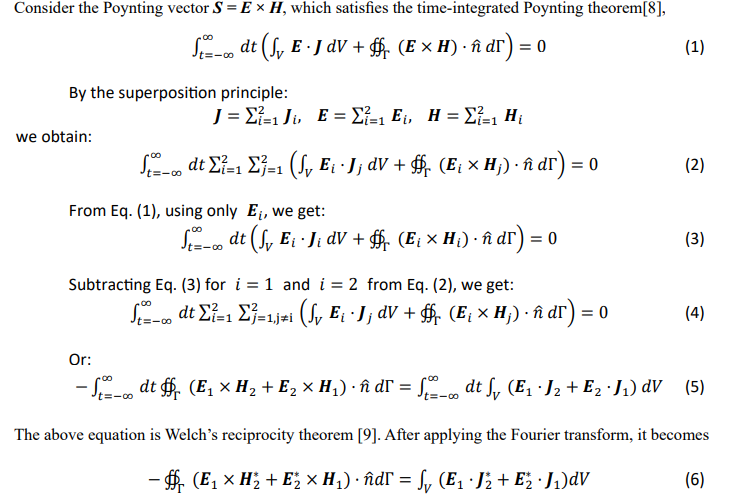
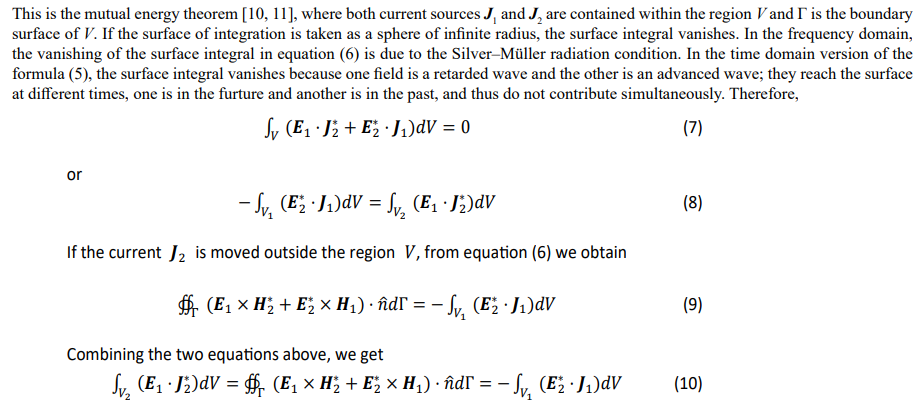
Consider the Poynting vector S = E × H, which satisfies the time-integrated Poynting theorem[8],
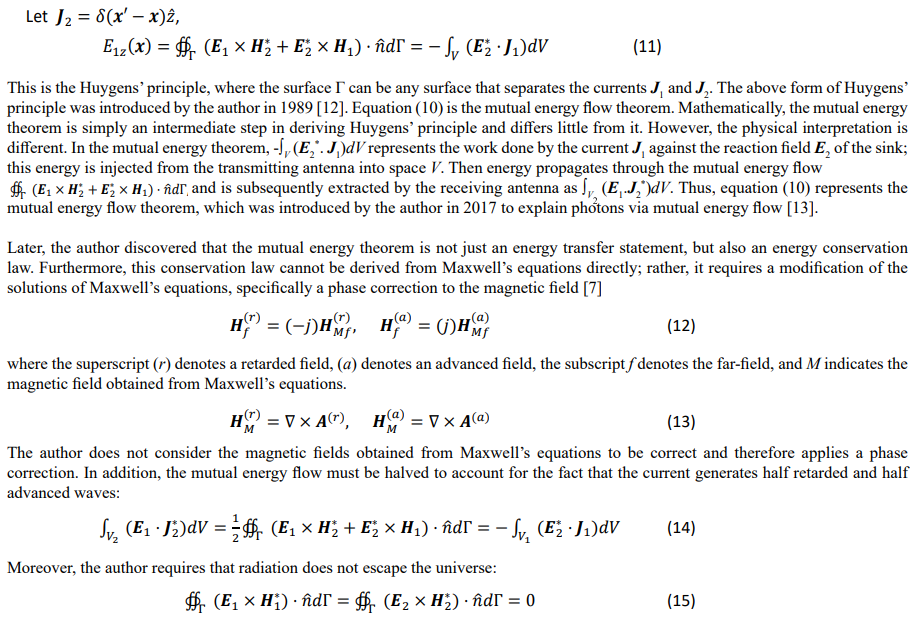
Equation (12) ensures that the above conditions are satisfied. These energy conservation conditions cannot be derived from classical Maxwell theory [7].
Focus of This Paper
This paper no longer investigates mutual energy flow from the perspective of electromagnetic fields. Instead, it analyzes the problem from the perspective of the Poynting vector and the mixed Poynting vector. We assume the author does not know whether energy is transmitted by mutual energy flow or self-energy flow but attempts to replace self-energy flow with mutual energy flow to explore what consequences may result.
Poynting Vector and Mixed Poynting Vector
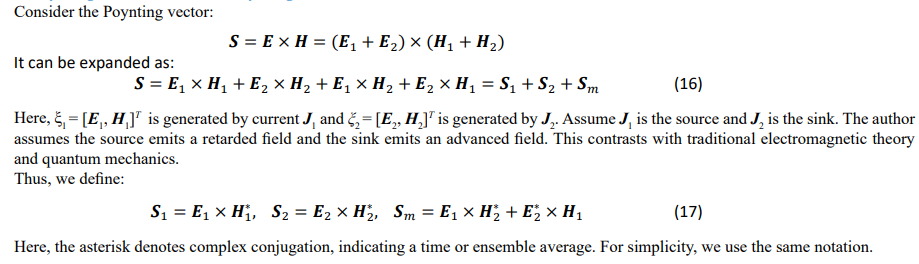
Traditional Electromagnetic Field Theory
Traditional theory asserts that only self-energy flows carry energy. Thus, S1 = E1 ×H1 * does the work, while S2 from the sink is negligible or ignored. In quantum theory, the EM wave (E1, H1) is emitted as a spherical wave, gradually collapsing into a plane wave (photon) directed toward the sink.
Advanced Waves from the Sink
By symmetry, energy might also be carried by the sink’s advanced wave SS2 E2 H∗2 . Initially spherical, it collapses toward the source.
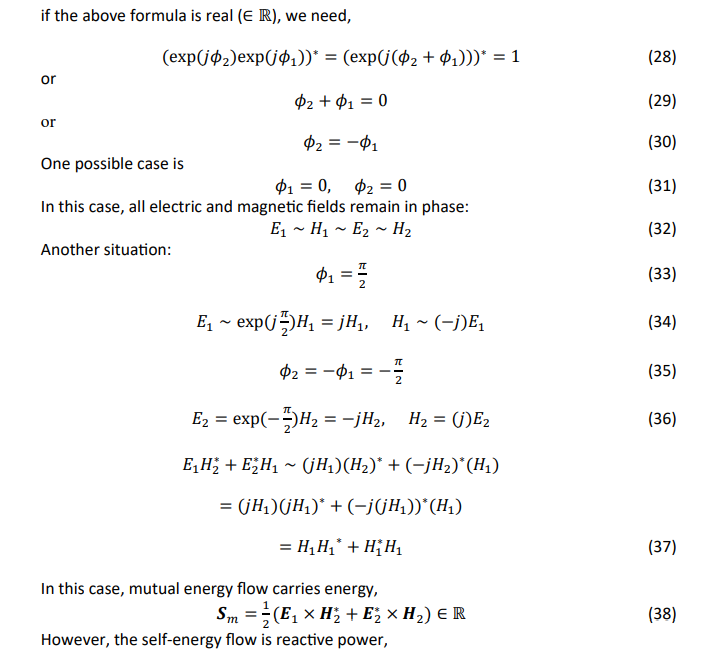
Coexistence of Retarded and Advanced Waves
According to Cramer’s transactional interpretation, the source emits a retarded wave and the sink emits an advanced wave. Their handshake creates a photon. Between source and sink, the superposition yields destructive interference outside the region, forming:
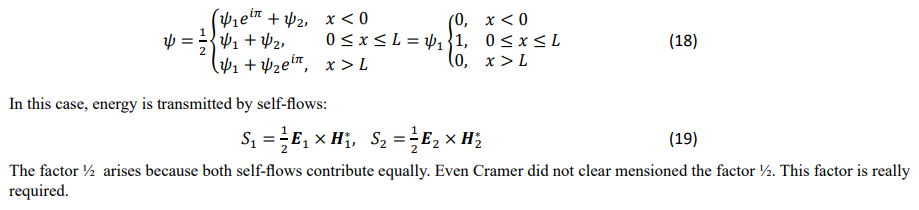
Concurrent Self- and Mutual-Energy Transfer

Mutual-Energy Transfer Only
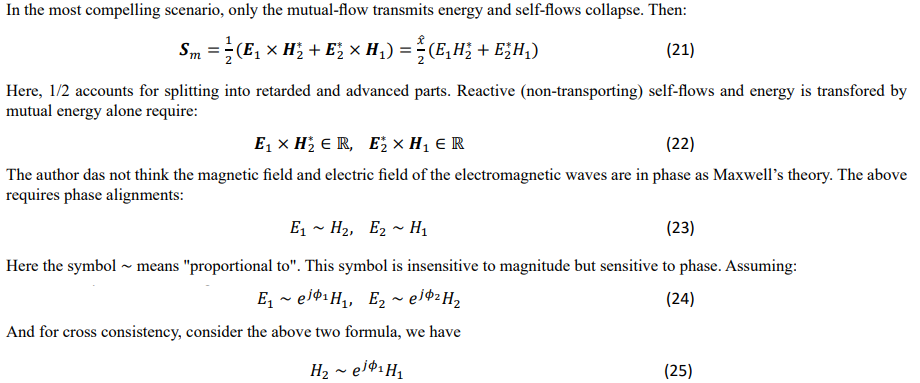
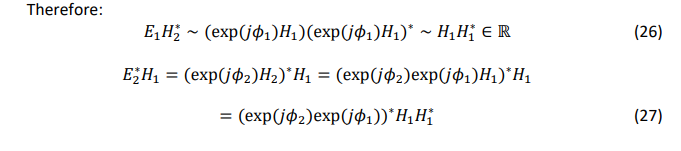
Comparison
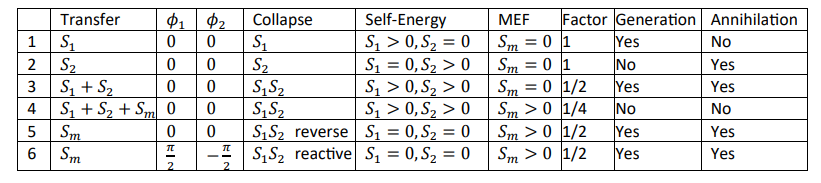
In the table “Transfer” means the energy transfer by which type of energy flow;  and are the phase difference between electric field and magnetic field; “Collapse” tells which energy flow shoud collapse; “Self-Energy” means self energy flow; “MEF” means the mutual energy flow; “factor” is the compress factor of the energy flow; “Gerneration” tells whether this energy flow generates from a source; “Annihilation” tells whether this energy flow annihilates at a sink.
Method 1 corresponds to classical electromagnetic theory and quantum mechanics, where energy transfer is achieved by SS1 only. SS1 results in generation but no annihilation. Methods 2 and 4 have not been proposed by others; the author includes them here to illustrate alternative possibilities. Method 3 is the transactional interpretation of quantum mechanics proposed by Cramer in 1986 [14,15]. This interpretation allows for sources and sinks, as well as retarded and advanced waves. However, it does not compute mutual energy flow.
Method 5 was proposed by the author in 2017 [13]. It does not modify the magnetic field obtained from Maxwell’s equations but instead adds a time-reversed electromagnetic wave to classical theory. The main drawback of this method is that one must introduce a time- reversed Maxwell’s equations.
The first four cases all require wave collapse. The fifth involves reverse wave collapse. Only the sixth does not require any wave collapse! Wave collapse is a physical process, yet there is no established equation describing it. On the other hand, reverse collapse can be described by an equation. If wave collapse could also be described by an equation, it would imply a modification of Maxwell’s electromagnetic theory.
Hence, all these methods inherently involve some correction to Maxwell’s theory. However, only the sixth case explicitly modifies the magnetic field. Moreover, mutual energy flow requires a normalization factor of 1/2 to transfer energy. This normalization factor is not derivable from Maxwell’s equations; it originates from the idea of half-retarded and half-advanced waves [4,5], which again constitutes a correction to Maxwell’s theory.
Examples
Transformer
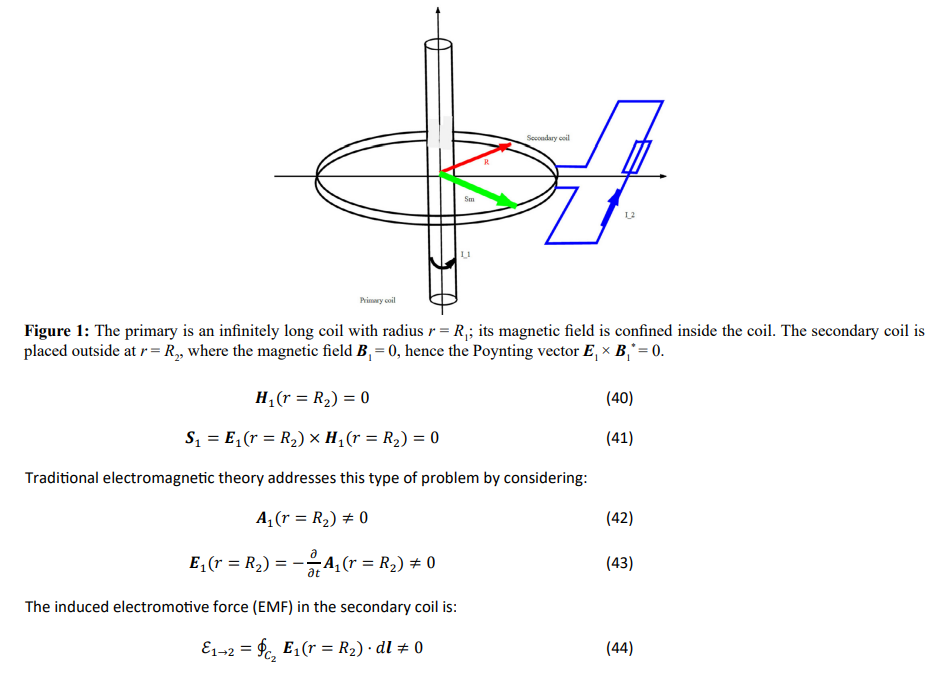
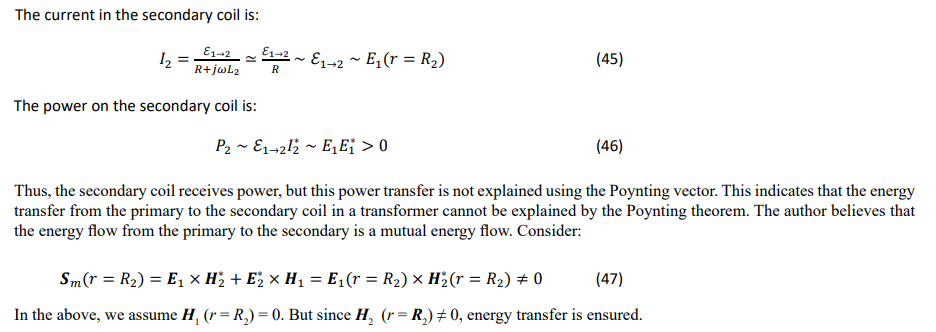
The energy flow in a transformer cannot be due to self-energy flow. This example relates to the so-called Maxwell-Lodge effect. In fact, the Aharonov-Bohm (AB) effect in quantum mechanics is also connected to this issue [16,17].
Assume a primary coil that is infinitely long, with its magnetic field completely confined inside the coil. The secondary coil is wound outside the primary coil at radius r=R2, as shown in Figure 1
Dipole Antenna Pair
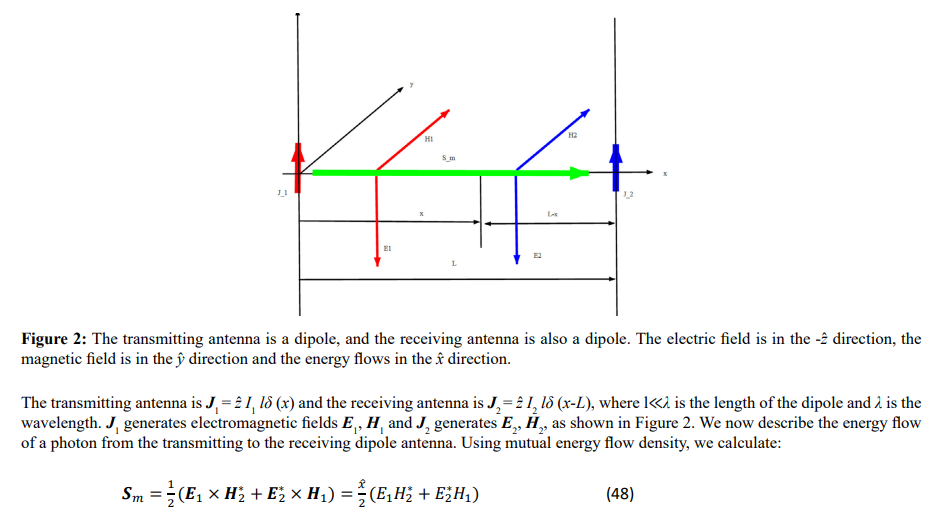
We assume that the source initially emits retarded spherical waves randomly in all directions, and the sink also emits advanced waves in all directions. Suppose the retarded wave from the source and the advanced wave from the sink are synchronized. This means when the electromagnetic wave from the source reaches the sink, the sink emits an advanced wave. Once synchronized, the advanced wave becomes a guiding wave for the retarded wave and vice versa. Due to the interference effect, both waves become quasi-plane waves directed from the source to the sink. This is equivalent to the collapse of both into plane waves.
Since the sink is to the right of the source, we assume the right side of each current emits retarded waves, and the left side emits advanced waves. At the current elements, the wave types flip. Thus, to the right of both currents, we have retarded waves, and to the left, advanced waves. Therefore:
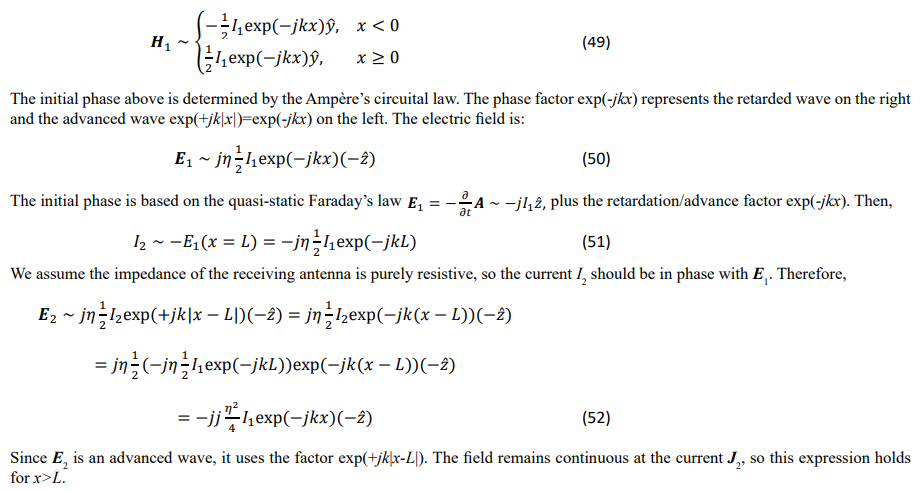
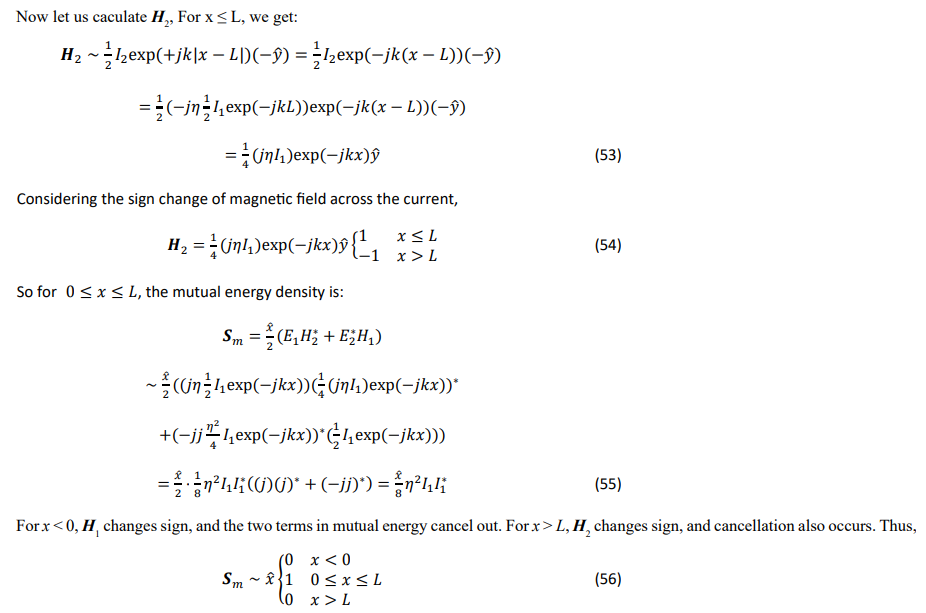
The sign changes of H1 and H2 can be explained either by Ampère’s law or by the wave-type inversion across the current – that is, the switch between retarded and advanced waves, as described by Eq. (12). For E1, H1, the wave is advanced for x < 0 and becomes retarded for x > 0. For E2, H2, it is advanced for x < L and retarded for x > L. This way, the mutual energy flow density Sm is generated at the source (x = 0) and annihilated at the sink (x = L), accurately describing photon creation and annihilation. This example corresponds exactly to Case 6 in the comparison table.
It is evident that when calculating the mutual energy flow, the electric and magnetic fields can be derived under magneto-quasistatic conditions, then modified using the appropriate retarded or advanced phase factors. Of course, Maxwell’s equations can also be used directly, but afterward, one must correct the magnetic field using Eq. (12). The electromagnetic field of a photon is a plane (or quasi- plane) wave and does not contain the static component Es = -∇ , so there is no need to apply correction to Es.
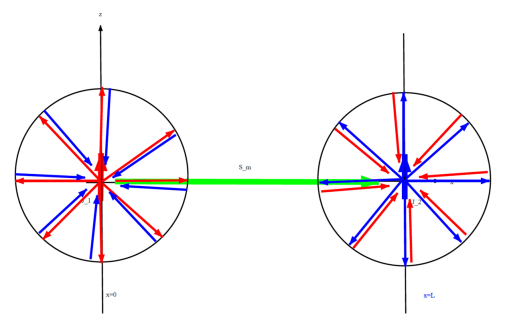
Figure 3: The transmitting and receiving antennas are both dipoles. The retarded and advanced waves are reactive powers and appear to collapse back in all directions.
Only along the source-sink line does mutual energy flow exist. In this example, the source initially emits retarded spherical waves, and the sink emits advanced spherical waves. After synchronization due to mutual interaction, both waves interfere and become quasi-plane waves directed from source to sink. This naturally explains the wave collapse. Alternatively, one can view the retarded and advanced waves as reactive power that is emitted into space and simultaneously collapses back to the source or sink. However, along the source- sink line, due to the existence of mutual energy flow, the energy of one photon is exactly transferred – see Figure 3. This figure also corresponds to Case 5 in the comparison table.
Case 5 is indeed a promising approach. However, it requires manually introducing time-reversed electromagnetic waves. Time-reversed EM waves may also generate time-reversed mutual energy flows, which might cancel the original mutual energy flow. Hence, it is not yet a perfect solution.
In Case 6, the self-energy flow formed by electric and magnetic fields is reactive power. During one oscillation cycle, the wave propagates forward for half the time and backward for the other half. On average, there is no net energy transfer. Since these waves do not transfer energy, they do not need to be interpreted probabilistically. Reactive waves and probabilistic interpretations serve similar roles. In this case, energy is fully transferred by the mutual energy flow.
Conclusion
If mutual energy flow is to replace self-energy flow, it must be normalized by a factor of 1/2 because it consists of two terms, which otherwise would double the energy flow. If energy is indeed transferred via mutual energy, then self-energy flow should not carry energy – otherwise, two types of photons would exist: self-energy photons and mutual-energy photons, contradicting observations. We observe only one type of photon. To prevent self-energy from carrying energy, it must either undergo reverse collapse or be constructed with a 90-degree phase difference between electric and magnetic fields. The latter requires a correction to classical Maxwell’s theory: namely, a 90-degree phase adjustment to the far-field magnetic component. This adjustment allows the magnetic field’s initial phase to be derived under magneto-quasistatic conditions, with the radiation field acquired by appending retarded or advanced phase factors.
The fields between a transmitting and receiving antenna, due to interference, become quasi-plane waves. The mutual energy flow calculated from them is created at the source and annihilated at the sink – precisely matching photon behavior. Thus, the mutual energy flow theory proposed herein can accurately describe photons. These ideas are also applicable to quantum mechanics.
References
- Schwarzschild. K. 1903. Nachr. ges. Wiss. Gottingen, pages 128,132.
- Tetrode. H. 1922. Zeitschrift fuer Physik, 10:137.
- Fokker, A. D. (1929). Ein invarianter Variationssatz für die Bewegung mehrerer elektrischer Massenteilchen. Zeitschrift für Physik,58(5), 386-393.
- Wheeler, J. A., & Feynman, R. P. (1945). Interaction with the absorber as the mechanism of radiation. Reviews of modern physics, 17(2-3), 157.
- Wheeler, J. A., & Feynman, R. P. (1949). Classical electrodynamics in terms of direct interparticle action. Reviews of modernphysics, 21(3), 425.
- Stephenson, L. M. (2000). The relevance of advanced potential solutions of maxwell's equations for special and general relativity.Physics Essays, 13(1), 138.
- Zhao, S. R. (2024). Electromagnetic wave theory of photons: Photons are mutual energy flows composed of retarded and advancewaves. Amazon.
- Poynting, J. H. (1883). On the transfer of energy in the electromagnetic field. Proceedings of the Royal Society of London, 36(228- 231), 186-187.
- Welch, W. J. January 1960. Reciprocity theorems for electromagnetic fields whose time dependence is arbitrary. IRE trans. On Antennas and Propagation, 8(1):68–73.
- Zhao, S. R. 1987. The application of mutual energy theorem in expansion of radiation field in spherical waves. ACTA Electronica Sinica, P.R. of China, 15(3):88–93.
- Zhao, S. R. March 1989.THE APPLICATION OF MUTUAL ENERGY FORMULA IN EXPANSION OF RADIATION FIELD INPLANE WAVES Journal of Electronics, P. R. China, 11(2):204–208.
- Zhao, S. R., Yang, K., Yang, K., Yang, X., & Yang, X. (2017). A new interpretation of quantum physics: Mutual energy flowinterpretation. American Journal of Modern Physics and Application, 4(3), 12-23.
- Cramer, J. G. (1986). The transactional interpretation of quantum mechanics. Reviews of modern physics, 58(3), 647.
- Cramer, J. G. (1988). An overview of the transactional interpretation of quantum mechanics. International Journal of Theoretical Physics, 27(2), 227-236.
- Rousseaux, G., Kofman, R., & Minazzoli, O. (2008). The Maxwell-Lodge effect: significance of electromagnetic potentials in theclassical theory. The European Physical Journal D, 49(2), 249-256.
- McDonald, K. T. 2013. Classical Aspects of the Aharonov-Bohm Effect.