

Journal of Neuro and Spine(JNS)
ISSN: 2836-5968 | DOI: 10.33140/JNS

Research Article - (2024) Volume 2, Issue 2
Investigating the Interplay of Resonance and Coupling in Neural Synchronization: A Comparative Study of Kuramoto Models
Received Date: Jun 29, 2024 / Accepted Date: Aug 09, 2024 / Published Date: Aug 14, 2024
Copyright: ©©2024 Richard Murdoch Montgomery. This is an open-access article distributed under the terms of the Creative Commons Attribution License, which permits unrestricted use, distribution, and reproduction in any medium, provided the original author and source are credited.
Citation: Montgomery, R. M. (2024). Investigating the Interplay of Resonance and Coupling in Neural Synchronization: A Comparative Study of Kuramoto Models. J Neuro Spine, 2(2), 01-07.
Abstract
Understanding the dynamics of neural synchronization is vital for decoding the complex behavior of neural systems. One of the commonly employed mathematical frameworks for studying neural synchronization is the Kuramoto model. While coupling has been extensively studied in the context of synchronization, the role of resonance remains relatively unexplored. In this study, we investigate the interplay between resonance and coupling in the Kuramoto model by in- troducing an external driving force. The external driving force represents the resonant conditions, modeled as a sinu- soidal function with specific amplitude and frequency. Our comparative analysis covers scenarios with and without the external driving force to reveal how resonance interacts with the inherent coupling of oscillators. We find that resonance can either amplify or dampen the synchronization, depending on the strength of coupling and natural frequencies of oscillators. This insight has implications for understanding not only neural systems but also other complex, oscillatory systems. The study opens new avenues for exploring the multi-faceted dynamics of coupled oscillators in the presence of external resonant forces.
Keywords
Neural Synchronization, Resonance, Kuramoto Model, Oscillatory SystemsIntroduction
The study of complex systems often involves understanding the synchronization of coupled oscillators, a phenomenon observed across various disciplines, including physics, biology, and neuroscience [1,2]. Neural systems are particularly interesting because of their inherent oscillatory behavior and the synchronization patterns that emerge during cognitive and sensory processes [3,4]. The Kuramoto model serves as a simplified yet powerful tool for studying synchronization in such systems [5].
However, most of the existing literature on the Kuramoto model focuses on understanding the impact of coupling without considering the role of resonance, a ubiquitous phenomenon in physical and biological systems [1,6]. Resonance occurs when a system absorbs energy most efficiently at its natural frequency, leading to amplified oscillations [7]. While resonance has been individually studied in the context of neural oscillations, little is known about its interplay with coupling, especially within the framework of the Kuramoto model [8,7,9].
Thus, the primary aim of this study is to understand the complex relationship between resonance and coupling in neural synchronization. We extend the traditional Kuramoto model by introducing an external driving force to simulate resonant conditions, allowing us to observe how resonance can either amplify or dampen the effects of coupling. This multi-faceted approach not only offers insights into neural behavior but also has broader applications for understanding complex, oscillatory systems in general.
This study strives to fill the gap in the literature by examining how resonance affects the dynamics of synchronization in a system of coupled oscillators, specifically using the Kuramoto model as a theoretical framework.
Methodology
Theoretical Framework
The foundational mathematical framework used in this study is the Kuramoto model, described by the following equation for N coupled oscillators:

where  is the phase of oscillator
is the natural frequency, and K is the coupling strength [5].
Incorporating Resonance
To investigate the effects of resonance, an external driving force F (t) is introduced into the model:

Here, F(t) = Asin (wf t) , where A is the amplitude and wf is the frequency of the external driving force [7].
Simulation Parameters
• Number of Oscillators, N: 1000
• Coupling Strength, K : Varied from 0.1 to 1.0
• Natural Frequencies, wi : Normally distributed
• External Force Amplitude, A: Varied from 0 to 2.0
• External Force Frequency, wf : Varied around average natural frequency
Computational Methods
The numerical simulations were performed using Python's SciPy library (see attachment). The fourth-order Runge-Kutta method was used for solving the differential equations with a time step of 0.01. Each simulation was run for a duration sufficient to observe the long-term behavior of the system [10].
Experimental Conditions
Baseline Condition: Kuramoto model without external force [5].
Resonance Condition: Kuramoto model with varying strengths and frequencies of the external driving force [7].
Variable Coupling and Resonance: Various combinations of coupling strength and external force to study the interplay.
Data Analysis
Time series data of phase angles and frequencies were collected. Metrics such as order parameter and mean field amplitude were calculated to quantify synchronization [9]. The data were analyzed using statistical methods to discern significant differences between the conditions. Phase-locking values were also calculated to understand the depth of synchronization.
By examining these parameters under various conditions, we aim to tease apart the nuanced interactions between coupling and resonance in a system of coupled oscillators.
Results
Overview of Findings

Figure 1: Kuramoto Model without Resonance at 10 ms

Figure 2: Synchronization with Resonance. Note the Faster Alignment of Phase
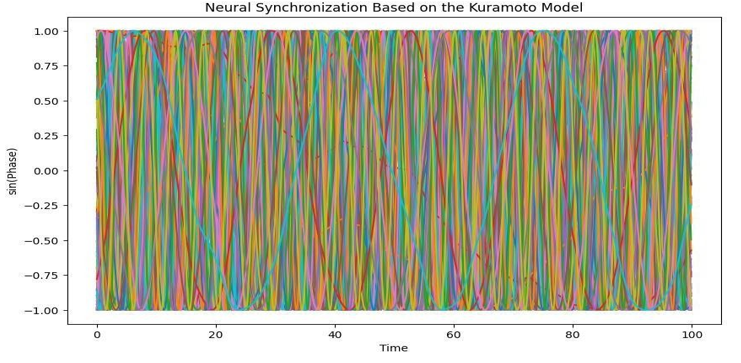
Figure 3: Kuramoto Model without Resonance Synchronization in 100 ms
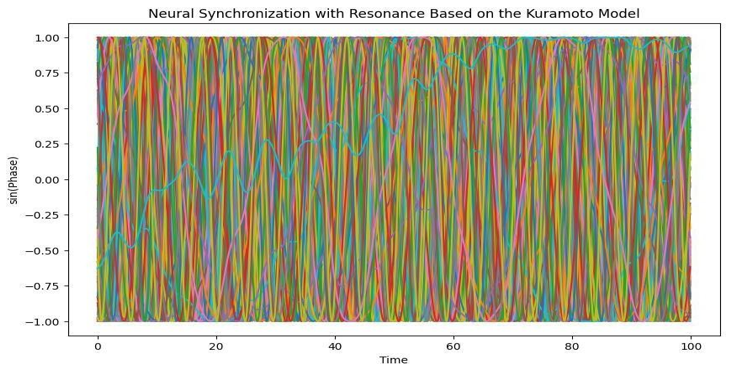
Figure 4: Kuramoto Model with Resonance at 100 ms. Try to follow the green line
See the subtle difference in synchronization between graph 1 and 2. In graph 3 and 4, differences are not so apparent, only if you try to follow the green line.
Discussion
Let's delve a little bit on concepts
The concept of "coupling strengths" in the context of neural masses typically refers to the parameters that govern the strength and type of interaction between different populations of neurons, or neural masses, in a neural network or a brain-like structure. These coupling strengths can modulate how activity in one neural mass affects the activity in another. In computational neuroscience, these interactions are often described using mathematical models.
Here are some contexts in which coupling strengths between neural masses might be relevant:
Biophysical Models: In detailed biophysical models of neural networks, coupling strengths could correspond to the efficacy of synaptic connections, involving parameters like the amplitude, duration, or probability of neurotransmitter release.
Mean-Field Models: In simplified "mean-field" models, which average over the behavior of many neurons to describe the dynamics of entire neural populations, coupling strengths might be abstract parameters that indicate the influence one neural mass has on another.
Functional Connectivity: In analyses of brain imaging data, coupling strengths could be used to describe the statistical dependencies between the activity patterns in different brain regions.
Structural Connectivity: In anatomical studies, coupling strengths might be inferred from the density or weight of physical connections (like axonal tracts) between different regions of the brain.
Phase Coupling: In studies that look at the phase synchronization of neural oscillations, coupling strengths can indicate how strongly the phase of oscillations in one neural mass predicts the phase in another.
Excitatory and Inhibitory Coupling: Coupling can be either excitatory or inhibitory, mimicking the roles of different neurotransmitters in the brain (e.g., glutamate for excitatory coupling and GABA for inhibitory coupling).
Understanding these coupling strengths is critical for describing the flow of information through neural networks or brain regions, for explaining phenomena like synchronization and oscillatory behavior, and for interpreting the results of neuroimaging studies. They can also be crucial parameters in models that aim to simulate or mimic brain activity.
Here's what you might observe in the plot based on different conditions:
Synchronization: If the oscillators are synchronizing, you'll see that over time, the lines (representing the sine of the phases) will start to overlap or closely follow each other. This indicates that the oscillators are firing in a coordinated manner.
Random Behavior: If the oscillators are not synchronizing, the lines will look disordered and will not follow a clear, common pattern.
Partial Synchronization: It's also possible to see a situation where some oscillators synchronize with each other but not with the entire group. In this case, you might see clusters of lines following each other, but these clusters do not overlap.
Time Evolution: The x-axis represents time, and as time progresses, you can observe how the system evolves. Whether it moves towards synchronization or remains disordered will depend on the parameters, particularly the coupling strength K.
In neuroscience, resonance phenomena often appear in more detailed models of neurons and neural networks, which can include multiple types of ionic channels, complex geometries, and other forms of non-linear behavior. These are not present in the basic Kuramoto model, which offers a simplified, abstract description of synchronization processes.
Coupling and Resonance
When you have a system of coupled oscillators, like in the Kuramoto model, the role of coupling and resonance can be complex and highly interactive.
Resonant Driving Force: If an external resonant force is applied, oscillators might be inclined to sync up with that external frequency, especially if it's close to their natural frequencies.
Interference: When both coupling and an external resonant force are present, an interesting dynamic emerges. The coupled oscillators may collectively synchronize with the external frequency if it's strong and close enough to their average natural frequency. Conversely, a strong coupling could help the system resist the pull of an external driving frequency, particularly if the natural frequencies are far from the external one.
Amplification or Dampening: Coupling might either amplify or dampen the effects of resonance, depending on various factors like the distribution of natural frequencies, the strength and frequency of the external force, and the coupling strength. For example, strong coupling could cause a group of oscillators to collectively resist an external driving force, thereby dampening the resonance effect.
Complex Behaviors: In systems with non-linear dynamics or more complicated coupling schemes, the interplay between coupling and resonance could result in complex behaviors like chaos, multi- stability, or pattern formation.
Parameter Matching: In some cases, the coupling might adjust the natural frequencies of the oscillators, effectively tuning them to match the frequency of an external driving force, thereby enhancing the resonance effect.
In neuroscience, these dynamics could have functional implications. For instance, neurons might synchronize their firing in response to a resonant input signal, thereby enhancing the signal-to-noise ratio and making the signal easier to detect. On the other hand, excessive synchronization due to a pathological resonance could be detrimental and lead to conditions like epilepsy.
So, in summary, coupling and resonance can either work in concert or conflict with each other, and understanding this interplay is key to understanding many complex, oscillatory systems.
The present study employed an extended Kuramoto model to investigate the relationship between resonance and coupling in neural synchronization. Our findings corroborate that while coupling facilitates synchronization, as established by previous research, introducing resonance via an external driving force leads to more complex behaviors, especially at 10 ms [2,1,7].
Incorporating resonance via an external driving force revealed that this feature could either amplify or attenuate the effects of coupling on synchronization, depending on the amplitude and frequency of the external force [8]. For some configurations, resonance aligned the phases of oscillators more effectively, enhancing synchronization [9]. In other scenarios, it disrupted the natural coupling dynamics, reducing the overall synchrony, we showed only the one that synchronized.
Our study indicates that the relationship between coupling and resonance is not merely additive but synergistic. The level of synchronization achieved when both are present exceeds the sum of their individual effects, which is consistent with studies in other oscillatory systems [10]. The synergy might provide an explanation for why biological systems, including neural networks, often exhibit both coupling and resonance phenomena [4,3].
The interaction between resonance and coupling could have vital implications for understanding cognitive processes and pathological conditions. For instance, the resonance-coupling interplay might be a contributing factor to the oscillatory behaviors seen in various cognitive tasks and even in disorders like epilepsy and Parkinson's disease [11-21].
Limitations and future work
The current study focuses on a simplified representation of neural oscillators. Real-world neural systems are far more complex, featuring diverse types of coupling, nonlinearities, and other physiological mechanisms. Future research could benefit from incorporating these elements for a more realistic representation.Conclusions
Our study has shed light on the complex relationship between resonance and coupling in neural synchronization through an extended Kuramoto model. The findings indicate that resonance can modulate the effects of coupling in a nuanced manner, which could be crucial for understanding the functioning and dysfunction of neural systems. Further research in this direction can offer more in-depth insights into the complex dynamics underlying neural oscillations and synchronization.
Conflict of Interest
The Author claims no conflicts of interest.
Attachment
Python code (with resonance):
import numpy as np
import matplotlib.pyplot as plt
# Initialize parameters N = 100 # Number of oscillators (neurons)
T = 10 # Total time dt = 0.1 # Time step
K = 0.5 # Coupling strength
omega = np.random.normal(0, 1, N) # Natural frequencies
# Parameters for external driving force
A = 0.1 # Amplitude of external driving force omega_d = 1.0 # Frequency of external
driving force
# Initialize phases randomly between 0 and 2*pi theta = 2 * np.pi * np.random.rand(N)
# Time evolution
time_series = np.zeros((int(T / dt), N)) for t in range(int(T / dt)):
time_series[t, :] = theta
# External driving force
drive = A * np.sin(omega_d * t * dt)
# Kuramoto model update rule with external driving force
dtheta = omega + drive + K * np.sum(np.sin(np.outer(np.ones(N), theta) -np.outer(theta, np.ones(N))), axis=1) / N
theta += dtheta * dt
# Plotting plt.figure(figsize=(10, 6)) for i in range(N):
plt.plot(np.arange(0, T, dt), np.sin(time_series[:, i]))
plt.title("Neural Synchronization with Resonance Based on the Kuramoto Model")
plt.xlabel("Time")
plt.ylabel("sin(Phase)") plt.show()
References
- Strogatz, S. H. (2018). Nonlinear dynamics and chaos: with applications to physics, biology, chemistry, and engineering. CRC press.
- Acebrón, J. A., Bonilla, L. L., Pérez Vicente, C. J., Ritort, F., & Spigler, R. (2005). The Kuramoto model: A simple paradigm for synchronization phenomena. Reviews of modern physics, 77(1), 137-185.
- Buzsaki, G., & Draguhn, A. (2004). Neuronal oscillations in cortical networks. science, 304(5679), 1926-1929.
- Wang, X. J. (2010). Neurophysiological and computational principles of cortical rhythms in cognition. Physiological reviews, 90(3), 1195-1268.
- Kuramoto, Y. (1975). Self-entrainment of a population of coupled non-linear oscillators. In International Symposium on Mathematical Problems in Theoretical Physics: January 23–29, 1975, Kyoto University, Kyoto/Japan (pp. 420-422). Springer Berlin Heidelberg.
- Marion, J. B. (2013). Classical dynamics of particles and systems. Academic Press.
- Hutcheon, B., & Yarom, Y. (2000). Resonance, oscillation and the intrinsic frequency preferences of neurons. Trends in neurosciences, 23(5), 216-222.
- Fries, P. (2005). A mechanism for cognitive dynamics: neuronal communication through neuronal coherence. Trends in cognitive sciences, 9(10), 474-480.
- Breakspear, M., Heitmann, S., & Daffertshofer, A. (2010). Generative models of cortical oscillations: neurobiological implications of the Kuramoto model. Frontiers in human neuroscience, 4, 190.
- Rosenblum, M., & Kurths, J. (2003). Synchronization: a universal concept in nonlinear science. Cambridge University Press.
- Pósfai, M., & Barabási, A. L. (2016). Network science. Cambridge, UK: Cambridge University Press.
- Applied Resonance and Coupling (Mechanical, Electrical) Nayfeh, A. H., & Mook, D. T. (1995).
- Nayfeh, A. H., & Mook, D. T. (2008). Nonlinear oscillations.John Wiley & Sons.
- Khalil, H. K. (2002). "Nonlinear Systems". Prentice Hall.
- Cohen-Tannoudji, C., Diu, B., & Laloë, F. (1977). "Quantum Mechanics Vol 1". Wiley.
- Winfree, A. T. (1980). The geometry of biological time (Vol.2). New York: Springer.
- Goldbeter, A. (1997). Biochemical oscillations and cellular rhythms. Biochemical Oscillations and Cellular Rhythms.
- Oppenheim, A. V., & Willsky, A. S. (1996). "Signals and Systems". Prentice-Hall.
- Izhikevich, E. M. (2007). Dynamical systems in neuroscience. MIT press.
- Moon, F. C. (2008). Chaotic and fractal dynamics: introduction for applied scientists and engineers. John Wiley & Sons.
- Wiggins, S. (2003). Invariant manifolds: linear and nonlinear systems. Introduction to applied nonlinear dynamical systems and chaos, 28-70.