

Journal of Humanities & Social Sciences(JHSS)
ISSN: 2690-0688 | DOI: 10.33140/JHSS
Impact Factor: 1.1

Research Article - (2026) Volume 9, Issue 3
Intuitive Advertising
2Professor and Chair of the Marketing Department in the Lubin School of Business, United States
Received Date: Feb 17, 2026 / Accepted Date: Mar 13, 2026 / Published Date: Mar 20, 2026
Copyright: ©2026 Francisco J Quevedo, et al. This is an open-access article distributed under the terms of the Creative Commons Attribution License, which permits unrestricted use, distribution, and reproduction in any medium, provided the original author and source are credited.
Citation: Quevedo, F. J., Gopalakrishna, P. (2026). Intuitive Advertising. J Huma Soci Scie, 9(3), 01-09.
Abstract
Consumers decisions are mostly intuitive, but when their choices and preferences are challenged or questioned in any way, consumers will tend to defend decisions by rationalizing what were from the beginning quick intuitive choices. However, advertisers insist on following 20th Century models of consumer behavior, which were based on the logic of consumption, thereby wasting billions of dollars trying to argue against feelings. Marketers should aim instead at triggering quick decision-making up front, using rational criteria only to support otherwise intuitive choices, if deemed necessary, to help customers justify their preferences post-facto, rather than focusing on logic first. This paradigm shift might be the key to future marketing communications success.
Keywords
Brand Appeal, Intuition, Consumer Preference, Logic, Rationalization, Paradigm
Introduction
This paper derives from a conference presentation at the Northeast Decisions Sciences Institute (NEDSI) in Cambridge, Massachusetts, and makes the case for intuitive, instead of rational, advertising, striking at the heart of the central and peripheral route theory of Petty, Cacioppo, & Schumann (1983), which proposes that high-involvement purchases will react better to argumentative advertising, while choosing staples will respond to a more symbolic means of communication, and most especially, this paper goes against common business practice; it is a call for rectification [1]. Our message: Persuasion over argumentation, cues and symbols over words.
According to Kahneman (2003, 2011), even our most important decisions in life are intuitive, if not emotional, while Simon (1987) would have added that consumer choice tends to be pre-established, but rationalized when questioned, a process he called “satisficing [2-4].” Despite clear findings that support a less than rational consumer decision process, Casais and Pereira (2021) point out that the 20th Century model of consumption logic continues to dominate advertising models in the 21st Century [5]. According to Statista (Navarro, 2023), close to $800 billion are being spent annually on price-based promotions; indeed, advertising is still very much attribute-based (Khanna, 2016) [6,7]. Our own monitoring of TV ads between 2024 and 2025, measured rationality dominating 70.77% of the spots.
Advertisers would do a better job at grabbing the attention of their target audiences up front if they tickled their intuition and supported their messages with rational criteria, if at all, to help consumers justify their preferences, instead of doing it the other way around, coming in hard with discounts and otherwise rational offers. Vargo & Lusch (2004) would include this shift in paradigms in the new evolving logic of Marketing [8].
Quevedo & Gopalakrishna (2020) found that consumer decisions are based on a combination of rational, intuitive, social, sensory, and emotional criteria, not to mention social references, pursuing Dalgic & Unal’s (1971) suggestion that deciphering the mystery created by the consumer’s thought-processes and perceptions, “the black box,” as it applies to different consumption scenarios, would be fundamental to defining and executing more effective marketing strategies [9,10]. The rational bias might be too costly, and misguided. Marketers may be failing to properly appeal to their target audiences, by focusing on logical arguments, which may be based on the wrong set of criteria.
Review of Literature
MacLean (1973) found that intuition is at the heart of our most primeval thought processes [11]. Indeed, intuitive thinking is more common, it is a quick and agile process says Kahneman (2011), while reasoning is slower [3]. Donohew, Dhoundiyal, & Cook (1988) state that intuition acts as the brain’s attention gatekeeper, making attention selective, and perception highly intuitive [12]. Accordingly, to reach the rational-processing brain, stimuli like advertising cues and messages must get through the intuitive brain, lest they are filtered out. Rationalization might be grossly overrated.
But what is intuition? Vaughan (1979) defines intuition as a way of knowing, recognizing things, a sixth sense, sort of speak, an unconscious process, most times [13]. Research by Roeser (2010) supports the idea that people follow their initial intuition (their “gut feeling,” he says) in making their decisions, while Denes-Raj & Epstein (1994) found that they do so sometimes against their better judgment, suggesting, with a bit of irony, perhaps, that intuition is â?¯in the endâ?¯ “irrational [14,15].” And yet, people have intuitive feelings and opinions about almost everything, said 2003 Nobel Prize winner Daniel Kahneman, who added that intuition supports most of our actions and decisions. Lastly, Kavalali (2015) suggests that many of our actions may have nothing to do with conscience, but with neurochemical dynamics [16].
Indeed, Eser, Isin, Bahar, & Tolon (2011) found that unconscious mental processes are major influences in people’s deliberations, extending Simon’s (1987) theory of bounded rationality into consumer decision-making [17]. Valente (2012) suggests that decisions are made by feeling, and that what follows is simply rationalizing [18]. West, Brockett, & Golden’s (1997) study on the role of intuition in neural networks, which aimed at building a predictive model of consumer choice, rationalization was found to be a means of making sense of otherwise intuitive and emotional decisions [19]. Furthermore, Bettman, Luce, & Payne (1998) had found that consumers choose based on pre-established preferences, or “evoked sets [20].” More recently, Schley, De Langhe, & Long (2020) found that rationalization –in the end– has diminishing returns, which could suggest that intuitive decision making has –on the contrary– an increasing marginal effect, meaning that the more consumers think about a purchase, and the more money they have to do as they please, the less likely they are to be rational about it, clinging to their intuitive or emotional preference (Quevedo, 2019) [21,22].
Rationality, as a construct, has also been analyzed; Rutgers (1999) suggested that a new concept was needed [23]. Indeed, Bargh (2002) questioned to what extent people are aware and in control of whatever influences, and the reasons for, their purchasing and consumption behavior [24]. “Are consumers really rational?” has been asked repeatedly (Steven, 2006; Shugan, 2006) [25,26]. Indeed, Gobé (2007) challenged the business establishment to consider feelings as human as rational thought, as we suggest in this paper [27].
Our Research
We put out a national survey of more than 740 respondents, presented with close to 150 questions, using Qualtrics and Amazon Mechanical Turk to sample the American middle-class, testing how consumers establish their brand preferences by measuring the weight of rationality, intuition, sensory and emotional considerations, and then challenged their preferences with cheaper offers from the less-preferred brands, to calibrate which criteria dominated their second-thoughts and deliberations, determining through advanced SEM Path Analysis what leads to the consumers’ choices, and how they defend them afterward. A combined scale was used, following Fishbein & Ajzen (1974) findings about the multidimensional nature of attitudes [28].
Two industries served to test the reliability of the scale; one would be the automobile industry, considering two extremes, popular vs. high-end brands, while the other was fast food vs. casual dining, to allow for quick thinking vs. more deliberate decision-making at each level. Well-known, most popular brands would allow subjects to express well-founded opinions; Toyota®, Hyundai® and Ford®, were used for popular cars, and BMW®, Mercedes Benz® and Lexus®, for premium vehicles. In terms of fast food, the top choices for American consumers are McDonald’s®, Starbucks®, Subway®, Taco Bell®, and Chick-fil-A®. Three of these were be singled out for testing, and in the casual dining category, restaurant chains like The Olive Garden®, Chipotle®, and Applebee’s® would point to high-end decisions.
After two test runs of the survey, the final sample was presented with 12 statements per brand to separate logical, intuitive, sensory and emotional criteria, one ranking question was presented to order their preferences, and one willingness-to-switch question for each of 12 products in the four distinct categories was used as the experimental manipulation. Statistical tests proved the scale’s reliability (Cronbach’s Alpha from .945 to .968), and the model’s significance (sig. .000).
Guided by four hypotheses, our research showed that (1st) consumer choice is guided by a combination of rational, intuitive, sensory and/or emotional criteria, with R coefficients between .736 and .762; (2nd) that emotional and intuitive appeals will have a stronger determining effect on brand preference, with R values dropping to .467 when measured separately; and (3rd) that even when considering high-ticket items, like buying a BMW®, for instance, intuitive criteria will dominate decision-making, with a regression coefficient of .71 as shown by the SEM Path Analysis graph below.

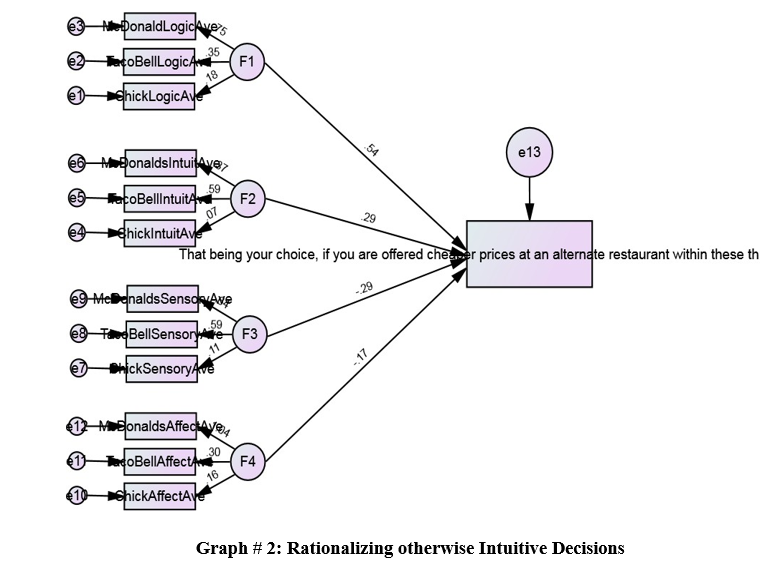
Lastly (4th), our research showed that intuitive brand preferences are rationalized when they are challenged by a competitive offer, turning a rather simple intuitive decision into a rationalized defense of the consumer’s choice, with a regression coefficient of .54 as shown below
Graph # 1: Intuition Dominates High-Involvement Decisions
Discussion of research Results
Our findings that consumer choice is guided by a combination of rational, intuitive, sensory and/or emotional criteria are consistent with the research of Zajonc & Markus (1982), Pawle & Cooper (2006), Chang & Tuan Pham (2013), Fetterman & Robinson (2013), Cian, Krishna, & Schwarz (2015), and Sweldens, Van Osselaer, & Janiszewski (2010); that emotional and intuitive appeals will have a stronger determining effect on brand preference confirms Hartman’s (2018) “compelling force” theory, Danesi’s (2018) “meaning of meaning” hypothesis, and confirms Bergqvist & Cowan’s (2018) finding that brand choice is not reason responsive; what we found, contradicts Petty et al.’s (1983) central -periphery theory by showing that even high-involvement purchase decisions follow intuitive criteria, extending Nobel Prize winning psychological research into brand choice decisions, confirming that brand preferences are rationalized when challenged as previously shown by Woodham, Hamilton, & Leak (2017) [1,29-38].
Managerial Implications
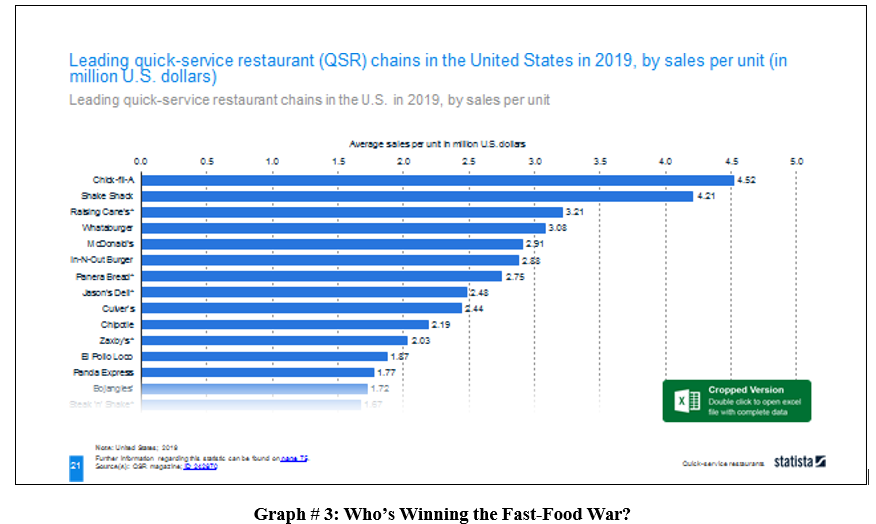
If Aaker (1996) found that brand personality can be manipulated in practice to influence brand choice, and considering the proven and determining influence of intuitive appeals in the setting of brand preferences, marketers may be missing the point when they argue the case in favor of their brands, as the rational approach may be irrelevant in determining consumer choice [39]. Offering combos for $5, for instance, will not stem the tide of consumers that are switching from the golden arches to a chicken filet, as Bazan (2024) found, and as the graph below shows [40].
The essence of our message is: if intuitive appeals matter so much, even in high-ticket purchase decisions, like purchasing a BMW®, rational advertising, based on price, in particular, will be generally ineffective. Marketers should find a way to point their messages, and their branding, a promise fulfilled, as Mullin (2006) defines it, to the brain’s intuitive and very selective gatekeeper, MacLean’s (1973) reptilian core, if they want to capture their consumers’ attention, especially in today’s day and age of fast digital marketing and intensive social media clutter, when all you have is a fraction of a second to catch the eye of your target, while they scroll on their cellphones; if consumers do “follow their nose” to make their decisions, why argue, literally? Arguments, in any case, should be designed as support, to help consumers rationalize otherwise intuitive decisions. Advertising should be â?»thereforeâ?» intuitive, not rational [41].
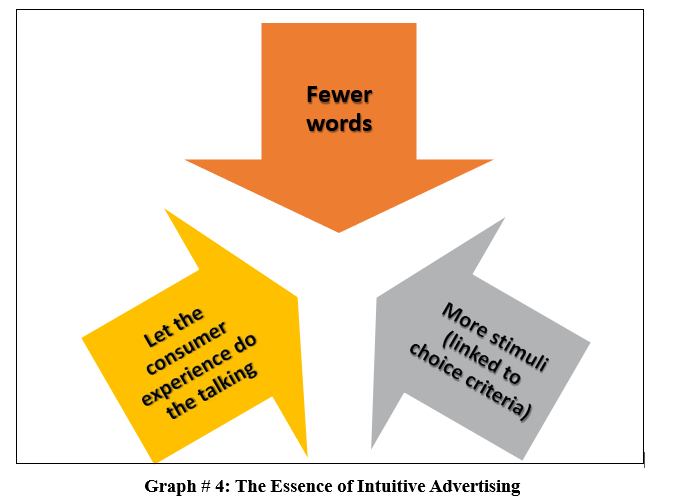
As suggested in Graph # 4 below, intuitive advertising uses fewer words and more stimuli to let the audience create the message in their minds. Sometimes, 15 seconds of silence in a TV ad can be more convincing than 30 seconds of empty arguments that do not click with the audience.
However, Kapferer & Kapferer (2004) pointed out that to define the proper branding strategy, and to sustain it toward the long-term, brand managers must calibrate their brands, and the competition, based on a more holistic and integrated scale, that is, on a wider set of considerations that go beyond the logical price and quality, and apply an integrative approach (Srinivasan, 1987) to determine, as we suggest, how they are being viewed by their audiences and consumers based on a combination of rational, intuitive, sensory and emotional appeals [42,43]. Only then can they decide on a proper course of action. Combining ignorance with initiative can be dangerous and costly, but ignoring the consumer is unforgiveable.
Intuitive ads represent only 3.08% of our 2024-2025 TV monitor. A clear example is Chick-fil-A®, a chain of fast-food that does not open on Sundays and evidently has far fewer points of sale than McDonald’s®, and yet is leading in sales per unit in the US, a fact that tends to corroborate, in “dollars and sense,” our findings and proposal: Intuitive advertising is more effective. Indeed, their ads are quite simple, and are supported by a fulfilled promise in each and every restaurant.
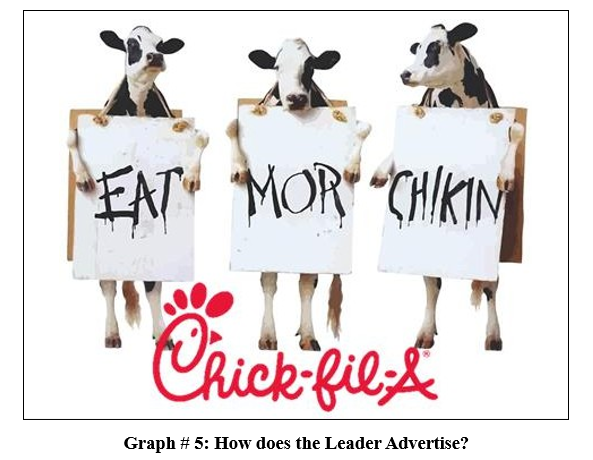
Intuitive advertising favors persuasion over argumentation. It uses more images and symbolism, less words, to allow consumers to reach their own conclusions. But beware, if a brand is a promise, branding must fulfill that promise. Advertising must be backed by effective operations, to let the customer experience do the talking (Cleff, Chun, & Walter 2014) [44].
In the casual dining sector, Chipotle® leads Applebee’s® in consumer preference. As shown in Graph # 6 below, their messages are quite opposed. One contains three words, the other uses ten words, or close to 35 when you include the footnote which nobody reads. One refers to ingredients, the other points to price. And one lets you interpret “ingredients” as you wish, be it freshness, taste or whatever, while the other leaves nothing to the imagination: $12.99, period!

Graph # 6: Intuition beats Reason
And even in the high-end automobile segment, we see the leader pursue intuition, whereas in the popular cars segment, advertisers emphasize monthly leasing costs as their main argument. When making the more important decisions, such as buying a BMW®, the senses, emotions and intuition, not reason, seem to be the driving force (pun intended), as shown on Graph # 7 below.

Graph # 7: Appealing to the Senses
Below is another example of a wordless ad that says it all. It plays with the audience’s imagination, and allows consumers to reach their own conclusions.

Graph # 8: When words aren’t necessary
Limitations and Future Research
Surely, when all you have is five bucks to get a meal, a $5 combo sounds most reasonable. Although we evaluated fast-food, casual dining, popular cars, and high-end vehicle purchases, not all consumer scenarios will necessarily follow the same criteria. Therefore, we propose to extend the RISE scale to include another “S” for social references, weighing the moderating effect of income and budget, and measuring the mediating effect of advertising on brand preferences, reaching into other product scenarios.
Conclusion and Recommendations
$800 billion dollars are being wasted in rational advertising. Advertisers may be missing their targets by appealing to logic when their audiences follow their feelings to make their decisions, and worse yet, when they have only a fraction of a second to decide, intuitively, what post to read and which influencer to pay attention to on social media (Kusumasondjaja, 2018) [45]. Emotional appeals may work (Lee, 2019), but the mind will tend to override the thought process (McMillan, 2014) [46]. Indeed, Batoni (2015), a psychiatrist, separates the concept of the mind from the definition of the brain [47]. He says that the brain is a neurological system, and the mind, a system of meanings and interpretations. Clues matter more than words in today’s advertising landscape (Sengupta, Goodstein, & Boninger, 1997) [48].
If intuition is so prevalent in consumer choice, if consumers are so intuitive in making decisions, why argue? Advertisers should try to say it all without saying anything. Use more cues than arguments.Let that black box in the audience’s mind do the work.
References
- Petty, R. E., Cacioppo, J. T., & Schumann, D. (1983). Central and peripheral routes to advertising effectiveness: The moderating role of involvement. Journal of consumer research, 10(2), 135-146.
- Kahneman, D. (2003). A perspective on judgment and choice: Mapping bounded rationality. American Psychologist, 58(9), 697-720.
- Kahneman, D. (2011). Thinking, fast and slow. Macmillan.ISBN 978-0374275631.
- Simon, H. A. (1987). Making Management Decisions: The Role of Intuition and Emotion. The Academy of Management Executive (1987-1989), (1). 57.
- Casais, B., & Pereira, A. C. (2021). The prevalence of emotional and rational tone in social advertising appeals. RAUSP Management Journal, 56(3), 282-294.
- Navarro, J.G. (2023), Media spending worldwide 2014-2022. [Chart] Statista.
- Khanna, P. (2016). A content analysis of emotional and rational appeals in selected products advertising. Soc Sci, 4(03), 2016.
- Vargo, S. L. & Lusch, R. F. (2004). Evolving to a new dominantlogic for marketing. Journal of Marketing, 68(1), 1-17.
- Quevedo, F., & Gopalakrishna, P. (2020). The 4 anchors of brand identity: Gaps in the literature. Journal of Humanities and Social Sciences, 3(2), 1-7.
- Dalgic, T. and Unal, S. (1971), Utilizing Consumer Psychology in Business Strategy, Hershey, PA, Business Science Reference.
- MacLean, P. (1973). A triune concept of the brain and behaviour: Hincks memorial lectures. University of Toronto Press.
- Donohew, J. F., Dhoundiyal, V., & Cook, P. L. (1988). Attention and our Ancient Past: The Scaly Thumb of the Reptile. The American Behavioral Scientist (1986-1994), 31(3), 312.
- Vaughan, F. E. (1979). Awakening intuition. Anchor.
- Roeser, S. (2010). Intuitions, Emotions and Gut Reactions in Decisions about Risks: Towards a Different Interpretation of ‘Neuroethics’. Journal of Risk Research, 13(2), 175.
- Denes-Raj, V., & Epstein, S. (1994). Conflict between intuitive and rational processing: when people behave against their better judgment. Journal of Personality and Social Psychology, (5), 819.
- Kavalali, Ege T. (2015). The Mechanisms and Functions of Spontaneous Neurotransmitter Release. Nature Reviews Neuroscience (1) 5.
- Eser, Zeliha, Isin, F. Bahar, & Tolon, (2011). Perceptions of Marketing Academics, Neurologists, and Marketing Professionals about Neuromarketing. Journal of Marketing Management, 27(7-8), 854-868.
- Valente, M. (2012). Evolutionary demand: a model for boundedly rational consumers. Journal of Evolutionary Economics, 22(5), 1029.
- West, P. M., Brockett, P. L., & Golden, L. L. (1997). A comparative analysis of neural networks and statistical methods for predicting consumer choice. Marketing Science, 16(4), 370.
- Bettman, J. R., Luce, M. F., & Payne, J. W. (1998). Constructive consumer choice processes. Journal of consumer research, 25(3), 187-217.
- Schley, D. R., De Langhe, B. & Long, A. R. (2020). System 1 Is Not Scope Insensitive: A New, Dual-Process Account of Subjective Value. Journal of Consumer Research.
- Quevedo, F. (2019). Given the Time and the Money to Think, Consumers will Rely more on Intuition, Sensations, and Emotions, rather than Rationale, to Decide. Advanced Journal of Social Science, 6(1), 38-47.
- Rutgers, M. R. (1999). Be rational! But what does it mean? A history of the idea of rationality and its relation to management thought. Journal of Management History, 5(1), 17-35.
- Bargh, J. A. (2002). Losing consciousness: Automatic influences on consumer judgment, behavior, and motivation. Journal of consumer research, 29(2), 280-285.
- Steven M., S. (2006). Editorial: Are Consumers Rational?Experimental Evidence. Marketing Science, (1), 1.
- Shugan, S.M. (2006). Are Consumers Rational? Marketing Science. 25(1):1-7; Institute for Operations Research and the Management Sciences (INFORMS).
- Gobé, M. (2007). Let’s Brandjam to Humanize Our Brands.Design Management Review, 18(1).
- Fishbein, M. & Ajzen, I. (1974). Attitudes towards objects as predictors of single and multiple behavioral criteria. Psychological Review, 81(1), 59-74.
- Zajonc, R. B. & Markus, H. (1982). Affective and Cognitive Factors in Preferences. Journal of Consumer Research, 9(2), 123-131.
- Pawle, J., & Cooper, P. (2006). Measuring emotion— Lovemarks, the future beyond brands. Journal of advertising research, 46(1), 38-48.
- Chang, H. H. & Tuan Pham, M. (2013). Affect as a Decision-Making System of the Present. Journal of Consumer Research, 40(1), 42.
- Fetterman, A. K., & Robinson, M. D. (2013). Do you use your head or follow your heart? Self-location predicts personality, emotion, decision making, and performance. Journal of Personality and Social Psychology, 105(2), 316.
- Cian, L., Krishna, A., & Schwarz, N. (2015). Positioning rationality and emotion: Rationality is up and emotion is down. Journal of Consumer Research, 42(4), 632-651.
- Sweldens, S., Van Osselaer, S. M., & Janiszewski, C. (2010). Evaluative conditioning procedures and the resilience of conditioned brand attitudes. Journal of Consumer Research, 37(3), 473-489.
- Hartman, B. (2018), Go Where the People Are: Analyzing Social Media and Methods for Delivering Faith-Based Messages, Drew University, ProQuest Dissertations Publishing, 2018.
- Danesi M. (2018) What Does It Mean? How Humans Represent the World. In: Of Cigarettes, High Heels, and Other Interesting Things. Palgrave Macmillan, New York
- Bergqvist, A. and Cowan, R. (2018). Evaluative Perception.First edition. Oxford University Press.
- Woodham, O. P., Hamilton, M. L., & Leak, R. L. (2017). I Know What I Like, I Like What I Know: How Breadth of Brand Experience and Cognitive Effort Influence Brand Switching. Journal of Marketing Theory & Practice, 25(2), 141-159.
- Aaker, D. A. (1996). Building strong brands. New York: FreePress, c1996.
- Bazan, O. (2024). Chick-fil-A vs McDonald’s. The EMS Sound: Emporia middle-school newspaper. December 17, 2024.
- Mullin, R. (2006). Branding: how to own a piece of your customer’s mind [marketing]. Engineering management, 16(5), 38-39.
- Kapferer, J.-N., & Kapferer, J.-N. (2004). The New Strategic Brand Management: creating and sustaining brand equity long term. London; Sterling, VA.: Kogan Page, 2004.
- Srinivasan, T. (1987). An Integrative Approach to Consumer Choice. Advances in Consumer Research, 14(1), 96-100.
- Cleff, T., I Chun, L., & Walter, N. (2014). Can You Feel it? -The Effect of Brand Experience on Brand Equity. IUP Journal of Brand Management, 11(2), 7.
- Kusumasondjaja, S. (2018). The roles of message appeals and orientation on social media brand communication effectiveness. Asia Pacific Journal of Marketing and Logistics.
- McMillan, A. (2014). Mind and Brain: A Critical Appraisal of Cognitive Neuroscience. Journal of the History of the Behavioral Sciences, 50(1), 112-113.
- Batoni, F. (2015). Jesucristo Psicoanalista. Editoriales Varias, Caracas, Venezuela, ISBN 9789801281498
- Sengupta, J., Goodstein, R. & Boninger, D. (1997). All cues are not created equal: Obtaining attitude persistence under low-involvement conditions. Journal of Consumer Research, 1997.
- Li, S. (2019). Emotional Appeals in Tourism TV Commercials: A Psycho-Physiological Study. Journal of Hospitality & Tourism Research.
- Quevedo, F. & Gopalakrishna, P. (2021). Rationality is Overrated: Brand choice is largely intuitive. Rutgers Business Review, 6(3), Fall edition.
- The Nobel Prize