

Journal of Mathematical Techniques and Computational Mathematics(JMTCM)
ISSN: 2834-7706 | DOI: 10.33140/JMTCM

Impact Factor: 1.3


Research Article - (2025) Volume 4, Issue 1
Introduction to Dynamic Operators: Lprt-Elements and Applications to Physics and Other their Applications
2Aassistant professor of applied mathematics and calculated, techniques department of National Metallurgical Academy, Ukraine
Received Date: Jan 03, 2025 / Accepted Date: Jan 29, 2025 / Published Date: Feb 06, 2025
Copyright: ©Â©2025 Oleksandr Danilishyn, et al. This is an open-access article distributed under the terms of the Creative Commons Attribution License, which permits unrestricted use, distribution, and reproduction in any medium, provided the original author and source are credited.
Citation: Danilishyn, O., Danilishyn, I., Pasynkov, V. (2025). Introduction to Dynamic operators: Lprt-elements and Applications to physics and other Their Applications. J Math Techniques Comput Math, 4(1), 01-16.
Abstract
There is a need to develop an instrumental mathematical base for new technologies. The task of the work is to create new approaches for this by 2 introducing new concepts and methods. Significance of the article: in a new qualitatively different approach to the study of complex processes through new mathematical, hierarchical, dynamic structures, fuzzy hierarchical dynamic structures, in particular those processes that are dealt with by Synergetics. In the articles [1]-[14] new mathematical structures and operators are constructed through one action - “containment”. Here, the construction of new mathematical structures and operators is carried out with generalization to any actions. In the articles [1]- [14] new mathematical structures and operators are constructed through one action - “containment”. Here, the construction of new mathematical structures and operators is carried out with generalization to any fuzzy actions.
Keywords
MHierarchical Structure (Dynamic Operator), Lprt-Elements, TLpr- Elements, Self-Type Lprt-Structure),Flprt-Elements, TFLpr- Elements, Self-Type FLprt-Structure
Lprt Elements, Self-type Lprt-Structures
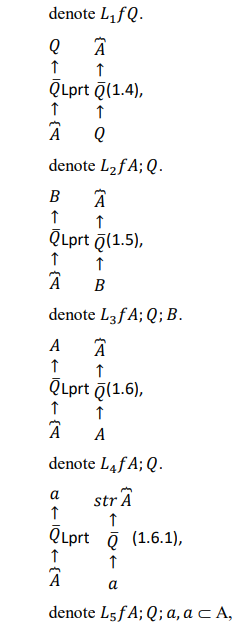
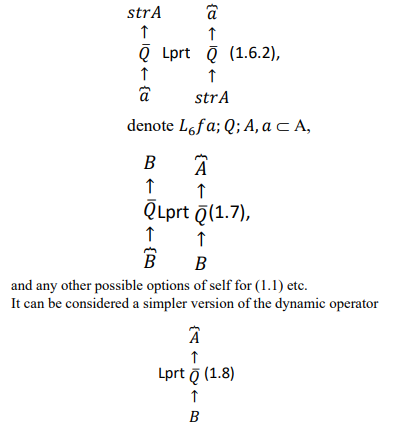
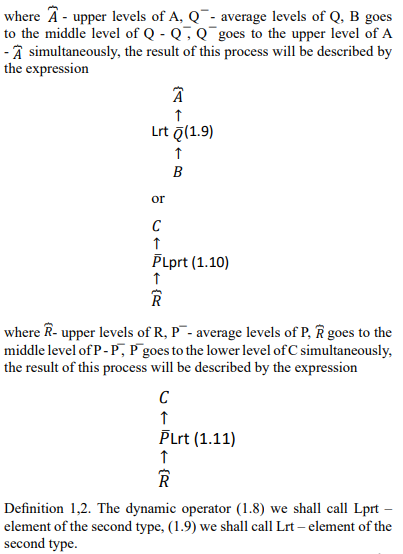
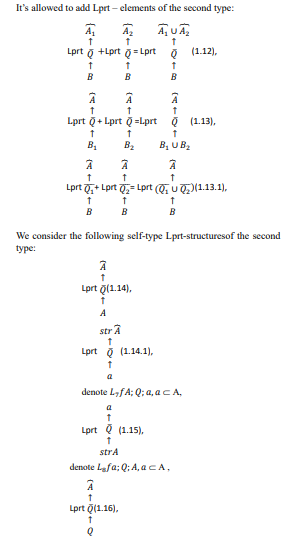
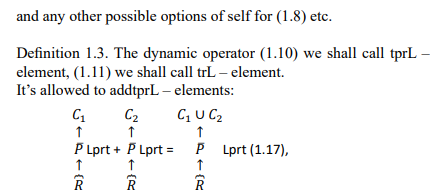
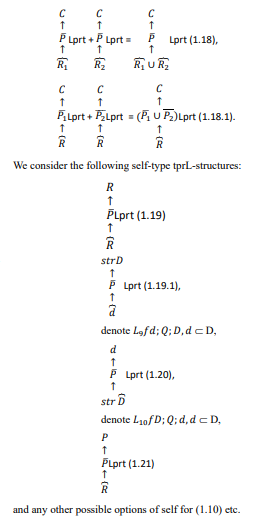
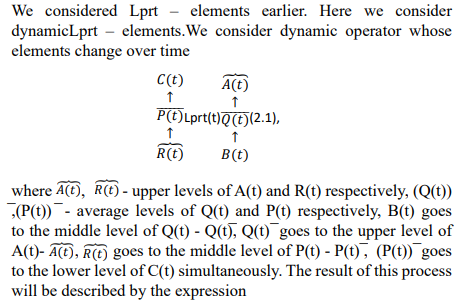
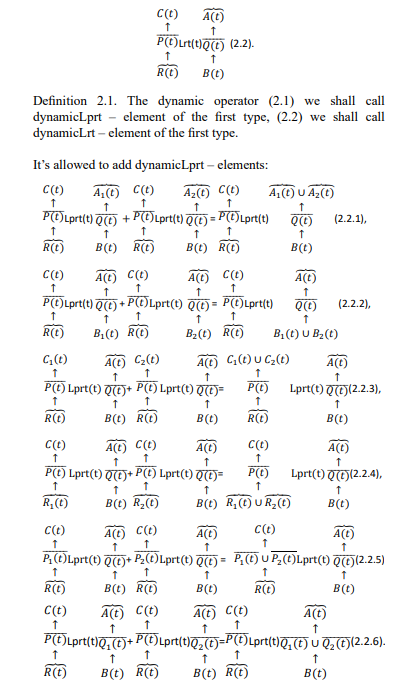
Dynamic Lprt Elements, Self-type Dynamic Lprt-Structures
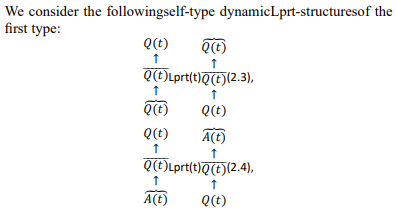
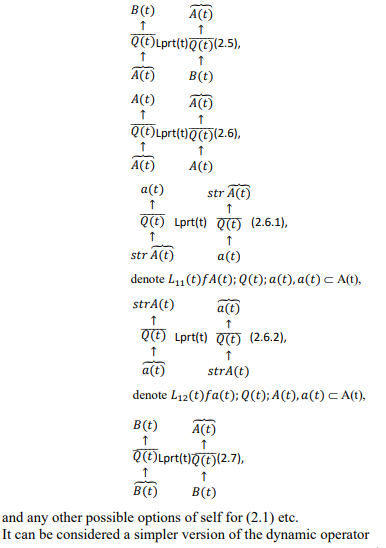
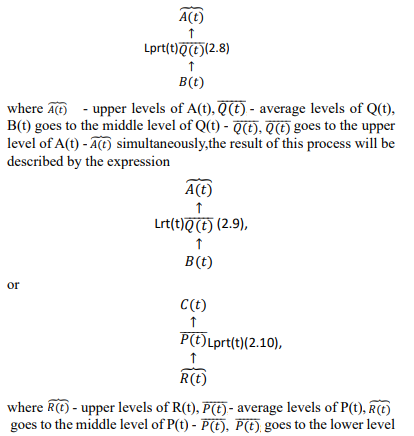
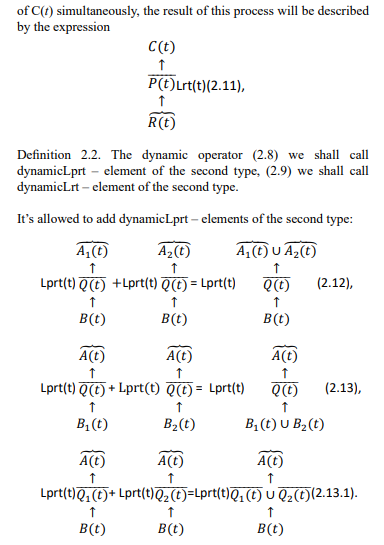
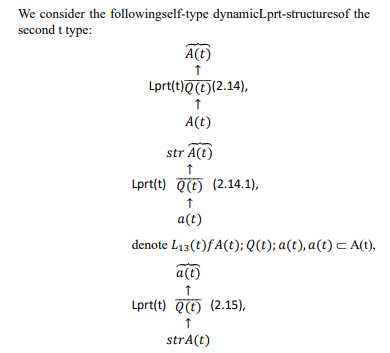
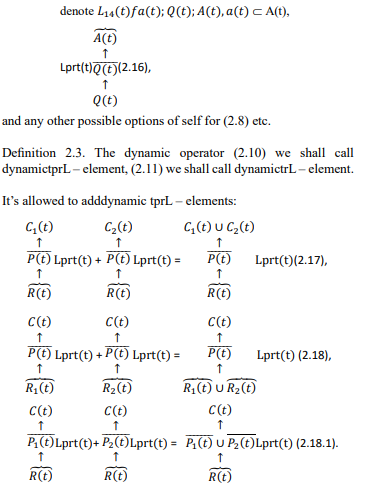
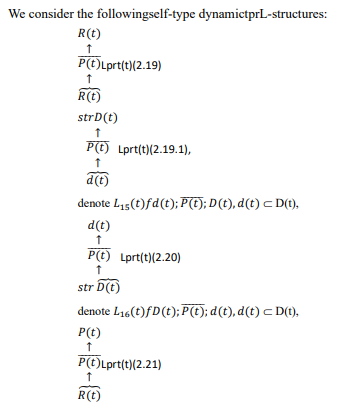
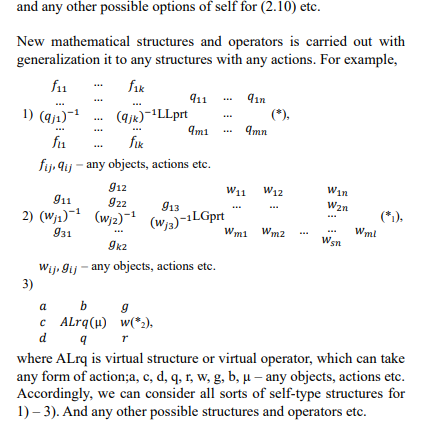
FLprt Elements, Self-type FLprt-Structures
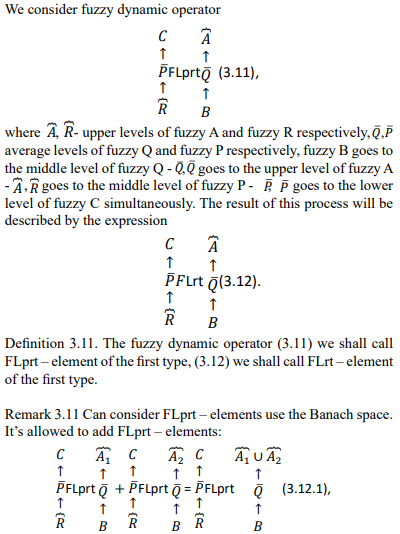
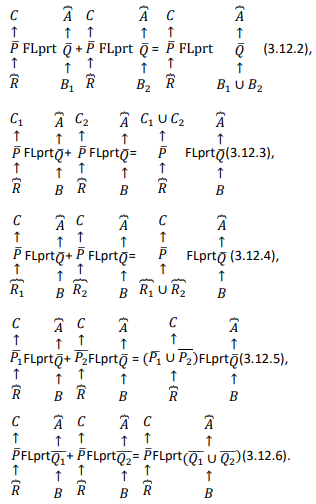
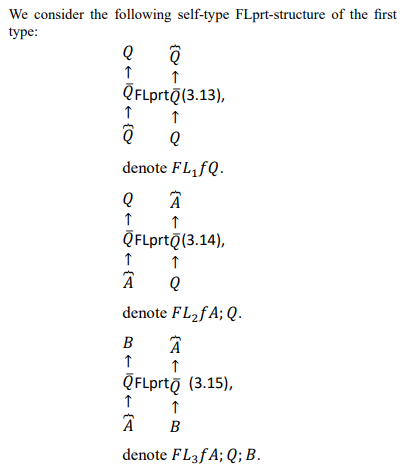
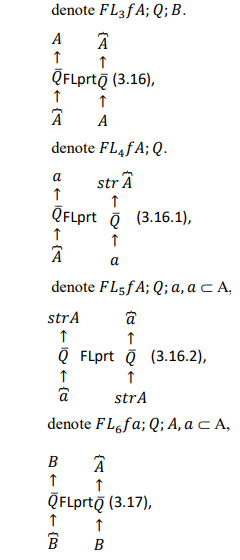
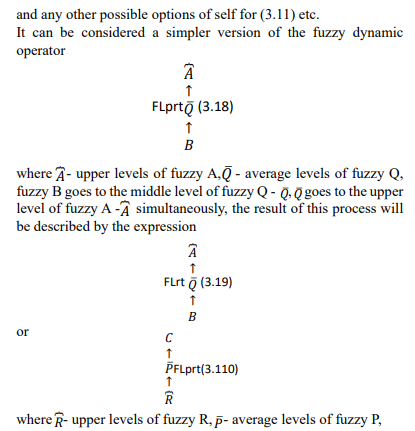
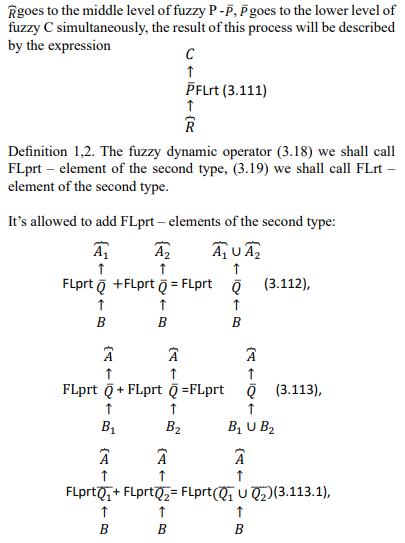
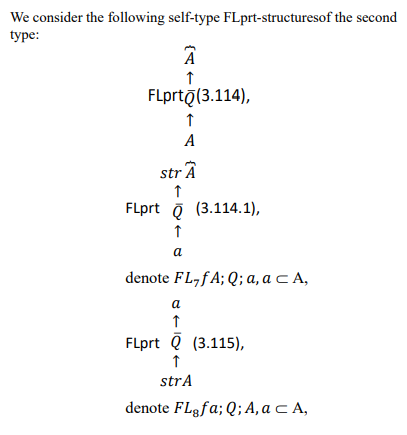
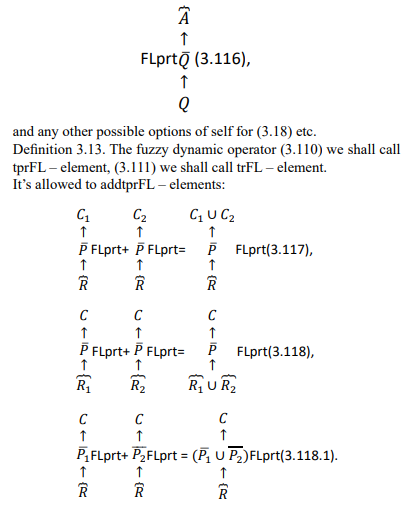
Dynamic FLprt Elements, Self-Type Dynamic FLprt- Structures
<img src="https://www.opastpublishers.com/scholarly-images/8748-6961ed505a4b3-introduction-to-dynamic-operators-lprtelements-and-applicati.png" width="500" height="600">
<img src="https://www.opastpublishers.com/scholarly-images/8748-6961ed74e1ef7-introduction-to-dynamic-operators-lprtelements-and-applicati.png" width="500" height="600">
<img src="https://www.opastpublishers.com/scholarly-images/8748-6961ed8e36ac7-introduction-to-dynamic-operators-lprtelements-and-applicati.png" width="500" height="600">
<img src="https://www.opastpublishers.com/scholarly-images/8748-6961eda65dae1-introduction-to-dynamic-operators-lprtelements-and-applicati.png" width="500" height="600">
<img src="https://www.opastpublishers.com/scholarly-images/8748-6961edc1069a9-introduction-to-dynamic-operators-lprtelements-and-applicati.png" width="500" height="600">
<img src="https://www.opastpublishers.com/scholarly-images/8748-6961eddf7c24f-introduction-to-dynamic-operators-lprtelements-and-applicati.png" width="500" height="600">
<img src="https://www.opastpublishers.com/scholarly-images/8748-6961edfa825b1-introduction-to-dynamic-operators-lprtelements-and-applicati.png" width="500" height="600">
<img src="https://www.opastpublishers.com/scholarly-images/8748-6961ee12f032b-introduction-to-dynamic-operators-lprtelements-and-applicati.png" width="500" height="600">
<img src="https://www.opastpublishers.com/scholarly-images/8748-6961ee2c6ba06-introduction-to-dynamic-operators-lprtelements-and-applicati.png" width="500" height="600">
Elements of the Theory of Variables of Fuzzy Hierarchical Fuzzy Dynamic Operators: FLprt
In contrast to the classical one-attribute fuzzy set theory, where only its contents are taken as a set, we consider a two-attribute fuzzy set theory with a fuzzy set as a fuzzy capacity and separately with its contents. We simply use a convenient form to represent the singularity of a fuzzy set. Articles [1]-[12] use the following methodology for permanent structures:
1. Cancellation of the axiom of regularity.
4. 2 attributes for the fuzzy set: fuzzy capacity and its content.
3. Fuzzy compression of a fuzzy set, for example, to a point.
4. “turning out” from one another, particularly from a fuzzy capacity, we pull out another fuzzy capacity, for example, itself, as its element.
5. The simultaneity of one (fuzzy compression) and the other (“eversion”).
6. Own fuzzy capacities.
7. Qualitatively new fuzzy programming and fuzzy Networks Here we will consider variable fuzzy structures (models), both discrete and continuous: a) with variable connections, b) with the variable backbone for links, c) generalized version; in particular,
<img src="https://www.opastpublishers.com/scholarly-images/8748-6961f08e85aa2-introduction-to-dynamic-operators-lprtelements-and-applicati.png" width="500" height="600">
<img src="https://www.opastpublishers.com/scholarly-images/8748-6961f0fddf637-introduction-to-dynamic-operators-lprtelements-and-applicati.png" width="500" height="600">
<img src="https://www.opastpublishers.com/scholarly-images/8748-6961f11927af1-introduction-to-dynamic-operators-lprtelements-and-applicati.png" width="500" height="600">
<img src="https://www.opastpublishers.com/scholarly-images/8748-6961f136e0363-introduction-to-dynamic-operators-lprtelements-and-applicati.png" width="500" height="600">
<img src="https://www.opastpublishers.com/scholarly-images/8748-6961f14d6ba98-introduction-to-dynamic-operators-lprtelements-and-applicati.png" width="500" height="600">
<img src="https://www.opastpublishers.com/scholarly-images/8748-6961f16a3232a-introduction-to-dynamic-operators-lprtelements-and-applicati.png" width="500" height="600">
<img src="https://www.opastpublishers.com/scholarly-images/8748-6961f181dbba3-introduction-to-dynamic-operators-lprtelements-and-applicati.png" width="500" height="200">
<img src="https://www.opastpublishers.com/scholarly-images/8748-6961f1a5e2696-introduction-to-dynamic-operators-lprtelements-and-applicati.png" width="500" height="600">
<img src="https://www.opastpublishers.com/scholarly-images/8748-6961f1bf9e97d-introduction-to-dynamic-operators-lprtelements-and-applicati.png" width="500" height="600">
<img src="https://www.opastpublishers.com/scholarly-images/8748-6961f1d979087-introduction-to-dynamic-operators-lprtelements-and-applicati.png" width="500" height="600">
Introduction to Fuzzy Program Operators Flprt, tprFL, FL1epr, FLeprt1
Here it is supposed to use a symbiosis of parallel actions and conventional calculations through sequential actions. This must be done through FLprt-Networks - fuzzy analogue of Sit-Networks in one of the central departments of which a conventional computer system is located. The parallel processor is itself fdeprogram fuzzy analogue of eprogram with direct parallel computing not through serial computing [1,6, 12].
<img src="https://www.opastpublishers.com/scholarly-images/8748-6961f6b7a6d3e-introduction-to-dynamic-operators-lprtelements-and-applicati.png" width="500" height="300">
alternating current of ultrahigh frequency or high-intensity ultra- short optical pulses laser of Nobel laureates 2018-year Gerard Mourou, Donna Strickland, or a combination of them. For the desired action, for example, using the direct parallel fdprogram
<img src="https://www.opastpublishers.com/scholarly-images/8748-6961f7111d653-introduction-to-dynamic-operators-lprtelements-and-applicati.png" width="500" height="100">
of fuzziness, we simultaneously enter the desired fuzzy set of codes R with measure of fuzziness µR using a microwave current with minimal amplitude and maximum frequency or high-intensity ultra-short optical pulses laser in Target-block.
In a conventional computer, the process of sequential calculation takes a certain time interval, in a directly parallel calculation by a neural network, the calculation is instantaneous, but it occupies a certain region of the space of calculation objects.
Consider the types of direct parallel fuzzy fdprogram operators:
1) fuzzy Lprt-program operators (designation FLprt-program operators)
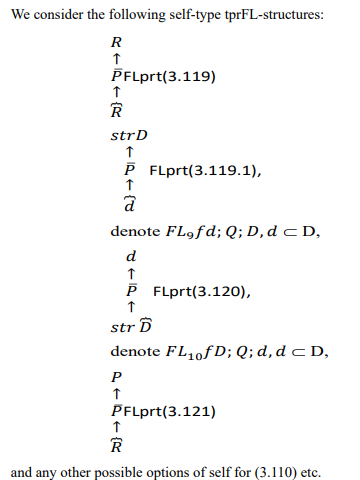
2) fuzzy tprL-program operators (designation tprFL-program operators)
3) fuzzy L1epr - program operators (designation FL1epr -program operators)
4) fuzzy Leprt1- program operators (designation FLeprt1-program operators)
<img src="https://www.opastpublishers.com/scholarly-images/8748-6961f7a6138bf-introduction-to-dynamic-operators-lprtelements-and-applicati.png" width="500" height="500">
Applications to Physics
To construct pseudo-living energies, it is necessary to take or form from energy A with an amplitude proportional (to the square of the frequency of energy A) self-energy. And then through activation SmnSprt in order to obtain the necessary pseudo-living energy from this self-energy, do this. Moreover self(A) ||| self(B) = (A|||A)|||(B|||B) = A|||B.
Remark 1. The installation of the “paradox: TN is everything, NG is everything else” creates a field for the creation of new abstractions in theoretical science and thereby significantly expands its boundaries.
In our opinion, one of the laws of physics should be the law of induction: any change (motion) induces a change (field) “perpendicular to it” This especially applies to flow. It’s just that the physical characteristics of “perpendicular” fields during ordinary not very large changes (movements) are so small. In particular, an electric current induces a magnetic field “perpendicular to it” and vice versa, a fluid flow induces a vortex field “perpendicular to it”. Only the specifics inherent in each will differ. Induction, as it were, balances (compensates) the movement. This is the result of resistance to the singularity of "emptiness" (order).
The next law of physics should be the law of "clotting": obtaining potential energy by "clotting"(up to ||| (identification) the elements of space-time, objects [14]. Moreover, e.g., a uniform movement in a straight line does not give potential energy, and uniform movement in a circle gives potential energy through centripetal acceleration a = v2/R. There is there "clotting" the element of space
<img src="https://www.opastpublishers.com/scholarly-images/8748-6961f899a3ab3-introduction-to-dynamic-operators-lprtelements-and-applicati.png" width="500" height="100">
considered above are examples of such operators of "clotting". Electron orbital in atoms is also "clotting". In particular, "clotting" allows to get some options of self-energy. Another option for obtaining self-energy through manifestations of higher levels. For example, A|||B can give a manifestation of the species self(A) = A|||A.
The next law of physics should be the law of the evolution of energies: the first stage of the evolution of energies - to "clotting", the second stage of the evolution of energies – to self-energies, the third stage of the evolution of energies - up to ||| (identification) of energies; and also the law of the involution (manifestations) of energies: from A|||B to A|||A = self(A) and B|||B = self(B) and further to A and B.
Remark 2. Any self -use can be used to design pseudo -proof energies if the amplitude of the action is inversely proportional to the square of the frequency of action.
Remark 3. In strings theory, to more correctly accept self -action as a string (in private., Self -school), which generates this self -object- an elementary particle.
Remark 4. To construct pseudo-living energies, it is necessary to take or form from energy A with an amplitude proportional (to the square of the frequency of energy A) self-energy. And then through activation SmnSprt in order to obtain the necessary pseudo-living energy from this self-energy, do this [13].
Remark 5. Any created self of object A creates the possibility of using a double from self(A), moreover this double of object self(A) is actually formed only through the upper level of self(A) and is not directly connected with the lower level of A, i.e., with the level of its objectivity. By manipulating the double, it is possible to perform all sorts of actions that are not available to the original due to the "absence" of the objectivity inherent in the original. All this follows from the nature of self(A), since self(A) is a structure containing A twice: the original and, as it were, a virtual copy of the original (the potency of the double). All this applies to any: both to the natural and to the theoretical, in particular, to the self -equation, the self –(boundary value) problem; the implementation will only be its own specific.
Remark 6. The 2022 Nobel laureates' experiments with the spin of bound electrons show the need for parallel physics, which specializes in studying the parallelism of processes.
Competiting Interest
There are no competing interests. All sections of the article are executed jointly.
Authors Contribution
The contribution of the authors is the same, we will not separate.
Acknowledgement
We are grateful to our academic supervisor Scientific director:Volodymyr Pasynkov - PhD of physic-mathematical science,assistant professor of applied mathematics and calculated techniques department of “National Metallurgical Academy” (Ukraine) for guidance and assistance in writing this article.
References
- Oleksandr, D., & Illia, D. (2023). Dynamical Sets Theory: S2t-Elements and Their Applications. J Math Techniques Compu t Math, 2(12), 479-498.
- Danilishyn, I., & Danilishyn, O. (2023). Dynamic Sets Set and Some of Their Applications to Neuroscience. Networks Set. New Advances in Brain & Critical Care, 4(2), 66-81.
- Danilishyn, O., & Danilishyn, I. (2023). Dynamic Sets S1et and Some of their Applications in Physics. Science Set Journal of Physics, 25, 1-11.
- Danilishyn, I., & Danilishyn, O. (2023). Dynamic Sets Se, Networks Se. Advances in Neurology and Neuroscience, 6 (2), 278-294.
- Danilishyn, I., & Danilishyn, O. (2023). Program OperatorsSIT, tS, S1e, Set1. J Sen Net Data Comm, 3(1), 138-143.
- Danilishyn Ð?.V. Danilishyn O.V. THE USAGE OFSIT-ELEMENTS FOR NETWORKS. IV International Scientific and Practical Conference ”GRUNDLAGEN DER MODERNEN WISSENCHAFTLICHEN FORSCHUNG ”,31.03.2023/Zurich, Switzerland.
- Danilishyn Ð?.V. Danilishyn O.V. tS – ELEMENTS. Collection of scientific papers «ΛÎ?Ð?OΣ» with Proceedings of the V International Scientific and Practical Conference, Oxford, June 23, 2023. Oxford-Vinnytsia: P.C. Publishing House & European Scientific Platform, 2023.Theoretical and empirical scientific research: concept and trends. pp.156-161, DOI 10.36074/logos-23.06.2023.42,
- Danilishyn Ð?.V. Danilishyn O.V. SET1 – ELEMENTS. INTERNATIONAL SCIENTIFIC JOURNAL GRAILOF SCIENCE â?? 28 June, 2023 with the proceedings of the:Correspondence International Scientific and Practical Conference SCIENCE IN MOTION: CLASSIC AND MODERN TOOLS AND METHODS IN SCIENTIFICINVESTIGATIONS held on June 9 th, 2023 by NGO European Scientific Platform (Vinnytsia, Ukraine) LLC International Centre Corporative Management (Vienna, Austria), pp. 239- 254.
- Danilishyn Ð?.V. Danilishyn O.V. DYNAMICAL SIT- ELEMENTS. IV International Scientific and Practical Conference ”GRUNDLAGEN DER MODERNEN WISSENCHAFTLICHEN FORSCHUNG ”, 31.03.2023/Zurich, Switzerland.
- Danilishyn Ð?.V. Danilishyn O.V. SOME APPLICATIONSOF SIT- ELEMENTS TO SETS THEORY AND OTHERS.Scientific practice: modern and classical research methods: Collection of scientific papers «ΛÎ?Ð?OΣ» with Proceedings of the IV International Scientific and Practical Conference, Boston, May 26, 2023. Boston-Vinnytsia: Primedia eLaunch & European Scientific Platform, 2023, pp.166-171.
- Danilishyn Ð?.V. Danilishyn O.V. SOME APPLICATIONS OF SIT- ELEMENTS TO CONTINUAL VALUED LOGICAND OTHERS. Features of the development of modern science in the pandemic’s era: a collection of scientific papers«SCIENTIA» with Proceedings of the IV International Scientific and Theoretical Conference, May 19, 2023. Berlin, Federal Republic of Germany: European Scientific Platform, pp.79-84. https://previous.scientia.report/index.php/archive/ issue/view/19.05.2023
- Danilishyn I., Danilishyn O. DYNAMIC SETS THEORY: SIT-ELEMENTS AND THEIR APPLICATIONS. Preprint.
- Danilishyn, O., Danilishyn, I., Pasynkov, V. (2024). Some aspects of directly parallel operation of neural networks and their subtle energy Advances in Machine& Artificial, 5(4), pp.1 - 7.
- Danilishyn, O., Danilishyn, I., Pasynkov, V. (2024). Intrtoduction to section of Dynamic mathematics: Theory of singularities of the type synthesizing. J Math Techniques Comput Math, 3(10), pp.1- 18.