

Journal of Economic Research & Reviews(JERR)
ISSN: 2771-7763 | DOI: 10.33140/JERR
Impact Factor: 1.3

Review Article - (2025) Volume 5, Issue 2
Internal Revenue Generation and Security Expenditure amidst Armed Banditry in Sokoto State Nigeria
Received Date: Apr 26, 2025 / Accepted Date: May 30, 2025 / Published Date: Jun 05, 2025
Copyright: ©©2025 Alhaji Kabiru, et al. This is an open-access article distributed under the terms of the Creative Commons Attribution License, which permits unrestricted use, distribution, and reproduction in any medium, provided the original author and source are credited.
Citation: Kabiru, A., Mohammed, S., Ahmed, Y., Kwazo, L. A. (2025). Internal Revenue Generation and Security Expenditure amidst Armed Banditry in Sokoto State Nigeria. J Eco Res & Rev, 5(2), 01-06.
Abstract
This study examines the impact of security expenditure on internal revenue generation amidst armed banditry in Sokoto State, Nigeria. Using the PMG model with panel data of seven selected local government areas in the state, the study found a negative impact of security spending on internal revenue generation. The study also discovered a positive impact of the interaction term of security expenditure and armed banditry on internal revenue generation in the state. The study recommends higher security expenditure in the state in the midst of armed banditry for the smooth running of businesses and increasing revenue generation in the state.
Keywords
Revenue, Generation, Expenditure, Security, Sokoto State and NigeriaIntroduction
Security expenditure is an important investment in maintaining security to pave way for sustainable growth (Rotberg, 2003). It is argued that states with large security expenditure could defend and control their activities effectively compared to smaller ones. Understanding the factors influencing security expenditure is imperative; as a key issue, security outlay is a central topic in the midst banditry. The potential role of security expenditure in critical situations of ensuring national security, make it essential that its determinants need to be understood. Many studies have emphasized the neoclassical side view that security expenditure diverts limited resources from the real economic sector and oppose investments in infrastructure, education, and health service. In contrast, Keynesian’s presumed that growing defense spending would increase aggregate demand, transfer of technology (from the defense sector to the real sector of the economy). It will also raise employment level; facilitate foreign direct investment (FDI) inflow and capital stock utilization, thereby stimulating growth.
There are trusts that a secure environment is essential for revenue flows, as it ensures adequate investment and productivity. Investors consider security as a basis for investment. security expenditure is primarily designed to provide a secure and safe economy that can attract domestic and foreign investments and affect productivity [1,2]. A sustained increase in states government internal-revenue generation is a necessary condition for developing the states in the northern Nigeria. Sokoto state is the poorest state in Nigeria according to [3]. The state internal revenue cannot maintain their monthly recurrent expenditure, not to mention capital expenditure. This slow face of the revenue generation makes the states relies heavily on federal government allocation.
Current data from the Beacon Consult (2023) has shown that Sokoto state is among the worst hit of armed banditry and kidnapping in Nigeria. A groups of violent non-State actors, widely referred to as Armed bandits, are laying siege to Nigeria’s most populated geopolitical zone, with distressing consequences, that at some point outweighs the fatalities from Boko Haram’s insurgency. In 2019, bandits were reportedly responsible for almost half of all violent deaths in Nigeria (Osasona, 2023). Bandits are a loose collection of various criminal groups involved in kidnap-for-ransom, armed robbery, cattle rustling, rape and other sexual violence, pillage and attacks on traders, farmers and travelers.
Security expenditure in the Sokoto state is a diversion of economic resources from the real economic sector to defense sector. Thus, the ability of the state government to provide meaningful infrastructure and essential services that will facilitate economic growth, and subsequently generate more revenue will be disputed. However, security spending is obvious in the states with high level of banditry. The expenditure will enhance foreign and domestic investors confidence and pave way for more revenue generation. Empirically, many studies aligned with neoclassical view that security spending crowd out investments and negate revenue generation [4]. Some studies on the other hand, opined that security spending accelerate investment by increasing purchasing power, transfer of technology, and increases aggregate demand [5]. Other studies held that there is no connection between security spending and revenue generation.
This study therefore aimed examines the connection between and revenue generation and security expenditure in the midst of armed banditry in Sokoto state Nigeria. Specifically, the study has the following objectives:
• To examined the impact of security spending on internal revenue generation of Sokoto state of Nigeria.
• Examine the joint impact of security expenditure and Armed Banditry on revenue generation in Sokoto states Nigeria.
This study on the interaction effect of security expenditure and revenue generation in the midst of banditry will enhance knowledge and policy preparation in separate ways. The study will be a pioneer study that will examine the joint effect of the security expenditure and armed banditry on.
Literature Review
Theoretical Literature
There is no commonly acceptable theory for economists to agree on; numerous schools of thought have arisen to better integrate security expenditure with economic growth (Dunne & Coulomb, 2008). The advent of the Neoclassical and Keynesian line of thought enables researchers to formulate several ways of relating security spending and internal revenue, helps to theorize the possible effects. The various avenues can be classified into the neoclassical supply base and the demand side of Keynesian perspectives, respectively, with a potential negative and positive impact.
On the dominant neoclassical viewpoint, security expenditure is a purely public good supplied by the government that acknowledges a well-defined public interest that it aims to protect. This perspective considers the state as a rational agent seeking to maximize the national interest by balancing the opportunity cost and the welfare benefits of military expenditure. Military expenditure is seen here as a public good. The opportunity cost defines its economic impacts: rivalry between it and other public investments, more generally referred to as 'guns versus butter.' Crowding-out of investment, unfavorable balance of payment in arms importing nations, a lesser amount of research and development (R&D) activities, bloated bureaucracies are some of the possible opportunity costs attached to high security spending [6]. In a nutshell, the neoclassicists accused the military expenditure of diverting economic resources from the real sector of the economy to the defense sector, thereby negating economic activities to sustain economic growth.
In contrast, Keynesian's demand-side saw a country as an entity that is above classes and constitutes the populace's general interest. Defense spending is considered a kind of public expenditure that raises aggregate demand, employment opportunities, and many other economic factors that cause economic growth through its multiplier effect. Thus, within the Keynesian scope, the state seems to be active and authoritarian, using spending to expand production and revenues through multiplier effects when aggregate demand is ineffective [7]. If aggregate demand is low compared to prospective supply, increased security spending may increase production rates, higher profits, and raised investment, and internal revenue [8]. Demand-side indicates that security expenditure increases internal revenue generation through the multiplier effect, raises aggregate demand, employment, capital utilization, level of productivity, and transfer of technology. Yakovlev (2007) stated that security spending increases new technology, extending to the economy's civilian sector [9]. As indicated by the aforementioned theoretical standpoints, the issue of whether and to what degree security spending has economic impact cannot be answered by using unreliable data and historical conclusions but needs systematic empirical research instead.
Empirical Literature
The Neoclassicists view claimed that a rise in military spending would lead to resource transfer from the real productive sector. The expenditures appear to crowd-out investments and slow economic growth [10]. Several empirical works indicated negative relation between military expenditure and economic growth. For example Pieroni, (2009) examined the link by investigating the impact of security spending on an endogenous growth model with technology [11]. The results of the study showed that, security expenditure harmed revenue generation. It is believed that the economic resources will shift from the real economic sector to the defence sector and thus reduce productivity in the presence of excess security load. While expanding the quest for this relationship, D’Agostino, Dunne, & Pieroni (2012), D’Agostino, Dunne, & Pieroni (2012b) and Hou & Chen (2014) investigates the association between security expenditure and growth in the developed and developing nations and found out that security expenditure denies internal revenue generation in the sample countries [12-14]. This group of studies argued that security expenditure competes with the real economy sector in terms of limited resources, human and physical capital, thereby crowding out investment and retard growth.
Additionally, Khalid & Abdulrazaq (2015) also examined link and found out that security expenditure reduces economic growth by diverting limited resources from the productive sector, resulting in the real economy sector's low performance [15]. To further examine the outcome of Khalid & Abdulrazaq (2015), a study was conducted by Künü et al. (2016) which revealed adverse effects of security spending on the sampled Middle East countries' economic performance [4,15]. The study highlighted that security expenditure reduces countries' ability to invest in human capital, roads, and other necessary infrastructure to pave the way for sustain increase in internal revenue generation. Equally, D'Agostino, Dunne, & Pieroni (2016) also found that military expenditure hurt revenue generation in countries with corruption compounding issues [16]. Furthermore, D’Agostino, Dunne, & Pieroni (2018) Used an endogenous growth model to showed that defence expenditure slows economic growth in non-high-income countries [17]. Most recently, study found that over the period 1960–2017, the global impact of security spending on economic growth continues to be negative, which dated back to the cold war and early post-cold war periods and was particularly noticeable in the North Atlantic Treaty Organization countries [18]. Similarly, Azam (2020) study revealed that Military spending negatively influenced revenue generation [19].
Contrarily, Wang et al. (2012) assessed the effects of defence expenditure on macroeconomic performance and productivity [20]. The findings indicated that the overall Malmquist's productivity index (MPI) with security spending higher than the non-security expenditure economic productivity. However, regional productivity analysis reveals that appropriate bootstrap productivity index allocation of security expenditure can effectively increase regional economic efficiency. Also, Chairil et al. (2013), Masoud Ali Khalid & Noor, (2015) and Yildirim & Öcal (2014) aligned with Wang et al. (2012) that security expenditure encourages growth through multiplier effect [20-23]. Other empirical studies in support of this view includes, Kossele Yapatake et al. (2017), Ahad & Dar (2017) whose studies examines the connection between security spending and growth [24,25]. The findings showed that security expenditure is statistically significant and has a beneficial connection to economic growth. The positive effect of security expenditure on revenue generation indicates a positive spin-off to the economy from the security expenditure. These concurred with Adams & Gold's (1987) view: There was a technological spin-off between the defence sector and the economy's industrial sector. Similarly, Saba & Ngepah (2019) and Raju & Ahmed (2019) also maintained that security expenditure successfully accelerates economic growth of the economies [26,27].
In general, the positive effect is attributed to the role of military expenditure in increasing employment levels, increasing aggregate demand, the development of human capital, and the transfer of technology (from the defence sector to the real economic sector) which has a multiplier effect on the productive sector of the economy. Conversely, some empirical studies discovered no significant relationship between security spending and revenue generation. For example Habibullah et al., (2008) whose results also shows no connection between security expenditure and economic growth in the Asian countries [28]. Also, Kollias & Paleologou (2010) present an update analysis of the security expenditure and growth nexus and the findings do not contradict those of Tsaurai (2014) results that there was no clear statistical correlation between security spending and growth [29,30]. Also, Chen et al. (2014) and Islam (2015) examined military burden and revenue generation [31,32]. The estimations outcome reinforced Chen et al. (2014) and Tsaurai (2014) view that there was no relation between security spending and revenue generation [30,31].
Methodology
Data
The data for the study is a panel data of 7 selected local government areas in sokoto states of Nigeria, from Q1-2015 to Q3-2024. The data for security expenditure and Mineral Rents is obtained from the state government ministry of finance. Internally Generated Revenue data is obtained from the National Bureau of Statistics. Similarly, the, data for Armed banditry incidence are sourced from the Beacon Consult data Bank. The folder of 7 selected local governments includes Isa, Sabon-Birni, Goronyo, Rabah, Gwadabawa, Tangaza, and Wurno local governments’ areas of Sokoto. The local governments were selected based on the armed banditry activities in the senatorial zone.
Empirical Model
The model for the association of revenue generation and security expenditure is constructed, similar to as [18,33-37]:

Equation 1 is transformed into econometrics form for efficient estimation below:

The interaction term of arm banditry (ABD) and security expenditure (SEX*ABD) is introduced to examine the combined effect of security expenditure and arm banditry on revenue generation. One could settle that more security spending in a terrorized economy would inspire investors’ confidence. More inflow of domestic and foreign investments can be guaranteed and thus ensures internal revenue generation. Therefore, the interaction between the arm banditry and security expenditure is introduced in the model as:

The IRG is the internal revenue generation, SEX is the security expenditure, ABD denotes arm banditry, and MRT represents mineral rent. The is a stochastic error term, while Subscript t stands for years and i stands for countries.
In equation (3),ß2 < 0 but ß3 > 0, we will settle that in the long run,
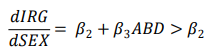
If the negative impact of security expenditure on the IRG is upturned by higher defence outlays in the arm bandit-prone states than region without arm banditry.
Results and Discussion
Table 1 shows a summary of the descriptive statistics for the variables. The mean value, Standard deviation, minimum and maximum values of all the variables are shown in the table.
|
VARIABLES |
Observations |
Mean |
St. Deviation |
Min. |
Max. |
|
IRG |
280 |
2.641 |
7.011501 |
0.72 |
5.1 |
|
SEX |
280 |
1.512 |
1.270012 |
.2 |
1.2 |
|
ABD |
280 |
1.314 |
2.65451 |
1.0 |
5.3 |
|
MRT |
280 |
2.142 |
1.972806 |
6.3 |
3.6 |
Table 1: Descriptive Statistics
The correlation test findings for independent variables are reported in Table 2 in the form of the matrix reports the correlation test. Given the range of absolute values from -0.0453 to 0.0678, the study concludes that there is no multicollinearity issue; because these values falls below the 0.80 benchmarks [38].
|
|
IRG |
SEX |
ABD |
MRT |
|
IRG |
1.0000 |
|
|
|
|
SEX |
0.0452 |
1.0000 |
|
|
|
ABD |
0.0532 |
0.0558 |
1.0000 |
|
|
MRT |
0.0675 |
-0.0515 |
-0.0453 |
1.0000 |
Table 2: Correlation Matrix
Table 3 shows that Hausman test results confirm the fitness of the PMG estimation. The Prob > chi2 for MG-PMG is 0.7358 and 0.4738 for PMG-DFE, the values are greater than 0.05, and thus, the PMG is prescribed. Even though, the study presents the estimates of MG and DFE in the table, but it only reports the PMG. The long-run coefficient for security expenditure (SEX) in the PMG model shows significant negative impact in the long run. The short-run coefficient of SEX showed negative relation only at 10% level of significance. This confirms that increasing security spending depressingly affect revenue generation in Sokoto state. Similarly, the negative impact of arm banditry has been shown both in the long run and short-run period. These finding are in line with the view that security expenditure crowd-outs investments [39,40]. The outcome could be attributed to the diversion of economic resources from the real sector of the economy to the security sector [34,39].
The study introduced the interaction of security expenditure and arm banditry (SEX*ABD) to see the joint impact of SEX*ABD on revenue generation in Sokoto state. The long run interaction term revealed positive impact of SEX*ABD on IRG in the study area. This disclosed that amidst armed banditry, security expenditure could boost the businesses and increases revenue generation in the state. to invest in the economy. This agrees with the findings of Aziz & Asadullah (2017); Lee (2017) that security expenditure in the midst of conflict, affects investment positively [34,41]. Mineral Rents (MRT) long run coefficient values also revealed positive significant impact on RVG in the state [42].
|
Independent Variable |
MG |
PMG |
DFE |
|
Long-run coefficients |
|||
|
SEX |
-0.210 (-0.39) |
- 0.322 (-8.11) *** |
- 0.013 (-0.32) |
|
ABD |
-0.329 (-0.02) |
-0.022 (-3.92) ** |
- 0.001 (-1.96)* |
|
SEX*ABD |
1.339 (1.28) |
0.272 (4.87) *** |
0.006 (1.97)* |
|
MRT |
0.926 (0.85) |
0.494 (6.08) *** |
0.691 (3.78) *** |
|
Speed of adjustment (ECT) |
-0.603 (-6.52) *** |
-0.351 (-4.17) *** |
-0.545 (-5.99) *** |
|
Short-run Coefficients |
|||
|
|
-0.088 (-1.52) |
-0.019 (-1.96)* |
0.023 (0.64) |
|
|
-0.007 (-0.60) |
-0.002 (-1.96)* |
-0.001 (-0.17) |
|
|
1.032 (1.08) |
0.272 (1.87) |
0.006 (1.92)* |
|
|
1.102 (0.63) |
0.217 (1.96) |
0.374 (0.97) |
|
CONSTANT |
-1.040 (-0.03) |
0.266 (3.91) *** |
1.617 (4.91) *** |
|
Hausman Test |
1.50(0.7358) |
4.24(0.4738) |
|
|
No. of countries |
7 |
7 |
7 |
|
Observations |
252 |
252 |
252 |
|
Note: The figures outside parenthesis are the Z-values while those in the parenthesis are p-values. *** and ** represents 1% and 5% significant levels |
|||

Table 3: Dependent Variable: IRG
Conclusion and Recommendation
The study examines the impact of security expenditure (SEX) on revenue generation in Sokoto state, Nigeria; sing panel data of 7 selected local governmentâ??s areas in Sokoto State, Nigeria from Q1 2015â??Q3 2024. The mean group (MG), pool mean group (PMG), dynamic fixed effects models, and were used to analyze the data. The outcome of the empirical examination shows that SEX negates revenue generation in the absence of arm banditry. However, in the midst of arm banditry security expenditure improves internal revenue generation. The MRT is found to have positive impact on revenue generation of Sokoto state. The study recommends an Increase in security expenditure in the state in order to curtail the menace of armed bandits and kidnappers so that businesses can develop and revenue generation increases. Similarly, the study recommends exploring other mineral resources in the state to increase employment opportunities and thus more revenue inflows [43-45].References
- Bandyopadhyay, S., Sandler, T., & Younas, J. (2014). Foreign direct investment, aid, and terrorism. Oxford Economic Papers, 66(1), 25-50.
- Blomberg, S. B., Hess, G. D., & Tan, D. Y. (2011). Terrorism and the economics of trust. Journal of Peace Research, 48(3), 383-398.
- National Bureau of Statistics. (2020). 2019 poverty and inequality in Nigeria: Executive summary. National Bureau of Statistics.
- Künü, S., Hopoglu, S., & Bozma, G. (2016). Conflict, defense spending and economic growth in the middle east: A panel data analysis. International Journal of Economics and Financial Issues, 6(1), 80-86.
- Kabiru, A., & Naseem, M. (2024). Foreign Direct Investment and Military Expenditure in the Face of Terrorism : Evidence from Sub-Saharan Africa. Journal of Investment Banking and Finance, 2(1), 1–13.
- Mylonidis, N. (2008). Revisiting the nexus between military spending and growth in the European Union. Defence and Peace Economics, 19(4), 265-272.
- Dunne, J. P., & Mohammed, N. A. (1995). Military spending in sub-saharan africa: Some evidence for 1967-85. Journal of Peace research, 32(3), 331-343.
- Faini, R., Annez, P., & Taylor, L. (1984). Defense spending, economic structure, and growth: Evidence among countries and over time. Economic development and cultural change, 32(3), 487-498.
- Yakovlev, P. (2007). Arms trade, military spending, and economic growth. Defence and peace economics, 18(4), 317-338.
- Sandler, T., & Hartley, K. (1995). Economics of Defense.Cambridge University Press.
- Pieroni, L. (2009). Military expenditure and economic growth. Defence and peace economics, 20(4), 327-339.
- d'Agostino, G., Dunne, J. P., & Pieroni, L. (2012). Assessing the effects of military expenditures on growth.
- d’Agostino, G., Dunne, J. P., & Pieroni, L. (2012). Corruption, military spending and growth. Defence and Peace Economics, 23(6), 591-604.
- Hou, N., & Chen, B. (2014). Military expenditure and investment in OECD countries: Revisited. Peace Economics, Peace Science and Public Policy, 20(4), 621-630.
- Khalid, M. A., & Abdulrazaq, M. A. (2015). The impact of military spending on economic growth : Evidence from the US economy. Research Journal of Finance and Accounting, 6(7), 183–191.
- d’Agostino, G., Dunne, J. P., & Pieroni, L. (2016). Government spending, corruption and economic growth. World development, 84, 190-205.
- d’Agostino, G., Dunne, J. P., & Pieroni, L. (2018). Military expenditure, endogeneity and economic growth. Defence and Peace Economics, 30(5), 509-524.
- Desli, E., & Gkoulgkoutsika, A. (2020). Military spending and economic growth: a panel data investigation. Economic Change and Restructuring, 54(3), 781-806.
- Azam, M. (2020). Does military spending stifle economicgrowth? The empirical evidence from non-OECD countries. Heliyon, 6(12).
- Wang, T. P., Shyu, S. H. P., & Chou, H. C. (2012). The impact of defense expenditure on economic productivity in OECD countries. Economic Modelling, 29(6), 2104-2114.
- Chairil, T., Sinaga, D., & Febrianti, A. (2013). Relationship between military expenditure and economic growth in ASEAN: evidence from Indonesia. Journal of ASEAN studies, 1(2), 106-121.
- Khalid, M. A., & Noor, Z. M. (2015). Military expenditure and economic growth in developing countries: evidence from system GMM estimates. Journal of Emerging Trends in Economics and Management Sciences, 6(1), 31-39.
- Yildirim, J., & Öcal, N. (2016). Military expenditures, economic growth and spatial spillovers. Defence and Peace Economics, 27(1), 87-104.
- Pacific, Y. K. T., Shan, L. J., & Ramadhan, A. A. (2017). Military expenditure, export, FDI and economic performance in Cameroon. Global Business Review, 18(3), 577-589.
- Ahad, M., & Dar, A. A. (2017). Modelling the asymmetric impact of defence spending on economic growth: An evidence from non-linear ARDL and multipliers. Journal of Economic and Administrative Sciences, 33(2), 131-149.
- Shaaba Saba, C., & Ngepah, N. (2019). Military expenditure and economic growth: evidence from a heterogeneous panel of African countries. Economic research-Ekonomska istrazivanja, 32(1), 3586-3606.
- Raju, M. H., &Ahmed, Z. (2019). Effect of military expenditure on economic growth: evidences from India Pakistan and China using cointegration and causality analysis. Asian Journal of German and European Studies, 4(1), 3.
- Habibullah, M. S., Law, S. H., & Dayang-Afizzah, A. M. (2008). Defense spending and economic growth in Asian economies: A panel error-correction approach.
- Kollias, C., & Paleologou, S. M. (2010). Growth, investment and military expenditure in the European Union-15. Journal of Economic Studies, 37(2), 228-240.
- Tsaurai, K. (2014). Military expenditure and the economy of Zimbabwe. Journal of Governance and Regulation, 3(2), 65-75.
- Chen, P. F., Lee, C. C., & Chiu, Y. B. (2014). The nexus between defense expenditure and economic growth: New global evidence. Economic Modelling, 36, 474-483.
- Islam, O. (2015). The Relation Between Military Expenditure & Economic Growth in Developing Countries : Evidence from a Panel of 41 Developing Countries. IORS Journal of Economics and Finance, 6(4), 57–65.
- Aizenman, J., & Glick, R. (2006). Military expenditure, threats, and growth. Journal of International Trade & Economic Development, 15(2), 129-155.
- Aziz, N., & Asadullah, M. N. (2017). Military spending, armed conflict and economic growth in developing countries in the post-Cold War era. Journal of Economic Studies, 44(1), 47-68.
- Gokmenoglu, K. K., Taspinar, N., & Sadeghieh, M. (2015). Military expenditure and economic growth: The case of Turkey. Procedia Economics and Finance, 25, 455-462.
- Iamsiraroj, S., & Ulubasoglu, M. A. (2015). Foreign direct investment and economic growth: A real relationship or wishful thinking?. Economic modelling, 51, 200-213.
- Pelinescu, E. (2015). The impact of human capital on economic growth. Procedia Economics and finance, 22, 184-190.
- Prodan, I. (2013). The effect of weather on stock returns: A comparison between emerging and developed markets. Anchor Academic Publishing (aap_verlag).
- Aziz, N., & Khalid, U. (2019). Armed conflict, military expenses and FDI inflow to developing countries. Defence and Peace Economics, 30(2), 238-251.
- Ebire, K., Onmonya, O., & Inim, V. E. (2018). Effects of the determinants of foreign direct investment in Nigeria: Error correction mechanism. Asian Journal of Economics and Empirical Research, 5(2), 155-164.
- Lee, C. Y. (2017). Terrorism, counterterrorism aid, and foreign direct investment. Foreign Policy Analysis, 13(1), 168-187.
- Alhaji, K., Mohammed, S., Muazu, S. A. (2021). Dynamic Panel Approach on Foreign Direct Investment and Terrorism in West and Central Africa. EPRA International Journal of Economic and Business Review-Peer Reviewe, 10(1).
- Federal Republic of Nigeria., (2022). Terrorism (Prevention and Prohibition) Act, 2022, Official Gazette, 91(109).
- Murtala A. R., (2018). Cattle Rustling and Armed Banditry along Nigeria–Niger Borderlands. IOSR Journal of Humanities and Social Science, 4(4), 67.
- Tosin, O., (2021). New Lords of Nigeria’s North West Bandits: Terrorists or Criminal Gang. The Republic.