

International Journal of Botany and Horticulture Research(IJBHR)
ISSN: 2994-872X | DOI: 10.33140/IJBHR
Impact Factor: 0.98


Research Article - (2023) Volume 1, Issue 1
Inter-Cropping of Soybean within Maize for Increasing the Crop Productivity and Cropping Intensity in the Coastal Region of Bangladesh
2Oilseed crop and Legume Breeder (Plant Breeding), Bangladesh Agricultural Research Institute (BARI),, Bangladesh
3On farm research division (OFRD), Bangladesh Agricultural Research Institute (BARI), Patuakhali, Bangladesh
4On farm research division (OFRD), Bangladesh Agricultural Research Institute (BARI), Tangail, Bangladesh
5Agronomy, Bangladesh Agricultural Research Institute (BARI), TCR-Substation, Munshijang, Bangladesh
Received Date: Jun 28, 2023 / Accepted Date: Jul 16, 2023 / Published Date: Aug 18, 2023
Copyright: ©Ã?©2023 Gazi Nazmul Hasan, Mahmudul Hasan Khan, et al. This is an open-access article distributed under the terms of the Creative Commons Attribution License, which permits unrestricted use, distribution, and reproduction in any medium, provided the original author and source are credited.
Citation: Hasan. G. N., Khan. M. H., Anik. R. H., Islam. M., Islam, M., et al. (2023). Inter-Cropping of Soybean within Maize for Increasing the Crop Productivity and Cropping Intensity in the Coastal Region of Bangladesh. Int J Bot Hor Res, 1(1), 25-30.
Abstract
A field trial was conducted at Bhola sadar and Daulatkhan during the rabi season of 2020-21 and 2021-22 at the farmer’s field under AEZ-18 to verify the agro-economic performance of intercropping of Soybean with Maize and to ensure the maximum utilization of the land for higher yield, Land Equivalent Ratio (LER) and economic return. The experiment was laid out in Randomized Complete Block Design on farmer’s field condition in Bhola sadar. Four treatments combination of different seed rate of mustard and cowpea viz., T1 = Sole maize, T2 = Sole Soybean, T3 = Two row maize (60cm x 25cm) with 2 row Soybean (30cm x 6cm), T4 = Pair row maize (120cm x 25cm) with 4 row Soybean (30cm x 6cm). Variety was BARI Hybrid Maize-16 and BARI Soybean-6. In case of maize no. of cobs plant-1, 1000-grain wt. (g) of maize was significantly influenced by intercrop combination in two consecutive years. Plant population was higher (7.13cm & 6.87 cm) in T1 treatments followed by T3 treatments (7.13cm & 6.87cm) and lower plant population was from T4 treatments (6.38cm & 6.12cm) due to pair row maize combination in two consecutive years. The highest no. of grains cob-1 (545 & 558) was recorded from T1 followed by T4 (536 & 539) and the lowest (518 & 496) was obtained from T3 treatment in 2021 & 2022 respectively. The highest maize grain yield (7.83 & 7.92 t ha-1) was obtained from sole maize in both the years. Grain yield (1.72 & 1.82 t ha-1) of sole soybean was significantly higher and lowest soybean grain yield (1.30 & 1.25 t ha-1) was obtained from T3 treatment in 2021 & 2022 respectively. The highest Maize Equivalent Yield 9.41 t ha-1 and 9.63 t ha-1 was recorded from T3 intercropped combination in two consecutive years (Table 3a & 3b). In T4 treatment, the LER was higher 1.80 & 1.71 and LER was lower 1.67 & 1.60 from T3 treatment in both years. Growing maize and soybean in intercropping under rainfed condition resulted in higher LER (Table 4) when grown as T3 and T4 indicting beneficial association between the two.
Keywords
Soybean, Maize, Crop Productivity, Cropping Intensity, Coastal Region, Bangladesh
Introduction
Intercropping is the practice of growing more than one crop simultaneously in alternating rows of the same field [1].The main advantage of intercropping is the more efficient utilization of the available resources and the increased productivity compared with each sole crop of the mixture [2,3]. Intercropping system is more productive than sole crop, especially under adverse conditions. Cereal and legume intercropping is recognized as a common cropping system by the small scale farmers in developing countries [4]. Intercropped legumes fix most of their N from the atmosphere and not compete with cereals for N resources [5]. Increased leaf cover in intercropping systems helps to reduce weed populations once the crops are established [1]. Having a variety of root systems in the soil reduces water loss, increases water uptake and increases transpiration. This is important during times of water stress, as intercropped plants use a larger percentage of available water from the field than mono cropped plants. Rows of maize in a field with a shorter crop will reduce the wind speed above the shorter crops and thus reduce desiccation [1]. Cereal-grain legume intercropping has potential to address the soil nutrient depletion on smallholder farms [6]. Flexibility, maximization of profit, minimization of risk, soil conservation and soil fertility improvement are some of the principal reasons for smallholder farmers to intercrop their farms/ crops [7].
Soybean (Glycine max) contain significant amounts of phytic acid, dietary minerals and B vitamins. Soy vegetable oil, used in food and industrial applications, is another product of processing the soybean crop. Soybean is the most important protein source for feed farm animals (that in turn yields animal protein for human consumption. Among the legumes, the soybean is valued for its high (38–45%) protein content as well as its high (approximately 20%) oil content. Maize (Zea mays L.) has become a staple food in many parts of the world. It has versatile usages in human food over tropical sub-tropical regions. maize is also used for corn ethanol, animal feed and other maize products, such as corn starch and corn syrup.
Maize can be grown all year round in Bangladesh and can therefore be fitted in the gap between the main cropping seasons without affecting the major crops. It can be harvested as fodder within 50 days of planting, as green cobs within 60-80 days and as grain within 100-130 days of planting.
Maize is a very popular grain crop among all cereals over the world as well as Bangladesh. Day by day cultivation of maize is increasing at Bhola because of high profit. At present near about 3000 ha area are occupied under maize cultivation in Bhola that was only 140 ha by the year of 2010. On the other hand, at the same period the area under soybean in Bhola was 1415 ha and it was increased by 7572 ha in 2019 (Source-DAE-Bhola). Both of those crops are grown at Rabi season in the region. But farmers cultivate this crop singly. It can be possible to intercrop with these crops for several benefits. Cereals like maize, sorghum and pearl millet can be used for intercropping with soybean due to their dissimilar growing patterns, morphology, phenology and nutrient requirement. Increased competition may be for water, nutrients, light or any combination of the three, ultimately leading to changes in crop productivity levels [8,9]. Intercropping has shown potential as a land-use efficient and sustainable agricultural practice, which is as well the main model to increase the land use efficiency in both traditional and modern agriculture. Different references are available about intercropping of soybean with maize increase yield and farmers income [10,11]. Therefore, the present study was undertaken to verify the agro-economic performance of intercropping of Soybean with Maize with the following objectives: to find out the appropriate intercrop combination for higher yield and economic return and to investigate yield, yield components and land equivalent ratio of intercropped maize and Soybean.
Materials and Methods
Field experiment was conducted to investigate growth and yield of maize and soybean grown alone as monocropping and in various combinations (intercropping). The experiment was conducted at Bhola sadar under Bhola district during the rabi season of 2020-21 and 2021-22 at the farmer’s field under AEZ-18. The design of the experiment was Randomized Complete Block with five dispersed replications. Four treatments combination viz., T1= Sole maize, T2= Sole Soybean, T3= Two row maize (60cm x 25cm) with 2 row Soybean (30cm x 6cm), T4= Pair row maize (120cm x 25cm) with 4 row Soybean (30cm x 6cm) were tested. Maize variety was BARI Hybrid Vutta-16 and Soybean variety was BARI Soybean-6. Unit plot size was 8m â?» 5m. Fertilizer dose for intercropping was 100-30-35-18-2 kg ha-1 N-P-K-S-Zn, respectively in the form of urea, TSP, MOP, gypsum and ZnSO4 respectively. As the crop was cultivated in rainfed condition all fertilizers were applied during final land preparation except urea. Both Mazie and Soybean seeds were sown in line sowing method. Sowing date of both soybean and Maize was 07-20 January, 2021 & 2022 and harvesting date of Soybean was 21-30 April 2021& 2022. For controlling Soybean hairy caterpillar, nitro 505 EC @ 2ml Lit-1 water was sprayed once. Leaf roller was controlled by spraying of Sevin 20EC @ 2 ml Lit-1 water twice after 10 days interval. Maize was harvested 10-18 May 2021 & 2022. Standard cultural practices were done as and when necessary. Data were collected plot wise and analyzed statistically.
Land Equivalent Ratio (LER):
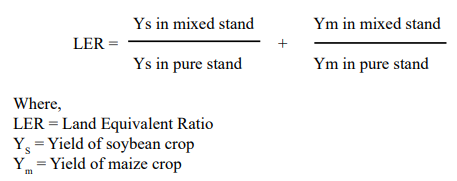
Land Equivalent Ratio (LER) is the most common index adopted in intercropping to measure the land productivity. It is often used as an indicator to determine the efficacy of intercropping [12]. The LER is a standardized index that is defined as the relative area required by sole crops to produce the same yield as intercrops [13]. The LER is the ratio of land required by pure (sole) crop to produce the same yield as that of intercrop was determined according to the following formula:
Result and Discussions
Yield and yield attributes
From the results it is revealed that no. of cobs plant-1, cob length (cm) of maize was not significantly influenced among the treatments by intercrop combination in two consecutive years. In case of plant population between T1 (7.13) and T3 (7.10) have no significant difference but statistically deference than T4 treatment (6.28). Cob length was higher in T1 followed by T4 in two consecutive years. Among the treatments statistically significant number of grains per cob was found in both the years. The highest no. of grains cob-1 (545 & 558) was recorded from T1 followed by T4 (536 & 539) and the lowest (518 & 496) was obtained from T3 treatment in 2021 & 2022 respectively. The highest maize grain yield (7.83 & 7.92 t ha-1) was obtained from sole maize in both the years (Table 1a & 1b).
|
Treatments |
Plant m-2 (no.) |
Cobs plant-1 (no.) |
Cob length (cm) |
Grains cob-1 (no.) |
1000-grain wt. (g) |
Grain yield (t ha-1) |
|
T1= Sole maize |
7.13 |
1.20 |
24.50 |
545 |
348 |
7.83 |
|
T2= Sole Soybean |
- |
- |
- |
- |
- |
- |
|
T3= 2 row soybean +2 row maize |
7.10 |
1.12 |
22.34 |
518 |
336 |
7.34 |
|
T4= 4 row soybean + pair row maize |
6.28 |
1.16 |
23.18 |
536 |
340 |
6.85 |
|
CV (%) |
10.43 |
9.62 |
7.26 |
13.17 |
8.44 |
10.26 |
|
LSD (0.05) |
0.69 |
NS |
1.97 |
5.61 |
4.37 |
0.76 |
Table 1a: Yield and Yield Contributing Characters of Maize under Intercrop Combinations at Bhola during the year of 2020-21
|
Treatments |
Plant m-2 (no.) |
Cobs plant-1 (no.) |
Cob length (cm) |
Grains cob-1 1000 (no.) |
-grain wt. (g) |
Grain yield (t ha-1) |
|
T1= Sole maize |
6.87 |
1.23 |
25.29 |
558 |
356 |
7.92 |
|
T2= Sole Soybean |
- |
- |
- |
- |
- |
- |
|
T3= 2 row soybean +2 row maize |
6.84 |
1.10 |
21.65 |
496 |
338 |
7.23 |
|
T4= 4 row soybean + pair row maize |
6.12 |
1.15 |
24.26 |
539 |
343 |
6.89 |
|
CV (%) |
12.36 |
8.75 |
7.68 |
11.78 |
9.72 |
12.26 |
|
LSD (0.05) |
0.62 |
NS |
2.62 |
6.27 |
5.62 |
0.89 |
Table 1b: Yield and Yield Contributing Characters of Maize under Intercrop Combinations at Bhola during the year of 2021-22
Soybean was harvested at pod maturity stage. The highest number of pods plant-1 was obtained from sole soybean than those of soybean intercropped with maize. Grain yield (1.72 & 1.82 t ha-1) of sole soybean was significantly higher in 2021 & 2022 respectively and lowest soybean grain yield (1.28 and 1.25 t ha-1) was obtained from T3 treatment (2 row soybean intercropped with 2 row maize during 2020-21 and 2021-22 respectively (Table 2a and 2b).
|
Treatments |
Plant m-2 (no.) |
Branches plant-1 (no.) |
Pods plant-1 (No.) |
Seeds pod-1 (no.) |
1000-seed wt. (g) |
Seed yield (t ha-1) |
|
T1= Sole maize |
- |
- |
- |
- |
- |
- |
|
T2= Sole Soybean |
58.34 |
4.82 |
52.23 |
2.54 |
61.34 |
1.72 |
|
T3= 2 row soybean +2 row maize |
54.76 |
3.55 |
43.96 |
2.47 |
58.12 |
1.28 |
|
T4= 4 row soybean + pair row maize |
46.72 |
4.53 |
48.78 |
2.50 |
60.23 |
1.60 |
|
CV (%) |
10.32 |
8.36 |
11.60 |
9.27 |
7.42 |
8.45 |
|
LSD (0.05) |
3.27 |
0.23 |
2.74 |
NS |
NS |
0.09 |
Table2a: Yield and Yield Contributing Characters of Soybean under Intercrop Combinations at Bhola during the year of 2020-21.
|
Treatments |
Plant m-2 (no.) |
Branches plant-1 (no.) |
Pods plant-1 (No.) |
Seeds pod-1 (no.) |
1000-seed wt. (g) |
Seed yield (t ha-1) |
|
T1= Sole maize |
- |
- |
- |
- |
- |
- |
|
T2= Sole Soybean |
56.82 |
4.78 |
53.46 |
2.68 |
61.25 |
1.82 |
|
T3= 2 row soybean +2 row maize |
52.31 |
3.30 |
41.17 |
2.46 |
60.10 |
1.25 |
|
T4= 4 row soybean + pair row maize |
43.35 |
4.60 |
49.62 |
2.52 |
61.18 |
1.56 |
|
CV (%) |
12.36 |
7.39 |
10.61 |
8.27 |
7.42 |
7.68 |
|
LSD (0.05) |
4.02 |
0.14 |
6.13 |
0.18 |
NS |
0.19 |
Table 2b. Yield and yield contributing characters of Soybean under intercrop combinations at Bhola during the year of 2021-22
The highest Maize Equivalent Yield 9.41 and 9.63 t ha-1 was recorded from T (4 row soybean + pair row maize) intercropped combination followed by T3 treatment (2 row soybean with 2 row maize) and the lowest was obtained from sole Soybean (Table 3a and 3b) in both the consecutive year.
|
Treatments |
Maize Equivalent Yield (t ha-1) |
Gross return (Tk ha-1) |
Total variable cost (Tk ha-1) |
Gross margin (Tk ha-1) |
|
T1= Sole maize |
7.83 |
195750 |
78350 |
117400 |
|
T2= Sole Soybean |
2.75 |
68750 |
42175 |
26575 |
|
T3= 2 row soybean +2 row maize |
9.38 |
234500 |
86350 |
148150 |
|
T4= 4 row soybean + pair row maize |
9.41 |
235250 |
88350 |
146900 |
|
Price of output: (Tk. Kg-1): Maize- 25; Soybean- 40 |
||||
Table 3a: Maize Equivalent Yield of Maize Soybean Intercrops at Bhola during the year of 2020-21.
|
Treatments |
Maize Equivalent Yield (t ha-1) |
Gross return (Tk ha-1) |
Total variable cost (Tk ha-1) |
Gross margin (Tk ha-1) |
|
T1= Sole maize |
7.92 |
237600 |
88750 |
148850 |
|
T2= Sole Soybean |
3.34 |
100200 |
45350 |
54850 |
|
T3= 2 row soybean +2 row maize |
9.21 |
276300 |
92600 |
183700 |
|
T4= 4 row soybean + pair row maize |
9.63 |
288900 |
98200 |
190700 |
|
Price of output: (Tk. Kg-1): Maize- 25; Soybean- 40 |
||||
Table 3b: Maize Equivalent Yield of Maize Soybean Intercrops at Bhola during the year of 2021-22.
Cost and Return
Cost and return analysis revealed that highest gross return (Tk. 235250, Tk. 288900 ha-1) was obtained from T4 treatment (pair row maize +4 row soybean) in both the years followed by T3 treatment. In case of gross margin, the highest (Tk. 148150 ha-1) was from T3 treatmentsin 2020-21 but it was higher (Tk. 190700 ha1) from T4 treatment in 2021-22.
|
Crop Stands |
LER (2020-21) |
LER (2021-22) |
|
|
T2= Sole Soybean |
1 |
1 |
|
|
T3= 2 row soybean +2 row maize |
1.67 |
1.60 |
|
|
T4= 4 row soybean + pair row maize |
1.80 |
1.71 |
|
Table 4: Land Equivalent Ratio (LER) of Crops Grown alone and mixed with each other with and without Compost Application.
Land Equivalent Ratio (LER)
When two crops are grown together, yield advantages occur because of differences in their use of resources [14]. The Land Equivalent Ratio (LER) was more with intercropped than sole crop. The LER was greater than 1.0 in all the intercrop treatments (Table 4). In T3 treatment, the LER was 1.67 in 2021 but it was 1.60 in the year 2022. On the other hand, in T4 treatment, the LER was 1.80 in 2021 but it was 1.71 in the year 2022. Growing maize and soybean in intercropping under rainfed condition resulted in higher LER (Table 4) when grown as T3 and T4 indicting beneficial association between the two.
Farmer’s Opinion
Maize with soybean intercropped was found as a profitable practice at Bhola region though they faced some difficulties performing different intercultural operations like weeding and fertilization. Therefore, they can earn more income easily without hampering the main crop (Maize).
Conclusion
Considering the yield and return it can be concluded that intercropping of four rows soybean with two rows maize performed better than other treatment combinations in terms of higher MEY, Gross return and LER in both 202021 and 2021-22. From the result of this experimentation, it is evident that, intercropping is more profitable than the sole cropping and risk of cultivation of one crop can be reduced by mixed cropping[15,16].
Data Availability
All data were provided in the Results section of this manuscript.
Conflict of Interest
The authors sincerely declare no conflict of interest in research and article preparation. Authors’ Contributions Gazi Nazmul Hasan are key personnel for the conceptualization of this article. Gazi Nazmul Hasan and Md Mahmudul Hasan Khan were responsible for methodology, data curation, and the formal analysis. Gazi Nazmul Hasan and Md Mahmudul Hasan Khan wrote the original draft of this paper. and Md Mahmudul Hasan Khan were responsible for editing and supervision, and validation. Md. Rashidul Hasan Anik, Md. Mominul Islam Md. Mainul Islam, Shomoresh Roy and Rojina Akter reviewed and edited the paper. All authors have read sincerely and agreed to publish a version of the manuscript.
Acknowledgments
The authors are grateful to the Bangladesh Agricultural Research Institute for funding and other technical support for successfully completing the research works.
References
- Beets, W. C. (1990). Raising and sustaining productivity of smallholder farming systems in the tropics: a handbook of sustainable agricultural development. AgBe Publishing.
- Launay, M., Brisson, N., Satger, S., Hauggaard-Nielsen, H., Corre-Hellou, G., Kasynova, E., ... & Gooding, M. J. (2009). Exploring options for managing strategies for pea–barley intercropping using a modeling approach. European journal of agronomy, 31(2), 85-98.
- Mucheru-Muna, M., Pypers, P., Mugendi, D., Kung’u, J., Mugwe, J., Merckx, R., & Vanlauwe, B. (2010). A staggered maize–legume intercrop arrangement robustly increases crop yields and economic returns in the highlands of Central Kenya. Field crops research, 115(2), 132-139
- Tsubo, M., Mukhala, E., Ogindo, H. O., & Walker, S. (2003). Productivity of maize-bean intercropping in a semi-arid region of South Africa. Water Sa, 29(4), 381-388.
- Vesterager, J. M., Nielsen, N. E., & Høgh-Jensen, H. (2008). Effects of cropping history and phosphorus source on yield and nitrogen fixation in sole and intercropped cowpea–maize systems. Nutrient Cycling in Agroecosystems, 80, 61-73.
- Sanginga, N., & Woomer, P. L. (Eds.). (2009). Integrated soil fertility management in Africa: principles, practices, and developmental process. CIAT.
- Matusso, J. M. M., Mugwe, J. N., & Mucheru-Muna, M. (2014). Potential role of cereal-legume intercropping systems in integrated soil fertility management in smallholder farming systems of Sub-Saharan Africa. Research Journal of Agriculture and Environmental Management, 3(3), 162-174.
- Singh, D., Singh, R., Rao, V. U. M., & Shekhar, C. (2008). Evaluation of spatial arrangements of soybean (Glycine max) and pigeon pea (Cajanuscajan) in intercropping system.Haryana Agricultural University Journal of Research, 38(1/2), 33-36.
- Carruthers, K., Prithiviraj, B., Fe, Q., Cloutier, D., Martin, R. C., & Smith, D. L. (2000).
- Li, L., Tilman, D., Lambers, H., & Zhang, F. S. (2014). Plant diversity and overyielding: insights from belowground facilitation of intercropping in agriculture. New phytologist, 203(1), 63-69.
- Brooker R W, Bennett A E, Cong W F, Daniell T J, George TS, Hallett P D, Hawes C, Iannetta P P
- Brintha, I., & Seran, T. H. (2009). Effect of paired row planting of radish (Raphanus sativus L.) intercropped with vegetable amaranthus (Amaranthus tricolor L.) on yield components of radish in sandy regosol.
- Mead, R., & Willey, R. (1980). The concept of a ‘land equivalent ratio’and advantages in yields from intercropping.Experimental agriculture, 16(3), 217-228.
- Willey, R.W., M. Natarajan, M.S. Reddy, and M.R. Rao. (1983). intercropping studies with annual crops: In Better Crop for Food. Nugent, J. and Connor, M. (Eds), Pitman Co., London.
- M, Jones H G, Karley A J, Li L, McKenzie B M, Pakeman R J, Paterson E, Schöb C, Shen J, Squire G, Watson C A, Zhang C, Zhang F, et al. 2015. Improving intercropping: a synthesis of research in agronomy, plant physiology and ecology. New Phytologist, 206, 107–117.
- Intercropping corn with soybean, lupin and forages: Yield component responses. European Journal of Agronomy, 12, 103–115.