

International Journal of Forensic Research(IJFR)
ISSN: 2767-2972 | DOI: 10.33140/IJFR
Impact Factor: 1.9

Research Article - (2025) Volume 6, Issue 1
Influence of Culture Among Users of Illegal Drugs: An Ethnography Study
Received Date: Jan 28, 2025 / Accepted Date: Feb 26, 2025 / Published Date: Mar 19, 2025
Copyright: ©©2025 Hamida Al Harthi. This is an open-access article distributed under the terms of the Creative Commons Attribution License, which permits unrestricted use, distribution, and reproduction in any medium, provided the original author and source are credited.
Citation: Al Harthi, H. (2025). Influence of Culture Among Users of Illegal Drugs: An Ethnography Study. In J Fore Res, 6(1), 01-10.
Abstract
Introduction: The Oman citizen's community significantly shapes the drug user's life and identity after incarceration. We acknowledge that community support plays a significant role in a drug user's life. The community's attitude towards a drug user released from prison is very much linked to the tribal nature of society, which is supported by how most Oman citizens interpret their religion. We seek to investigate the impact of cultural influences and familial reintegration among Oman citizens on individuals who turn to illicit substances following their incarceration.
Methods: We recruited 19 Omani males aged 18–35 imprisoned in Oman Central Prison using purposive sampling. We conducted a focused ethnography over 8 months to explore drug-related experiences both outside and during prison. Face-to-face, semi-structured interviews with the participants yielded detailed transcripts and field notes. We thematically analyzed these and compared the results with the existing literature.
Results: The participants described how stigmatization and rejection from society and family thwarted their attempts to reintegrate into the Omani community after their release from prison. The participants were facing difficulties in maintaining relationships with their family members and feeling a part of the family, despite their status. The primary reason for their loss of identity and self-worth appeared to be their lost or detached bonding with their families. The enormity of their accumulated psychophysiological trauma contributed to their early relapse and reincarceration.
Conclusion: Drug users face the challenge of reestablishing contact with their families. The majority of participants reported that their family's lack of support was the primary factor contributing to their early relapse. Close family connections individualize the internal feeling of self-worth of drug users and increase motivation to seek help from family, especially during the period soon after release from prison.
Keywords
Substance Use, Prisoners, Re-Imprisonment, Qualitative Research, Ethnography, Oman
Introduction
Substance users in the family paradigm view addiction as a symptom of a deeper problem within their familial and relational context. This might be a localized issue, affecting just the individuals inside the nuclear family or spanning over many generations. Over several generations, the assessment evolved to evaluate how family members manage the anxieties and challenges of being an individual with substance use within a social group [1]. Globally, a family systems viewpoint is likely most recognized for the phrase, "The whole is greater than the sum of its parts." This implies that if we merely look at each person in the family, we won't grasp the dynamic interplay that happens when those people join together [1]. The connection between insecure attachment and substance use signifies a distinct attachment stance, exemplified by the avoidance attachment pattern, which involves balancing negative emotions and attachment requirements [2].
Culture, as a part of Omani society, represents belief, common language, religion, identity, food tradition, rituals, and norms shared by Oman citizens [3]. In this context, researchers characterized Omani culture as the total of beliefs, values, and practices that are common in any population or society [4]. Currently, most Oman citizen families are moderate to extremely wealthy [4,5]. Therefore, the issue lies in the negative impact of economic inequality between these extremes on their lifestyle choices. Traditionally, Omani families have followed the joint family system, where three generations live together [6]. Nowadays, most Oman citizen families reside in single residences in urban areas; however, the joint family is still important [7]. Though physically separate, members keep in constant contact with each other through either daily visits or regular telephone calls. Many factors, such as the relationships between fathers and sons (including uncles and male cousins), which form the backbone of the family, contribute to the definition of family in Gulf Cooperation Council (GCC) countries, including Oman.
For years, Oman citizen families have been known to be maledominated in all aspects and perspectives, and this has not changed despite new developments and a more modern lifestyle. The attachment between Oman citizen family members is strong and linked to the collective nature of Omani culture, which is further supported by Islamic principles [8]. The culture itself is designed to avoid face-to-face conflict situations, a design that has permeated modern settings as well, and this ritual persists in the 21st century. Thus, when he is no longer part of society, he has lost his identity. It is not surprising that such a person will seek to lower his pain in any manner possible, the most direct route being more drugs. Consequently, shame and stigmatization will impact the entire family. Unfortunately, people affected by substance addiction form one of the most frequently stigmatized population groups in Oman, regardless of their social status [9]. Fear of being labeled as an "addict" or even an "ex-addict" often leads families to withdraw and avoid social interactions due to the presence of a drug user in the family [10]. In Oman, substance users and their families will experience discrimination that limits the stigmatized person’s ability to be part of the Omani community, including avoidance of the “other” in social situations [11]. Hence, this study aims to investigate the impact of Oman citizens’ cultural influences and family reintegration on users of illegal drugs after imprisonment in Oman.
Materials and Methods
Study Setting
We conducted this study at the central prison in Sumail, Oman, which is located approximately 80 kilometers—roughly one hour's drive—from the capital city, Muscat. This is the only central prison in the country with a capacity of 5000 prisoners, and it houses adults (men and women) sentenced by Omani courts for various crimes. We divide the buildings into separate sections for serving long and short sentences, women and men, and a section exclusively for illegal drug users. The Directorate General of Prisons, under the Oman Royal Police, supervises and runs the prison.
The central prison consists of two main areas: the first area consists of administration buildings and prison blocks that house long-term prisoners. We conducted this study in the second area, known as Al-Iwaa. The Al-Iwaa area is home to the majority of illegal drug users, some minors (other crimes), and detainees awaiting trial.
Study Participants & Recruitment
We conducted an ethnographic study between 2019 and 2020. Due to the difficulties of recruiting participants from prison settings, a total of 19 individuals were selected from Oman Central Prison's records using purposive sampling. According to the literature, focused ethnography can recruit up to 30 participants in a study [12].
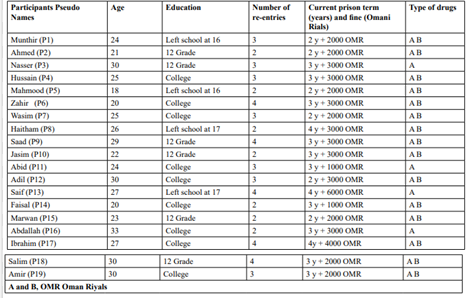
Table 1: The Study Participants’ Details
Data Collection Method
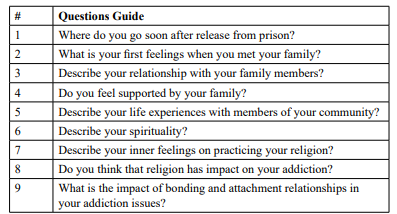
We use semi-structured interviews to explore issues and gather information about the phenomena under investigation because they enable participants to share their stories in greater detail [9,13]. We developed these interview guides based on their personal understanding of the topic under investigation. We asked the participants to elaborate on their journey and how they reintegrated into their families shortly after their release from prison based on the guide. The question guide included open-ended questions about close relationships with their family members. (Table 2) After their release from prison, the participants discussed returning to their families, friends, and neighborhoods. Participants had experienced obstacles and difficulties because their families had misconceptions about addiction, even though many families were educated; however, they were still under the influence of old traditional Omani families, where illiteracy was prevalent. The study will present the participants' initials as P followed by a number.
Table 2: The Questions Guide
Ethnographic Thematic Data Analysis
This study used thematic analysis as a basis for qualitative data analysis. Mainly, it followed the six-step process outlined by Braun and Clarke [14] for thematic analysis. First, become familiar with the data itself. Second, generate preliminary and systematic codes as you go through the data. Third, re-organize the codes into tentative themes. Fourth, review the themes created. Fifth, determine the research's final set of themes and/or subthemes. Lastly, summarize the research findings based on the selected themes or subthemes. We defined the thematic analysis and procedural guidelines; qualitative research widely uses the model [14,15].
Ethical approval
The Research Ethics Panel at Queen Margaret University (QMU) in the UK and the Royal Oman Police (ROP) in Oman granted ethical approval for this study. The study also took into account the rights of the participants, who are prisoners, by protecting their privacy, maintaining research confidentiality, and considering the reporting process for any observed violations of their human rights. We obtained informed consent from all the participants.
Results
Living in a community is one of the challenges for Substance users. All participants assert that the culture of Oman's citizens is characterized by reserve, perceiving addiction as malevolent and criminal, and stigmatizing individuals with addiction as not religious. People who use illegal drugs face discrimination, stigma, and rejection, which has impeded their recovery. The community views them as individuals who have brought shame to both themselves and their families. The themes below reveal participants’ experiences as drug users in the Omani community.
Themes One: Omani Family and Illegal Substance Use The participants’ responses suggested they were experiencing severance of family bonds. Most revealed that they felt they no longer belonged to an Omani family as their drug addiction had dented the family honor. This is brought out by the statements of two participants:
‘…. I don’t feel I belong to this family anymore; I get kicked out of my house almost every day by my father …. but I don’t have anywhere else to live so I am forced to stay in my parents’ house though I know that I’m not welcomed …. not because of my addiction, but because my father doesn’t count me as his son anymore …. I am someone who put our family down (p2).
In terms of family reputation, the image of the family name is the main concern of each family in the community. The family names and tribal names demonstrate the status of a person in their neighborhood or region.
‘…. Most of the time I don’t mention my family name or tribe … if anyone comes to know who I am then my family is going to be shamed and discriminated against as much as I am …. My family and tribe are very well known, and I have brought shame to my family …. (p1)’. I am from a very well-known tribe in Oman … My father is the Sheikh of our area … I have 9 brothers and I am number 8, all my older brothers are well-educated, and married to very well-known families … I am a student of Islamic law (Sharia) …. My brothers and I were the pride of our tribe until I became an addict then everything fell apart …. (p13)’
Thus, one member’s addiction can sink an entire family’s reputation that they have carefully preserved, perhaps over generations. The family shame, anger, and frustration are then targeted on the users of illegal drugs.
Themes Two: Family’s Shame and Loss of Honour
The participants are aware of this, and in addition to their defensiveness, they also deeply feel guilt, which intensifies their self-blame. Despite this, upon release from prison, most former users of illegal substances have nowhere else to go except to their homes. However, bringing them back could potentially cause further social alienation within the family. Recidivism among former addicts is high; society tends to believe that ‘once an addict, always an addict’. Such continued discrimination resulted in the participants experiencing a significant amount of guilt.
. Last year my sister’s marriage proposal was rejected when the family who proposed the alliance came to know that I was a drug addict … thereafter everyone kept blaming me for how I shamed my family …. it’s so sad to put them in this position … I wish I could change the past ….’ (p5). ‘…. My family used to be a welcoming family for people in our area …. whole neighborhood and relatives used to visit my father every week ….
we used to have big family gatherings to welcome guests every week after Friday prayers …since I became a drug addict, they stopped coming ….’ (p6).
P7 believed that he was responsible for his father’s early resignation from his job and the diminishment of the reputation of their family, he said.
‘…. My father held a high post in the police department as a colonel … everybody knew my father … when I became addicted and caught by the police, he took early retirement and remained away from his colleagues to avoid shame … Since then, he never spoke to me again …. He put on me the responsibility of what happened to our family …’. (p19).
From these responses, a bigger picture emerges — how the ripples generated by one person’s exposure as an addict spread to his immediate family, then the extended family, and the entire tribe. There is a drastic fall in the marriage value due to the reputation risk for all involved.
‘…. I fell in love with a girl. I went to propose to her, the family was willing at the beginning because they knew of my family’s reputation but after a few days, the proposal was rejected because they came to know that I am a drug addict …’(p8).
All participants acknowledged that after their release from prison, they found they had lost their social reputation and were distanced from their community as well as their families.
Themes Three: Users of Illegal Drugs labeled as Criminals
Family members also may make accusations of theft, leading to a loss of self-respect and dignity among users of illegal drugs. P9 mentioned
‘…Sometimes at home, they misplace things, and they start accusing me of stealing but after sometimes they find it …. How many times do I have to convince them that I did not steal or even use their belongings? It takes time for them to realize that I am innocent. These accusations are killing me ….
Participants have disclosed how the label of criminal affects them. Their main concern is that accusations without evidence are made even by the closest people around them.