


Research Article - (2021) Volume 5, Issue 1
Important heterosis on hybridization
Received Date: Apr 26, 2021 / Accepted Date: May 06, 2021 / Published Date: May 14, 2021
Copyright: ©Copyright: Ã?©2021 Mahdi Tajalifar. This is an open-access article distributed under the terms of the Creative Commons Attribution License, which permits unrestricted use, distribution, and reproduction in any medium, provided the original author and source are credited.
Citation: Mahdi Tajalifar (2021) Important heterosis on hybridization. Stem Cell Res Int 5(1):03-07.
Abstract
An understanding of heterosis in genetic terms had to await the rediscovery of Mendel’s laws in 1900. It was immediately apparent that hybrids are more heterozygous than their parents. A decrease in the number of heterozygote’s implied an increase in the number of homozygote’s. This immediately gave rise to two explanations. The `dominance` hypothesis notes that most recessive mutants are deleterious, so inbred lines are weakened by having an increase in the number of homozygous recessive genes. Hybrids, in contrast, are stronger because the recessives from each parent are usually concealed by dominants from the other. The over dominance hypothesis assumes that there are some loci at which the heterozygote is superior to either homozygote. Although the two ideas are not mutually exclusive, the dominance hypothesis is now generally favored. This explanation also applies to variety and species hybrids, because the hybrids are always more heterozygous than their parents, the more so as the parents diverge. The contrast is greatest, however, when the parents are highly homozygous inbred lines. Hybrid vigor, the increase in such characteristics as size, growth rate, fertility, and yield of hybrid organism over those of it parents. Plant and animal breeders explain hetrosis mating two different pure bredlines that have extain desirable traits. The first generation offspring generally show in greater measure, the desired characteristic of both parents. This vigor may decrease, however, if the hybrids are mated together, so the parental lines must be maintained and crossed for each new crop or group desired.
Keywords
Mendel, Immediately, Homozygous, Hypothesis and Greatest.
Introduction
Understanding the genetic bases underlying heterosis is a major issue in maize (Zea mays L.). We extended the North Carolina design III (NCIII) by using three populations of recombinant in- bred lines derived from three parental lines belonging to different crossed with each parental line to obtain nine families of hybrids. A total of 1253 hybrids were evaluated for grain moisture, silking date, plant height, and grain yield. Quantitative trait loci (QTL) mapping was carried out on the six families obtained from crosses to parental lines following the “classical” NCIII method and with a multiparental connected model on the global design, adding the three families obtained from crosses to the nonparental line. Re- sults of the QTL detection highlighted that most of the QTL detect- ed for grain yield displayed apparent over dominance effects and limited differences between heterozygous genotypes, whereas for grain moisture predominance of additive effects was observed. For plant height and silking date results were intermediate. Except for grain yield, most of the QTL identified showed significant addi- tives by additive epistatic interactions. High correlation observed between heterosis and the heterozygosity of hybrids at markers confirms the complex genetic basis and the role of dominance in heterosis. An important proportion of QTL detected were located close to the centromeres. We hypothesized that the lower recom- bination in these regions favors the detection of (i) linked QTL in repulsion phase, leading to apparent over dominance for heterotic traits and
(ii) linked QTL in coupling phase, reinforcing apparent additive effects of linked QTL for the other traits.
Material and Method
1. Dominance offsprings to parents called hybrid vigour or het- erosis.
2. Dominance average offsprings to average two parent called heterosis.
On modified plants average offspring is very important. Because that is marker development yield. The increase in such character- istics as size, growth, rate, fertility and yield of a hybrid organism over those of its parent.
Heterosis:
1. over dominance
2. dominance
3. epistasis
the over throw of the concept of combining ability in crossbreed- ing by the concept of heritability.
Heterosis is causes create hybrid. Because hybrid is stronger than of parent. Mean heterosis is hybrid vigor. Vigor is synoname to strong. Heterosis has been of immense economic value in agri- culture and has important implications regarding the fitness and fecundity of individuals in natural population.
1. Over dominance hypothesis: on year 1908 East and Shall in- troduction word hetrosis. Cause heterosis is being non pure on hybrid.
2. Dominance hypothesis: on year 1910 bruse, keeble and pellew introduction dominance hypothesis. Create genus crossbreeding of heterogenesis.
3. Epistasis hipotesis: other theory is for heterosis a comprehen- sive model to explain the phenomenology of hetrosis. Online consistently displayed parent-of-origin heterosis for growth related trait. Heterosis on maize is very important. Because production maize modern was heterosis. Parent maize was Teosint and Tripsacum. This plants are wide plant. Maize is stronger of two parent. Hetrosis is a concern to all breeders. But the mechanism of heterosis remains unknown.
Two parent that have low yield. Their off spring may be better yield. Heterosis must be on all progeny. If just on F1 or F2 was. This is phenomenon is random. And relationship to change envi- ronment. Heterosis cause is increase yield.
Heterosis is hybrid vigur. Vigur is fitness off springs of parents. Off spring producted of hetrosis have yield very big.
Analize hetrosis: hetrosis have connection to hetrozygote. Hetro- sis is result cross two hetrozygote parents. Hetrosis is stronger of parent. Offspring result of hetrosis called hybrid. Hybrids have the best yield of two parents. Hetrosis causes reduce inbreeding. Be- cause Inbreeding is selfing. Hetrosis is Hetrozigous. But selfing is homozygous. Hetrosis is cross between group. But Inbreeding and selfing is cross within group. Hetrosis is on plants hybrid. Plant hybrid is: Maize. Sorgum. Sunflower. Sugerbeet. rice. Triticale. Single cross is hybrid. Single cross is better yield of two parent. Hetrosis is connection with CMS. Two parent may be Male ste- rility. But their off spring was not CMS. Hetrosis have to refer Aloploid. Hetrosis is wheat and barley. Hetrosis is elationship to resistance parents.
Resistance is better yield.
Figure caption
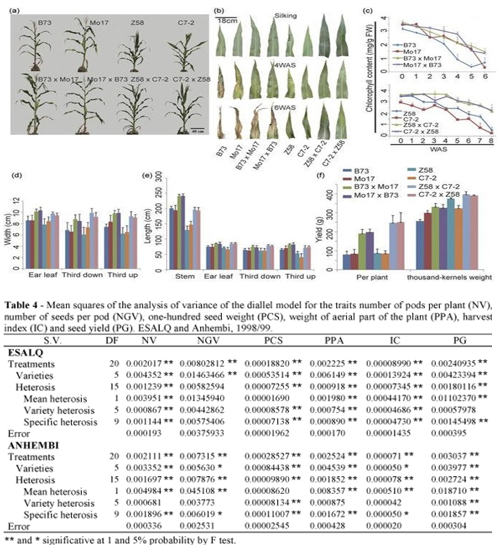
Figure graphics
Heterosis or Hybrid Vigour: Types, Causes and Effects Article Shared by <=”” div=”” style=”margin: 0px; pad- ding: 0px; border: 0px; outline: 0px; font-size: 16px; vertical-align: bottom; background: transparent; max-width: 100%;”>
ADVERTISEMENTS:
In this article we will discuss about Heterosis or Hybrid Vigour:- 1. Meaning of Heterosis 2. History of Heterosis 3. Types of Heterosis 4. Causes 5. Effects.
Meaning of Heterosis:
When two homozygous inbreeds (a true breeding line obtained by continuous inbreeding) of genetically unlike constituents are crossed together, the resulting hybrids obtained from the crossed seeds are usually robust, vigorous, productive and taller than the either parents.
This increased productivity or superiority over the parents is known as heterosis or hybrid vigour. Heterosis can be defined as the superiority of F1 hybrid over both the parents in terms of yield or some other character.
History of Heterosis:
Heterosis has been known since the art of hybridization came into existence. Koelreuter (1763) was the first to report hybrid vigour in the hybrids of tobacco, Datura etc. Mendel (1865) observed this in pea crosses.
ADVERTISEMENTS:
Darwin (1876) also reported that inbreeding in plants results in deterioration of vigour and the crossing in hybrid vigour. On the basis of his experiments Beal (1877- 1882) concluded that F1 hy- brids yield as much as 40 percent more of the parental varieties. From subsequent studies on inter-varietal crosses in maize, it was observed that some of the hybrids show heterosis.
While discussing the work on maize during a lecture at Gottingen (West Germany), Dr. G.H. ShuII (1914) proposed the term hetero- sis (Gr. heteros different and osis = condition). Poweri (1944, 45) reported that the crossing, however, may result in either weak or vigorous hybrids as compared to parental inbreeds.
ADVERTISEMENTS:
Hybrid vigour is used as synonym of heterosis. It is generally agreed that hybrid vigour describes only superiority of the hybrid over the parents while heterosis describes the other situation as well i.e., crossing over may result in weak hybrids e.g., many hy- brids in tomato are earlier (vegetative phase is replaced by repro- ductive phase).
Earliness in many crops is agriculturally desirable so, it is argued that F, shows faster development in which vegetative phase is re- placed by the reproductive phase more quickly than in the parents.
On the basis of this explanation it was justified to use the term hybrid vigour as synonym of heterosis.
However, Whaley (1944) was of the opinion that it would be more appropriate to term the developed superiority of the hybrids as hy- brid vigour and to refer to the mechanism by which the superior- ity is developed as heterosis. Smith (1955) opined that the use of heterosis and hybrid vigour as synonyms is highly desirable on the basis of their long usage.
Types of Heterosis:
Heterosis is of two types:
True heterosis (euheterosis) and pseudo-heterosis.
1. True heterosis:
It is inherited.
It can be further divided into two types:
ADVERTISEMENTS:
(a) Mutational true heterosis:
It is the sheltering or shadowing of the deleterious, un-favourable, often lethal, recessive mutant genes by their adaptively superior dominant alleles.
(b) Balanced true heterosis:
It arises out of balanced gene combinations with better adaptive value and agricultural usefulness.
2. Pseudo-heterosis:
Crossing of the two parental forms brings in an accidental, exces- sive and un- adaptable expression of temporary vigour and vegeta- tive overgrowth. It is also called luxuriance.
Causes of Heterosis:
The phenomenon of heterosis can be explained on the basis of the causes: Genetic causes and Physiological causes.
A. Genetic Causes:
There are two possible causes of heterosis viz.;
(i) Dominance
(ii) Over-dominance
(i) Dominance hypothesis:
This theory was proposed by Davenport (1910), Bruce (1910) and Keable and Pellew (1910).This theory is based on the assumption that hybrid vigour results from bringing together female domi- nant genes. According to this theory, genes that are favourable for vigour and growth are dominant, and genes that are harmful to the individual are recessive.
The dominant genes contributed by one parent may complement the dominant genes contributed by the other parent, so that F1 will have the more favourable combination of dominant genes, than ei- ther parent e.g., Dominant genes ABCDE are favourable for good yield. Inbred A has the genotype AA BB cc dd (AB dominant) and inbred B has the genotye aa bb CC DD (CD dominant).
The genotype of the F1 hybrid is as follows:
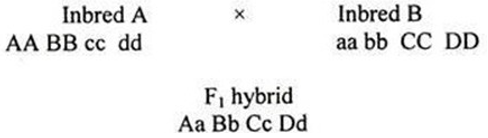
The F1 hybrid contains dominant genes at all the loci represented here (ABCD) and exhibits more vigour than either of the parent inbred lines.
Objectives
There are two main objections:
1. Failure in the isolation of inbreeds as vigorous as hybrids: If the above hypothesis is true, it should be possible to isolate in- breeds with all dominant genes. Such inbreeds would be as vigor- ous as the F1 hybrids. However, such hybrids have not been isolated. Jones (1917) in this modified theory entitled “Dominance of Linked Genes Hypothesis” provided explanation for this.
He suggested that there may be a linkage between some favourable dominant genes and some un-favourable recessive genes and as a result it is not possible to obtain true breeding homozygous indi- vidual for all dominant genes in F2 generation.
2. Symmetrical distribution in F2:
It is already studied that in F2 dominant and recessive characters segregate in the ratio of 3:1. If heterosis is due to dominance of in- dependent factors, the F2 distribution curve for heterotic character should be skewed (slanting) rather than smooth and symmetrical. But the curve of F2 is always, smooth and symmetrical and not skewed. This objection was removed by Collins (1921). Accord- ing to him trait like yield is governed by large number of genes or polygenes, which exhibit continuous variation resulting in sym- metrical distribution of genes.
(ii) Over dominance hypothesis:
This hypothesis was given by Shull (1903) and East (1908) inde- pendently. According to the supposition hybrid vigour on the basis of heteozygosity is superior to homozygosity. According to this hypothesis there are contrasting alleles for example a1 and a2, for a single locus. Each allele produces favourable yet different effects in the plant.
In a heterozygous plant (a1, a2) a combination of the effects is produced which is more favourable in the plant than the effect pro- duced by either of the alleles alone. This phenomenon of hetero- zygote(a1 a2) being superior to the homozygotes (a1a1 or a2a2) is termed over dominance.
Various names have been given to this idea e.g., super dominance (Fisher 1930), interaction of alleles at a single locus (East, 1930) over-dominance (Hull, 1945) etc., but the term over-dominance is widely accepted.
B. Physiological Causes:
(i) Greater initial capital hypothesis:
This hypothesis was proposed by Ashby (1930). He studied the physiology of inbreeds and hybrids of maize and tomato and con- cluded that hybrid vigour is due to an increased initial embryo size. He termed it as ‘Greater initial capital.’
(ii) Cytoplasmic-nuclear interactions:
Michelis, Shull, Lewis, and others suggested that hybrid vigour is the interaction of cytoplasmic and nuclear systems. Cytoplasm is transparent fluid rich in RNA and mitochondria, which is usually transmitted through the female parent to the offspring.
Effects or Manifestations of Heterosis:
Whatever may be the cause (genetical or physiological), heterosis is a well-known phenomenon.
It is basically the result of the increased metabolic activity of the heterozygote Its effects are well established or manifested in the following tree ways:
1. Quantitative Effects:
(a) Increase in size and genetic vigour:
Hybrids are generally more vigorous I;e larger, healthier and faster growing than the parents e.g., head size in cabbage jowar cob size in maize, fruit size in tomato etc.
(b) Increase in yield:
Yield may be measured in terms of grain, fruit, seed, leaf tuber or the whole plant.
Hybrids usually have increased yield.
(c) Better quality:
Hybrids show improved quality e.g., hybrids in onion show better keeping quality.
2. Physiological Effects:
(a) Greater resistance to diseases and pests:
Some hybrids show greater resistance to insects or diseases than parents.
(b) Greater flowering and maturity: Earliness is highly desirable in vegetables In many cases, hybrids are earlier in flowering and maturity than the parents, e.g. tomato hybrids are earlier than their parents.
(c) Greater Adaptability:
Hybrids are usually less susceptible to adverse environmental con- ditions.
3. Biological Effects:
Hybrids exhibiting heterosis show an increase in biological effi- ciency i.e., an increase in fertility (reproduction ability) and sur- vival ability.
Heterosis in animals:
(i) Mule is a hybrid from a cross between Jack (Equus hemicus) and Mare (Earns equus) which has been known since ancient times for its well-known qualities of strength and stubbornness.
(ii) Cross between red Sindhi breed of Indian Cattle and Jersey breed of America contams 30% more butter fat in milk.
(iii) Increased pork yield in pigs, more egg laying hens, silk pro- duction in silk worms etc.
Akcnowledgement
I am thank of my mother and father that supporter me. And news Agency (Mehr, Fars, Irna, Moj, Imna) and (Aftab-Yazd, rayehe mehr) that published my subject science. And journal healthy house plant (Mrs. Julie Bowden-Davis) that send your news of prof. Hermann heege am thanks that my subject used on university Kiel Germany.
On finish thanks journal genetics and plant breeding that publish my article.
Funding source
I havenot need to funding source.
Result and discussion
Dominance average offspring to average two parent called hetrosis that is marker development yield. The increase in such character- istic as size, growth, rate, fertility and yield of a hybrid organism over those of it parent.
Heterosis:
1. over dominance
2. dominance
3. epistasis
hetrosis is causes create hybrid. Because hybrid is stronger than of parent. Over dominance hypothesis on year 1908 East and shall introduction word hetrosis. Cause hetrosis is being non-pure on hybrid.
2. dominance hypotsis: on year 1910 bruse, keeble and pillow introduction dominance hypothesis. Create genus crossbreeding of hetrogenesis.
3. Epistasis hipotsis: other theory is hetrosis.
Hetrosis on maize is very important. Because production maize modern was hetrosis. Parent maize was teosint and trip sacum. This plants are wide plant. Maize is stronger of two parent. Hetro- sis is a concern to all breeder.
Hetrosis must be on all progeny. If just on F1 or F2 was.
Hetrosis is hybrid vigur. Vigure is fitness off springs of parents. Off spring producted of hetrosis have connection to hetrosygote.
Hetrosis is result cross two hetrozygote parents. Hetrosis is stron- ger of parent. Offspring result of hetrosis called hybrid.
Hybrid have the best yield of two parents. Hetrosis causes reduse inbreeding, because inbreeding is selfing. Hetrosis is heterozy- gous.
References
- www.britannica.com/science/hetrosis
- en.wikipedia.org/wiki/hetrosis
- www.sciencedirect.com/topic/agricultural-and-biological-sci- ence/hetrosis
- www.ncbi.nlm.nih.gov/pmc/articles/puc3276634
- www.ncbi.nlm.nih.gov/pubmed/12812083
- www.hindawi.com/journal/isrn/2012/682824/
- www.plantcell.org/content/22/7/2105
- www.nature.com/articles/nplants201592
- www.nature.com/articles/srep08750
- www.biologydiscussion.com/plant/breeding/hetrosis-orhy-brid-vigour-types- causes-and-effects/17672.