

International Journal of Preventive Medicine and Care(IJPMC)
ISSN: 2994-032X | DOI: 10.33140/IJPMC

Review Article - (2024) Volume 2, Issue 1
Impact of COVID-19 on Child Development: A systematic review
2University of Mississippi Medical Center, Jackson, MS, USA
3Department of Epidemiology & Biostatistics, Jackson State University, Jackson, MS, USA
Received Date: Dec 07, 2023 / Accepted Date: Dec 27, 2023 / Published Date: Jan 08, 2024
Copyright: ©©2024 Maude H. Jones, et al. This is an open-access article distributed under the terms of the Creative Commons Attribution License, which permits unrestricted use, distribution, and reproduction in any medium, provided the original author and source are credited.
Citation: Jones, M. H., Walker, J. B., Jones, E. A. K. (2024). Impact of COVID-19 on Child Development: A systematic review. Int J Prev Med Care, 2(1), 01-07.
Abstract
Background: As a result of the pandemic, families and children have faced physical, emotional, and mental challenges. However, there has been little attention given to the relationship between the COVID-19 pandemic and child development. This systematic review aims to identify the impact of the pandemic on child development, globally.
Methods: This study follows the PRISMA guidelines for the systematic review of 16 quantitative and qualitative studies conducted between 2020-2023.
Results: This systematic review suggest that the COVID-19 pandemic played a crucial role in hindering child development in early childhood.
Conclusion: Therefore, it is important to promote and implement the use of policies and strategies to overcome these obstacles.
Introduction
In the United States, children and families have been significantly impacted by the COVID-19 pandemic [1]. As a result of the pandemic, families and children have faced physical, emotional, and mental challenges [2,3]. However, researchers have focused more on the impact of COVID-19 on adults and adolescent mental health [4,5]. There has been little attention given to the relationship between the COVID-19 pandemic and child development [6].
The impact of the COVID-19 pandemic on child development should be a focal point in education research due to the importance of normal child development, which leads to socially, emotionally, and educationally developed children, and adults [7,8]. Poor child development in early childhood can result in learning challenges and difficulty with social interactions, and dependency and nonproductive behaviors in adulthood. [9,10]. All of these outcomes are not needed in a world that is permeated with both physical and mental health challenges for all ages. Due to the negative impact that the pandemic has had, it is imperative to review the impact of COVID-19 on child development to understand the relationship and to provide strategies that can be implemented to address poor developmental outcomes in children.
The aim of the systematic review was to assess the impact of the COVID-19 pandemic on child development. Specifically, the objectives of this review are: (1) To identify the impact of the pandemic on child development, globally, (2) To provide quality research that will inform parents, early childhood educators, and education policy makers about developmental challenges associated with the pandemic to overcome any obstacles to positive developmental outcomes.
Materials and Methods
The systematic review included studies following the PRISMA guidelines [11]. The study focuses on published primary articles associated with the impact of COVID-19 on child development. Table 1 shows the inclusions and exclusions of the review.
|
Inclusion Criteria |
Exclusion Criteria |
|
Quantitative studies |
Studies that were not in English |
|
Qualitative studies |
Studies that only involved ages 9 |
|
Human studies |
and older |
|
Scholarly papers |
Review articles |
|
Age group: 0-8 years |
Not human studies |
|
COVID-19 |
|
|
Child Development |
|
Table 1. Inclusion and Exclusion Criteria.
Search Guidelines
The primary search engines used to identify articles included EBSCOhost, Google Scholar, CINAHL, Consumer Health Complete, Education Research Complete, Educational Administration Abstracts, Health Source: Nursing/Academic, APA PsychArticles, Psychology and Behavioral Sciences Collection, APA PsychInfo, and Teacher Reference Center. The studies were chosen for the review based on inclusion criteria, such as (1) articles being written in English; (2) being quantitative studies; (3) being qualitative studies (4) being scholarly papers; (5) using human participants between the ages of 0-8 years; (5) being associated with COVID-19; and (6) being associated with child development. The search was performed on 24 April 2023. The time limit for the studies was from 2020–2023. Table-2 shows the search string.
|
Search Strategies |
No. of Studies Available |
|
Search terms used: ‘COVID-19’ OR ‘COVID-19 pandemic’ OR |
345,000 |
|
‘SARS-CoV-2 ’ OR ‘child development |
|
|
Total number of studies excluded based on eligibility criteria |
332,500 |
|
Total number of studies excluded due to being duplicates |
12,000 |
|
Total number of studies excluded because either they were |
484 |
|
review articles |
|
|
Total number of studies accepted and reviewed |
16 |
Table 2. Research Thread for all Databases.
Screening Guidelines
The Preferred Reporting Items for Systematic Reviews and Meta-Analysis (PRISMA) guidelines (2009) were used as a guide to evaluate the review process [11]. Selected abstracts were reviewed to ensure eligibility. Full-text articles of eligible abstracts were retrieved and assessed on whether they answered the research questions and fulfilled the inclusion criteria. Studies were included if a consensus was reached by the researchers.
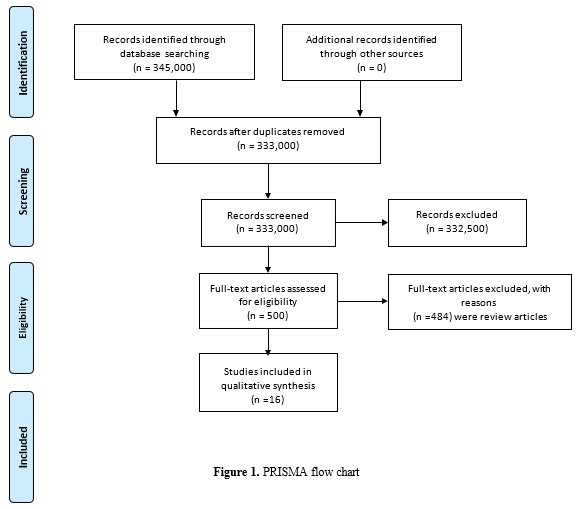
Research Information System (RIS) formatted references were exported from the databases, where studies were automatically screened based on the inclusion criteria and then imported into CADIMA. 500 studies were imported into CADIMA were accessed based on title and abstracts. The researchers assessed the studies twice before discussing if the studies should be chosen for full-text review. Conflicts were managed by group discussions between the researchers of the study. After the initial discussion, the researchers agreed that 500 studies should be selected for further screening using the inclusion criteria. During this second phase of screening for excluding review articles, the researchers independently screened the 500 articles twice for the second time. Conflicts were managed by group discussions. After discussion, 484 more articles were excluded because they were review articles, and 16 articles were selected to be included in the systematic review. The PRISMA flow chart (Figure 1) depicts the search and inclusion process for the systematic review.
Quality Appraisal
Studies were appraised for quality using CADIMA. Through CADIMA, standards for critical appraisal and the rating scale were defined. We followed the critical appraisal tools for systematic reviews developed by the University of Adelaide, South Australia [12]. A rating scale from 0 to 3 was based on the following criteria: (1) Study design—cross-sectional, case–control, or cohort study = 1, otherwise = 0; (2) Sample size— large = 1, small = 0; (3) Selection of participants—random selection or lack of bias = 1, non-random sample or convenience sample or presence of bias = 0 points. Based on the above-mentioned criteria, the researchers rated each of the 16 studies independently from a range of 0 to 3. Due to having no major inter-observer variations in the evaluation of the quality of the studies, an average of the three scores was presented in Table 3 under the quality appraisal section.
Results
A summary of the methodology, characteristics of findings, the impact of COVID-19 on child development, quality appraisal, and the countries of the studies are presented in Table 3. Of the 16 studies reviewed, 4 were conducted in the United States, 3 were conducted in Indonesia, 2 were conducted in Germany and 1 each in Australia, Canada, China, Africa, United Kingdom, and globally. 15 studies were quantitative and 1 study was qualitative. All the selected studies were conducted among children, ranging from infancy to eight years old.
The total sample size used in studies ranged from 12 to 2,000,000, having a median sample size of 762 (Quartile-1 = 12 and Quartile-3 = 36,000); 7 out of 16 (44%) had sample sizes of more than 1000. In terms of standardized tools, all studies (100%) used standardized assessment tools.
An average score of 3 out of 3, meant excellent in 13 studies (81%), 2 meant moderate/good in 3 studies (19%), and no study scored 0-1, which meant poor.
Benefits of COVID-19 on Child Development
Of the 16 studies, 1 (6%) showed the benefits of COVID-19 on child development. One study found that the COVID-19 pandemic benefited child development [13]. The study established that child development was benefited in 4 areas-allowing children to learn new skills, getting children indulged in indoor physical activities, personality development, and self-confidence build up [13]. The benefits to child development by allowing children to learn new skills gave children an advantage of learning new educational methods that would benefit them later in life [13]. Being indulged in indoor physical activities benefited child development by allowing children to get involved physically, and creatively by learning new ways to be physically active indoors [13]. Personality development and self-confidence build up also benefited child development by establishing social-emotional strengths that will benefit children as they progress into adulthood [13].
Lack of Benefits of COVID-19 on Child Development
Of the 16 studies, 15 (94%) supported the notion that child development was negatively impacted by COVID-19. Several studies constituted that child development, explicitly social and emotional development, was negatively affected by the pandemic. One study emphasized that COVID-19 related stress on the family leads to negative impacts on child development, specifically, social, and emotional development [14]. The study also concluded that the social and emotional developmental challenges are expressed in children as conduct problems and callous unemotional disruptions. Another study also revealed that the pandemic resulted in detrimental effects on child development, specifically social and emotional development [15]. The study also found that less independent children had more issues with their social behavior than independent children, who were left to “clean-up the mess [fallout]” [15]. Another study also determined that COVID-19 negatively impacted child development, explicitly social development [16]. The study also found that social isolation from stay at home polices resulted in challenges with social development in early childhood [16]. Another study also acknowledged that child development, specifically social development was impaired by the pandemic [17]. Another study also confirmed that child development, distinctly social development, was negatively impacted by the COVID-19 pandemic [18]. The study recognized that the increased use of technology and lack of social interaction hindered social and emotional development. The study also found that the pandemic resulted in social delays in early childhood.
Several other studies attributed the negative effects of the pandemic to hindering learning skills associated with child development. A study found that the learning loss from not physically attending in-person school would be difficult to overcome and that it would greatly impact those in stages of early childhood as they may lack foundational learning skills [19]. A different study also identified learning challenges associated with child development due to the pandemic [20]. The study found that the pandemic resulted in significant decreases in mathematics and language skills. Another study also found that school closures, physical distancing, and the lack of community-based services resulted in a negative impact on learning development that is significantly important in child development [21]. A different study also noted that the pandemic delayed the development of fine motor skills, and community skills in early childhood [22]. A study also identified that the pandemic affected learning skills involved in child development, such as vocabulary, language, and executive functions [23]. A study also found that parental unemployment and stress due to the pandemic caused impairments in learning skills that resulted in the loss of academic achievement and the lack of appropriate development [24].
Several other studies found that the pandemic negatively impacted child development by causing delays and challenges. Two studies noted that children faced child development delays due to school closures associated with the pandemic [25,26]. Another study also noted that children encountered developmental challenges caused by the COVID-19 pandemic [27]. A study also concluded that the pandemic caused developmental challenges to child development for children, who were enrolled in/attended early childhood education centers and for children, who were not enrolled in/did not attend early childhood education centers [28].
|
Author [Ref] |
Major Findings |
Impact of COVID-19 on Child Development |
Quality Appraisal (Out of 3) |
Country of Study |
|
Brown et al. [19] |
n=121; Majority of the children in the study faced developmental challenges that affected learning, social, and wellbeing outcomes |
Yes-negative |
3-excellent |
Australia |
|
Quenzer-Alfred et al. [20] |
n= 49; Children, who were unable to attend preschool due to the pandemic faced developmental challenges that resulted in significant decreases in language and mathematical skills compared to children, who were able to attend preschool prior to the pandemic |
Yes-negative |
3-excellent |
Germany |
|
Whitley et al. [21] |
n= 6000; The COVID-19 pandemic negatively affected children’s ability to learn and develop due to physical distancing, school closures, and the lack of community-based services |
Yes-negative |
3-excellent |
Canada |
|
Waller [14] |
n= 303; Surveyed parents felt that the pandemic resulted in challenges in social and emotional development based on the high rate and frequency of child conduct problems, and callous-unemotional traits. |
Yes-negative |
3-excellent |
United States |
|
Ekyana et al. [15] |
n=150; Surveyed parents revealed that children faced social development delays |
Yes-negative |
3-excellent |
Indonesia |
|
Huang et al. [22] |
n= 6,054; Neurodevelopment assessments were conducted on 6-month and 1 year old children, which resulted in an increased risk of delays in fine motor skills, and communication skills for children, who experienced the COVID-19 pandemic |
Yes-negative |
3-excellent |
China |
|
Spaull et al. [25] |
n=19,741; Children faced developmental delays during the pandemic due to preschool and school closures, which resulted in challenges with mental health, nutrition, and physical health |
Yes-negative |
2-good |
Africa |
|
Davies et al. [23] |
n= 189; Parent-report data from families revealed that children, ages 8 to 36 months, who continued to receive early childhood education and care during the pandemic had more growth in vocabulary, and language and executive functions than children that did not receive early childhood education and care during the pandemic |
Yes-negative |
3-excellent |
United Kingdom |
|
Najamuddin et al. [16] |
Qualitative; COVID-19 negatively affected social development among children in stages of early childhood |
Yes-negative |
2-good |
Indonesia |
|
Gupta et al. [13] |
n= 2,000,000; COVID-19 positively impacted child development in children by allowing them to learn new skills, getting indulged in indoor physical activities, self-confidence build, and personality development |
Yes-positive |
2-good |
Global |
|
Dillman et al. [17] |
n=90; Parental perceived stress resulted in delays in social-emotional child development |
Yes-negative |
3-excellent |
Germany |
|
Deoni et al. [27] |
n=762; The environmental changes associated with the COVID-19 pandemic negatively impacted child development |
Yes-negative |
3-excellent |
United States |
|
Wijaya et al. [18] |
n= 12 mothers; Increased use of technology and lack of social interaction resulted in poor social and emotional development in children, ages 0-8 years |
Yes-negative |
3-excellent |
Indonesia |
|
Lee et al. [26] |
n= 85, 328; Two-thirds of childcare centers closed in the sample of U.S. counties resulted in delays in child development |
Yes-negative |
3-excellent |
United States |
|
Cascio et al. [28] |
n= 60,000; Children, who enrolled in/attended early childhood education centers and children, who were not enrolled in/did not attend early childhood education centers faced the same developmental challenges during the pandemic |
Yes-negative |
3-excellent |
United States |
|
Parolin et al. [24] |
n=36,000; Unemployment and stress directly affected child development (i.e., academic achievement and behavior) |
Yes-negative |
3-excellent |
United States |
Table 3. Impact of COVID-19 on Child Development
Discussion
Negative Effects of the COVID-19 Pandemic on Child Development
In this systematic review, there was strong evidence to support that the COVID-19 pandemic detrimentally affected child development. The pandemic resulted in social and emotional developmental challenges within the child development process. The pandemic also negatively impacted learning milestones within child development stages, resulted in developmental delays, and resulted in classroom disruptions, lower levels of academic success, and mental health issues in adulthood. Understanding the role of the pandemic in effecting child development can allow parents, early childhood educators, and educational policy makers to implement actions that will assist with helping young children adapt as they manage dealing with the effects of the pandemic. This includes recognizing and addressing fear and stress, keeping children healthy, and helping children stay socially connected. This finding has been supported by two other studies [29,30]. These authors found significant negative relationships between the COVID-19 pandemic and child developmental outcomes in early childhood.
Child Developmental Benefits from the COVID-19
Pandemic While most of the studies in the review revealed the negative impacts of the COVID-19 pandemic on child development in stages of early childhood, there was still one study that found benefits to child developmental outcomes. In this review, 1 study found benefits to child developmental progressions for young children during the current pandemic. The study found that the pandemic improved child developmental outcomes by providing an opportunity for young children to become more familiar with technology that can be used as the grow and mature, by providing a means to engage in physical indoor activities, and by improving esteem and resiliency, which fosters confidence and benevolent and strong personalities. These findings might differ from most studies due to the sample of participants screened within the study being more aware of strategies to support their children during periods of crisis, such as the COVID-19 pandemic.
Conclusions
Globally, the COVID-19 pandemic has played a significant role in negatively impacting child development. The pandemic has caused poor child development outcomes that have resulted in delays, social and emotional challenges, and difficulty mastering learning milestones within early childhood. Revealing that young children could benefit from the implementation of policies and strategies that could assist parents in providing support for young children, such as promoting CDC parental resources for early childhood, innovative, and accessible virtual learning tools, ensuring the provision of community-based services, and alleviating economic strain on parents and families. Further research is needed to study the impact of the COVID-19 pandemic on child development after and before the pandemic to gauge a true measurement of the possible strain.
References
- Kutsar, D., & Kurvet-Käosaar, L. (2021). The impact of the COVID-19 pandemic on families: Young people’s experiences in Estonia. Frontiers in sociology, 6, 732984.
- Whaley, G. L., & Pfefferbaum, B. (2023). Parental challenges during the COVID-19 pandemic: psychological outcomes and risk and protective factors. Current psychiatry reports, 25(4), 165-174.
- Gadermann, A. C., Thomson, K. C., Richardson, C. G., Gagné, M., McAuliffe, C., Hirani, S., & Jenkins, E. (2021). Examining the impacts of the COVID-19 pandemic on family mental health in Canada: findings from a national cross-sectional study. BMJ open, 11(1), e042871.
- Xiong, J., Lipsitz, O., Nasri, F., Lui, L. M., Gill, H., Phan, L., ... & McIntyre, R. S. (2020). Impact of COVID-19 pandemic on mental health in the general population: A systematic review. Journal of affective disorders, 277, 55-64.
- Nature Publishing Group. Young people’s mental health isfinally getting the attention it needs. Nature News.2021.
- Rouse, H. L., Shearer, R. J. B., Idzikowski, S. S., Nelson,A. H., Needle, M., Katz, M. F., ... & Reeves, M. (2020). Developmental impacts of the COVID-19 pandemic on young children: a conceptual model for research with integrated administrative data systems. International journal of population data science, 5(4).
- Centers for Disease Control and Prevention. Child development basics. Centers for Disease Control and Prevention, 2023.
- Child development: The first 5 years. Raising Children Network, 2023.
- Steinmetz, N. (2010). The development of children and the health of societies. Paediatrics & Child Health, 15(1), 11-12.
- Juth T. Does quality early childhood education lead to more successful lives as adults?. The Science Behind It, 2020.
- Moher, D., Liberati, A., Tetzlaff, J., Altman, D. G., & PRISMA Group*. (2009). Preferred reporting items for systematic reviews and meta-analyses: the PRISMA statement. Annals of internal medicine, 151(4), 264-269.
- Joanna Briggs Institute. JBI Critical Appraisal Tools. Place of Publication: The University of Adelaide, South Australia n.d.
- Gupta, S., & Jawanda, M. K. (2020). The impacts of COVID-19 on children. Acta Paediatrica (Oslo, Norway: 1992), 109(11), 2181.
- Waller, R., Powell, T., Rodriguez, Y., Corbett, N., Perlstein, S., White, L. K., ... & Wagner, N. J. (2021). The impact of the COVID-19 pandemic on children’s conduct problems and callous-unemotional traits. Child Psychiatry & Human Development, 1-12.
- Ekyana, L., Fauziddin, M., & Arifiyanti, N. (2021). Parents’ perception: early childhood social behaviour during physical distancing in the covid-19 pandemic. Jurnal Pendidikan Usia Dini, 15(2), 258-280.
- Najamuddin, N., Sahrip, S., Siahaan, K. W. A., Yunita, W., & Ananda, R. (2022). The Impact of The Dissemination of The Covid-19 Epidemic on Social Development in Early Children. International Journal of Elementary Education, 6(2).
- Dillmann, J., Sensoy, Ö., & Schwarzer, G. (2022). Parental perceived stress and its consequences on early social-emotional child development during COVID-19 pandemic. Journal of Early Childhood Research, 20(4), 524-538.
- Wijaya, R. P. C., Bunga, B. N., & Kiling, I. Y. (2022). Socio-emotional struggles of young children during COVID-19 pandemic: Social isolation and increased use of technologies. Journal of Early Childhood Research, 20(1), 113-127.
- Brown, N., Te Riele, K., Shelley, B., & Woodroffe, J. (2020). Learning at home during COVID-19: Effects on vulnerable young Australians. Independent rapid response report. Retrieved from University of Tasmania website: http://ecite. utas. edu. au/139877.
- Quenzer-Alfred, C., Schneider, L., Soyka, V., Harbrecht, M., Blume, V., & Mays, D. (2021). No nursery ‘til school–the transition to primary school without institutional transition support due to the COVID-19 shutdown in Germany. European journal of special needs education, 36(1), 127-141.
- Whitley, J., Beauchamp, M. H., & Brown, C. (2021). The impact of COVID-19 on the learning and achievement of vulnerable Canadian children and youth. Facets, 6(1), 1693-1713.
- Huang, P., Zhou, F., Guo, Y., Yuan, S., Lin, S., Lu, J., ...& Qiu, X. (2021). Association between the COVID-19 pandemic and infant neurodevelopment: a comparison before and during COVID-19. Frontiers in pediatrics, 9, 662165.
- Davies, C., Hendry, A., Gibson, S. P., Gliga, T., McGillion, M., & Gonzalez-Gomez, N. (2021). Early childhood education and care (ECEC) during COVID-19 boosts growth in language and executive function. Infant and child development, 30(4), e2241.
- Parolin, Z. (2020). Unemployment and child health during COVID-19 in the USA. The Lancet Public Health, 5(10), e521-e522.
- Spaull, N., & Van der Berg, S. (2020). Counting the cost: COVID-19 school closures in South Africa and its impact on children. South African Journal of Childhood Education, 10(1), 1-13.
- Lee, E. K., & Parolin, Z. (2021). The care burden during COVID-19: A national database of child care closures in the United States. Socius, 7, 23780231211032028.
- Deoni, S. (2022). Impact of the COVID-19 pandemic environment on early child brain and cognitive development. Biological Psychiatry, 91(9), S26.
- Cascio, E. (2021). COVID-19, early care and education, and child development.
- Araújo, L. A. D., Veloso, C. F., Souza, M. D. C., Azevedo,J. M. C. D., & Tarro, G. (2021). The potential impact of the COVID-19 pandemic on child growth and development: a systematic review. Jornal de pediatria, 97, 369-377. https:// doi.org/10.1016/j.jped.2020.08.008.
- Penna, A. L., de Aquino, C. M., Pinheiro, M. S. N., do Nascimento, R. L. F., Farias-Antúnez, S., Araújo, D. A. B. S., ... & Castro, M. C. (2023). Impact of the COVID-19 pandemic on maternal mental health, early childhood development, and parental practices: a global scoping review. BMC Public Health, 23(1), 388.