



Research Article - (2026) Volume 11, Issue 2
Impact of Cooking Methods on Saturated Fat, Sodium, and Omega-3 Content in Animal-Based Foods: Implications for Cardiovascular Risk

Received Date: Feb 07, 2026 / Accepted Date: Aug 17, 2026 / Published Date: Sep 03, 2026
Copyright: ©2026 Carlos Scherr. This is an open-access article distributed under the terms of the Creative Commons Attribution License, which permits unrestricted use, distribution, and reproduction in any medium, provided the original author and source are credited.
Citation: Scherr, C. (2026). Impact of Cooking Methods on Saturated Fat, Sodium, and Omega-3 Content in Animal-Based Foods: Implications for Cardiovascular Risk. Cardio Open, 11(2), 01-08.
Abstract
Background: Excess intake of saturated fat and sodium contributes significantly to cardiovascular disease. Although dietary guidelines emphasize limiting these nutrients, the impact of cooking methods on nutrient composition remains poorly characterized.
Objective: To evaluate how different cooking methods influence saturated fat, sodium, and omega-3 fatty acid content in commonly consumed animal-based foods.
Methods: Twenty-nine foods of animal origin and two of plant origin were analyzed. The present study reports data for beef sirloin, poultry (chicken and Chester®, Gallus gallus domesticus), shrimp, and 10 fish species. Samples were prepared using standardized cooking methods, including grilling, frying, stewing, roasting, and boiling. Cooking temperature and preparation time were kept constant within each cooking method to ensure methodological consistency. Nutrient concentrations were determined under standardized laboratory conditions. Omega-3 concentrations were compared across cooking methods using the Kruskal–Wallis test. Comparisons of saturated fat content between beef preparations were performed using the Mann–Whitney U test. Statistical significance was defined as p < 0.05.
Results: Cooking methods significantly modified nutrient composition. Removal of visible fat from beef reduced saturated fat content by approximately 28%, whereas frying with added fat restored higher levels, resulting in values similar to those observed in preparations with visible fat. In poultry, saturated fat content differed by more than threefold according to the presence of skin and the cooking method. Fried shrimp preparations showed higher sodium concentrations compared with grilled preparations. Omega-3 levels in fish varied markedly across cooking methods, exceeding a 1000% variation within the same species; for example, sardine omega-3 content ranged from <0.01 to 1.48 g/100 g.
Conclusion: Cooking techniques can markedly influence nutrient composition and may affect dietary exposure to key cardiovascular risk factors. Cardiovascular risk is influenced not only by the type of food consumed but also by the method of preparation. Incorporating food preparation practices into dietary recommendations may improve adherence to heart-healthy dietary patterns by expanding food choices and promoting nutritional education.
Keywords
Cooking Methods, Saturated Fat, Sodium, Omega-3 Fatty Acids, Cardiovascular Risk, Nutrition, Dietary Counseling
Introduction
Cardiovascular disease (CVD) remains the leading cause of mortality worldwide and represents a major global public health challenge [1]. Dietary risk factors account for a substantial proportion of cardiovascular morbidity and mortality, contributing significantly to disability-adjusted life years and premature deaths globally [2]. Among these factors, excessive intake of saturated fat and sodium has been consistently associated with hypertension, dyslipidemia, endothelial dysfunction, and progression of atherosclerotic disease [3]. Current cardiovascular prevention guidelines recommend limiting saturated fat intake to less than 10% of total daily energy consumption and sodium intake to less than 2 g/day [4]. These recommendations are supported by epidemiological and clinical evidence linking dietary patterns to cardiovascular outcomes. Nevertheless, adherence to heart-healthy dietary patterns remains suboptimal worldwide, including among individuals with established cardiovascular disease or multiple cardiometabolic risk factors [5,6].
Most nutritional recommendations and epidemiological investigations focus primarily on food selection and dietary patterns, whereas comparatively little attention has been given to food preparation practices. Cooking methods may substantially influence the nutritional composition of foods through mechanisms such as fat addition during cooking, lipid exchange between foods and cooking oils, structural changes induced by heating, and moisture loss during thermal processing. These processes may alter concentrations of key nutrients, including saturated fat, sodium, and bioactive fatty acids, potentially modifying the metabolic and cardiovascular effects of otherwise similar foods. Large epidemiological investigations, including the Prospective Urban Rural Epidemiology (PURE) study and other global analyses of dietary patterns, have provided important insights into the relationship between diet and cardiovascular outcomes [5].
However, such studies typically evaluate foods as consumed without systematically accounting for differences in preparation techniques. As a result, an important dimension of dietary exposure remains insufficiently characterized in the current literature. Experimental evidence suggests that several cooking-related factors, including trimming visible fat from meat, removing poultry skin, selecting different cooking oils, and applying moist versus dry heat techniques, may significantly modify nutrient composition [7-9]. Changes in saturated fat and omega-3 fatty acids are of particular relevance in cardiovascular prevention because of their roles in lipid metabolism, inflammatory pathways, and vascular function [10]. Despite this biological plausibility, systematic analyses evaluating how different cooking methods affect nutrient composition across commonly consumed animal-based foods remain limited. A clearer understanding of how cooking practices influence nutrient composition may refine dietary recommendations and improve the effectiveness of nutritional counseling in preventive cardiology. Recent and contemporary dietary guidance documents emphasize reduction of saturated fat, sodium chloride, processed foods, and ultra-processed foods, while encouraging consumption of polyunsaturated fats and fish [11-13]. However, they provide limited practical recommendations regarding preparation methods, as if cooking practices were nutritionally neutral. This creates an actionable information gap for clinicians, dietitians, and the general population. Therefore, the present study aimed to evaluate the effects of different cooking methods on saturated fat, sodium, and omega-3 fatty acid content of commonly consumed animal-based foods under controlled laboratory conditions.

Figure 1: Central Illustration: Cooking methods modify cardiovascular-relevant nutrients in animal-based foods. Trimming and lower-fat preparations may reduce saturated fat, whereas frying and added fats may increase saturated fat and sodium exposure. Fish fatty acid profiles may vary substantially depending on cooking method and lipid exchange during preparation
Methods
Study Design and Food Samples
Beef sirloin, poultry (chicken and Chester®), shrimp, and fish species (salmon,badejo, cherne, filhote, namorado, pescadinha, pirarucu, robalo, sardine, and trout) were analyzed. Samples were prepared in triplicate and subdivided to reduce within-cut variability. For beef, three whole pieces were purchased. From each piece, one sample was taken for each preparation method, totaling three independent samples per treatment. Each sample was further subdivided into three subsamples collected from the beginning, middle, and end of the muscle cut to minimize variability related to muscle or fat distribution. For chicken breast and Chester®, three samples were used for each condition, with skin and without skin. Each sample weighed approximately 50 g and followed the same triplicate treatment procedure. For fish, three whole individuals of each species were analyzed. From each fish, one sample was collected for each preparation method, totaling three independent samples per treatment. Each sample was subdivided into three subsamples collected from the beginning, middle, and end of the fillet to ensure representativeness across muscle regions and control for natural variation. The entire fatty acid chain (from C10 - capric to C20 - arachidonic) and cholesterol were analyzed in all foods, both on a wet and dry basis.
Cooking Procedures and Nutrient Analyses
Cooking methods included grilling, pan-frying, stewing, roasting, and boiling, using soybean oil, refined olive oil, extra-virgin olive oil, or butter when applicable. All preparations were performed under standardized laboratory conditions. Saturated fat and sodium were expressed as mg/100 g, whereas omega-3 fatty acids were expressed as g/100 g. Percentage variation was calculated as ((maximum − minimum) / minimum) × 100.
Statistical Analysis
Omega-3 levels were analyzed using the Kruskal–Wallis test. Saturated fat in beef preparations was compared using Mann–Whitney tests for pairwise comparisons. Statistical significance was defined as p < 0.05. Data in tables and figures are presented as mean ± SD where available.
Results
Overall Variability Introduced by Cooking Methods
Cooking methods produced substantial variability in the nutrient composition of animal-based foods. The magnitude of these changes differed between food groups but was particularly pronounced for fatty acids in fish and for saturated fat in poultry. Across the foods analyzed, preparation techniques modified nutrient concentrations to an extent that, in several cases, exceeded differences typically observed between distinct food categories. These findings support the relevance of cooking practices as determinants of dietary nutrient exposure.
Beef: Effect of Visible Fat and Cooking Technique
Saturated fat levels in beef varied according to preparation technique. Removal of visible fat before grilling reduced saturated fat concentrations from 2596.95 mg/100 g to 2026.13 mg/100 g, representing an approximate 28% reduction. In contrast, pan-frying with added fat increased saturated fat levels to 2596.62 mg/100 g, values comparable to those observed in grilled beef with visible fat. Table 1. Mann–Whitney analysis indicated that removal of visible fat significantly reduced saturated fat levels and that pan-frying with added fat significantly increased saturated fat compared with grilling without fat (p < 0.05).
|
Method |
Mean |
SD |
|
Grilled with visible fat |
2596.95 |
348.80 |
|
Grilled without visible fat |
2026.13 |
493.53 |
|
Pan-fried without added fat |
2245.66 |
398.75 |
|
Pan-fried with added fat |
2596.62 |
538.90 |
Table 1: Saturated Fat in Beef Sirloin (Mean ± SD, mg/100 g) Three Samples of Each
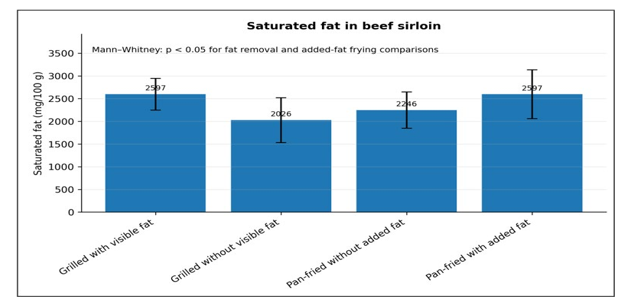
Figure 2: Saturated fat content in beef sirloin according to cooking method and visible fat removal. Bars represent mean values of 3 and error bars represent SD. Numeric labels indicate mean values. Removal of visible fat reduced saturated fat by approximately 28%, whereas pan-frying with added fat restored values comparable to grilled beef with visible fat
Poultry: Combined Effects of Skin and Cooking Method
In poultry, saturated fat levels varied markedly depending on the presence of skin and cooking technique. Fried poultry with skin showed the highest saturated fat concentration (2227.18 mg/100 g), whereas boiled skinless poultry presented the lowest value (659.04 mg/100 g). This represents more than a threefold difference in saturated fat levels within the same food category, depending solely on preparation technique and skin presence. Overall, preparations with skin consistently presented higher saturated fat levels than skinless preparations. The results regarding meat and poultry are illustrated in Figure 1.
|
Method |
Mean |
SD |
|
With skin, fried |
2227.18 |
270.67 |
|
With skin, grilled |
1748.85 |
108.51 |
|
With skin, boiled |
1915.58 |
222.57 |
|
Without skin, fried |
1504.82 |
123.15 |
|
Without skin, grilled |
764.63 |
43.66 |
|
Without skin, boiled |
659.04 |
14.20 |
Table 2: Saturated Fat in Poultry (Mean ± SD, mg/100 g) Three Ssamples of Each
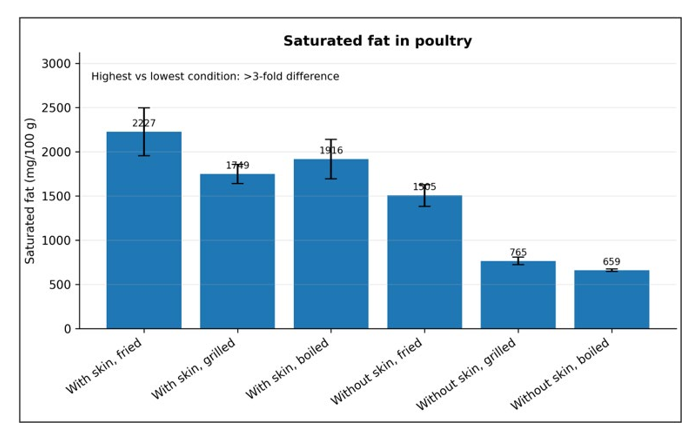
Figure 3: Saturated fat variability in poultry according to skin presence and cooking method. Bars represent mean values of 3 and error bars represent SD. Numeric labels indicate mean values. The highest values were observed in fried preparations with skin, whereas the lowest values were found in boiled skinless preparations
Shrimp: Sodium Variability
Sodium concentrations in shrimp were higher in fried preparations compared with grilled shrimp. Mean sodium values increased from 1104 mg/100 g in grilled shrimp to 1340 mg/100 g in fried shrimp, representing an approximate 21% increase. Although this difference did not reach statistical significance, the observed trend suggests that frying may contribute to higher sodium exposure in seafood preparations.
|
Method |
Mean |
SD |
|
Grilled |
1104 |
88.34 |
|
Fried |
1340 |
187.10 |
Table 3: Sodium in Shrimp (Mean ± SD, mg/100 g) Three Samples of Each

Figure 4: Sodium content in shrimp according to cooking method. Bars represent mean values and error bars represent SD. Numeric labels indicate mean values of 3. Fried shrimp showed an approximate 21% increase in sodium compared with grilled shrimp; this comparison was not statistically significant
Fish: Omega-3 Fatty Acid Variability
Fish preparations demonstrated the greatest variability in nutrient composition, particularly with respect to omega-3 fatty acids. Kruskal–Wallis testing revealed statistically significant differences in omega-3 concentrations across cooking methods for all analyzed species (p < 0.05). The magnitude of variation was particularly notable in sardine (~14,700%), robalo (~3,300%), pirarucu (~1,766%), and badejo (~1,600%). These findings suggest that cooking methods may substantially modify fatty acid profiles through mechanisms such as lipid exchange with cooking oils and concentration effects related to moisture loss during heating.
|
Species |
Variation (%) |
|
Sardine |
14.700 |
|
Robalo |
3.300 |
|
Pirarucu |
1.766 |
|
Badejo |
1.600 |
Table 4: Omega-3 Variability across Fish Species According to Cooking Method
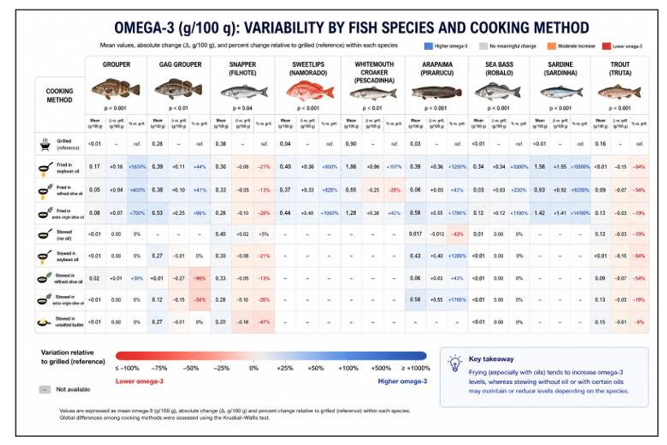
Figure 5: Variability in omega-3 fatty acid content in fish according to cooking method. Each point represents the percentage variation across cooking methods within a species. The y-axis is shown on a logarithmic scale because of the large magnitude of variation. Kruskal–Wallis testing showed statistically significant differences for all analyzed species (p < 0.05)
Selected Fish Preparations: Saturated Fat Variability
Selected fish preparations also demonstrated meaningful variability in saturated fat levels. Filhote stewed with butter showed a saturated fat value of 3.86 g/100 g. Cherne fried in soybean oil contained less saturated fat (1.10 g/100 g) than grilled cherne (1.56 g/100 g). Sardine fried in refined olive oil presented lower saturated fat levels (2.71 g/100 g) compared with frying in soybean oil (3.31 g/100 g), as can be seen in Table 5. These observations illustrate that even within the same species, cooking technique and fat source may influence the resulting lipid profile.
|
Preparation |
Saturated fat (g/100 g) |
|
Filhote stewed with butter |
3.86 |
|
Cherne fried in soybean oil |
1.10 |
|
Cherne grilled |
1.56 |
|
Sardine fried in refined olive oil |
2.71 |
|
Sardine fried in soybean oil |
3.31 |
Table 5: Selected fish saturated fat values according to cooking method and fat source. 3 samples of each 3 fish for each method of preparation, and from these, 3 subsamples of each: one from the beginning, one from the middle, and one from the end
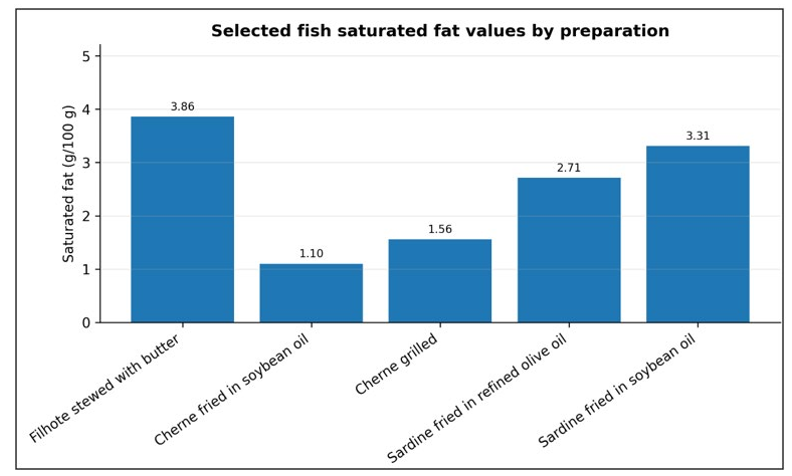
Figure 6: Saturated fat content in selected fish preparations according to cooking method and fat source. Numeric labels indicate saturated fat values in g/100 g. These selected examples illustrate that cooking method and fat source can alter the lipid profile even within similar food categories
Key Practical Observations
• Visible fat removal in beef produced a clinically intuitive reduction in saturated fat exposure.
• Poultry skin and frying had a combined effect, with more than a threefold difference between the highest and lowest preparations.
• Frying increased sodium content in shrimp by approximately 21%, although this comparison was not statistically significant.
• Omega-3 measurements varied dramatically across fish cooking methods, exceeding 1000% variation in several species.
• The type of cooking fat may influence final saturated fat values in selected fish preparations.
Discussion
This study demonstrates that cooking methods can substantially influence the nutrient composition of animal-based foods. In several cases, the magnitude of variation introduced by preparation techniques exceeded differences typically expected between food groups. These findings highlight an important and often overlooked dimension of nutritional science: foods are not consumed as static raw ingredients, but as prepared meals whose nutrient profile may be altered by culinary technique. In beef, trimming visible fat before cooking produced a meaningful reduction in saturated fat levels. Conversely, pan-frying with added fat restored saturated fat concentrations to levels comparable to those observed in beef prepared with visible fat. These results support a practical and clinically relevant message: saturated fat exposure from red meat can be modified not only by reducing portion size or frequency of intake, but also by changing preparation practices. In poultry, the presence of skin combined with frying produced the highest saturated fat values, whereas boiled skinless preparations produced the lowest values. The more than threefold variation observed within the same food category underscores the importance of anatomical characteristics and cooking method in determining nutritional exposure. This has direct relevance to dietary counseling, because advising patients to remove poultry skin or avoid frying may be easier to implement than recommending complete exclusion of commonly consumed foods.
Shrimp preparations showed higher sodium levels after frying compared with grilling. Although this difference did not reach statistical significance, the direction and magnitude of change are clinically relevant in the context of population-level sodium exposure. Even modest increases in sodium density may be important for individuals with hypertension, heart failure, chronic kidney disease, or high baseline sodium intake. Fish preparations demonstrated the greatest variability, particularly for omega-3 fatty acids. These results should be interpreted cautiously. Higher measured omega-3 values after some cooking methods may reflect lipid exchange with cooking oils, concentration due to moisture loss, or analytical effects related to changes in tissue composition rather than true preservation of endogenous fish omega-3 fatty acids. Nevertheless, the results clearly demonstrate that the measured fatty acid profile of fish is highly sensitive to preparation technique. The findings are consistent with the broader food science literature showing that frying, reheating oils, and high-temperature cooking can alter lipid composition through oil absorption, oxidation, hydrolysis, polymerization, and exchange of fatty acids between the food matrix and cooking medium [7-9]. These processes may change not only the quantity of fat but also the quality of the lipid profile. In the setting of cardiovascular prevention, this distinction is important because different fatty acid classes may have divergent effects on plasma lipids, inflammation, endothelial function, and atherosclerotic risk [10].
Large nutritional epidemiology studies, including PURE, have advanced understanding of diet-disease relationships [5]. However, most dietary assessment instruments incompletely capture cooking technique, cooking fat, degree of frying, removal of visible fat, or poultry skin consumption. Failure to account for preparation practices may introduce exposure misclassification and partially explain heterogeneity across studies evaluating meat, fish, saturated fat, and cardiovascular outcomes. Current cardiovascular guidelines appropriately emphasize dietary patterns, reductions in saturated fat and sodium, and replacement of saturated fat with unsaturated fat [4,11-13]. However, practical culinary guidance remains limited. The present findings suggest that preparation methods may be a feasible and culturally adaptable target for intervention. Rather than focusing exclusively on food restriction, clinicians may improve adherence by translating nutrient goals into concrete cooking recommendations: remove visible fat, avoid frying with added fat when saturated fat reduction is desired, remove poultry skin, prefer lower-sodium preparation approaches, and consider cooking fat selection.
From a public health perspective, cooking guidance may represent a low-cost strategy to improve diet quality. It may be especially valuable in populations where animal-based foods are culturally important and complete avoidance is unlikely. By modifying preparation technique, individuals may reduce exposure to saturated fat and sodium while preserving dietary acceptability and cultural continuity. Overall, these findings help address an important gap in the literature by quantifying the magnitude of nutrient variability introduced by cooking methods. Incorporating food preparation practices into nutritional research, food composition databases, and dietary counseling may improve the precision of cardiovascular prevention strategies.
Limitations
This study has several limitations.
• First, the experimental design was conducted under controlled laboratory conditions, which may not fully reflect real-world variability in temperature, cooking duration, cookware, oil quantity, seasoning practices, and oil reuse.
• Second, sample size was limited, although triplicate preparation and subsampling were used to reduce within-food variability. Larger studies with broader food sources and repeated analyses are needed to confirm these findings.
• Third, the study measured nutrient composition but did not evaluate bioavailability. Changes in measured nutrient content may not directly translate into changes in absorption, metabolism, or clinical cardiovascular outcomes.
• Fourth, the study focused on selected animal-based foods and did not evaluate plant-based foods, mixed dishes, sauces, or complete meals. Therefore, the findings should not be generalized to entire dietary patterns without further study.
• Finally, increases in measured omega-3 content after certain cooking methods should not be interpreted as evidence that frying necessarily improves nutritional quality. Such increases may reflect lipid exchange, concentration effects, or analytical changes rather than true preservation of endogenous omega-3 fatty acids.
Conclusion
Cooking methods exert a substantial influence on the nutrient composition of animal-based foods. Variability in saturated fat, sodium, and omega-3 levels within the same food depending on preparation technique highlights cooking practices as an often-overlooked determinant of dietary quality. Incorporating food preparation practices into dietary recommendations may enhance nutritional counseling, improve adherence to heart-healthy diets, and contribute to more effective cardiovascular risk prevention strategies [14].
Funding
Instituto Nacional De Metrologia, Qualidade E Tecnologia
Data Availability
The data supporting the findings are presented in the tables and figures of this manuscript.
Author Contributions
Conceptualization, methodology, data interpretation, manuscript drafting, and critical revision by the author Carlos Scherr.
References
- World Health Organization. (2014). GLOBAL STATUS REPORT on noncommunicable diseases World Health Organization. High Blood Pressure: Global and Regional.
- Benjamin, E. J., Muntner, P., Alonso, A., Bittencourt, M. S., Callaway, C. W., Carson, A. P., ... & American Heart Association Council on Epidemiology and Prevention Statistics Committee and Stroke Statistics Subcommittee. (2019). Heart disease and stroke statistics 2019 update: a report from the American Heart Association. Circulation, 139(10), e56-e528.
- Mozaffarian, D., Fahimi, S., Singh, G. M., Micha, R., Khatibzadeh, S., Engell, R. E., ... & Powles, J. (2014). Global sodium consumption and death from cardiovascular causes. New England Journal of Medicine, 371(7), 624-634.
- Visseren, F. L. J., Mach, F., Smulders, Y. M., Carballo, D.,Koskinas, K. C., Bäck, M., ... & Ungar, A. (2021). ESC guidelines on cardiovascular disease prevention in clinical practice. Eur Heart J2021; 42: 3227-3337.
- Teo, K., Lear, S., Islam, S., Mony, P., Dehghan, M., Li, W.,... & PURE Investigators, O. B. O. T. (2013). Prevalence of a healthy lifestyle among individuals with cardiovascular disease in high-, middle-and low-income countries: The Prospective Urban Rural Epidemiology (PURE) study. Jama, 309(15), 1613-1621.
- López-Bueno, R., Núñez-Cortés, R., Calatayud, J., Salazar-Méndez, J., Petermann-Rocha, F., López-Gil, J. F., & del Pozo Cruz, B. (2024). Global prevalence of cardiovascular risk factors based on the Life's Essential 8 score: an overview of systematic reviews and meta-analysis. Cardiovascular research, 120(1), 13-33.
- Cui, Y., Hao, P., Liu, B., & Meng, X. (2017). Effect of traditional Chinese cooking methods on fatty acid profiles of vegetable oils. Food Chemistry, 233, 77-84.
- Jain, A., Passi, S. J., & Selvamurthy, W. (2024). Total fat and fatty acid profile including TFA content of Indian fried foods versus the oils used for frying. Journal of Food Science and Technology, 61(11), 2185-2195.
- Aduol, K. O., Onyango, A. N., Mokua, B. N. K., Okoth, J. K., & Ayua, E. O. (2025). Reheating oils during deep frying alters fatty acid profiles, lipid peroxidation level, and nutritional indices of French fries. Journal of Food Science, 90(9), e70555.
- Calder, P. C. (2004). n–3 Fatty acids and cardiovascular disease: evidence explained and mechanisms explored. Clinical science, 107(1), 1-11.
- Lichtenstein, A. H., Khera, A., Anderson, C. A., Appel, L. J., DeSilva, D. M., Gardner, C., ... & American Heart Association. (2026). 2026 dietary guidance to improve cardiovascular health: a scientific statement from the American heart association. Circulation, 153(18), e1285-e1295.
- Writing Committee Members, Blumenthal, R. S., Morris,P. B., Gaudino, M., Johnson, H. M., Anderson, T. S., ... & Wilkins, J. T. (2026). 2026 ACC/AHA/AACVPR/ABC/ACPM/ADA/AGS/APhA/ASPC/NLA/PCNA guideline on the management of dyslipidemia: a report of the American College of Cardiology/American Heart Association Joint Committee on Clinical Practice Guidelines. Circulation, 153(17), e1154-e1276.
- Mach, F., Koskinas, K. C., Roeters van Lennep, J. E., TokgözoÄ?lu, L., Badimon, L., Baigent, C., ... & Sabatine,M. S. (2025). 2025 Focused Update of the 2019 ESC/EAS Guidelines for the management of dyslipidaemias: Developed by the task force for the management of dyslipidaemias of the European Society of Cardiology (ESC) and the European Atherosclerosis Society (EAS). European heart journal, 46(42), 4359-4378
- Estruch, R., Ros, E., Salas-Salvadó, J., Covas, M. I.,Corella, D., Arós, F., ... & Martínez-González, M. A. (2013). RETRACTED: Primary prevention of cardiovascular disease with a Mediterranean diet. New England journal of medicine, 368(14), 1279-1290.